
Judge, 1922-06-10 · page 10 of 36
Judge — June 10, 1922 — page 10: what you’re looking at
What you’re looking at
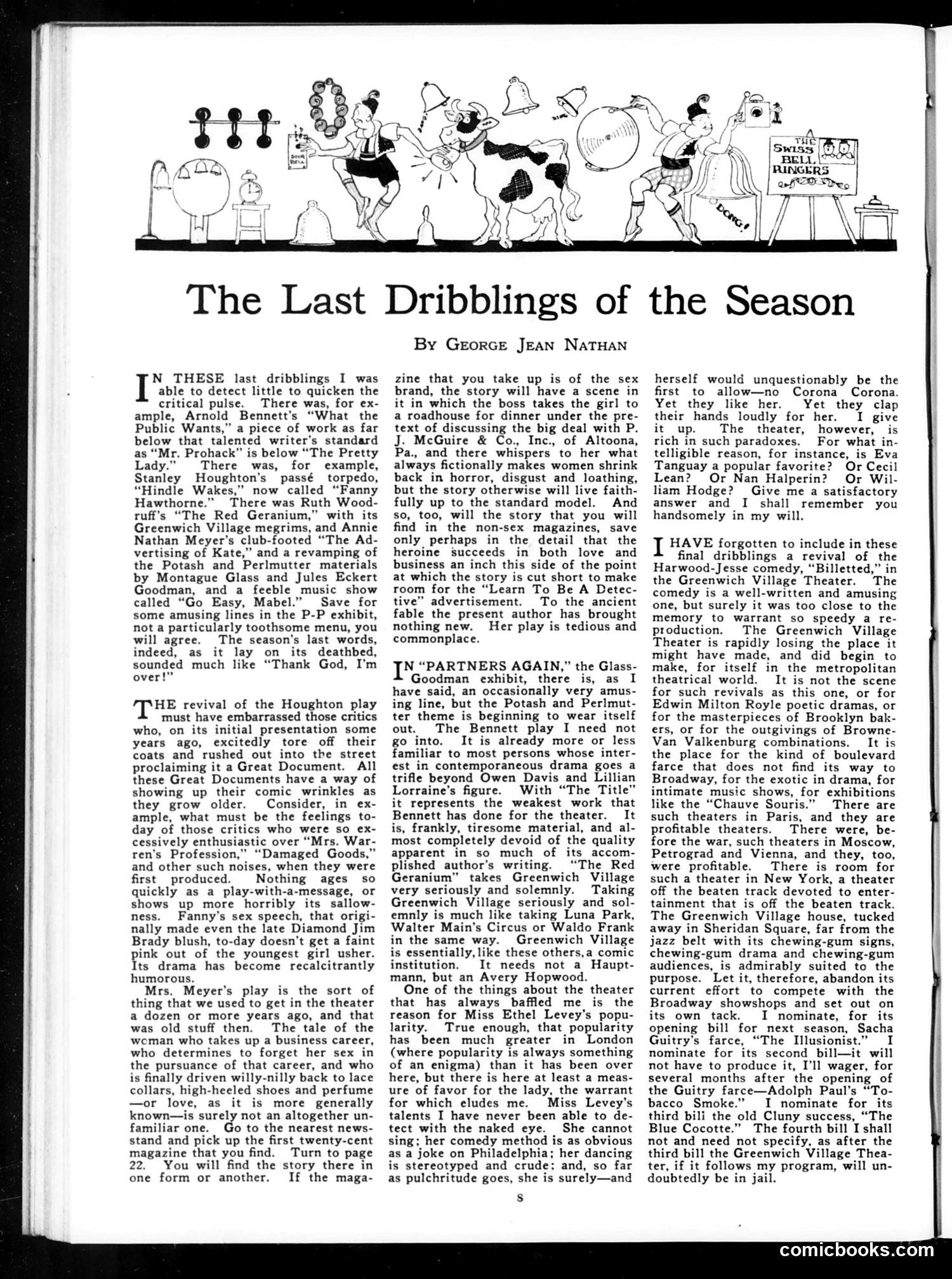
This is a theater review column by George Jean Nathan, a prominent drama critic. The cartoon header depicts various theatrical performers and props in exaggerated, comedic style—typical Judge magazine satirical illustration. Nathan reviews several recently-closed Broadway productions with withering dismissal. He mocks plays that were once hailed as serious social documents—particularly Stanley Houghton's "Hindle Wakes" and Shaw's "Mrs. Warren's Profession"—arguing they've aged poorly and now seem quaint or unintentionally funny rather than provocative. His central critique targets plays recycling tired formulaic plots: women abandoning careers for love, or the "business woman discovers she needs perfume and lace collars" narrative that Nathan claims appears interchangeably in cheap magazines and Broadway theaters alike. He's particularly harsh on Annie Nathan Meyer's "The Advertising of Kate," dismissing it as derivative 1910s-era material presented as new. The satire targets both lazy playwrights and critics who once overpraised didactic drama as "Great Documents"—suggesting theatrical fashion and critical judgment both age badly.
📄 Transcribed text from this page (OCR, searchable)
Machine-transcribed from the original scan — historical spelling and the odd misread are preserved.
The Last Dribblings of the Season N THESE last dribblings I was able to detect little to quicken the critical pulse. There was, for ex- ample, Arnold Bennett's “What the Public Wants,” a piece of work as far below that talented writer's standard as “Mr. Prohack” is below “The Pretty Lady.” There was, for example, Stanley Houghton’s passé torpedo, “Hindle Wakes,” now called “Fanny Hawthorne.” There was Ruth Wood- ruff’s “The Red Geranium,” with its Greenwich Village megrims, and Annie Nathan Meyer's club-footed “The Ad- vertising of Kate,” and a revamping of the Potash and Perlmutter materials by Montague Glass and Jules Eckert Goodman, and a feeble music show called “Go Easy, Mabel.” Save for some amusing lines in the P-P exhibit, not a particularly toothsome menu, you will agree. The season's last words, indeed, as it lay on its deathbed, sounded much like “Thank God, I’m over!” THE revival of the Houghton play must have embarrassed those critics who, on its initial presentation some years ago, excitedly tore off their coats and rushed out into the street proclaiming it a Great Document. All these Great Documents have a way of showing up their comic wrinkles as they grow older. Consider, in ex- ample, what must be the feelings to- day of those critics who were so ex- cessively enthusiastic over “Mrs. War- ren’s Profession,” “Damaged Goods,” and other such noises, when they were first produced. Nothing ages so quickly as a play-with-a-message, or shows up more horribly its sallow- ness. Fanny’s sex speech, that origi- nally made even the late Diamond Jim Brady blush, to-day doesn’t get a faint pink out of the youngest girl usher. Its drama has become recalcitrantly humorous. Mrs. Meyer's play is the sort of thing that we used to get in the theater a dozen or more years ago, and that was old stuff then. The tale of the woman who takes up a business career, who determines to forget her sex in the pursuance of that career, and who is finally driven willy-nilly back to lace collars, high-heeled shoes and perfume —or love, as it is more generally known—is surely not an altogether un- familiar one. Go to the nearest news- stand and pick up the first twenty-cent magazine that you find. Turn to page 22. You will find the story there in one form or another. If the maga- By Georce Jean NaTHAN zine that you take up is of the sex brand, the story will have a scene in it in which the boss takes the girl to a roadhouse for dinner under the pre- text of discussing the big deal with P. J. McGuire & Co., Inc., of Altoona, Pa., and there whispers to her what always fictionally makes women shrink back in horror, disgust and loathing, but the story otherwise will live faith- fully up to the standard model. And so, too, will the story that you will find in the non-sex magazines, save only perhaps in the detail that the heroine succeeds in both love and business an inch this side of the point at which the story is cut short to make room for the “Learn To Be A Detec- tive” advertisement. To the ancient fable the present author has brought nothing new. Her play is tedious and commonplace. N “PARTNERS AGAIN,” the Glass- Goodman exhibit, there is, as have said, an occasionally very amus- ing line, but the Potash and Perlmut- ter theme is beginning to wear itself out. The Bennett play I need not go into. It is already more or less familiar to most persons whose inter- est in contemporaneous drama goes a trifle beyond Owen Davis and Lillian Lorraine’s figure. With “The Title” it represents the weakest work that Bennett has done for the theater. It is, frankly, tiresome material, and al- most completely devoid of the quality apparent in so much of its accom- plished author's writing. “The Red Geranium” takes Greenwich Village very seriously and solemnly. Taking Greenwich Village seriously and sol- emnly is much like taking Luna Park, Walter Main’s Circus or Waldo Frank in the same way. Greenwich Village is essentially, like these others,a comic institution. It needs not a Haupt- mann, but an Avery Hopwood. One of the things about the theater that has always baffled me is the reason for Miss Ethel Levey’s popu- larity. True enough, that popularity has been much greater in London (where popularity is always something of an enigma) than it has been over here, but there is here at least a meas- ure of favor for the lady, the warrant for which eludes me. Miss Levey’s talents I have never been able to de- tect with the naked eye. She cannot sing; her comedy method is as obvious as a joke on Philadelphia; her dancing is stereotyped and crude: and, so far as pulchritude goes, she is surely—and 8 herself would unquestionably be the first to allow—no Corona Corona. Yet they like her. Yet they clap their hands loudly for her. I give it up. The theater, however, is rich in such paradoxes. For what in- telligible reason, for instance, is Eva Tanguay a popular favorite? Or Cecil Lean? Or Nan Halperin? Or Wil- liam Hodge? Give me a satisfactory answer and I shall remember you handsomely in my will. I HAVE forgotten to include in these final dribblings a revival of the Harwood-Jesse comedy, “Billetted,” in the Greenwich Village Theater. The comedy is a well-written and amusing one, but surely it was too close to the memory to warrant so speedy a re- production. The Greenwich Village Theater is rapidly losing the place it might have made, and did begin to make, for itself in the metropolitan theatrical world. It is not the scene for such revivals as this one, or for Edwin Milton Royle poetic dramas, or for the masterpieces of Brooklyn bak- ers, or for the outgivings of Browne- Van Valkenburg combinations. It is the place for the kind of boulevard farce that does not find its way to Broadway, for the exotic in drama, for intimate music shows, for exhibitions like the “Chauve Souris.” There are such theaters in Paris, and they are profitable theaters. There were, be- fore the war, such theaters in Moscow, Petrograd and Vienna, and they, too, were profitable. There is room for such a theater in New York, a theater off the beaten track devoted to enter- tainment that is off the beaten track. The Greenwich Village house, tucked away in Sheridan Square, far from the jazz belt with its chewing-gum signs, chewing-gum drama and chewing-gum audiences, is admirably suited to the purpose. Let it, therefore, abandon its current effort to compete with the Broadway showshops and set out on its own tack. I nominate, for its opening bill for next season, Sacha Guitry’s farce, “The Illusionist.” I nominate for its second bill—it will not have to produce it, I'll wager, for several months after the opening of the Guitry farce—Adolph Paul's “To- bacco Smoke.” I nominate for its third bili the old Cluny success, “The Blue Cocotte.” The fourth bill I shall not and need not specify, as after the third bill the Greenwich Village Thea- ter, if it follows my program, will un- doubtedly be in jail. comicbooks.com