
Judge, 1922-06-10 · page 22 of 36
Judge — June 10, 1922 — page 22: what you’re looking at
What you’re looking at
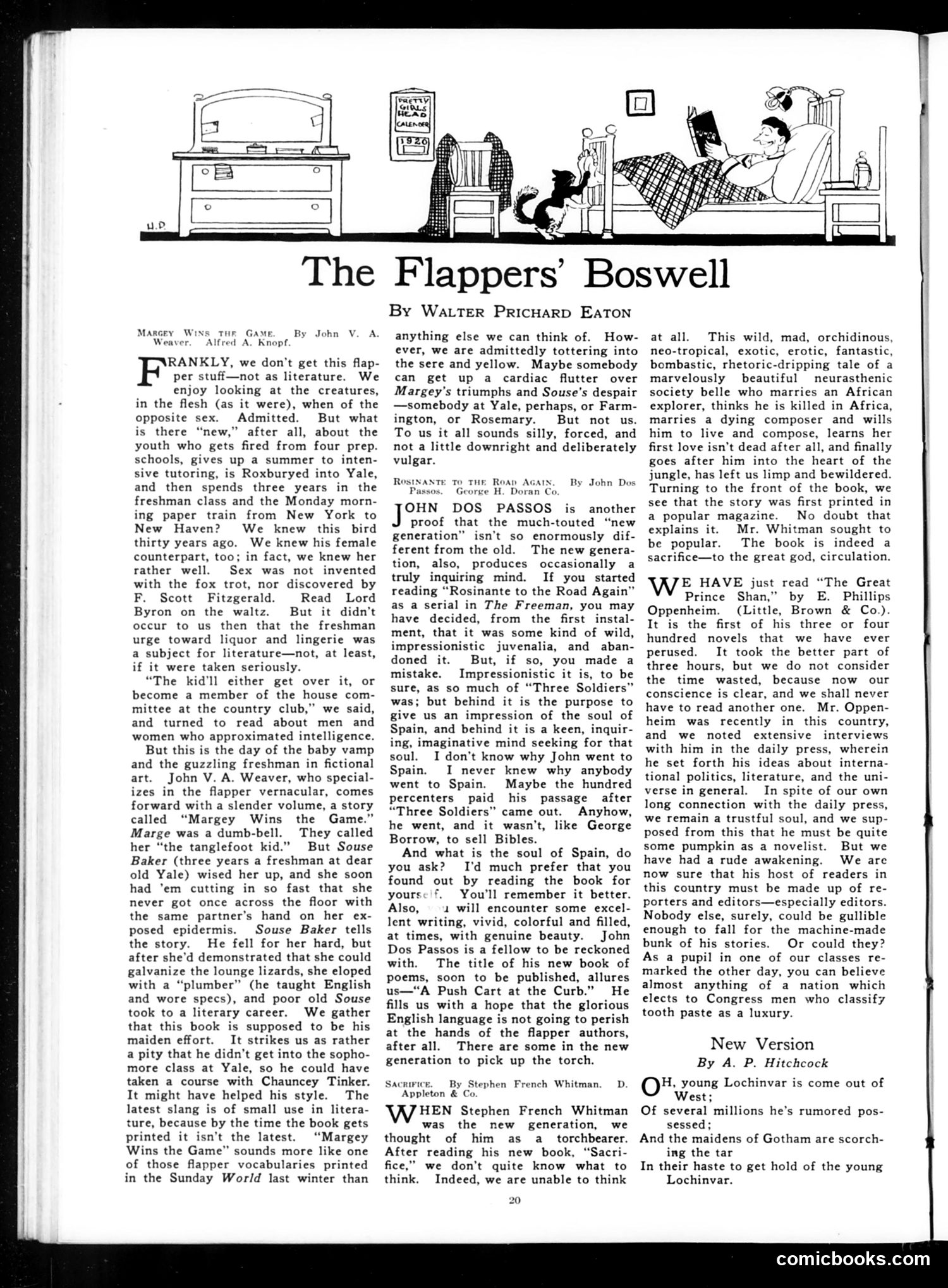
This page contains book reviews from Judge magazine's literary section. The lead review critiques John V.A. Weaver's novel "Margey Wins the Game," which depicts 1920s youth culture—specifically the "flapper" phenomenon and collegiate excess. The reviewer dismisses the book as trivial literature, arguing that youthful indiscretion and sexual behavior aren't new phenomena deserving serious literary treatment. The reviewer notes that rapid slang obsolescence undermines the book's relevance. The secondary review discusses John Dos Passos's "Rosinante to the Road Again," praising it as genuinely thoughtful despite its impressionistic style. The contrast suggests Judge's editors valued substance over trendy subject matter when evaluating contemporary literature.
📄 Transcribed text from this page (OCR, searchable)
Machine-transcribed from the original scan — historical spelling and the odd misread are preserved.
The Flappers’ Boswell Wins THE Game. By John V. A. Alfred A. Knopf. MARGEY Weaver RANKLY, we don't get this flap- per stuff—not as literature. We enjoy looking at the creatures, in the flesh (as it were), when of the opposite sex. Admitted. But what is there “new,” after all, about the youth who gets fired from four prep. schools, gives up a summer to inten- sive tutoring, is Roxburyed into Yale, and then spends three years in the freshman class and the Monday morn- ing paper train from New York to New Haven? We knew this bird thirty years ago. We knew his female counterpart, too; in fact, we knew her rather well. Sex was not invented with the fox trot, nor discovered by F. Scott Fitzgerald. Read Lord Byron on the waltz. But it didn’t occur to us then that the freshman urge toward liquor and lingerie was a subject for literature—not, at least, if it were taken seriously. “The kid’ll either get over it, or become a member of the house com- mittee at the country club,” we said, and turned to read about men and women who approximated intelligence. But this is the day of the baby vamp and the guzzling freshman in fictional art. John V. A. Weaver, who special- izes in the flapper vernacular, comes forward with a slender volume, a story called “Margey Wins the Game.” Marge was a dumb-bell. They called her “the tanglefoot kid.” But Souse Baker (three years a freshman at dear old Yale) wised her up, and she soon had ‘em cutting in so fast that she never got once across the floor with the same partner’s hand on her ex- posed epidermis. Souse Baker tells the story. He fell for her hard, but after she'd demonstrated that she could galvanize the lounge lizards, she eloped with a “plumber” (he taught English and wore specs), and poor old Souse took to a literary career. We gather that this book is supposed to be his maiden effort. It strikes us as rather a pity that he didn’t get into the sopho- more class at Yale, so he could have taken a course with Chauncey Tinker. It might have helped his style. The latest slang is of small use in litera- ture, because by the time the book gets printed it isn’t the latest. “Margey Wins the Game” sounds more like one of those flapper vocabularies printed in the Sunday World last winter than By Wa tTeR PRICHARD EATON anything else we can think of. How- ever, we are admittedly tottering into the sere and yellow. Maybe somebody can get up a cardiac flutter over Margey’s triumphs and Souse’s despair —somebody at Yale, perhaps, or Farm- ington, or Rosemary. But not us. To us it all sounds silly, forced, and not a little downright and deliberately vulgar. RosINANTE To THE Reap AGAIN. By John Dos Passos. George H. Doran Co. OHN DOS PASSOS is another proof that the much-touted “new generation” isn't so enormously dif- ferent from the old. The new genera- tion, also, produces occasionally a truly inquiring mind. If you started reading “Rosinante to the Road Again” as a serial in The Freeman, you may have decided, from the first instal- ment, that it was some kind of wild, impressionistic juvenalia, and aban- doned it. But, if so, you made a mistake. Impressionistic it is, to be sure, as so much of “Three Soldiers” was; but behind it is the purpose to give us an impression of the soul of Spain, and behind it is a keen, inquir- ing, imaginative mind seeking for that soul. I don’t know why John went to Spain. I never knew why anybody went to Spain. Maybe the hundred percenters paid his passage after “Three Soldiers” came out. Anyhow, he went, and it wasn't, like George Borrow, to sell Bibles. And what is the soul of Spain, do you ask? I'd much prefer that you found out by reading the book for yourse'f. You'll remember it better. Also, 4 will encounter some excel- lent writing, vivid, colorful and filled, at times, with genuine beauty. John Dos Passos is a fellow to be reckoned with. The title of his new book of poems, soon to be published, allures us—“A Push Cart at the Curb.” He fills us with a hope that the glorious English language is not going to perish at the hands of the flapper authors, after all. There are some in the new generation to pick up the torch. Sacririce. By Stephen French Whitman. _ D. Appleton & Co. WHEN Stephen French Whitman was the new generation, we thought of him as a_ torchbearer. After reading his new book, “Sacri- fice,” we don’t quite know what to think. Indeed, we are unable to think 20 at all. This wild, mad, orchidinous, neo-tropical, exotic, erotic, fantastic, bombastic, rhetoric-dripping tale of a marvelously beautiful neurasthenic society belle who marries an African explorer, thinks he is killed in Africa, marries a dying composer and wills him to live and compose, learns her first love isn’t dead after all, and finally goes after him into the heart of the jungle, has left us limp and bewildered. Turning to the front of the book, we see that the story was first printed in a popular magazine. No doubt that explains it. Mr. Whitman sought to be popular. The book is indeed a sacrifice—to the great god, circulation. WE HAVE just read “The Great Prince Shan,” by E. Phillips Oppenheim. (Little, Brown & Co.). It is the first of his three or four hundred novels that we have ever perused. It took the better part of three hours, but we do not consider the time wasted, because now our conscience is clear, and we shall never have to read another one. Mr. Oppen- heim was recently in this country, and we noted extensive interviews with him in the daily press, wherein he set forth his ideas about interna- tional politics, literature, and the uni- verse in general. In spite of our own long connection with the daily press, we remain a trustful soul, and we sup- posed from this that he must be quite some pumpkin as a novelist. But we have had a rude awakening. We are now sure that his host of readers in this country must be made up of re- porters and editors—especially editors. Nobody else, surely, could be gullible enough to fall for the machine-made bunk of his stories. Or could they? As a pupil in one of our classes re- marked the other day, you can believe almost anything of a nation which elects to Congress men who classify tooth paste as a luxury. New Version By A. P. Hitchcock H, young Lochinvar is come out of West; Of several millions he’s rumored pos- sessed; And the maidens of Gotham are scorch- ing the tar In their haste to get hold of the young Lochinvar. comicbooks.com