
Judge, 1922-06-10 · page 21 of 36
Judge — June 10, 1922 — page 21: what you’re looking at
What you’re looking at
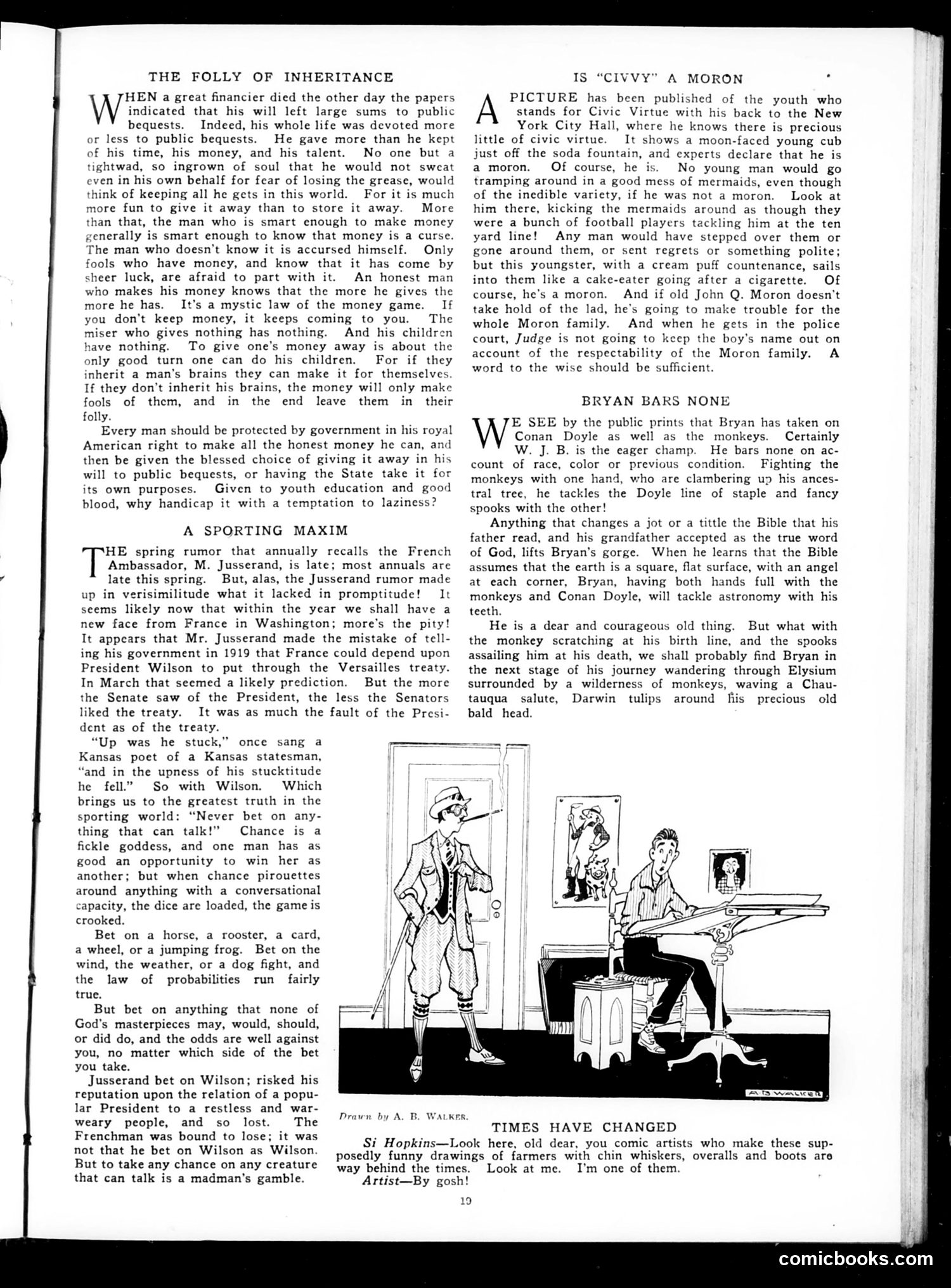
This page contains three satirical pieces: **"The Folly of Inheritance"** argues wealthy financiers should give away their money rather than pass it to heirs, claiming inherited wealth makes fools of children. The piece advocates government protection of wealth-earning but encourages philanthropic giving. **"A Sporting Maxim"** criticizes French Ambassador Jusserand for betting his reputation that President Wilson would secure Senate ratification of the Versailles Treaty (1919). The satire mocks Wilson's political incompetence, comparing him to a stuck Kansas politician. The section argues "never bet on anything that can talk"—implying unpredictable human behavior makes negotiation impossible. Jusserand lost his position over this miscalculation. **"Is 'Civvy' a Moron"** (partially visible) appears to mock a statue or representation of "Civic Virtue" near New York City Hall, suggesting irony about virtue's presence in politics. The accompanying cartoon by A.D. Walker depicts what appears to be a domestic or workplace scene with multiple figures.
📄 Transcribed text from this page (OCR, searchable)
Machine-transcribed from the original scan — historical spelling and the odd misread are preserved.
THE FOLLY OF INHERITANCE HEN a great financier died the other day the papers W indicated that his will left large sums to public Indeed, his whole life was devoted more or less to public bequests. He gave more than he kept of his time, his money, and his talent. No one but a tightwad, so ingrown of soul that he would not sweat even in his own behalf for fear of losing the grease, would think of keeping all he gets in this world. For it is much more fun to give it away than to store it away. More than that, the man who is smart enough to make money generally is smart enough to know that money is a curse. The man who doesn’t know it is accursed himself. Only fools who have money, and know that it has come by sheer luck, are afraid to part with it. An honest man who makes his money knows that the more he gives the more he has. It's a mystic law of the money game. If you don't keep money, it keeps coming to you. The miser who gives nothing has nothing. And his children have nothing. To give one’s money away is about the only good turn one can do his children. For if they inherit a man’s brains they can make it for themselves. If they don’t inherit his brains, the money will only make fools of them, and in the end leave them in their folly. Every man should be protected by government in his royal American right to make all the honest money he can, and then be given the blessed choice of giving it away in his will to public bequests, or having the State take it for its own purposes. Given to youth education and good blood, why handicap it with a temptation to laziness? bequests. A SPORTING MAXIM HE spring rumor that annually recalls the French Ambassador, M. Jusserand, is late; most annuals are late this spring. But, alas, the Jusserand rumor made up in verisimilitude what it lacked in promptitude! It seems likely now that within the year we shall have a new face from France in Washington; more’s the pity! It appears that Mr. Jusserand made the mistake of tell- ing his government in 1919 that France could depend upon President Wilson to put through the Versailles treaty. In March that seemed a likely prediction. But the more the Senate saw of the President, the less the Senators liked the treaty. It was as much the fault of the Presi- dent as of the treaty. “Up was he stuck,” once sang a Kansas poet of a Kansas statesman, “and in the upness of his stucktitude he fell.” So with Wilson. Which brings us to the greatest truth in the sporting world: “Never bet on any- thing that can talk!” Chance is a fickle goddess, and one man has as good an opportunity to win her as another; but when chance pirouettes around anything with a conversational capacity, the dice are loaded, the game is crooked. Bet on a horse, a rooster, a card, a wheel, or a jumping frog. Bet on the wind, the weather, or a dog fight, and the law of probabilities run fairly true. But bet on anything that none of God’s masterpieces may, would, should, or did do, and the odds are well against you, no matter which side of the bet you take. Jusserand bet on Wilson; risked his reputation upon the relation of a popu- lar President to a restless and war- weary people, and so _ lost. The Frenchman was bound to lose; it was not that he bet on Wilson as Wilson. But to take any chance on any creature that can talk is a madman’s gamble. Drawn by A. IS “CIVVY” A MORON ss PICTURE has been published of the youth who A stands for Civic Virtue with his back to the New York City Hall, where he knows there is precious little of civic virtue. It shows a moon-faced young cub just off the soda fountain, and experts declare that he is a moron. Of course, he is. No young man would go tramping around in a good mess of mermaids, even though of the inedible variety, if he was not a moron. Look at him there, kicking the mermaids around as though they were a bunch of football players tackling him at the ten yard line! Any man would have stepped over them or gone around them, or sent regrets or something polite; but this youngster, with a cream puff countenance, sails into them like a cake-eater going after a cigarette. Of course, he’s a moron. And if old John Q. Moron doesn't take hold of the lad, he’s going to make trouble for the whole Moron family. And when he gets in the police court, Judge is not going to keep the boy’s name out on account of the respectability of the Moron family. A word to the wise should be sufficient. BRYAN BARS NONE E SEE by the public prints that Bryan has taken on W cconan Doyle as well as the monkeys. Certainly W. J. B. is the eager champ. He bars none on ac- count of race, color or previous condition. Fighting the monkeys with one hand, who are clambering up his ances- tral tree, he tackles the Doyle line of staple and fancy spooks with the other! Anything that changes a jot or a tittle the Bible that his father read, and his grandfather accepted as the true word of God, lifts Bryan's gorge. When he learns that the Bible assumes that the earth is a square, flat surface, with an angel at each corner, Bryan, having both hands full with the monkeys and Conan Doyle, will tackle astronomy with his teeth. He is a dear and courageous old thing. But what with the monkey scratching at his birth line, and the spooks assailing him at his death, we shall probably find Bryan in the next stage of his journey wandering through Elysium surrounded by a wilderness of monkeys, waving a Chau- tauqua salute, Darwin tulips around his precious old bald head. B. WALKER, TIMES HAVE CHANGED Si Hopkins—Look here, old dear, you comic artists who make these sup- posedly funny drawings of farmers with chin whiskers, overalls and boots are way behind the times. Artist—By gosh! 19 Look at me. I'm one of them. comicbooks.com