
Judge, 1922-06-10 · page 5 of 36
Judge — June 10, 1922 — page 5: what you’re looking at
What you’re looking at
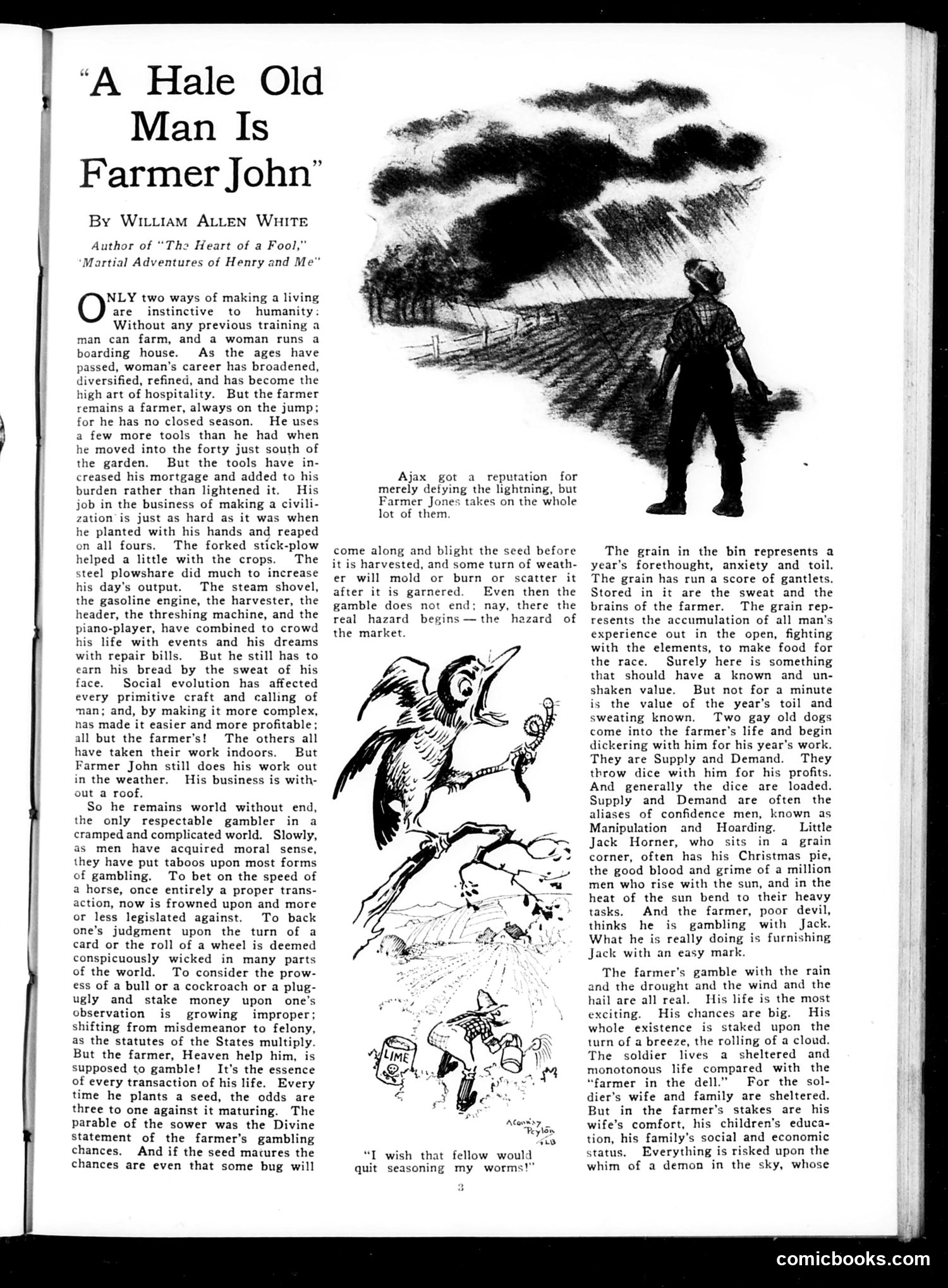
This William Allen White essay uses farming as metaphor for life's fundamental work. The illustrations satirize the farmer's gamble against nature: lightning threatening crops, dice-playing (referencing "Supply and Demand"), and a character named "Jack Horner" manipulating grain prices. The satire targets commodity speculation and market manipulation by traders who profit from farmers' labor while bearing none of the actual risk. The farmer genuinely gambles with weather, pests, and soil—real stakes. Meanwhile, speculators like Jack Horner gamble with loaded dice in "a grain corner," rigging markets through information advantages. The piece critiques industrial capitalism's exploitation of agricultural workers and argues farmers deserve recognition as society's only "respectable gamblers" since they face authentic, uncontrollable hazards.
📄 Transcribed text from this page (OCR, searchable)
Machine-transcribed from the original scan — historical spelling and the odd misread are preserved.
‘A Hale Old Man Is Farmer John’ By Witiram ALLEN WHITE Author of “Tho Heart of a Fool,” Martial Adventures of Henry and Me" are instinctive to humanity: Without any previous training a man can farm, and a woman runs a boarding house. As the ages have passed, woman's career has broadened, diversified, refined, and has become the high art of hospitality. But the farmer remains a farmer, always on the jump; for he has no closed season. He uses a few more tools than he had when he moved into the forty just south of the garden. But the tools have in- creased his mortgage and added to his burden rather than lightened it. His job in the business of making a civili- zation is just as hard as it was when he planted with his hands and reaped on all fours. The forked stick-plow helped a little with the crops. The steel plowshare did much to increase his day’s output. The steam shovel, the gasoline engine, the harvester, the header, the threshing machine, and the piano-player, have combined to crowd his life with events and his dreams with repair bills. But he still has to earn his bread by the sweat of his face. Social evolution has affected every primitive craft and calling of man; and, by making it more complex, nas made it easier and more profitable; all but the farmer's! The others all have taken their work indoors. But Farmer John still does his work out in the weather. His business is with- out a roof. So he remains world without end, the only respectable gambler in a cramped and complicated world. Slowly, as men have acquired moral sense, they have put taboos upon most forms of gambling. To bet on the speed of a horse, once entirely a proper trans- action, now is frowned upon and more or less legislated against. To back one’s judgment upon the turn of a card or the roll of a wheel is deemed conspicuously wicked in many parts of the world. To consider the prow- ess of a bull or a cockroach or a plug- ugly and stake money upon one’s observation is growing improper; shifting from misdemeanor to felony, as the statutes of the States multiply. But the farmer, Heaven help him, is supposed to gamble! It’s the essence of every transaction of his life. Every time he plants a seed, the odds are three to one against it maturing. The parable of the sower was the Divine Statement of the farmer's gambling chances. And if the seed matures the chances are even that some bug will Orr two ways of making a living Ajax got a_ reputation for merely defying the lightning, but Farmer Jones takes on the whole lot of them come along and blight the seed before it is harvested, and some turn of weath- er will mold or burn or scatter it after it is garnered. Even then the gamble does not end; nay, there the real hazard begins—the hazard of the market. Acoos's Reylan Lo “I wish that fellow would quit seasoning my worms!” The grain in the bin represents a year’s forethought, anxiety and toil. The grain has run a score of gantlets. Stored in it are the sweat and the brains of the farmer. The grain rep- resents the accumulation of all man's experience out in the open, fighting with the elements, to make food for the race. Surely here is something that should have a known and un- shaken value. But not for a minute is the value of the year’s toil and sweating known. Two gay old dogs come into the farmer's life and begin dickering with him for his year's work. They are Supply and Demand. They throw dice with him for his profits. And generally the dice are loaded. Supply and Demand are often the aliases of confidence men, known as Manipulation and Hoarding. Little Jack Horner, who sits in a grain corner, often has his Christmas pie, the good blood and grime of a million men who rise with the sun, and in the heat of the sun bend to their heavy tasks. And the farmer, poor devil, thinks he is gambling with Jack. What he is really doing is furnishing Jack with an easy mark. The farmer's gamble with the rain and the drought and the wind and the hail are all real. His life is the most exciting. His chances are big. His whole existence is staked upon the turn of a breeze, the rolling of a cloud. The soldier lives a sheltered and monotonous life compared with the “farmer in the dell.” For the sol- dier’s wife and family are sheltered. But in the farmer's stakes are his wife’s comfort, his children’s educa- tion, his family’s social and economic status. Everything is risked upon the whim of a demon in the sky, whose comicbooks.com