
A complete issue · 36 pages · 1922
Judge — May 20, 1922
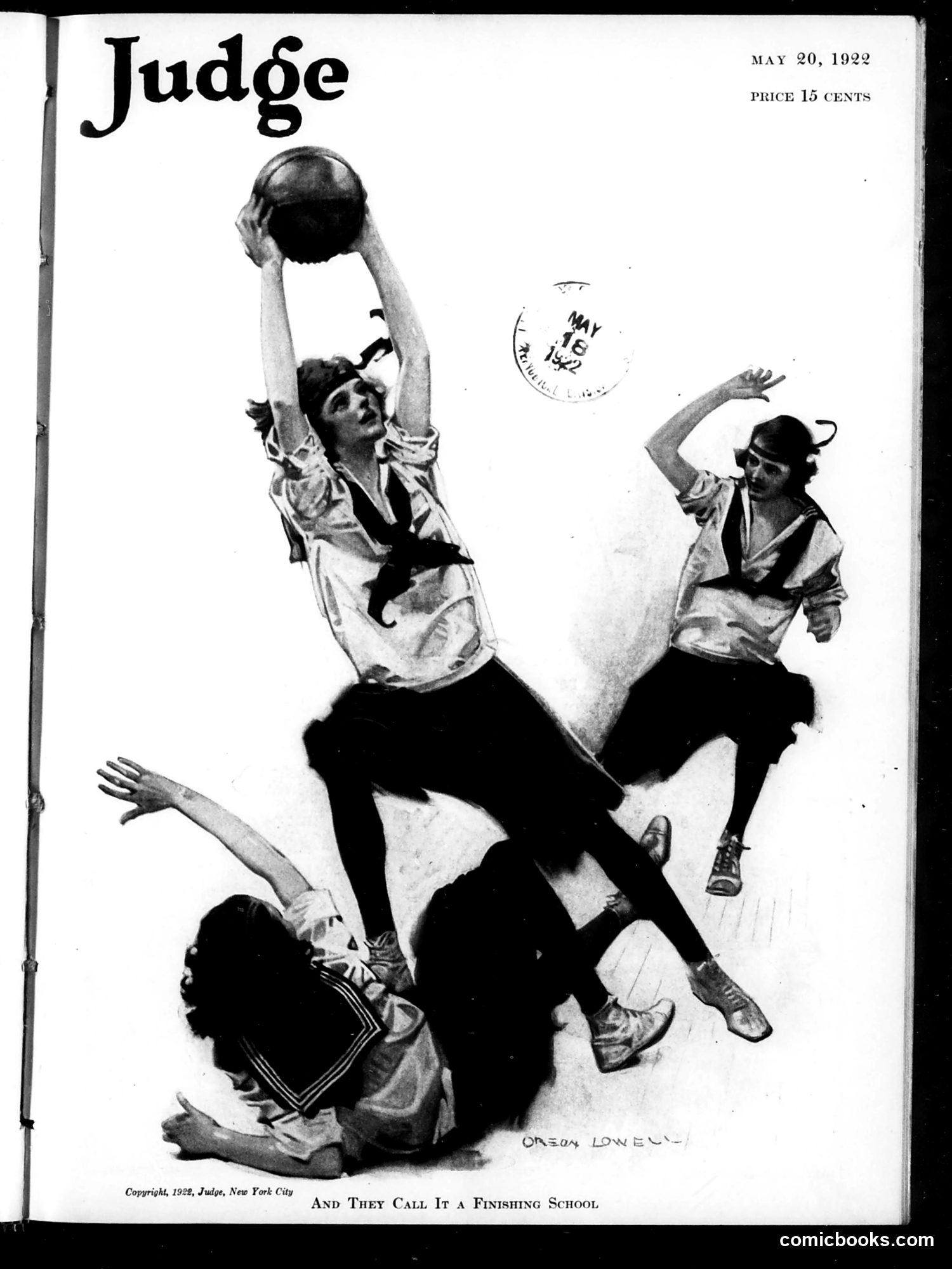
This May 1922 *Judge* cartoon satirizes basketball as a violent sport disguised as refined physical education. The image shows three figures engaged in aggressive play—jumping, colliding, and scrambling for the ball—with one player falling beneath the others. The caption's irony is the key: calling basketball a "finishing school" mocks the sport's brutality while also playing on the era's "finishing schools" (exclusive institutions for young women's education and social refinement). The cartoon suggests basketball, promoted as civilized athletic training, actually involves roughhousing and physical chaos. This reflects 1920s debates about whether basketball was an appropriate, genteel activity or a dangerously rough sport unsuitable for participants (likely women, given the era's gender anxieties about sports).
This page is primarily **promotional text for Leslie's Weekly magazine** (May 20 issue), not a political cartoon. The content satirizes **government inefficiency** by comparing overstaffed private business to the U.S. Government's bloated workforce. It criticizes the expense of maintaining unnecessary government positions, sarcastically referring to "swivel chair warmers"—bureaucrats who ostensibly do little productive work while costing taxpayers millions. The piece uses a rhetorical device: if a private stockholder wouldn't tolerate such waste, why should taxpayers accept it in government? This reflects **early 20th-century Progressive Era critiques** of government waste and inefficiency. The page then advertises Leslie's upcoming articles, including pieces on radio, treasure hunting, and current events—standard magazine promotion of the period.
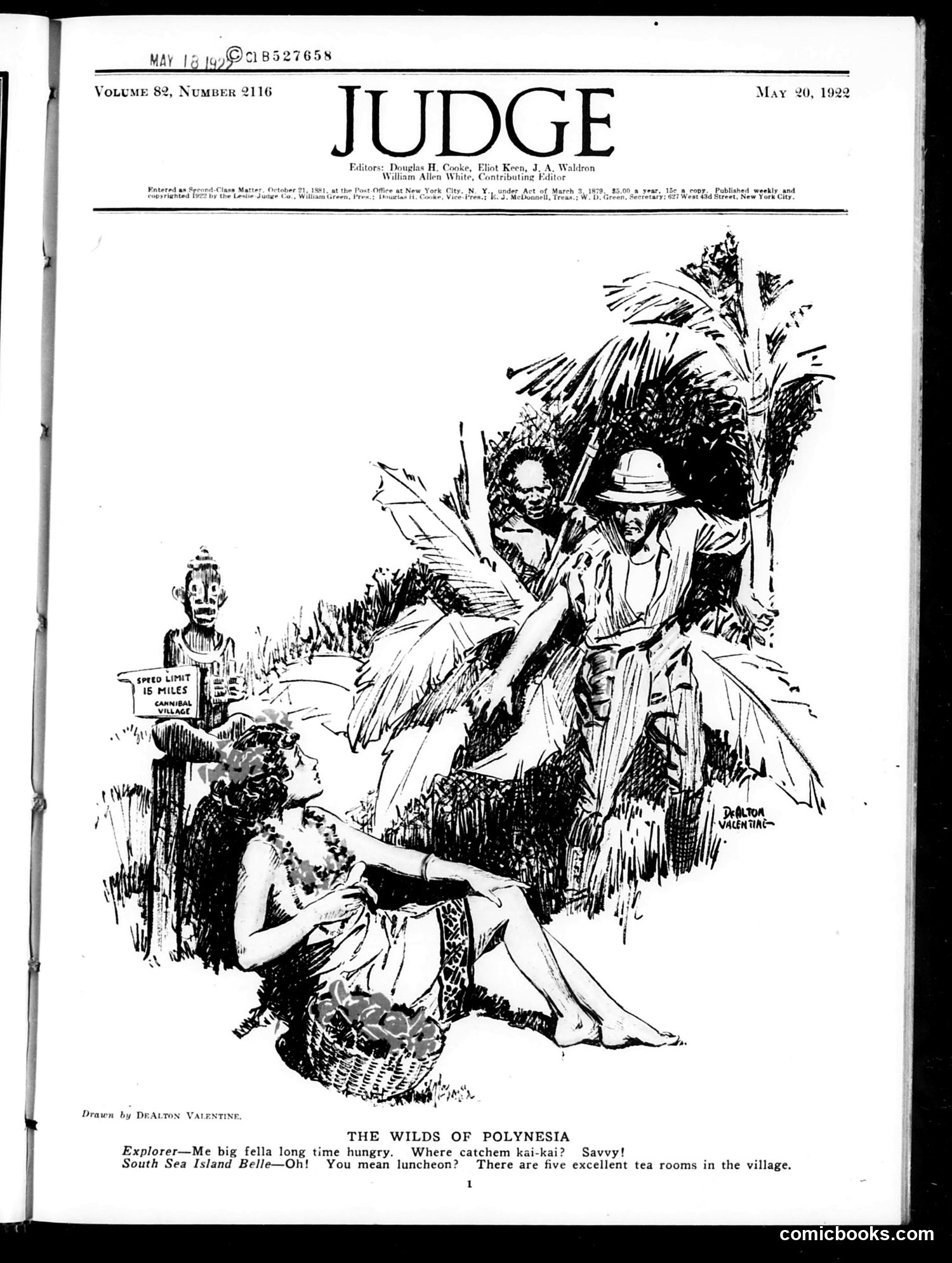
This 1922 Judge magazine cartoon by Daulton Valentine satirizes colonial-era tourist encounters in the South Pacific. The illustration depicts a wealthy Western woman (representing the "South Sea Island Belle") encountering indigenous Polynesian people in their tropical setting. The humor derives from the collision between civilized pretension and primitive reality: the explorer claims hunger and seeks "kai-kai" (food), while the fashionable tourist expects luxury amenities like "tea rooms." The "speed limit 15 miles cannibal" sign suggests dark humor about alleged cannibalism. The satire mocks both the naïve expectations of wealthy Western tourists and the stereotypical depiction of Pacific Islanders as exotic, uncivilized "others"—reflecting common early 20th-century colonial attitudes and racial caricatures now recognized as offensive.
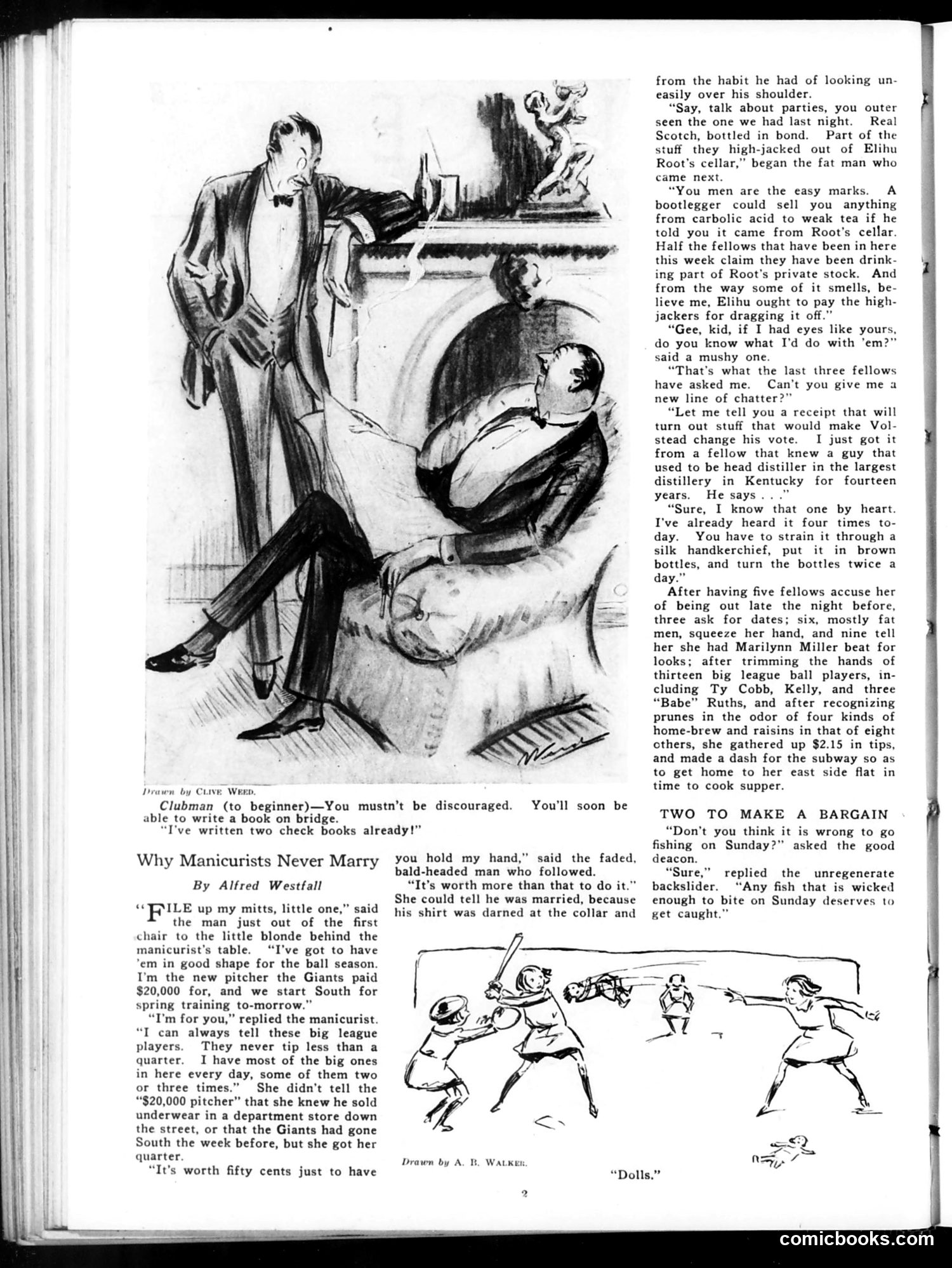
This page contains two separate pieces of humor content: **"Why Manicurists Never Marry"** (by Alfred Westfall): A satirical article mocking manicurists' romantic prospects. The accompanying Clive Weed cartoon depicts a bald man at a manicurist's table, representing the "discouraging" reality manicurists face—supposedly encountering unattractive clientele. The humor relies on physical appearance stereotypes and the notion that proximity to unflattering customers would deter marriage prospects. **"Two to Make a Bargain"**: A brief joke about fishing and catching fish on Sunday, with an A.H. Walker illustration titled "Dolls" showing women playing baseball or similar sport. Both pieces reflect early 20th-century casual attitudes toward appearance-based humor and gender roles. The manicurist piece particularly reflects period anxieties about women's professional work and marriageability.
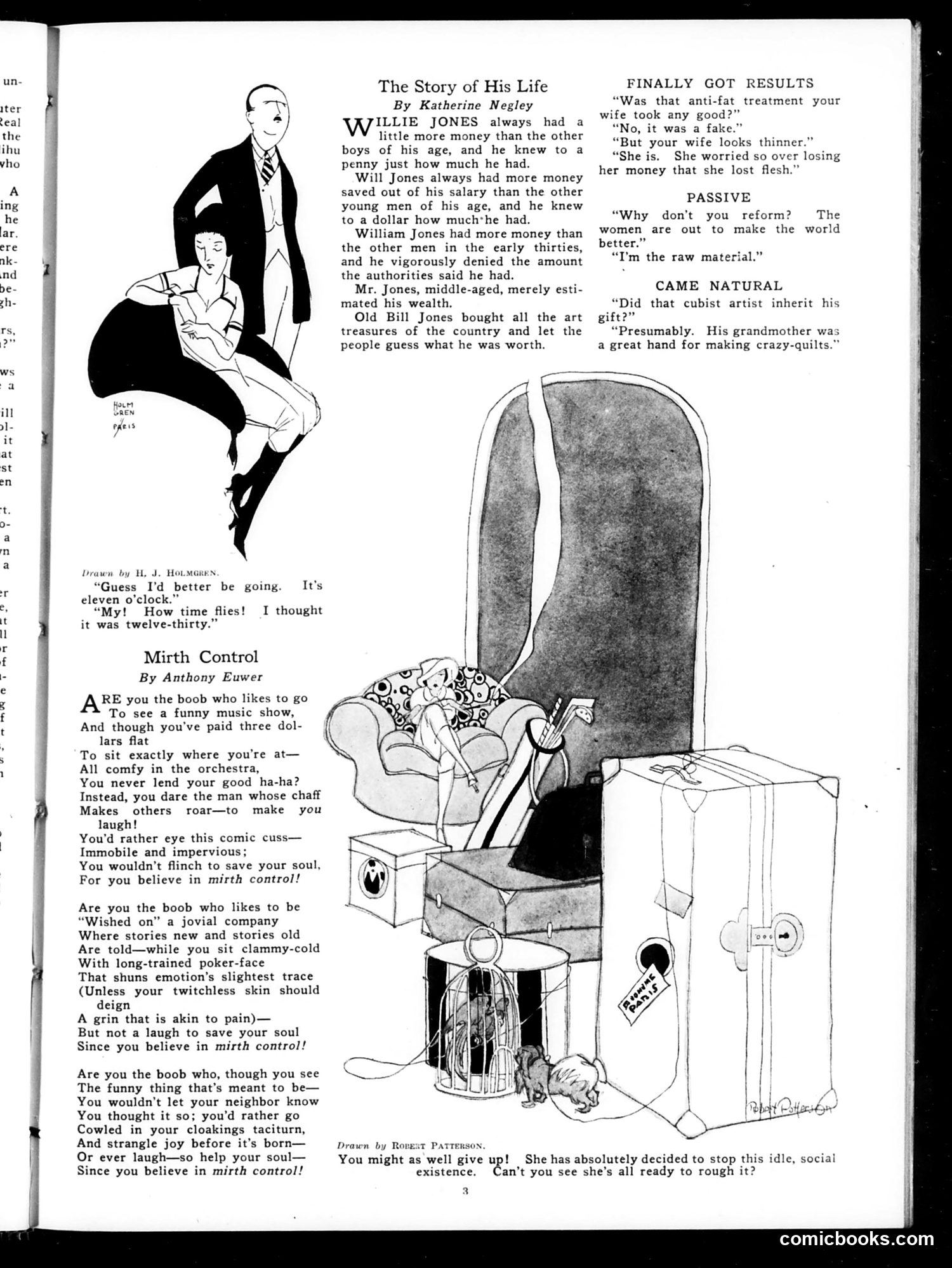
This page contains two distinct pieces: **"The Story of His Life" by Katherine Metcalfe** satirizes wealthy Willie Jones, depicted as a privileged man who always had more money and possessions than his peers. The accompanying illustration shows Jones with a woman, mocking the shallow materialism of the idle rich who amass art collections primarily to display wealth rather than appreciate art. **"Mirth Control" by Anthony Euwer** is a poem satirizing birth control advocacy. It mockingly addresses different "boobs" (fools) who support birth control through various hypocritical motivations—seeking social status, avoiding embarrassment about having children, or maintaining selfish lifestyles. The cartoon illustration shows a woman decidedly rejecting domestic life and motherhood as incompatible with her modern desires, presenting birth control as liberation from traditional female roles.
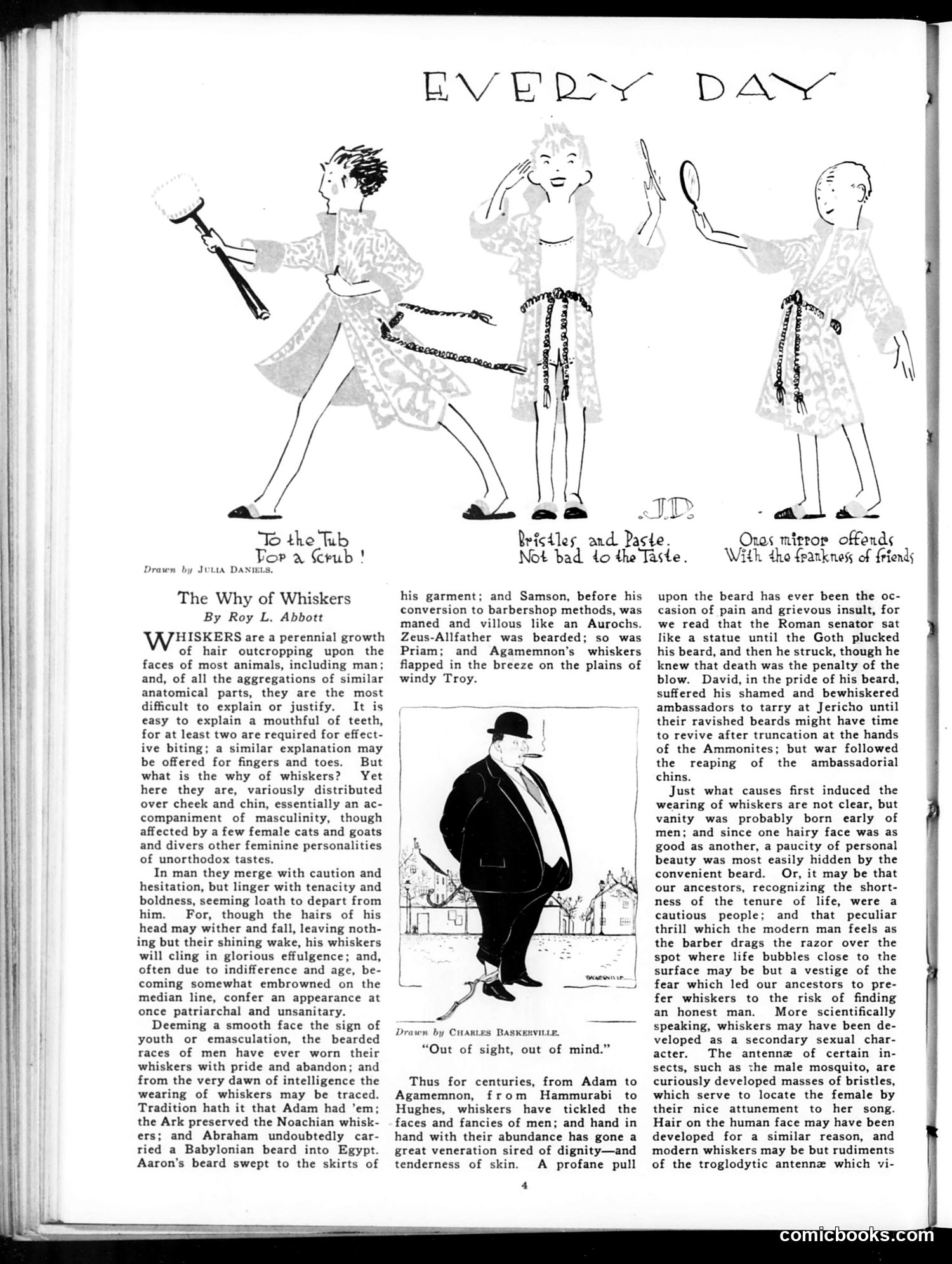
**Top Cartoon: "Everyday"** Three illustrated vignettes by Julia Daniels show women performing domestic tasks—scrubbing, grooming, and housekeeping—depicting routine "women's work." The captions suggest monotonous daily drudgery, mocking the limited scope of women's expected roles. **Main Article: "The Why of Whiskers"** Roy L. Abbott's satirical piece explores men's beards historically and socially. The accompanying illustration by Charles Barkerville shows a well-dressed man in a bowler hat, captioned "Out of sight, out of mind"—likely suggesting beards conceal vanity or masculine insecurity beneath fashionable appearance. The article traces beard-wearing from Biblical times through modern society, humorously suggesting beards reflect both masculine pride and anxieties about aging and appearance.
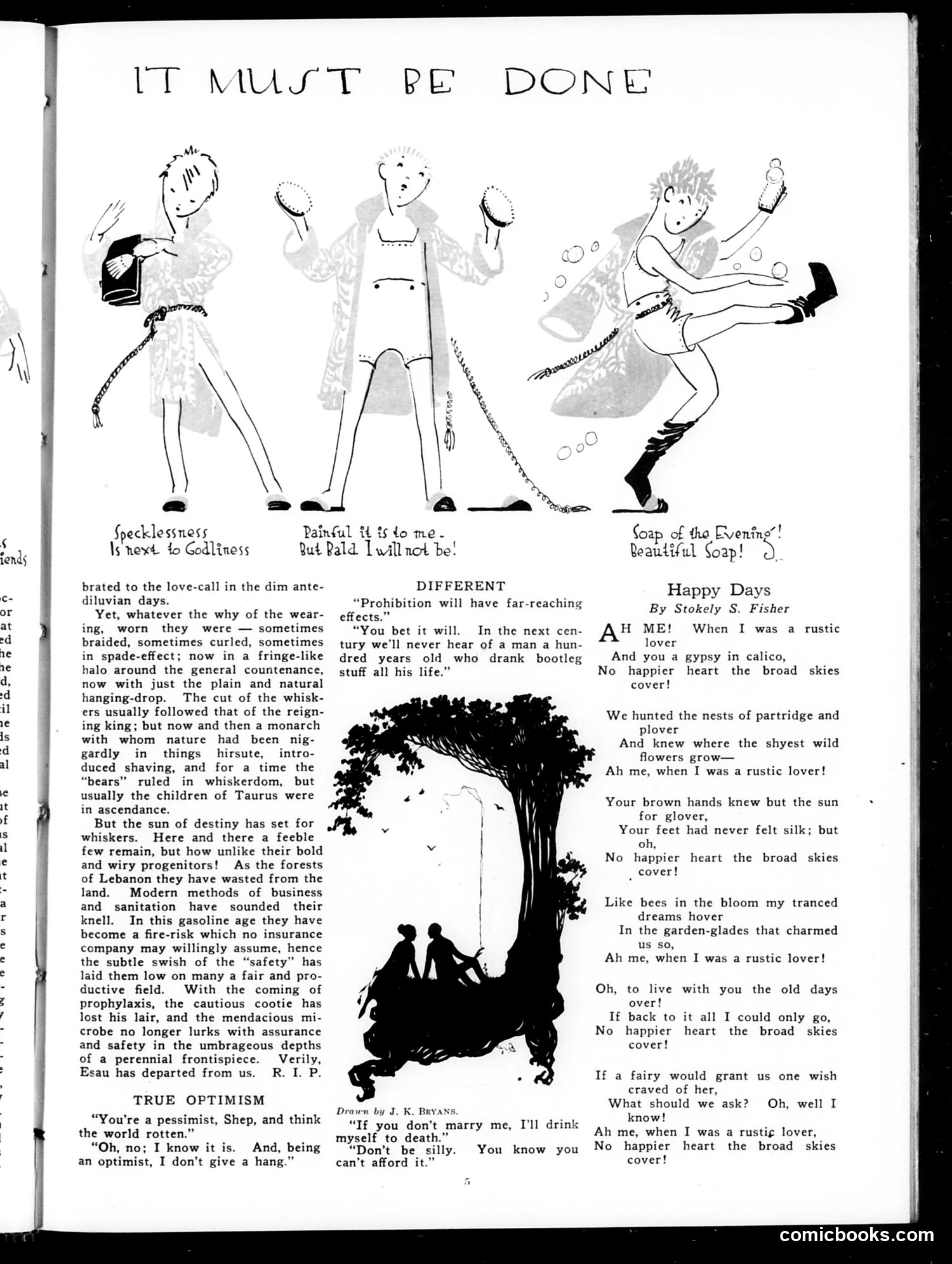
This page from Judge contains several satirical pieces reflecting early 20th-century American social concerns: **"It Must Be Done"** (top): Four cartoon figures illustrate feminine grooming standards—depicting women engaged in beauty rituals (hair care, makeup, bathing). The satire mocks the labor-intensive demands placed on women to maintain appearance. **"True Optimism"** and **"Different"**: Brief joke exchanges satirizing male attitudes. One contrasts pessimism with indifference; another mocks Prohibition's expected effects on longevity, suggesting heavy drinkers won't live to old age anyway. **"Happy Days" (poem)**: A sentimental piece romanticizing rustic courtship, contrasting simple pastoral love with modern urban life. **Long prose section** on facial hair: A humorous editorial lamenting the decline of beards and whiskers, attributing their disappearance to modern hygiene, business practices, and safety concerns (notably mentioning lice and the "safety" razor). It's nostalgic social commentary on changing masculine grooming standards. The page reflects pre-1920s American concerns with modernity, gender roles, and social etiquette.
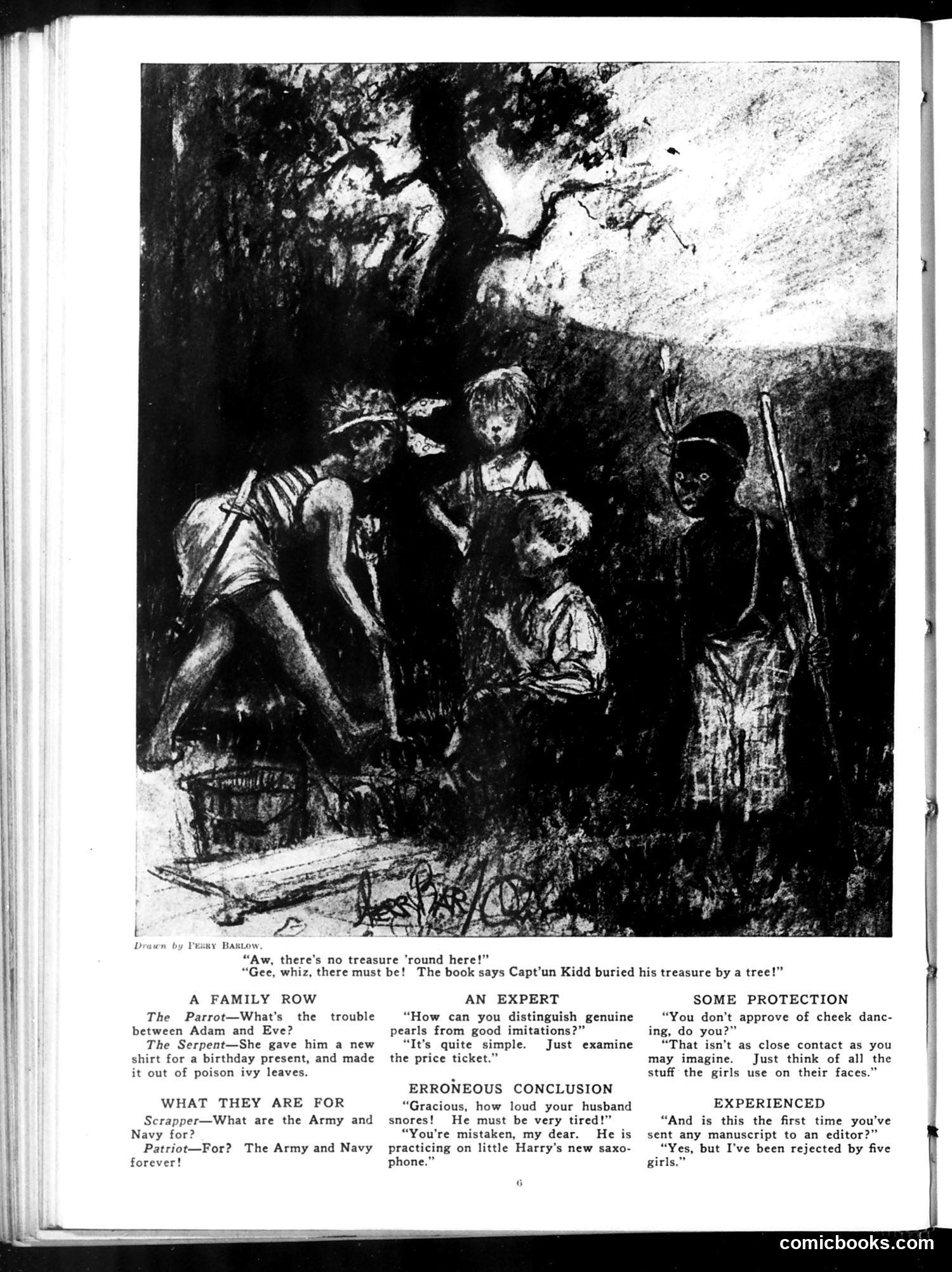
This page from *Judge* magazine contains six brief satirical jokes typical of early 20th-century American humor: 1. **"A Family Row"**: A crude Adam-and-Eve joke where the serpent boasts about giving Eve poison ivy leaves as a shirt—mocking domestic quarrels and blaming women. 2. **"What They Are For"**: Political satire suggesting the Army and Navy exist perpetually, not for specific purposes—commentary on military spending. 3. **"An Expert"**: Jokes that experts identify real pearls by examining price tags, satirizing shallow consumerism and fake expertise. 4. **"Erroneous Conclusion"**: Mocks a wife misinterpreting her husband's loud snoring as practice on their son's new saxophone—light domestic humor. 5. **"Some Protection"**: Jokes that cheek-dancing isn't intimate contact because girls wear heavy makeup—satirizing both the dance craze and women's cosmetics use. 6. **"Experienced"**: A rejected manuscript writer claims five women rejected him before—playing on romantic rejection and literary failure. The illustration depicts what appears to be a treasure-hunting scene, matching the pirate theme referenced in the captions.
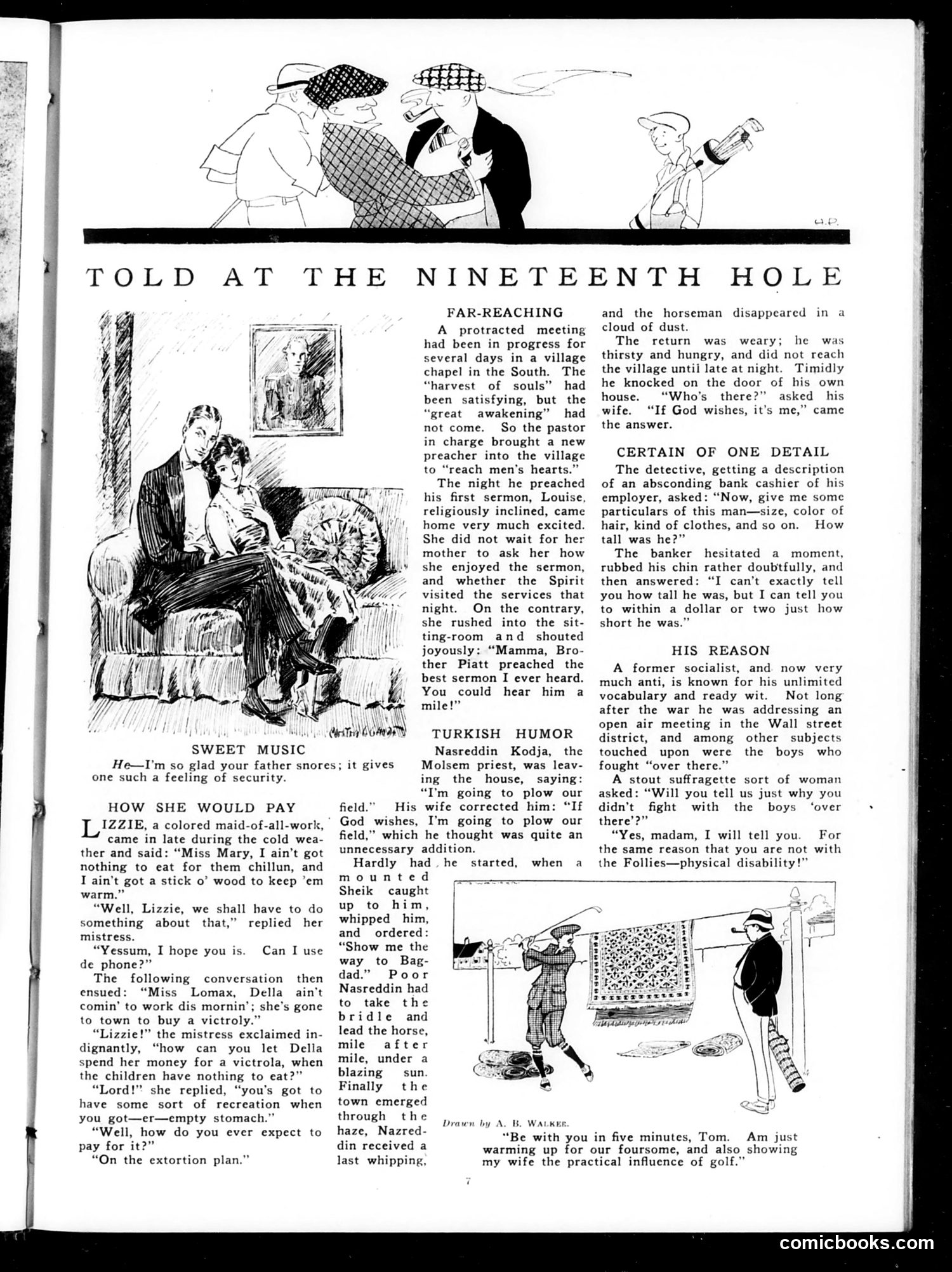
This page collects several short humorous anecdotes, likely from the 1920s-30s era. The title references the nineteenth hole (the clubhouse bar at golf courses), a genteel setting for swapping jokes. **Key content includes:** - **"How She Would Pay"**: A racist dialect joke about "Lizzie," a Black maid, whose colleague Della buys a victrola (record player) on credit despite her children's poverty. The "joke" plays on stereotype and financial irresponsibility. - **"Turkish Humor"**: A folktale about Nasreddin Kodja correcting his master's speech about plowing fields (adding "if God wishes"), then ironically later saying "if God wishes, it's me" when returning home—deflating his own lesson through humiliation. - **"His Reason"**: A post-WWI joke where a former socialist's refusal to fight is compared to a suffragette not being in the Follies—both due to "physical disability," a snide retort attacking women's rights advocates. The cartoon at bottom shows a golfer explaining his lateness by warming up with his wife. The satire reflects period attitudes toward class, religion, gender, and patriotism.
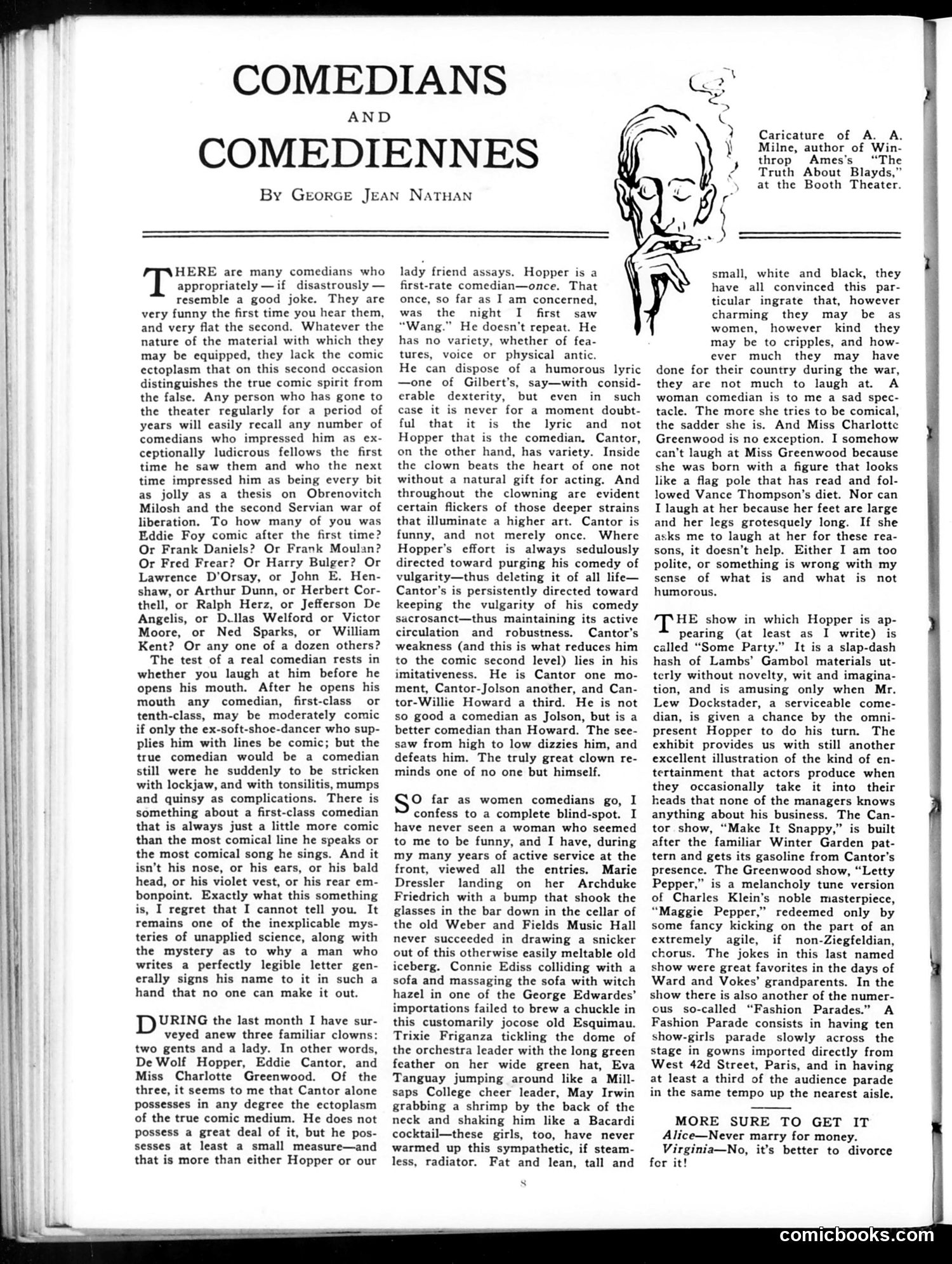
This is a theater criticism essay evaluating popular stage comedians of the era. Nathan argues that true comedic talent is intrinsic—a performer should be funny even in silence, not reliant on scripts or songs. **The figures discussed** include De Wolf Hopper (criticized as a one-hit wonder after his show "Wang"), Eddie Cantor (praised for genuine comedic instinct and willingness to embrace vulgarity), and Charlotte Greenwood (dismissed as unfunny). Nathan also catalogs other comedians—Frank Daniels, Harry Bulger, Victor Moore, and others—asking if audiences found them funny only once. **The satire's point**: Nathan mocks comedians who depend entirely on material rather than possessing inherent stage presence. The caricature at top right appears to be A.A. Milne, another theater figure. For modern readers: this reflects early 20th-century live theater criticism, when comedians performed repeatedly and audiences could judge whether their appeal was durable or novelty-based.
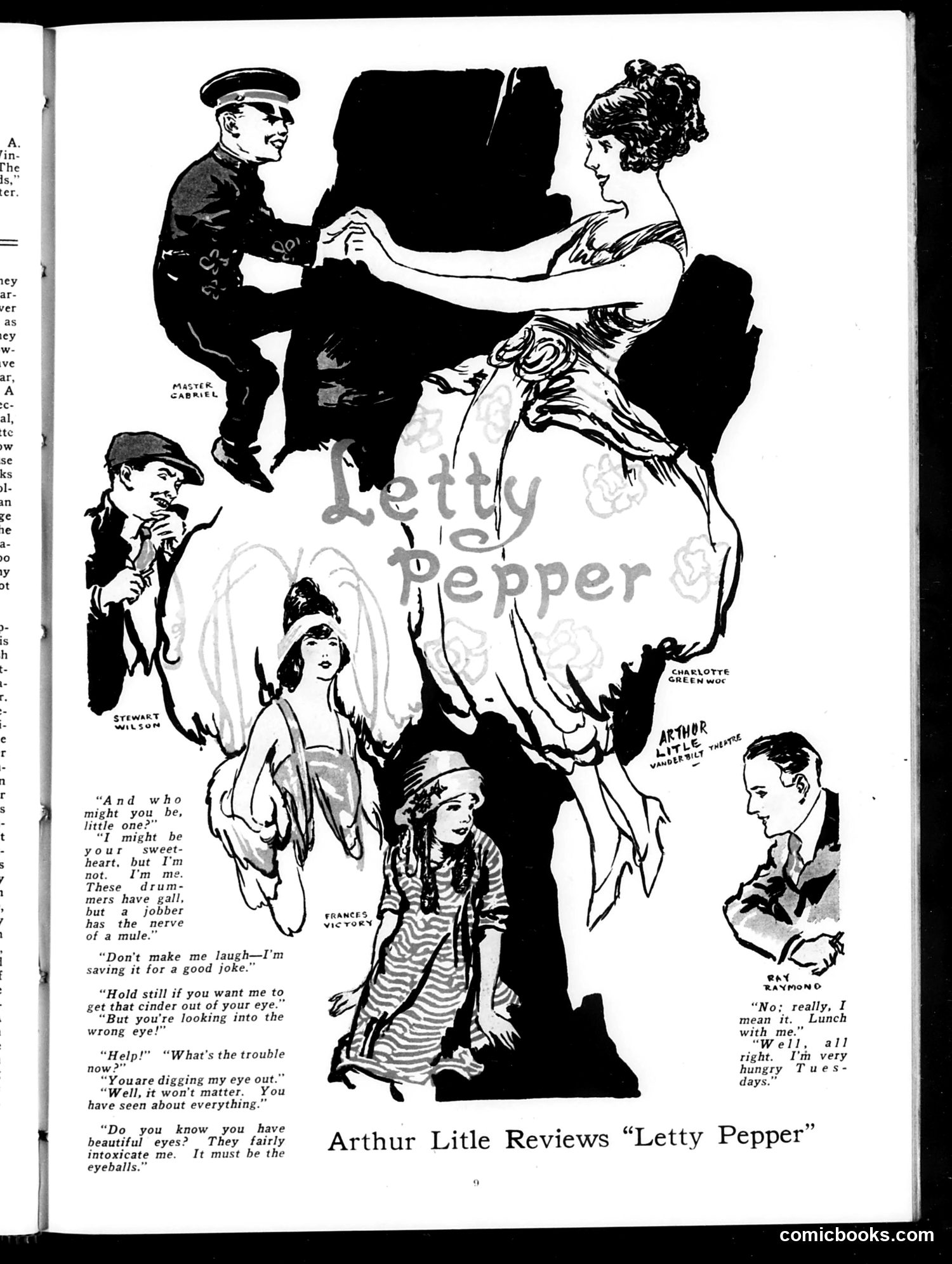
This page reviews a theatrical production or film titled "Letty Pepper." The illustrated vignettes show various romantic and comedic scenes featuring the character Letty (played by Frances Ray, according to the credits), interacting with male characters including soldiers and civilians. The humor centers on Letty's witty, irreverent dialogue—she deflects romantic advances with sharp quips ("I might be your sweetheart, but I'm not. I'm me") and treats flirtation as a transaction ("I'll lunch with you...I'm very hungry Tuesdays"). This appears to satirize the "modern woman" of the era—independent, quick-witted, and uninterested in traditional feminine submission to male flattery. The review showcases her comedic boldness as entertainment, reflecting early 20th-century attitudes toward changing gender dynamics and women's increasing social freedom.
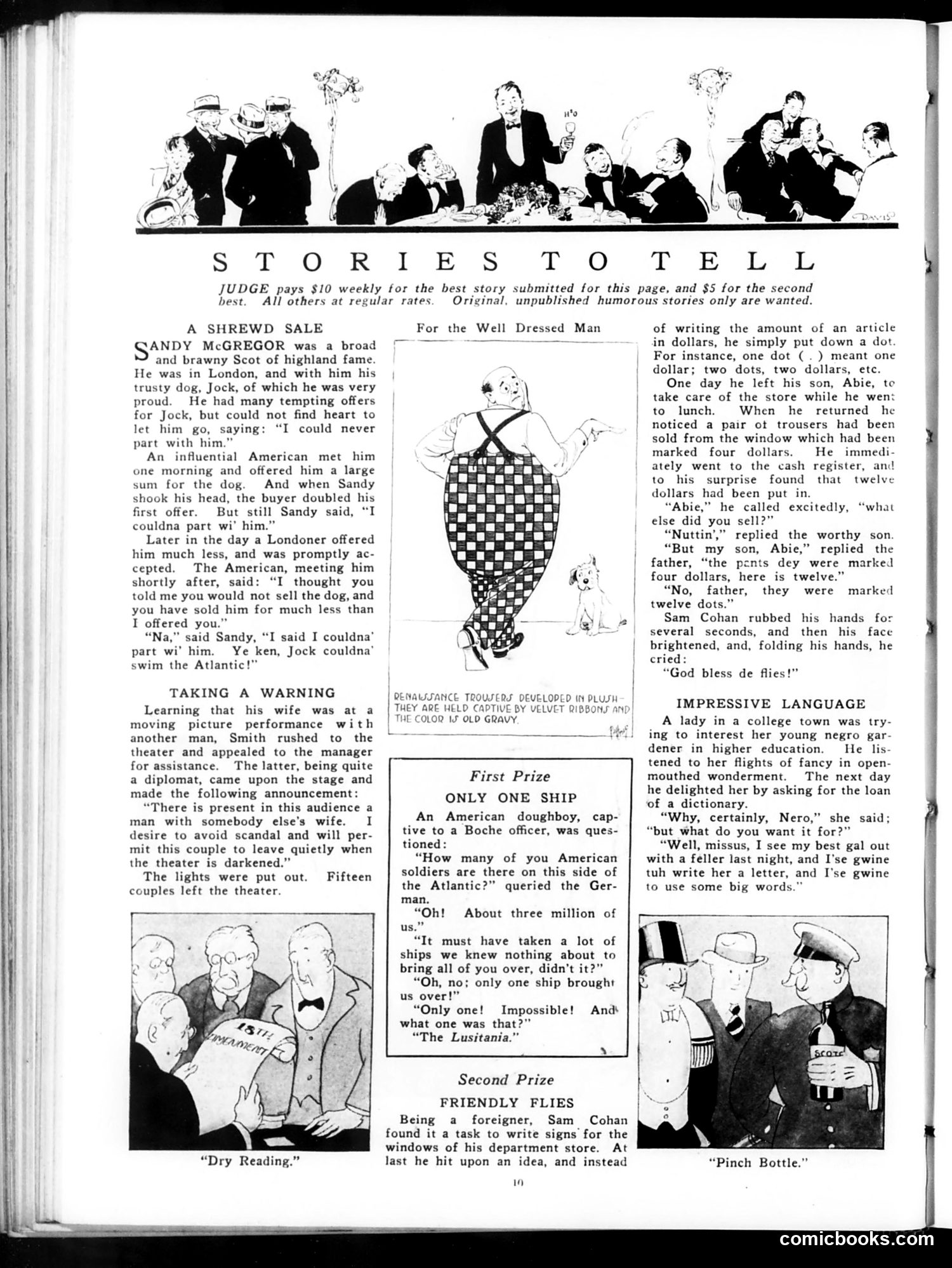
This is a humor page from *Judge* magazine featuring three prize-winning short stories submitted by readers. **"A Shrewd Sale"** plays on Scottish dialect stereotypes—Sandy McGregor refuses to sell his dog to a wealthy American but accepts less money from a Londoner because the dog "couldna swim the Atlantic," implying he'd lose it anyway. **"Only One Ship"** references WWI. A German officer interrogates an American soldier about troop transport, expecting a complex answer. The soldier jokes that only one ship brought three million troops—the *Lusitania*, the British ocean liner torpedoed by Germans in 1915 with heavy loss of life. The dark humor inverts the tragedy into absurdist comeuppance. **"Friendly Flies"** features a Jewish immigrant store owner (Sam Cohan) using dots instead of dollar signs to mark prices. His son Abie misinterprets four dots as twelve dots, accidentally overcharging—but this benefits the father, prompting his grateful exclamation about "de flies" (a phonetic Jewish-dialect joke). These stories reflect period stereotypes: Scottish, German, and Jewish immigrant characters rendered through exaggerated dialect.
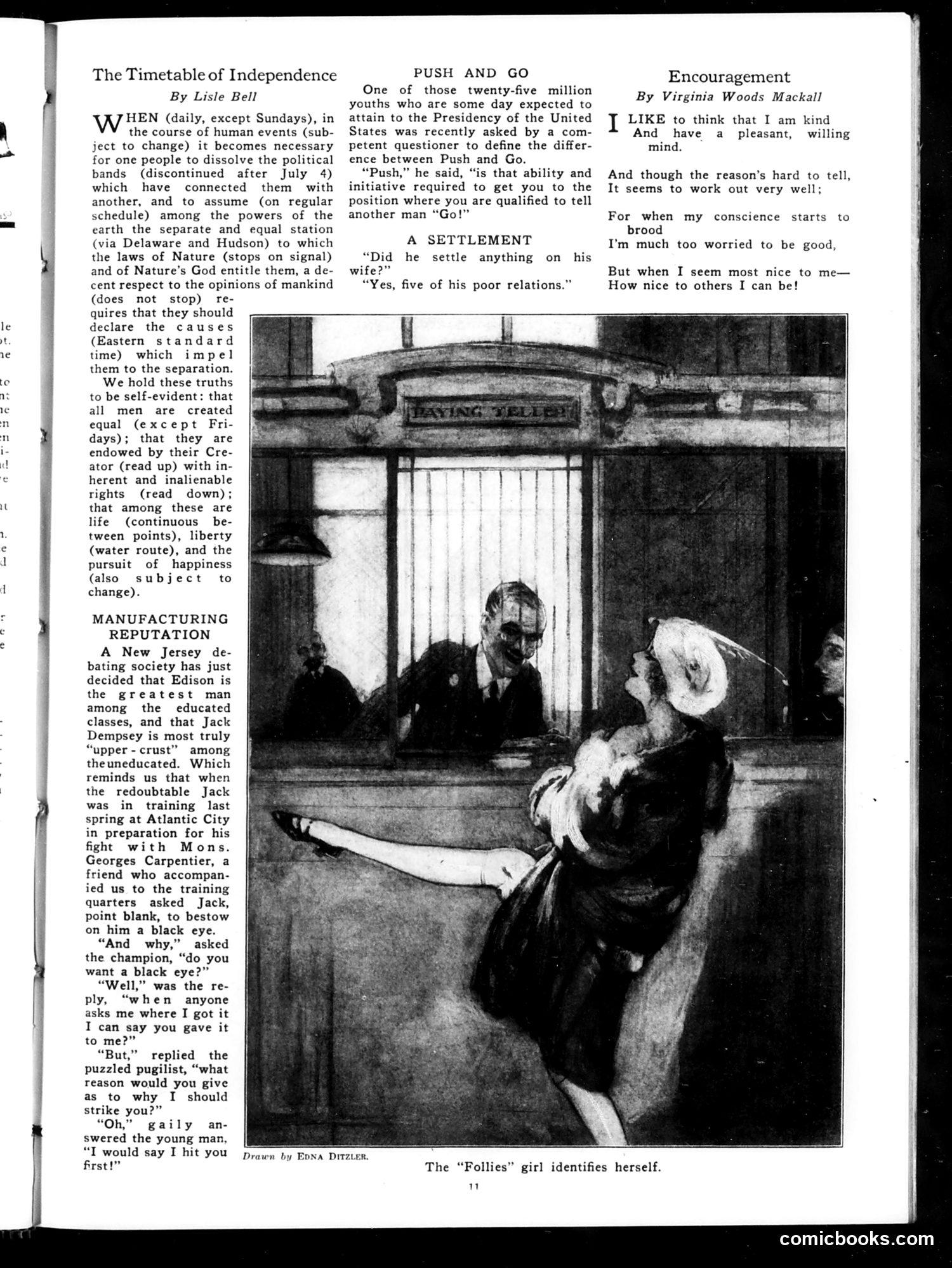
This page contains three satirical pieces mocking American institutions and values: **"The Timetable of Independence"** parodies the Declaration of Independence by inserting modern bureaucratic language—train schedules, water routes, signals—into the founding document. The satire suggests America's grand ideals have been reduced to mechanical, corporate routine. **"Push and Go"** ridicules social climbing: a youth defines "Push" as the initiative to reach a position where you can boss others around. It satirizes American ambition as purely self-serving. **"Manufacturing Reputation"** mocks class perception and celebrity worship. Edison is deemed greatest by educated people; boxer Jack Dempsey by the uneducated—revealing that reputation is manufactured rather than earned. The anecdote about wanting a black eye to claim association with Dempsey exposes how people exploit celebrity connections for social status. The illustration shows a woman in theatrical costume, likely from the Ziegfeld Follies, "identifying herself"—possibly suggesting performers manufacture personas for public consumption. Overall, the page satirizes American pretension, ambition, and manufactured identity.
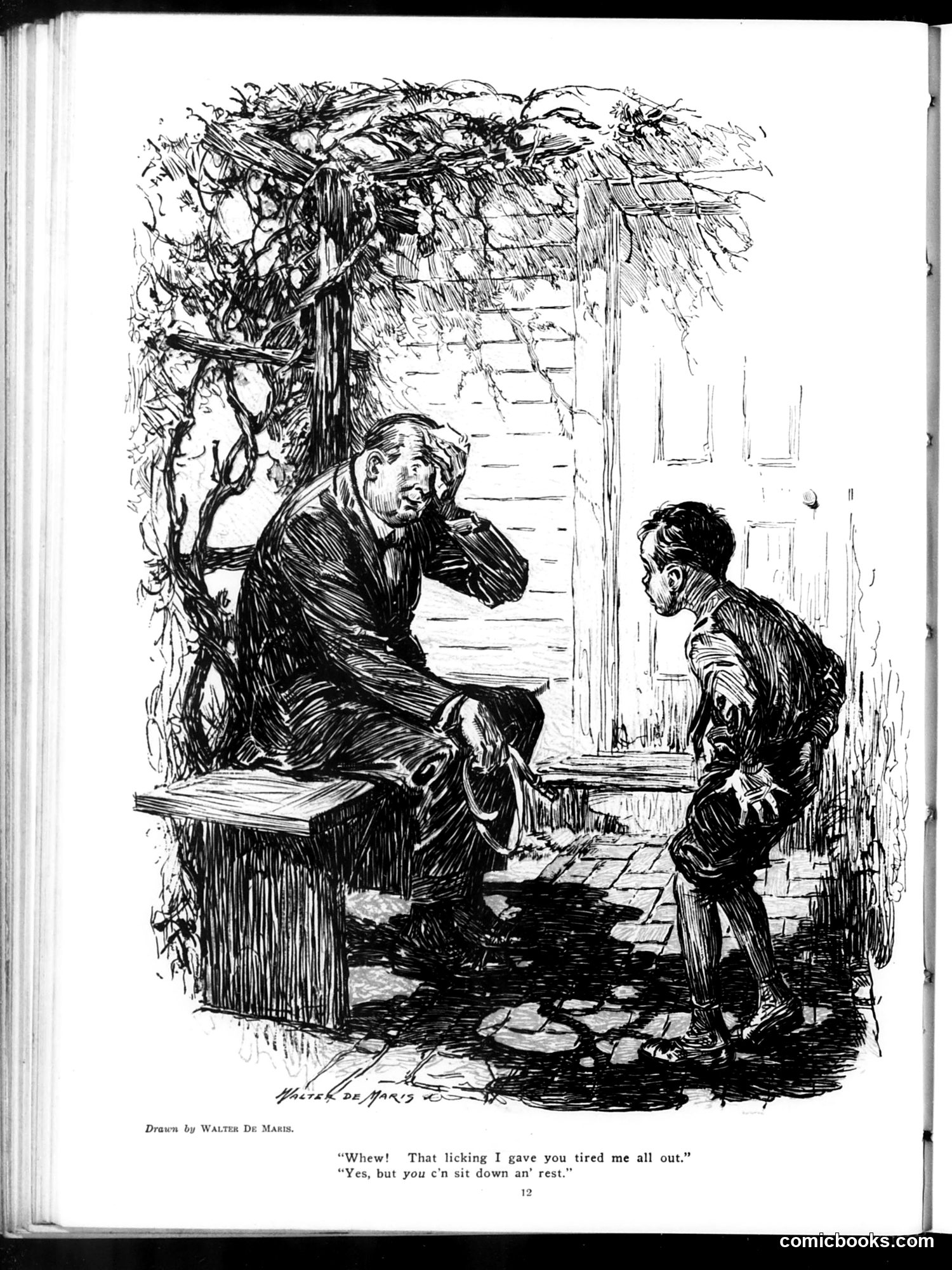
This cartoon depicts an adult and child in what appears to be a domestic scene near a tree and building. The dialogue suggests the adult has physically disciplined the child ("that licking I gave you"), and the child responds by offering the exhausted adult a place to sit and recover. The satire critiques corporal punishment as a disciplinary practice. By showing the adult more exhausted from administering the beating than the child is from receiving it, the cartoon mockingly illustrates the absurdity and inefficiency of physical punishment. The child's patient, almost sympathetic response—offering rest—adds ironic commentary: the punishment has harmed only the punisher's stamina, not achieved any meaningful correction. This reflects late 19th/early 20th-century debates about child-rearing methods and the growing criticism of excessive physical discipline.
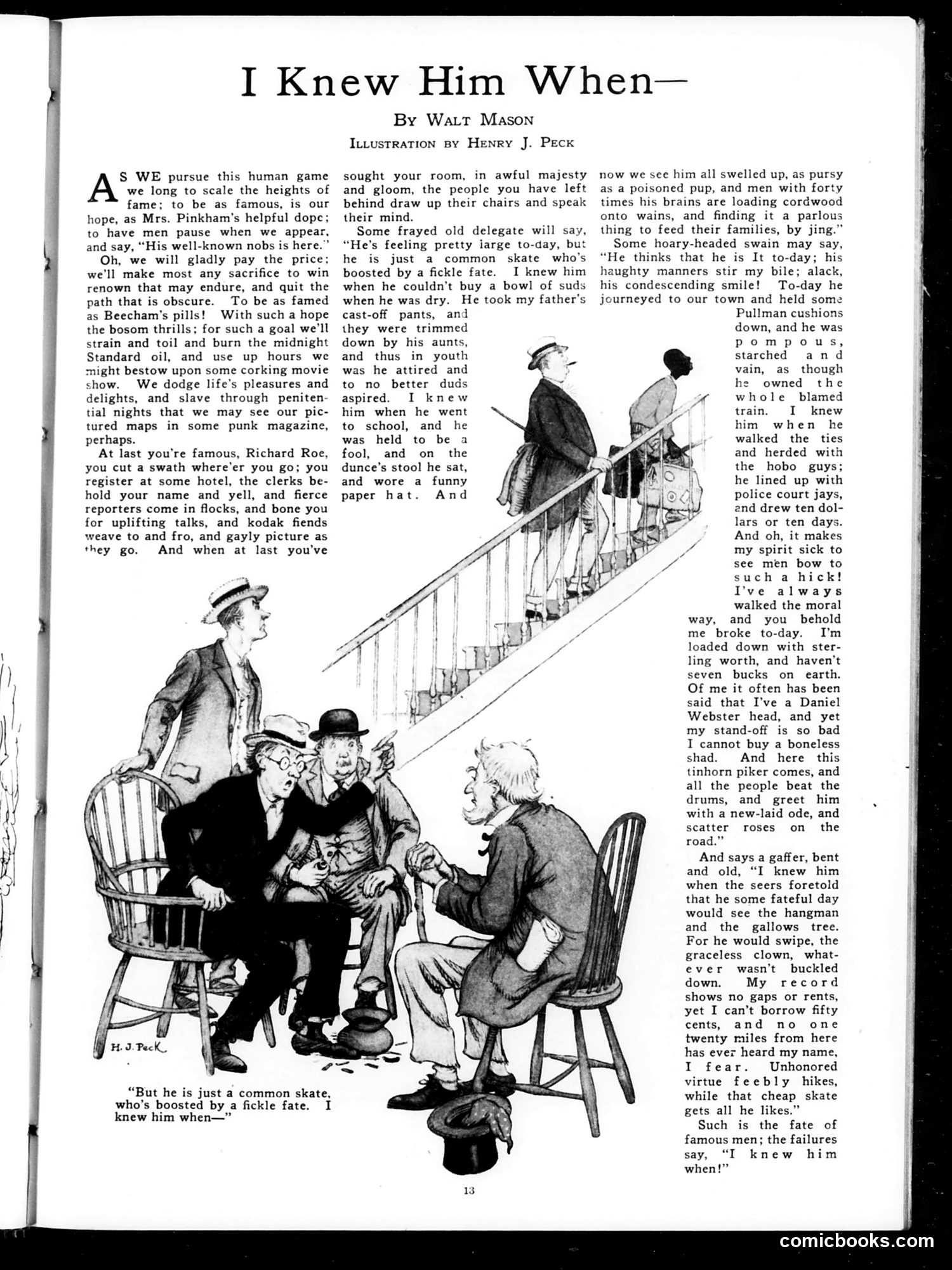
This satirical piece mocks the human obsession with fame and the bitter resentment of the unsuccessful toward the newly famous. The illustration shows a successful man (identified only as "Richard Roe," a generic everyman name) being greeted by admirers at what appears to be a hotel or public venue, while several shabby figures in the background represent his past acquaintances. The satire's point: once someone achieves success, those left behind—the failures and mediocre—invariably claim intimate knowledge of his humble origins, using phrases like "I knew him when" to diminish his accomplishments. Each character recounts embarrassing details (poverty, foolishness, criminality) to convince themselves that his rise was mere luck ("fickle fate"), not merit. Meanwhile, they—virtuous and morally upright—remain broke and forgotten. The piece critiques both social climbing and the mean-spirited envy of those unable to succeed, suggesting that character rarely determines fortune in American society.
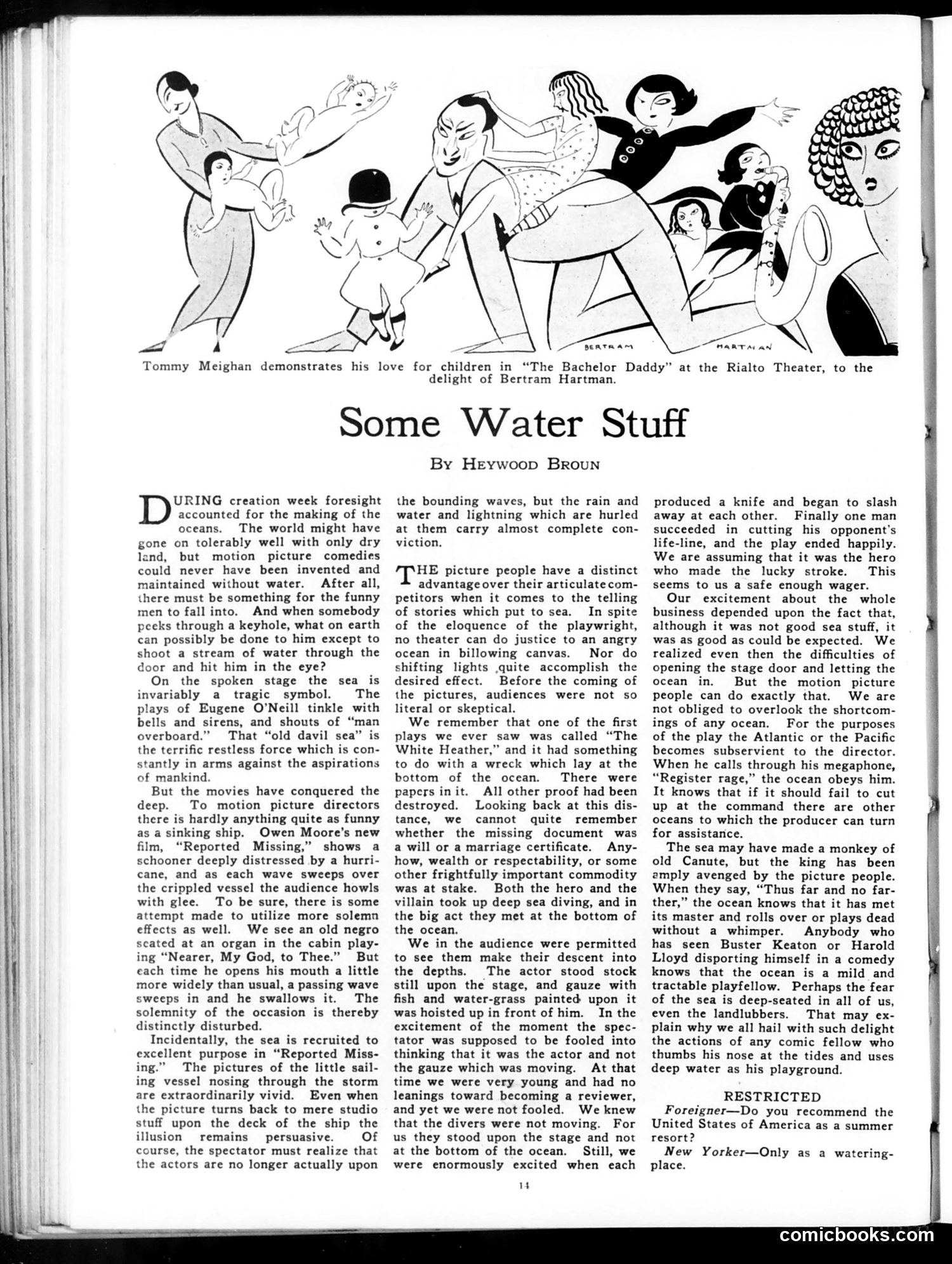
This is a film criticism piece by Heywood Broun (a prominent American journalist) comparing how theater and cinema depict the ocean. The accompanying illustration shows Tommy Meighan, a silent film star, in the comedy "The Bachelor Daddy" at the Rialto Theater. Broun's satire contrasts theatrical traditions—where the sea symbolizes tragedy (referencing Eugene O'Neill's serious dramas)—with cinema's comedic use of water. He mocks how movies treat drowning and shipwrecks as slapstick comedy material, noting audiences laugh as characters swallow waves or sink. The critique highlights cinema's technical advantage: convincing water effects (rain, lighting) create authentic ocean illusions that stage productions cannot achieve with painted gauze and stationary actors. Broun illustrates this with a memory of unconvincing stage diving scenes where audiences could plainly see actors weren't actually moving. The satire suggests movies have "conquered" the ocean by trivializing it—transforming O'Neill's symbol of human struggle into mere comedic prop.
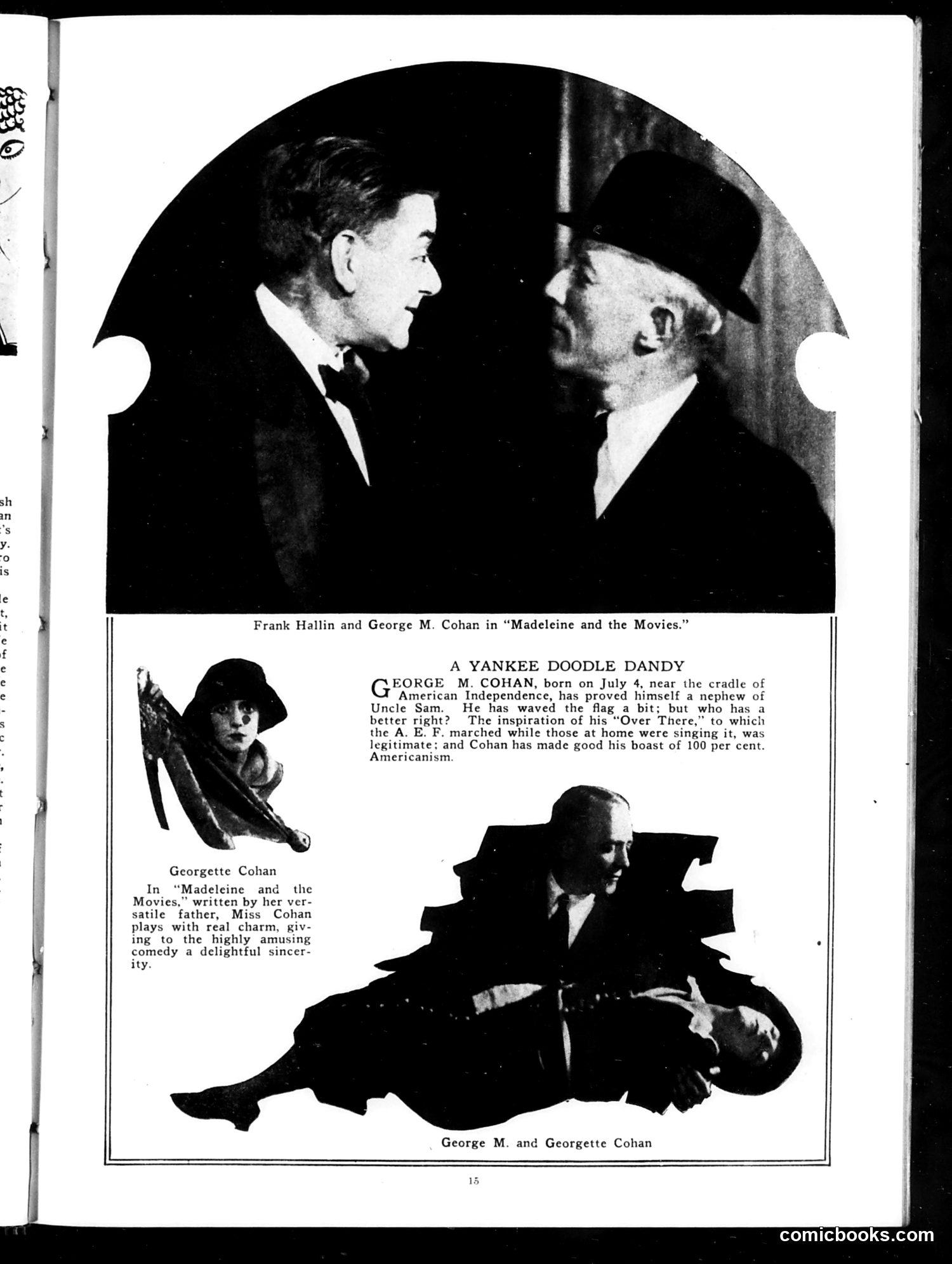
This page celebrates George M. Cohan and his daughter Georgette in the film "Madeleine and the Movies." The satirical headline plays on Cohan's patriotic persona: born on July 4th, he's positioned as quintessentially American—a "nephew of Uncle Sam." The text references Cohan's famous WWI song "Over There," which the American Expeditionary Forces marched to during the war. The satire is gentle: it mockingly acknowledges Cohan's self-proclaimed "100 per cent. Americanism" and his flag-waving while suggesting this patriotic branding is somewhat self-serving, yet legitimate given his genuine contributions to war morale. Georgette, described as playing with "real charm" and "sincerity," benefits from her father's theatrical reputation. The page functions as entertainment industry promotion dressed in patriotic language—typical of Judge magazine's blend of celebrity coverage and social commentary.
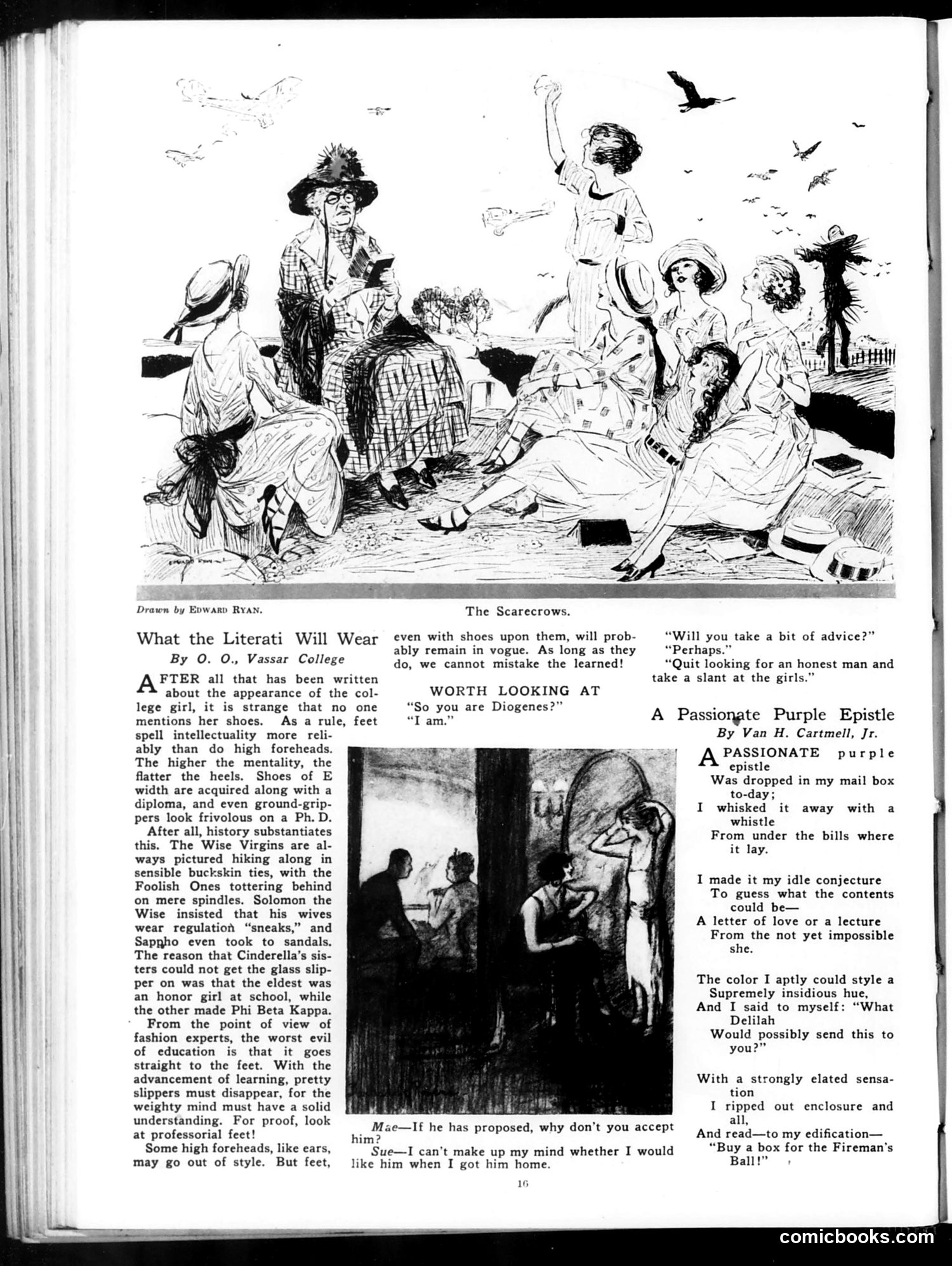
This page contains three satirical pieces mocking intellectual pretension and courtship customs of early 20th-century college life. **"What the Literati Will Wear"** (top): A humorous essay arguing that educated women's intellectuality is revealed by their feet—specifically, that highly educated women wear flat, sensible shoes rather than fashionable heels. It references historical "wisdom" (Wise Virgins, Solomon, Sappho, Cinderella) to suggest learning literally flattens women's feet and destroys fashion sense. The satire mocks both the pretentiousness of intellectual women and the absurdity of judging intellect by footwear. **"The Scarecrows"** (middle): A cartoon and brief dialogue scene satirizing romantic miscommunication—a man proposes, but the woman cannot decide if she'd like him as a husband, suggesting men are only worth considering as romantic prospects, not domestic partners. **"A Passionate Purple Epistle"** (bottom): A poem mocking romantic disappointment—a man receives a mysterious purple letter, anticipating love correspondence, only to discover it's a mundane request to buy raffle tickets for a fireman's ball.
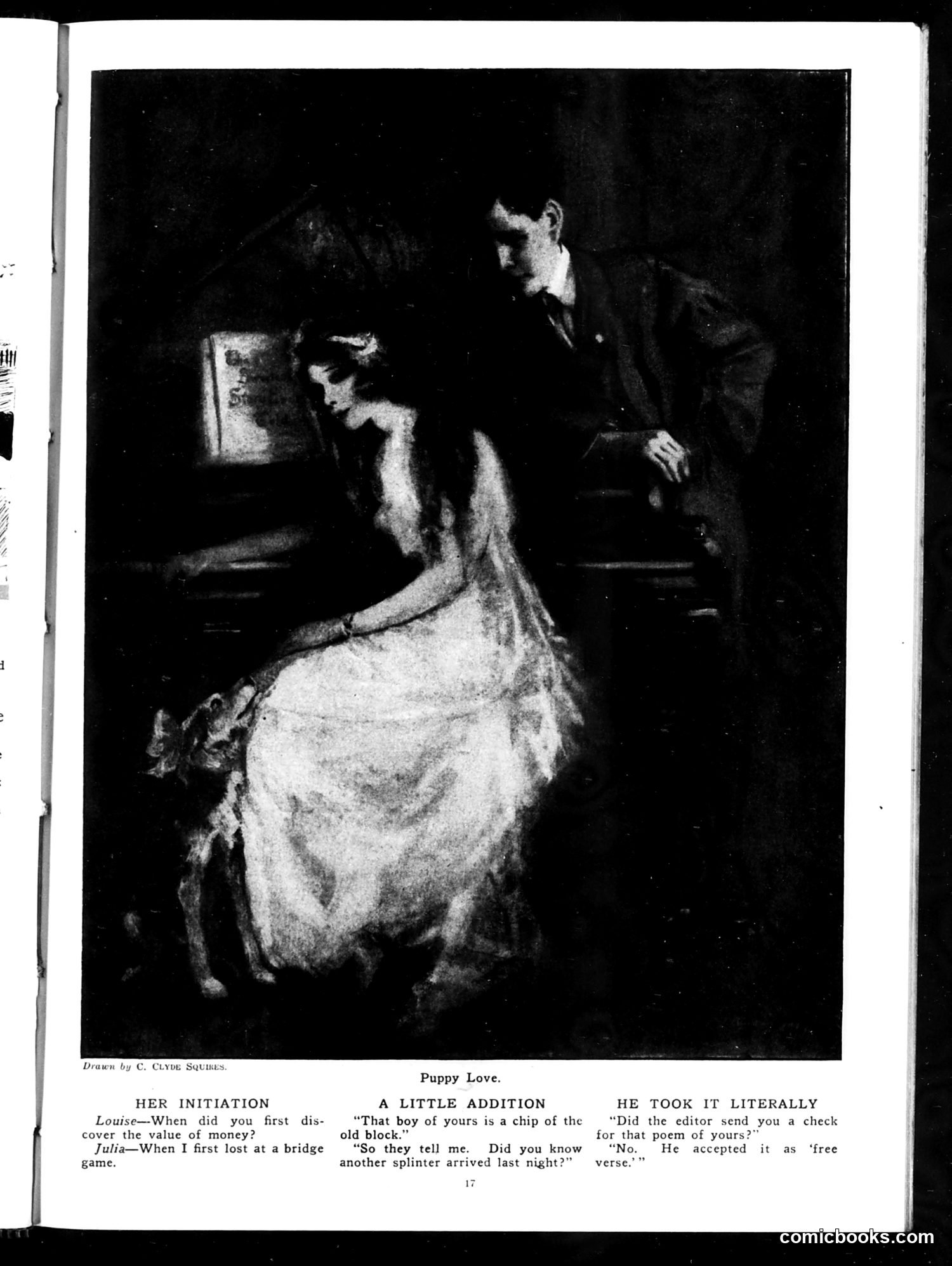
This page contains three brief humorous vignettes drawn by C. Clyde Squires, typical of Judge's light domestic comedy: **"Her Initiation"** jokes that a woman (Louise) discovers money's value only through losing at bridge—suggesting women were stereotyped as poor card players. **"A Little Addition"** plays on the phrase "chip of the old block" (meaning a child resembles their parent). A woman notes her son is like his father, then reveals "another splinter arrived"—meaning another illegitimate child. The humor relies on the double meaning and mild scandal of extramarital offspring. **"He Took It Literally"** depicts a poet whose editor accepts their work as "free verse"—punning on the literary term "free verse" (unrhymed poetry) while the editor actually means unpaid work. These are genteel domestic jokes targeting middle-class readers, relying on wordplay and marital/social situations rather than political satire.
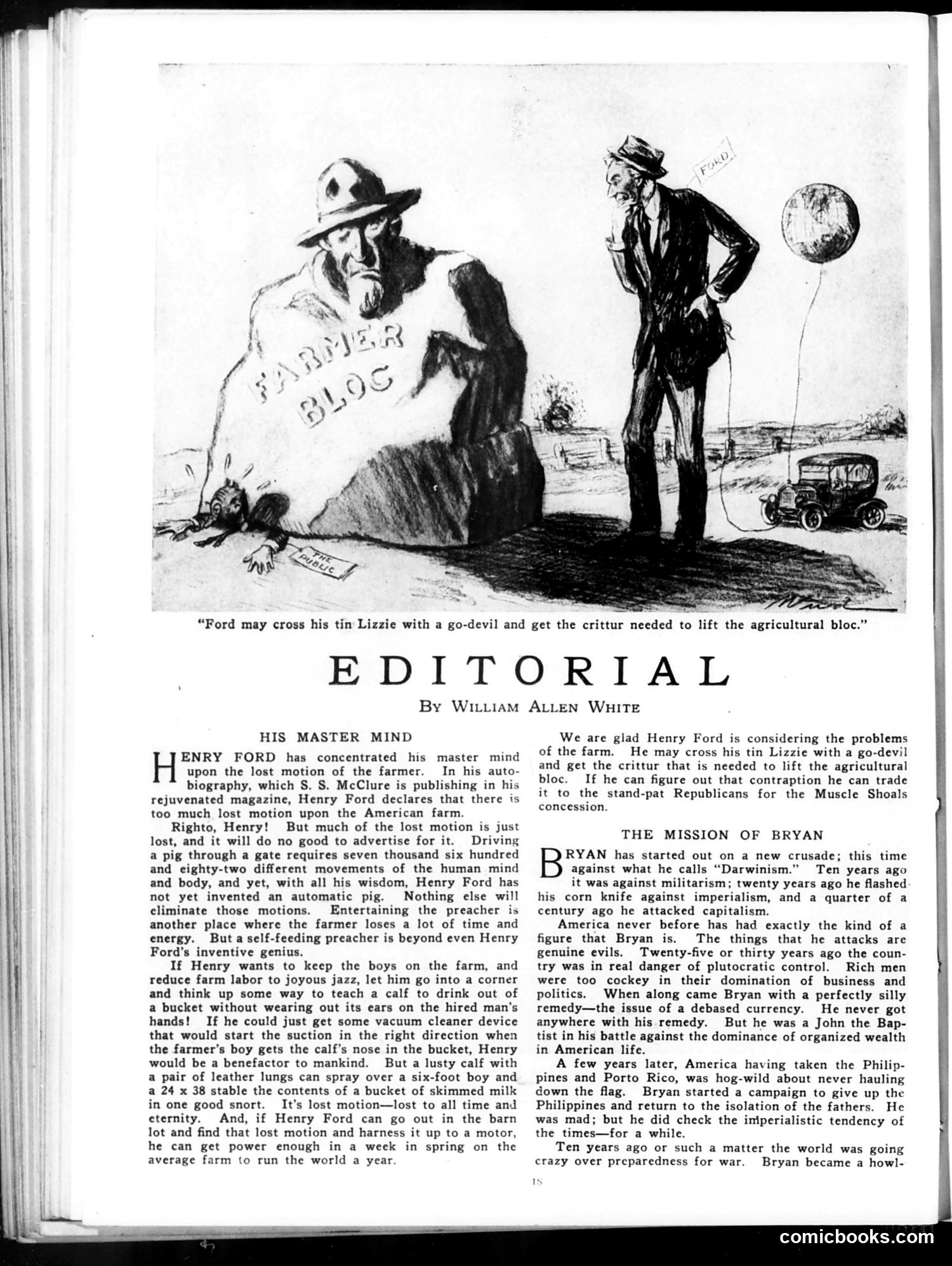
This editorial page from Judge magazine satirizes Henry Ford's agricultural ambitions and praises William Jennings Bryan's reform crusades. **The Cartoon:** The illustration depicts Ford as a figure wrapped in a "Farmer's Bloc" banner, while another man holds a balloon. The caption jokes that Ford might "cross his tin Lizzie [Model T] with a go-devil" to solve farm problems—satire suggesting Ford's industrial solutions are inadequate for farming's real inefficiencies. **Editorial Content:** William Allen White humorously dismisses Ford's claims about eliminating farm "lost motion," arguing that genuine farm problems (teaching calves to drink, entertaining preachers) can't be mechanized away. White sarcastically suggests Ford trade his invention to Republicans for Muscle Shoals concessions—likely referencing contemporary hydroelectric power debates. **Bryan Section:** The piece praises William Jennings Bryan as a prophetic crusader against genuine evils: plutocracy, imperialism, and militarism—even when his specific remedies (like currency debasement) failed. Bryan emerges as a moral voice who influenced policy despite flawed solutions.
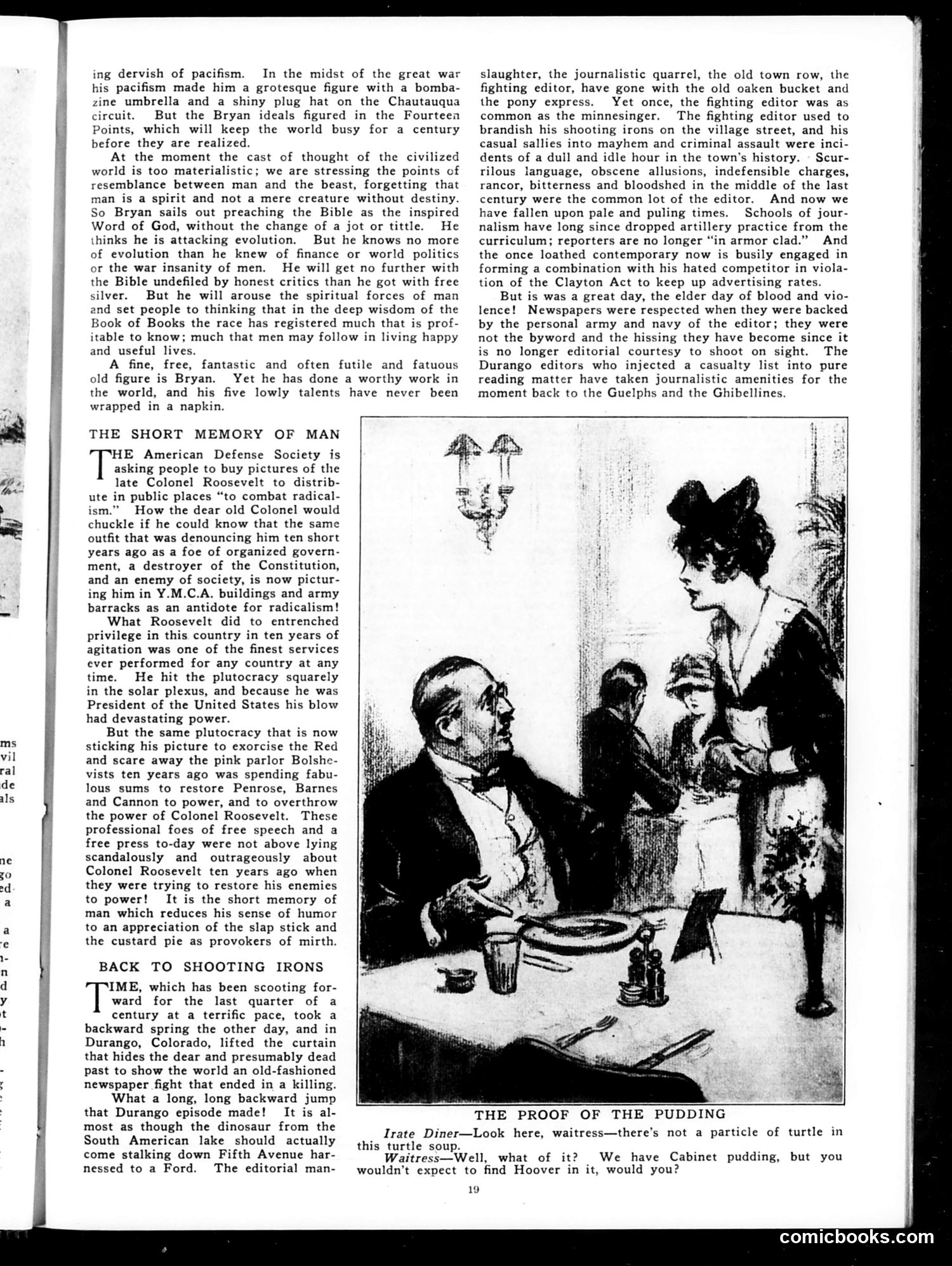
This page contains two distinct sections: **"The Short Memory of Man"** critiques the American Defense Society's hypocrisy. A decade earlier, conservatives attacked Theodore Roosevelt as an enemy of organized government and the Constitution. Now—presumably post-WWI, when anti-radical sentiment surged—these same groups use Roosevelt's image to combat "radicalism." The author sarcastically notes Roosevelt's actual legacy: attacking entrenched plutocracy during his presidency. The piece highlights how political enemies become convenient allies when their image serves a new purpose. **"Back to Shooting Irons"** laments the decline of violent newspaper feuds. It nostalgically recalls Durango, Colorado editors who conducted literal armed combat, contrasting this with modern journalism's "pale and puling times." The piece presents this violence ironically—editors once gained respect through personal armies and public shootouts, now reduced to advertising rate-fixing agreements. The cartoon titled **"The Proof of the Pudding"** depicts a restaurant scene where a diner complains about lack of turtle in turtle soup; the waitress responds with Cabinet pudding containing Hoover. This appears to criticize Herbert Hoover's policies using culinary metaphor.
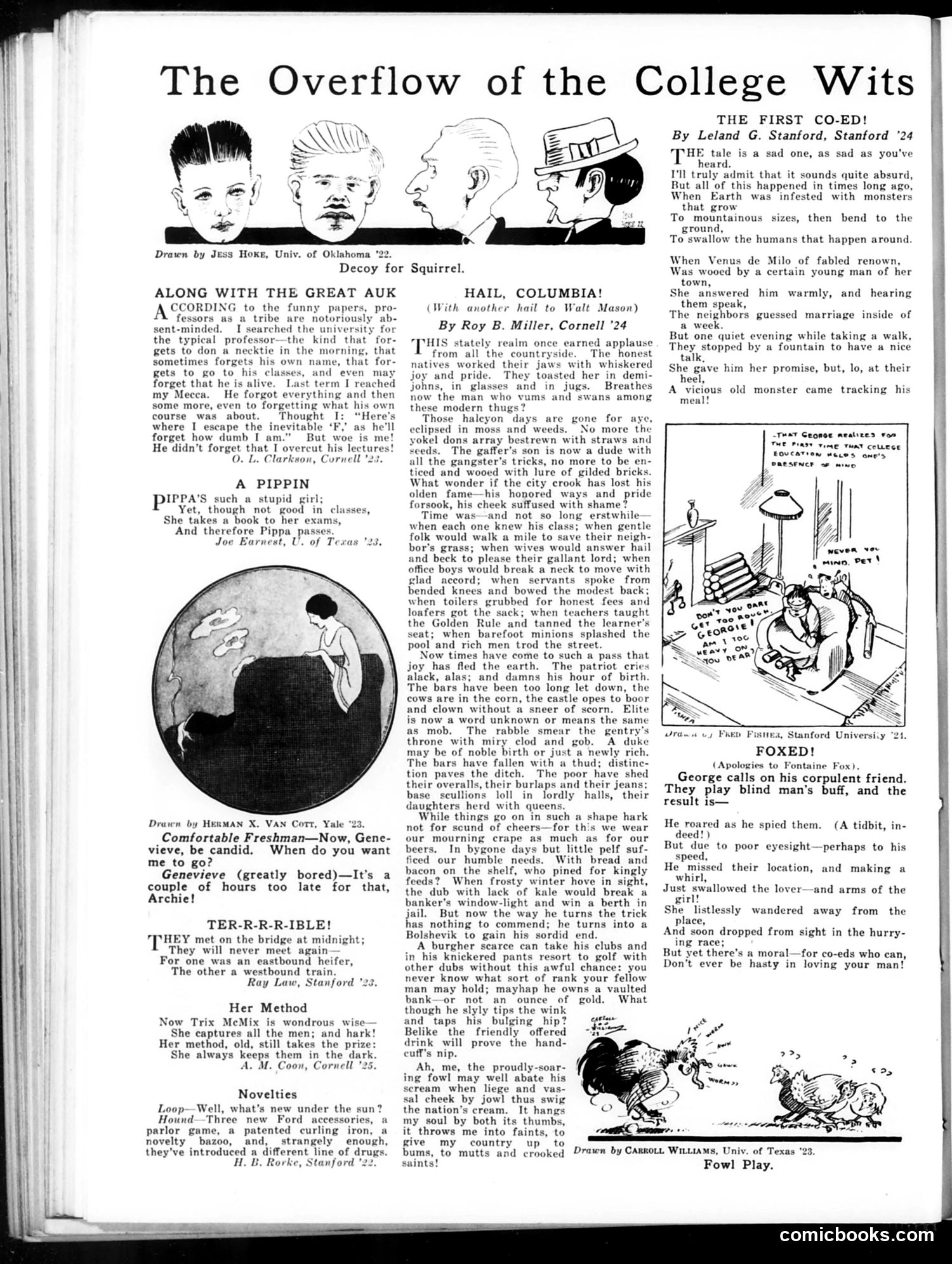
This is a 1924 college humor page from *Judge* magazine featuring student-written jokes and cartoons. The content reflects typical collegiate wit of the era: **Main pieces:** - **"Decoy for Squirrel"**: Caricatured heads illustrating a joke about an absent-minded professor—a stock character representing academia's perceived irrelevance to practical life. - **"Hail, Columbia!"**: A lengthy nostalgic poem lamenting the decline of American social order. It contrasts an idealized past (honest farmers, obedient servants, respected elites, teachers enforcing discipline) with a degraded present where social hierarchies have collapsed—"the poor have shed their overalls" and mingle with the wealthy. This reflects 1920s conservative anxiety about post-WWI social mobility and changing class structures. - **Minor jokes** about forgetful students, romantic mishaps, and campus life typical of college periodicals. The satire targets generational and social decline through nostalgia, a common theme in 1920s American letters.
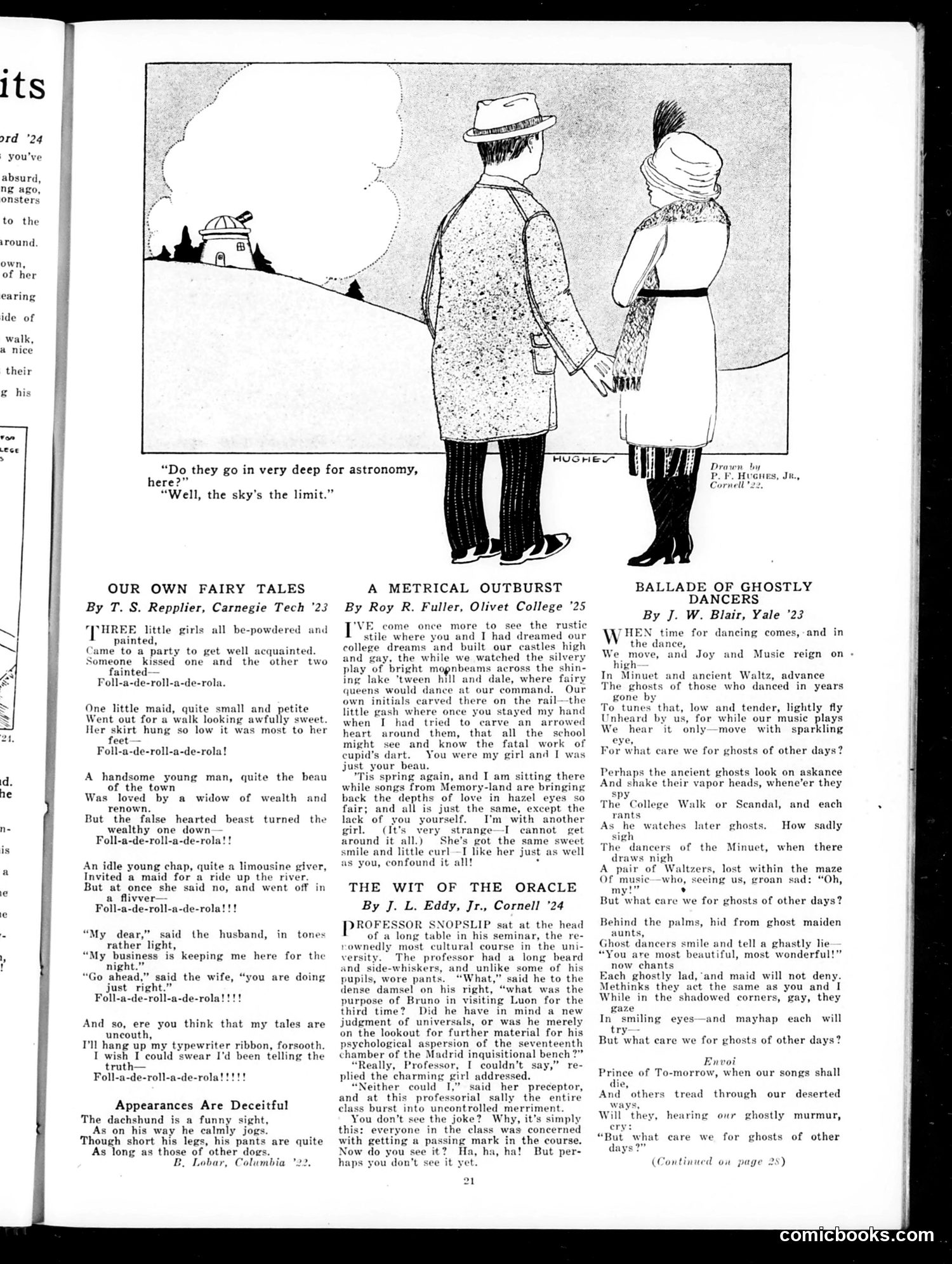
This single-panel cartoon depicts two well-dressed figures observing a distant observatory or astronomical building on a hilltop. The man asks if astronomers "go in very deep" for their work, to which the woman replies, "Well, the sky's the limit." The joke is a double entendre playing on the phrase "sky's the limit" (meaning no upper bound to possibility). It literally refers to the astronomer's field of study while humorously suggesting the couple's romantic possibilities are equally boundless. The cartoon appears to be flirting commentary on courtship expectations in 1920s collegiate society. The artwork is credited to "Hughes" and appears in a student publication context, suggesting this was lighthearted humor for young readers. The reference to "astronomy" likely carries no deeper political or social meaning beyond the pun itself.
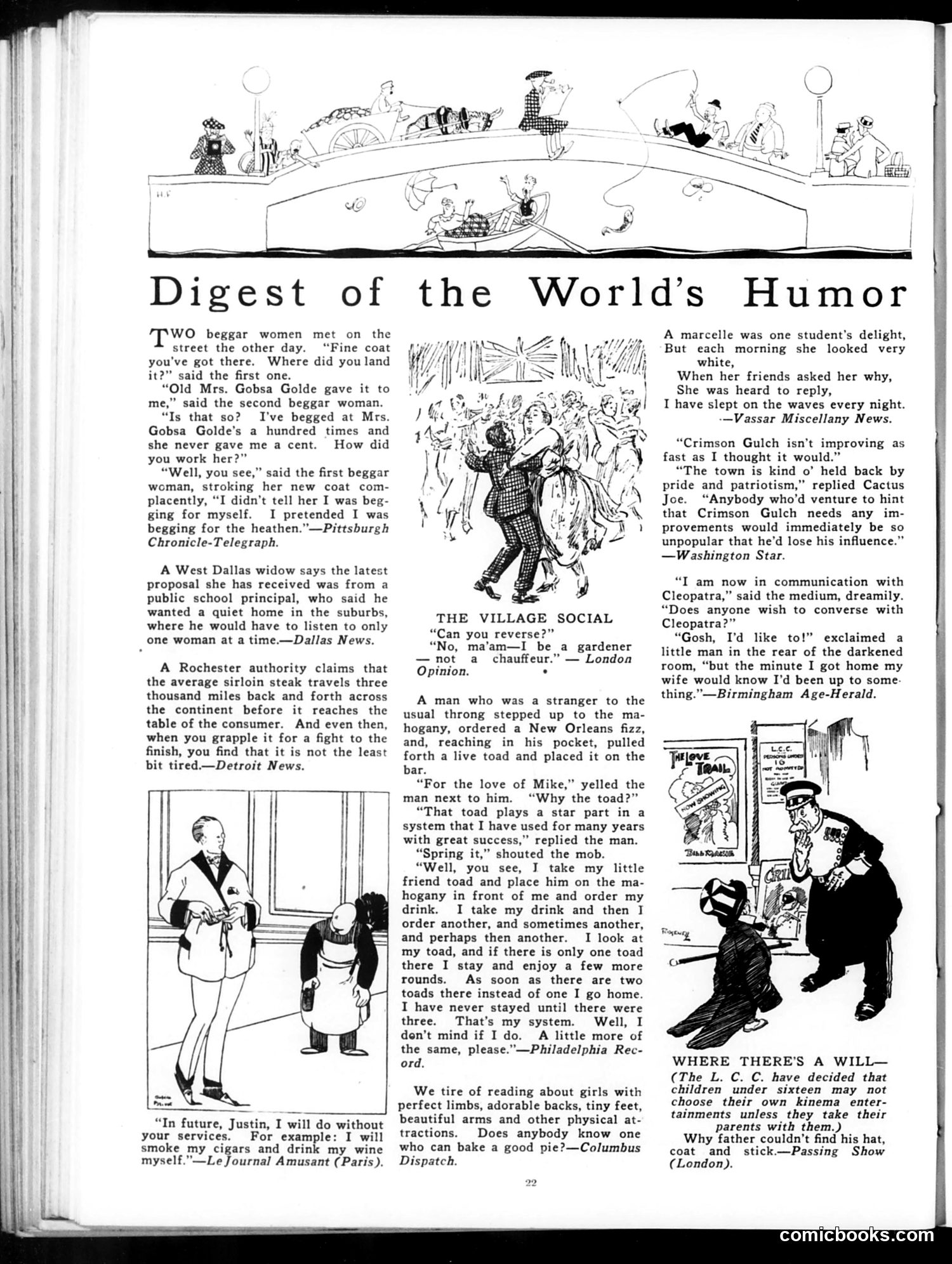
This page from *Judge* magazine collects brief humorous anecdotes and jokes from various newspapers, typical of early-20th-century humor columns. **Key satirical targets:** - **Begging/charity deception**: A beggar manipulates a wealthy woman by claiming to beg for "heathens" rather than herself—mocking both dishonest panhandling and sentimental charity. - **Gender relations**: Multiple jokes mock marriage and wives, reflecting period attitudes (a principal wanting a home where he hears "only one woman," a man preferring pie-baking skills to physical beauty). - **Alcohol and sobriety**: A drunk man uses a toad as a visual double-vision test to know when to stop drinking—dark humor about alcoholism. - **Spiritualism**: A medium's séance is interrupted when a man admits his wife would suspect infidelity if he consulted Cleopatra—satirizing both séance fraud and marital suspicion. - **Film censorship**: A brief note mocks new British film restrictions requiring parental supervision for minors, treating children's entertainment choices as needing moral oversight. The humor is gentle social observation rather than sharp political satire.
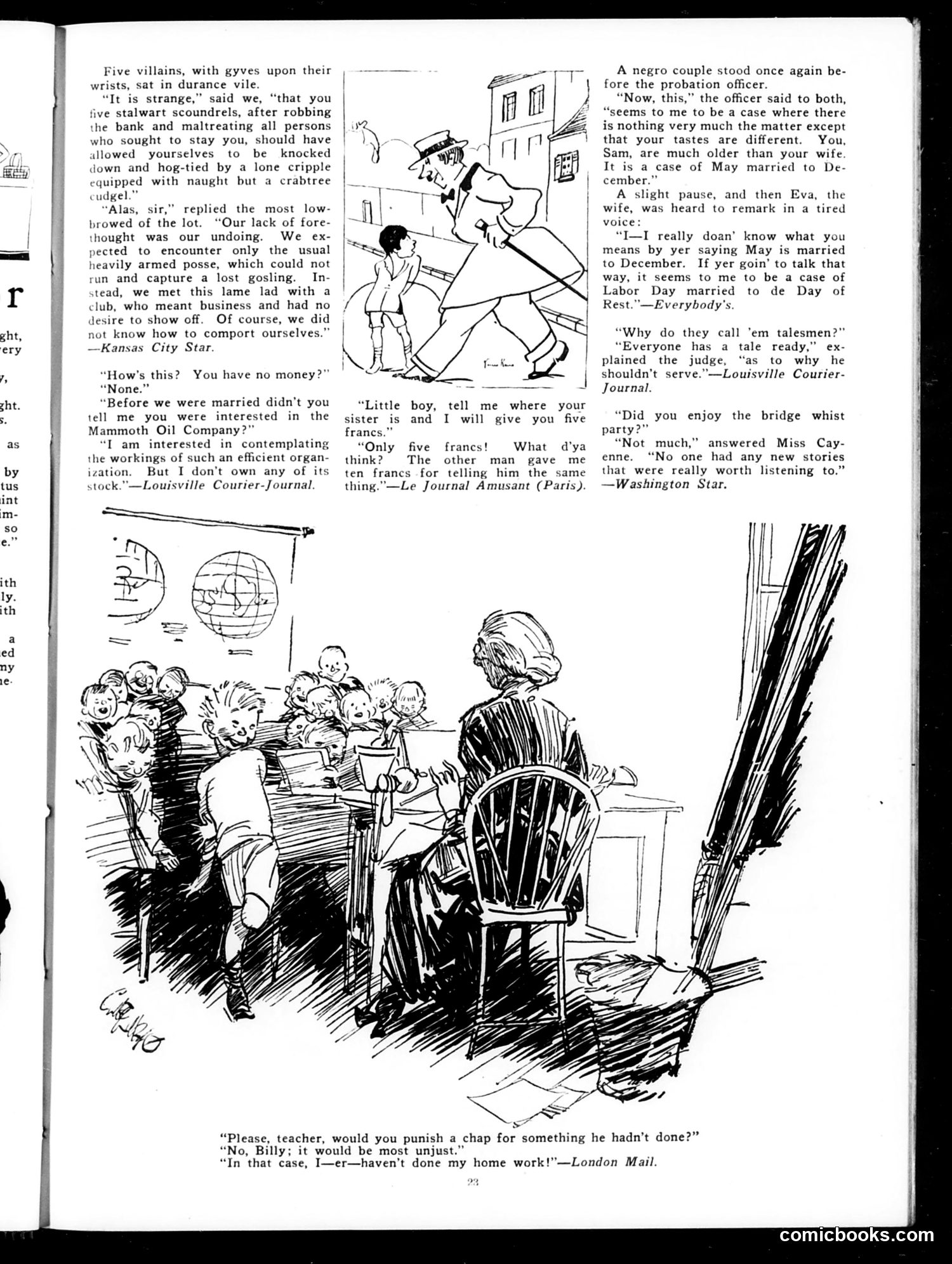
This page collects six brief satirical anecdotes typical of early 20th-century American humor magazines: 1. **The cripple outsmarts criminals**: Five armed bank robbers are defeated by a single disabled man with a club because they expected armed resistance, not genuine determination. 2. **Oil stock husband**: A man claims interest in Mammoth Oil Company but owns no stock—satirizing empty financial boasting. 3. **Child's bribery**: A boy negotiates with a stranger offering francs for his sister's location, implying he previously accepted payment for the same information. 4. **Teacher's logic trap**: A student exploits the teacher's principle against unjust punishment by claiming he hasn't done homework. 5. **Racial couple's marital discord**: Uses a "May-December marriage" metaphor; the wife reframes it as "Labor Day to Day of Rest"—suggesting exhaustion from overwork. 6. **Jury duty excuse**: Men claim they have reasons to avoid jury service because everyone tells convenient stories. The humor relies on wordplay, logical paradoxes, and social observation rather than visual comedy. The racial anecdote reflects period attitudes but centers marital inequality.
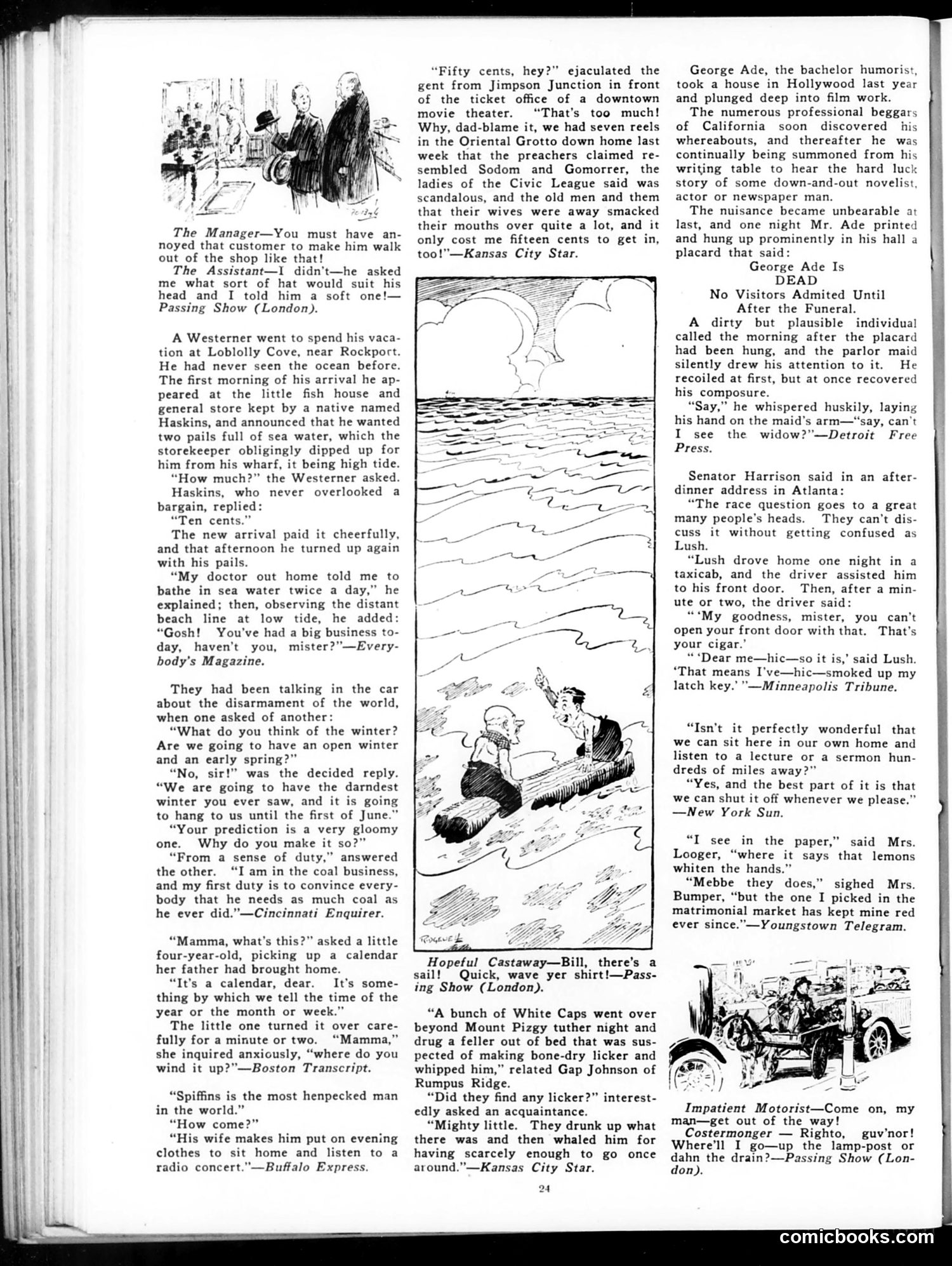
This page contains several brief humorous anecdotes typical of Judge magazine's satirical humor, targeting early 20th-century American foibles: **The shop assistant joke** mocks rudeness disguised as honesty—telling a customer his head needs a "soft" hat. **The sea-water story** satirizes rural merchants' opportunism and city folk's naïveté, depicting a Westerner paying for ocean water he could obtain free. **The coal-dealer anecdote** uses dark humor about business ethics during apparent disarmament discussions—a coal merchant cynically admits he manipulates people into buying excess fuel for profit. **The calendar joke** gently mocks a child's confusion between mechanical and informational devices. **The radio joke** satirizes marital dynamics and the novelty of radio entertainment requiring formal dress at home. **The movie ticket complaint** contrasts small-town morality with urban entertainment pricing, referencing scandalous nickelodeon content. The page reflects 1920s-30s anxieties: urbanization, new technology, changing morality, and economic opportunism.
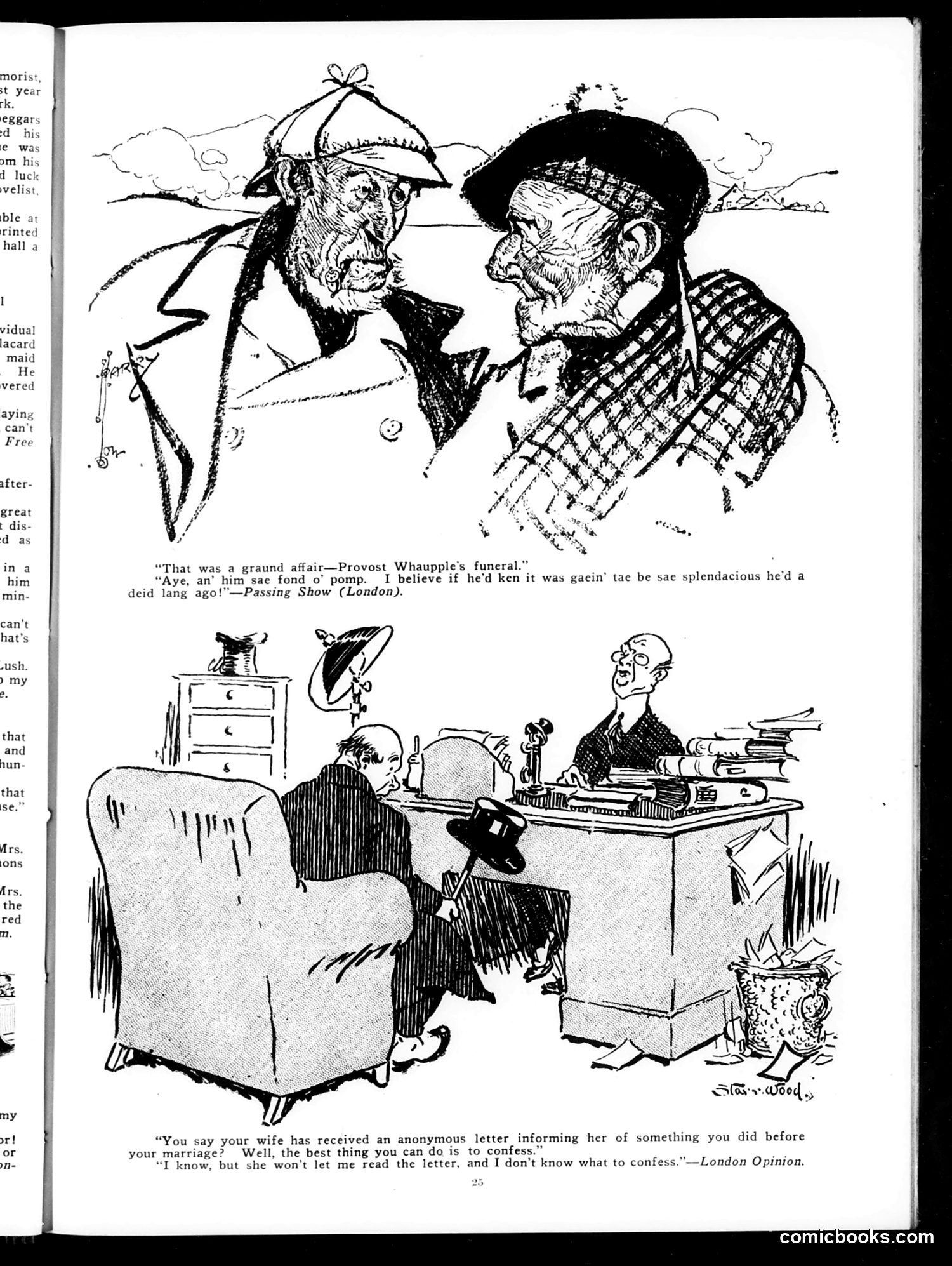
This page contains two separate cartoons with distinct jokes: **Top cartoon:** Two Scottish men discuss a funeral. The humor relies on Scottish dialect and a darkly ironic observation: one man notes that Provost Whaupple was so fond of pomp that had he known his funeral would be so "splendacious" (splendid), he would have died long ago—implying he might have hastened his own death to enjoy such grandeur. It's absurdist humor playing on vanity. **Bottom cartoon:** A man sits in an armchair while his wife's employer (at a desk) offers marital advice: confess to whatever anonymous letter revealed about pre-marital wrongdoing. The joke's twist: the husband can't confess because his wife won't let him read the letter—so he doesn't know what transgression to admit to. It satirizes both marital suspicion and the awkwardness of admitting guilt without knowing the specific accusation. Both cartoons mock human folly through everyday domestic and social situations.
This is a book review essay, not a cartoon page. The illustration at top depicts a library scene with figures reading and lounging among books—a generic design accompanying the literary critique below. Walter Prichard Eaton reviews Ludwig Lewisohn's book "The Drama and the Stage," critiquing Lewisohn's dismissive attitude toward American theater. Lewisohn, a drama critic, argues American theater lacks truth and moral purpose, favoring European plays (Ibsen, Hauptmann, Galsworthy) over American works. Eaton's complaint: Lewisohn, being Jewish and intellectually European-oriented, cannot appreciate genuinely American drama like "The First Year"—popular domestic comedies reflecting actual American values. Eaton argues a critic must understand his audience's perspective, not simply impose foreign aesthetic standards. The piece satirizes intellectual snobbery that dismisses popular native entertainment in favor of imported "serious" drama. The essay contains ethnic stereotyping typical of 1920s Judge magazine.
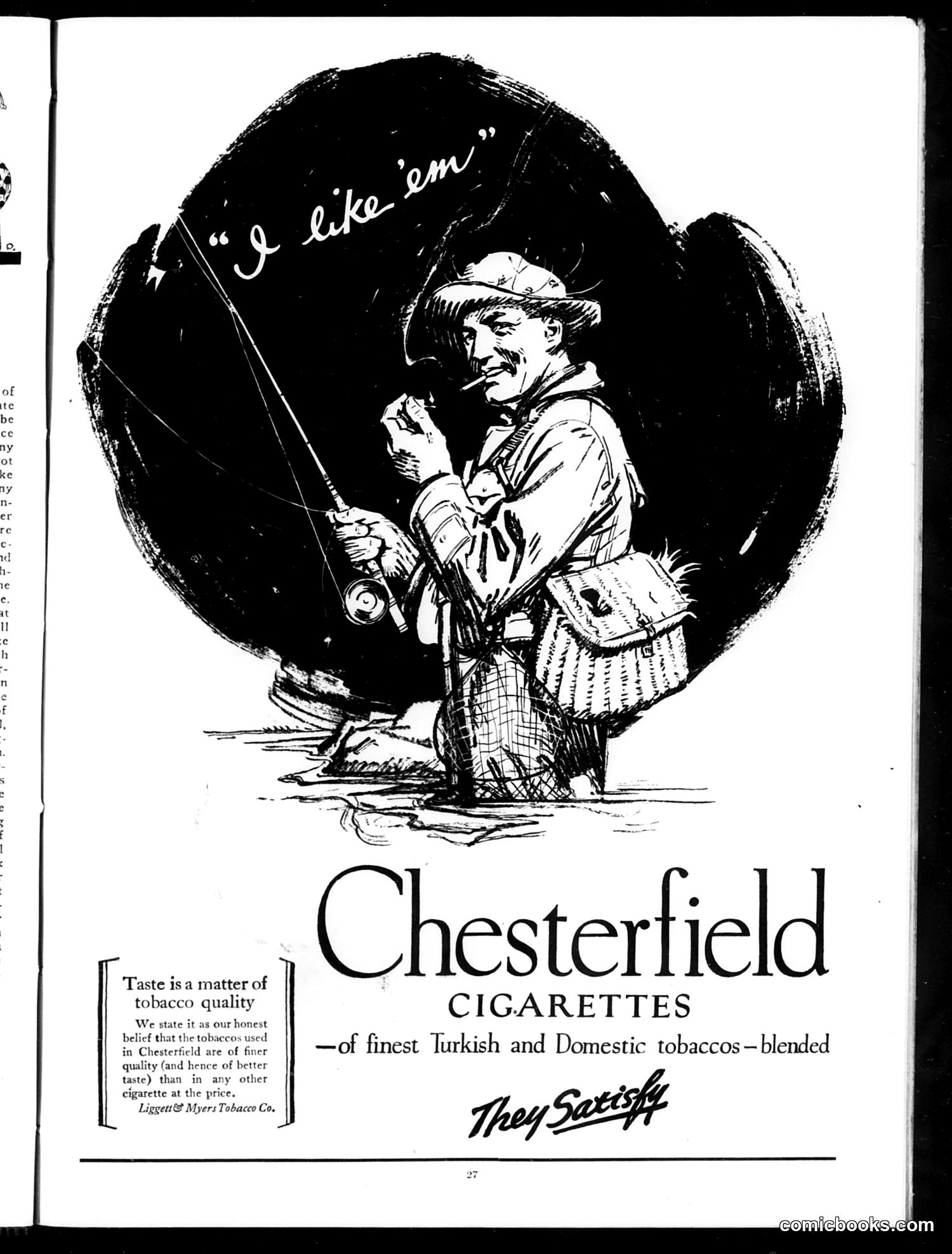
This page is a **cigarette advertisement**, not political satire. It features a Chesterfield cigarettes ad from Liggett & Myers Tobacco Co. The illustration shows a cartoonish fisherman with "I like 'em" quoted above him, smoking contentedly while fishing. The visual suggests satisfaction and leisure—typical advertising imagery of the era. The accompanying text claims Chesterfield cigarettes contain superior tobacco quality "at the price," positioning the brand as a value product with premium tobacco. The fisherman figure appears designed to represent an everyman consumer endorsing the product through his satisfied expression. This is straightforward vintage advertising using folksy imagery and endorsement messaging—common early-to-mid twentieth-century tobacco marketing before health warnings became mandatory.
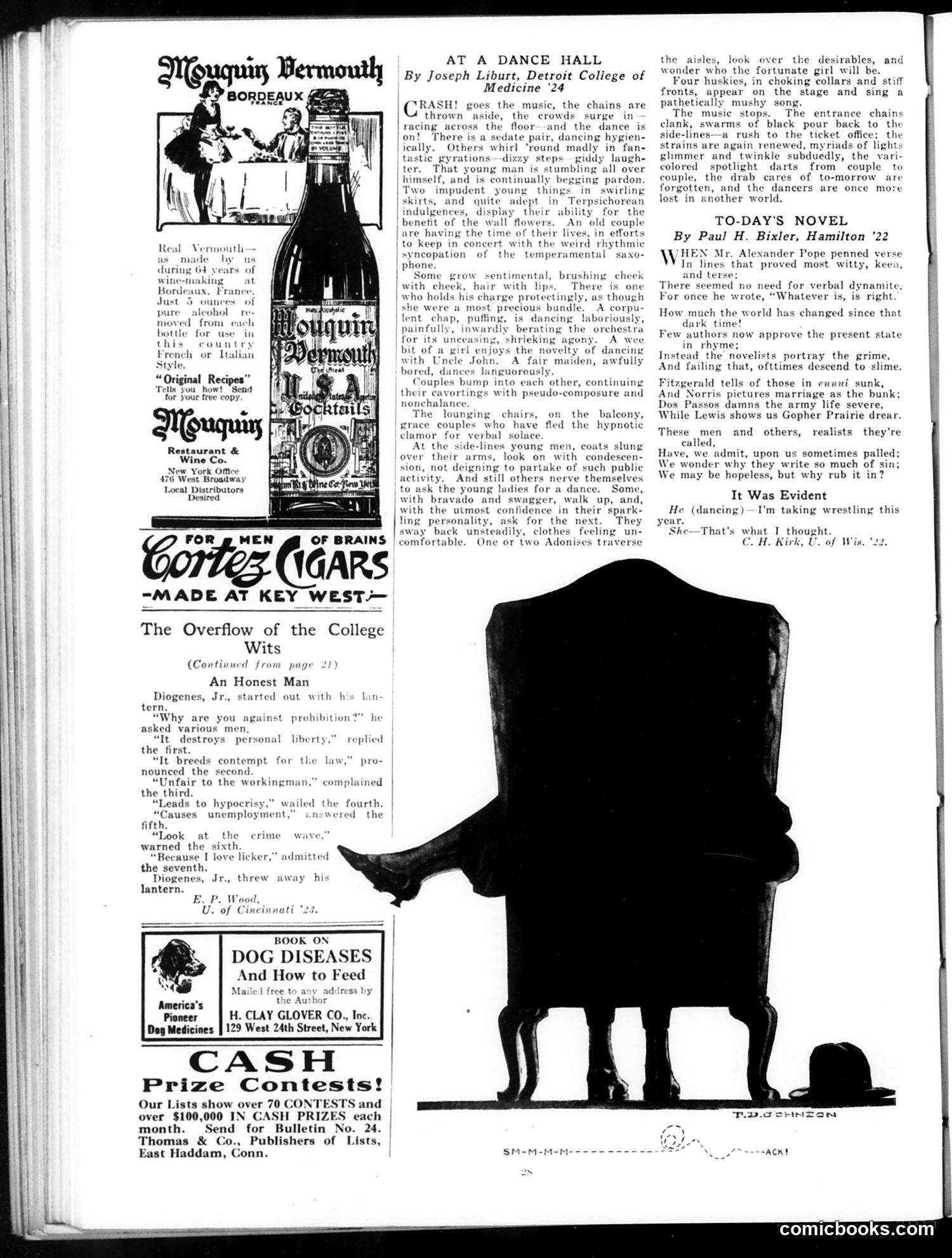
This page contains two distinct elements: **"At a Dance Hall"** is a descriptive essay about 1920s jazz-age dancing—capturing the energy of a college dance with flappers doing the Charleston, couples dancing "hygienically" versus wildly, and the social dynamics of young people asking each other to dance. It's social observation rather than satire. **"The Overflow of the College Wits"** is a short humor piece where "Diogenes, Jr." (referencing the ancient philosopher who carried a lantern searching for an honest man) asks various men why they oppose Prohibition. Each gives a different reason—it violates liberty, breaks law, harms workers, encourages hypocrisy, causes unemployment, etc. The final answer—"Because I love licker" (liquor)—is the punchline: after all the noble arguments, the honest truth is simply that people want to drink alcohol. The satire mocks the elaborate justifications people gave for opposing Prohibition while the real motivation was desire for alcohol itself. This is typical 1920s college humor from Judge magazine.
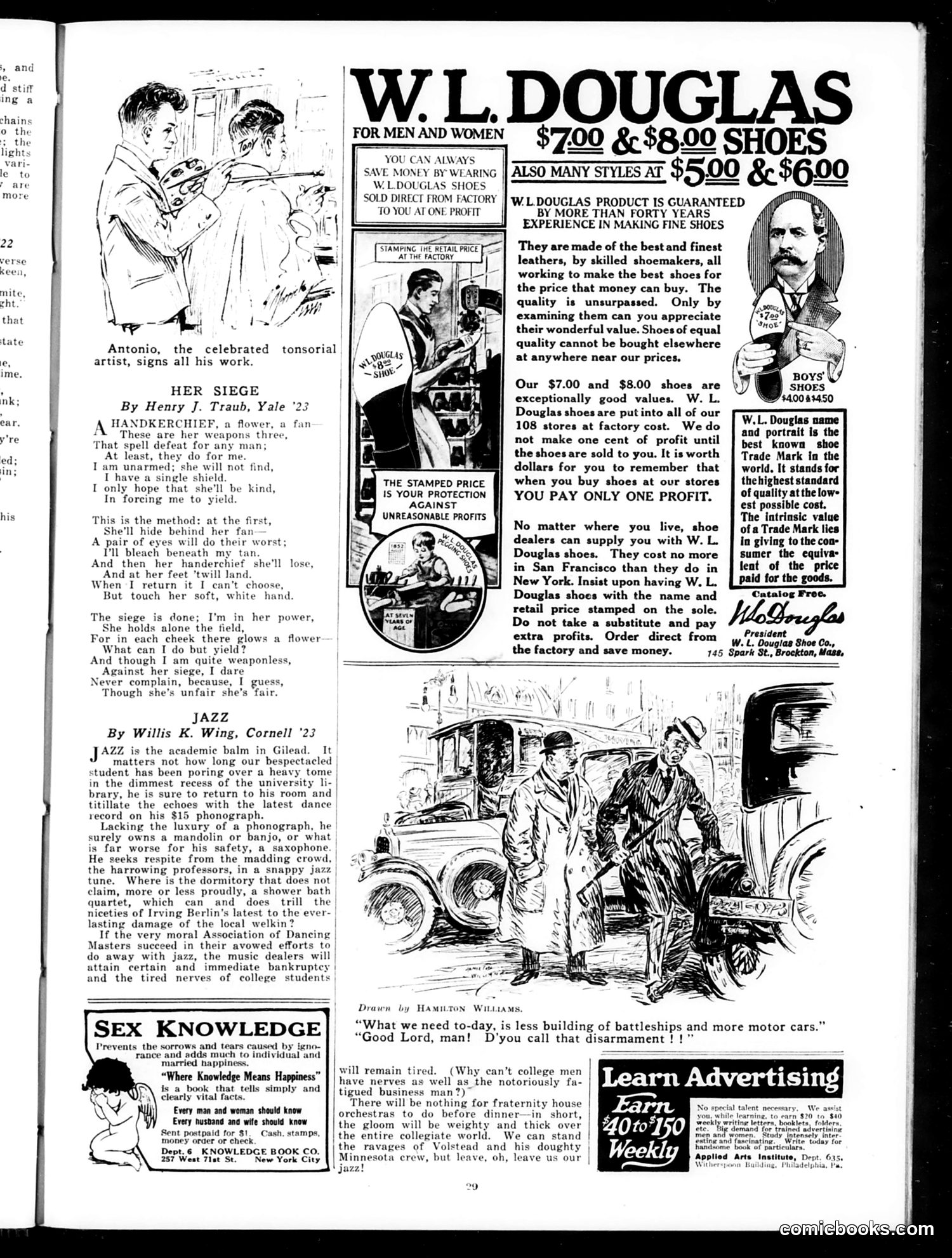
This page contains primarily **advertising and light satirical poetry** rather than political cartoons. The main content includes: 1. **"Her Siege"** — A romantic poem about courtship using military metaphor. A young man describes being "conquered" by a woman's flirtation (fan, flower, handkerchief, soft hand). It's gentle satire of college romance rituals. 2. **"Jazz"** — Commentary on college life, mocking students' obsession with phonographs and jazz music as escape from studying. The author suggests jazz is so prevalent that if it were banned, music dealers would go bankrupt and students would lose their "respite." 3. **Large W.L. Douglas Shoes Advertisement** — Dominates the right side, featuring a portrait of the company founder and emphasizing direct factory-to-consumer sales to undercut profits from middlemen. 4. **"Sex Knowledge" advertisement** — Partially visible at bottom, a mail-order book. The page reflects 1920s college culture (Jazz Age), consumer economics (factory-direct sales), and typical magazine advertising strategy of this era.
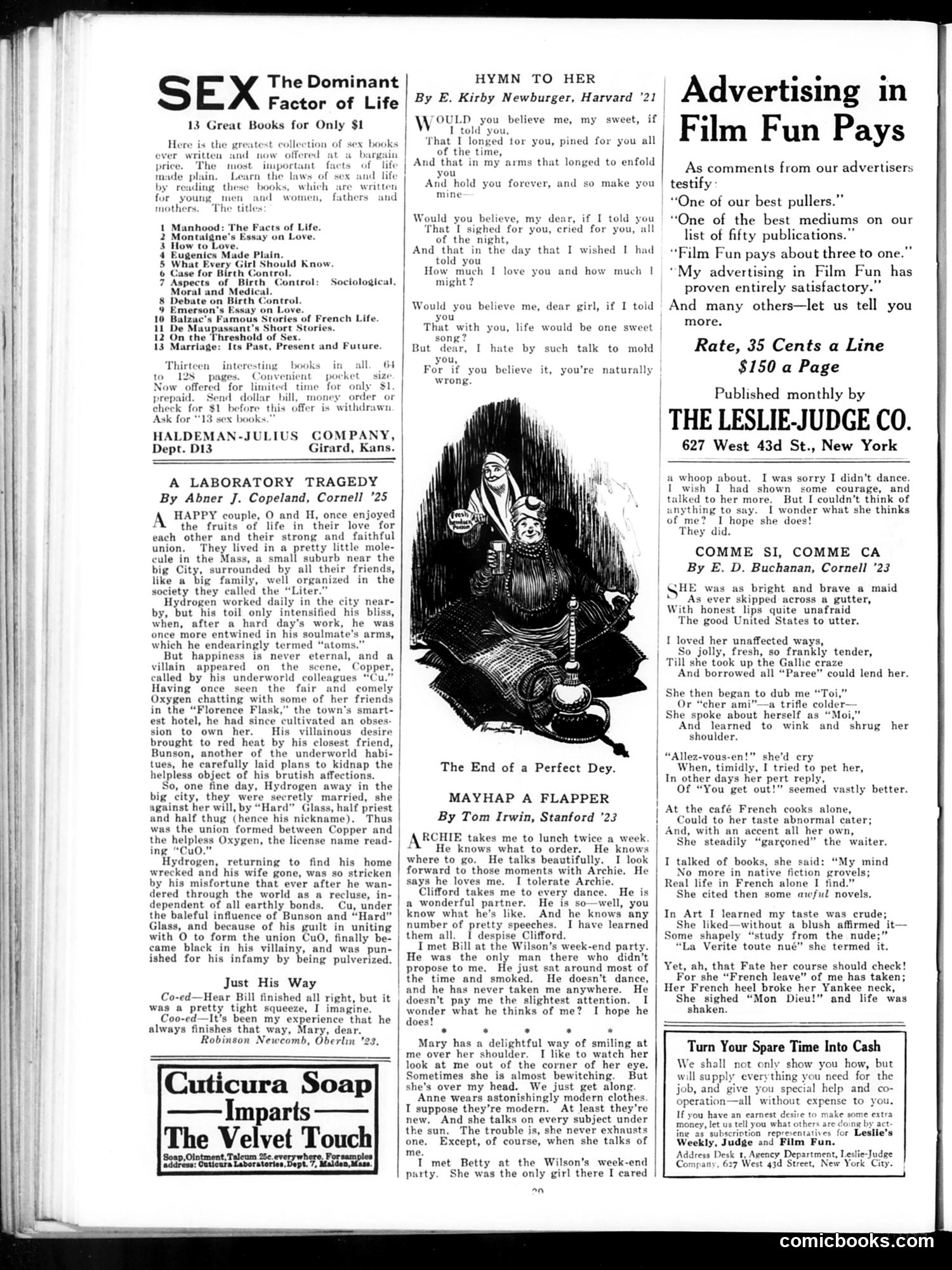
This page from *Judge* magazine contains primarily **literary and advertising content** rather than political satire or editorial cartoons. The main content includes: **Literary pieces:** A poem "Hymn to Her" (sentimental love verse), a humorous story "A Laboratory Tragedy" (using chemistry terminology as metaphor—Hydrogen and Oxygen's failed marriage disrupted by Copper), and several shorter comic pieces about college life. **The central illustration** depicts a figure in hooded/religious garb with dramatic expressionistic shading, captioned "The End of a Perfect Day"—appearing to illustrate one of the stories rather than serve as independent political satire. **Heavy advertising focus:** Multiple ads for sex education books (Haldeman-Julius Company), Cuticura Soap, and employment opportunities dominate the page. The content reflects 1920s collegiate humor and attitudes toward sexuality, romance, and gender. There is **no identifiable political cartoon or satirical commentary** on this particular page—it functions primarily as a literary/advertising section rather than editorial commentary.
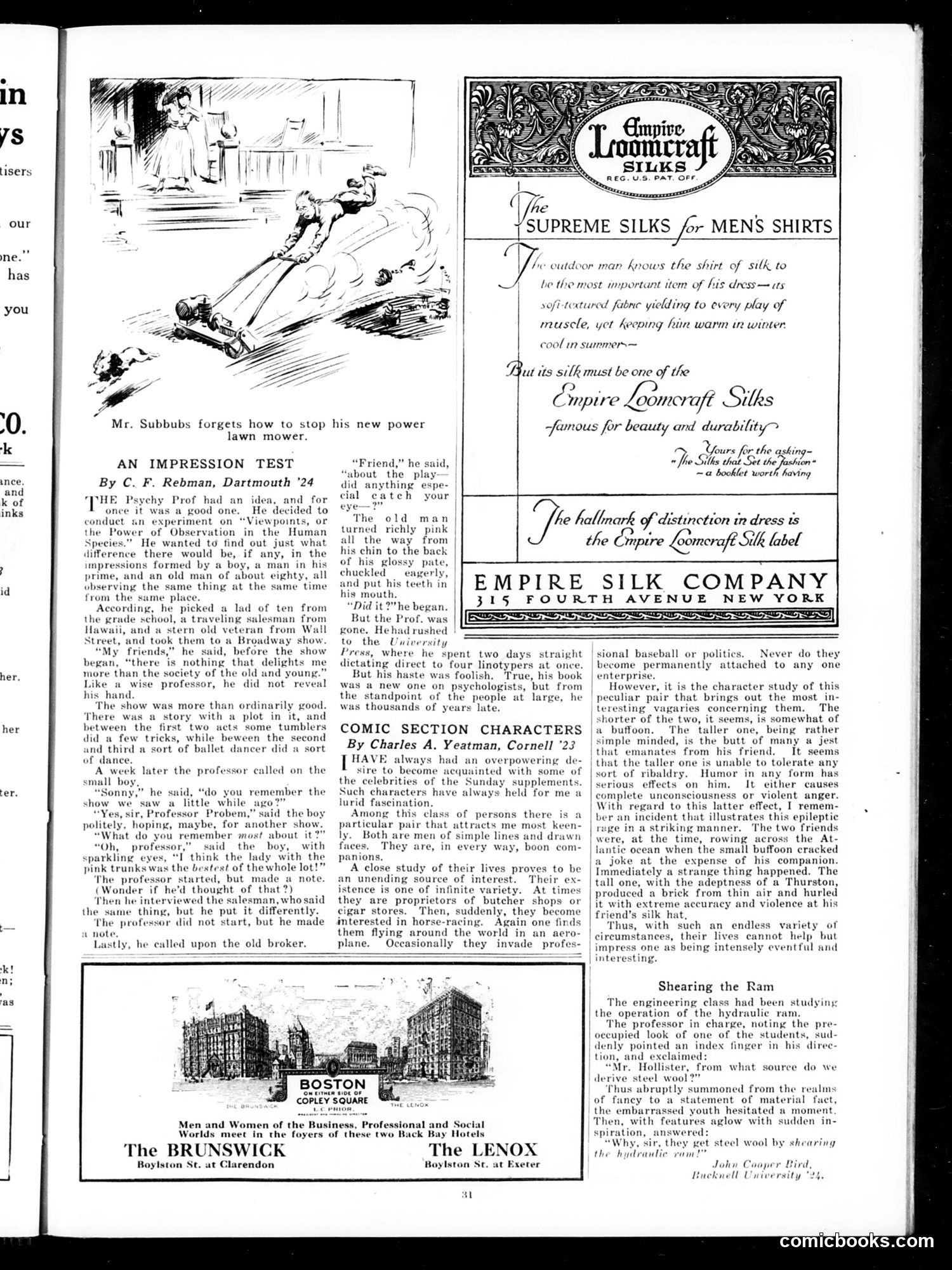
This page combines a short humorous story with advertisements. The main cartoon, titled "An Impression Test," satirizes academic psychology experiments. A professor conducts a study comparing how a schoolboy, a businessman, and an elderly veteran perceive the same Broadway show. The joke is that the professor never reveals his actual findings—instead, he rushes off to publish a book about psychology, apparently having forgotten his own experiment entirely. The satire mocks both pretentious academic research (conducting elaborate studies without meaningful conclusions) and the publishing industry's haste to capitalize on trendy subjects. The story's punchline suggests the professor's book is already outdated before publication. The page also includes advertisements for Empire Loomcraft Silks and Boston hotels, with a separate "Comic Section Characters" feature discussing character types in comics.
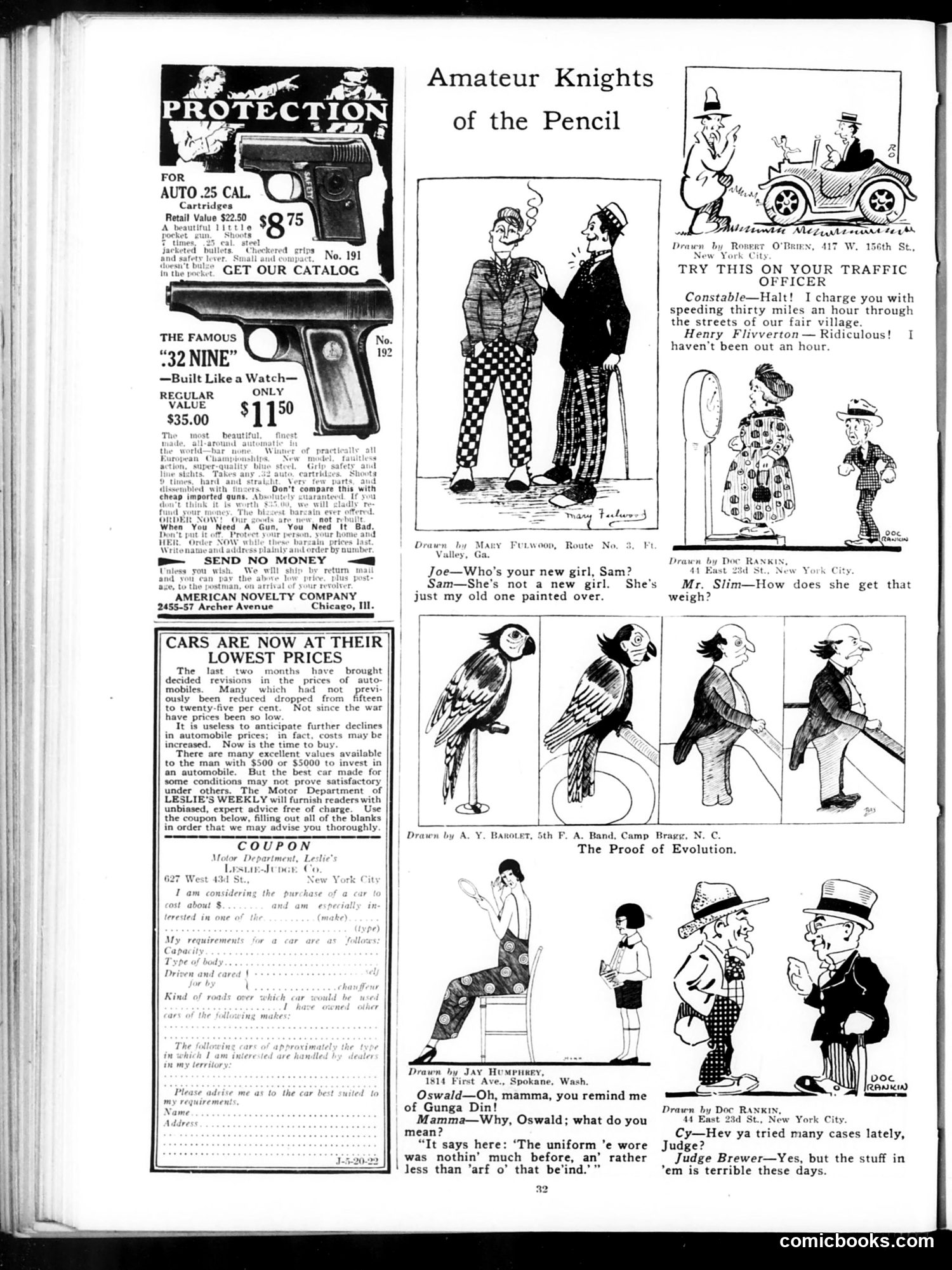
This page mixes advertisements with humorous cartoons typical of 1920s Judge magazine. **The cartoons satirize:** 1. **"Amateur Knights of the Pencil"**: A collection of sight gags about dating and automobiles. One joke mocks superficial relationships—a man's "new girl" is just his old girlfriend with fresh makeup. Another targets traffic enforcement absurdity: a speeder claims innocence because he "hasn't been out an hour" (implying impossible speed). 2. **"The Proof of Evolution"**: A four-panel visual gag showing birds progressively transforming into humans, satirizing Darwinian evolution theory—still controversial in the 1920s. 3. **The Oswald/Mamma joke**: References Kipling's "Gunga Din" poem, where the speaker criticizes the title character's uniform being shabby and poorly-fitted ("nothin' much before...less than 'arf o' that be'ind"). The humor relies on readers knowing this literary reference. The ads (firearms, automobiles, novelty items) suggest the magazine's male-oriented readership and 1920s consumer culture context.
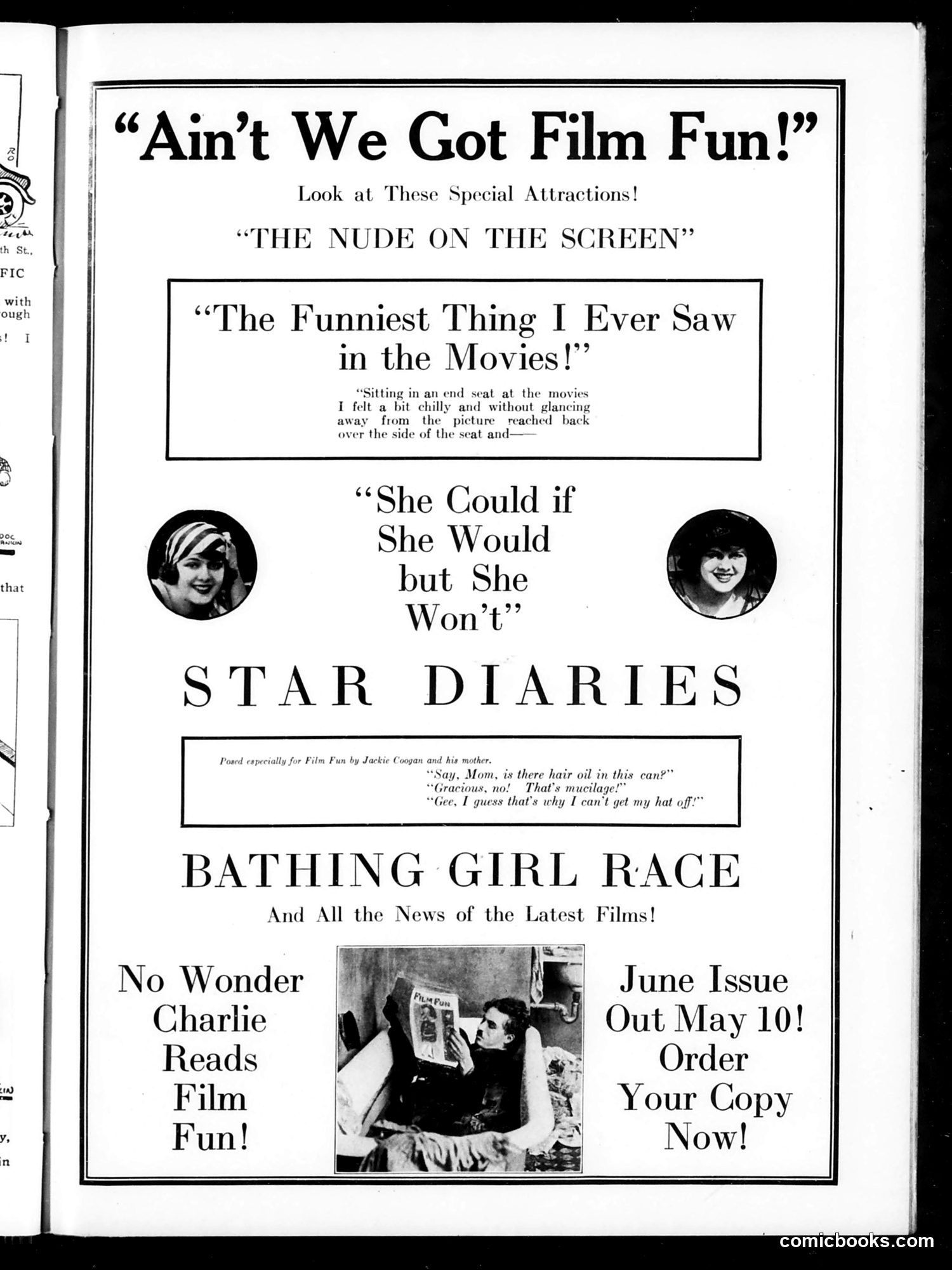
This is primarily a **house advertisement** for *Film Fun*, a companion publication to Judge magazine, rather than satirical content. It promotes *Film Fun's* May 10 issue through playful, suggestive titles of fictional film features. The advertised attractions—"The Nude on the Screen," "She Could if She Would but She Won't," and "Bathing Girl Race"—reflect early 1920s entertainment's focus on cheesecake imagery and mild sexual innuendo. These titles suggest the comedic appeal centered on attractive women and bathing costumes, popular in silent-era short films. The reference to "Charlie" likely means Charlie Chaplin, whose celebrity made film magazines themselves popular reading material. The page capitalizes on early cinema's novelty as entertainment and the commercial appeal of film-related periodicals during Hollywood's nascent era.
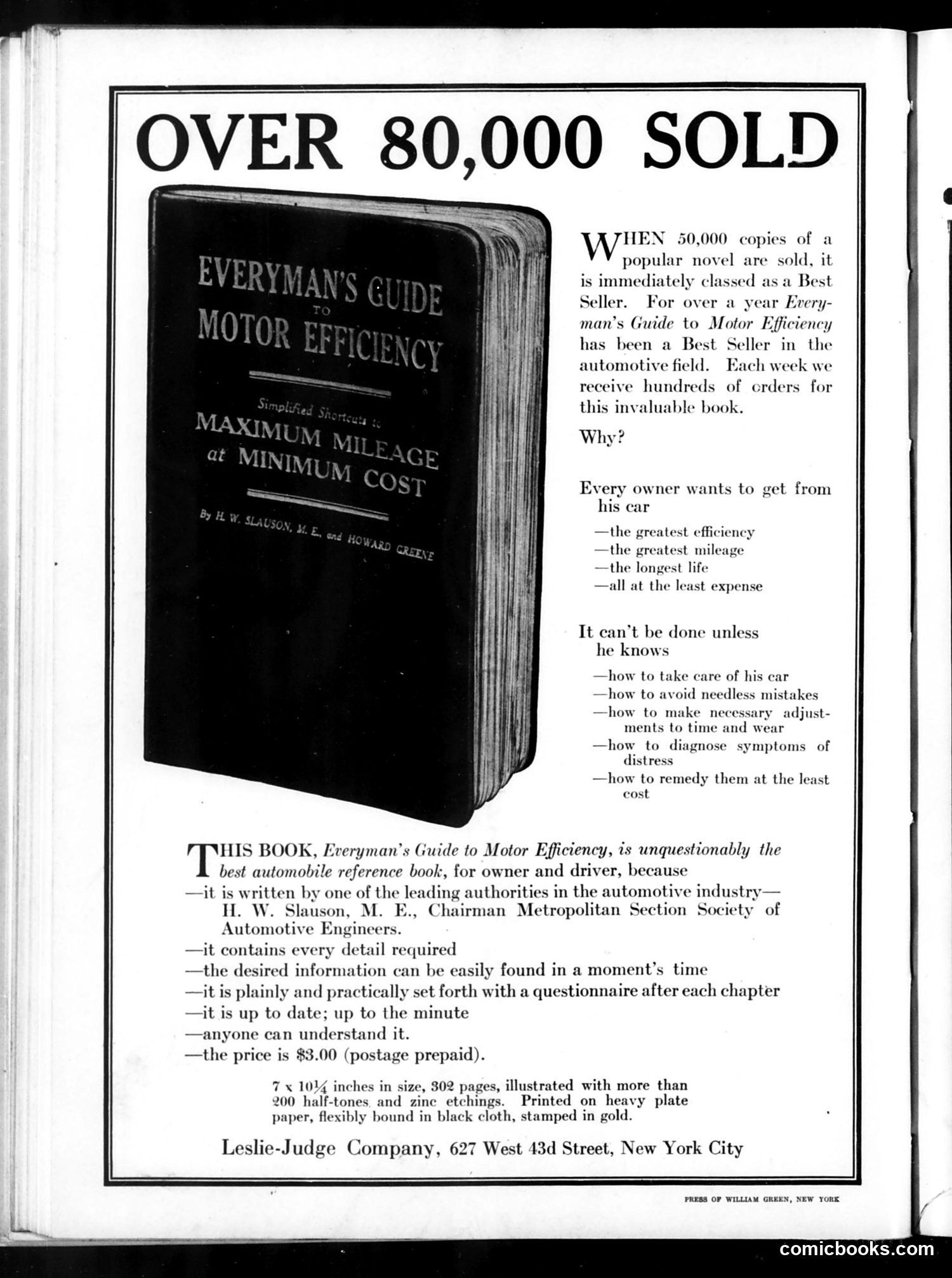
This page is **not a cartoon or satire**, but rather a **full-page advertisement** for "Everyman's Guide to Motor Efficiency," a practical automotive manual by H.W. Slauson. The ad uses marketing language common to the era, claiming the book has sold over 80,000 copies and achieved "Best Seller" status. It appeals to car owners' desires for efficiency, fuel economy, and cost savings—concerns that were clearly significant to early 20th-century automobile owners managing expensive vehicles. The format and claims are straightforward advertising: the book teaches car maintenance, diagnosis, and repair to minimize expenses. At $3.00 (postage prepaid), it was positioned as an accessible reference guide for any car owner to understand their vehicle. There is **no political content, satire, or caricature** on this page. It simply demonstrates how Judge magazine's publishers used the publication to sell related products to their automotive-interested readership.