
Judge, 1922-05-20 · page 10 of 36
Judge — May 20, 1922 — page 10: what you’re looking at
What you’re looking at
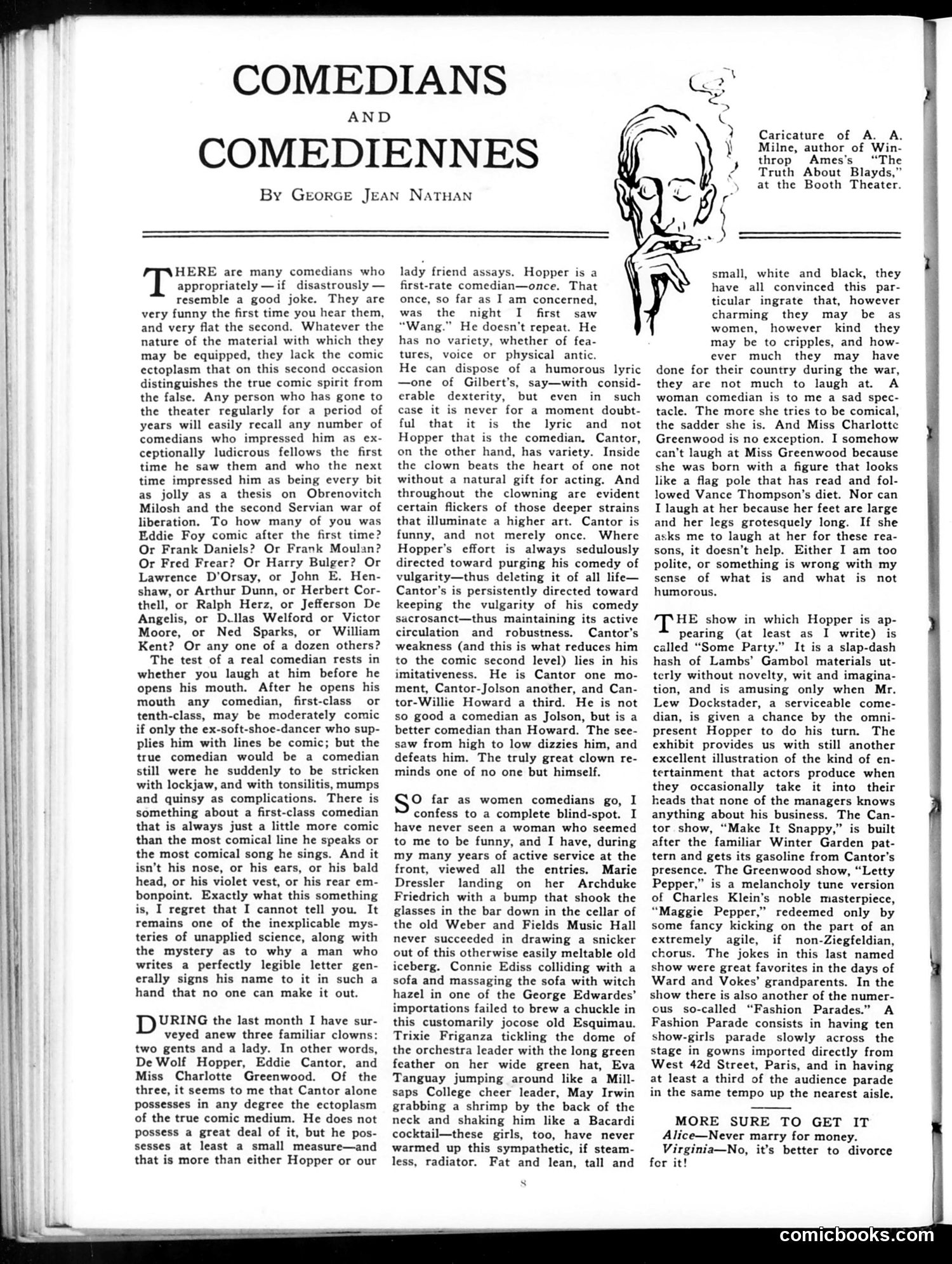
This is a theater criticism essay evaluating popular stage comedians of the era. Nathan argues that true comedic talent is intrinsic—a performer should be funny even in silence, not reliant on scripts or songs. **The figures discussed** include De Wolf Hopper (criticized as a one-hit wonder after his show "Wang"), Eddie Cantor (praised for genuine comedic instinct and willingness to embrace vulgarity), and Charlotte Greenwood (dismissed as unfunny). Nathan also catalogs other comedians—Frank Daniels, Harry Bulger, Victor Moore, and others—asking if audiences found them funny only once. **The satire's point**: Nathan mocks comedians who depend entirely on material rather than possessing inherent stage presence. The caricature at top right appears to be A.A. Milne, another theater figure. For modern readers: this reflects early 20th-century live theater criticism, when comedians performed repeatedly and audiences could judge whether their appeal was durable or novelty-based.
📄 Transcribed text from this page (OCR, searchable)
Machine-transcribed from the original scan — historical spelling and the odd misread are preserved.
COMEDIANS AND COMEDIENNES By GeorGe JEAN NATHAN appropriately —if disastrously — resemble a good joke. They are very funny the first time you hear them, and very flat the second. Whatever the nature of the material with which they may be equipped, they lack the comic ectoplasm that on this second occasion distinguishes the true comic spirit from the false. Any person who has gone to the theater regularly for a period of years will easily recall any number of comedians who impressed him as ex- ceptionally ludicrous fellows the first time he saw them and who the next time impressed him as being every bit as jolly as a thesis on Obrenovitch Milosh and the second Servian war of liberation. To how many of you was Eddie Foy comic after the first time? Or Frank Daniels? Or Frank Moulan? Or Fred Frear? Or Harry Bulger? Or Lawrence D'Orsay, or John E. Hen- shaw, or Arthur Dunn, or Herbert Cor- thell, or Ralph Herz, or Jefferson De Angelis, or D.llas Welford or Victor Moore, or Ned Sparks, or William Kent? Or any one of a dozen others? The test of a real comedian rests in whether you laugh at him before he opens his mouth. After he opens his mouth any comedian, first-class or tenth-class, may be moderately comic if only the ex-soft-shoe-dancer who sup- plies him with lines be comic; but the true comedian would be a comedian still were he suddenly to be stricken with lockjaw, and with tonsilitis, mumps and quinsy as complications. There is something about a first-class comedian that is always just a little more comic than the most comical line he speaks or the most comical song he sings. And it isn’t his nose, or his ears, or his bald head, or his violet vest, or his rear em- bonpoint. Exactly what this something is, I regret that I cannot tell you. It remains one of the inexplicable mys- teries of unapplied science, along with the mystery as to why a man who writes a perfectly legible letter gen- erally signs his name to it in such a hand that no one can make it out. 6 igen are many comedians who URING the last month I have sur- veyed anew three familiar clowns: two gents and a lady. In other words, De Wolf Hopper, Eddie Cantor, and Miss Charlotte Greenwood. Of the three, it seems to me that Cantor alone possesses in any degree the ectoplasm of the true comic medium. He does not possess a great deal of it, but he pos- sesses at least a small measure—and that is more than either Hopper or our lady friend assays. Hopper is a first-rate comedian—once. That once, so far as I am concerned, was the night I first saw “Wang.” He doesn't repeat. He has no variety, whether of fea- tures, voice or physical antic. He can dispose of a humorous lyric —one of Gilbert's, say—with consid- erable dexterity, but even in such case it is never for a moment doubt- ful that it is the lyric and not Hopper that is the comedian. Cantor, on the other hand, has variety. Inside the clown beats the heart of one not without a natural gift for acting. And throughout the clowning are evident certain flickers of those deeper strains that illuminate a higher art. Cantor is funny, and not merely once. Where Hopper’s effort is always sedulously directed toward purging his comedy of vulgarity—thus deleting it of all life— Cantor's is persistently directed toward keeping the vulgarity of his comedy sacrosanct—thus maintaining its active circulation and robustness. Cantor's weakness (and this is what reduces him to the comic second level) lies in his imitativeness. He is Cantor one mo- ment, Cantor-Jolson another, and Can- tor-Willie Howard a third. He is not so good a comedian as Jolson, but is a better comedian than Howard. The see- saw from high to low dizzies him, and defeats him. The truly great clown re- minds one of no one but himself. se far as women comedians go, I confess to a complete blind-spot. I have never seen a woman who seemed to me to be funny, and I have, during my many years of active service at the front, viewed all the entries. Marie Dressler landing on her Archduke Friedrich with a bump that shook the glasses in the bar down in the cellar of the old Weber and Fields Music Hall never succeeded in drawing a snicker out of this otherwise easily meltable old iceberg. Connie Ediss colliding with a sofa and massaging the sofa with witch hazel in one of the George Edwardes’ importations failed to brew a chuckle in this customarily jocose old Esquimau. Trixie Friganza tickling the dome of the orchestra leader with the long green feather on her wide green hat, Eva Tanguay jumping around like a Mill- saps College cheer leader, May Irwin grabbing a shrimp by the back of the neck and shaking him like a Bacardi cocktail—these girls, too, have never warmed up this sympathetic, if steam- less, radiator. Fat and lean, tall and Caricature of A. A. Milne, author of Win- throp Ames’s “The Truth About Blayds,” at the Booth Theater. small, white and black, they have all convinced this par- ticular ingrate that, however charming they may be as women, however kind they may be to cripples, and how- ever much they may _ have done for their country during the war, they are not much to laugh at. A woman comedian is to me a sad spec- tacle. The more she tries to be comical, the sadder she is. And Miss Charlotte Greenwood is no exception. I somehow can’t laugh at Miss Greenwood because she was born with a figure that looks like a flag pole that has read and fol- lowed Vance Thompson's diet. Nor can I laugh at her because her feet are large and her legs grotesquely long. If she asks me to laugh at her for these rea- sons, it doesn’t help. Either I am too polite, or something is wrong with my sense of what is and what is not humorous. HE show in which Hopper is ap- pearing (at least as I write) is called “Some Party.” It is a slap-dash hash of Lambs’ Gambol materials ut- terly without novelty, wit and imagina- tion, and is amusing only when Mr. Lew Dockstader, a serviceable come- dian, is given a chance by the omni- present Hopper to do his turn. The exhibit provides us with still another excellent illustration of the kind of en- tertainment that actors produce when they occasionally take it into their heads that none of the managers knows anything about his business. The Can- tor show, “Make It Snappy,” is built after the familiar Winter Garden pat- tern and gets its gasoline from Cantor's presence. The Greenwood show, “Letty Pepper,” is a melancholy tune version of Charles Klein’s noble masterpiece, “Maggie Pepper,” redeemed only by some fancy kicking on the part of an extremely agile, if non-Ziegfeldian, chorus. The jokes in this last named show were great favorites in the days of Ward and Vokes’ grandparents. In the show there is also another of the numer- ous so-called “Fashion Parades.” A Fashion Parade consists in having ten show-girls parade slowly across the stage in gowns imported directly from West 42d Street, Paris, and in having at least a third of the audience parade in the same tempo up the nearest aisle. MORE SURE TO GET IT Alice—Never marry for money. Virginia—No, it’s better to divorce for it! comicbooks.com