
Judge, 1922-05-20 · page 25 of 36
Judge — May 20, 1922 — page 25: what you’re looking at
What you’re looking at
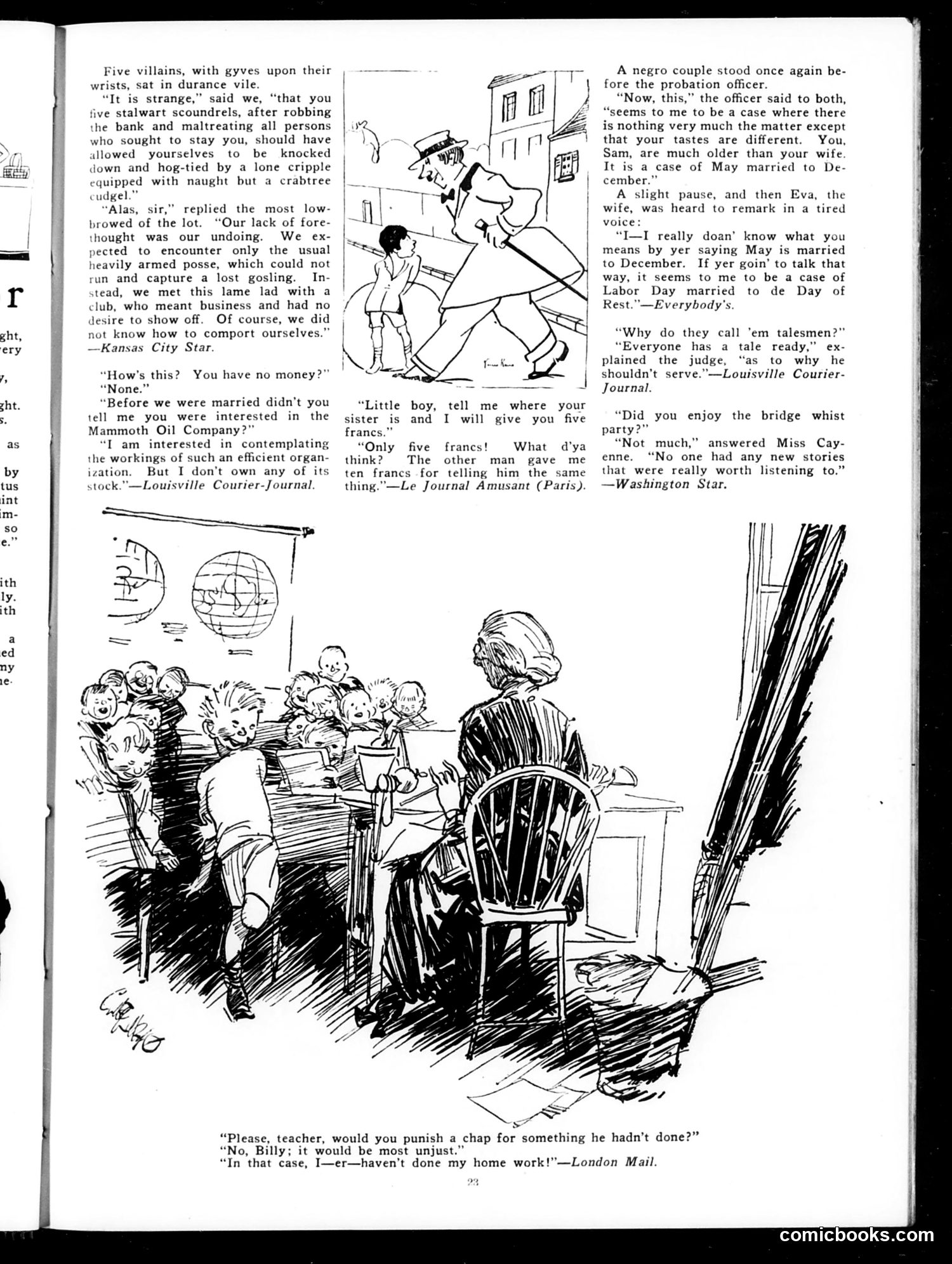
This page collects six brief satirical anecdotes typical of early 20th-century American humor magazines: 1. **The cripple outsmarts criminals**: Five armed bank robbers are defeated by a single disabled man with a club because they expected armed resistance, not genuine determination. 2. **Oil stock husband**: A man claims interest in Mammoth Oil Company but owns no stock—satirizing empty financial boasting. 3. **Child's bribery**: A boy negotiates with a stranger offering francs for his sister's location, implying he previously accepted payment for the same information. 4. **Teacher's logic trap**: A student exploits the teacher's principle against unjust punishment by claiming he hasn't done homework. 5. **Racial couple's marital discord**: Uses a "May-December marriage" metaphor; the wife reframes it as "Labor Day to Day of Rest"—suggesting exhaustion from overwork. 6. **Jury duty excuse**: Men claim they have reasons to avoid jury service because everyone tells convenient stories. The humor relies on wordplay, logical paradoxes, and social observation rather than visual comedy. The racial anecdote reflects period attitudes but centers marital inequality.
📄 Transcribed text from this page (OCR, searchable)
Machine-transcribed from the original scan — historical spelling and the odd misread are preserved.
ght, ery ry ght. ith ly. ith Five villains, with gyves upon their wrists, sat in durance vile. “It is strange,” said we, “that you five stalwart scoundrels, after robbing the bank and maltreating all persons who sought to stay you, should have allowed yourselves to be knocked down and hog-tied by a lone cripple equipped with naught but a crabtree cudgel.” ‘Alas, sir,” replied the most low- browed of the lot. “Our lack of fore- thought was our undoing. We ex- pected to encounter only the usual heavily armed posse, which could not run and capture a lost gosling. In- tead, we met this lame lad with a club, who meant business and had no desire to show off. Of course, we did not know how to comport ourselves.” —Kansas City Star. “How's this? You have no money?” “None.” “Before we were married didn’t you tell me you were interested in the Mammoth Oil Company?” “I am interested in contemplating the workings of such an efficient organ- ization. But I don’t own any of its stock."—Louisville Courier-Journal. where your “Little boy, tell me sister is and I will give you five francs.” “Only five francs! What d'ya think? The other man gave me ten francs for telling him the same thing.”"—Le Journal Amusant (Paris). “Please, teacher, would you punish a chap for something he hadn’t done?” “No, Billy; it would be most unjust.” “In that case, I—er—haven’t done my home work!”—London Mail. A negro couple stood once again be- fore the probation officer. “Now, this,” the officer said to both, “seems to me to be a case where there is nothing very much the matter except that your tastes are different. You, Sam, are much older than your wife It is a case of May married to De- cember.” A slight pause, and then Eva, the wife, was heard to remark in a tired voice: “I—I really doan’ know what you means by yer saying May is married to December. If yer goin’ to talk that way, it seems to me to be a case of Labor Day married to de Day of Rest." —Everybody’'s “Why do they call ‘em talesmen?” “Everyone has a tale ready,” ex- plained the judge, “as to why he shouldn't serve.”—Louisville Courier- Journal. “Did you party?” “Not enne. that were really worth listening to. —Washington Star. enjoy the bridge whist much,” answered Miss Cay- “No one had any new stories comicbooks.com