
Judge, 1922-05-20 · page 26 of 36
Judge — May 20, 1922 — page 26: what you’re looking at
What you’re looking at
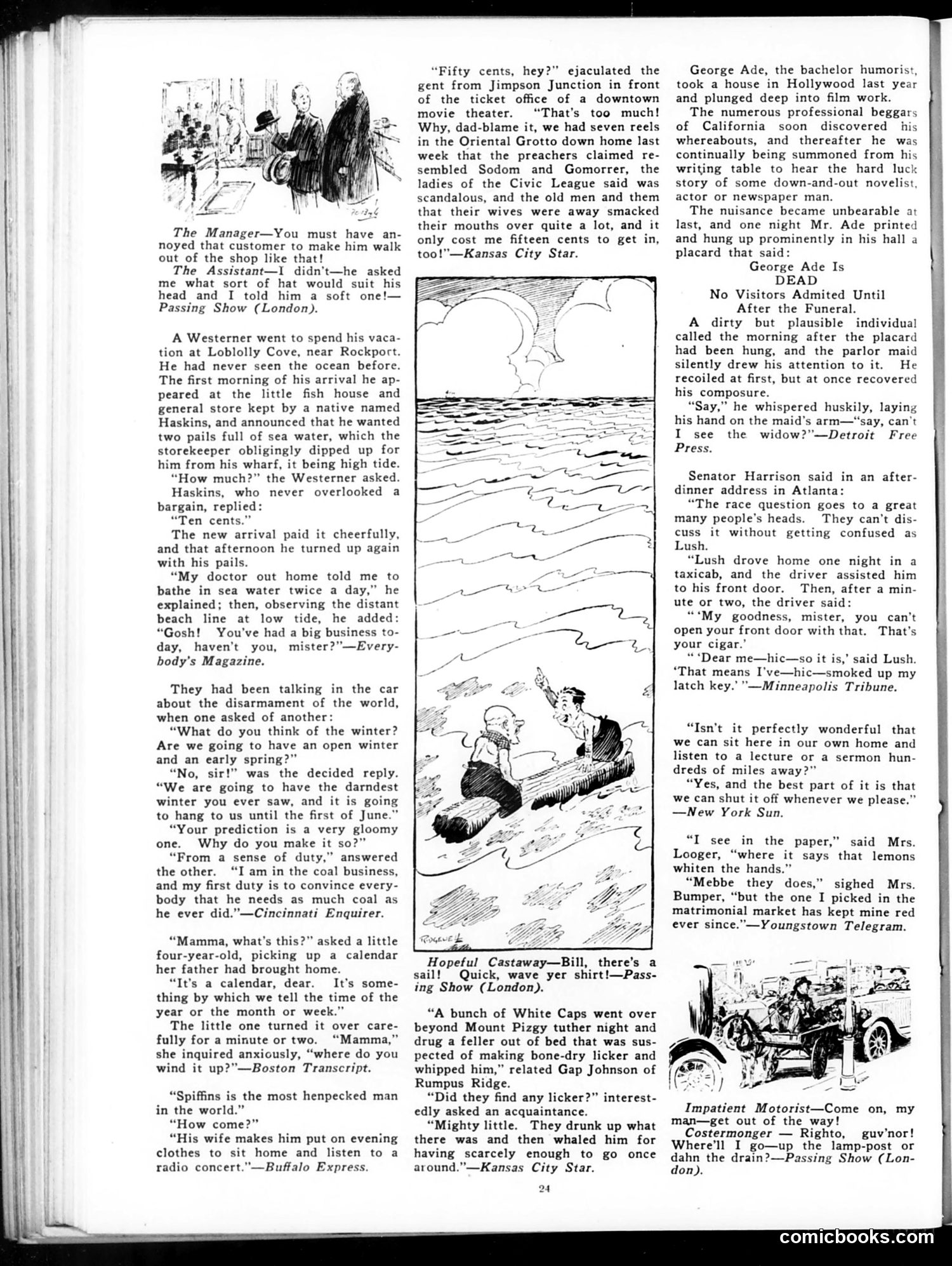
This page contains several brief humorous anecdotes typical of Judge magazine's satirical humor, targeting early 20th-century American foibles: **The shop assistant joke** mocks rudeness disguised as honesty—telling a customer his head needs a "soft" hat. **The sea-water story** satirizes rural merchants' opportunism and city folk's naïveté, depicting a Westerner paying for ocean water he could obtain free. **The coal-dealer anecdote** uses dark humor about business ethics during apparent disarmament discussions—a coal merchant cynically admits he manipulates people into buying excess fuel for profit. **The calendar joke** gently mocks a child's confusion between mechanical and informational devices. **The radio joke** satirizes marital dynamics and the novelty of radio entertainment requiring formal dress at home. **The movie ticket complaint** contrasts small-town morality with urban entertainment pricing, referencing scandalous nickelodeon content. The page reflects 1920s-30s anxieties: urbanization, new technology, changing morality, and economic opportunism.
📄 Transcribed text from this page (OCR, searchable)
Machine-transcribed from the original scan — historical spelling and the odd misread are preserved.
The Manager—You must have an- noyed that customer to make him walk out of the shop like that! The Assistant—I didn’t—he asked me what sort of hat would suit his head and I told him a soft one!— Passing Show (London). A Westerner went to spend his vaca- tion at Loblolly Cove, near Rockport. He had never seen the ocean before. The first morning of his arrival he ap- peared at the little fish house and general store kept by a native named Haskins, and announced that he wanted two pails full of sea water, which the storekeeper obligingly dipped up for him from his wharf, it being high tide. “How much?” the Westerner asked. Haskins, who never overlooked a bargain, replied: “Ten cents.” The new arrival paid it cheerfully, and that afternoon he turned up again with his pails. “My doctor out home told me to bathe in sea water twice a day,” he explained; then, observing the distant beach line at low tide, he added: “Gosh! You've had a big business to- day, haven't you, mister?”—Every- body’s Magazine. They had been talking in the car about the disarmament of the world, when one asked of another: “What do you think of the winter? Are we going to have an open winter and an early spring?” “No, sir!” was the decided reply. “We are going to have the darndest winter you ever saw, and it is going to hang to us until the first of June.” “Your prediction is a very gloomy one. Why do you make it so?” “From a sense of duty,” answered the other. “I am in the coal business, and my first duty is to convince every- body that he needs as much coal as he ever did.”—Cincinnati Enquirer. “Mamma, what's this?” asked a little four-year-old, picking up a calendar her father had brought home. “It's a calendar, dear. It’s some- thing by which we tell the time of the year or the month or week.” The little one turned it over care- fully for a minute or two. “Mamma,” she inquired anxiously, “where do you wind it up?”—Boston Transcript. “Spiffins is the most henpecked man in the world.” “How come?” “His wife makes him put on evening clothes to sit home and listen to a radio concert."—Buffalo Express. “Fifty cents, hey?” ejaculated the gent from Jimpson Junction in front of the ticket office of a downtown movie theater. “That's too much! Why, dad-blame it, we had seven reels in the Oriental Grotto down home last week that the preachers claimed re- sembled Sodom and Gomorrer, the ladies of the Civic League said was scandalous, and the old men and them that their wives were away smacked their mouths over quite a lot, and it only cost me fifteen cents to get in, too!"—Kansas City Star. Hopeful Castaway—Bill, there’s a sail! Quick, wave yer shirt!—Pass- ing Show (London). “A bunch of White Caps went over beyond Mount Pizgy tuther night and drug a feller out of bed that was sus- pected of making bone-dry licker and whipped him,” related Gap Johnson of Rumpus Ridge. “Did they find any licker?” interest- edly asked an acquaintance. “Mighty little. They drunk up what there was and then whaled him for having scarcely enough to go once around.”—Kansas City Star. 24 George Ade, the bachelor humorist, took a house in Hollywood last year and plunged deep into film work. The numerous professional beggars of California soon discovered his whereabouts, and thereafter he was continually being summoned from his writing table to hear the hard luck story of some down-and-out novelist, actor or newspaper man. The nuisance became unbearable at last, and one night Mr. Ade printed and hung up prominently in his hall a placard that said: George Ade Is DEAD No Visitors Admited Until After the Funeral. A dirty but plausible individual called the morning after the placard had been hung, and the parlor maid silently drew his attention to it. He recoiled at first, but at once recovered his composure. “Say,” he whispered huskily, laying his hand on the maid’s arm—“say, can't I see the widow?”—Detroit Free Press. Senator Harrison said in an after- dinner address in Atlanta: “The race question goes to a great many people's heads. They can’t dis- cuss it without getting confused as Lush. “Lush drove home one night in a taxicab, and the driver assisted him to his front door. Then, after a min- ute or two, the driver said: ““My goodness, mister, you can’t open your front door with that. That's your cigar.’ “Dear me—hic—so it is,’ said Lush. ‘That means I've—hic—smoked up my latch key.’ ""—Minneapolis Tribune. “Isn't it perfectly wonderful that we can sit here in our own home and listen to a lecture or a sermon hun- dreds of miles away?” “Yes, and the best part of it is that we can shut it off whenever we please.” —New York Sun. “I see in the paper,” said Mrs. Looger, “where it says that lemons whiten the hands.” “Mebbe they does,” sighed Mrs. Bumper, “but the one I picked in the matrimonial market has kept mine red ever since."—Youngstown Telegram. Impatient Motorist—Come on, my man—get out of the way! Costermonger — Righto, guv’nor! Where’ll I go—up the lamp-post or dahn the drain?—Passing Show (Lon- don). comicbooks.com