
Judge, 1922-05-20 · page 16 of 36
Judge — May 20, 1922 — page 16: what you’re looking at
What you’re looking at
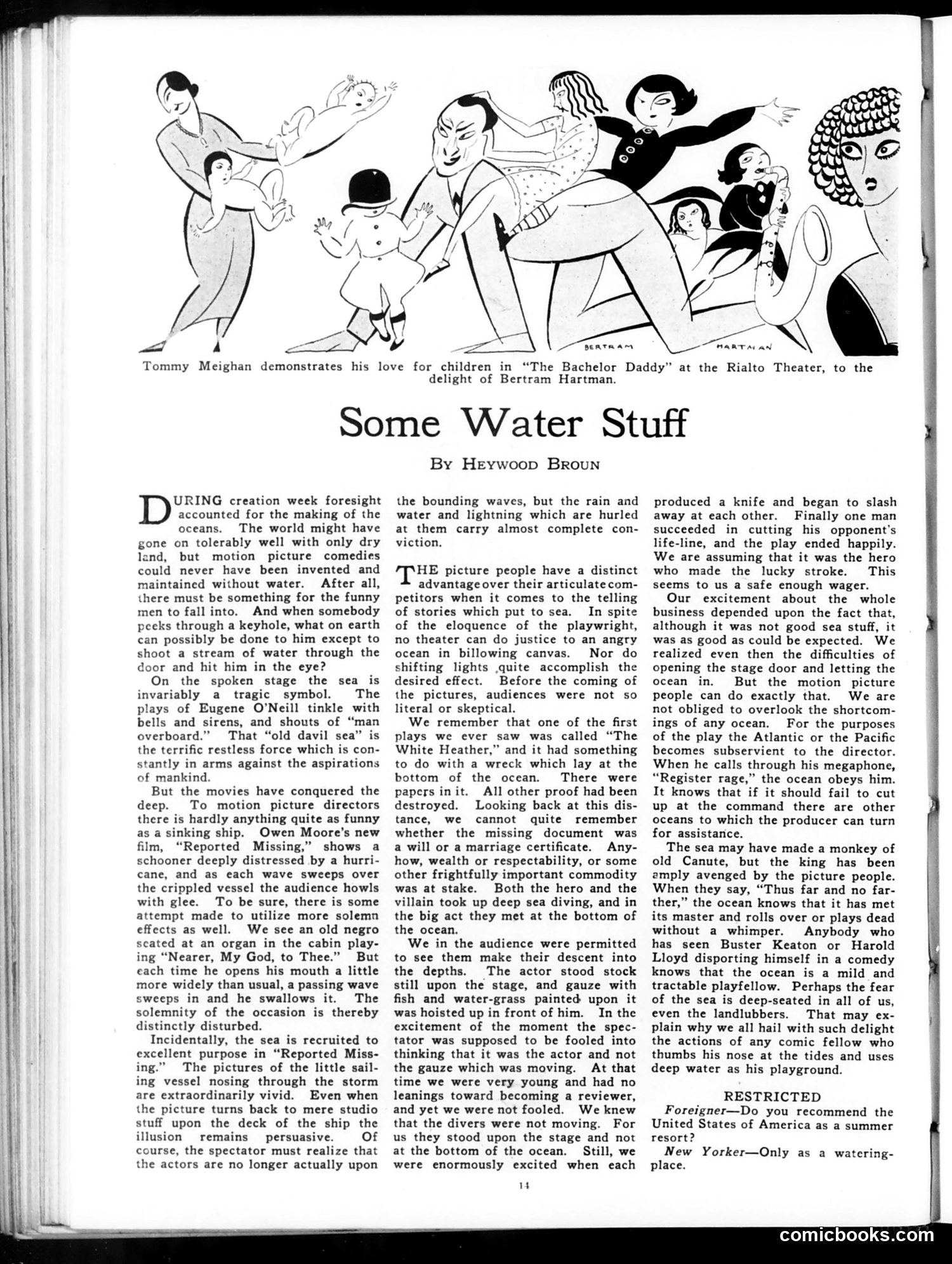
This is a film criticism piece by Heywood Broun (a prominent American journalist) comparing how theater and cinema depict the ocean. The accompanying illustration shows Tommy Meighan, a silent film star, in the comedy "The Bachelor Daddy" at the Rialto Theater. Broun's satire contrasts theatrical traditions—where the sea symbolizes tragedy (referencing Eugene O'Neill's serious dramas)—with cinema's comedic use of water. He mocks how movies treat drowning and shipwrecks as slapstick comedy material, noting audiences laugh as characters swallow waves or sink. The critique highlights cinema's technical advantage: convincing water effects (rain, lighting) create authentic ocean illusions that stage productions cannot achieve with painted gauze and stationary actors. Broun illustrates this with a memory of unconvincing stage diving scenes where audiences could plainly see actors weren't actually moving. The satire suggests movies have "conquered" the ocean by trivializing it—transforming O'Neill's symbol of human struggle into mere comedic prop.
📄 Transcribed text from this page (OCR, searchable)
Machine-transcribed from the original scan — historical spelling and the odd misread are preserved.
——— Tommy Meighan demonstrates his love for children in delight of Bertram Hartman. “The Bachelor Daddy” at the Rialto Theater, to the Some Water Stuff URING creation week foresight accounted for the making of the oceans. The world might have gone on tolerably well with only dry land, but motion picture comedies could never have been invented and maintained without water. After all, there must be something for the funny men to fall into. And when somebody peeks through a keyhole, what on earth can possibly be done to him except to shoot a stream of water through the door and hit him in the eye? On the spoken stage the sea is invariably a tragic symbol. The plays of Eugene O'Neill tinkle with bells and sirens, and shouts of “man overboard.” That “old davil sea” is the terrific restless force which is con- stantly in arms against the aspirations of mankind. But the movies have conquered the deep. To motion picture directors there is hardly anything quite as funny as a sinking ship. Owen Moore’s new film, “Reported Missing,” shows a schooner deeply distressed by a hurri- cane, and as each wave sweeps over the crippled vessel the audience howls with glee. To be sure, there is some attempt made to utilize more solemn effects as well. We see an old negro seated at an organ in the cabin play- ing “Nearer, My God, to Thee.” But each time he opens his mouth a little more widely than usual, a passing wave sweeps in and he swallows it. The solemnity of the occasion is thereby distinctly disturbed. Incidentally, the sea is recruited to excellent purpose in “Reported Miss- ing.” The pictures of the little sail- ing vessel nosing through the storm are extraordinarily vivid. Even when the picture turns back to mere studio stuff upon the deck of the ship the illusion remains persuasive. Of course, the spectator must realize that the actors are no longer actually upon By Heywoop Broun the bounding waves, but the rain and water and lightning which are hurled at them carry almost complete con- viction. ASHE picture people have a distinct advantage over their articulatecom- petitors when it comes to the telling of stories which put to sea. In spite of the eloquence of the playwright, no theater can do justice to an angry ocean in billowing canvas. Nor do shifting lights quite accomplish the desired effect. Before the coming of the pictures, audiences were not so literal or skeptical. We remember that one of the first plays we ever saw was called “The White Heather,” and it had something to do with a wreck which lay at the bottom of the ocean. There were papers init. All other proof had been destroyed. Looking back at this dis- tance, we cannot quite remember whether the missing document was a will or a marriage certificate. Any- how, wealth or respectability, or some other frightfully important commodity was at stake. Both the hero and the villain took up deep sea diving, and in the big act they met at the bottom of the ocean. We in the audience were permitted to see them make their descent into the depths. The actor stood stock still upon the stage, and gauze with fish and water-grass painted upon it was hoisted up in front of him. In the excitement of the moment the spec- tator was supposed to be fooled into thinking that it was the actor and not the gauze which was moving. At that time we were very young and had no leanings toward becoming a reviewer, and yet we were not fooled. We knew that the divers were not moving. For us they stood upon the stage and not at the bottom of the ocean. Still, we were enormously excited when each 4 produced a knife and began to slash away at each other. Finally one man succeeded in cutting his opponent's life-line, and the play ended happily. We are assuming that it was the hero who made the lucky stroke. This seems to us a safe enough wager. Our excitement about the whole business depended upon the fact that, although it was not good sea stuff, it was as good as could be expected. We realized even then the difficulties of opening the stage door and letting the ocean in. But the motion picture people can do exactly that. We are not obliged to overlook the shortcom- ings of any ocean. For the purposes of the play the Atlantic or the Pacific becomes subservient to the director. When he calls through his megaphone, “Register rage,” the ocean obeys him. It knows that if it should fail to cut up at the command there are other oceans to which the producer can turn for assistance. The sea may have made a monkey of old Canute, but the king has been emply avenged by the picture people. When they say, “Thus far and no far- ther,” the ocean knows that it has met its master and rolls over or plays dead without a whimper. Anybody who has seen Buster Keaton or Harold Lloyd disporting himself in a comedy knows that the ocean is a mild and tractable playfellow. Perhaps the fear of the sea is deep-seated in all of us, even the landlubbers. That may ex- plain why we all hail with such delight the actions of any comic fellow who thumbs his nose at the tides and uses deep water as his playground. RESTRICTED Foreigner—Do you recommend the United States of America as a summer resort? New Yorker—Only as a watering- place. comicbooks.com