
Judge, 1922-05-20 · page 15 of 36
Judge — May 20, 1922 — page 15: what you’re looking at
What you’re looking at
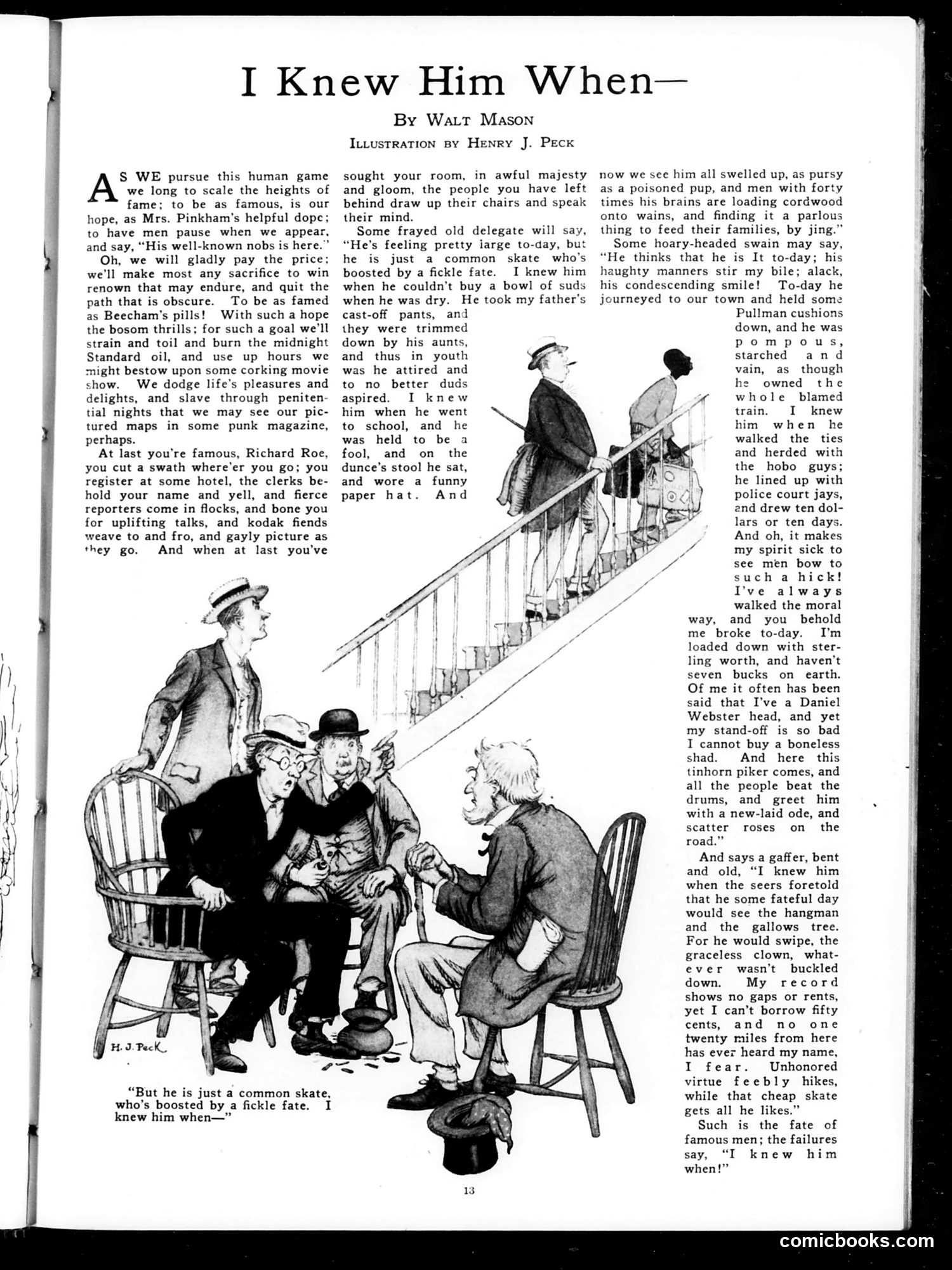
This satirical piece mocks the human obsession with fame and the bitter resentment of the unsuccessful toward the newly famous. The illustration shows a successful man (identified only as "Richard Roe," a generic everyman name) being greeted by admirers at what appears to be a hotel or public venue, while several shabby figures in the background represent his past acquaintances. The satire's point: once someone achieves success, those left behind—the failures and mediocre—invariably claim intimate knowledge of his humble origins, using phrases like "I knew him when" to diminish his accomplishments. Each character recounts embarrassing details (poverty, foolishness, criminality) to convince themselves that his rise was mere luck ("fickle fate"), not merit. Meanwhile, they—virtuous and morally upright—remain broke and forgotten. The piece critiques both social climbing and the mean-spirited envy of those unable to succeed, suggesting that character rarely determines fortune in American society.
📄 Transcribed text from this page (OCR, searchable)
Machine-transcribed from the original scan — historical spelling and the odd misread are preserved.
q S WE pursue this human game 4 A we long to scale the heights of j fame; to be as famous, is our hope, as Mrs. Pinkham’s helpful dope; to have men pause when we appear, and say, “His well-known nobs is here.” Oh, we will gladly pay the price; we'll make most any sacrifice to win renown that may endure, and quit the path that is obscure. To be as famed as Beecham’s pills! With such a hope the bosom thrills; for such a goal we'll strain and toil and burn the midnight Standard oil, and use up hours we might bestow upon some corking movie show. We dodge life's pleasures and delights, and slave through peniten- tial nights that we may see our pic- tured maps in some punk magazine, perhaps. At last you're famous, Richard Roe, you cut a swath where’er you go; you register at some hotel, the clerks be- hold your name and yell, and fierce reporters come in flocks, and bone you for uplifting talks, and kodak fiends weave to and fro, and gayly picture as they go. And when at last you've who's boosted by a fickle fate. knew him when—” “But he is just a common skate, I Knew Him When— By Watt Mason IttustrRaTION BY Henry J. Peck sought your room, in awful majesty and gloom, the people you have left behind draw up their chairs and speak their mind. Some frayed old delegate will say, “He’s feeling pretty iarge to-day, but he is just a common skate who's boosted by a fickle fate. I knew him when he couldn't buy a bowl of suds when he was dry. He took my father's cast-off pants, and they were trimmed down by his aunts, and thus in youth was he attired and to no better duds now we see him all swelled up, as pursy as a poisoned pup, and men with forty times his brains are loading cordwood onto wains, and finding it a parlous thing to feed their families, by jing.” Some hoary-headed swain may say, “He thinks that he is It to-day; his haughty manners stir my bile; alack, his condescending smile! To-day he journeyed to our town and held some Pullman cushions down, and he was pompous, starched and vain, as though aspired. I knew him when he went to school, and he was held to be a fool, and on the dunce’s stool he sat, and wore a funny paper hat. And y Y he owned the } a whole blamed j train. I knew him when he walked the ties and herded with the hobo guys; he lined up with police court jays, and drew ten dol- lars or ten days. And oh, it makes my spirit sick to see men bow to such a hick! I've always walked the moral way, and you behold me broke to-day. I’m loaded down with ster- ling worth, and haven't seven bucks on earth. Of me it often has been said that I’ve a Daniel Webster head, and yet my stand-off is so bad I cannot buy a boneless shad. And here this tinhorn piker comes, and all the people beat the drums, and greet him with a new-laid ode, and scatter roses on the road.” And says a gaffer, bent and old, “I knew him when the seers foretold that he some fateful day would see the hangman and the gallows tree. For he would swipe, the graceless clown, what- ever wasn’t buckled down. My record shows no gaps or rents, yet I can’t borrow fifty cents, and no one twenty miles from here has ever heard my name, I fear. Unhonored virtue feebly hikes, while that cheap skate gets all he likes.” Such is the fate of famous men; the failures say, “I knew him when!” comicbooks.com