
Judge, 1922-05-20 · page 6 of 36
Judge — May 20, 1922 — page 6: what you’re looking at
What you’re looking at
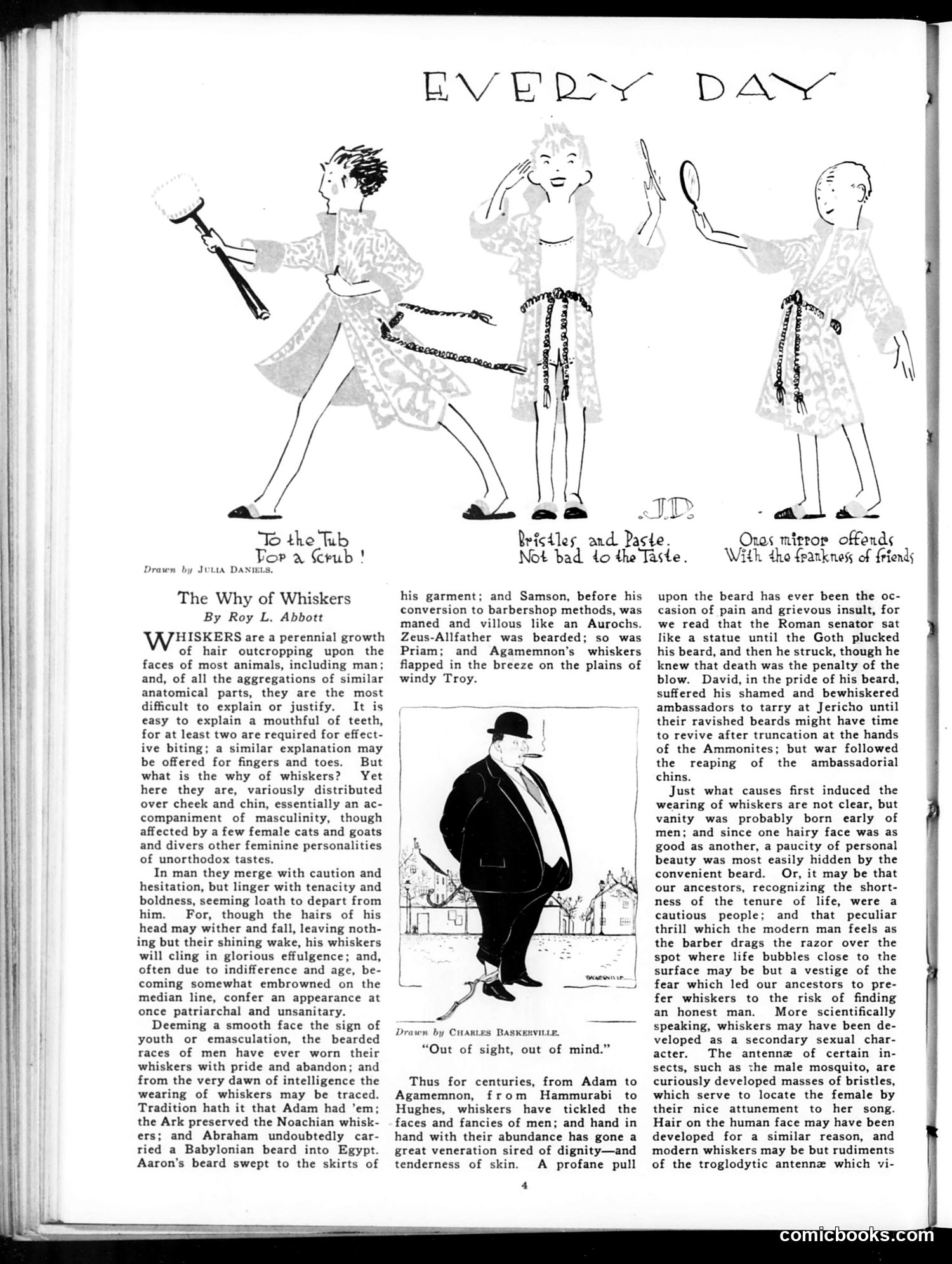
**Top Cartoon: "Everyday"** Three illustrated vignettes by Julia Daniels show women performing domestic tasks—scrubbing, grooming, and housekeeping—depicting routine "women's work." The captions suggest monotonous daily drudgery, mocking the limited scope of women's expected roles. **Main Article: "The Why of Whiskers"** Roy L. Abbott's satirical piece explores men's beards historically and socially. The accompanying illustration by Charles Barkerville shows a well-dressed man in a bowler hat, captioned "Out of sight, out of mind"—likely suggesting beards conceal vanity or masculine insecurity beneath fashionable appearance. The article traces beard-wearing from Biblical times through modern society, humorously suggesting beards reflect both masculine pride and anxieties about aging and appearance.
📄 Transcribed text from this page (OCR, searchable)
Machine-transcribed from the original scan — historical spelling and the odd misread are preserved.
To the Tub Vor a Scrub ! Drawn by JULIA DANIELS. The Why of Whiskers By Roy L. Abbott WHISKERS are a perennial growth of hair outcropping upon the faces of most animals, including man; and, of all the aggregations of similar anatomical parts, they are the most difficult to explain or justify. It is easy to explain a mouthful of teeth, for at least two are required for effect- ive biting; a similar explanation may be offered for fingers and toes. But what is the why of whiskers? Yet here they are, variously distributed over cheek and chin, essentially an ac- companiment of masculinity, though affected by a few female cats and goats and divers other feminine personalities of unorthodox tastes. In man they merge with caution and hesitation, but linger with tenacity and boldness, seeming loath to depart from him. For, though the hairs of his head may wither and fall, leaving noth- ing but their shining wake, his whiskers will cling in glorious effulgence; and, often due to indifference and age, be- coming somewhat embrowned on the median line, confer an appearance at once patriarchal and unsanitary. Deeming a smooth face the sign of youth or emasculation, the bearded races of men have ever worn their whiskers with pride and abandon; and from the very dawn of intelligence the wearing of whiskers may be traced. Tradition hath it that Adam had ’e the Ark preserved the Noachian whisk- ers; and Abraham undoubtedly car- ried a Babylonian beard into Egypt. Aaron’s beard swept to the skirts of BVP Row DAN \ aa. Reisdles and Paste. Not bad 4o the Taste. his garment; and Samson, before his conversion to barbershop methods, was maned and villous like an Aurochs. Zeus-Allfather was bearded; so was Pria: and Agamemnon’s whiskers flapped in the breeze on the plains of windy Troy. Drawn by CHARLES BASKERVILLE. “Out of sight, out of mind.” Thus for centuries, from Adam to Agamemnon, from Hammurabi to Hughes, whiskers have tickled the faces and fancies of men; and hand in hand with their abundance has gone a great veneration sired of dignity—and tenderness of skin. A profane pull 4 Onos mirror offends With the fpankness of {fends upon the beard has ever been the oc- casion of pain and grievous insult, for we read that the Roman senator sat like a statue until the Goth plucked his beard, and then he struck, though he knew that death was the penalty of the blow. David, in the pride of his beard, suffered his shamed and bewhiskered ambassadors to tarry at Jericho until their ravished beards might have time to revive after truncation at the hands of the Ammonites; but war followed the reaping of the ambassadorial chins. Just what causes first induced the wearing of whiskers are not clear, but vanity was probably born early of men; and since one hairy face was as good as another, a paucity of personal beauty was most easily hidden by the convenient beard. Or, it may be that our ancestors, recognizing the short- ness of the tenure of life, were a cautious people; and that peculiar thrill which the modern man feels as the barber drags the razor over the spot where life bubbles close to the surface may be but a vestige of the fear which led our ancestors to pre- fer whiskers to the risk of finding an honest man. More scientifically speaking, whiskers may have been de- veloped as a secondary sexual char- acter. The antenne of certain in- sects, such as the male mosquito, are curiously developed masses of bristles, which serve to locate the female by their nice attunement to her song. Hair on the human face may have been developed for a similar reason, and modern whiskers may be but rudiments of the troglodytic antenne which vi-