
A complete issue · 37 pages · 1921
Judge — December 31, 1921
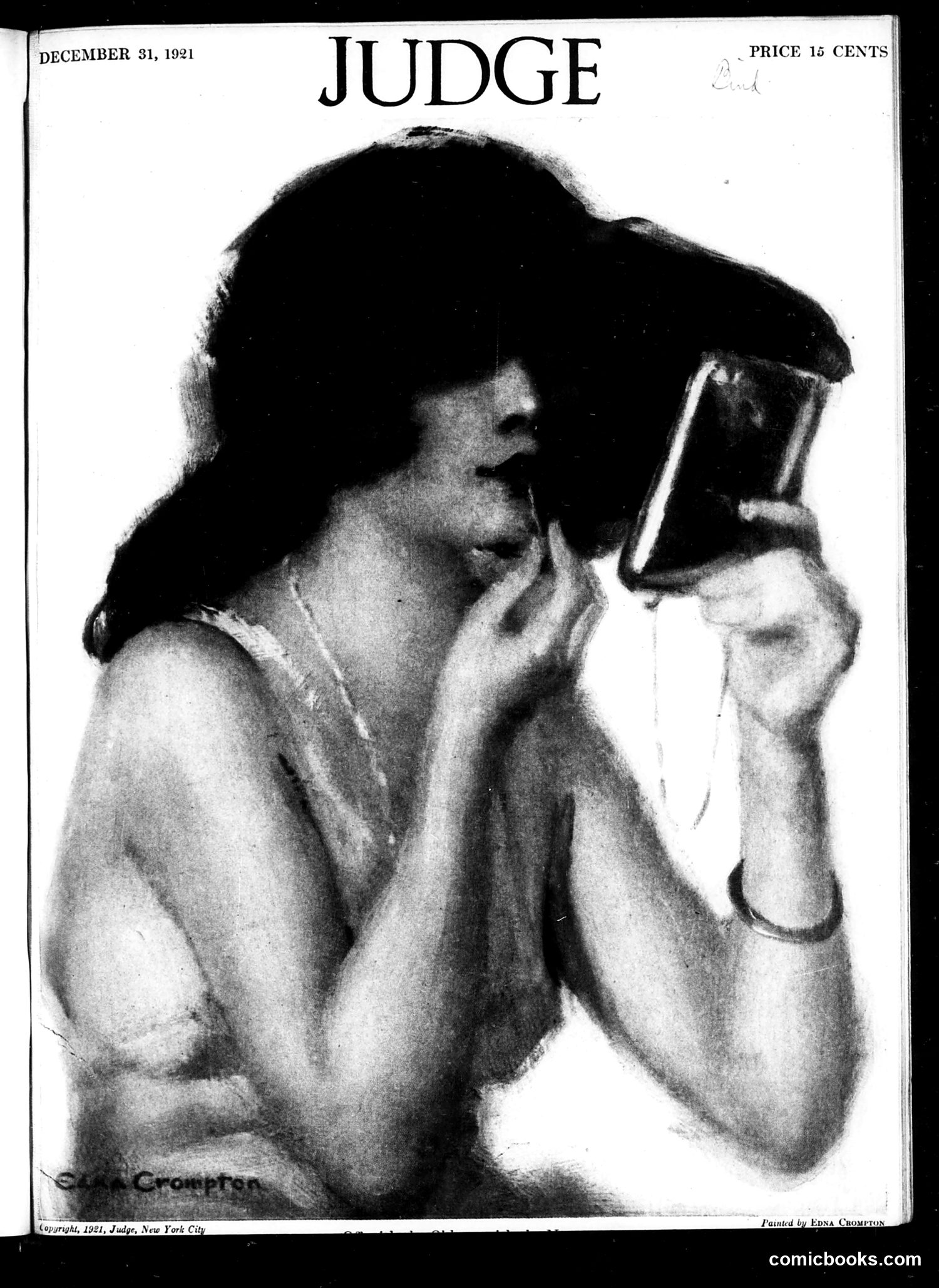
This Judge magazine cover from December 31, 1921 shows a woman holding a mirror to her face in profile, examining her reflection. The image appears to be commentary on vanity or self-examination, though the specific satirical target remains unclear from the visual alone. The OCR text provided contains only publication information and no article text that would clarify the intended joke or social commentary. Given the date (New Year's Eve 1921), this could reference New Year's resolutions or self-reflection, but without additional context from the magazine's accompanying text, I cannot definitively identify the specific person being caricatured or the precise satirical point being made. The photograph credit indicates it was taken by Ema Courtenay.
This page is primarily **promotional content**, not satirical cartoon material. It announces that Samuel Hopkins Adams, a noted author and journalist, will begin a new article series called "Buck Up, Business!" in Leslie's Weekly, starting December 31. The text emphasizes Adams's optimistic analysis of American business conditions and industrial prospects. His first article, "The Stage Is Set for Better Things," reflects post-war economic recovery optimism. The page also mentions a contribution by Francis H. Sisson of the Guaranty Trust Company titled "Smile and the World Trades With You." The primary "joke" or selling point is the magazine's return to its pre-war price of 10 cents per copy—positioned as good news for readers during economic recovery.
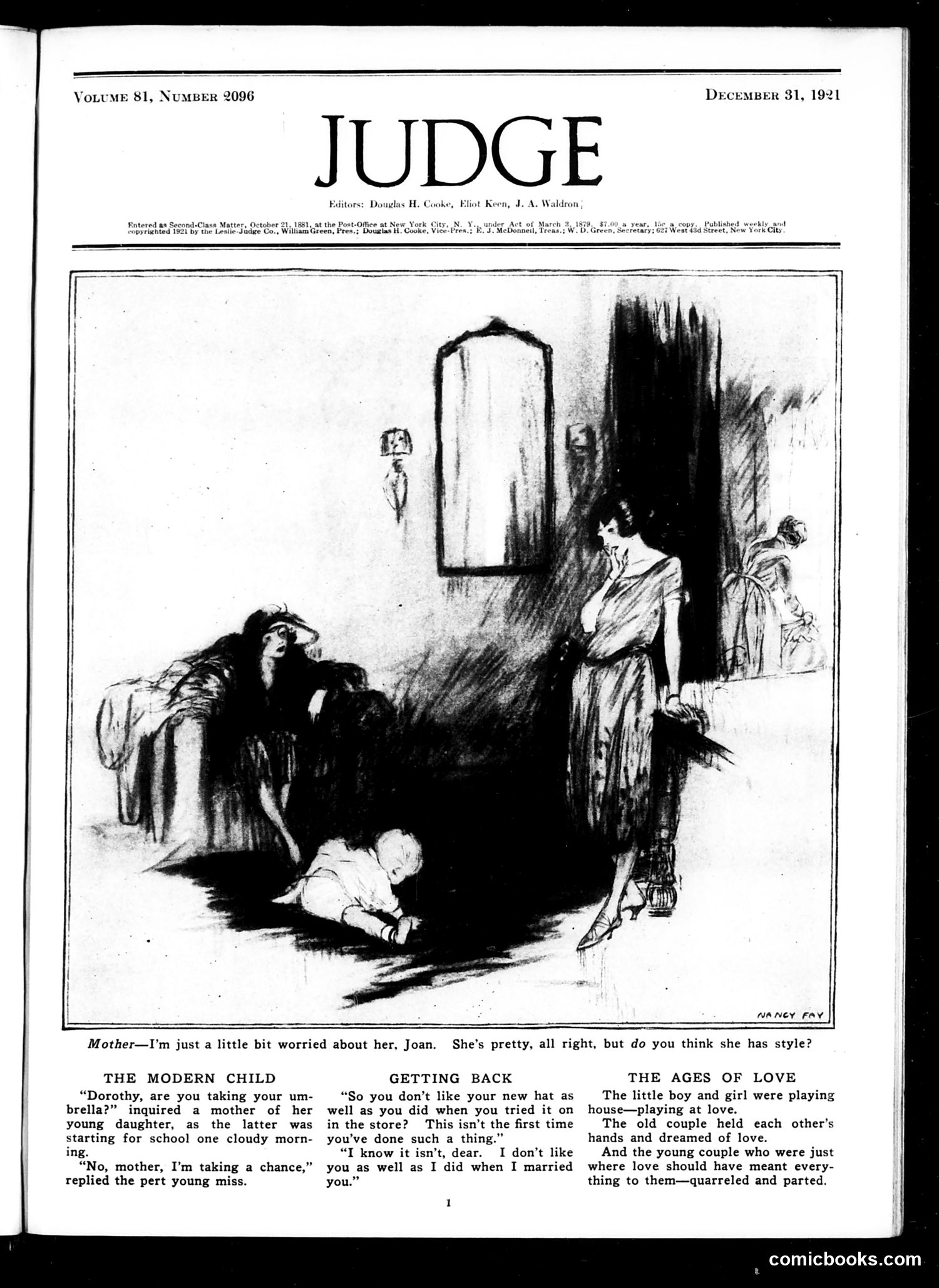
This page contains three separate, unrelated humor pieces typical of Judge's format: **"The Modern Child"** satirizes changing parental authority. A mother asks her daughter about taking an umbrella; the daughter cheekily refuses, claiming she's "taking a chance"—suggesting modern youth reject parental guidance. **"Getting Back"** humorously depicts marital discord. A husband dislikes his wife's new hat purchase, referencing her previous shopping complaints. The joke is mutual blame in marriage. **"The Ages of Love"** sentimentally contrasts three stages: young children playing innocently at love, an elderly couple romanticizing their past, and a young couple quarreling despite their partnership—a commentary on how romantic ideals deteriorate through actual relationship experience. The illustration by Hersey Fay shows an elegant interior scene accompanying one sketch.
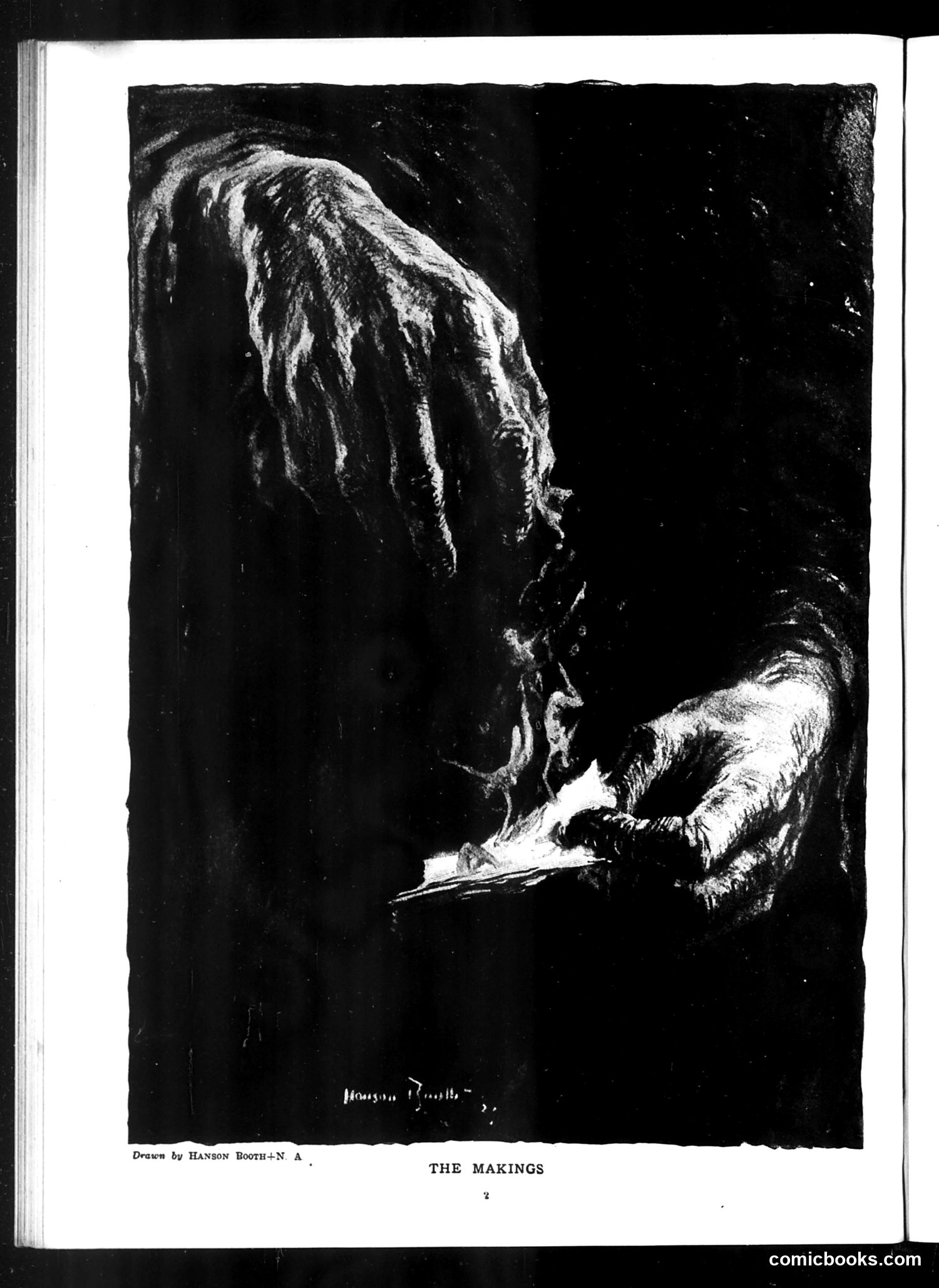
This artwork by Hanson Booth appears to depict a figure with long, disheveled hair hunched over, holding what looks like a document or paper. The title "The Makings" suggests commentary on creation or construction of something—likely political or social in nature, given Judge magazine's satirical focus. The dramatic chiaroscuro (strong light-dark contrast) and grotesque rendering emphasize a somewhat sinister or critical tone. Without additional context identifying the specific figure or historical moment, the cartoon likely comments on either a controversial creator/leader or the problematic nature of some contemporary political development. The allegorical style was common in early 20th-century American satire. More specific identification would require additional surrounding text or publication date information.
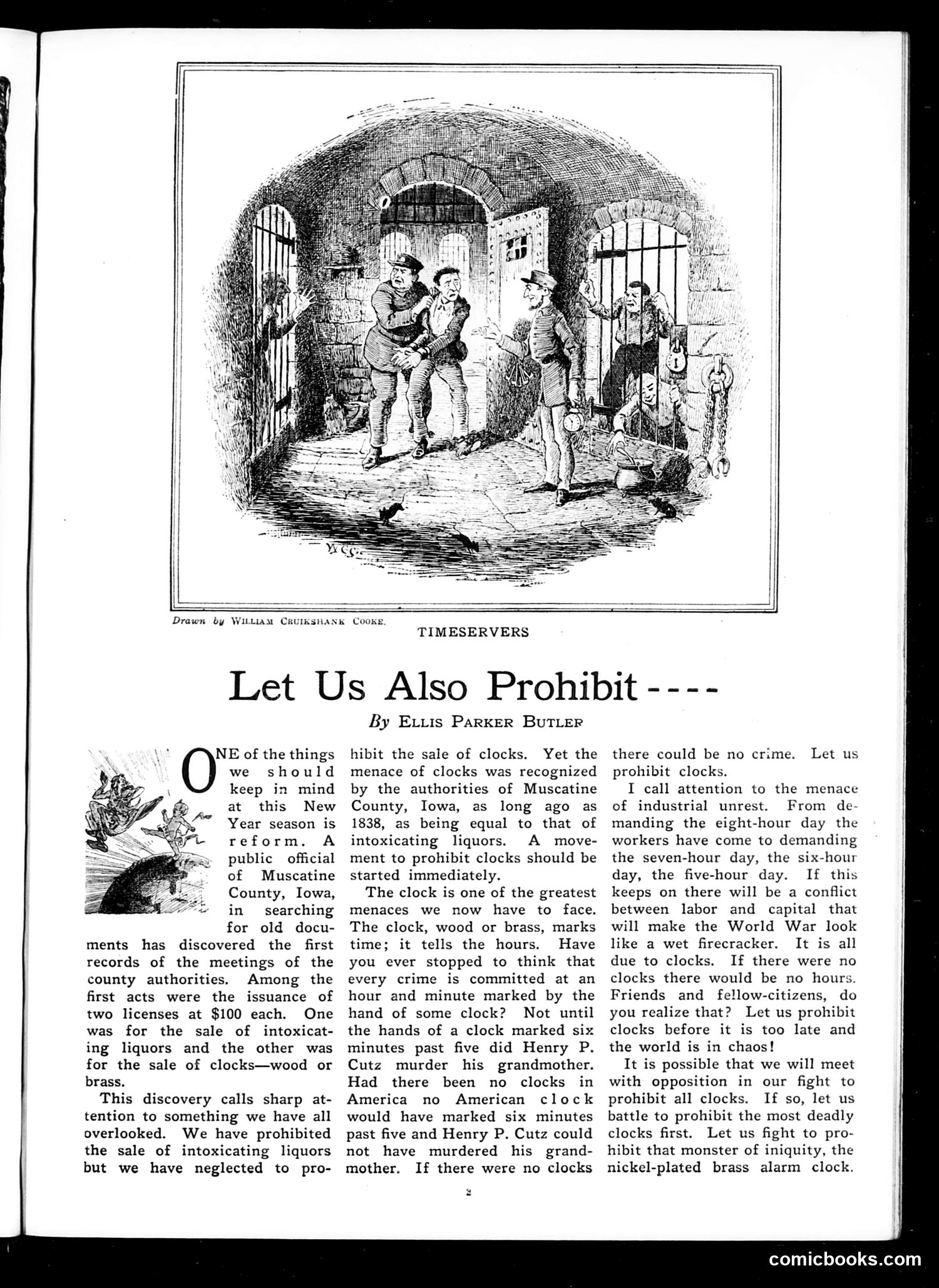
This satirical piece mocks the Prohibition movement through absurdist logic. Butler argues that if society prohibits alcohol to prevent crime, it should logically prohibit clocks too—since crimes occur at specific times marked by clocks. He cites a fictional case: Henry P. Cutz murdered his grandmother at "six minutes past five," implying the clock enabled the crime. The cartoon (drawn by William Makepeace Thackeray Cooke) depicts what appears to be a jail or institutional setting with uniformed officials, likely illustrating the absurd consequences of over-regulation. Butler's satire attacks Prohibition advocates as illogical, suggesting their reasoning—that removing a tool prevents wrongdoing—is as ridiculous as blaming timepieces for crime. It's commentary on the Prohibition Era's (1920-1933) sweeping social control.
The text, titled "Somebody's Mother," is a satirical opinion piece attacking wristwatches as a source of social corruption. The author argues that wristwatches—adopted widely after 1914—bear direct responsibility for increased crime rates in America (citing 287,965 crimes committed that year). The satire works through absurd logic: by enabling people to track time precisely, wristwatches supposedly encourage criminal behavior and moral decay. The author demands a constitutional amendment prohibiting all timepieces. This appears to be early 20th-century social critique using humor to mock either progressive reformers' tendency toward extreme positions or society's susceptibility to blaming new technology for social problems. The faint sketch at the top likely illustrates "somebody's mother," though details are unclear.
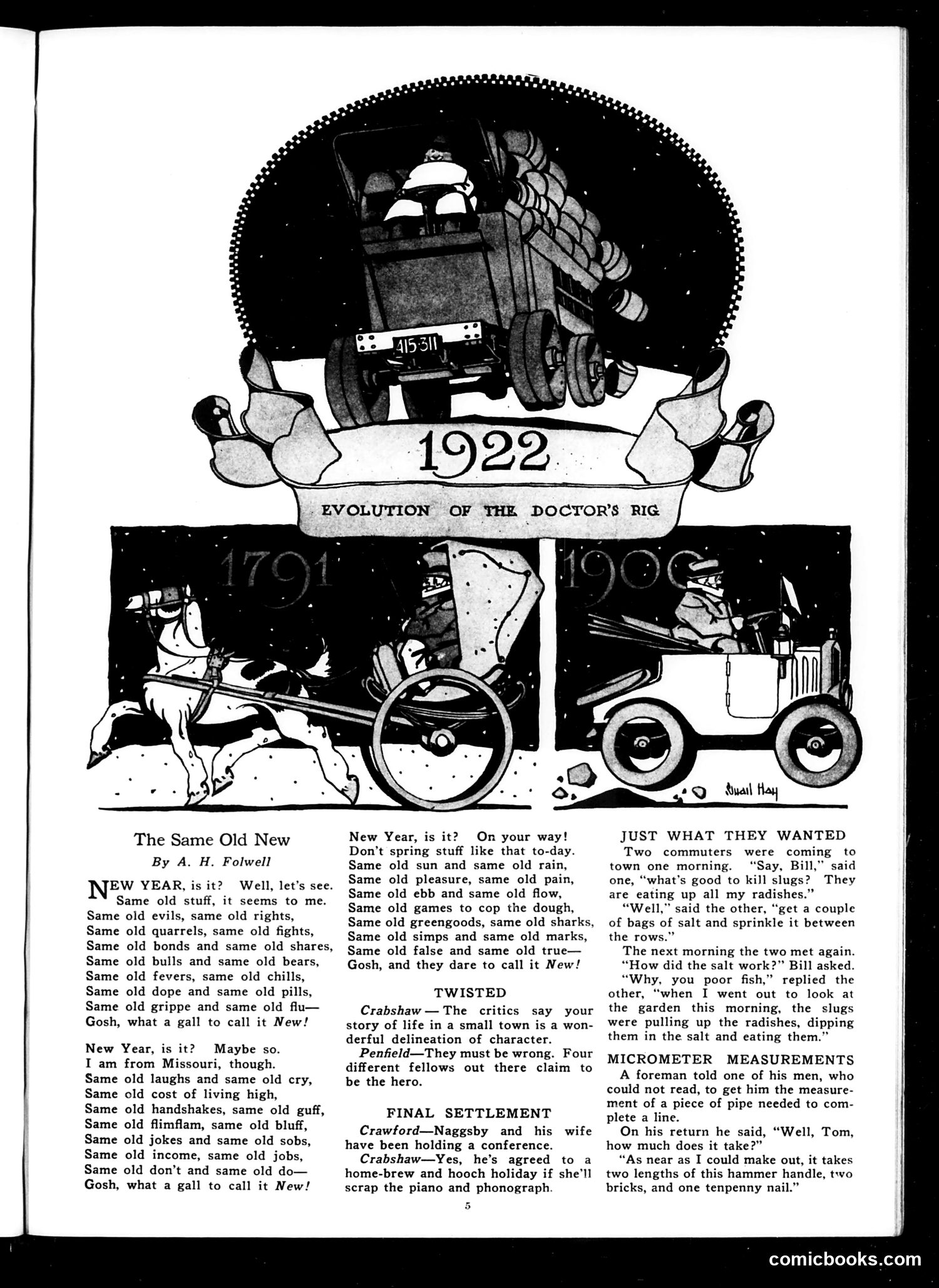
This page from *Judge* satirizes the persistence of social problems despite the new year. The main cartoon at top shows the "evolution" of a doctor's vehicle from 1791 (horse-drawn carriage) through 1906 (early automobile) to 1922 (modern car), suggesting technological progress while implying doctors' fees remain constant—a commentary on how modernization benefits commerce more than ordinary people. The text below, "The Same Old New" by A.H. Folwell, hammers this theme: New Year's resolutions are futile because society's fundamental issues (poverty, inequality, corruption, disease) never change. The accompanying short jokes mock human foolishness and miscommunication, reinforcing the cynical message that nothing genuinely improves—we merely cycle through the same problems with fresh calendars.
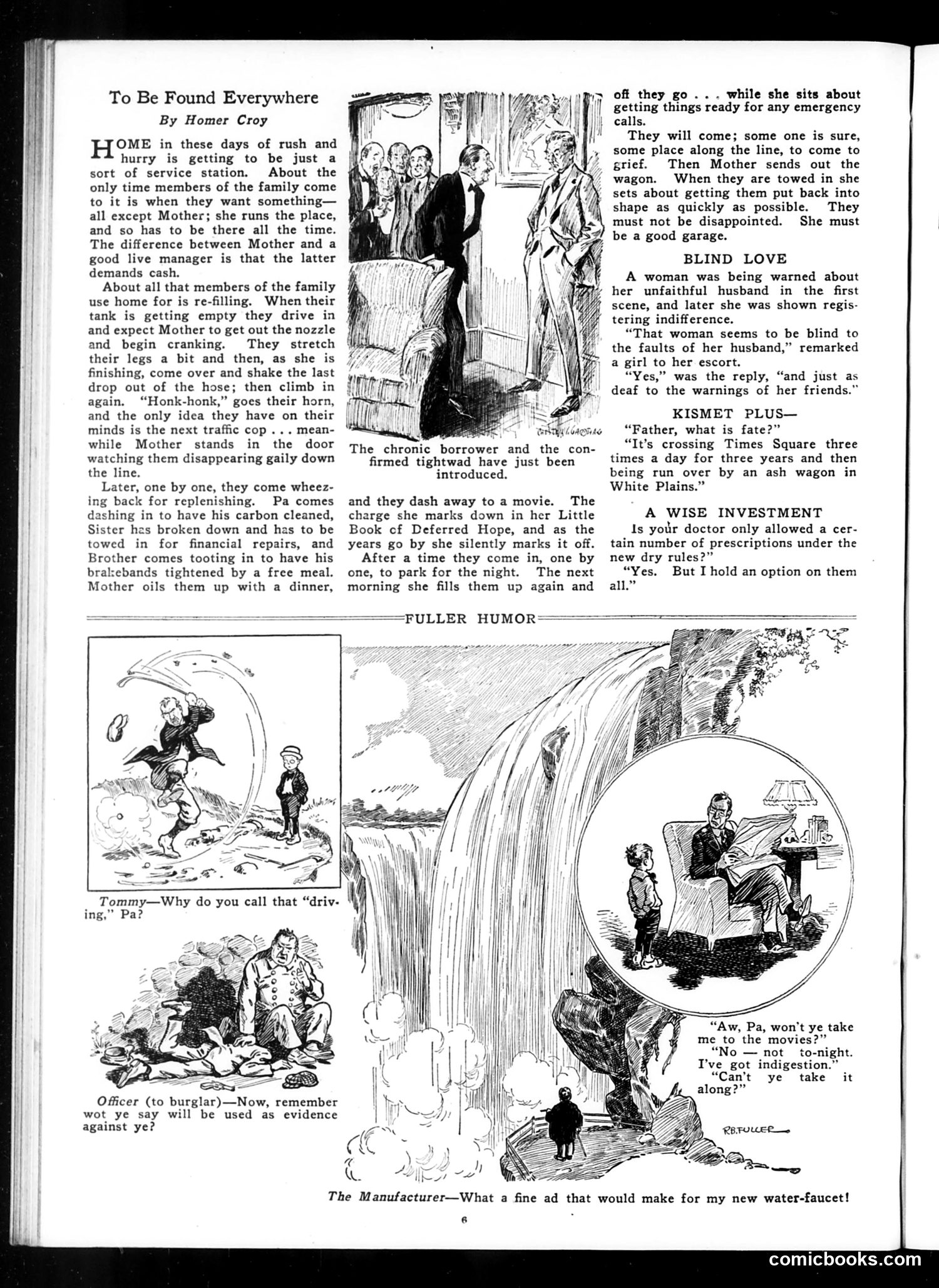
This page satirizes **early 1920s domestic life**, depicting the modern home as a "service station" where Mother is the perpetual attendant. **Main Article ("To Be Found Everywhere"):** Homer Croy critiques how family members treat home as a refueling stop—children and husbands extract services (meals, repairs, laundry) from Mother without gratitude, then leave. The metaphor compares Mother to a garage mechanic who must always be available, never demanding payment like a real business manager would. **The Humor Section** contains unrelated brief jokes: - A child's innocent question about "driving" - A burglar's warning about evidence - Observations on blind love and fate - A doctor joke about Prohibition-era prescription limits **Social Context:** This reflects post-WWI anxiety about changing family dynamics and women's unpaid domestic labor. The satire gently criticizes both family members' ingratitude and the expectation that Mother accept this role without complaint—a modernist critique of traditional gender roles disguised as light humor.
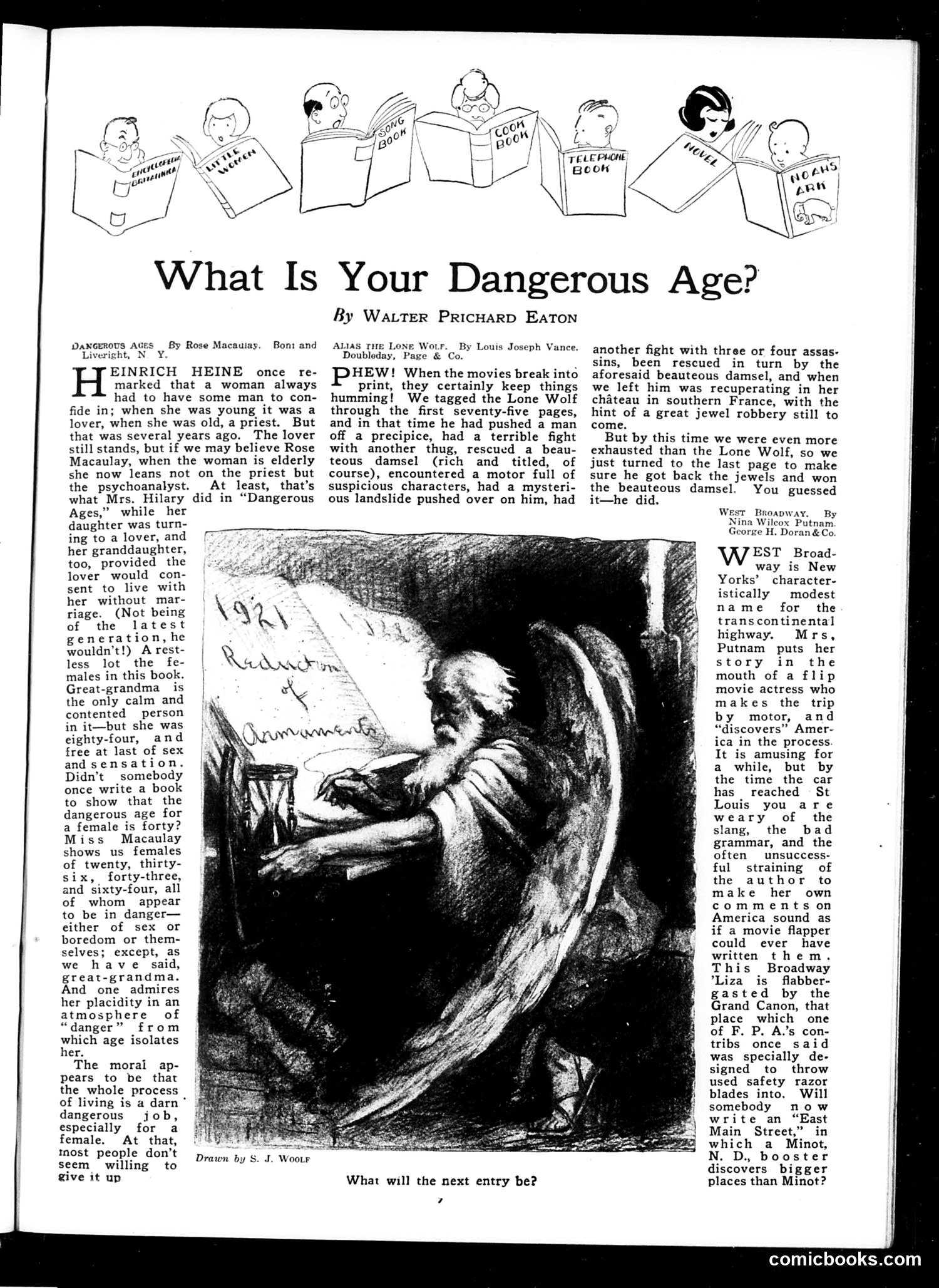
This page reviews three books, using satirical commentary typical of Judge magazine's literary criticism. **Top Section - "Dangerous Ages":** The cartoon header shows various figures hidden behind books labeled with different genres/interests, illustrating Rose Macaulay's novel about women of different ages (20 to 64) who are all restless and seeking either romantic relationships or psychological analysis. The reviewer satirizes that women face constant "danger" from boredom and desire throughout their lives, with only the elderly finding peace. **Middle Review - "Alias the Lone Wolf":** Mocks adventure fiction adapted from film, ridiculing the relentless action (fights, rescues, chases) as exhausting and formulaic. The reviewer humorously admits skipping to the ending to confirm the predictable happy resolution. **Bottom Review - "West Broadway":** Criticizes a novel narrated by a frivolous movie actress discovering America by car. The satire targets the author's failed attempt to capture authentic "flapper" dialogue and commentary—suggesting that real movie actresses couldn't write such strained, affected prose. The page reflects 1920s literary snobbery toward popular entertainment and mass-market fiction.
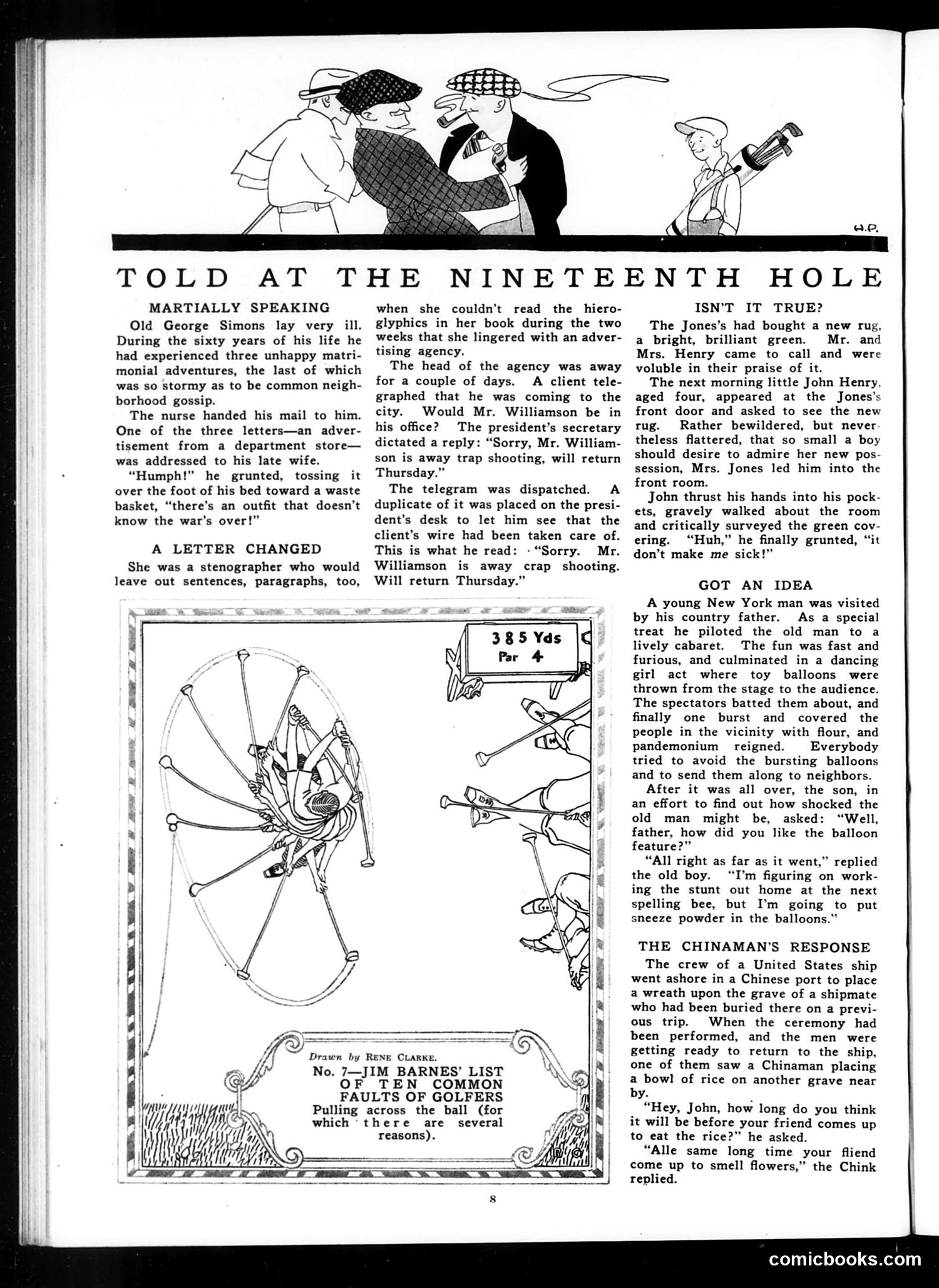
This page presents humorous anecdotes, typical of Judge's "Nineteenth Hole" gossip column. The jokes satirize early 20th-century American social conventions: **"A Letter Changed"** mocks stenographic carelessness: a secretary's poor handwriting transforms "trap shooting" into "crap shooting" in a business telegram, creating embarrassing miscommunication. **"Isn't It True?"** presents gentle domestic humor: a four-year-old's lukewarm response ("don't make me sick") deflates adults' enthusiasm for a new green rug, satirizing adults' assumptions about children's impressions. **"Got An Idea"** jokes about cultural differences: a rural father, entertained by cabaret chaos, plans to replicate the flour-covered-balloon stunt at a spelling bee using sneeze powder—a fish-out-of-water gag. **"The Chinaman's Response"** uses ethnic humor (period-typical dialect stereotyping) where a Chinese man's witty retort—comparing Americans' flower-smelling to his friend eating rice from a grave—suggests respectful skepticism toward Western funeral customs while implying similar illogic on both sides.
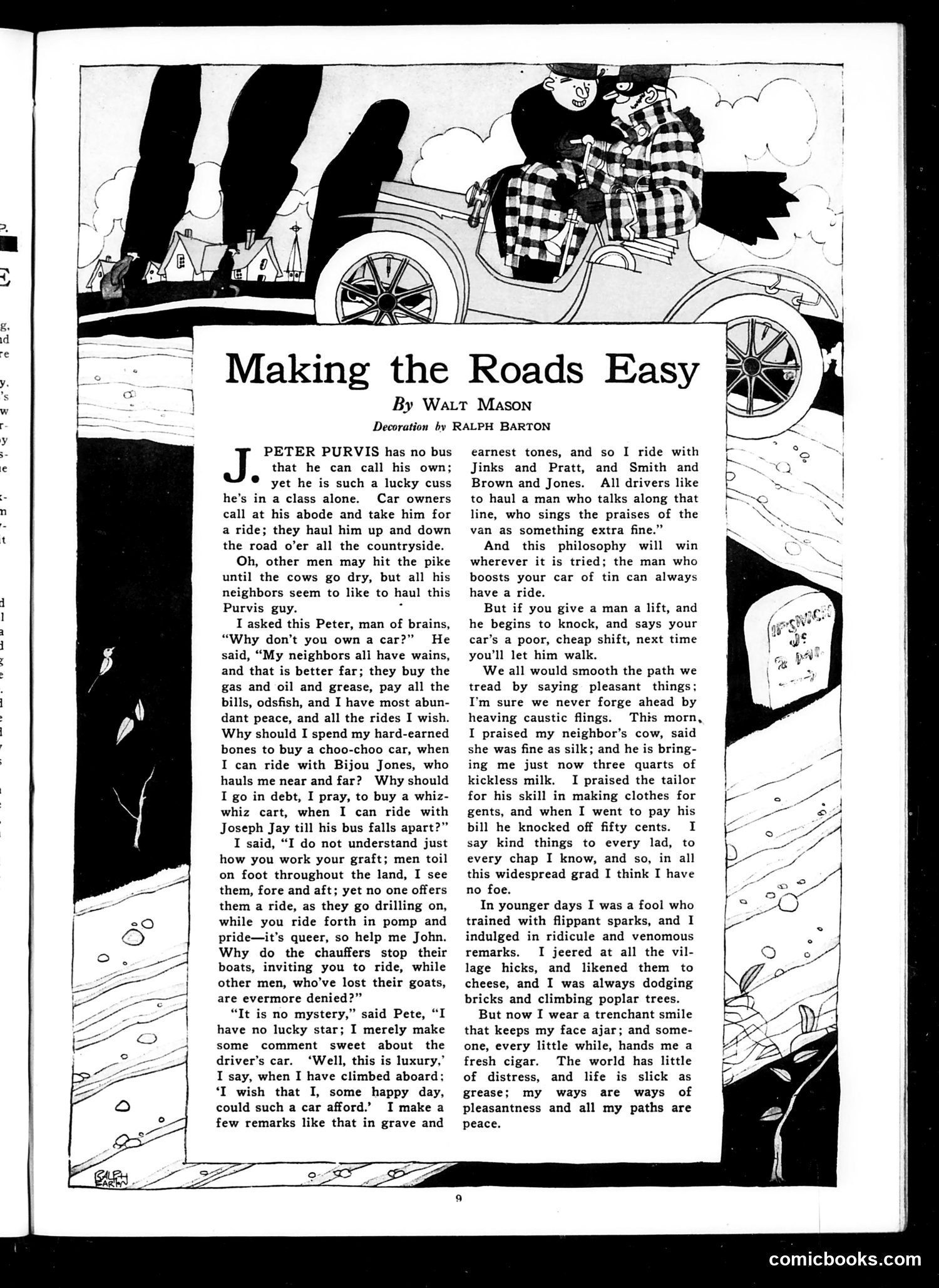
This is a humorous essay illustrated by Ralph Barton about social psychology and getting ahead through flattery and pleasantness. The protagonist, Peter Purvis, owns no car but constantly receives rides from neighbors. When asked why he doesn't buy his own automobile, he explains his philosophy: he compliments drivers' cars sincerely and effusively, and they happily oblige him with rides. The piece argues this strategy—praising others generously—works universally: he's gotten free milk by complimenting a cow, discount tailoring by praising a tailor's skills. The moral is that kindness, compliments, and pleasant remarks open doors that money alone cannot. The author contrasts his younger self, who mocked villagers and faced hostility, with his current approach of universal flattery, which brings him peace and social advantage. It's essentially advice literature wrapped in satire—advocating calculated pleasantness as a practical life strategy in the 1920s automobile age.
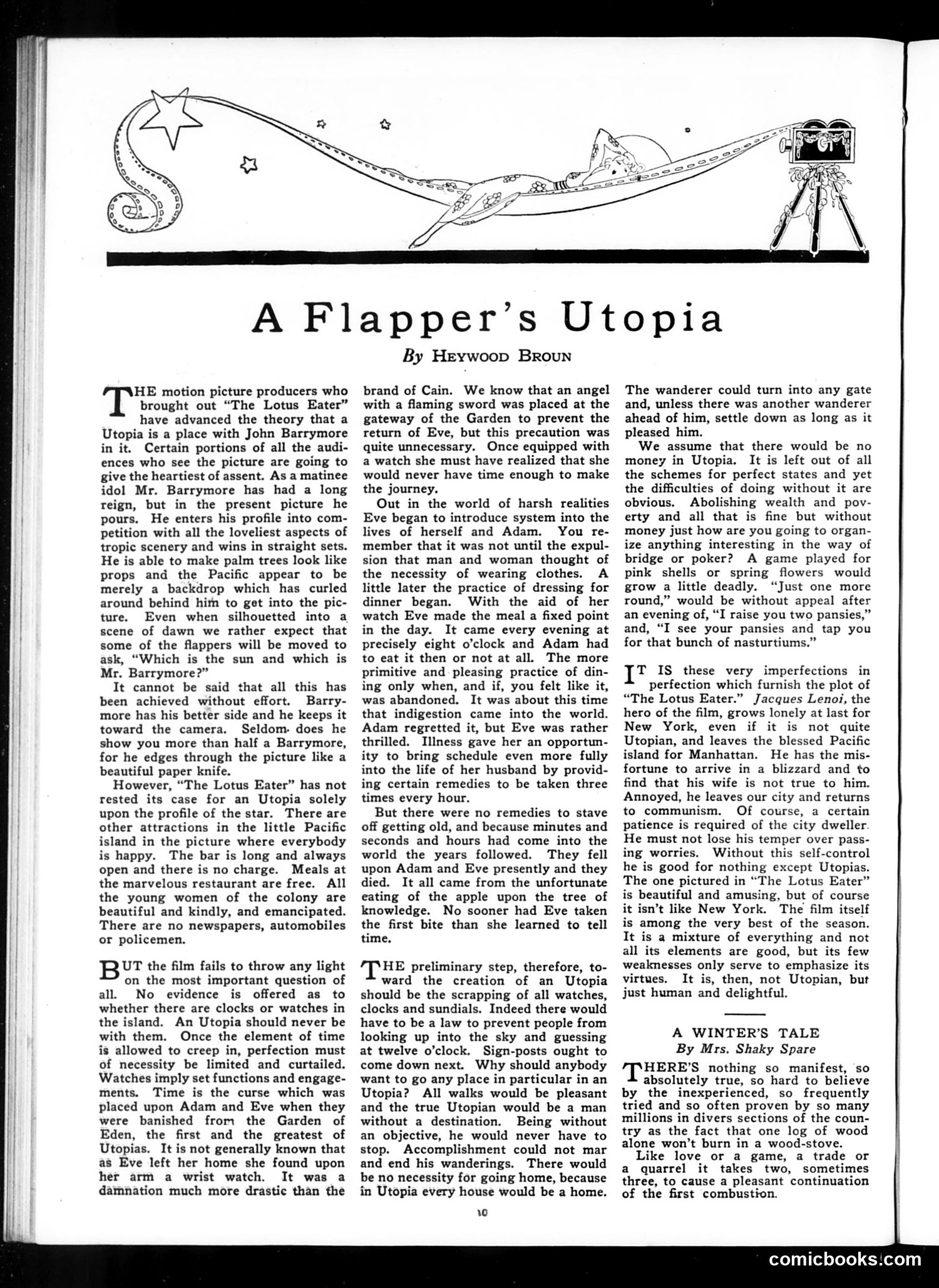
This is a film review by Heywood Broun satirizing both the 1921 movie "The Lotus Eater" and 1920s ideals of paradise. **The Setup:** The piece mocks movie producers' claim that a utopia simply needs actor John Barrymore in it. Broun facetiously agrees, joking that Barrymore's famous profile is so striking it outshines tropical scenery—he "edges through the picture like a beautiful paper knife," showing only his best side. **The Satire:** The film depicts an island paradise with free food, alcohol, beautiful women, and no newspapers or police. Broun's real critique: it fails to address whether clocks exist there. He argues time-keeping devices are civilization's original curse, tracing them to Eve's wrist watch after Eden's expulsion. The watch imposed schedules, dress codes, mealtimes, and ultimately mortality itself—civilization's burdens. **The Point:** For modern readers, this reflects 1920s "Flapper" culture's rebellion against Victorian schedules and constraints. Broun suggests true utopia requires rejecting not just material poverty but temporal discipline itself—a witty commentary on whether freedom from society's demands is actually achievable.
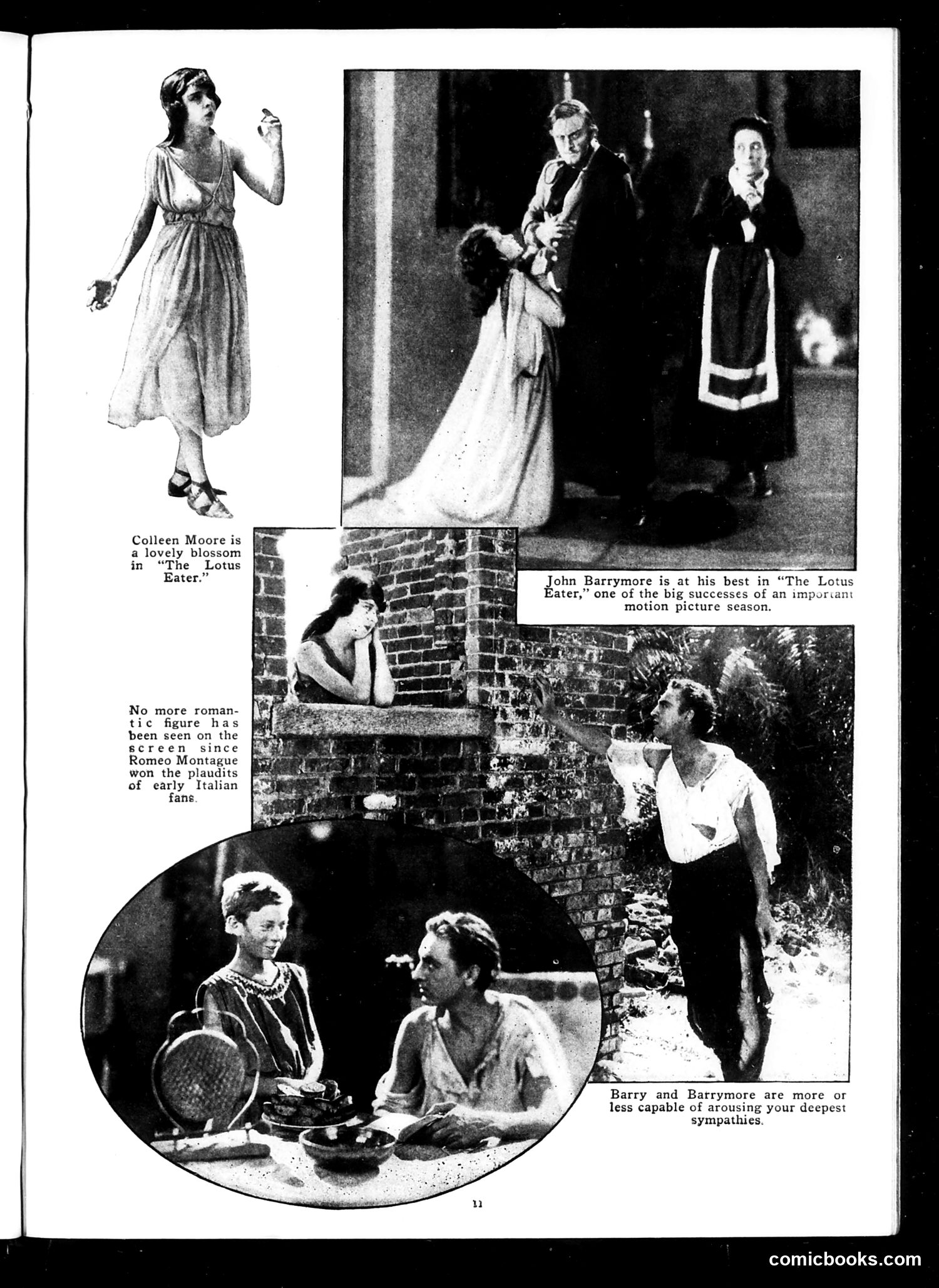
This page reviews the silent film "The Lotus Eater," featuring actors Colleen Moore and John Barrymore. The layout presents multiple scenes from the movie with promotional commentary. The text praises Moore as a "lovely blossom" and compares her romantic appeal to Romeo and Juliet, suggesting she's an exceptional screen presence. Barrymore receives similar praise, described as "at his best" in a commercially successful picture. The final caption—"Barry and Barrymore are more or less capable of arousing your deepest sympathies"—appears mildly backhanded, suggesting the actors competently evoke emotional response from audiences, though the tepid phrasing ("more or less capable") hints the review may be somewhat qualified in its enthusiasm. This represents typical Judge magazine coverage: promotional film criticism mixed with entertainment industry gossip for a general readership interested in early Hollywood personalities.
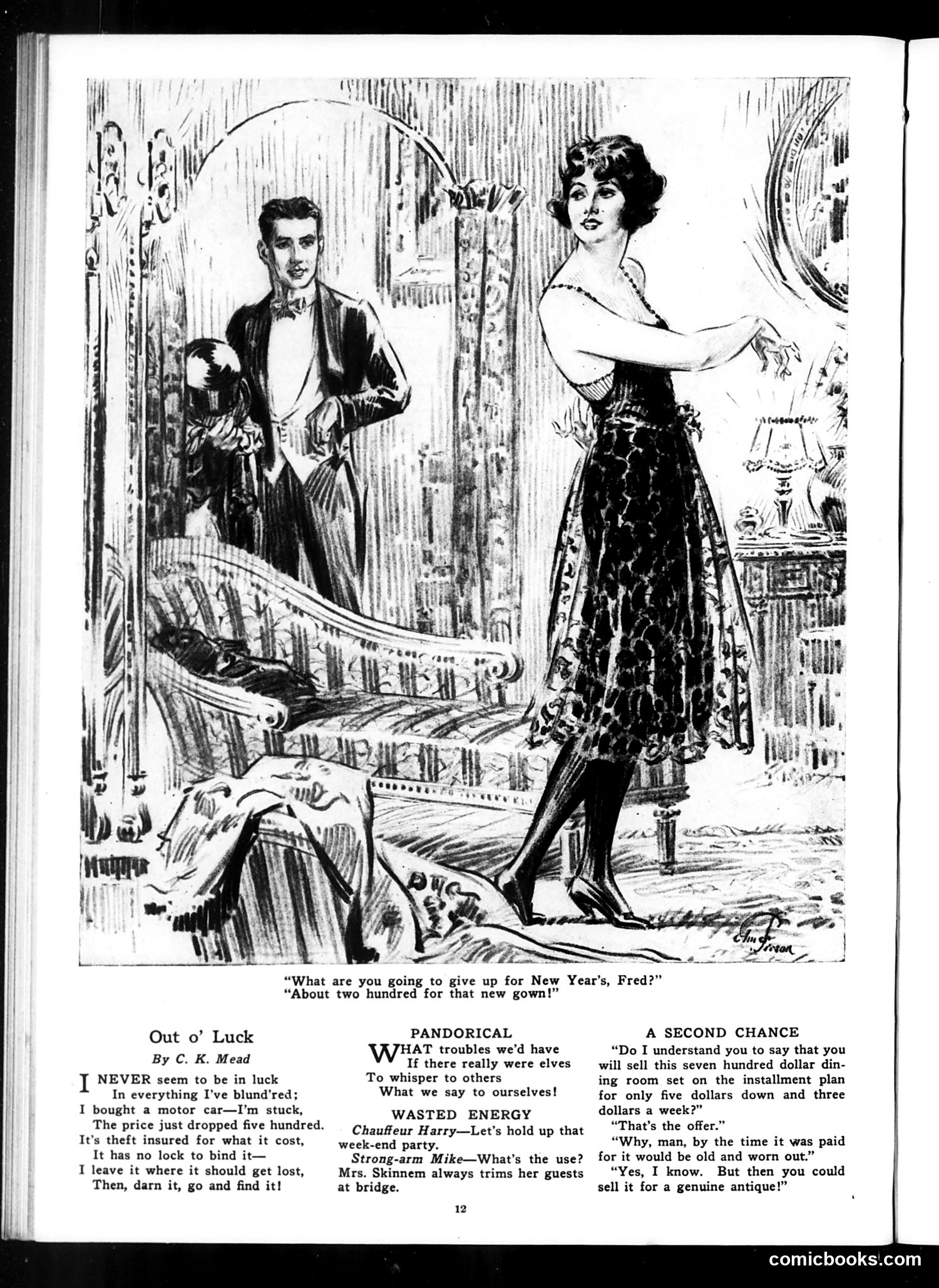
This page from *Judge* presents early 20th-century satirical humor about consumer culture and New Year's resolutions. The main cartoon depicts a couple discussing New Year's sacrifices—the woman asks what the man will "give up," and he sarcastically replies he'll sacrifice "about two hundred for that new gown," mocking the impossibility of actual restraint during the holiday season. Below are several short humorous pieces: "Out o' Luck" mocks a man who bought a car he can't afford; "Pandorical" jokes about wishing elves could whisper advice; "Wasted Energy" ridicules penny-pinching (trimming guests at bridge); and "A Second Chance" satirizes installment buying—a man considers purchasing expensive furniture on credit, joking that by the time it's paid off, it will be "old and worn out" and could be sold as an antique. The satire targets consumer excess and the contradiction between New Year's resolutions and actual spending habits.
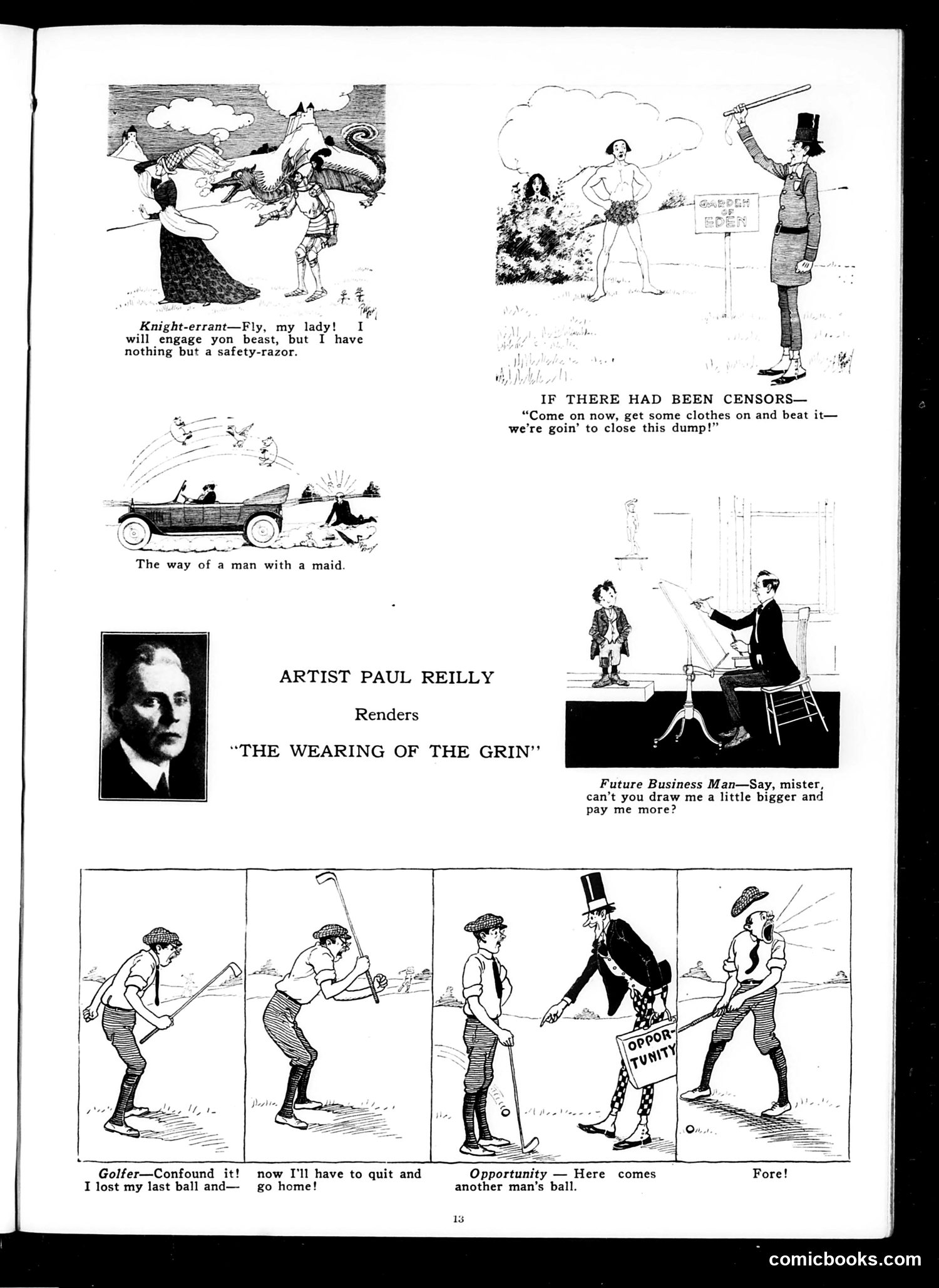
This Judge magazine page presents several satirical cartoons on modern life and social commentary: **Top section** mocks censorship with a medieval knight scene—the joke being that if censors existed, they'd shut down even innocent activities (implied: a couple in compromising situations). **Middle cartoons** offer social satire: a man hiring help at reduced pay; a businessman requesting larger drawings for less money—poking fun at economic exploitation and shrinking wages during what appears to be the early 20th century. **Golf sequence** uses a golfer losing his ball as metaphor for life's disappointments—when "opportunity" (another man's ball) arrives, the golfer must leave, illustrating how fortune favors others while misfortune dogs the everyman. The humor relies on wordplay and visual puns about balls and opportunity. Overall, the page satirizes workplace dynamics, economic hardship, and life's arbitrary injustices through everyday scenarios.
This is a theater criticism essay by George Jean Nathan, not a political cartoon. It defends actor **William Gillette** against technical criticism, arguing that "bad" acting—imperfect, artless, human—can be more engaging than polished performances. Nathan contrasts Gillette with other actors of the era (Walter Hampden, Robert Edeson, John Mason) to show that crude technique sometimes produces better results. He names other "bad but effective" actors: Cyril Keightley, Eric Maturin, Reginald Barlow, Lowell Sherman, Charles Cherry, and others. The core argument: authentic imperfection mirrors real human behavior better than artificial polish. A worn armchair feels cozier than formal Sheraton furniture—similarly, Gillette's monotone voice and awkward gestures captivate audiences more than technically perfect acting. For moderns: this reflects early 20th-century theater debates about naturalism versus artifice—advocating for what we'd now call "authentic" or "naturalistic" acting over theatrical grandstanding.
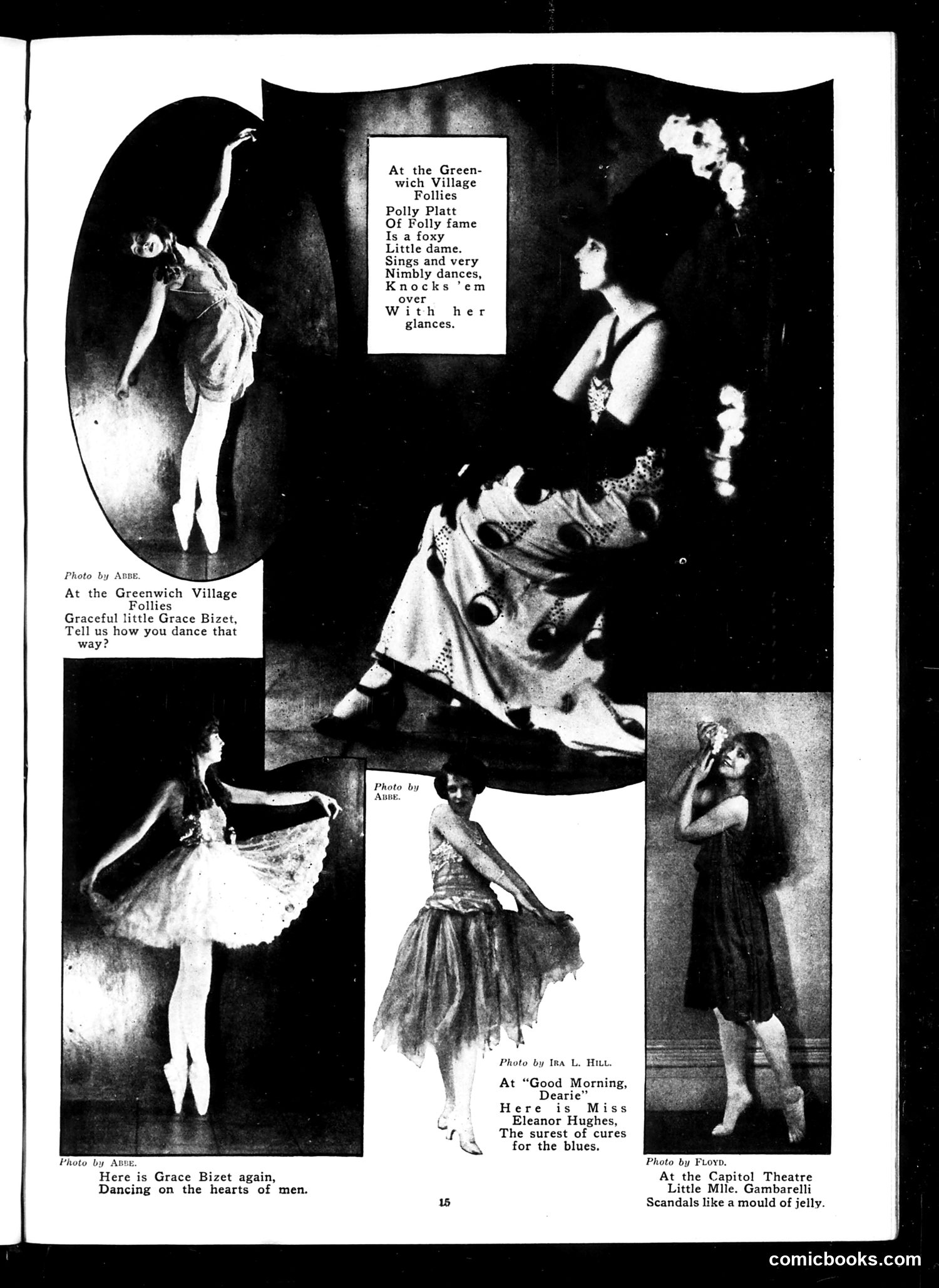
This page showcases theatrical performers from early 1920s New York entertainment venues—the Greenwich Village Follies, "Good Morning, Dearie," and Capitol Theatre "Scandals." Rather than political satire, it's a celebrity photo spread with lighthearted verse captions about dancers and singers. The captions employ typical period humor: Grace Bizet "dancing on the hearts of men," Polly Platt described as a "foxy little dame," Eleanor Hughes as a "cure for the blues," and a crude joke about Mlle. Gambarelli's physique ("like a mould of jelly"). This reflects Judge's evolution toward entertainment coverage and Broadway gossip—common magazine content of the era. The photographers credited (Abbe, Floyd, Ira L. Hill) were working theatrical photographers. The page documents 1920s popular entertainment culture rather than offering political commentary.
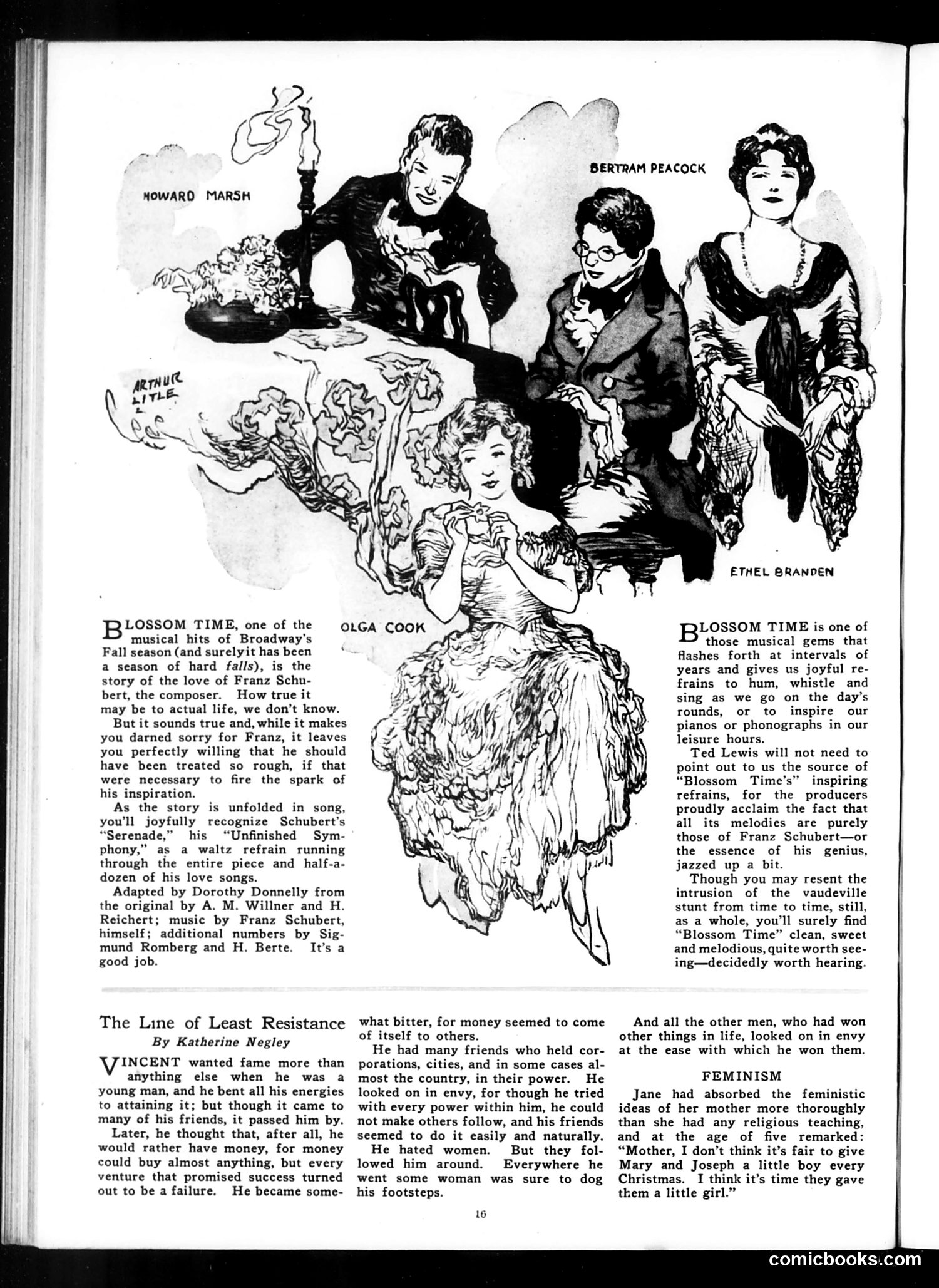
This page contains two distinct pieces: **"Blossom Time" Review**: A theater review of a Broadway musical about composer Franz Schubert's love life, adapted by Dorothy Donnelly. The illustrated cast includes Howard Marsh, Bertram Peacock, Olga Cook, and Ethel Branden. The review praises the show's incorporation of Schubert's actual compositions, noting it flashes melodious gems periodically, though acknowledging occasional "vaudeville stunts" interrupt the narrative. **"The Line of Least Resistance" (by Katherine Negley)**: A short story about Vincent, a man who paradoxically fails at pursuing what he consciously desires (fame, money, influence) yet succeeds effortlessly at what he doesn't want (attracting women). The irony critiques how effort often backfires while apathy mysteriously yields results. **"Feminism" brief**: A satirical quip where five-year-old Jane, indoctrinated with feminist ideology by her mother, protests the Christian nativity narrative's gender imbalance—wanting Mary and Joseph to receive a daughter occasionally instead of perpetually a son.
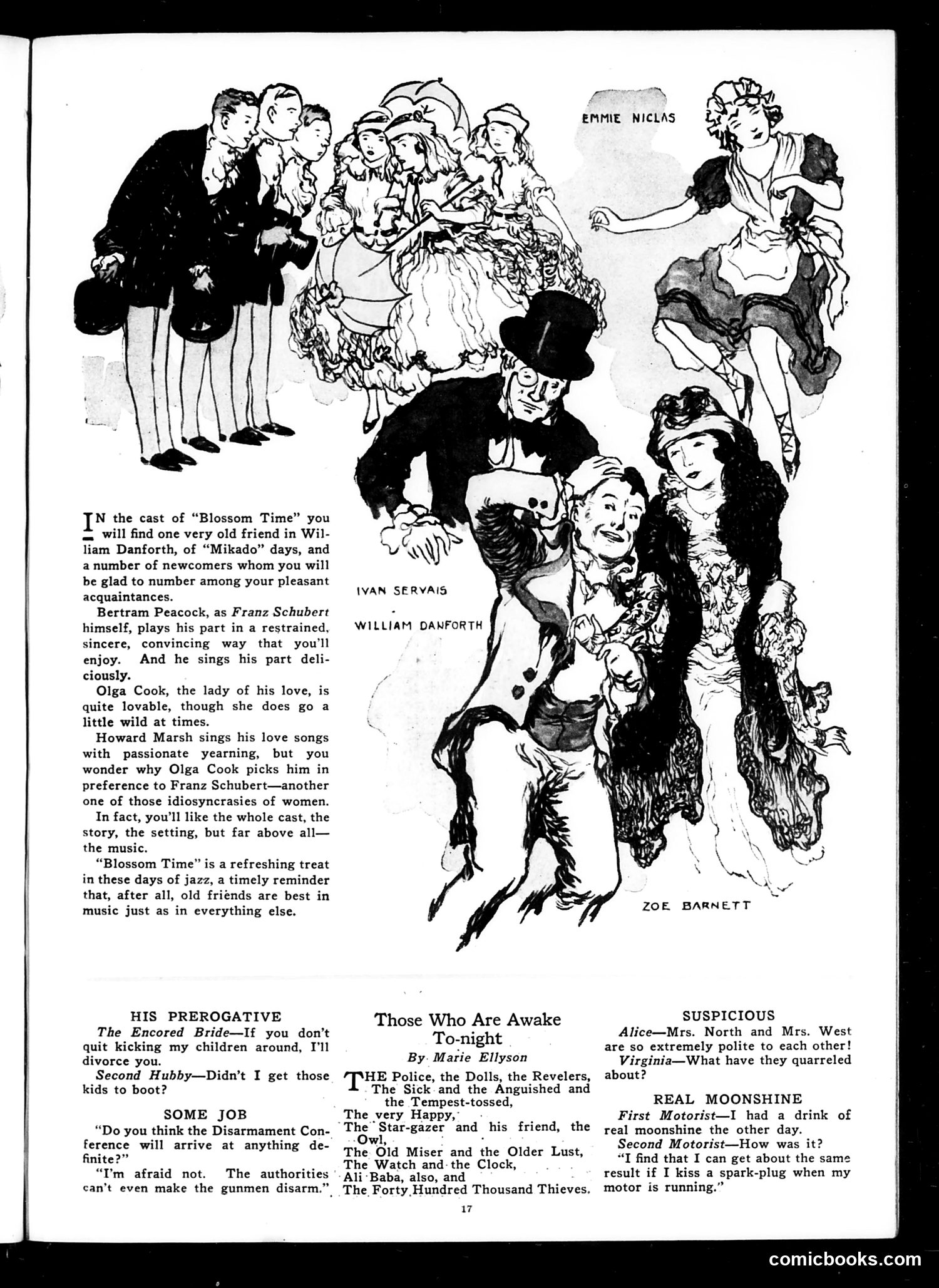
This page reviews the Broadway musical *"Blossom Time,"* praising its cast (Bertram Peacock as Schubert, Olga Cook, Howard Marsh, William Danforth) and score as a welcome respite from contemporary jazz. The critic notes the "idiosyncrasies of women" in preferring one suitor over another—typical 1920s gender commentary. The illustrated portraits identify cast members including Emmie Niclas and Zoe Barnett. Below are three unrelated humor items: a joke about a remarried man's children, a dig at ineffective disarmament conferences ("gunmen" won't disarm), and Prohibition-era bootleg liquor humor (comparing moonshine to kissing a spark plug). The page reflects post-WWI American culture: nostalgia for pre-jazz aesthetics, ongoing Disarmament Conference discussions, and widespread Prohibition (1920-1933) that spawned underground "moonshine" production and humor.
This editorial uses satirical imagery and rhetoric to argue against blind faith in "progress." The accompanying illustration shows a figure ringing bells—literally "ringing in the new"—mocking the celebratory impulse to declare advancement. White's central argument: technological and political changes (from candlelight to electricity, from monarchy to democracy) are *not* inherently progress. He references World War I's devastation ("ten million souls unto Eternity"), suggesting that mechanized warfare exposed modernity's dark side. The satire targets naive reformers and political figures (possibly Hearst, mentioned explicitly) who believe institutional change automatically improves society. White argues that real progress requires centuries, not declarations, because humans internalize change slowly. The essay pessimistically concludes that post-WWI reality contradicts utopian hopes—the "Goddess of Peace" appears as merely "a shriveled old hag." The piece represents early 20th-century intellectual skepticism about technological determinism.
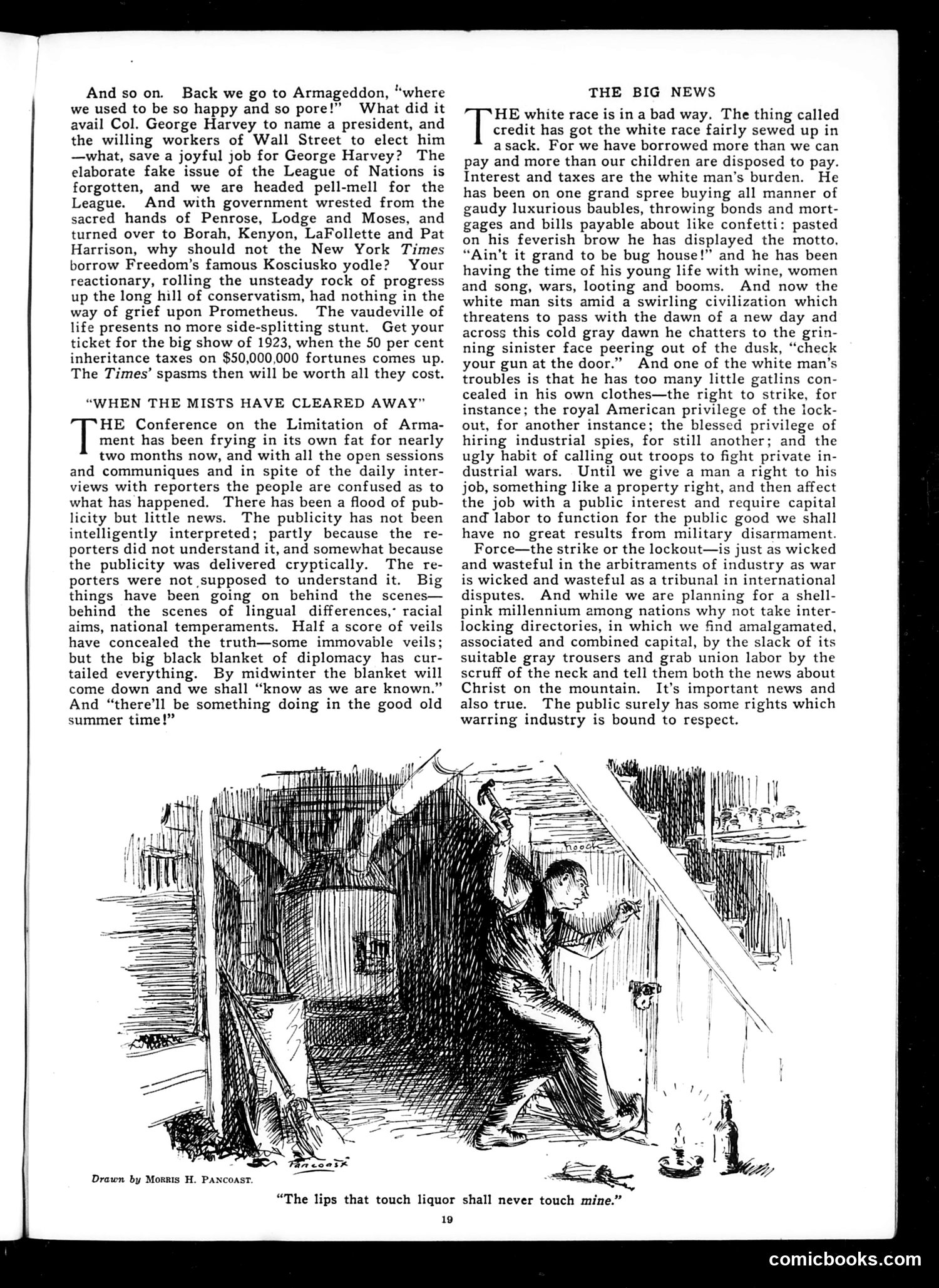
This page contains political commentary critical of American capitalism and labor relations, likely from the early 1920s (the text references a "big show of 1923"). **The Main Article ("The Big News"):** The author argues that Western civilization faces collapse due to overconsumption and debt. The white race has overspent on luxuries and borrowed beyond repayment capacity. The cartoon by Morris Pancoast (below) depicts a figure confronting a threatening silhouette—likely representing the consequences of this reckless spending or social chaos. **Key Critique:** The piece blames industrial conflict on unequal power dynamics. Workers lack job security ("property rights"), while management wields weapons: the right to hire spies, call troops against strikers, and impose lockouts. The author argues these tools are as destructive as warfare, and until workers gain fundamental rights, disarmament conferences cannot succeed. **Political Context:** References to Harvey, Penrose, Lodge, Borah, and LaFollette indicate post-WWI debates over League of Nations membership and Republican/Progressive divisions. The satire attacks both capitalist excess and labor's vulnerability in 1920s America.
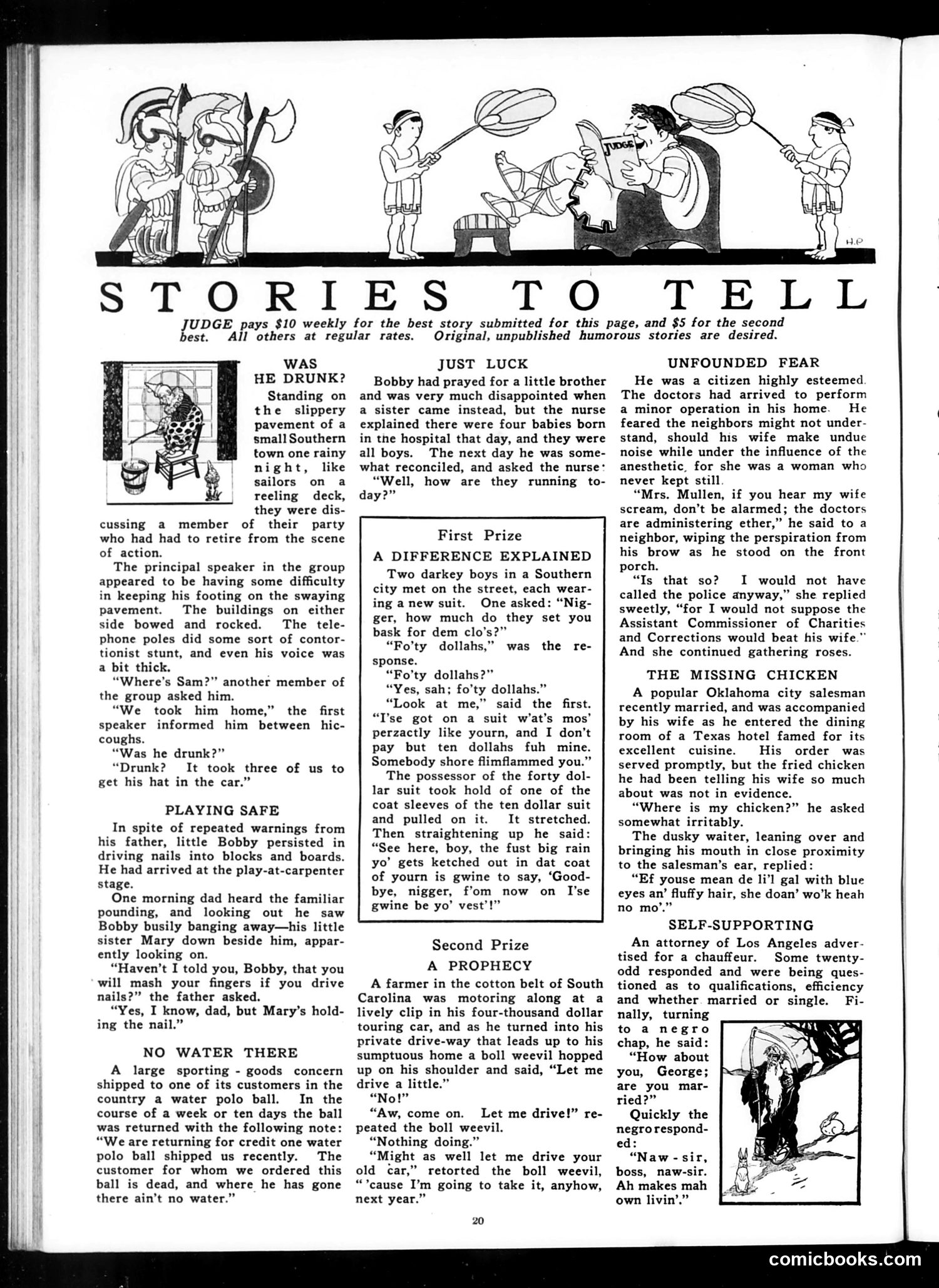
This is a humor submission page from Judge magazine, offering cash prizes ($10 first prize) for short jokes. The page contains five brief comedic stories exploiting period stereotypes and social anxieties: **"Was He Drunk?"** — A drunk man's slurred speech and difficulty standing make the punchline: it took three men just to fit his hat in the car (implying extreme intoxication). **"Just Luck"** — A child's innocent misunderstanding: disappointed about getting a sister instead of a brother, he asks how many boys the hospital is "running to" daily—confusing the phrase with a game score. **"A Difference Explained"** — Uses racial caricature and dialect to joke about cheap versus expensive clothing; the punchline hinges on the cheap suit's poor quality (stretches easily, will shrink in rain, becoming worthless). **"A Prophecy"** — A boll weevil (cotton pest destroying Southern crops) climbs onto a wealthy farmer's shoulder, threatening to eventually destroy his prosperity through agricultural damage. **"Unfounded Fear"** — A man fears neighbors will judge his wife's anesthetic-induced noise during a home surgery as improper behavior.
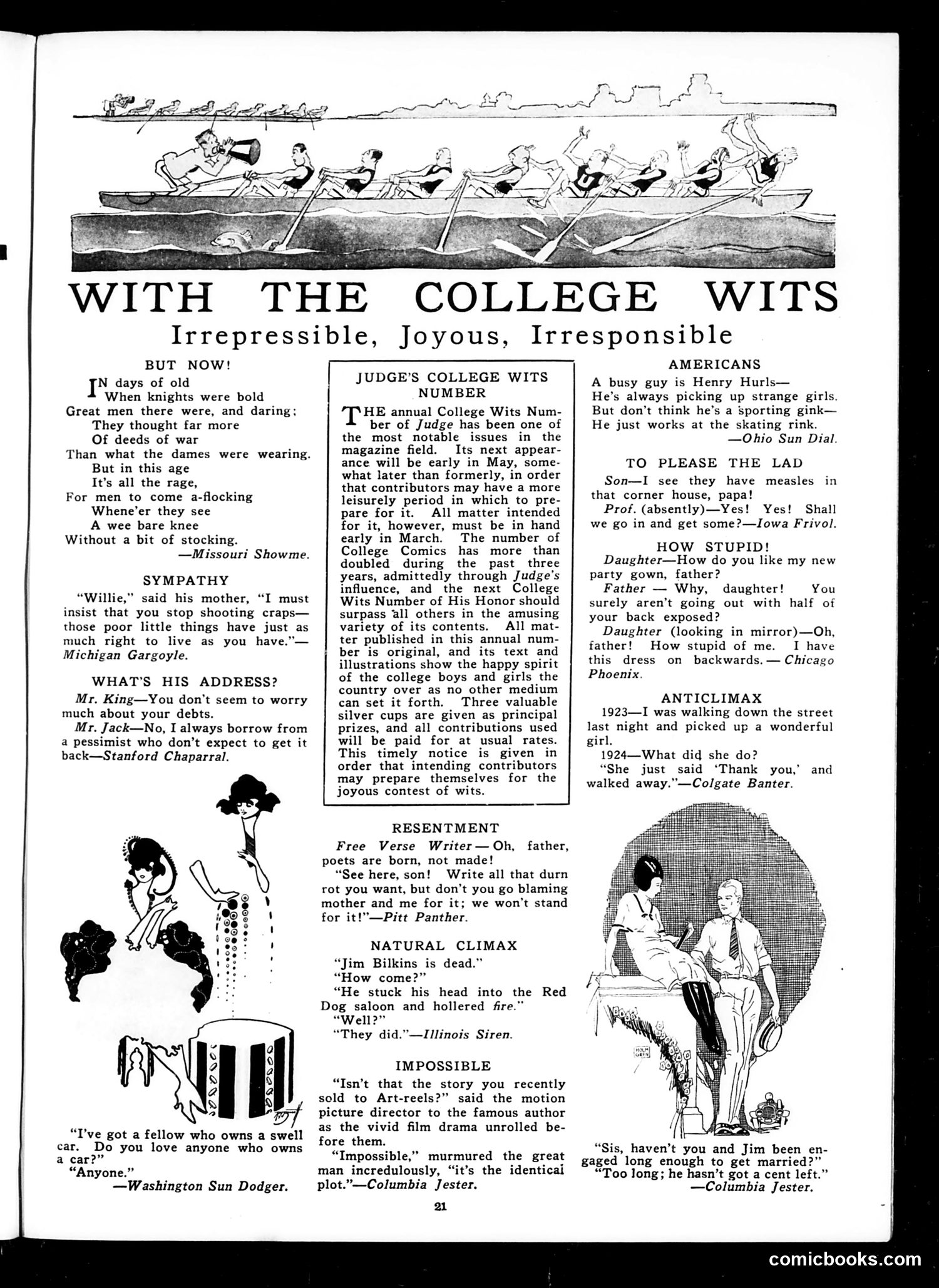
This page showcases humorous contributions from college newspapers, a format Judge regularly featured. The content reflects 1920s college social anxieties and generational humor. **Key themes:** - **"Missouri Showme"**: Satirizes modern men's preoccupation with women's exposed legs (fashionable shorter skirts of the 1920s) versus traditional masculine ideals of martial courage. - **"Sympathy"**: A child-rearing joke playing on the mother's anthropomorphization of "craps" (likely dice or animals). - **Social commentary**: Several jokes mock romantic entanglement ("Anticlimax") and financial irresponsibility in courtship—reflecting post-WWI economic concerns. - **Free verse/poetry mockery**: "Resentment" jokes that modern poets blame their parents for their artistic failures. The page announces Judge's annual College Wits competition, offering silver cups for the best submissions, positioning the magazine as arbiter of college humor. The overall tone celebrates youthful irreverence while gently mocking modern romance, fashion, and artistic pretension.
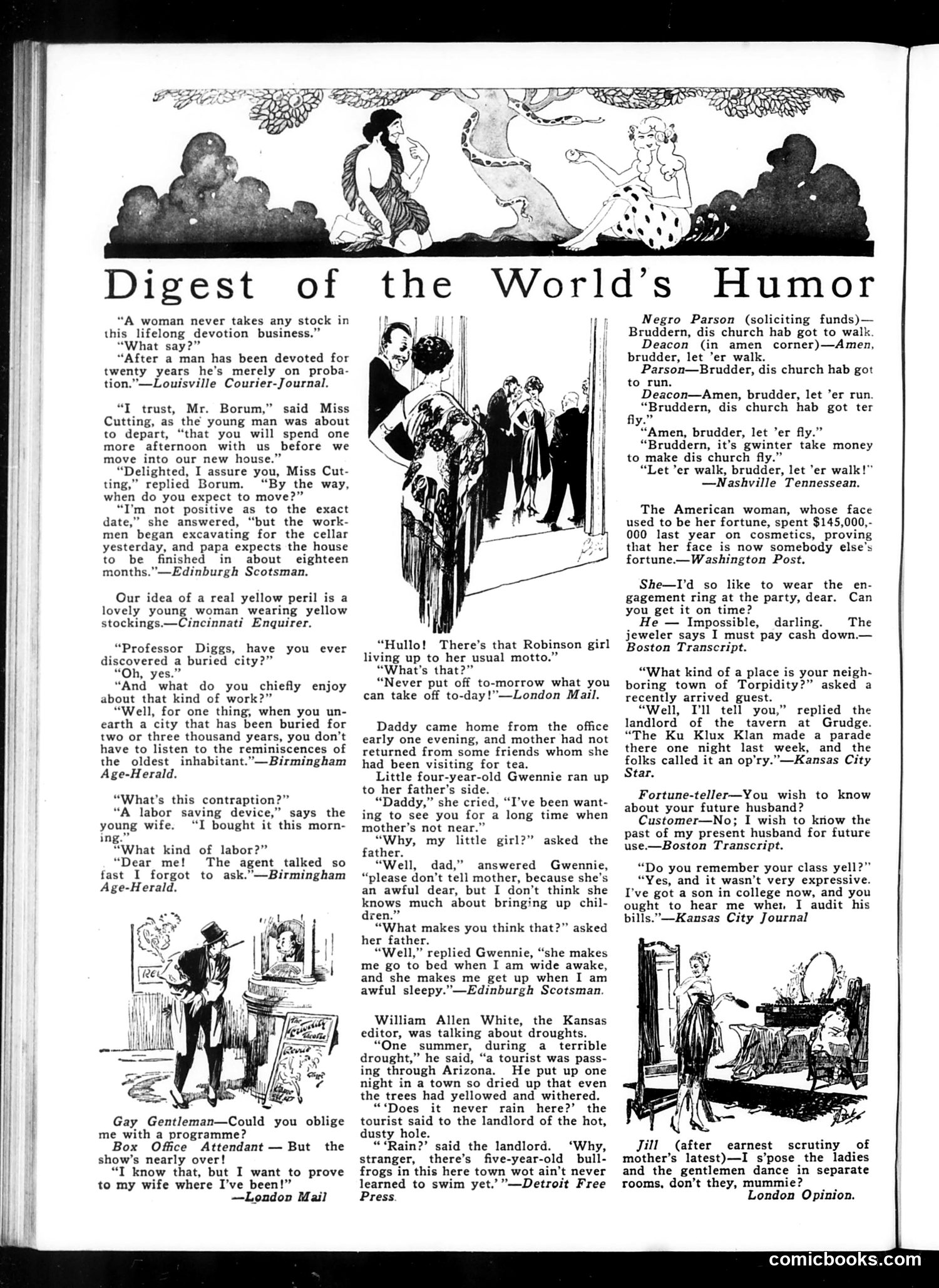
This page contains a collection of short humorous anecdotes and jokes drawn from international newspapers and magazines—a common Judge magazine feature. The content satirizes everyday social situations and gender relations of the early 20th century. Key themes include: **Women and relationships**: Jokes mock women's devotion to lengthy courtships ("merely on probation"), female materialism (the engagement ring joke), and women's interest in cosmetics and appearance. **Domestic life**: Several jokes target wives' behavior and parenting choices, with children supposedly preferring fathers' company. **Social commentary**: A racist dialect joke features a "Negro Parson" soliciting church funds—representative of period stereotyping. Other jokes mock labor-saving devices, archaeological tedium, and extreme drought conditions. The cartoons (silhouettes and illustrations) appear to depict social scenes accompanying these jokes, though their specific details are unclear in reproduction. The humor reflects early 1900s attitudes: skepticism about women's judgment, class anxiety, and casual ethnic caricature typical of the era's mainstream satire.
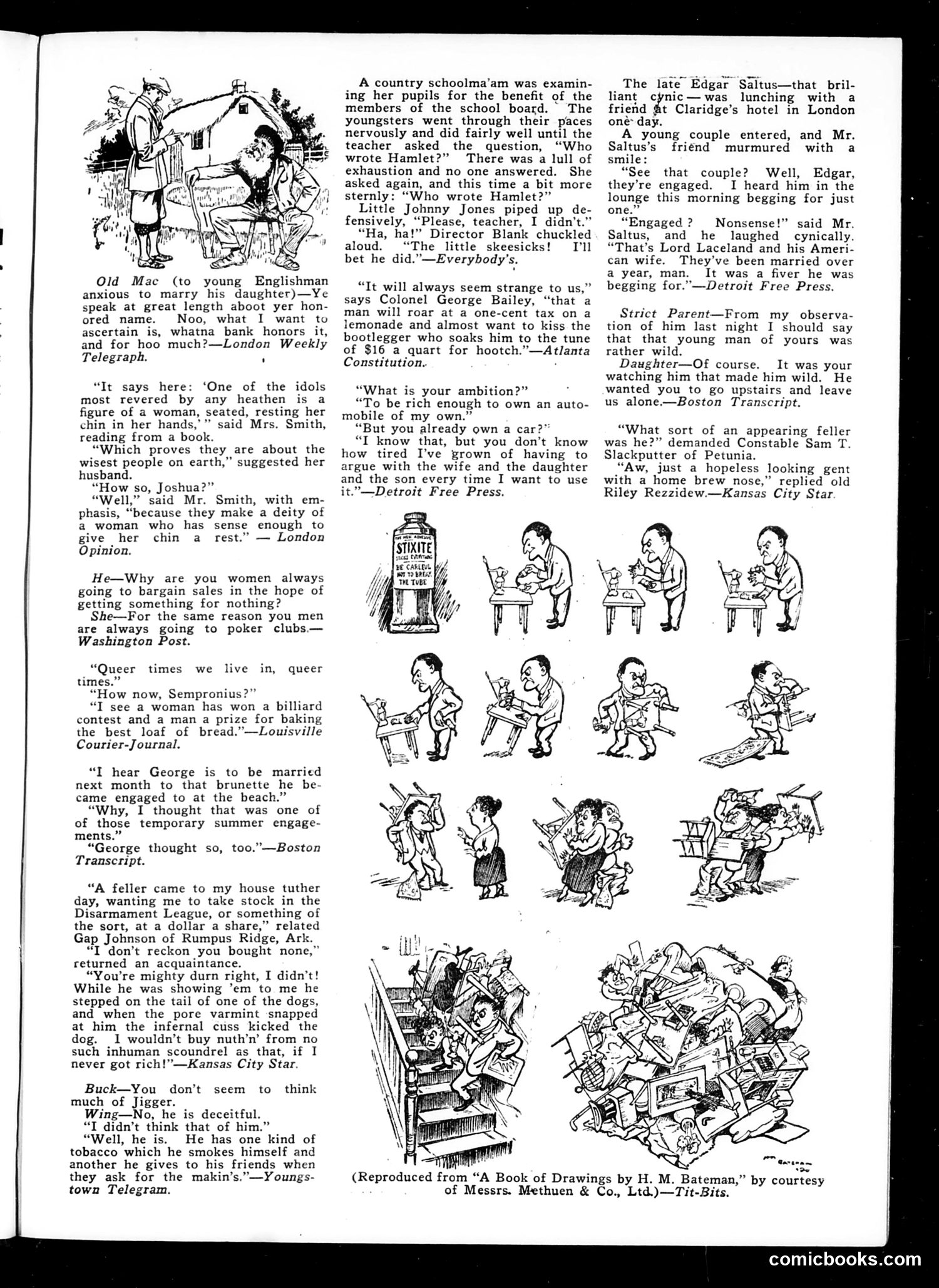
This page collects brief humorous anecdotes satirizing early 20th-century social conventions, primarily around gender roles and marriage. The main cartoon sequence (by H.M. Bateman) depicts a man progressively losing his composure while dining—a visual joke about domestic frustration, likely related to the recurring theme: **husbands' lack of autonomy**. Multiple anecdotes mock men's powerlessness in marriage: a husband must argue with wife and children to use "his" car; a groom begs money from his wife after one year of marriage; a suitor's value is measured by his bank account rather than character. Other jokes target women's shopping habits and competitive social behavior ("queer times" when a woman wins at billiards and a man bakes bread). One anecdote satirizes naive patriotism—a man refuses investment in a "Disarmament League" after the salesman kicks a dog. The page reflects **pre-1920s anxieties** about shifting gender roles and modern consumer culture, presenting marriage as a financial and social battlefield where men lose control and independence.
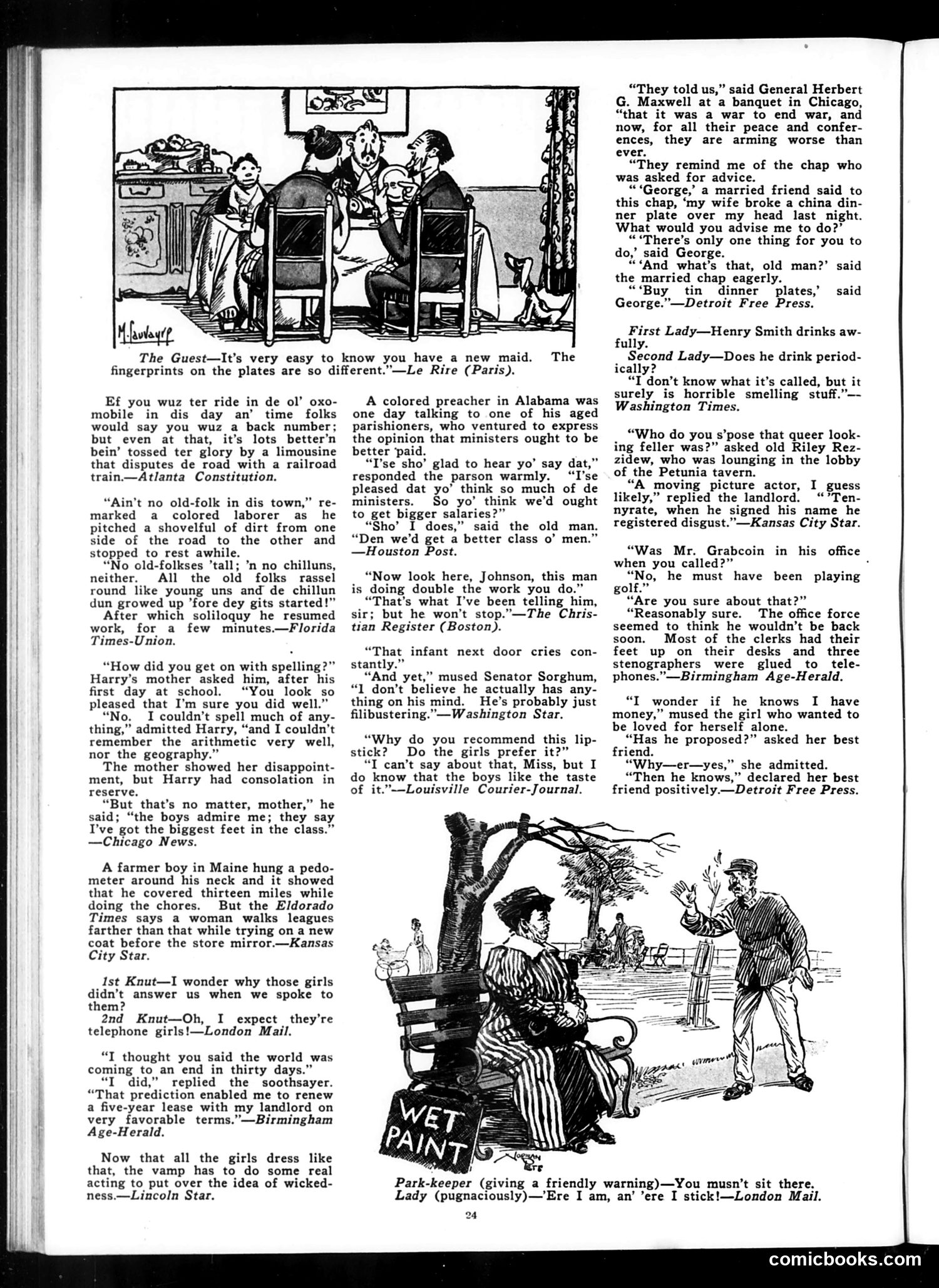
This page collects brief humorous anecdotes and jokes typical of early-20th-century American magazines. Key satire includes: **Main cartoon** (bottom): Shows a woman sitting by wet paint, with a park-keeper warning her. The joke plays on the phrase "wet paint"—the lady misinterprets the warning as a compliment about her appearance rather than a literal caution. **Notable jokes reference:** - Post-WWI disarmament hypocrisy (General Maxwell quip about peace conferences while nations rearm) - Class anxieties (new maids, automobiles vs. trains, women's fashion) - Racial stereotypes common to the era (exaggerated dialect in "colored" characters' speech) - Gender humor (women trying on coats, "vamps," lipstick preferences) - Senator Sorghum's filibustering reference (political gridlock) **The humor relies on:** Wordplay, misunderstandings, and social observation. The content reflects 1920s anxieties about modernization, changing gender roles, and post-war skepticism—all delivered through gentle satirical barbs at contemporary life.
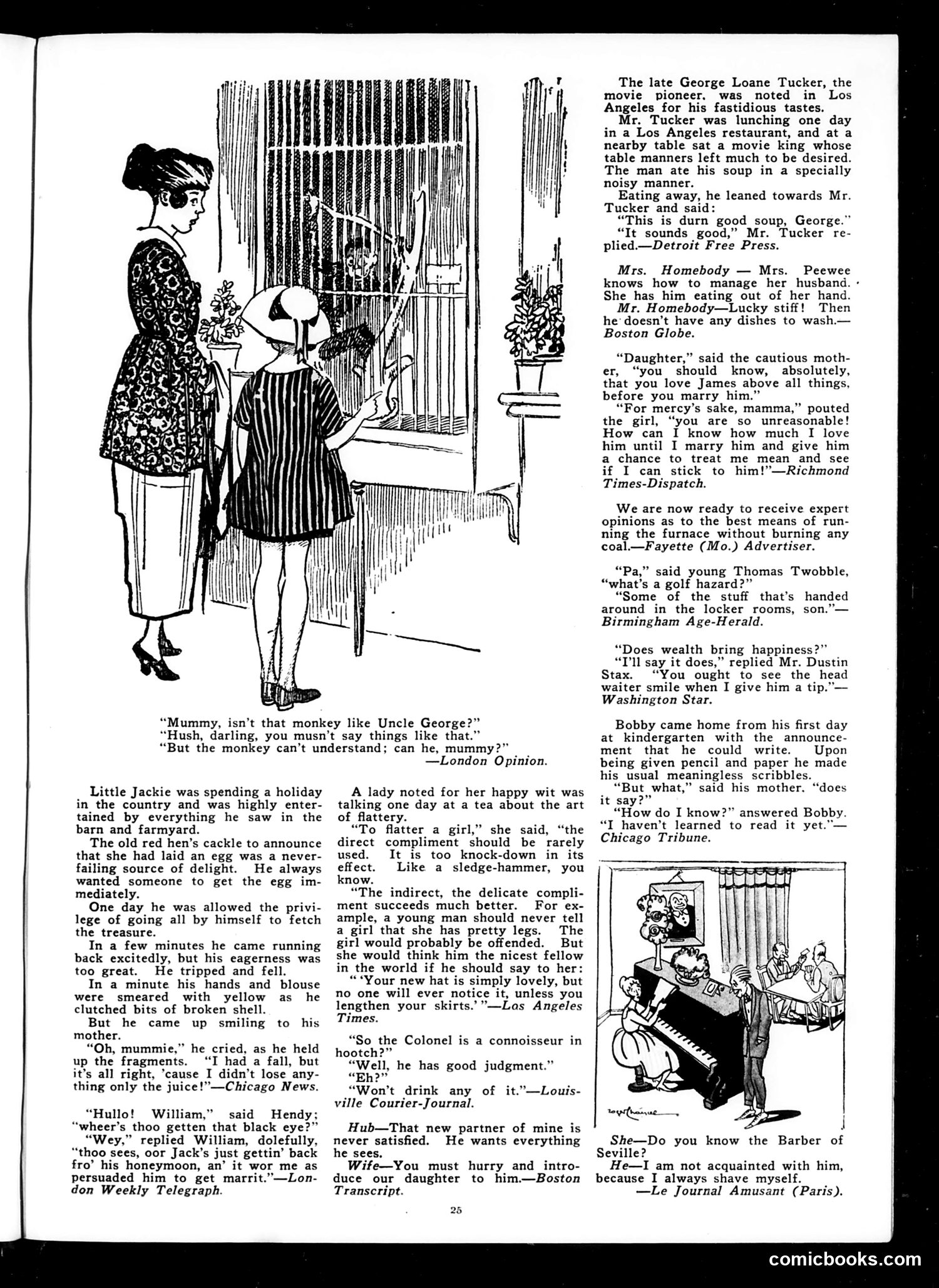
This page from *Judge* is primarily a **collection of brief humorous anecdotes and jokes** rather than political cartoons. The single illustration shows a woman and child at a birdcage, accompanying a joke about a child comparing Uncle George to a monkey. The humor reflects **early 20th-century domestic and social comedy**: children's innocent bluntness, marriage difficulties, flattery techniques, and etiquette mishaps. One anecdote mocks a movie producer's pretentiousness about soup quality. Another satirizes wealth's hollow rewards—a wealthy man's happiness measured only by a waiter's smile. The jokes assume a **middle-class, white, Anglo-American audience** concerned with propriety, courtship, and social climbing. There's no apparent political content; instead, the satire targets universal human foibles: vanity, marital discord, and pretension. The page exemplifies *Judge's* format: mixing visual gags with brief comic prose for quick entertainment rather than sustained social commentary.
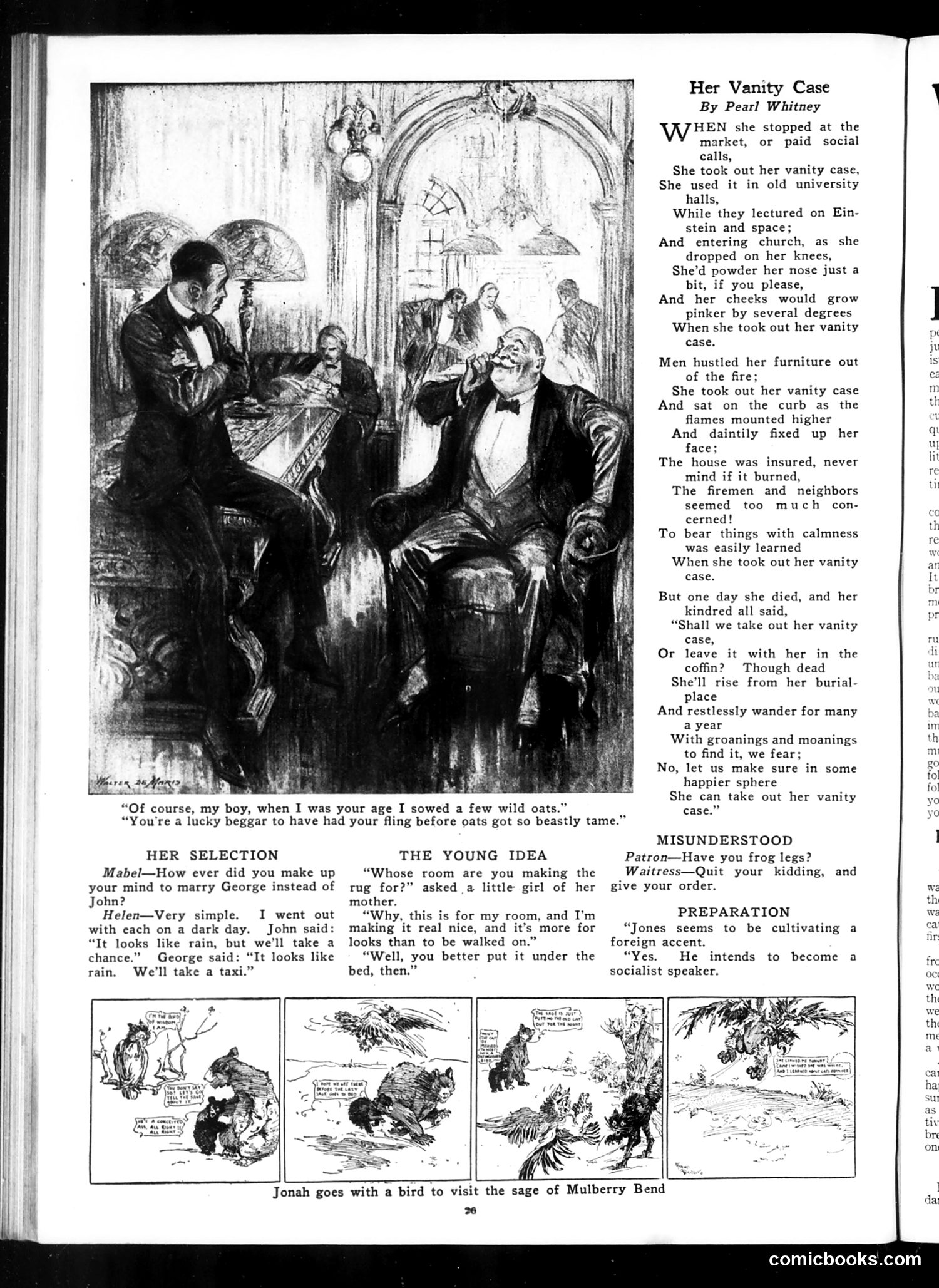
This page contains several short satirical pieces mocking early 20th-century social conventions and attitudes: **"Her Vanity Case"** (poem): Satirizes women's vanity and superficiality. The central joke is that a woman obsessively uses her compact mirror in every situation—lectures, church, even during a house fire—prioritizing appearance over genuine concerns. The dark humor culminates in suggesting she'll haunt the afterlife searching for it, implying her vanity defines her entire existence. **"Her Selection"** and other brief jokes mock courtship rituals and gender expectations of the era, with humor deriving from unexpected practical choices (taxi over risk-taking) determining marriage prospects. **"The Young Idea"** uses a child's innocent logic to expose adult pretense—the mother decorates a rug for appearance rather than function, prompting the child to suggest hiding it under the bed. The bottom comic strip appears unrelated, featuring a character named Jonah with a bird. Overall, the page reflects 1920s-era satire targeting feminine vanity, materialism, and social artifice.
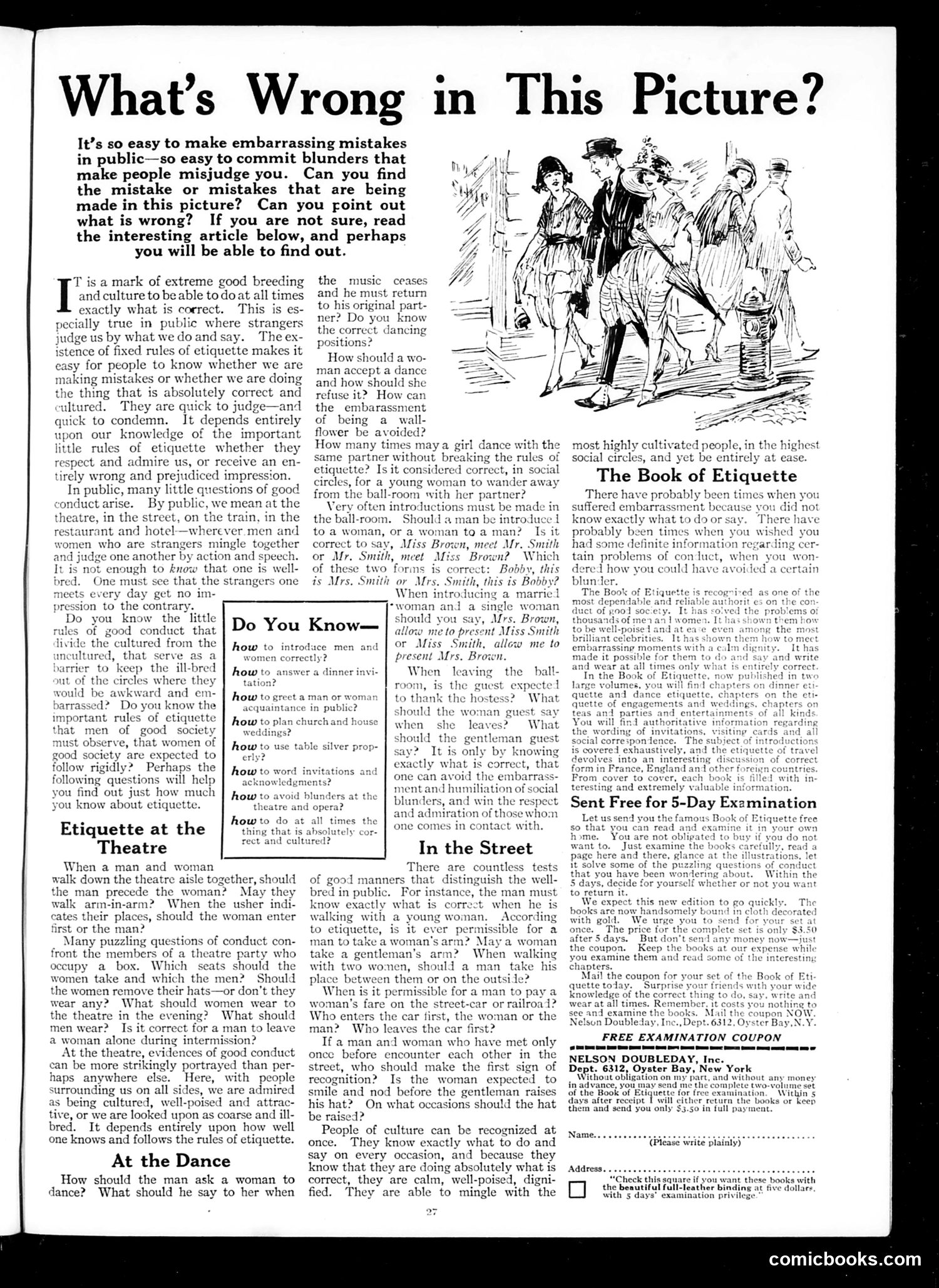
This is an etiquette instructional page from *Judge* magazine, not a political cartoon. The illustration shows a street scene with several figures in early 20th-century dress, apparently depicting a social situation where etiquette rules might be violated. The accompanying text presents a quiz about proper etiquette in various social settings—theaters, dances, and streets. Readers are challenged to identify mistakes in the illustrated scene and test their knowledge of contemporary social rules through questions about introductions, dance protocol, theater conduct, and proper behavior between men and women in public. The page promotes the magazine's book *The Book of Etiquette*, offering it free to readers who submit examination coupons. This reflects the era's emphasis on standardized rules of "good breeding" and social respectability as markers of class status.
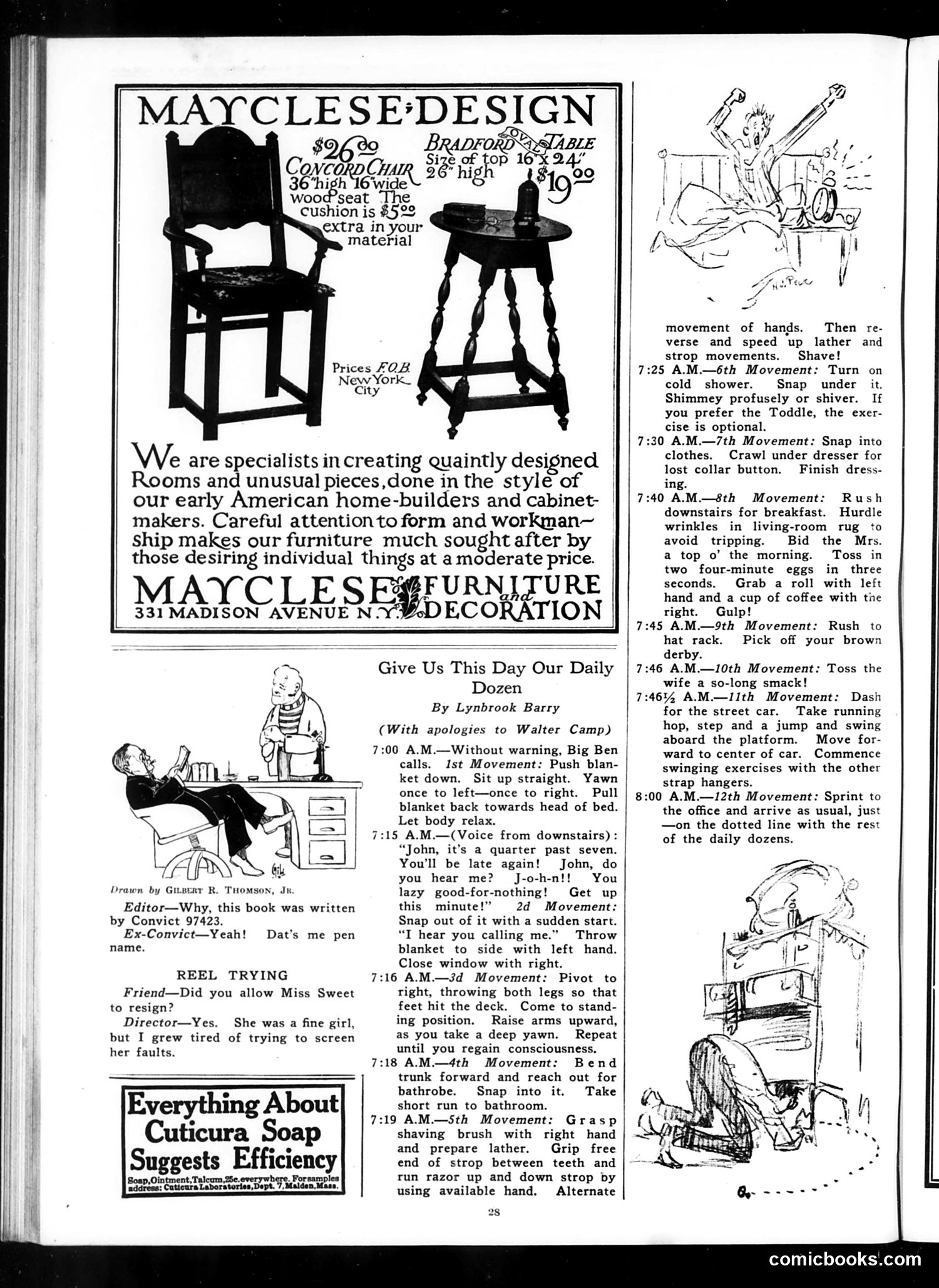
This page is primarily **advertising and humor columns**, not political satire. The main content is "Give Us This Day Our Daily Dozen" by Lynbrook Barry—a comedic parody of the popular "Daily Dozen" exercise routine (a 1920s fitness trend). It humorously reimagines morning exercises as frantic, ungraceful movements: being jolted awake by a nagging voice, diving out of bed, rushing through grooming and breakfast, and sprinting to catch the streetcar to work. The joke mocks both the exercise craze and the harried modern commuter's daily routine. The page also features **Mayclese Furniture** advertisements showcasing Colonial Revival chairs and tables, and sidebar jokes about convict authors and workplace resignations—typical light humor filler for magazines of this era. **No significant political commentary** is present; this reflects Judge magazine's shift toward general humor and advertising by the 1920s.
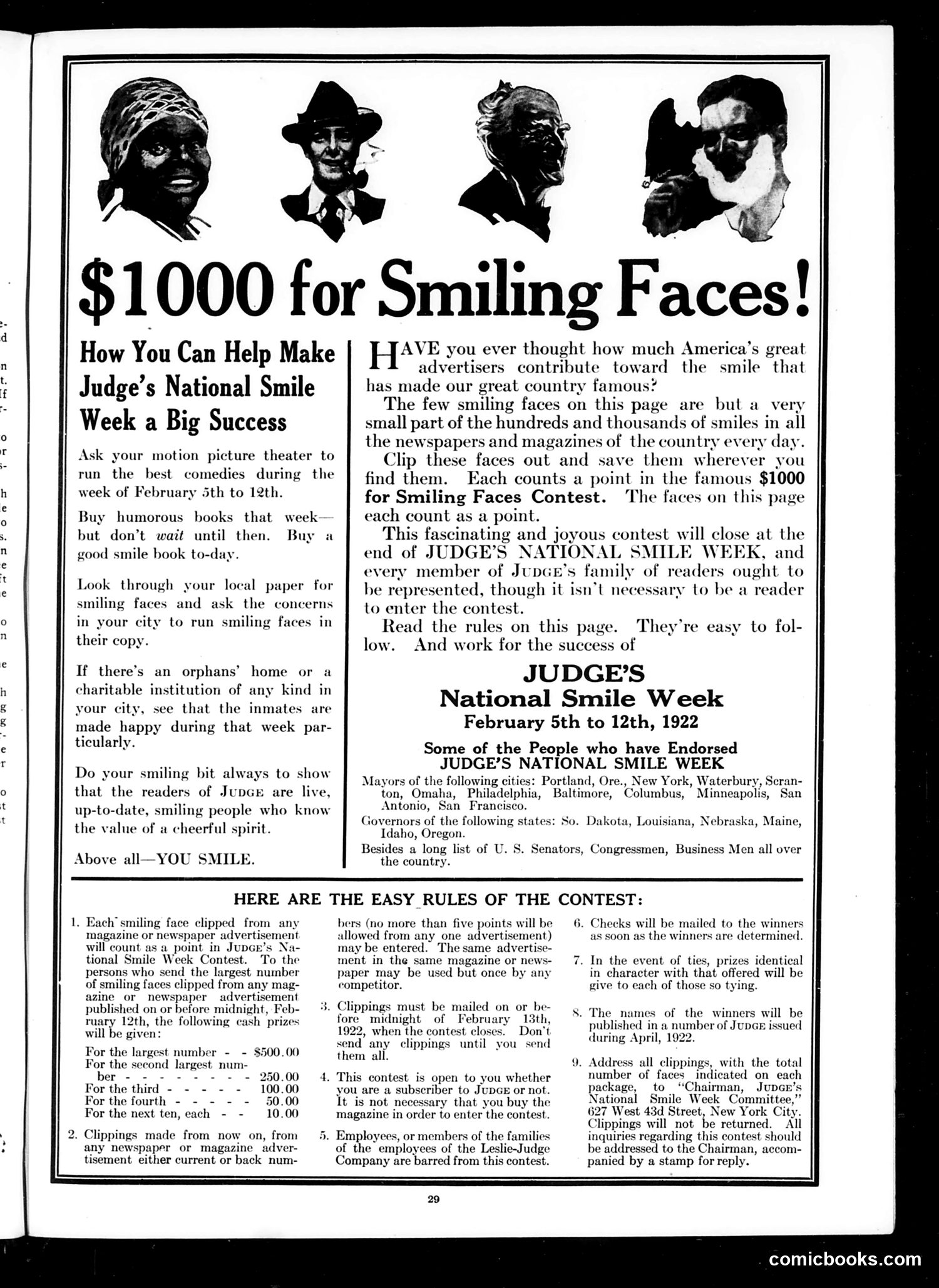
This page announces a promotional contest by *Judge* magazine, offering $1,000 in prizes for collecting clipped "smiling faces" from newspaper and magazine advertisements during February 5-12, 1922. The four illustrated faces at the top appear to be caricatured types—likely representing different ethnicities or social classes in exaggerated style typical of early-20th-century advertising and satire. The contest asks readers to collect these images as "points," framing it as celebrating American advertising's contribution to national cheerfulness. This reflects the era's boosterism and consumerism: the magazine presents smile-collecting and product-viewing as patriotic acts. The endorsements from mayors and governors suggest an organized, publicity-driven campaign. **Modern readers should note**: The caricatured faces employ racial and ethnic stereotyping common to the period but now recognized as offensive. The contest itself is essentially an advertising gimmick disguised as civic uplift—promoting consumption and media engagement as moral goods.
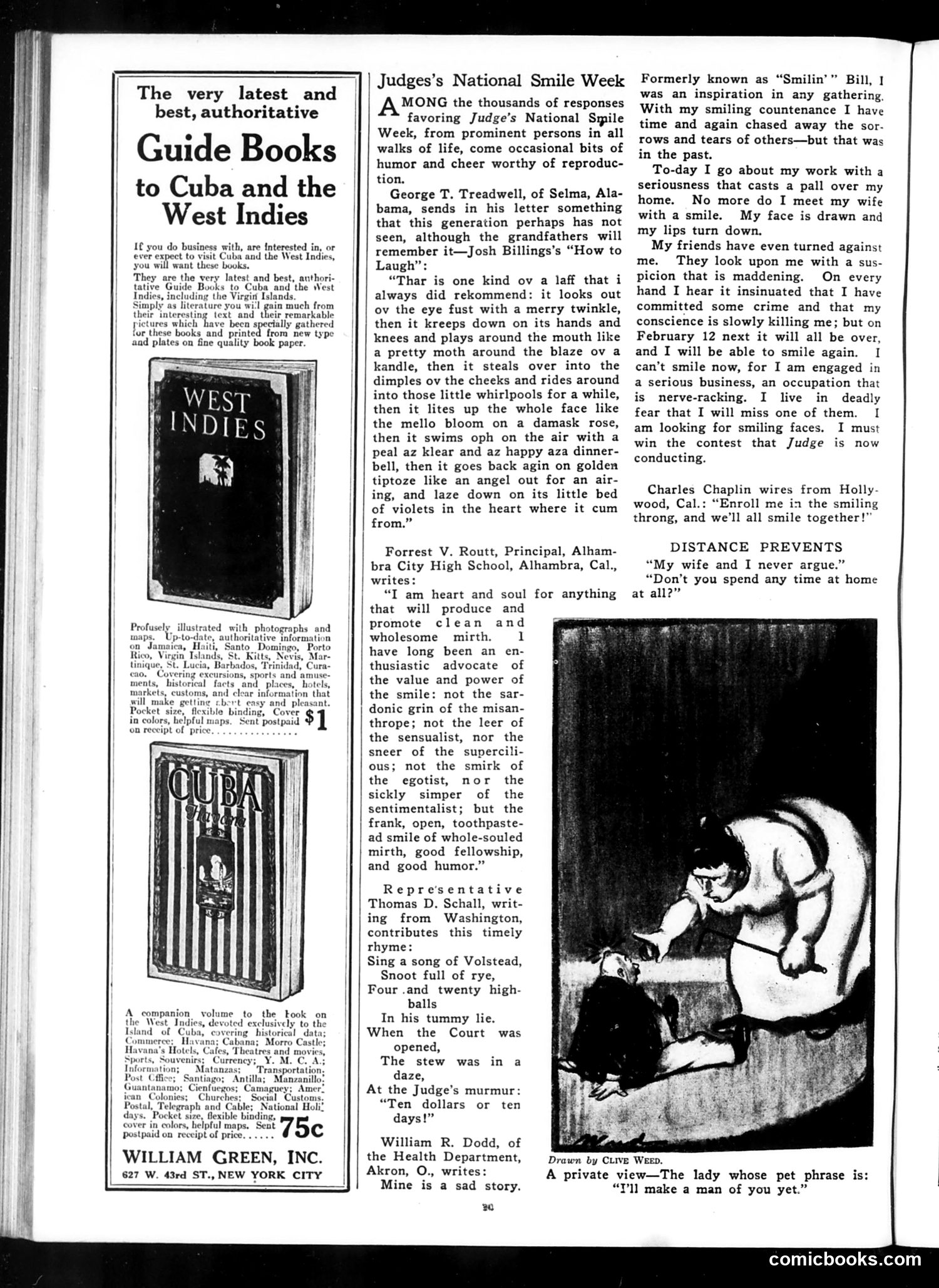
This page primarily features **advertisements for travel guides** (Cuba and West Indies) alongside **reader responses to Judge magazine's "National Smile Week" campaign**. The cartoon depicts **a woman with a small dog**, captioned "A private view—The lady whose pet phrase is: 'I'll make a man of you yet.'" This is a domestic humor joke playing on the era's gender dynamics—the woman's confident assertion about "making a man" of someone (likely a romantic partner or husband) is undermined by her petite stature and the presence of a small lap dog. The reader submissions celebrate smiling and good humor, including **a reference to Prohibition** (the Volstead Act): Thomas D. Schall's poem jokes about a drunk man ("Snoot full of rye") appearing in court, fined "$10 or 10 days"—satirizing both alcohol prohibition and judicial consequences. William R. Dodd's contribution creates dark irony: he claims to be "Smilin' Bill" but cannot smile because he's engaged in unnamed serious business he fears will be discovered, suggesting paranoia about hidden activity—likely bootlegging or other Prohibition-era illegal work.
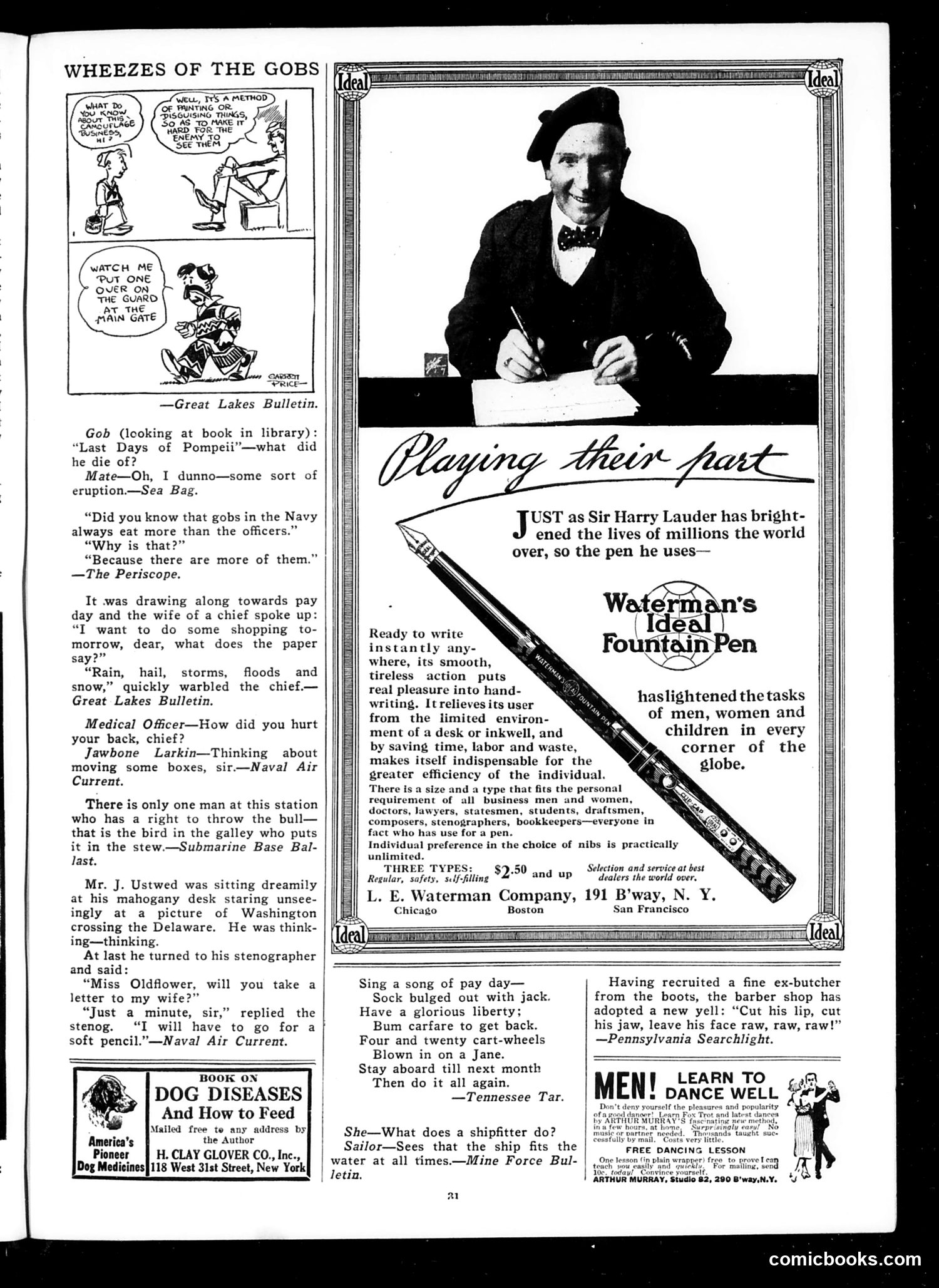
This page collects military humor ("gobs" = sailors) from various naval publications. The cartoons mock Navy life through enlisted men's perspectives: **Main Comic Strip** (top left): A sailor demonstrates sneaking past the main gate guard—depicting typical barracks mischief. **Standalone Jokes** reference: - Sailors' appetites (more men = more food consumed) - Navy hierarchy and officers - Pay day hardships and limited shore leave - The tedium of naval routine **Context for Modern Readers**: These jokes reflect WWI-era Navy culture, where enlisted men faced strict discipline, low pay, and limited liberty. The humor is self-deprecating but also subtly critical—depicting sailors as resourceful rule-breakers making the best of difficult conditions. The page also includes period advertising (Waterman fountain pens, dog medicine) and unrelated brief jokes from other military publications, typical of Judge's miscellaneous format. The satire isn't political but **social-class commentary**: enlisted men's complaints about authority, pay, and restrictions.
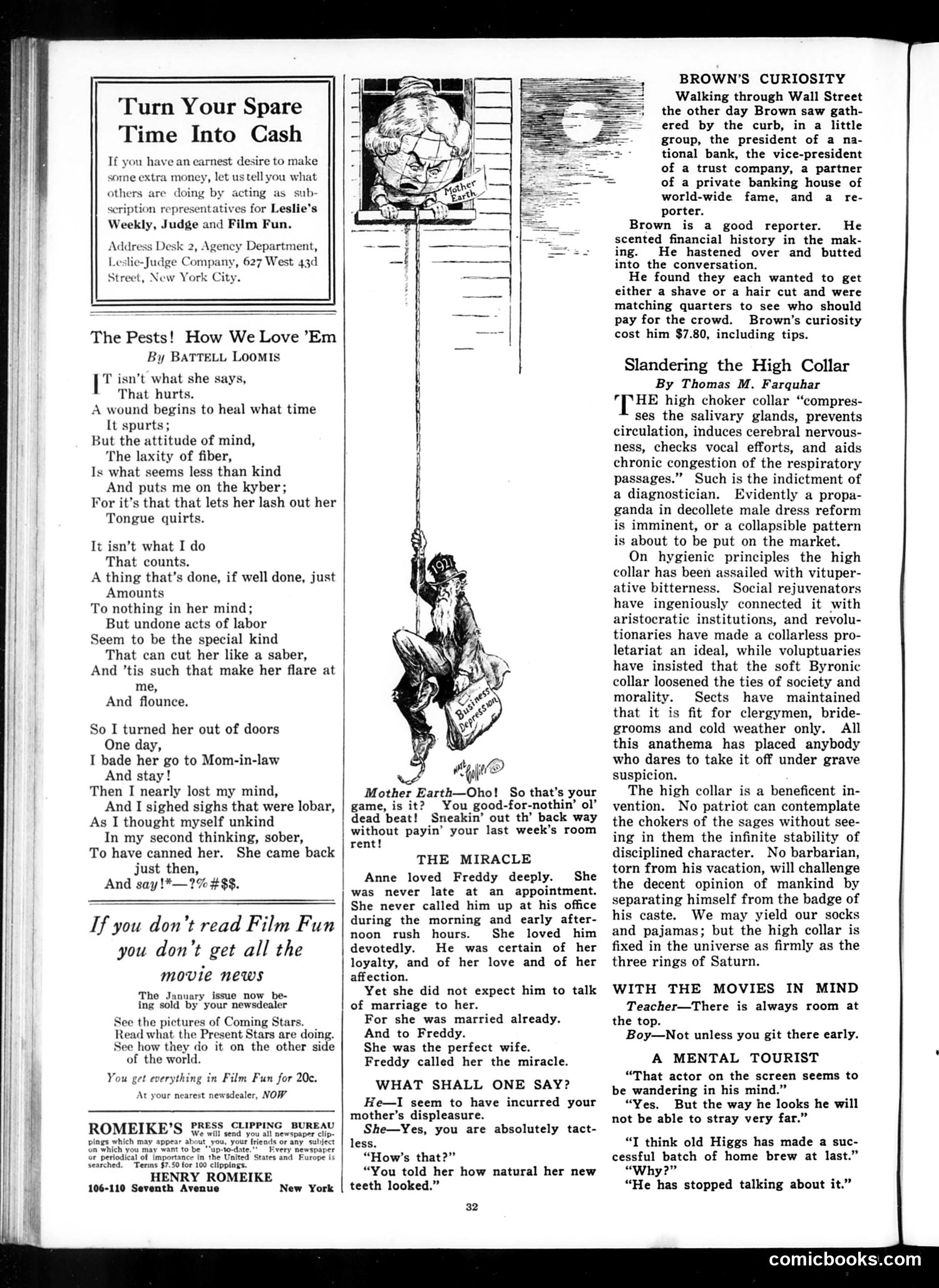
This page combines advertisements, poetry, short humor pieces, and satirical commentary typical of Judge magazine's format. **Key Content:** The main cartoon shows a landlady ("Mother Earth") confronting a tenant sneaking out without paying rent—a common early-20th-century urban scenario. The satire mocks both deadbeat renters and the desperation of landlords. **Short stories and jokes** include "The Miracle" (satirizing infidelity—a wife so perfect her husband doesn't realize she's already married to him) and "Brown's Curiosity" (mocking Wall Street financiers reduced to matching quarters for haircuts, undermining their perceived importance). **The essay "Slandering the High Collar"** satirizes recent pseudo-scientific health claims against formal neckwear, anticipating coming fashion reform movements. The **poetry by Battell Loomis** humorously depicts marital discord, emphasizing emotional neglect over actual wrongdoing. Overall, the page reflects Judge's focus on social satire targeting urban middle and upper-class hypocrisy, financial pretension, and domestic life.
This is a **house advertisement** for *Judge* magazine itself, not political satire. The page promotes the magazine's value by arguing that humor is psychologically beneficial—a "shock absorber" for life's hardships. The advertisement names real contributors: William Allen White (Kansas newspaper editor/political commentator), George Jean Nathan (theater critic), Heywood Broun (columnist), and Walter Prichard Eaton (drama critic)—lending credibility by association with established intellectuals. The pitch emphasizes *Judge*'s features: color illustrations, humor departments like "Stories to Tell" and "Digest of the World's Humor," and regular comic content. At 15 cents per copy, it frames subscription as a modest health investment—better disposition and "real happiness." The appeal is distinctly early-20th-century: humor as therapeutic necessity for modern life's stresses, and the prestige of pairing comedy with serious literary/journalistic figures. The ad reflects *Judge*'s self-positioning as witty but also intellectually respectable satire.
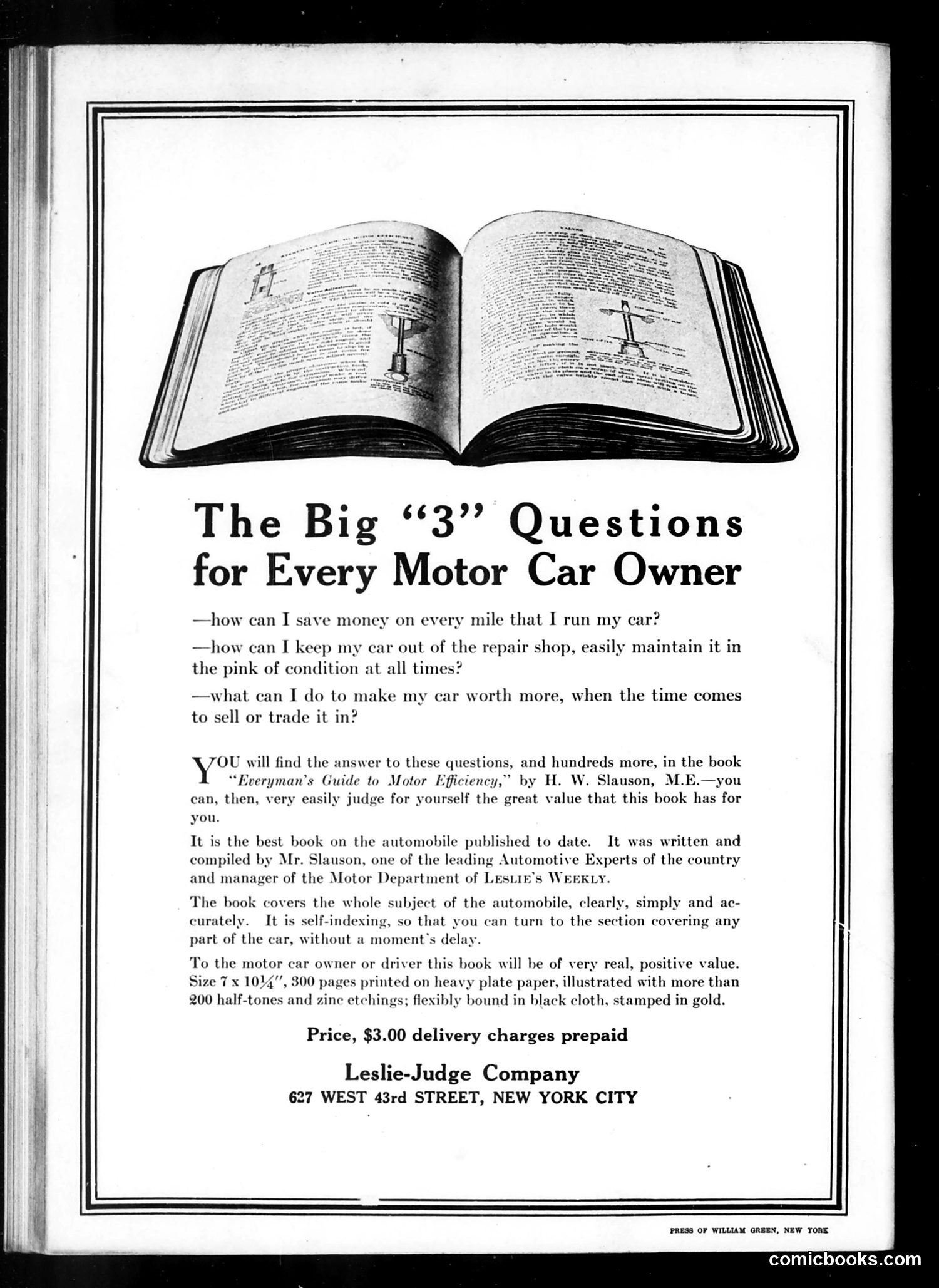
This is a full-page advertisement, not a cartoon. It promotes "Everyman's Guide to Motor Efficiency" by H.W. Slauson, described as the "best book on the automobile published to date." The ad addresses three concerns for 1920s car owners: fuel economy, maintenance, and resale value—practical worries for early automobile owners when cars were expensive and repairs frequent. The book, published by Leslie-Judge Company, costs $3.00 with prepaid delivery and features 300 pages with over 200 illustrations. Slauson is identified as an automotive expert and manager of Leslie's Weekly's Motor Department. The ad reflects the era's emerging car culture and the demand for accessible technical guidance as automobiles became more common household items.

I can see this is a Judge magazine page, but the image is almost entirely black with only minimal visible detail—a white border on the left edge and a few faint marks scattered throughout. The OCR text only provides a watermark ("comicbooks.com") with no actual article or cartoon content to analyze. Without legible text or discernible illustrations, I cannot identify specific figures, political references, or the satirical intent of any content on this page. The page appears to be either severely degraded, improperly scanned, or blank. To provide meaningful analysis of the cartoon's historical and political context, a clearer image would be necessary.