
Judge, 1921-12-31 · page 11 of 37
Judge — December 31, 1921 — page 11: what you’re looking at
What you’re looking at
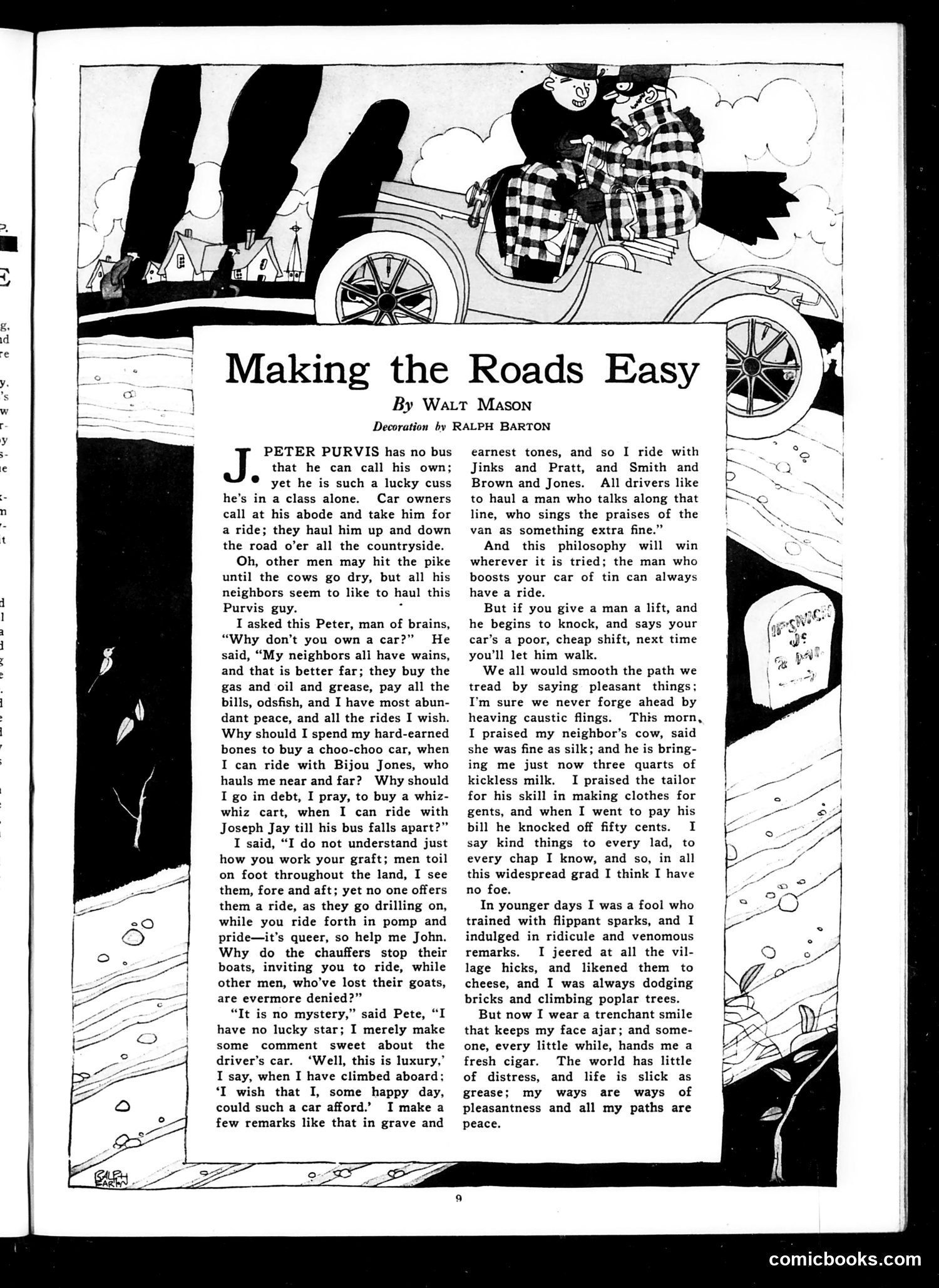
This is a humorous essay illustrated by Ralph Barton about social psychology and getting ahead through flattery and pleasantness. The protagonist, Peter Purvis, owns no car but constantly receives rides from neighbors. When asked why he doesn't buy his own automobile, he explains his philosophy: he compliments drivers' cars sincerely and effusively, and they happily oblige him with rides. The piece argues this strategy—praising others generously—works universally: he's gotten free milk by complimenting a cow, discount tailoring by praising a tailor's skills. The moral is that kindness, compliments, and pleasant remarks open doors that money alone cannot. The author contrasts his younger self, who mocked villagers and faced hostility, with his current approach of universal flattery, which brings him peace and social advantage. It's essentially advice literature wrapped in satire—advocating calculated pleasantness as a practical life strategy in the 1920s automobile age.
📄 Transcribed text from this page (OCR, searchable)
Machine-transcribed from the original scan — historical spelling and the odd misread are preserved.
Making the Roads Easy By Watt Mason Decoration by RALPH BARTON that he can call his own; yet he is such a lucky cuss he’s in a class alone. Car owners call at his abode and take him for a ride; they haul him up and down the road o’er all the countryside. Oh, other men may hit the pike until the cows go dry, but all his neighbors seem to like to haul this Purvis guy. . I asked this Peter, man of brains, “Why don’t you own acar?” He said, “My neighbors ali have wains, and that is better far; they buy the gas and oil and grease, pay all the bills, odsfish, and I have most abun- dant peace, and all the rides I wish. Why should I spend my hard-earned bones to buy a choo-choo car, when I can ride with Bijou Jones, who hauls me near and far? Why should I go in debt, I pray, to buy a whiz- whiz cart, when I can ride with Joseph Jay till his bus falls apart?” I said, “I do not understand just how you work your graft; men toil on foot throughout the land, I see them, fore and aft; yet no one offers them a ride, as they go drilling on, while you ride forth in pomp and pride—it’s queer, so help me John. Why do the chauffers stop their boats, inviting you to ride, while other men, who’ve lost their goats, are evermore denied?” “It is no mystery,” said Pete, “I have no lucky star; I merely make some comment sweet about the driver’s car. ‘Well, this is luxury,” I say, when I have climbed aboard: ‘I wish that I, some happy day, could such a car afford.’ I make a few remarks like that in grave and J PETER PURVIS has no bus e a ° come earnest tones, and so I ride with Jinks and Pratt, and Smith and Brown and Jones. All drivers like to haul a man who talks along that line, who sings the praises of the van as something extra fine.” And this philosophy will win wherever it is tried; the man who boosts your car of tin can always have a ride. But if you give a man a lift, and he begins to knock, and says your car’s a poor, cheap shift, next time you'll let him walk. We all would smooth the path we tread by saying pleasant things; I’m sure we never forge ahead by heaving caustic flings. This morn, I praised my neighbor’s cow, said she was fine as silk; and he is bring- ing me just now three quarts of kickless milk. I praised the tailor for his skill in making clothes for gents, and when I went to pay his bill he knocked off fifty cents. I say kind things to every lad, to every chap I know, and so, in all this widespread grad I think I have no foe. In younger days I was a fool who trained with flippant sparks, and I indulged in ridicule and venomous remarks. I jeered at all the vil- lage hicks, and likened them to cheese, and I was always dodging bricks and climbing poplar trees. But now I wear a trenchant smile that keeps my face ajar; and some- one, every little while, hands me a fresh cigar. The world has little of distress, and life is slick as grease; my ways are ways of pleasantness and all my paths are peace, comicbooks.com