
Judge, 1921-12-31 · page 9 of 37
Judge — December 31, 1921 — page 9: what you’re looking at
What you’re looking at
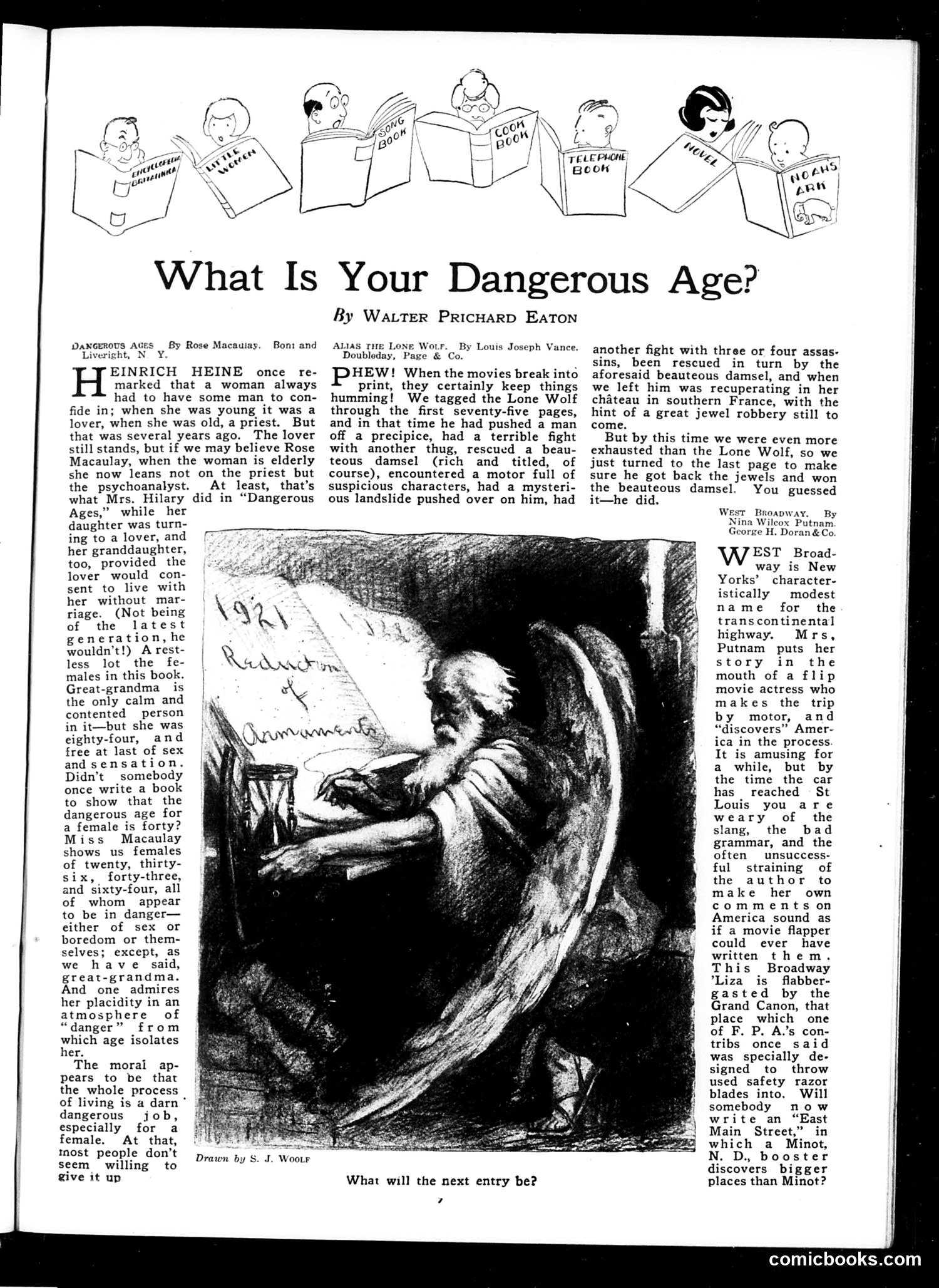
This page reviews three books, using satirical commentary typical of Judge magazine's literary criticism. **Top Section - "Dangerous Ages":** The cartoon header shows various figures hidden behind books labeled with different genres/interests, illustrating Rose Macaulay's novel about women of different ages (20 to 64) who are all restless and seeking either romantic relationships or psychological analysis. The reviewer satirizes that women face constant "danger" from boredom and desire throughout their lives, with only the elderly finding peace. **Middle Review - "Alias the Lone Wolf":** Mocks adventure fiction adapted from film, ridiculing the relentless action (fights, rescues, chases) as exhausting and formulaic. The reviewer humorously admits skipping to the ending to confirm the predictable happy resolution. **Bottom Review - "West Broadway":** Criticizes a novel narrated by a frivolous movie actress discovering America by car. The satire targets the author's failed attempt to capture authentic "flapper" dialogue and commentary—suggesting that real movie actresses couldn't write such strained, affected prose. The page reflects 1920s literary snobbery toward popular entertainment and mass-market fiction.
📄 Transcribed text from this page (OCR, searchable)
Machine-transcribed from the original scan — historical spelling and the odd misread are preserved.
DANGEROUS AGES By Rose Macaulay. Bont and Liveright, No Y. EINRICH HEINE once re- marked that a woman always had to have some man to con- fide in; when she was young it was a lover, when she was old, a priest. But that was several years ago. The lover still stands, but if we may believe Rose Macaulay, when the woman is elderly she now leans not on the priest but the psychoanalyst. At least, that’s what Mrs. Hilary did in “Dangerous Ages,” while her daughter was turn- ing to a lover, and her granddaughter, too, provided the lover would con- sent to live with her without mar- riage. (Not being of the latest generation, he wouldn’t!) A rest- less lot the fe- males in this book. Great-grandma is the only calm and contented person in it—but she was eighty-four, and free at last of sex andsensation. Didn’t somebody once write a book to show that the dangerous age for a female is forty? Miss Macaulay shows us females of twenty, thirty- six, forty-three, and sixty-four, all of whom appear to be in danger— either of sex or boredom or them- selves; except, as we have said, great-grandma. And one admires her placidity in an atmosphere of “danger” from which age isolates her. The morai ap- pears to be thar the whole process of living is a darn * dangerous job, especially for a female. At that, tnost people don’t seem willing to give it up Drawn by S. J. Woour \ Re Sorck® ‘ie «\ Your Dangerous Age? By Water PricHarD Eaton ALIAS THE Lone Wotr. By Louis Joseph Vance. Doubleday, Page & Co. HEW! When the movies break into print, they certainly keep things humming! We tagged the Lone Wolf through the first seventy-five pages, and in that time he had pushed a man off a precipice, had a terrible fight with another thug, rescued a beau- teous damsel (rich and titled, of course), encountered a motor full of suspicious characters, had a mysteri- ous landslide pushed over on him, had What will the next entry be? 7 another fight with three or four assas- sins, been rescued in turn by the aforesaid beauteous damsel, and when we left him was recuperating in her chateau in southern France, with the hint of a great jewel robbery still to come. But by this time we were even more exhausted than the Lone Wolf, so we just turned to the last page to make sure he got back the jewels and won the beauteous damsel. You guessed it—he did. We: Broapway. By a Wilcox Putnam. Jeorge H. Doran & Co. EST Broad- way is New Yorks’ character- istically modest name for the transcontinental highway. Mrs, Putnam puts her story in the mouth of a flip movie actress who makes the trip by motor, and “discovers” Amer- ica in the process. It is amusing for a while, but by the time the car has_ reached St Louis you are weary of the slang, the bad grammar, and the often unsuccess- ful straining of the author to make her own comments on America sound as if a movie flapper could ever have written them. This Broadway *Liza is flabber- gasted by the Grand Canon, that place which one of F. P. A.’s con- tribs once said was specially de- signed to throw used safety razor blades into, Will somebody now write an “East Main Street,” in which a Minot, N. D., booster discovers bigger places than Minot? comicbooks.com