
Judge, 1921-12-31 · page 5 of 37
Judge — December 31, 1921 — page 5: what you’re looking at
What you’re looking at
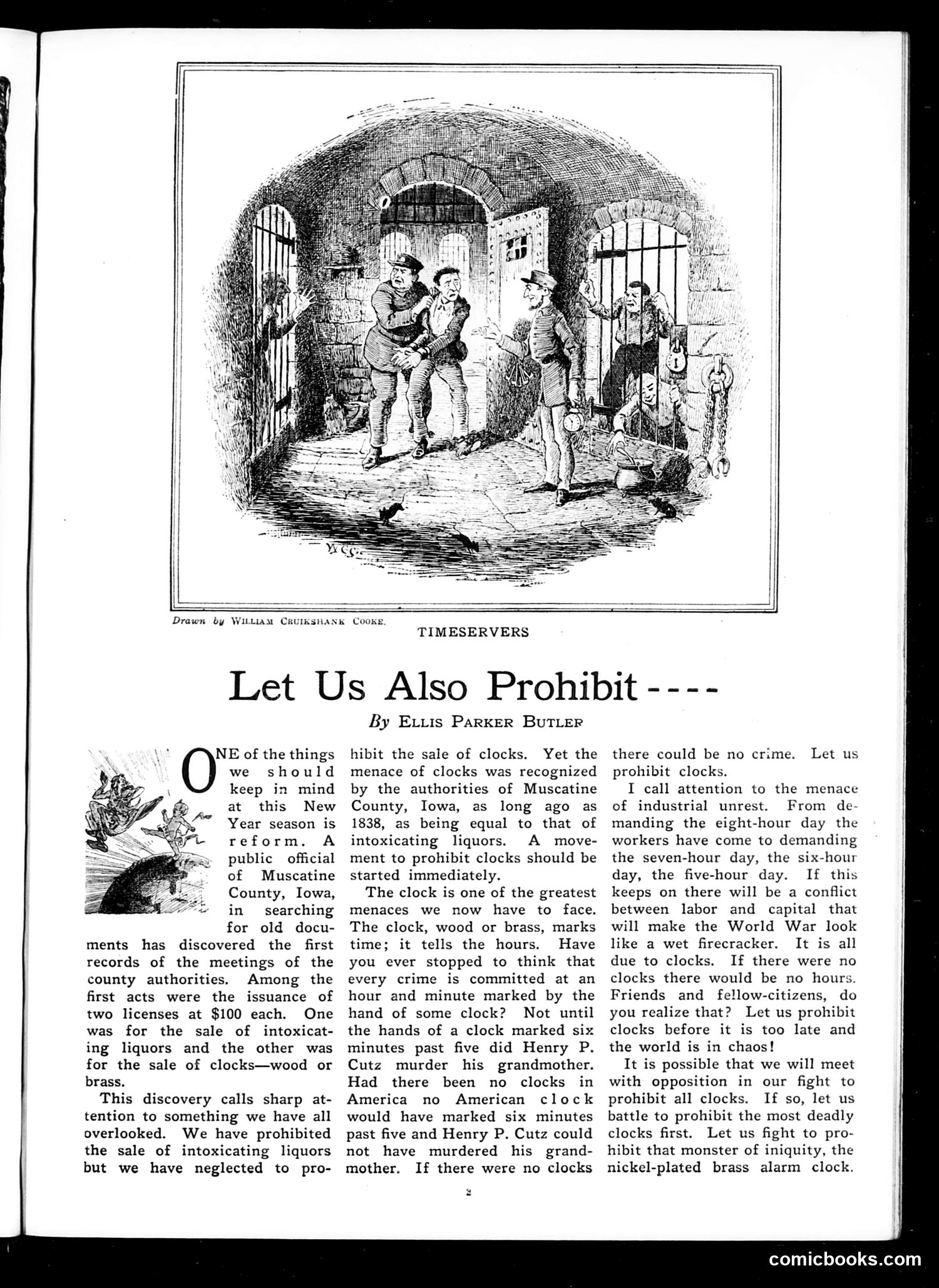
This satirical piece mocks the Prohibition movement through absurdist logic. Butler argues that if society prohibits alcohol to prevent crime, it should logically prohibit clocks too—since crimes occur at specific times marked by clocks. He cites a fictional case: Henry P. Cutz murdered his grandmother at "six minutes past five," implying the clock enabled the crime. The cartoon (drawn by William Makepeace Thackeray Cooke) depicts what appears to be a jail or institutional setting with uniformed officials, likely illustrating the absurd consequences of over-regulation. Butler's satire attacks Prohibition advocates as illogical, suggesting their reasoning—that removing a tool prevents wrongdoing—is as ridiculous as blaming timepieces for crime. It's commentary on the Prohibition Era's (1920-1933) sweeping social control.
📄 Transcribed text from this page (OCR, searchable)
Machine-transcribed from the original scan — historical spelling and the odd misread are preserved.
Drawn by Witiam CRUIKSHANK Cooke. TIMESERVERS Let Us Also Prohibit ---- \\t NE of the things we should \ keep in mind & at this New . Year season is reform. A public official of Muscatine County, Iowa, in searching for old docu- ments has discovered the first records of the meetings of the county authorities. Among the first acts were the issuance of two licenses at $100 each. One was for the sale of intoxicat- ing liquors and the other was for the sale of clocks—wood or brass, This discovery calls sharp at- tention to something we have all overlooked. We have prohibited the sale of intoxicating liquors but we have neglected to pro- By Extis PARKER BUTLEP hibit the sale of clocks. Yet the menace of clocks was recognized by the authorities of Muscatine County, Iowa, as long ago as 1838, as being equal to that of intoxicating liquors. A move- ment to prohibit clocks should be started immediately. The clock is one of the greatest menaces we now have to face. The clock, wood or brass, marks time; it tells the hours. Have you ever stopped to think that every crime is committed at an hour and minute marked by the hand of some clock? Not until the hands of a clock marked six minutes past five did Henry P. Cutz murder his grandmother. Had there been no clocks in America no American clock would have marked six minutes past five and Henry P. Cutz could not have murdered his grand- mother. If there were no clocks there could be no crime. Let us prohibit clocks. I call attention to the menace of industrial unrest. From de- manding the eight-hour day the workers have come to demanding the seven-hour day, the six-hour day, the five-hour day. If this keeps on there will be a conflict between labor and capital that will make the World War look like a wet firecracker. It is all due to clocks. If there were no clocks there would be no hours. Friends and fellow-citizens, do you realize that? Let us prohibit clocks before it is too late and the world is in chaos! It is possible that we will meet with opposition in our fight to prohibit all clocks. If so, let us battle to prohibit the most deadly clocks first. Let us fight to pro- hibit that monster of iniquity, the nickel-plated brass alarm clock. comicbooks.com