
Judge, 1921-12-31 · page 12 of 37
Judge — December 31, 1921 — page 12: what you’re looking at
What you’re looking at
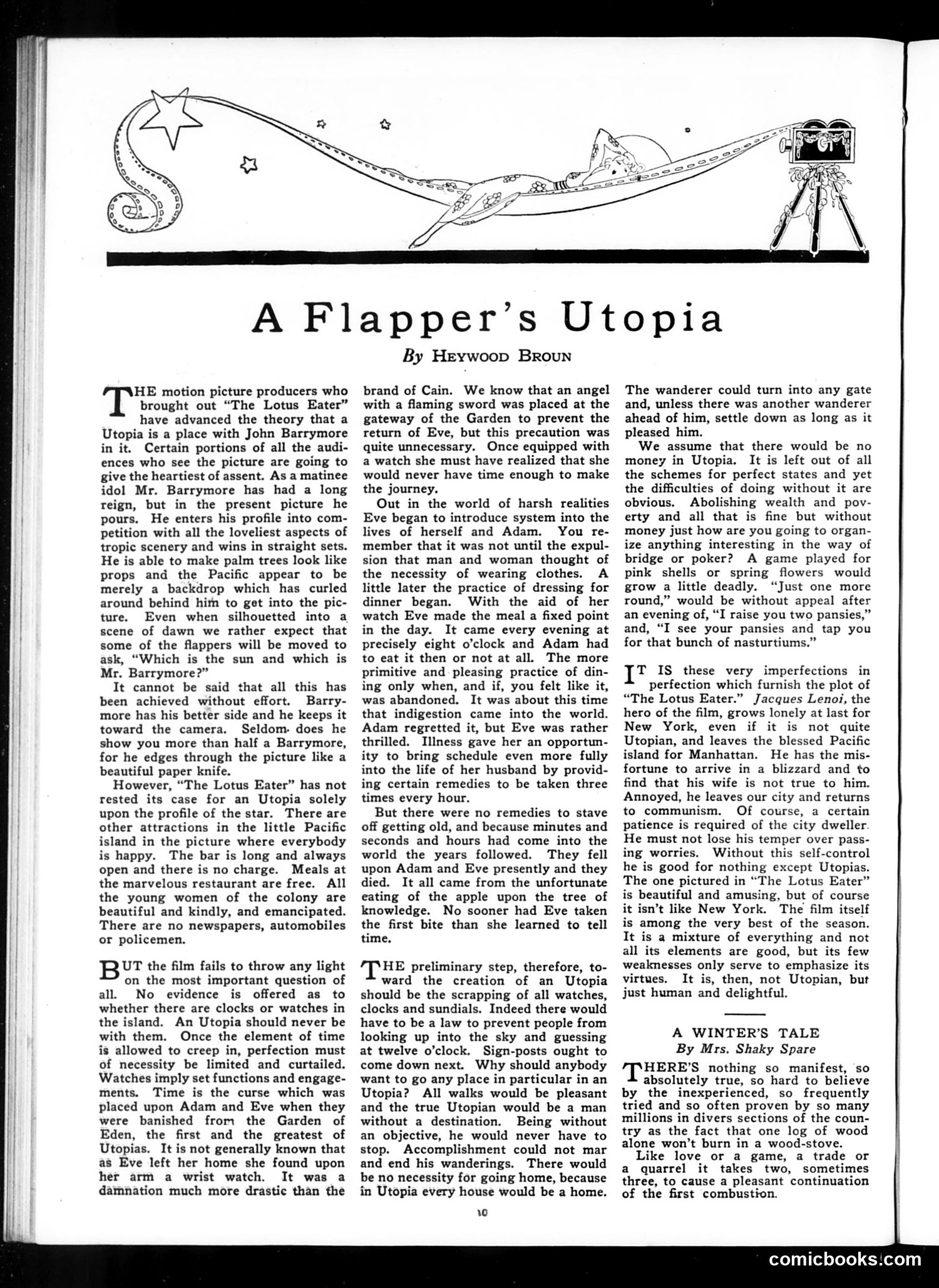
This is a film review by Heywood Broun satirizing both the 1921 movie "The Lotus Eater" and 1920s ideals of paradise. **The Setup:** The piece mocks movie producers' claim that a utopia simply needs actor John Barrymore in it. Broun facetiously agrees, joking that Barrymore's famous profile is so striking it outshines tropical scenery—he "edges through the picture like a beautiful paper knife," showing only his best side. **The Satire:** The film depicts an island paradise with free food, alcohol, beautiful women, and no newspapers or police. Broun's real critique: it fails to address whether clocks exist there. He argues time-keeping devices are civilization's original curse, tracing them to Eve's wrist watch after Eden's expulsion. The watch imposed schedules, dress codes, mealtimes, and ultimately mortality itself—civilization's burdens. **The Point:** For modern readers, this reflects 1920s "Flapper" culture's rebellion against Victorian schedules and constraints. Broun suggests true utopia requires rejecting not just material poverty but temporal discipline itself—a witty commentary on whether freedom from society's demands is actually achievable.
📄 Transcribed text from this page (OCR, searchable)
Machine-transcribed from the original scan — historical spelling and the odd misread are preserved.
A Flapper’s Utopia By Heywoop Broun HE motion picture producers who brought out “The Lotus Eater” have advanced the theory that a Utopia is a place with John Barrymore in it. Certain portions of all the audi- ences who see the picture are going to give the heartiest of assent. As a matinee idol Mr. Barrymore has had a long reign, but in the present picture he pours. He enters his profile into com- petition with all the loveliest aspects of tropic scenery and wins in straight sets. He is able to make palm trees look like props and the Pacific appear to be merely a backdrop which has curled around behind him to get into the pic- ture. Even when silhouetted into a scene of dawn we rather expect that some of the flappers will be moved to ask, “Which is the sun and which is Mr. Barrymore?” It cannot be said that all this has been achieved without effort. Barry- more has his better side and he keeps it toward the camera. Seldom. does he show you more than half a Barrymore, for he edges through the picture like a beautiful paper knife. However, “The Lotus Eater” has not rested its case for an Utopia solely upon the profile of the star. There are other attractions in the little Pacific island in the picture where everybody is happy. The bar is long and always open and there is no charge. Meals at the marvelous restaurant are free. All the young women of the colony are beautiful and kindly, and emancipated. There are no newspapers, automobiles or policemen. Bur the film fails to throw any light on the most important question of all. No evidence is offered as to whether there are clocks or watches in the island. An Utopia should never be with them. Once the element of time is allowed to creep in, perfection must of necessity be limited and curtailed. Watches imply set functions and engage- ments. Time is the curse which was placed upon Adam and Eve when they were banished from the Garden of Eden, the first and the greatest of Utopias. It is not generally known that as Eve left her home she found upon her arm a wrist watch. It was a damnation much more drastic than the brand of Cain. We know that an angel with a flaming sword was placed at the gateway of the Garden to prevent the return of Eve, but this precaution was quite unnecessary. Once equipped with a watch she must have realized that she would never have time enough to make the journey. Out in the world of harsh realities Eve began to introduce system into the lives of herself and Adam. You re- member that it was not until the expul- sion that man and woman thought of the necessity of wearing clothes. A little later the practice of dressing for dinner began. With the aid of her watch Eve made the meal a fixed point in the day. It came every evening at precisely eight o’clock and Adam had to eat it then or not at all. The more primitive and pleasing practice of din- ing only when, and if, you felt like it, was abandoned. It was about this time that indigestion came into the world. Adam regretted it, but Eve was rather thrilled. Illness gave her an opportun- ity to bring schedule even more fully into the life of her husband by provid- ing certain remedies to be taken three times every hour. But there were no remedies to stave off getting old, and because minutes and seconds and hours had come into the world the years followed. They fell upon Adam and Eve presently and they died. It all came from the unfortunate eating of the apple upon the tree of knowledge. No sooner had Eve taken the first bite than she learned to tell time. ‘THE preliminary step, therefore, to- ward the creation of an Utopia should be the scrapping of all watches, clocks and sundials. Indeed there would have to be a law to prevent people from looking up into the sky and guessing at twelve o’clock. Sign-posts ought to come down next. Why should anybody want to go any place in particular in an Utopia? All walks would be pleasant and the true Utopian would be a man without a destination. Being without an objective, he would never have to stop. Accomplishment could not mar and end his wanderings. There would be no necessity for going home, because in Utopia every house would be a home. 10 The wanderer could turn into any gate and, unless there was another wanderer ahead of him, settle down as long as it pleased him. We assume that there would be no money in Utopia. It is left out of all the schemes for perfect states and yet the difficulties of doing without it are obvious. Abolishing wealth and pov- erty and all that is fine but without money just how are you going to organ- ize anything interesting in the way of bridge or poker? A game played for pink shells or spring flowers would grow a little deadly. “Just one more round,” would be without appeal after an evening of, “I raise you two pansies,” and, “I see your pansies and tap you for that bunch of nasturtiums.” Jt IS these very imperfections in perfection which furnish the plot of “The Lotus Eater.” Jacques Lenoi, the hero of the film, grows lonely at last for New York, even if it is not quite Utopian, and leaves the blessed Pacific island for Manhattan. He has the mis- fortune to arrive in a blizzard and to find that his wife is not true to him. Annoyed, he leaves our city and returns to communism. Of course, a certain patience is required of the city dweller. He must not lose his temper over pass- ing worries. Without this self-control he is good for nothing except Utopias. The one pictured in “The Lotus Eater” is beautiful and amusing, but of course it isn’t like New York. The film itself is among the very best of the season. It is a mixture of everything and not all its elements are good, but its few weaknesses only serve to emphasize its virtues. It is, then, not Utopian, but just human and delightful. A WINTER'S TALE By Mrs. Shaky Spare (THERE'S nothing so manifest, so absolutely true, so hard to believe by the inexperienced, so frequently tried and so often proven by so many millions in divers sections of the coun- try as the fact that one log of wood alone won’t burn in a wood-stove. Like love or a game, a trade or a quarrel it takes two, sometimes three, to cause a pleasant continuation of the first combustion. comicbooks!com