
Judge, 1921-12-31 · page 18 of 37
Judge — December 31, 1921 — page 18: what you’re looking at
What you’re looking at
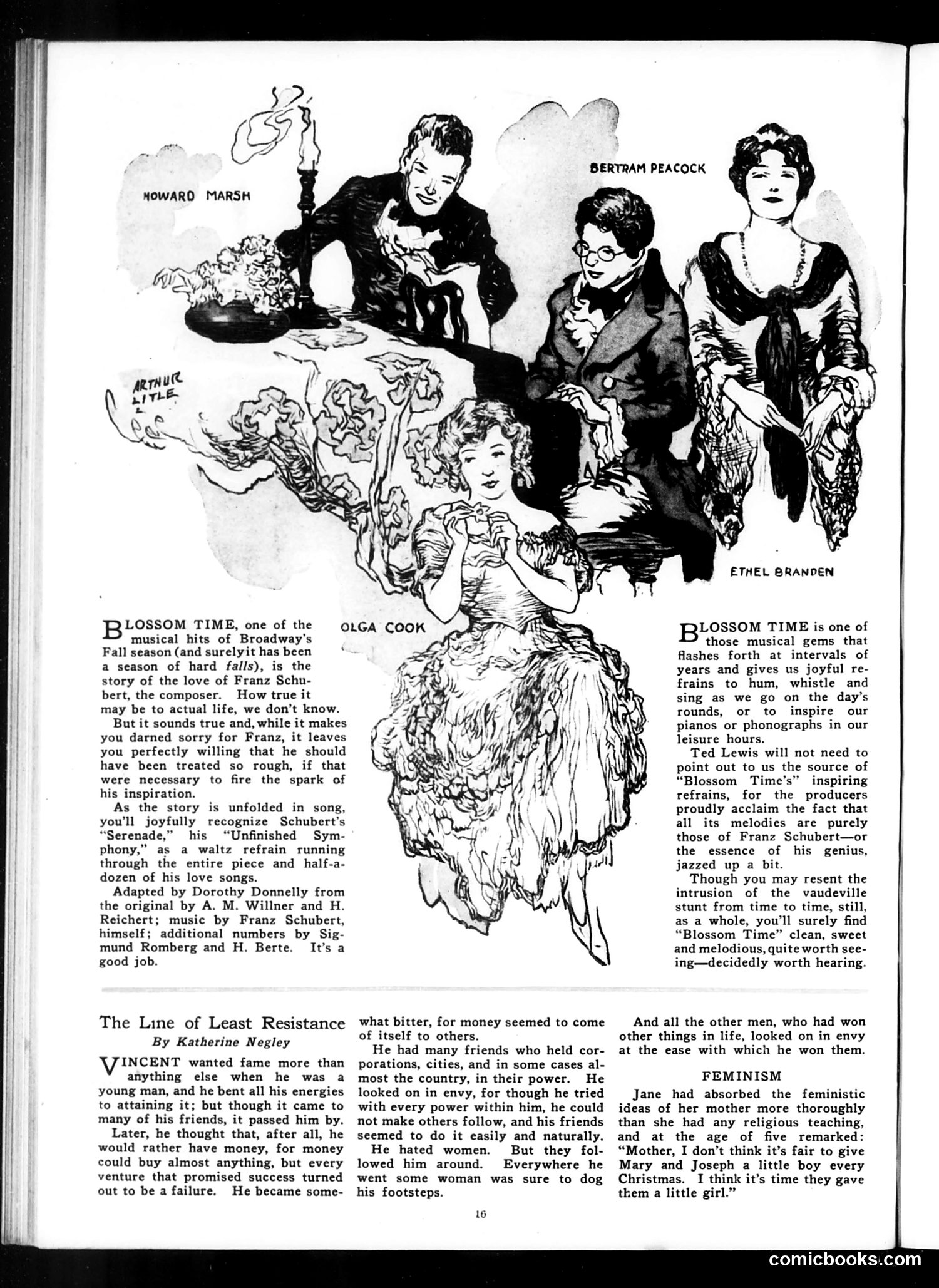
This page contains two distinct pieces: **"Blossom Time" Review**: A theater review of a Broadway musical about composer Franz Schubert's love life, adapted by Dorothy Donnelly. The illustrated cast includes Howard Marsh, Bertram Peacock, Olga Cook, and Ethel Branden. The review praises the show's incorporation of Schubert's actual compositions, noting it flashes melodious gems periodically, though acknowledging occasional "vaudeville stunts" interrupt the narrative. **"The Line of Least Resistance" (by Katherine Negley)**: A short story about Vincent, a man who paradoxically fails at pursuing what he consciously desires (fame, money, influence) yet succeeds effortlessly at what he doesn't want (attracting women). The irony critiques how effort often backfires while apathy mysteriously yields results. **"Feminism" brief**: A satirical quip where five-year-old Jane, indoctrinated with feminist ideology by her mother, protests the Christian nativity narrative's gender imbalance—wanting Mary and Joseph to receive a daughter occasionally instead of perpetually a son.
📄 Transcribed text from this page (OCR, searchable)
Machine-transcribed from the original scan — historical spelling and the odd misread are preserved.
HOWARO MARSH LOSSOM TIME, one of the musical hits of Broadway's Fall season (and surelyit has been a season of hard falls), is the story of the love of Franz Schu- bert, the composer. How true it may be to actual life, we don’t know. But it sounds true and, while it makes you darned sorry for Franz, it leaves you perfectly willing that he should have been treated so rough, if that were necessary to fire the spark of his inspiration. As the story is unfolded in song, you'll joyfully recognize Schubert's “Serenade,” his “Unfinished Sym- phony,” as a waltz refrain running through the entire piece and half-a- dozen of his love songs. Adapted by Dorothy Donnelly from the original by A. M. Willner and H. Reichert; music by Franz Schubert, himself; additional numbers by Sig- mund Romberg and H. Berte. It’s a good job. The Line of Least Resistance By Katherine Negley INCENT wanted fame more than anything else when he was a young man, and he bent all his energies to attaining it; but though it came to many of his friends, it passed him by. Later, he thought that, after all, he would rather have money, for money could buy almost anything, but every venture that promised success turned out to be a failure. He became some- , ME 4 ? what bitter, for money seemed to come of itself to others. He had many friends who held cor- porations, cities, and in some cases al- most the country, in their power. He looked on in envy, for though he tried with every power within him, he could not make others follow, and his friends seemed to do it easily and naturally. He hated women. But they fol- lowed him around. Everywhere he went some woman was sure to dog his footsteps. 16 BERTRAM PEACOCK ETHEL BRANDEN LOSSOM TIME is one of those musical gems that flashes forth at intervals of years and gives us joyful re- frains to hum, whistle and sing as we go on the day’s rounds, or to inspire our pianos or phonographs in our leisure hours. Ted Lewis will not need to point out to us the source of “Blossom Time’s” inspiring refrains, for the producers proudly acclaim the fact that all its melodies are purely those of Franz Schubert—or the essence of his genius, jazzed up a bit. Though you may resent the intrusion of the vaudeville stunt from time to time, still, as a whole, you'll surely find “Blossom Time” clean, sweet and melodious, quite worth see- ing—decidedly worth hearing. And all the other men, who had won other things in life, looked on in envy at the ease with which he won them. FEMINISM Jane had absorbed the feministic ideas of her mother more thoroughly than she had any religious teaching, and at the age of five remarked: “Mother, I don’t think it’s fair to give Mary and Joseph a little boy every Christmas. I think it’s time they gave them a little girl.” comicbooks.com