
Judge, 1921-12-31 · page 25 of 37
Judge — December 31, 1921 — page 25: what you’re looking at
What you’re looking at
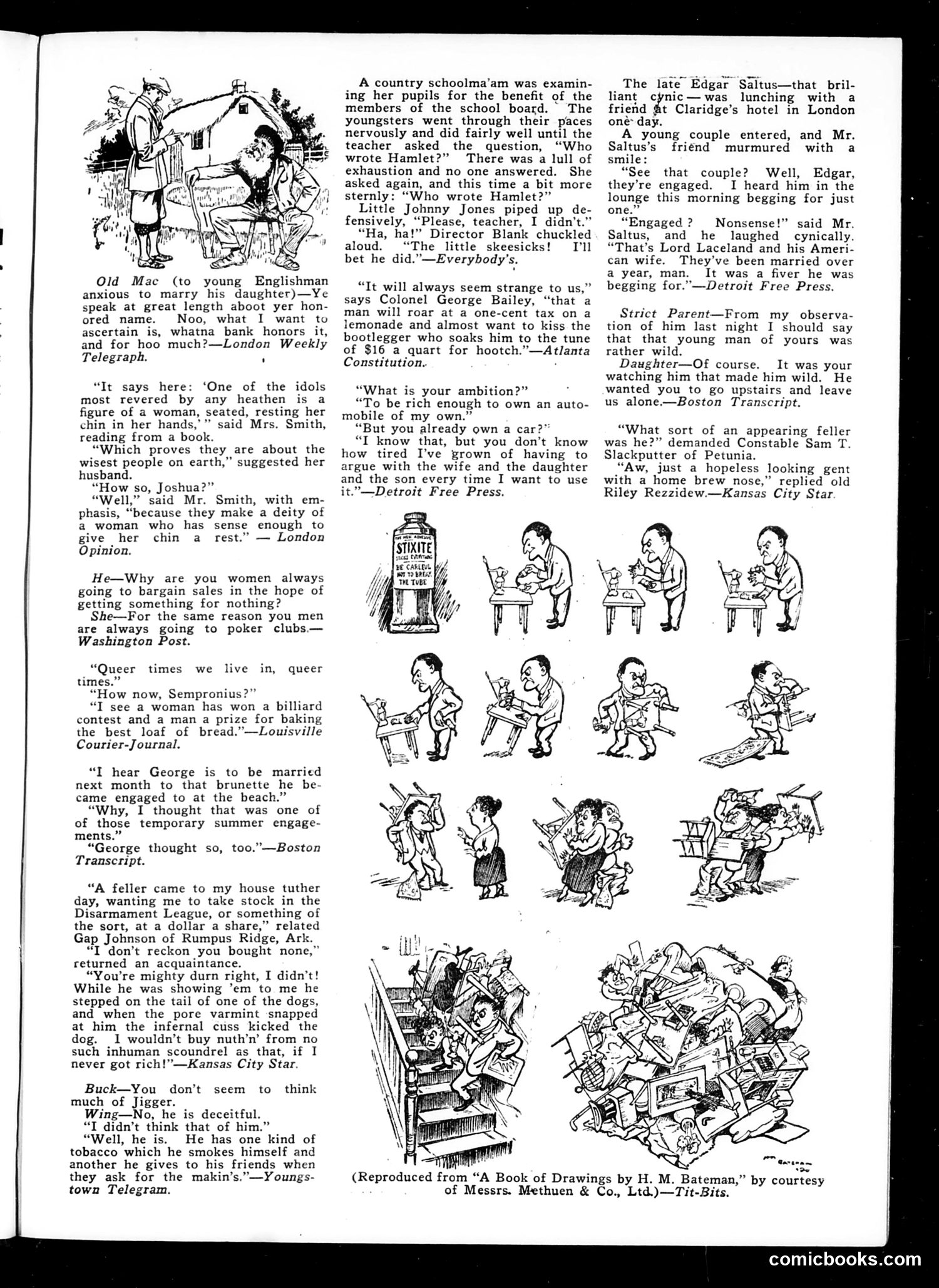
This page collects brief humorous anecdotes satirizing early 20th-century social conventions, primarily around gender roles and marriage. The main cartoon sequence (by H.M. Bateman) depicts a man progressively losing his composure while dining—a visual joke about domestic frustration, likely related to the recurring theme: **husbands' lack of autonomy**. Multiple anecdotes mock men's powerlessness in marriage: a husband must argue with wife and children to use "his" car; a groom begs money from his wife after one year of marriage; a suitor's value is measured by his bank account rather than character. Other jokes target women's shopping habits and competitive social behavior ("queer times" when a woman wins at billiards and a man bakes bread). One anecdote satirizes naive patriotism—a man refuses investment in a "Disarmament League" after the salesman kicks a dog. The page reflects **pre-1920s anxieties** about shifting gender roles and modern consumer culture, presenting marriage as a financial and social battlefield where men lose control and independence.
📄 Transcribed text from this page (OCR, searchable)
Machine-transcribed from the original scan — historical spelling and the odd misread are preserved.
Old Mac (to young Englishman anxious to marry his daughter)—Ye speak at great length aboot yer hon- ored name. Noo, what I want to ascertain is, whatna bank honors it, and for hoo much?—London Weekly Telegraph. ‘ “It says here: ‘One of the idols most revered by any heathen is a figure of a woman, seated, resting her chin in her hands,’” said Mrs. Smith, reading from a book. “Which proves they are about the wisest people on earth,” suggested her husband. “How so, Joshua?” “Well,” said Mr. Smith, with em- phasis, “because they make a deity of a woman who has sense enough to give her chin a_ rest.” — London Opinion. He—Why are you women always going to bargain sales in the hope of getting something for nothing? She—For the same reason you men are always going to poker clubs.— Washington Post. live in, we queer “Queer times times.” “How now, Sempronius?” “I see a woman has won a billiard contest and a man a prize for baking the best loaf of bread.”—Louisville Courier-Journal. “I hear George is to be married next month to that brunette he be- came engaged to at the beach.” “Why, I thought that was one of of those temporary summer engage- ments.” “George thought so, too.”—Boston Transcript. “A feller came to my house tuther day, wanting me to take stock in the Disarmament League, or something of the sort, at a dollar a share,” related Gap Johnson of Rumpus Ridge, Ark. “T don’t reckon you bought none, returned an acquaintance. “You’re mighty durn right, I didn’t! While he was showing ’em to me he stepped on the tail of one of the dogs, and when the pore varmint snapped at him the infernal cuss kicked the dog. 1 wouldn’t buy nuth’n’ from no such inhuman scoundrel as that, if I never got rich!”—Kansas City Star. Buck—You don’t seem to think much of Jigger. Wing—No, he is deceitful. “TI didn’t think that of him.” “Well, he is. He has one kind of tobacco which he smokes himself and another he gives to his friends when they ask for the makin’s.”—Youngs- town Telegram. A country schoolma’am was examin- ing her pupils for the benefit of the members of the school board. The youngsters went through their paces nervously and did fairly well until the teacher asked the question, “Who wrote Hamlet?” There was a lull of exhaustion and no one answered. She asked again, and this time a bit more sternly: “Who wrote Hamlet?” Little Johnny Jones piped up de- fensively, “Please, teacher, I didn’t.” “Ha, ha!” Director Blank chuckled aloud. “The little skeesicks! I'll bet he did.”—Everybody’s. “Tt will always seem strange to us,” says Colonel George Bailey, “that a man will roar at a one-cent tax on a lemonade and almost want to kiss the bootlegger who soaks him to the tune of $16 a quart for hootch.”—Atlanta Constitution. “What is your ambition?” “To be rich enough to own an auto- mobile of my own.” “But you already own a car?” “I know that, but you don’t know how tired I’ve grown of having to argue with the wife and the daughter and the son every time I want to use it."—Detroit Free Press. The late Edgar Saltus—that bril- liant cynic—was lunching with a friend @t Claridge’s hotel in London oné day. A young couple entered, and Mr. Saltus’s friénd murmured with a smile: “See that couple? Well, Edgar, they’re engaged. I heard him in the lounge this morning begging for just one. “Engaged ? Nonsense!” said Mr. Saltus, and he laughed cynically. “That’s Lord Laceland and his Ameri- can wife. They've been married over a year, man. It was a fiver he was begging for.”"—Detroit Free Press. Strict Parent—From my _ observa- tion of him last night I should say that that young man of yours was rather wild. Daughter—Of course. It was your watching him that made him wild. He wanted you to go upstairs and leave us alone.—Boston Transcript. “What sort of an appearing feller was he?” demanded Constable Sam T. Slackputter of Petunia. “Aw, just a hopeless looking gent with a home brew nose,” replied old Riley Rezzidew.—Kansas City Star (Reproduced from “A Book of Drawings by H. M. Bateman,” by courtesy soe of Messrs. Methuen & Co., Ltd.) —Tit-Bits. comicbooks.com