
A complete issue · 36 pages · 1921
Judge — December 24, 1921
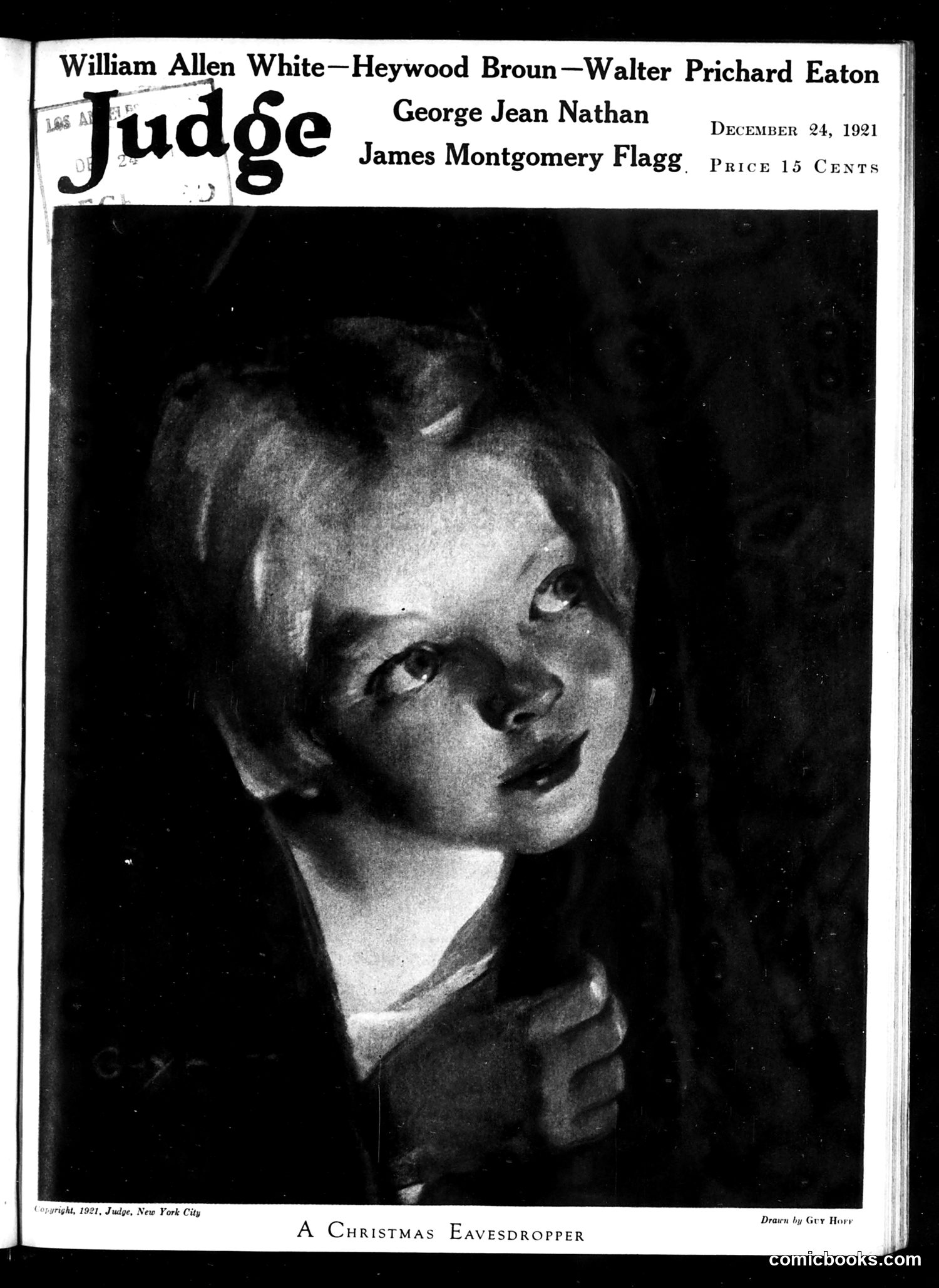
This is a **Judge magazine cover from December 24, 1921** featuring a portrait titled "A Christmas Eavesdropper." The image shows a young child's face in profile, drawn by Guy Hoff. The cover lists several names at the top—William Allen White, Heywood Broun, Walter Prichard Eaton, George Jean Nathan, and James Montgomery Flagg—suggesting these were contributors to that issue. The actual satirical content or political commentary is **unclear from the image alone**. The title "Christmas Eavesdropper" suggests a child overhearing adult conversation, possibly implying social commentary about innocence encountering worldly affairs—common Judge magazine themes. Without the accompanying article text, the specific satire's target remains indeterminate.
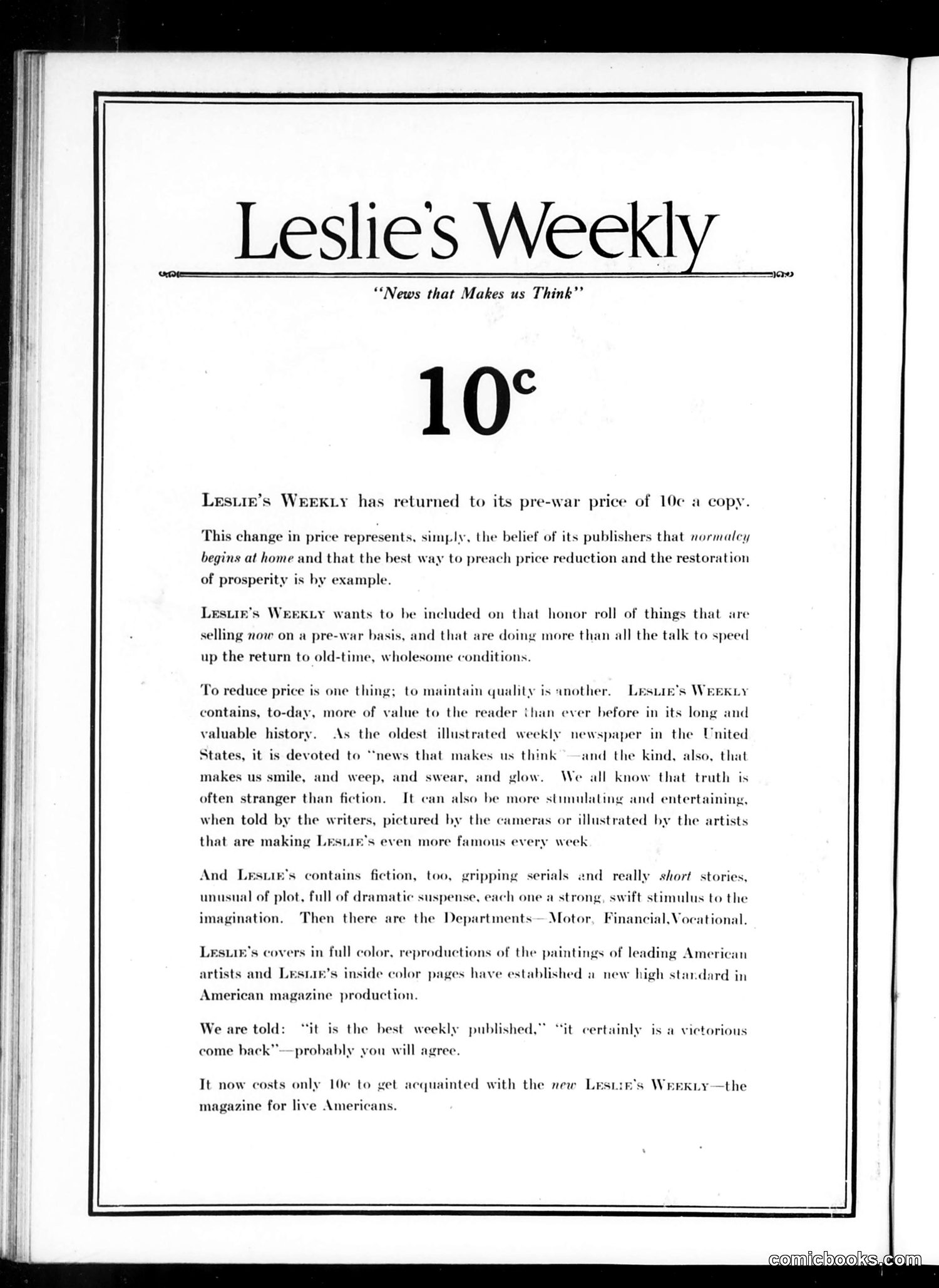
This page is **not a political cartoon** but rather a promotional advertisement for *Leslie's Weekly* magazine announcing its price reduction to 10¢ per copy (its pre-war price). The ad emphasizes the publication's commitment to quality content despite lowering costs. It highlights *Leslie's Weekly* as "the oldest illustrated weekly newspaper in the United States," distinguished by its color covers featuring American artists' paintings and its mix of fiction, serials, short stories, and departments covering motors, finance, and vocational topics. The "normalcy begins at home" reference suggests this post-WWI messaging—promoting price reduction as a patriotic return to pre-war prosperity and "wholesome conditions." The appeal targets ordinary Americans seeking affordable, quality journalism during economic recovery.
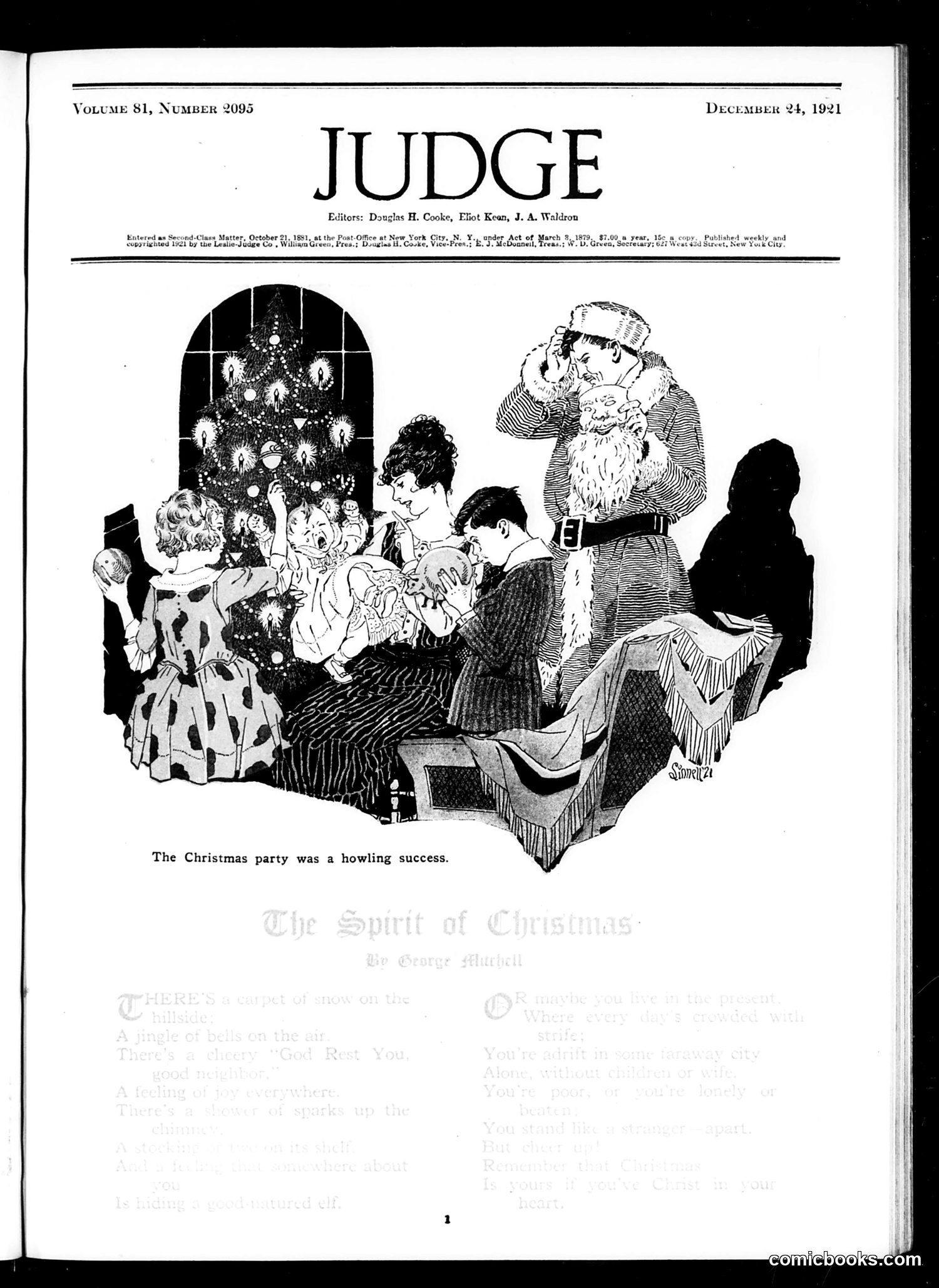
This page features a Christmas-themed illustration titled "The Christmas party was a howling success," accompanied by a poem called "The Spirit of Christmas" by George Mitchell. The image depicts a festive domestic scene with Santa Claus distributing gifts to children gathered around a decorated Christmas tree. Adult figures observe the celebration, which appears warmly satirical rather than politically pointed. The accompanying poem emphasizes traditional Christmas sentiments—snow, bells, charity, and goodwill—suggesting the magazine's focus here is sentimental rather than satirical commentary. This appears to be seasonal holiday content rather than political satire, offering readers uplifting Christmas messaging during the post-World War I period. The "howling success" caption humorously describes the chaotic but joyful family celebration.
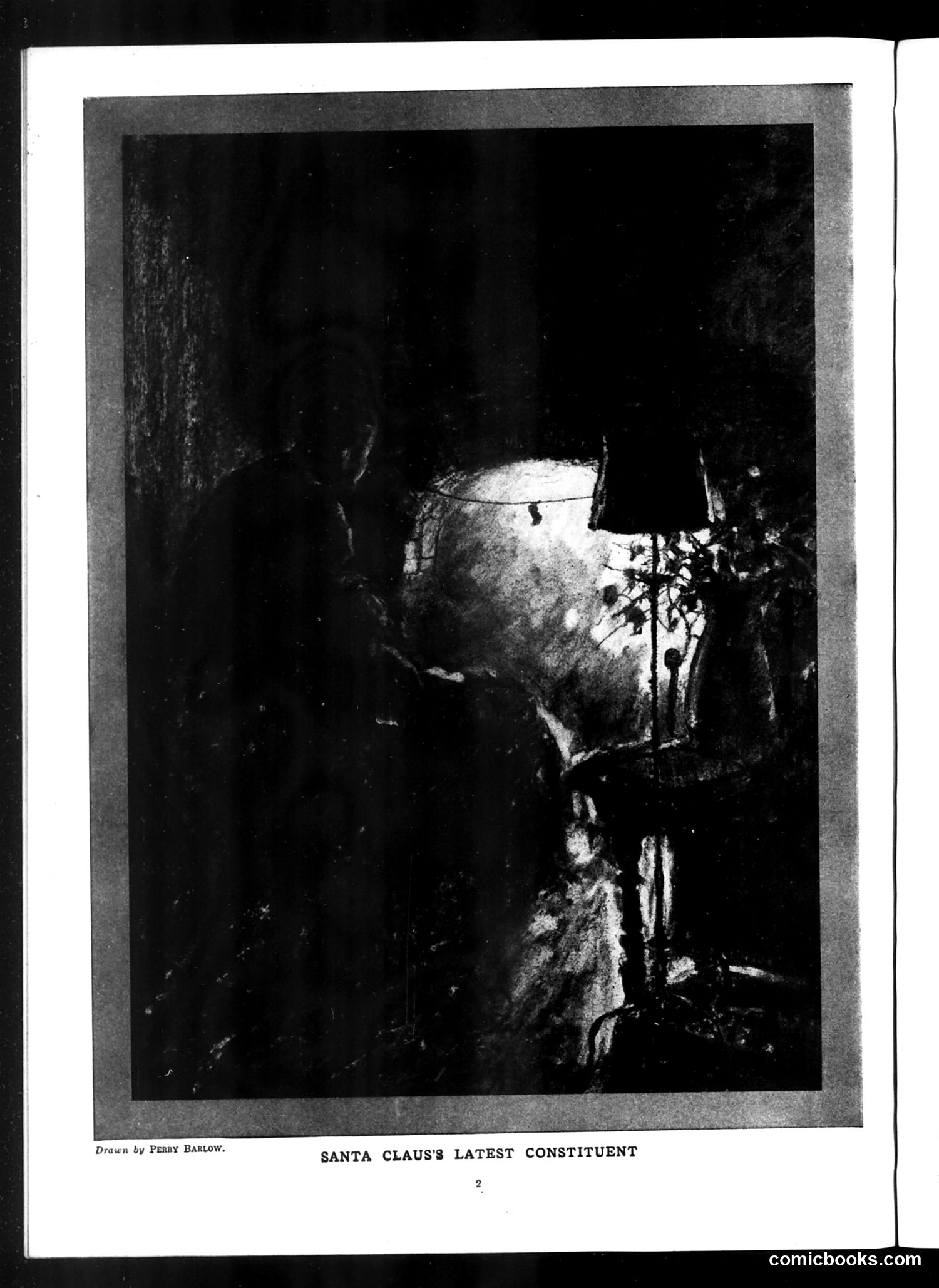
This political cartoon by Perry Barlow, titled "Santa Claus's Latest Constituent," appears to depict a dark, shadowy figure emerging from or hiding within darkness, with only partial features visible—notably what seems to be a round face or head. The ambiguous, ominous rendering suggests this represents an unwelcome or problematic "constituent" (voter/person) that Santa Claus has acquired. Without additional context about the specific date of this *Judge* magazine issue, the exact political target remains unclear. However, the satire likely critiques either a specific political figure, immigrant group, or social element that the cartoonist considered an unwanted addition to the American body politic during the period when *Judge* was published. The grotesque rendering emphasizes disapproval or mockery of this "constituent."
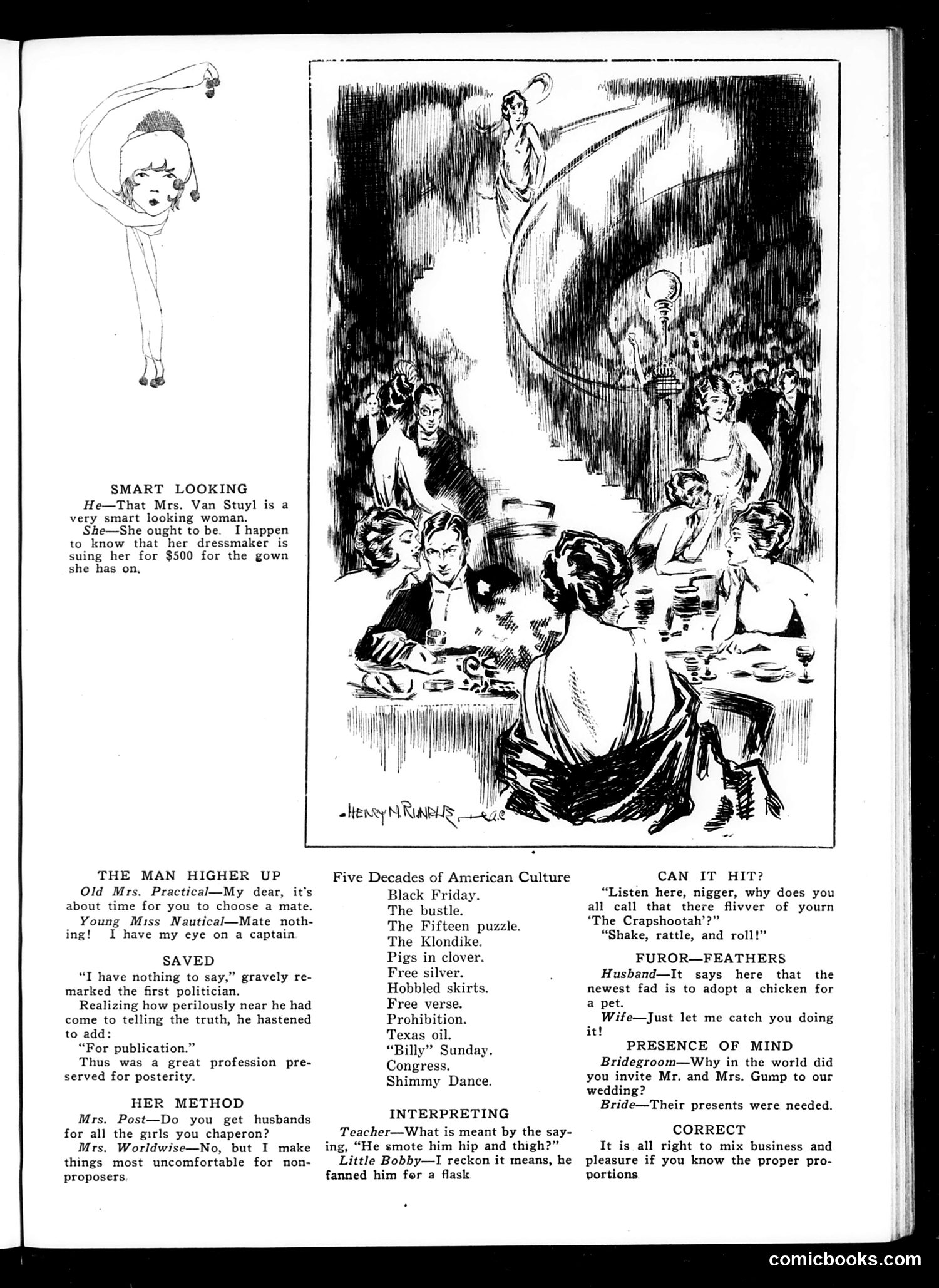
This page contains humor columns and a society cartoon rather than political satire. The central illustration by Henry Raleigh depicts an elegant dinner party where Mrs. Van Stuyl, described as a "very smart looking woman," displays her expensive $500 gown to other society guests. The surrounding text consists of humorous advice columns addressing social etiquette and romantic situations among the upper classes. References include period concerns like Prohibition and contemporary cultural phenomena (Black Friday, the Klondike gold rush, hobbled skirts). The humor targets bourgeois society manners and pretension—Mrs. Van Stuyl's conspicuous consumption of luxury goods exemplifies the material obsessions Judge's readership found amusing or worthy of gentle mockery. This reflects early 20th-century satirical commentary on wealth and social climbing.
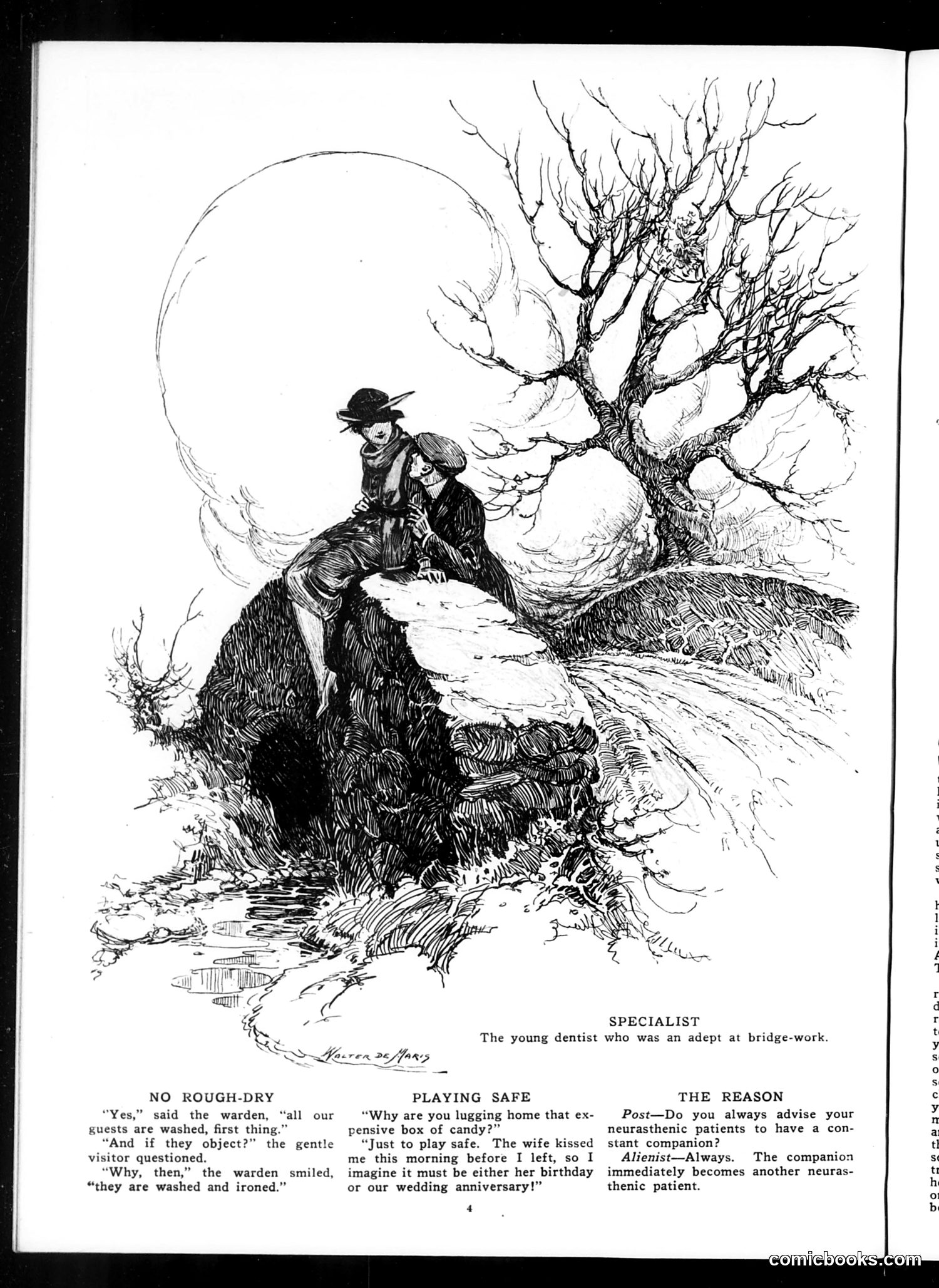
This page from *Judge* magazine contains three brief comic anecdotes with accompanying illustration. The main artwork depicts "SPECIALIST: The young dentist who was an adept at bridge-work"—a visual pun showing a man sitting atop a tree stump or log, literally doing bridge construction work while wearing a bowler hat, suggesting he's a dentist by profession. The humor trades on "bridge-work," a dental procedure for replacing missing teeth. Below are three separate jokes about domestic situations: a host dealing with unwashed guests, a wife's expensive candy purchases, and a doctor's advice about patient companionship. These are genteel, middle-class humor typical of early 20th-century *Judge* magazine—wordplay and gentle domestic satire rather than political commentary. The overall tone targets polite society's social conventions and marital dynamics.
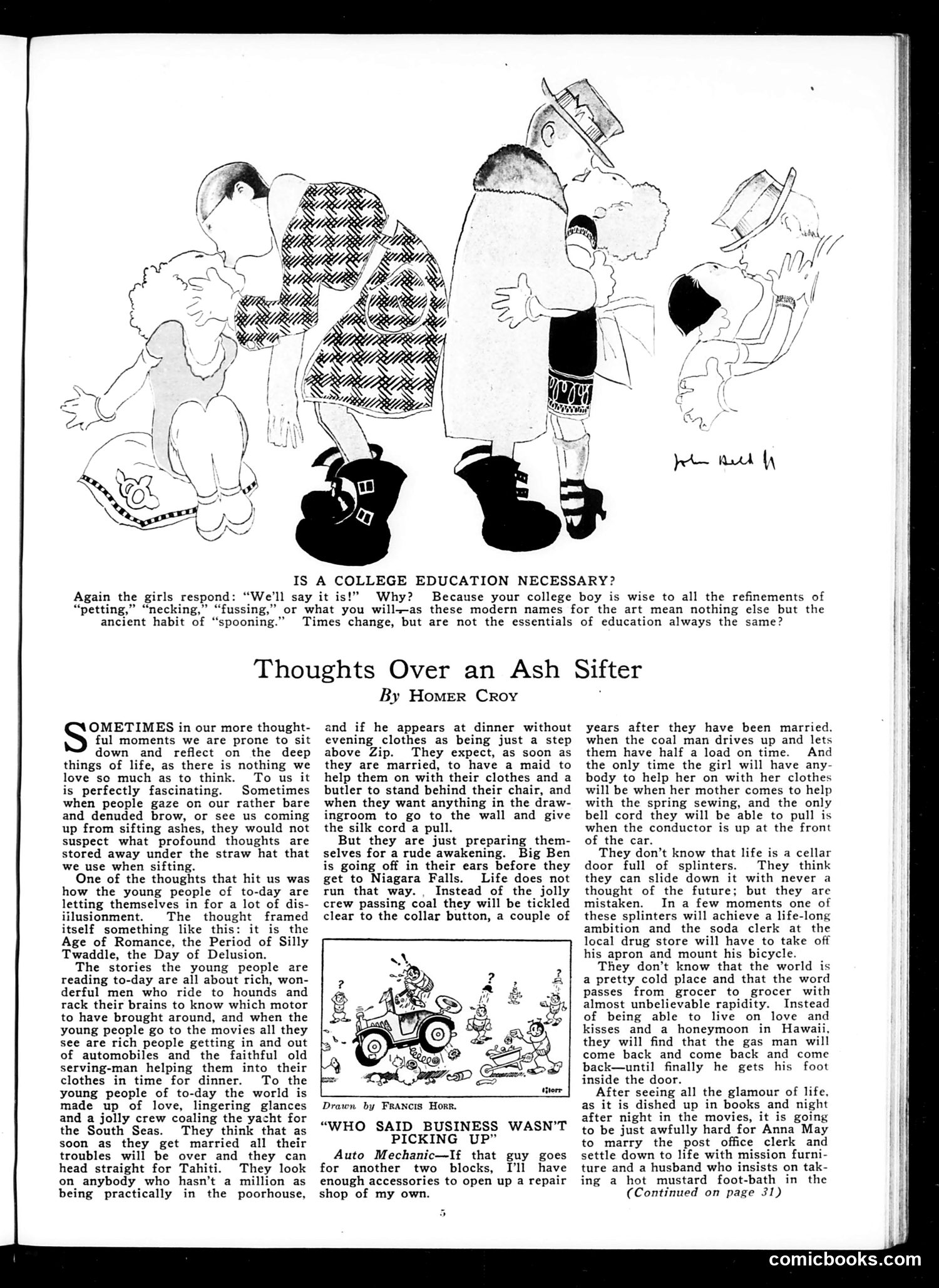
**Top Cartoon - "Is a College Education Necessary?"** This satirical illustration mocks the superficiality of 1920s romance among college-educated youth. The cartoon depicts young women endorsing college education because it teaches men modern courtship techniques—"petting," "necking," "fussing"—merely renamed versions of the old practice of "spooning." The satire suggests that despite educational advancement, young people haven't evolved beyond ancient romantic behavior, only rebranded it with contemporary slang. **Main Article - "Thoughts Over an Ash Sifter" by Homer Croy** This humorous essay critiques young people's romantic delusions, shaped by movies and popular fiction featuring wealthy lifestyles. Croy argues youth expect marriage to solve all problems and imagine luxurious lives with servants and yachts. The reality, he satirizes, is far grimmer: they'll face financial struggles, creditors (coal men, grocers, gas companies), and mundane hardship. The piece uses mordant wit to deflate 1920s consumerist and romantic fantasy culture.
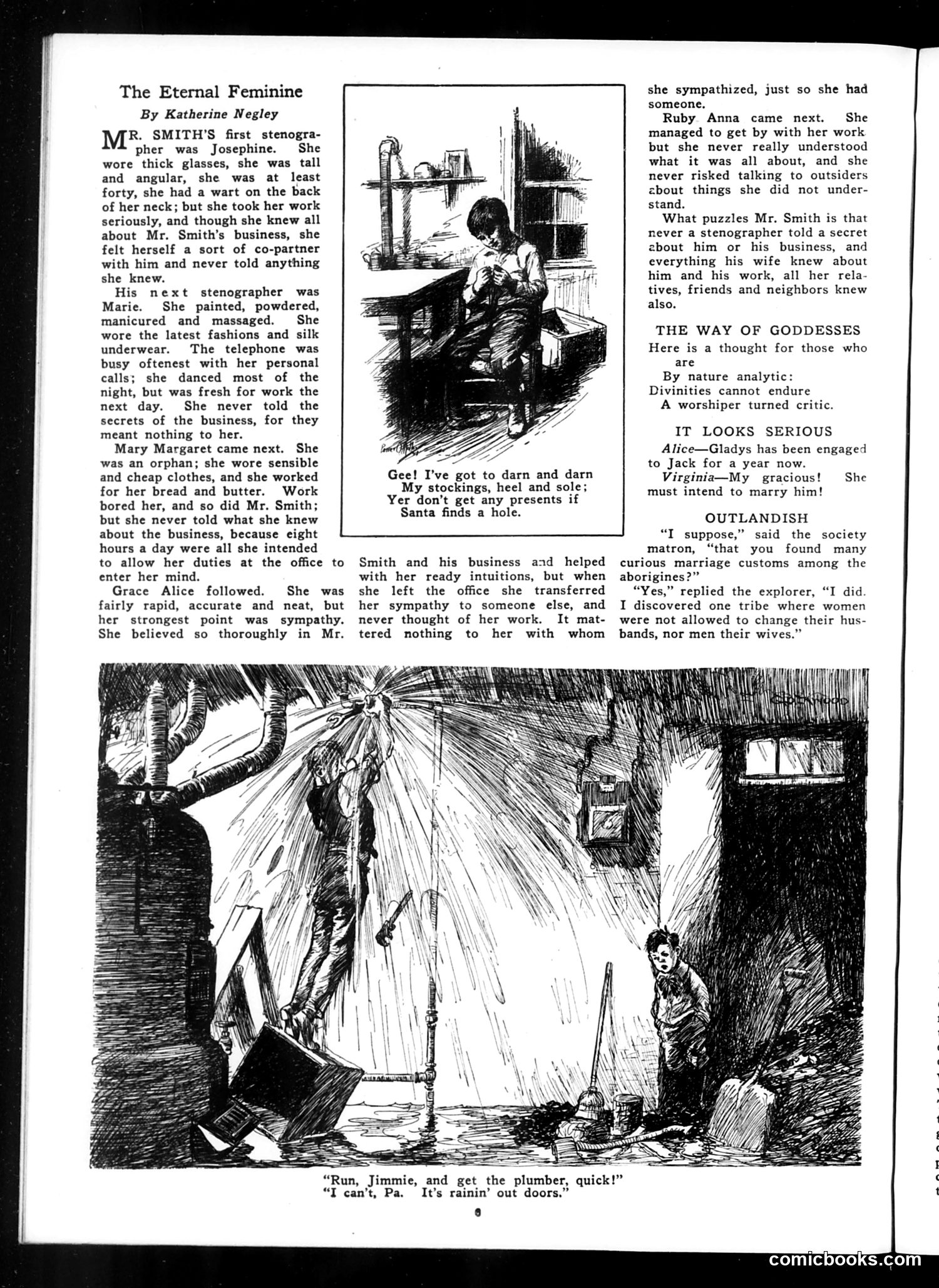
This page contains a short story by Katherine Negley satirizing workplace dynamics and gender stereotypes in the early 20th century. The narrative contrasts five stenographers hired by Mr. Smith, each representing different female "types": the plain, serious worker; the fashionable but frivolous one; the practical orphan; the emotionally sympathetic woman; and the incompetent one. The satire's point: despite their vastly different personalities and values, none of these women breach confidentiality about Smith's business—yet his wife, who should theoretically be most trustworthy, gossips everything to relatives and neighbors. This inverts contemporary assumptions about female loyalty and discretion, suggesting that professional obligation transcends personality, while personal relationships undermine it. The page includes unrelated humor: a children's verse about darned stockings, an aphorism about goddesses, and a joke about explorer customs mocking prudish Victorian marriage attitudes.
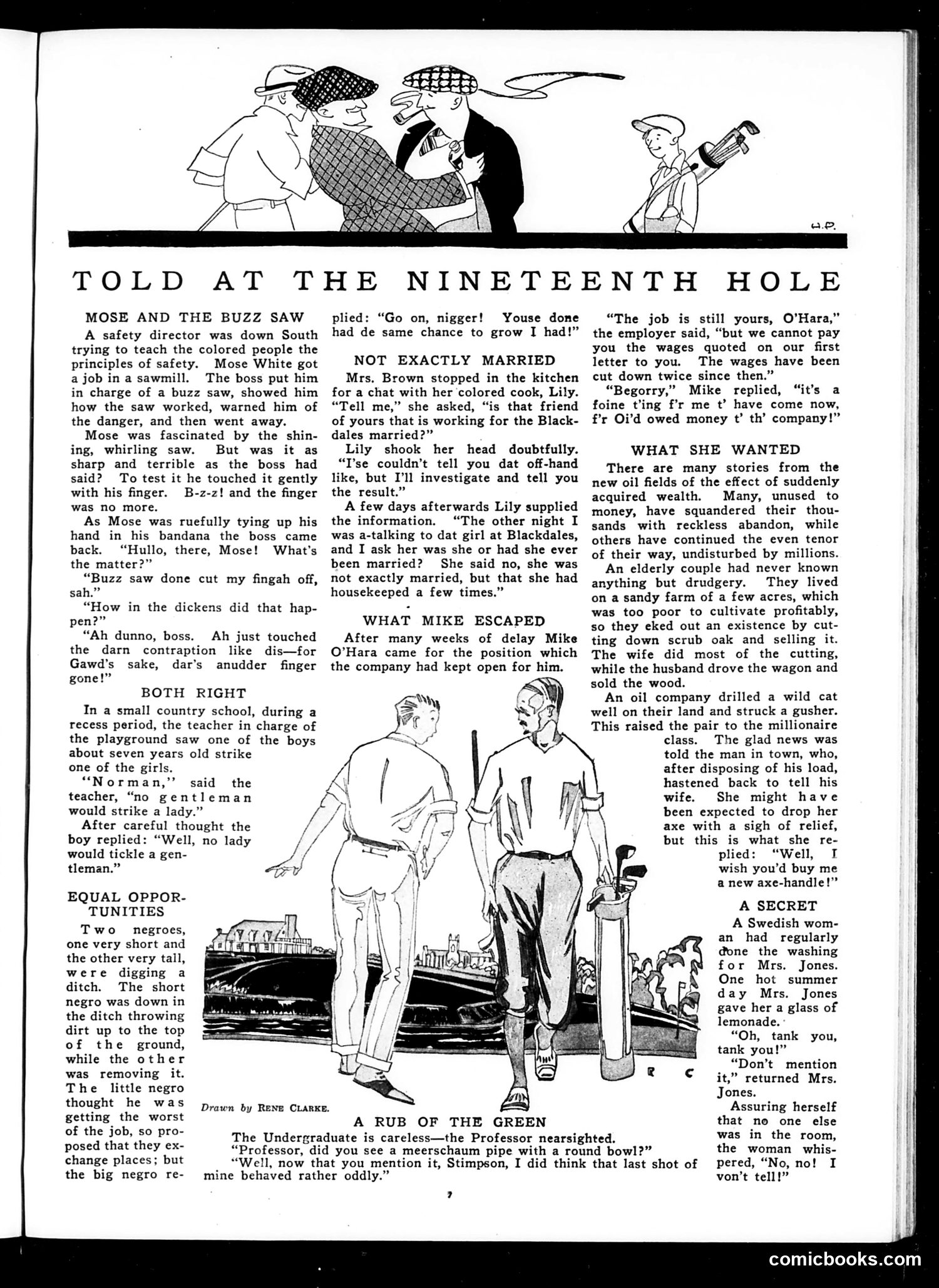
This page from Judge magazine contains racist humor typical of early-20th-century American satire. The content relies on demeaning stereotypes of Black people and Irish immigrants. **Key sections:** - **"Mose and the Buzz Saw"**: A minstrel-style story depicting a Black worker ("Mose") as foolishly ignorant, touching a running saw twice and losing fingers. The humor depends on racist caricature of Black speech and supposed stupidity. - **"Both Right" and "Equal Opportunities"**: Child and workplace anecdotes using the racial slur in dialogue, presenting racist "logic" as amusing. - **"Not Exactly Married"**: Features a Black cook ("Lily") depicted with dialect, presented as naive or loose in morals. - **"What Mike Escaped"**: References an Irish character with stereotypical Irish-American dialect ("Begorry," "foine"). The cartoons (by Rene Clarke) illustrate some stories with exaggerated racial and ethnic caricatures. The magazine's satire targets working-class and immigrant populations through dehumanizing stereotypes presented as comedy.
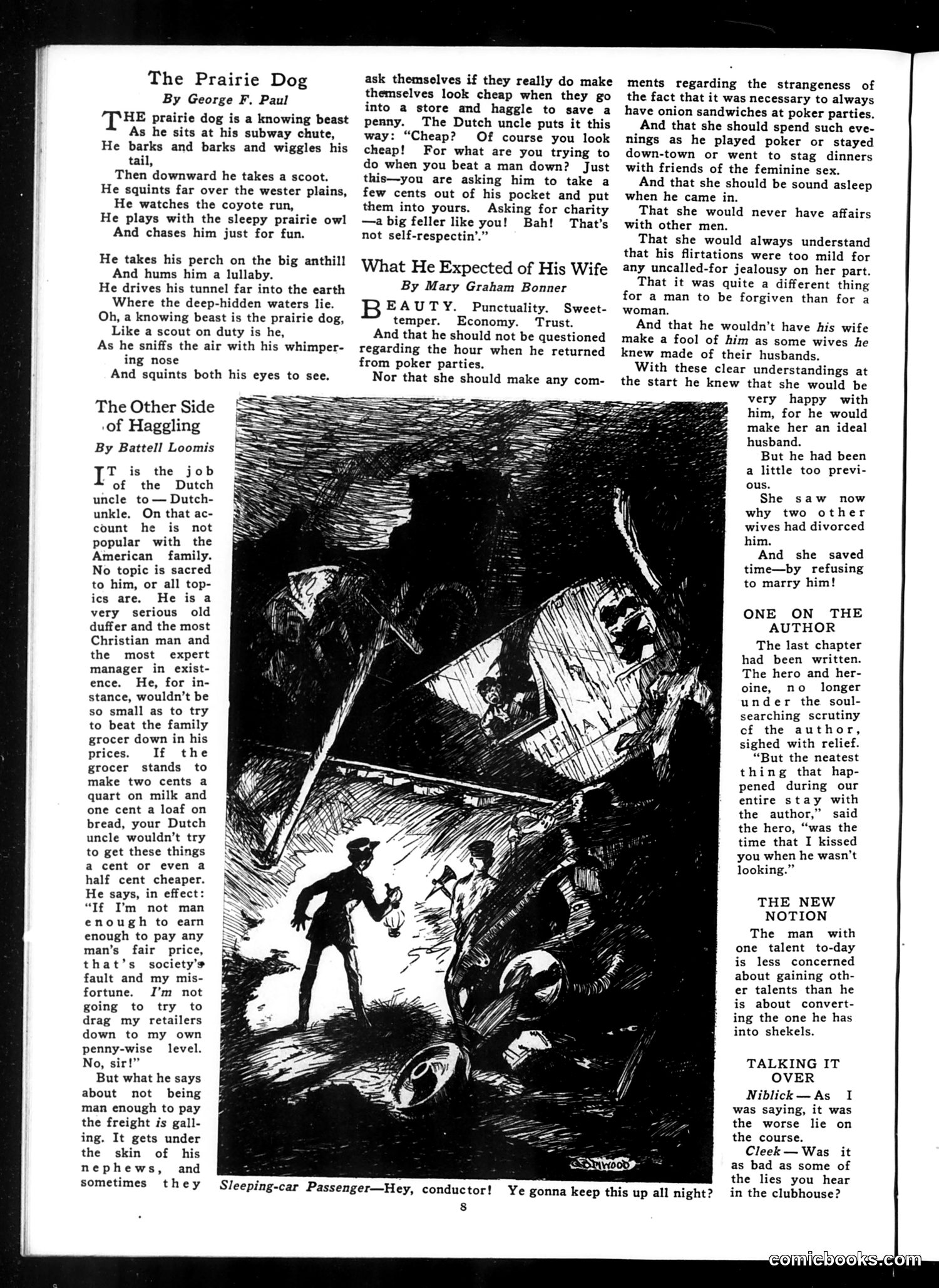
This page contains three satirical pieces mocking early 20th-century American attitudes: **"The Prairie Dog"** is sentimental nature poetry—likely gentle satire of overly romantic descriptions of Western wildlife common in period literature. **"The Other Side of Haggling"** satirizes the "Dutch uncle" (a stern moralist who offers unwelcome advice). It mocks both this sanctimonious figure *and* working-class penny-pinching. The Dutch uncle refuses to haggle with grocers on moral grounds, yet condescends to those who do—exposing the hypocrisy of moral superiority masking class judgment. **"What He Expected of His Wife"** is sharp social satire about marital double standards. The piece lists a husband's unrealistic expectations—beauty, punctuality, economy, unquestioned acceptance of his poker nights and flirtations—while he demands she never has affairs or questions him. The punchline: a woman wisely refuses to marry such a man after seeing two previous wives divorced him. This mocks men's entitled, contradictory demands of wives. The sleeping-car illustration appears unrelated cartoon humor about train passengers.
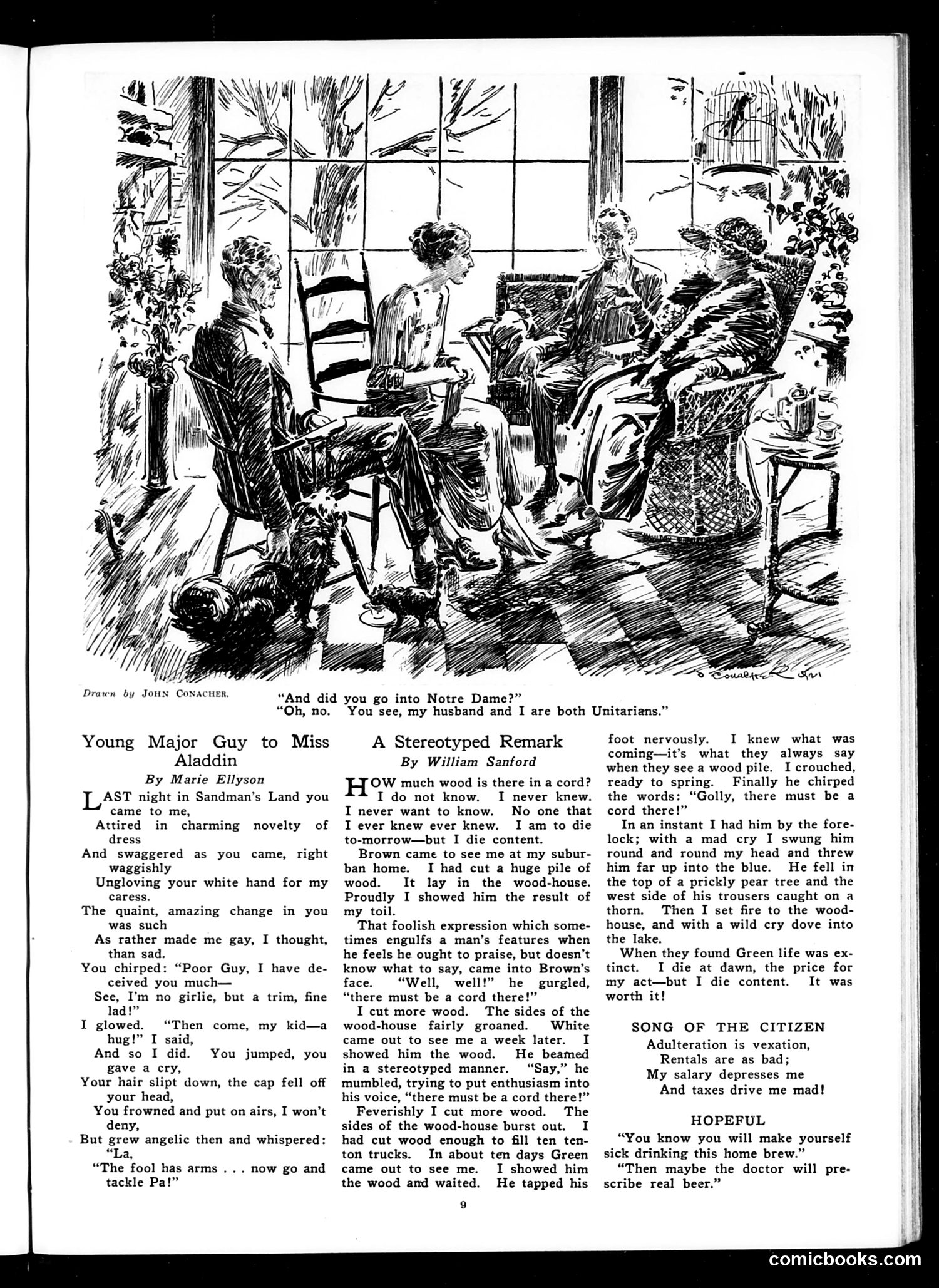
This page contains three distinct pieces of satire: **"Young Major Guy to Miss Aladdin"** (poem): A dream-narrative joke about gender role-playing and deception in courtship. The speaker believes his companion is a woman who's playfully revealed herself as male, then reverts to feminine behavior—satirizing performative gender and romantic confusion. **"A Stereotyped Remark"** (prose): The main satire targets repetitive, empty social conventions. The narrator becomes increasingly maddened by visitors who—upon seeing his wood pile—automatically say "there must be a cord there," regardless of actual quantity. It mocks how people mindlessly repeat clichéd remarks rather than genuine observation, escalating absurdly to violence and suicide. The point: society's reliance on thoughtless stock phrases in social interaction. **Bottom items**: Brief comic verses satirizing common complaints (inflation, taxes, prohibition-era "home brew"), and a joke about circumventing alcohol prohibition laws through doctor prescriptions. The common thread: all mock shallow or formulaic behavior in modern society.
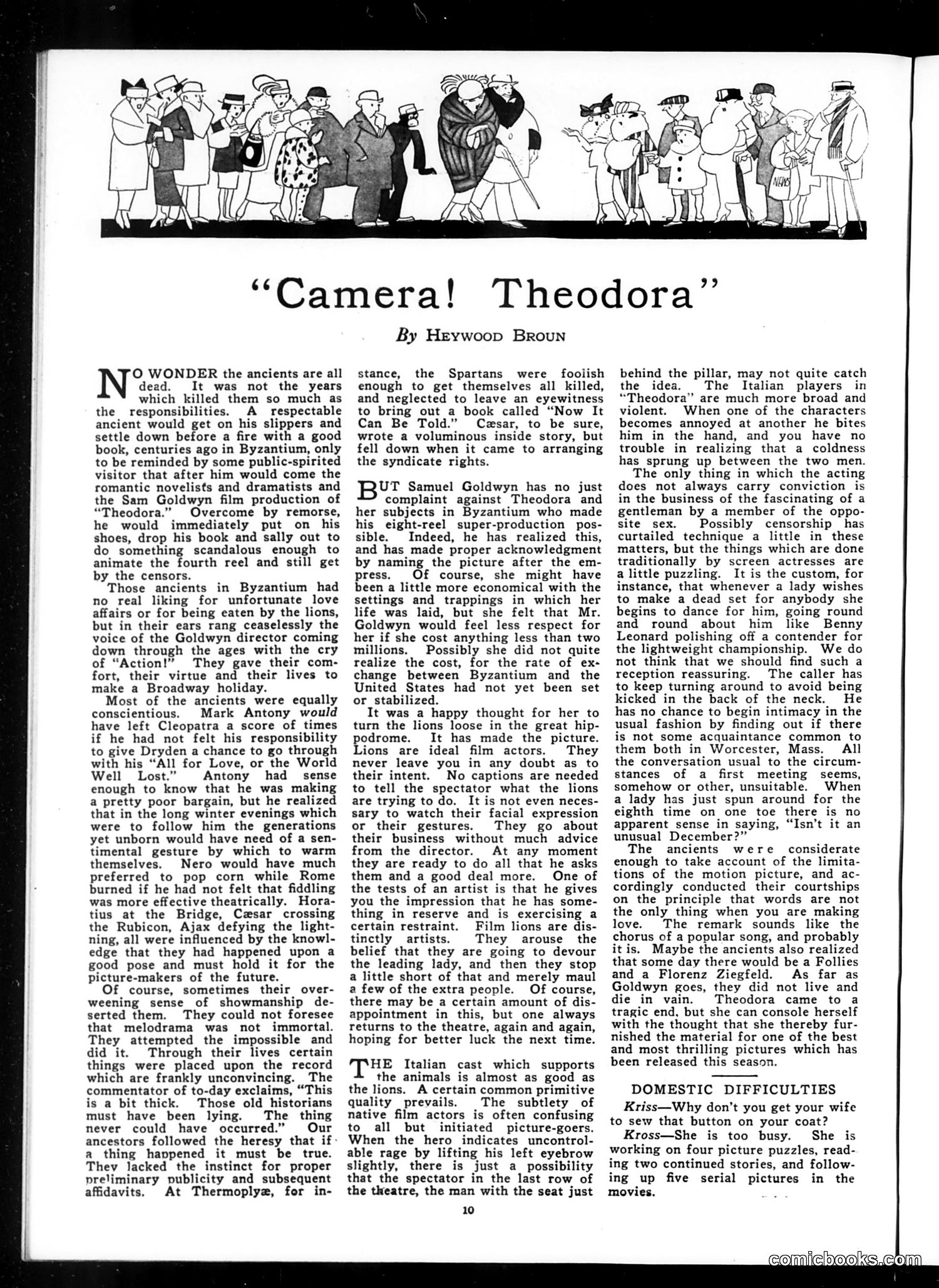
This is a satirical essay by Heywood Broun (byline visible) about Samuel Goldwyn's film production of *Theodora*. The illustration shows a silhouette line of various historical and contemporary figures. **The satire's point:** Broun humorously argues that historical figures—Mark Antony, Nero, the Spartans, Caesar—actually shaped their famous deeds *for future dramatization*, anticipating they'd become stories. Ancient people supposedly felt obligated to behave dramatically enough to interest future novelists and filmmakers. **The specific target:** Goldwyn's two-million-dollar *Theodora* film production, which depicts the Byzantine empress. Broun ironically suggests Theodora herself—aware of Goldwyn's eventual interest—deliberately created spectacles (like releasing lions in the hippodrome) to ensure cinematic appeal. **The joke:** It inverts causality: instead of history naturally inspiring cinema, Broun suggests historical figures preemptively performed *for cinema*, taking responsibility to future audiences over their own comfort and virtue. It's a clever dig at both Hollywood's grandiosity and cinema's power over historical imagination.
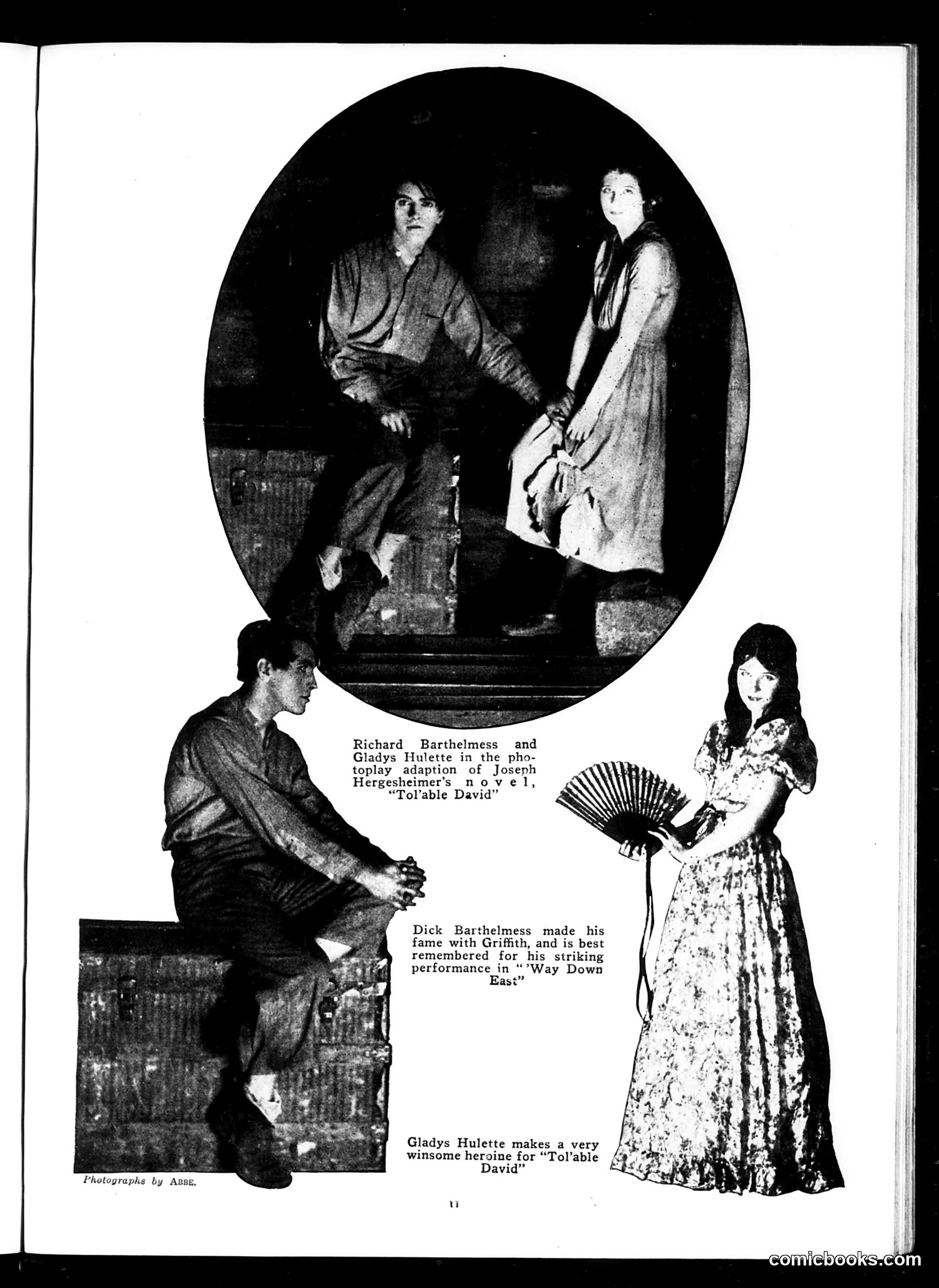
This page features promotional photographs for the silent film adaptation of Joseph Hergesheimer's novel "Tol'able David." Rather than political satire, it's an entertainment feature showcasing cast members Richard Barthelmess and Gladys Hulette. The captions note Barthelmess's reputation from working with director D.W. Griffith and his acclaimed performance in "Way Down East," while praising Hulette's appeal as the film's heroine. The photographs include both a scene from the film (top) and individual portraits of the actors. This represents Judge magazine's typical coverage of contemporary popular culture and cinema for its readers.
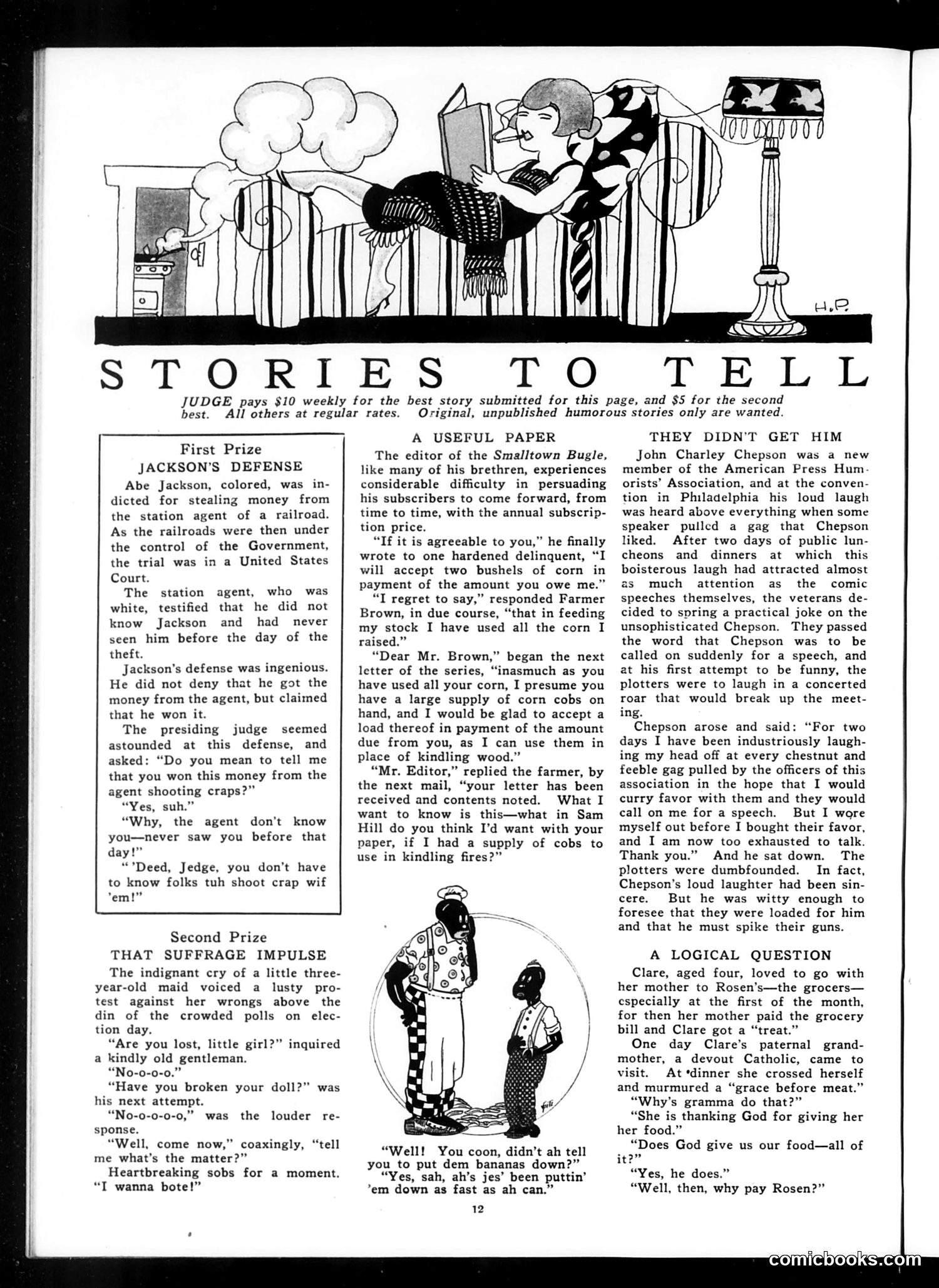
This is a humor page featuring four original short stories submitted for publication. The content reflects early 20th-century American attitudes: **"Jackson's Defense"** presents a racist caricature of a Black railroad worker who uses "craps" (dice gambling) as a legal defense for theft—the joke relies on dialect humor ("'deed, Jedge") and portrays him as clever yet foolish. **"That Suffrage Impulse"** mocks women's voting rights by depicting a toddler demanding a vote, suggesting suffrage advocates are emotionally immature—common anti-suffrage satire of the era. **"A Useful Paper"** uses dialect humor with African American characters ("ah's jes' been puttin'") to joke about a newspaper editor's desperate barter for corn cobs. **"They Didn't Get Him"** depicts humor industry insiders attempting to embarrass a naive newcomer, ultimately failing. The page exhibits period-typical casual racism, anti-women's suffrage sentiment, and working-class humor stereotyping. These stories reflect Judge's satirical voice targeting contemporary social issues and prejudices.
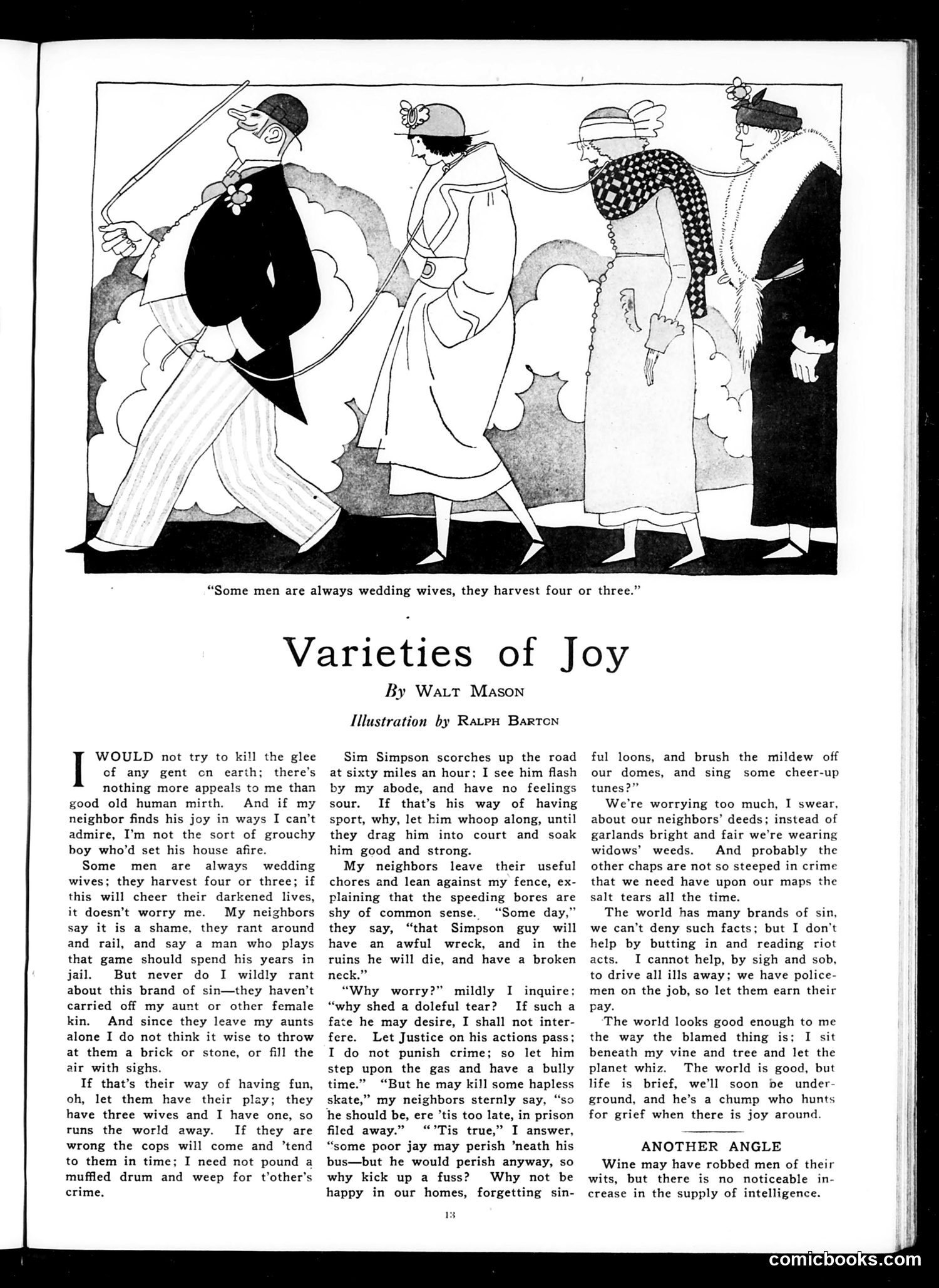
This 1920s Judge magazine piece satirizes moral busybodies and excessive social concern-mongering. The cartoon illustration depicts what appears to be fashionable women gossiping, complementing Mason's essay about minding one's own business. Mason argues that people shouldn't police others' harmless vices—whether repeated marriages (the opening caption jokes about serial remarriage), reckless speeding (Sim Simpson), or other personal indulgences. His point: endless moral outrage about neighbors' behavior accomplishes nothing and sours life unnecessarily. Instead of worrying about others' "sins," people should focus on their own contentment. The satire targets the moralizing tendency of respectable society to condemn and catastrophize about others' choices while ignoring that police and justice systems already exist to handle actual crimes. The final note about wine and intelligence suggests that moral decline isn't caused by vices alone—stupidity persists regardless. This reflects Jazz Age skepticism toward Victorian prudishness and Prohibition-era moral legislation.
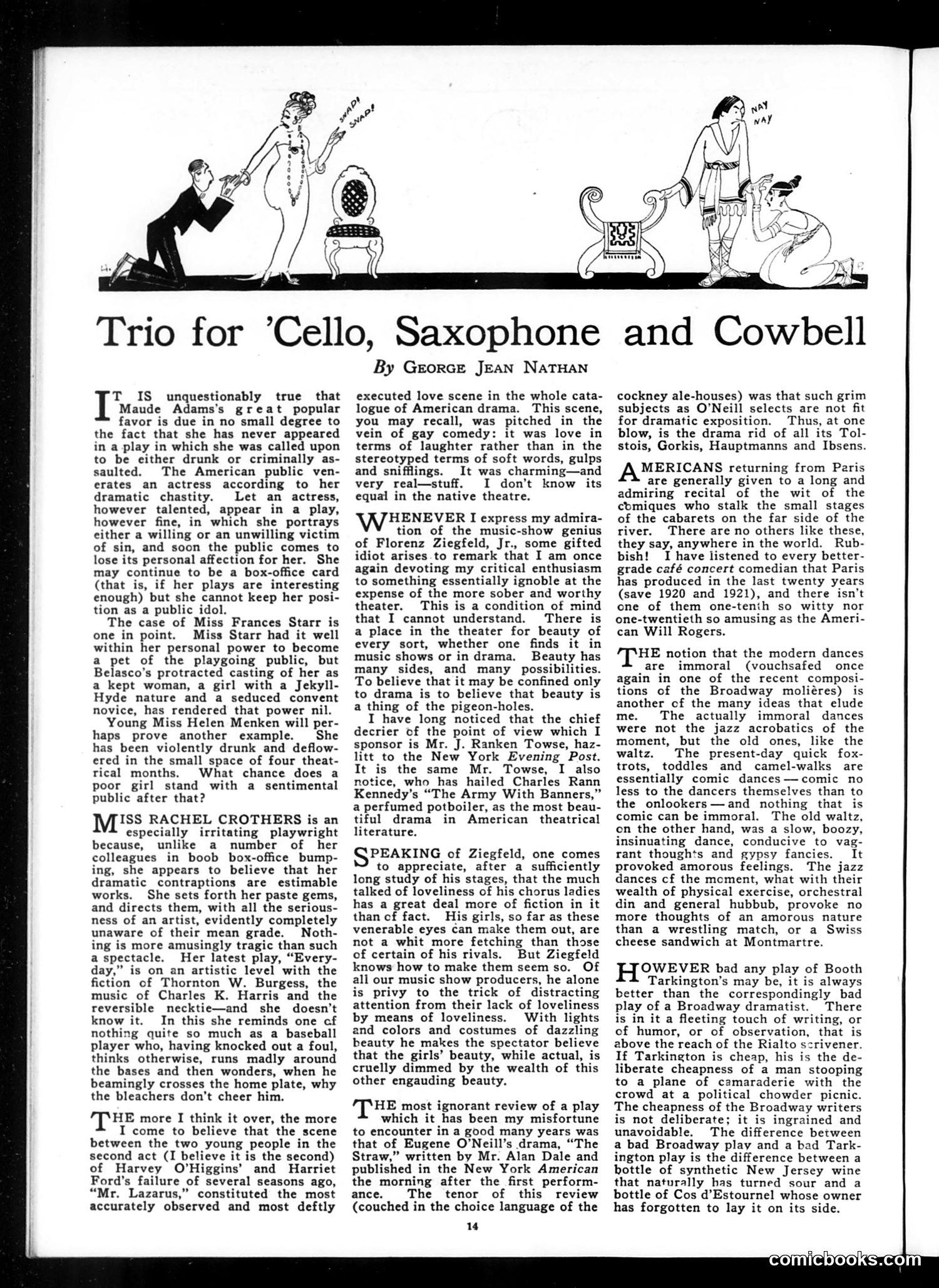
The cartoon heading this page depicts three figures in a absurdist scene: a man on his knees playing what appears to be a cello toward a woman in classical dress, with a decorative chair and cowbell completing the "trio." The illustration satirizes pretentious or incongruous artistic combinations—mixing serious instruments (cello) with lowbrow ones (cowbell). The article by George Jean Nathan that follows is theater criticism discussing American playwrights and performers. Nathan critiques actress Rachel Crothers for producing mediocre work while treating it seriously, comparing her to a baseball player who hits a foul but runs the bases triumphantly. He also discusses other actresses (Maude Adams, Frances Starr) and their public reputations, while praising Florenz Ziegfeld's musicales and criticizing theater critic J. Ranken Towse for dismissing musical theater while praising inferior dramatic works. The satire targets theatrical pretension and inconsistent critical standards rather than specific political figures.
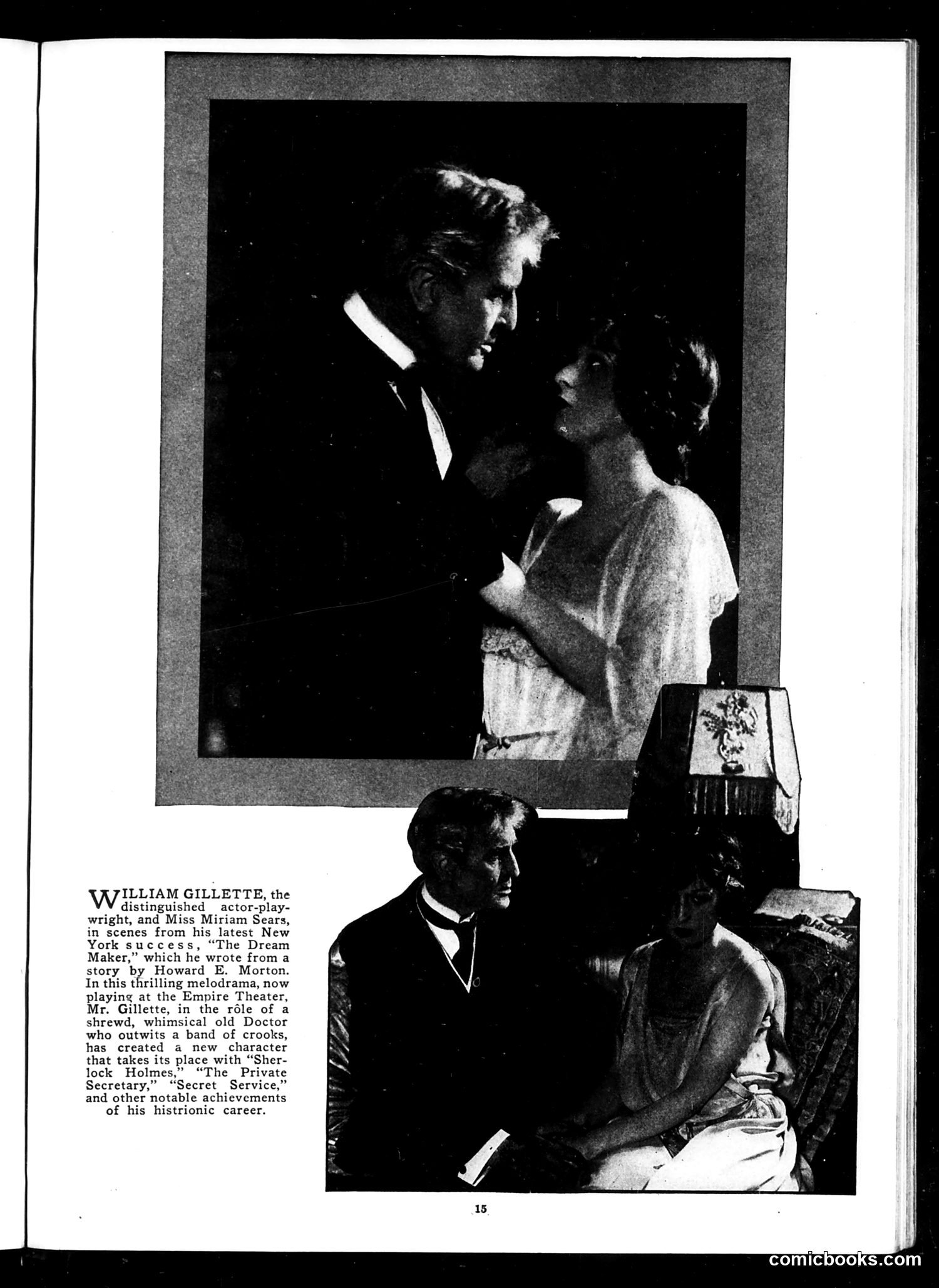
This is not a political cartoon but rather **theatrical promotion** for actor William Gillette's play "The Dream Maker," written by Gillette himself from a Howard E. Morton story, currently playing at the Empire Theater in New York. The page features two photographs from the production: the upper image shows Gillette (in formal attire) opposite actress Miriam Sears in a dramatic scene; the lower shows Gillette in character as the shrewd, whimsical Doctor who outsmarts criminals—the play's central role. The text emphasizes Gillette's distinguished career, comparing this character to his famous prior roles, particularly **Sherlock Holmes**, establishing his prestige in American theater. This is essentially a **cast photograph with promotional copy** rather than satire—typical Judge magazine content mixing entertainment coverage with humor publications of the era.
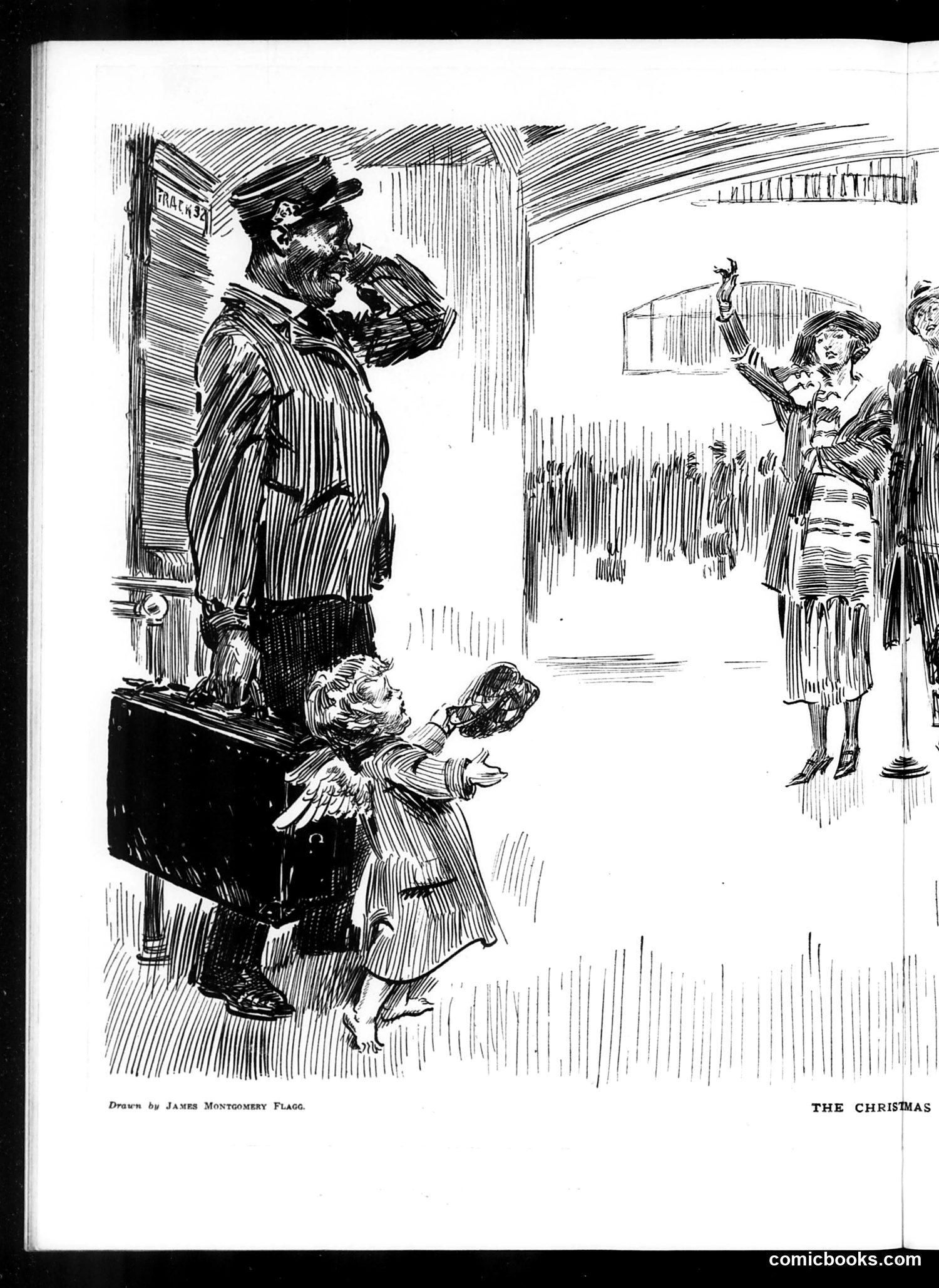
This ink drawing by James Montgomery Flagg depicts a Christmas scene with satirical social commentary. On the left, a well-dressed man with a beard and hat stands at a doorway, seemingly caroling or greeting. A small child reaches upward toward him. On the right, a woman holds what appears to be a sign or notice, with other figures visible in the background. The incomplete title "THE CHRISTMAS" and fragmentary OCR text make the specific satire unclear. However, the composition suggests commentary on Christmas charity, class divisions, or holiday traditions among different social strata. The contrast between the figures' presentations and their interactions likely contains the cartoon's point, though the exact satirical target remains uncertain without more context.
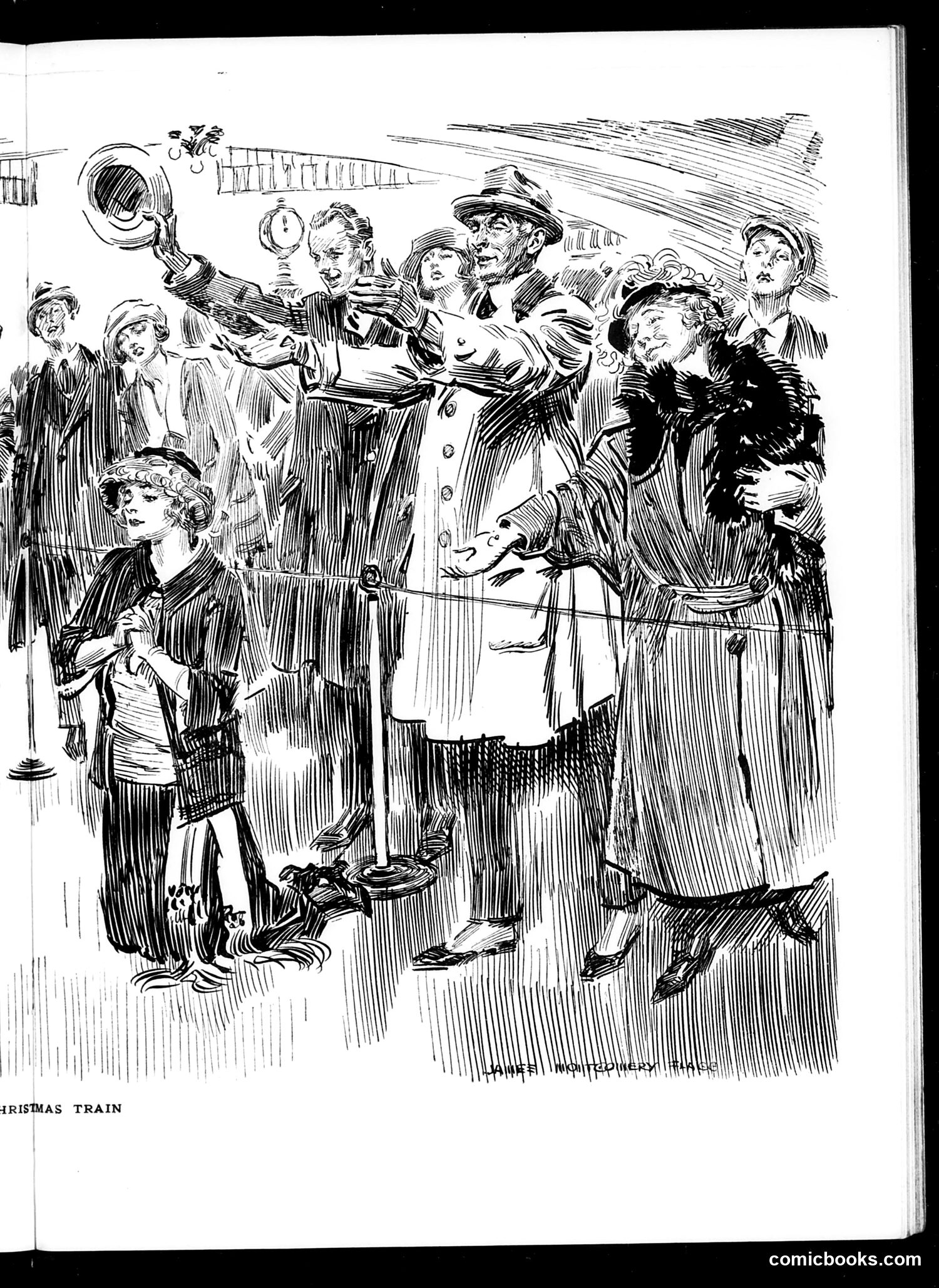
This satirical cartoon depicts a crowded Christmas train platform scene, likely from the early 20th century. The illustration shows well-dressed passengers—men in hats and coats, women in fashionable dress with furs—gathered around what appears to be a conductor or porter holding luggage and a pocket watch. The satire likely mocks the chaotic holiday travel rush, a recurring Judge magazine theme. The exaggerated expressions and cramped composition emphasize the overcrowding and stress of Christmas-season rail travel. The specific social commentary remains unclear without additional context, but this appears to be commenting on the commercialization of Christmas and the frantic consumer culture surrounding holiday travel during this period.
**The Main Editorial by William Allen White** satirizes technological progress through absurdist humor. It celebrates J.T. Lemyre, a fictional Canadian inventor who creates a device to harvest energy from rocking chairs—allowing fathers to sit idle on porches while generating household power. White mocks both the era's obsession with labor-saving inventions (which had revolutionized women's kitchen work) and the irony that fathers would be celebrated for *not working* while mothers continue laboring. The reference to "Watts who harnessed steam" puns on both the inventor James Watt and hymn-writer Isaac Watts. **"The Columnists" section** discusses the evolution of American newspaper humor columns, tracing lineage from 18th-century essayists (Steele, Lamb) through 19th-century humorists (Josh Billings, Artemus Ward) to contemporary columnists like Franklin P. Adams. It celebrates how humor journalism shaped American culture during westward expansion, featuring dialect comedians and literary humorists who entertained readers while the nation "conquered a continent." Both pieces reflect Progressive Era attitudes: technological optimism mixed with social commentary.
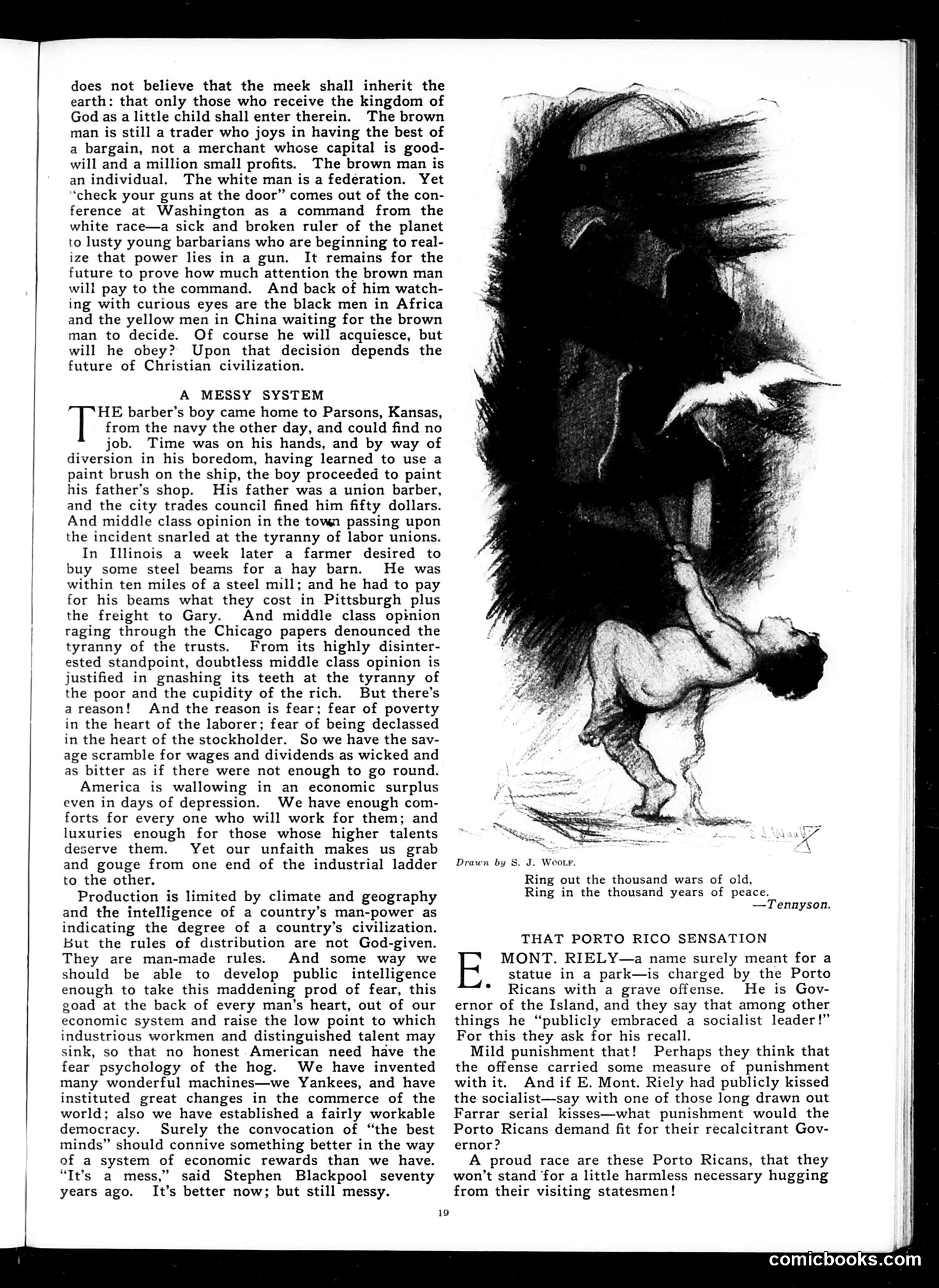
**The Cartoon (by S.J. Woolf):** Depicts a figure appearing distressed or contorted, illustrating the article's theme of economic anxiety and social struggle. **"A Messy System":** This article critiques economic inequality through two anecdotes. A navy barber's boy paints his father's shop and the union fines the father $50—middle-class opinion blames "labor tyranny." Meanwhile, a farmer near a steel mill must pay Pittsburgh prices plus freight—middle-class opinion blames "trust tyranny." The author argues both labor and capital operate from *fear*: workers fear poverty and declassing; stockholders fear losing wealth. Judge argues America has *economic surplus* but poor distribution systems. The author (quoting Dickens's Stephen Blackpool) calls for better public intelligence to remove "fear psychology" from economics and establish fairer reward systems. **"That Porto Rico Sensation":** References Governor Mont. Riely's mild punishment of Puerto Rican socialists, arguing they deserve harsher discipline. The piece mocks their "demands" and portrays Puerto Ricans as oversensitive to American governance.
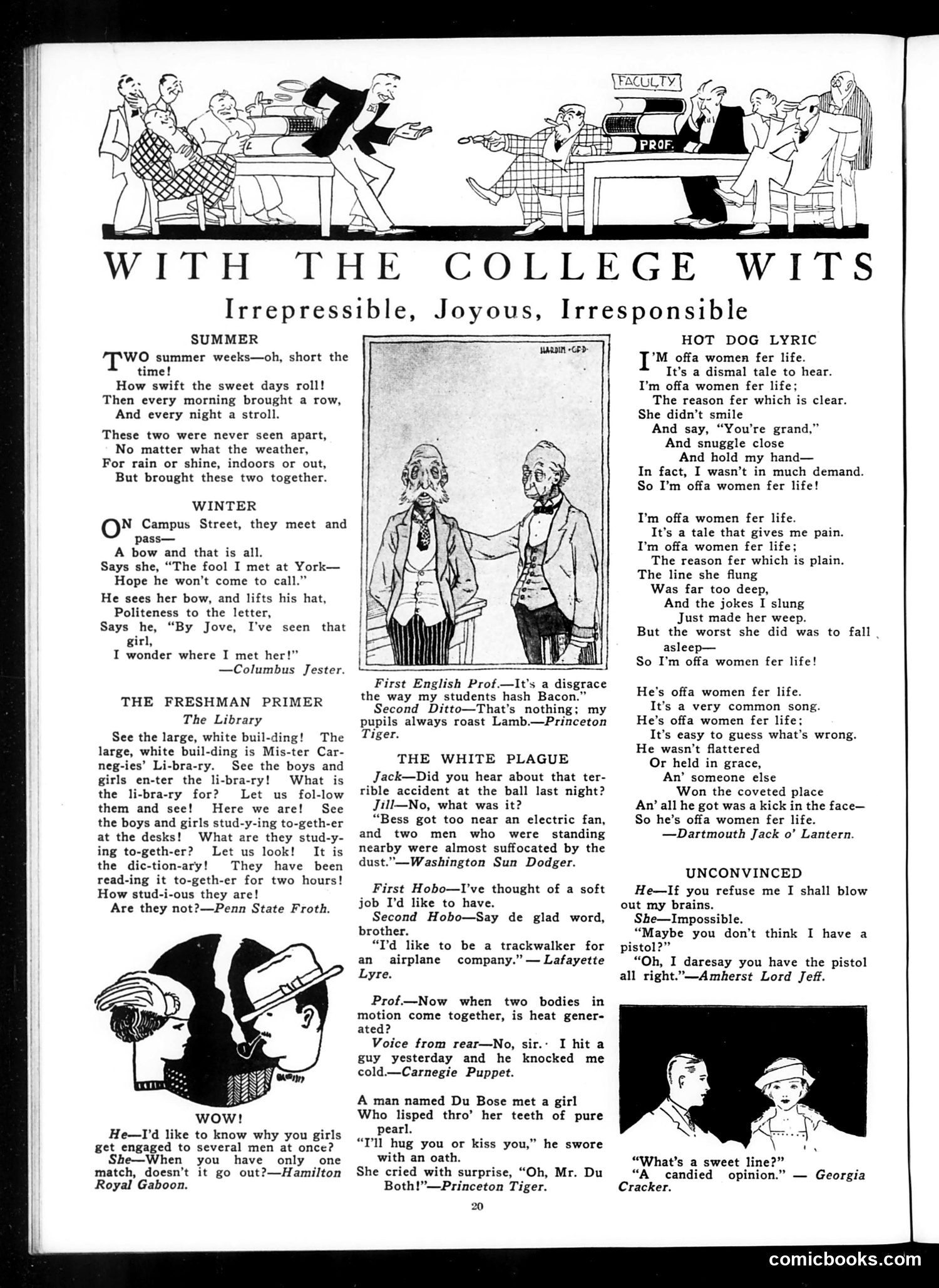
This page from *Judge* magazine presents college humor circa early 1900s, featuring various jokes and satirical pieces about student life. **Main Content:** The page collects short humorous pieces from different college publications (noted by attributions like "Penn State Froth," "Princeton Tiger," "Lafayette Lyre"). The satire targets: - **Campus romance**: The opening section depicts a couple inseparable in summer but coldly distant in winter—mocking the fickleness of college relationships and social pretense. - **Library behavior**: "The Freshman Primer" satirizes students using the library primarily for socializing rather than studying, particularly via the running joke about couples studying "the dictionary" together for two hours. - **Student life stereotypes**: Other pieces mock academic pretension (professors discussing literature), physical comedy (the "White Plague" fan accident), and romantic rejection (the "Hot Dog Lyric" about swearing off women). The cartoons and layout illustrate exaggerated student types, reinforcing themes of youthful folly, romantic mishaps, and academic superficiality typical of college life humor from this era.
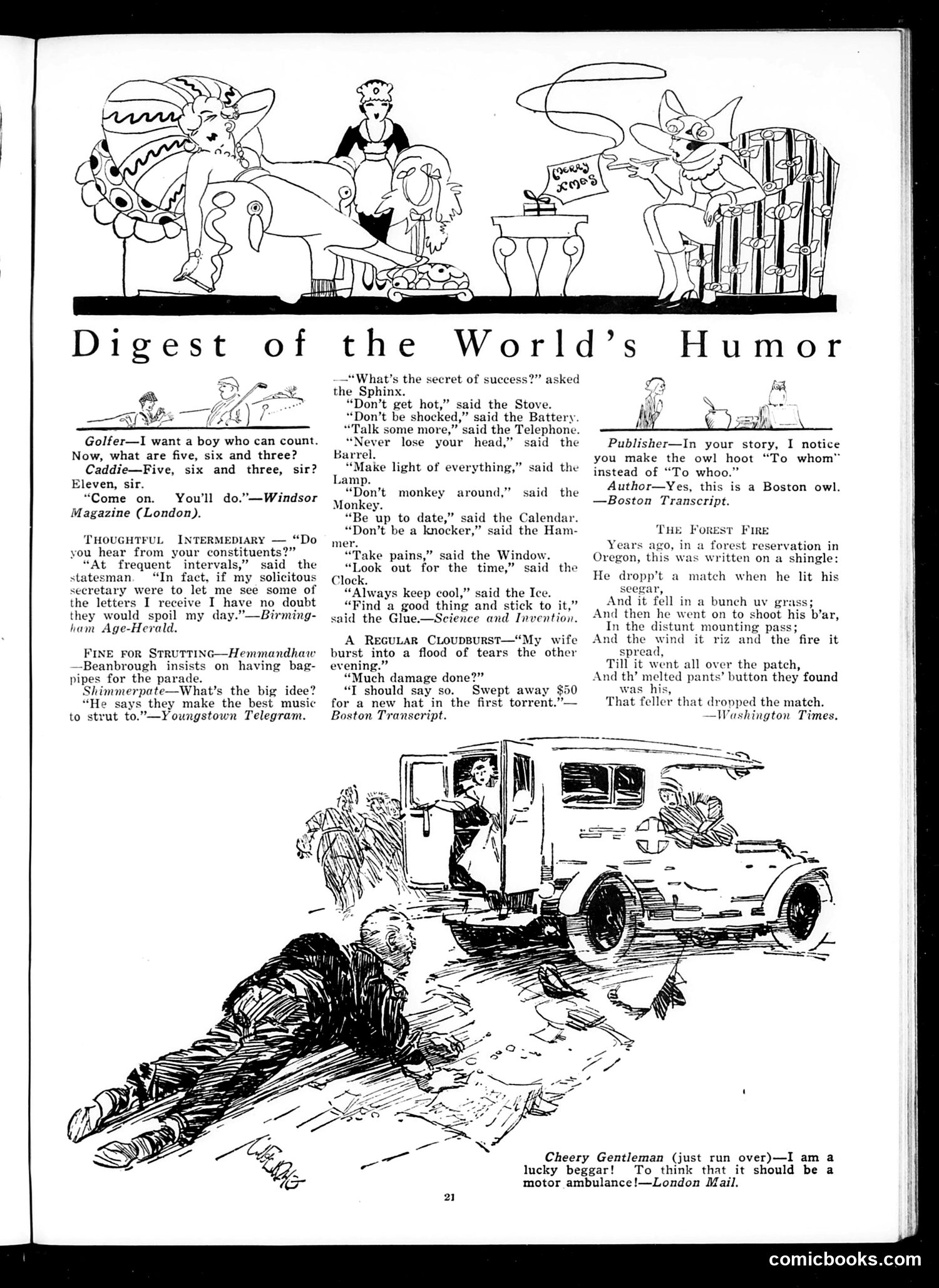
This is a humor digest page collecting jokes from various newspapers and magazines. The content consists of brief, disconnected comic anecdotes rather than unified political satire: **Key pieces:** - A caddie's math error (5+6+3=11) plays on working-class education - Politicians ignoring constituent complaints—mild political mockery - Anthropomorphic objects dispensing life advice (Stove, Battery, Telephone, etc.) as wordplay - A husband's complaint about his wife's shopping during emotional outbursts - A Boston owl's grammatically correct hooting (grammar joke) - A forest fire started by a careless smoker - A hit-and-run victim grateful for motor ambulance service (dark humor) **The satire:** These represent early 20th-century American humor—relatively gentle, often targeting absent-mindedness, marital dynamics, and new technology (automobiles, telephones). The "Cheery Gentleman" cartoon's darkly comic irony about being run over represents the period's adaptation to motorized danger as novel hazard.
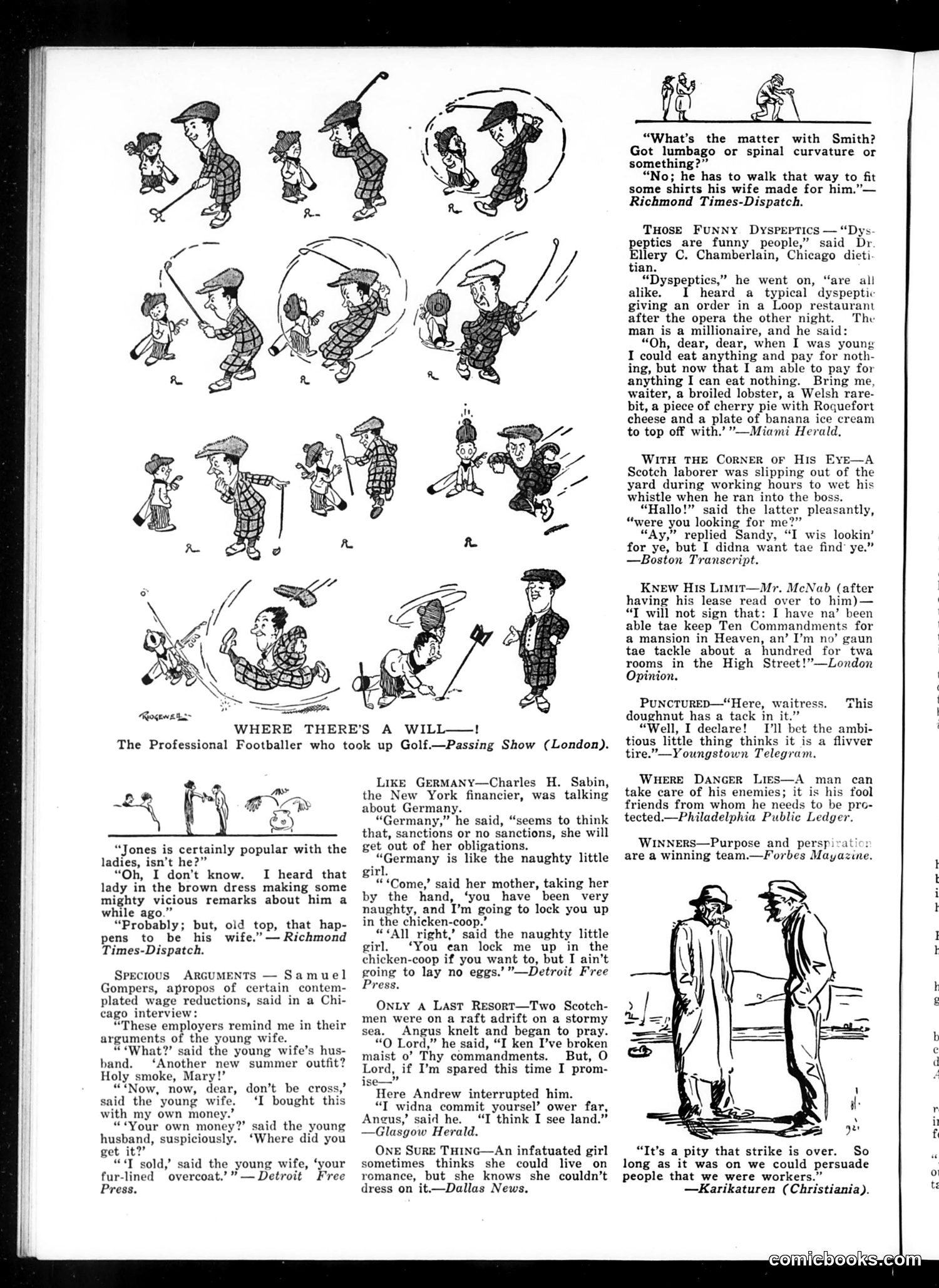
This page from *Judge* magazine contains a series of humorous anecdotes and one cartoon rather than political satire. **The Main Cartoon** ("Where There's a Will") depicts a professional footballer attempting golf—visual humor about athletic specialization, showing the footballer's comically poor form across multiple panels. **The Anecdotes** are brief jokes addressing early 20th-century domestic and social themes: - Wives' spending habits and marital friction over purchases - Labor disputes (Samuel Gompers' comparison of employers to stubborn wives) - Germany's refusal to honor post-WWI reparations obligations (compared to a defiant child) - Scottish frugality and religious commitment - Dyspepsia (indigestion) among wealthy men with nervous stomachs - Working-class Scots and their pragmatism The humor relies on stereotypes: nagging wives, Scottish parsimony, German irresponsibility, and class-based observations. These are social rather than political commentaries, reflecting period anxieties about marriage, economics, and national character.
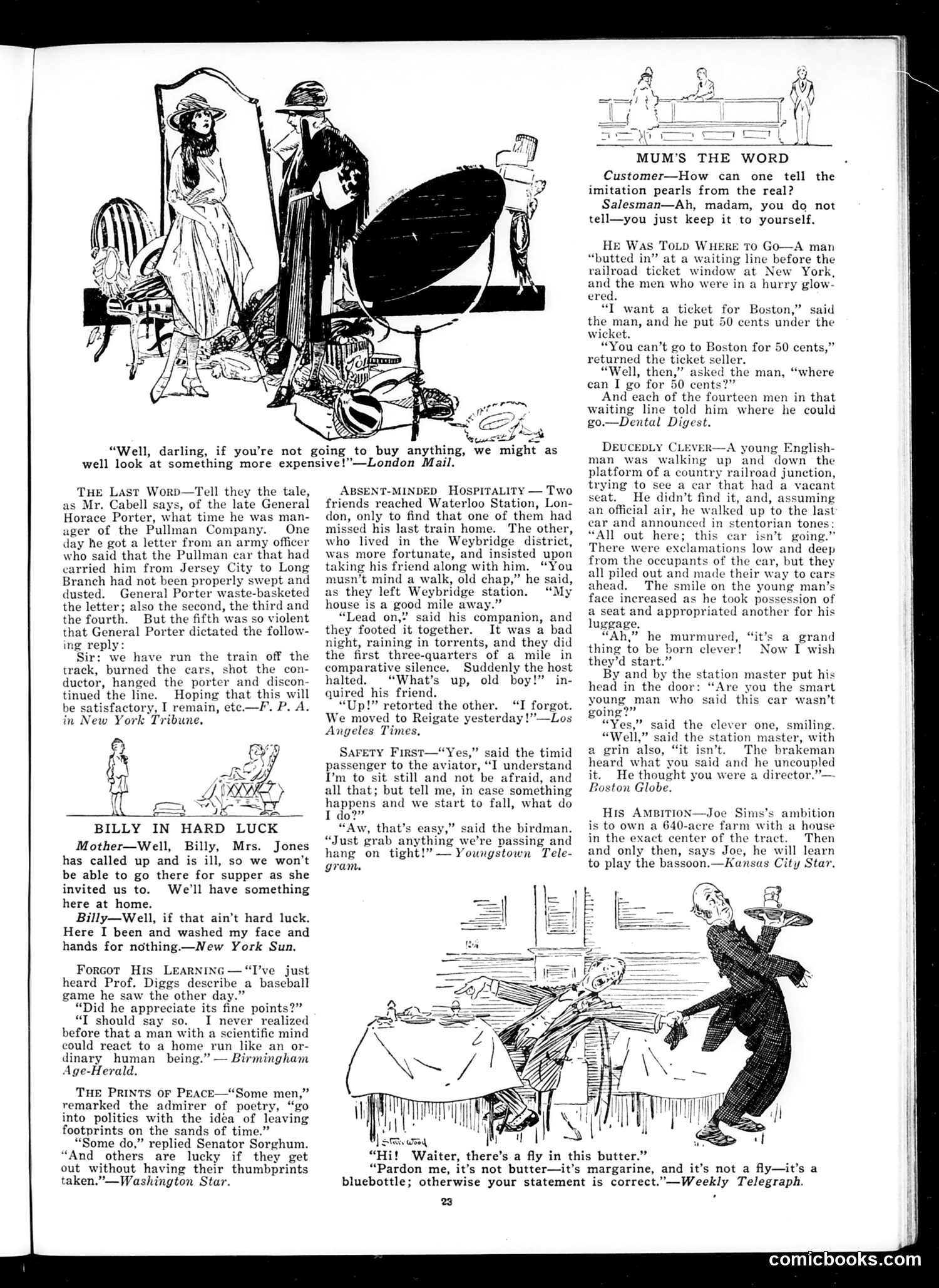
This page contains multiple short humorous anecdotes typical of early 20th-century *Judge* magazine. The cartoons and jokes satirize everyday social situations: **"Well, darling, if you're not going to buy anything..."** mocks couples who window-shop without purchasing—poking fun at window-shopping as an expensive leisure activity. **"The Last Word"** presents a satirical story about General Horace Porter (a real historical figure) responding absurdly to complaint letters about Pullman railroad cars by claiming he derailed trains and hanged porters—exaggerating management's dismissal of worker grievances. **"Billy in Hard Luck"** jokes about a child disappointed that a dinner invitation was cancelled, having washed up for nothing. The remaining anecdotes humorously depict absent-mindedness, confusion about train tickets, and misunderstandings in new situations like airplane travel. The humor relies on wordplay, exaggeration, and depicting characters as foolish or forgetful—typical satire of the period targeting middle-class social customs and bureaucratic absurdity.
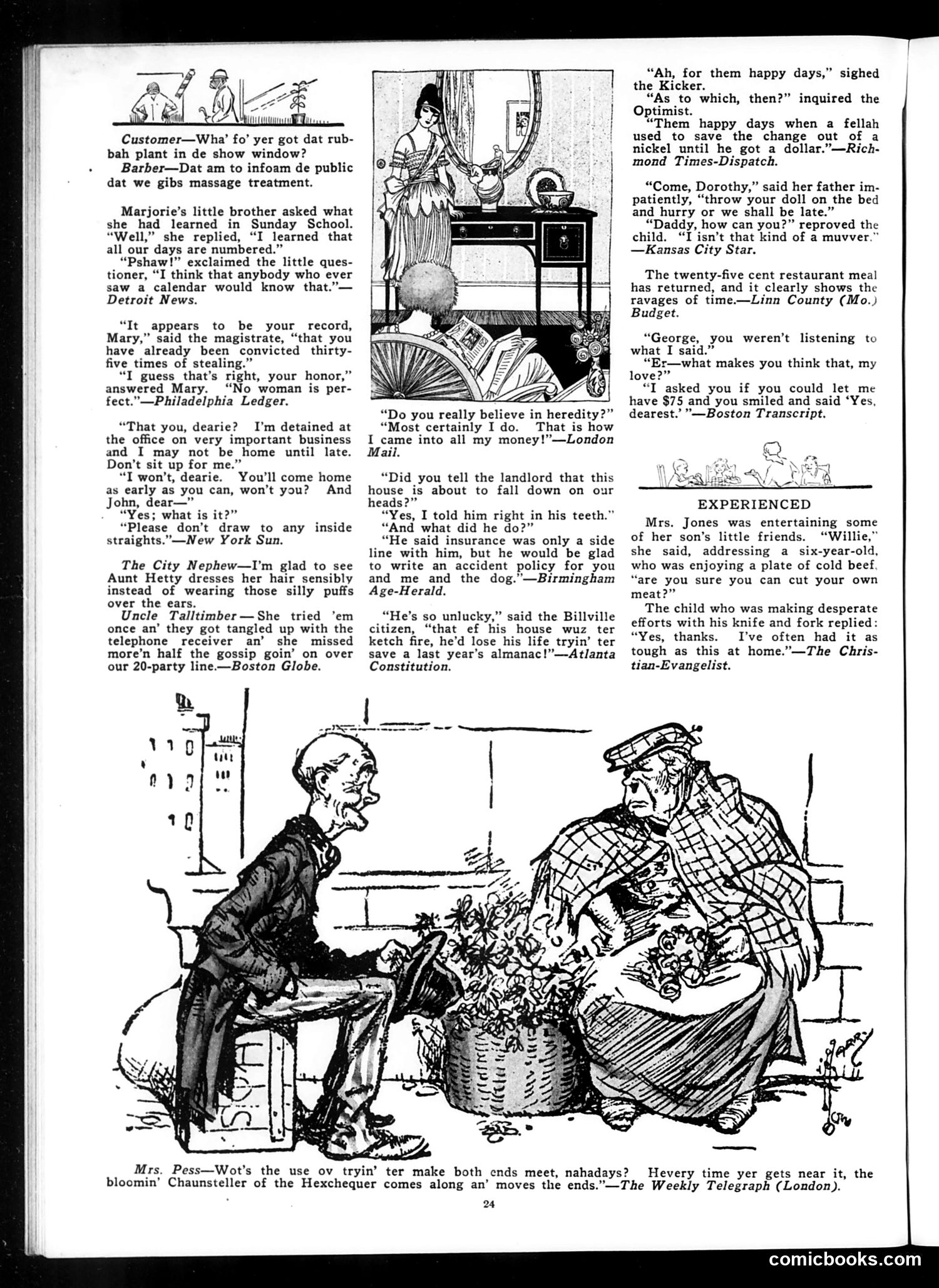
This page contains brief humorous anecdotes and jokes typical of early 20th-century American satirical magazines, plus one political cartoon at bottom. **The cartoon** depicts a working-class couple (identifiable by dress and setting) discussing household finances. The woman complains about "making both ends meet," while the man appears dismissive. The caption references the British Chancellor of the Exchequer, suggesting this is satire about government fiscal policy—specifically that whenever ordinary people attempt financial stability, government taxation ("moves the ends") disrupts their efforts. **The surrounding jokes** mock various social situations: marital finances, petty theft, landlord disputes, and misfortune. Several target working-class or immigrant characters (indicated by dialect spelling like "Wot's" and "Dat am"). **The broader context**: This reflects Judge's consistent satire of class dynamics, government overreach, and domestic life. The emphasis on financial struggle and governmental interference suggests post-WWI economic anxieties were significant to readers. The casual use of class-marked dialects reflects period attitudes about "lower" classes as inherently comedic subjects.
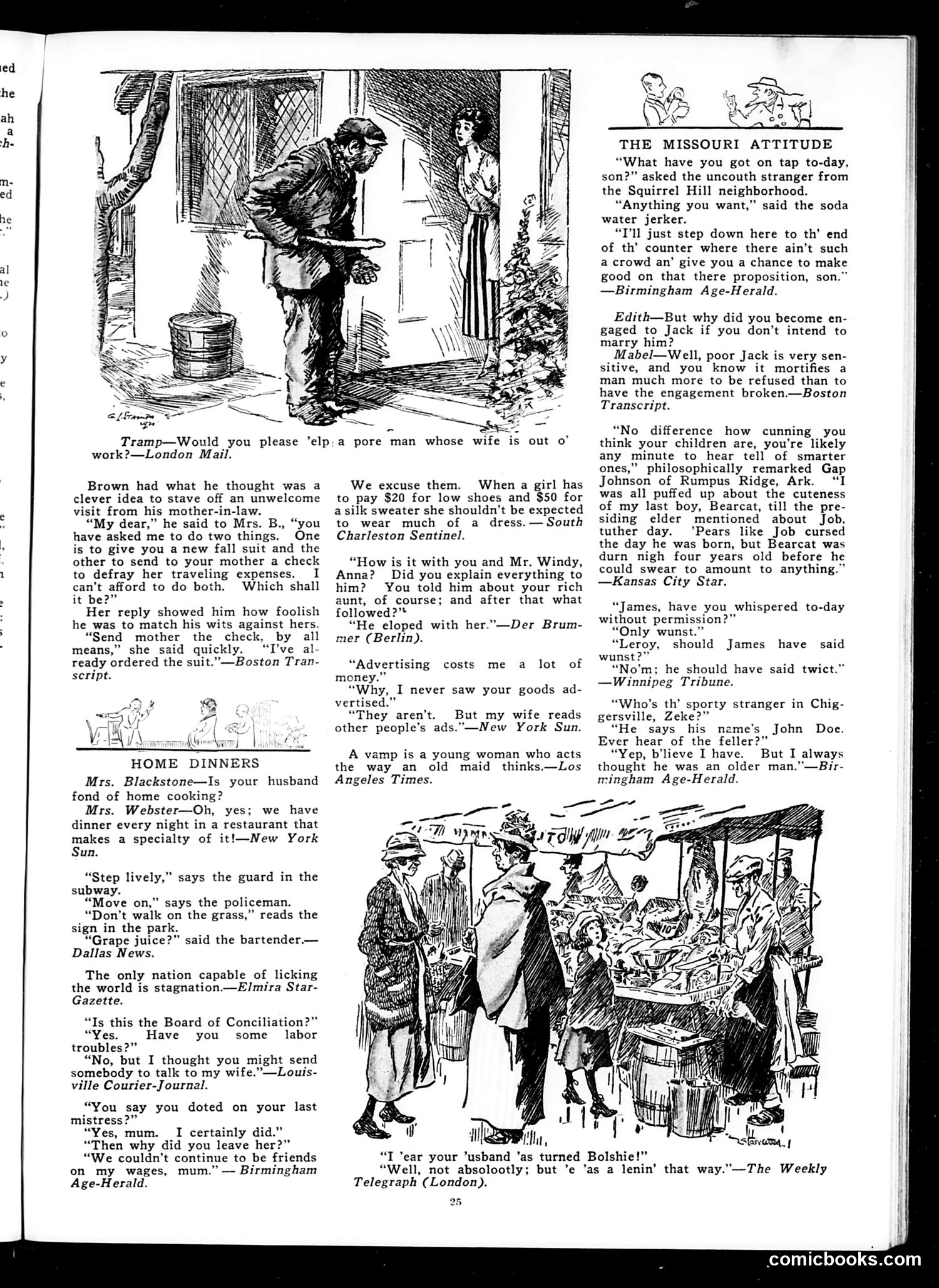
This page contains humorous anecdotes and jokes rather than political cartoons. The content reflects early 20th-century American and European humor focused on domestic life, social class, and urban manners. **Key themes:** - **Marriage satire**: Multiple jokes about wives outsmarting husbands financially or emotionally, reflecting anxieties about women's economic power and changing gender dynamics - **Class commentary**: References to servants, "tramps," and working-class characters using dialect ("'elp," "wunst") for comic effect—typical period condescension toward lower classes - **Urban modernity**: Jokes about subways, restaurants, advertising, and bars reflect rapid urbanization - **International humor**: German, British, and Canadian references show Judge's cosmopolitan readership **Bottom cartoon**: Shows a woman at what appears to be a market stall, with text referencing someone "turning Bolshie" (Bolshevik)—suggesting post-WWI anxiety about communist sympathies. The overall tone emphasizes clever domestic conflict, class stereotypes, and gentle social observation rather than serious political critique.
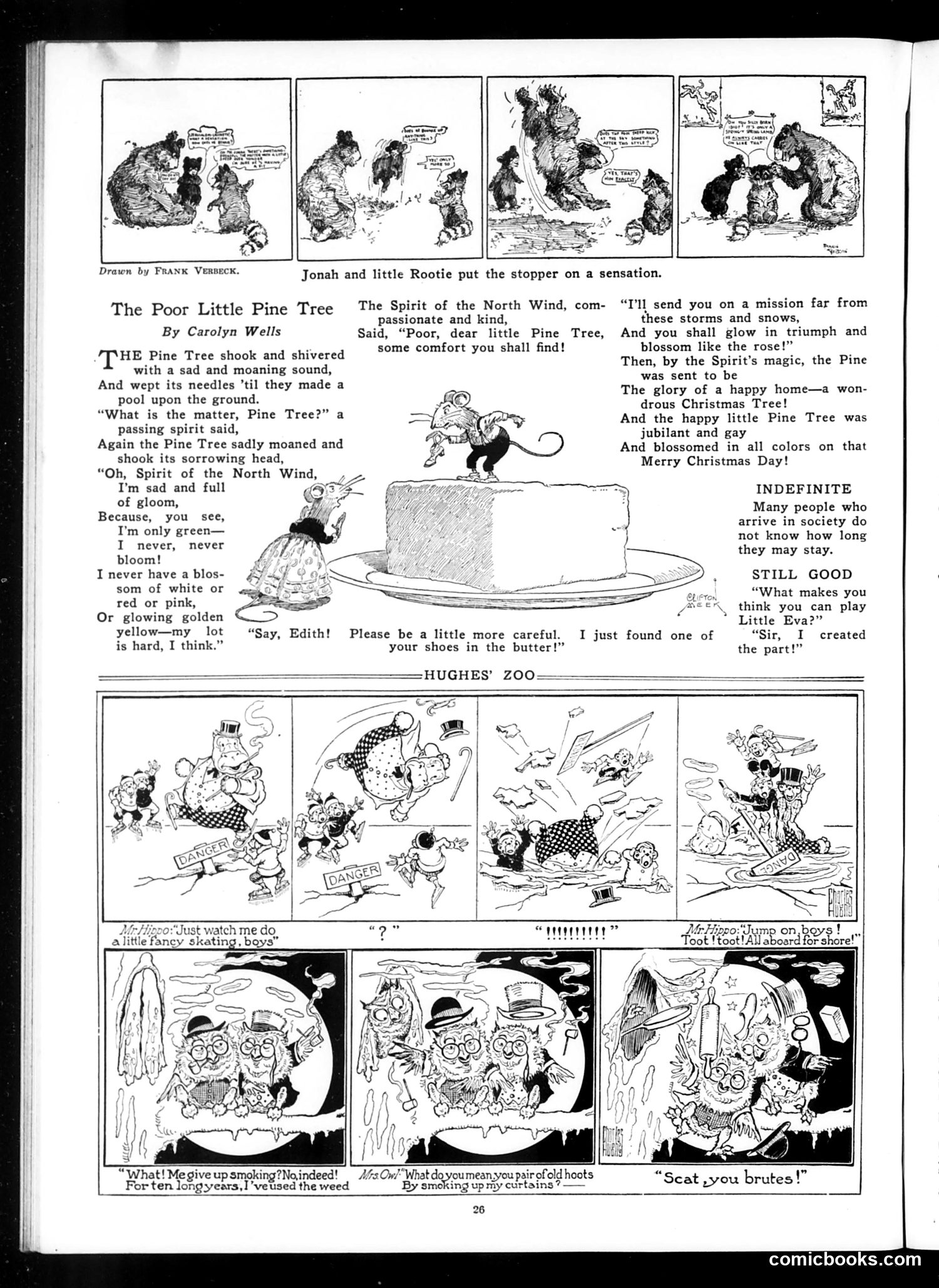
This page contains three separate humorous pieces typical of early 20th-century Judge magazine: **"The Poor Little Pine Tree"** is a sentimental illustrated poem about a sad evergreen that never blooms, comforted by the North Wind Spirit and transformed into a Christmas tree—a gentle, wholesome story with no political satire. **The middle panel shows domestic humor**: A woman (Edith) scolds a man for leaving a shoe in the butter, a simple joke about household mishaps. **"Hughes' Zoo"** is a comic strip featuring characters engaged in slapstick humor—ice skating mishaps, people falling, and what appears to be hobos or poor characters smoking in a cave, making crude jokes about poverty and smoking. The humor relies on physical comedy and class-based stereotypes common to the era. The page lacks overt political satire or caricature of identifiable public figures. It's primarily domestic and slapstick comedy aimed at general audiences, typical of Judge's lighter content mixed with occasional social commentary through exaggeration of everyday situations.
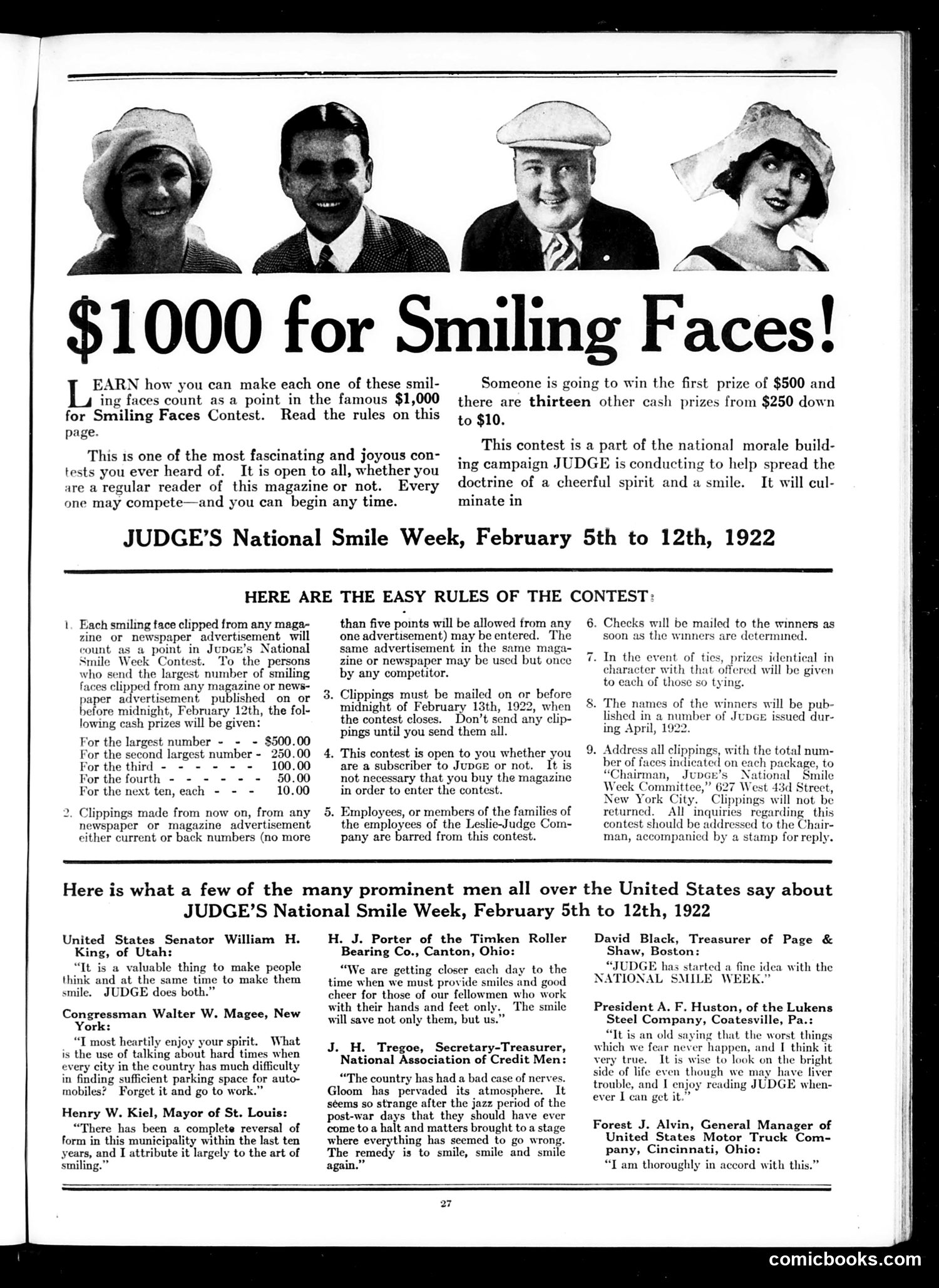
This page is primarily **advertising and promotion**, not satirical content. Judge magazine is running a contest offering $1,000 in prizes for readers who clip smiling faces from advertisements and submit them by February 13, 1922, during "National Smile Week." The four portrait photographs at the top show examples of "smiling faces" — likely from advertisements, though no identification is provided. The contest reflects a post-WWI "morale building campaign" promoting cheerfulness as a civic virtue. Endorsements from prominent figures (a U.S. Senator, congressman, mayors, and businessmen) frame smiling as patriotic and economically beneficial, not just pleasant. The satire here is subtle: Judge appears to be gently mocking early 1920s optimism and the era's tendency to prescribe smiling as a solution to social problems — promoting "good cheer" to workers while ignoring actual hardships. The tone suggests tongue-in-cheek promotion of a somewhat absurd idea.
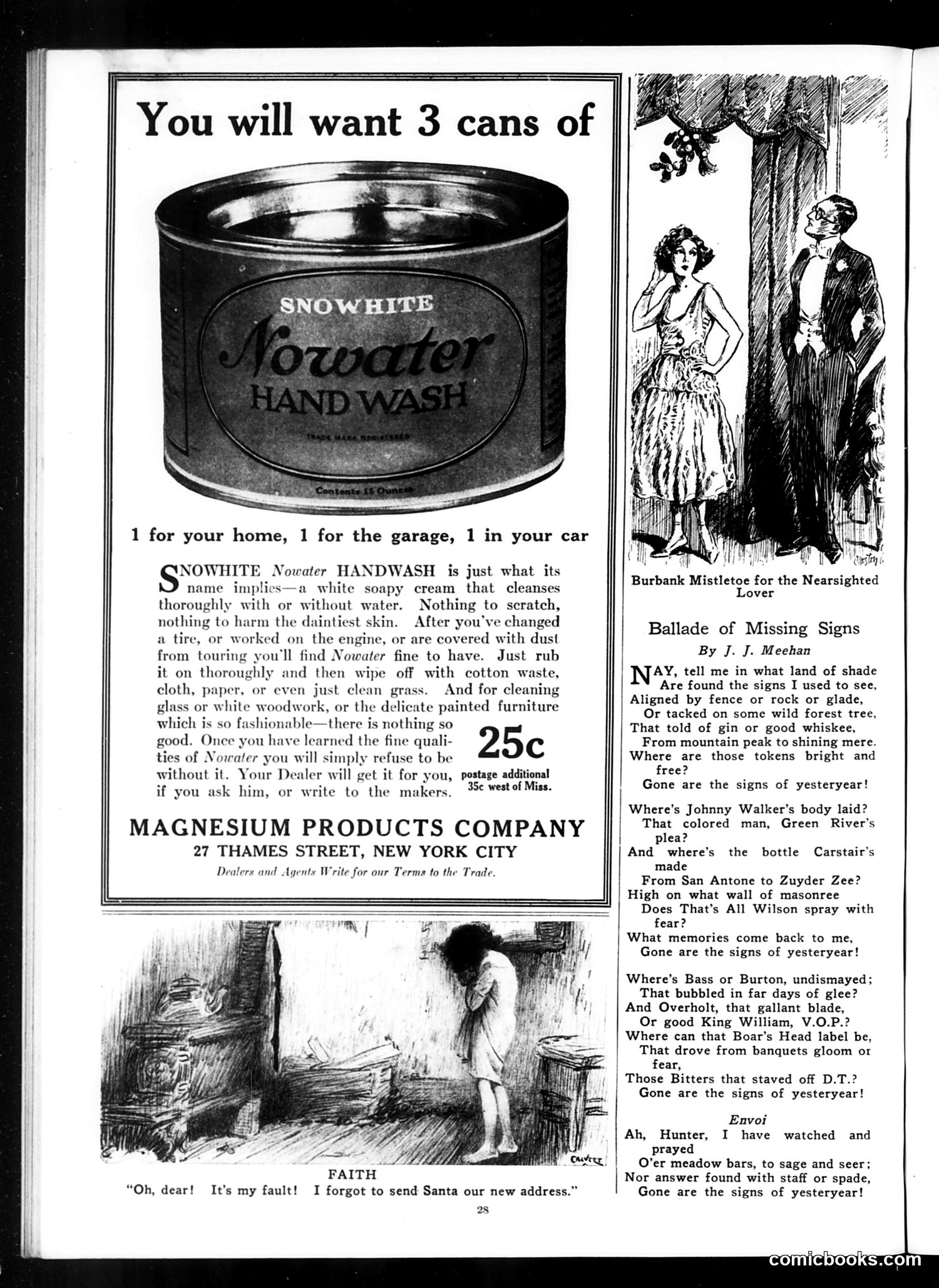
This page blends advertising with satirical poetry about Prohibition. The top features a commercial for Snowhite Nowater hand soap—a product promising to clean industrial grime without water, pitched for home, garage, and car use. The main satire is "Ballad of Missing Signs" by J.J. Meehan, a nostalgic poem lamenting the disappearance of alcohol advertising signs. The verses reference vanished whiskey and beer brand advertisements (Johnny Walker, Green River, Castair's, Bass, Overholt, and others) that once adorned American landscapes—references to "gin" and "good whiskee" signs now illegal under Prohibition. The two small cartoons provide supporting humor: "Burbank Mistletoe for the Nearsighted Lover" jokes about courtship, while "Faith" depicts a woman's Christmas worry about Santa's address—likely referencing post-WWI disruptions. The poem's refrain "Gone are the signs of yesteryear" transforms a Villon-inspired form into wistful commentary on Prohibition's enforcement, mockingly treating vanished liquor ads as cultural loss.
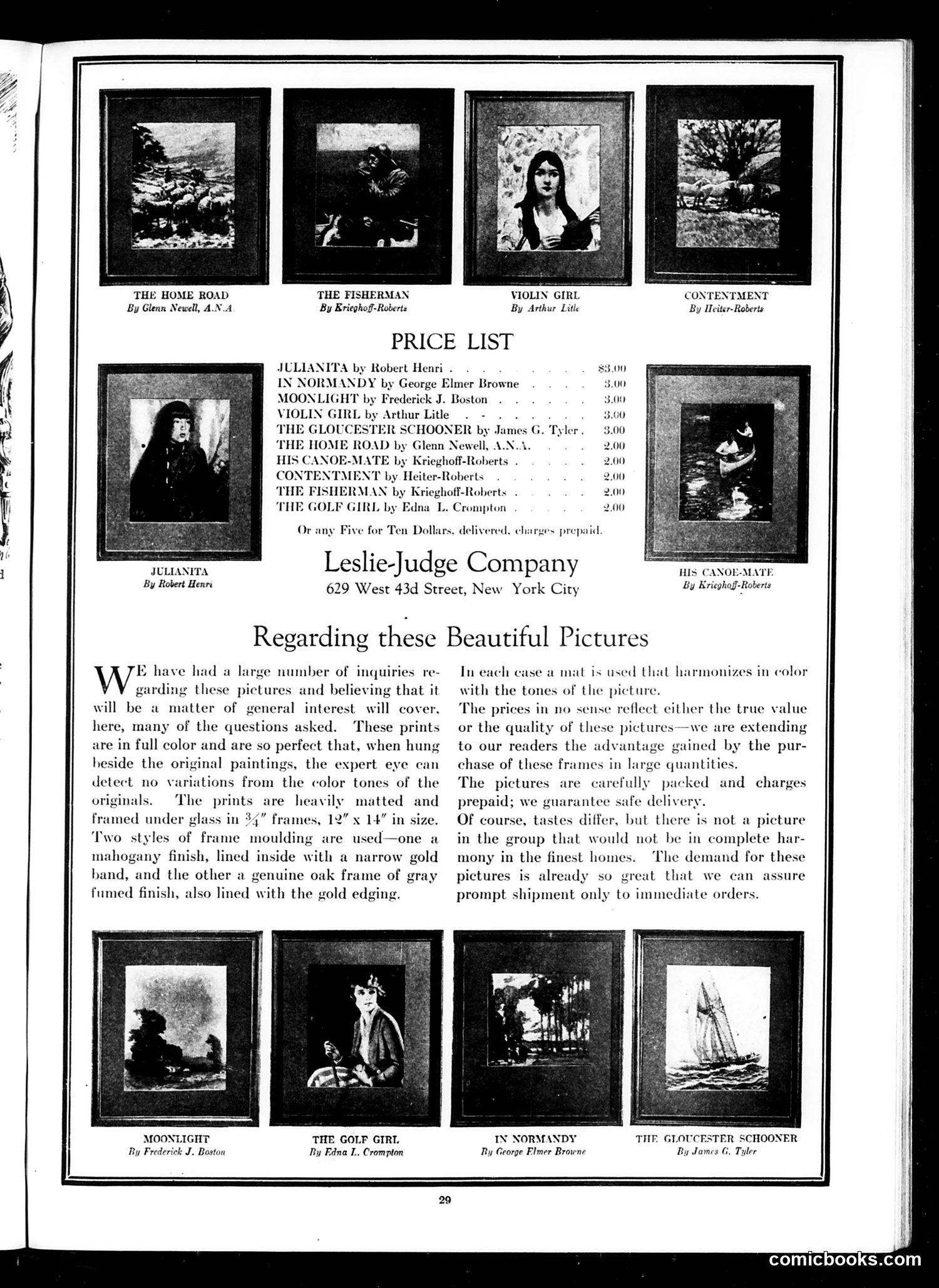
This page is primarily **advertising, not satire or political commentary**. It's a Leslie-Judge Company price list for fine art reproductions—framed prints of paintings by established artists like Robert Henri and Frederick J. Boston. The eight images shown are landscape and portrait paintings offered for sale, priced from $2.00 to $3.00 each, or five for ten dollars. The text emphasizes that these are full-color reproductions so faithful that experts cannot distinguish them from originals when hung beside paintings. They come framed in mahogany or oak, matted in coordinating colors. The only "satire" element, if any, is subtle: Judge magazine (typically known for political humor) is leveraging its reputation to market high-quality art reproductions to middle-class readers who couldn't afford original paintings. This represents commercial enterprise disguised as cultural endorsement.
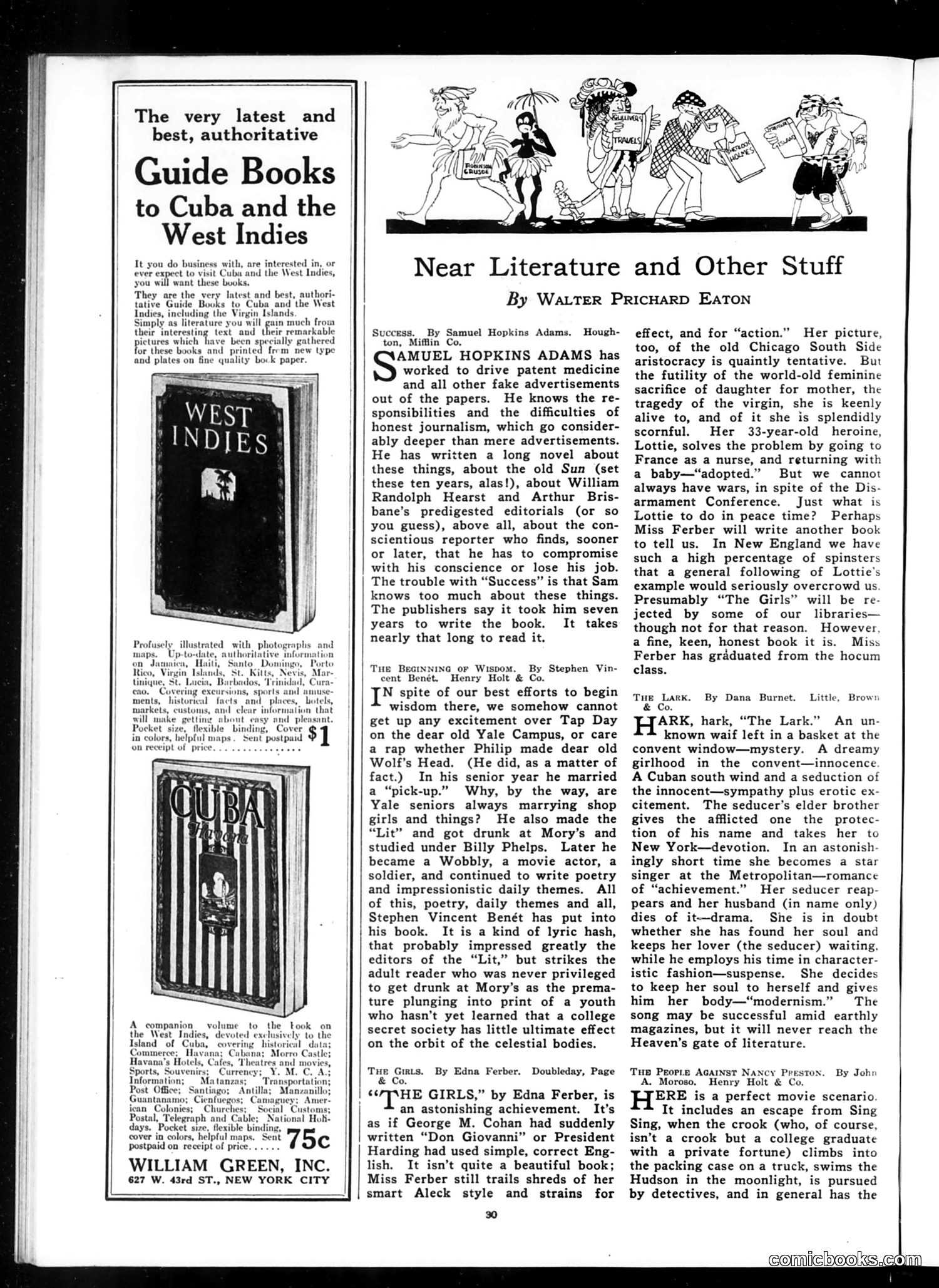
This page is primarily **book advertising and literary criticism**, not political satire. The top section advertises travel guides to Cuba and the West Indies—likely appealing to wealthy readers of this era interested in Caribbean tourism. The bulk of the page contains literary reviews by Walter Prichard Eaton of contemporary novels: - **"Success"** by Samuel Hopkins Adams—criticized as tediously long despite its worthy subject (journalism ethics, patent medicine fraud) - **Stephen Vincent Benét's "Bing or Wisdom"**—mocked as immature Yale nostalgia about secret societies and drunken antics - **Edna Ferber's "The Girls"**—praised as surprisingly sophisticated, though noting her typical stylistic quirks The reviews employ typical literary magazine wit, particularly the backhanded compliment structure (Ferber's achievement compared to Cohan or Harding writing well). There is no visible political cartoon on this page—it's a straightforward cultural/literary section from Judge magazine.
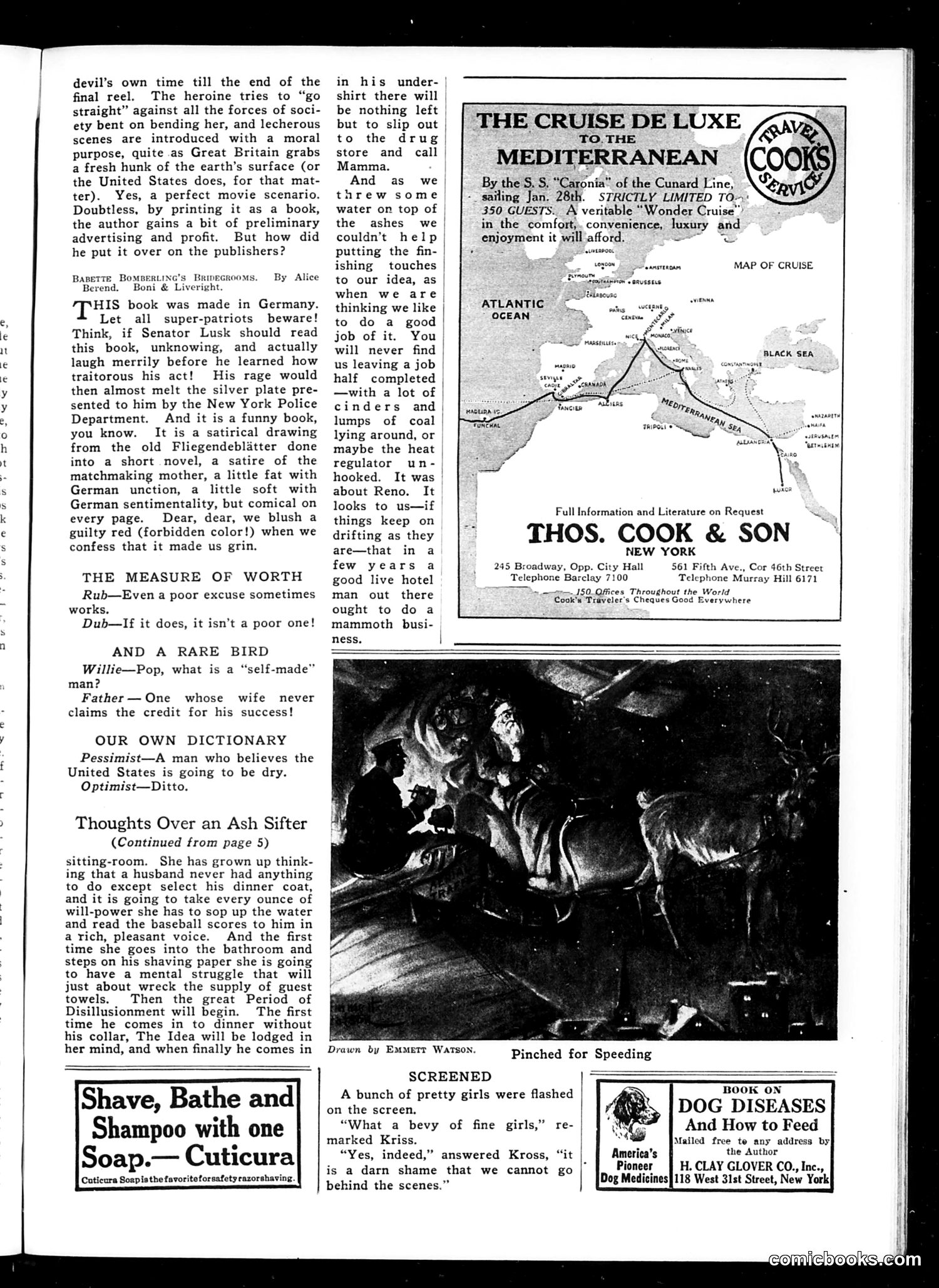
This page is primarily **advertisements and humorous columns** rather than political cartoons. Key content: **Text sections** include book reviews (notably one mocking German-authored "Bombberling's Bringrooms," with a jab at Senator Lusk—likely William H. Lusk, known for anti-radical activities), brief jokes about marriage and Prohibition, and a column on domestic disappointment. **The cartoon** "Pinched for Speeding" (by Emmett Watson) shows a woman being stopped by a police officer—likely referencing enforcement of traffic laws, a growing concern in the 1920s. **Advertisements** dominate: a Cunard cruise to the Mediterranean, Cuticura soap, and a dog-disease book. **Historical context**: References to Prohibition ("the United States is going to be dry") and post-WWI German suspicion date this to the early 1920s. The humor reflects anxieties about modernization, marriage, and social change typical of the era.
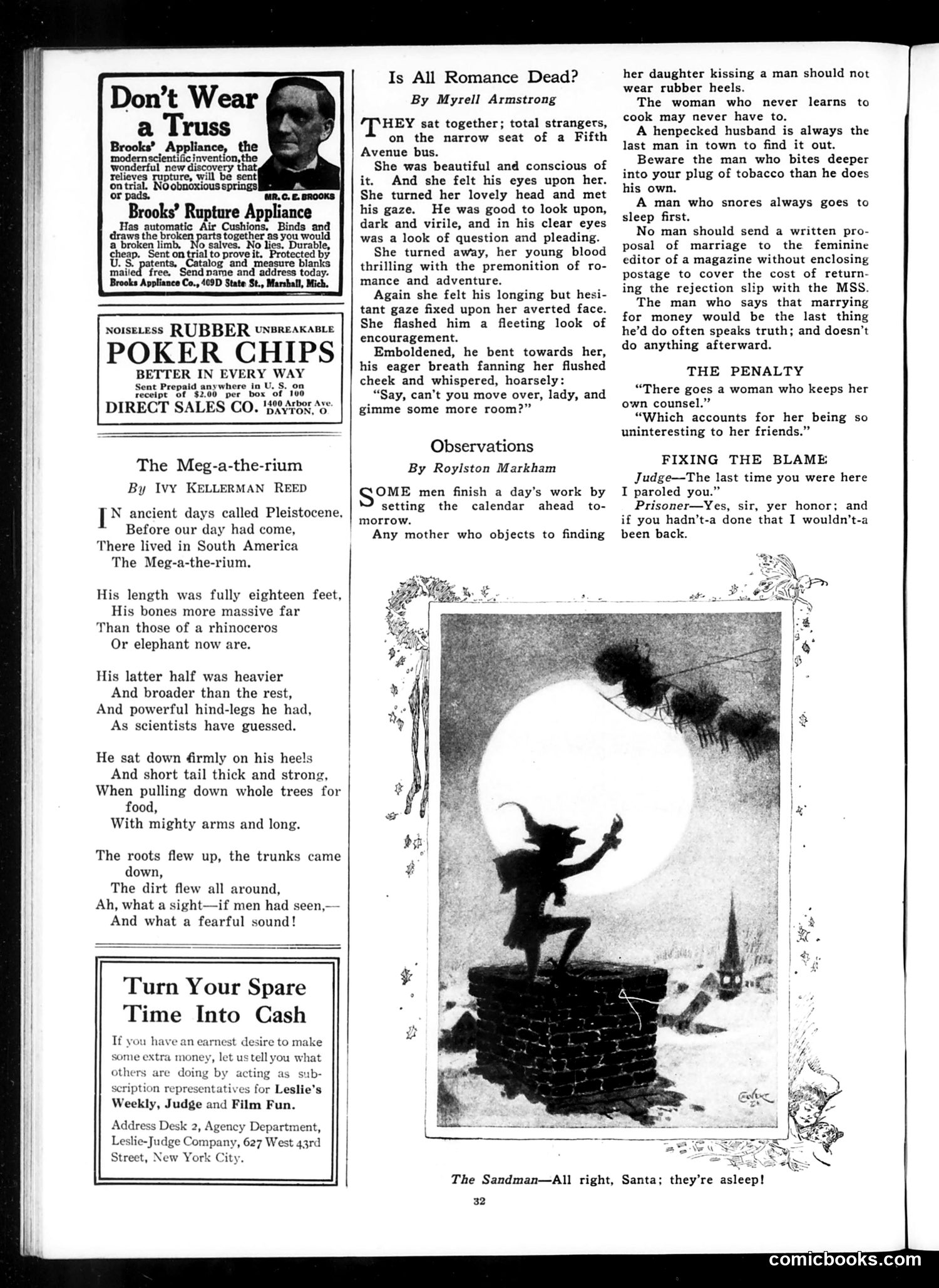
This page combines advertisements, poetry, and humor pieces typical of early 20th-century satirical magazines. **"The Meg-a-the-rium"** is a whimsical poem about an extinct prehistoric giant ground sloth, describing its enormous size and tree-eating habits. It's educational light verse with no political content. **"Is All Romance Dead?"** is a joke about disappointed romantic expectations: two strangers on a Fifth Avenue bus exchange meaningful glances suggesting impending romance, but the man merely asks the woman to move over for more seat space. The satire mocks the gap between romantic fantasy and mundane reality. **"Observations"** offers brief satirical quips about marriage, gender relations, and human behavior—typical Judge fare mocking domestic life and male-female dynamics. **"The Sandman"** illustration shows a silhouetted figure (Santa Claus) against a large moon, suggesting children should be asleep. The advertisements promote medical appliances (rupture treatment, poker chips) and subscription work—standard commercial filler for the era.
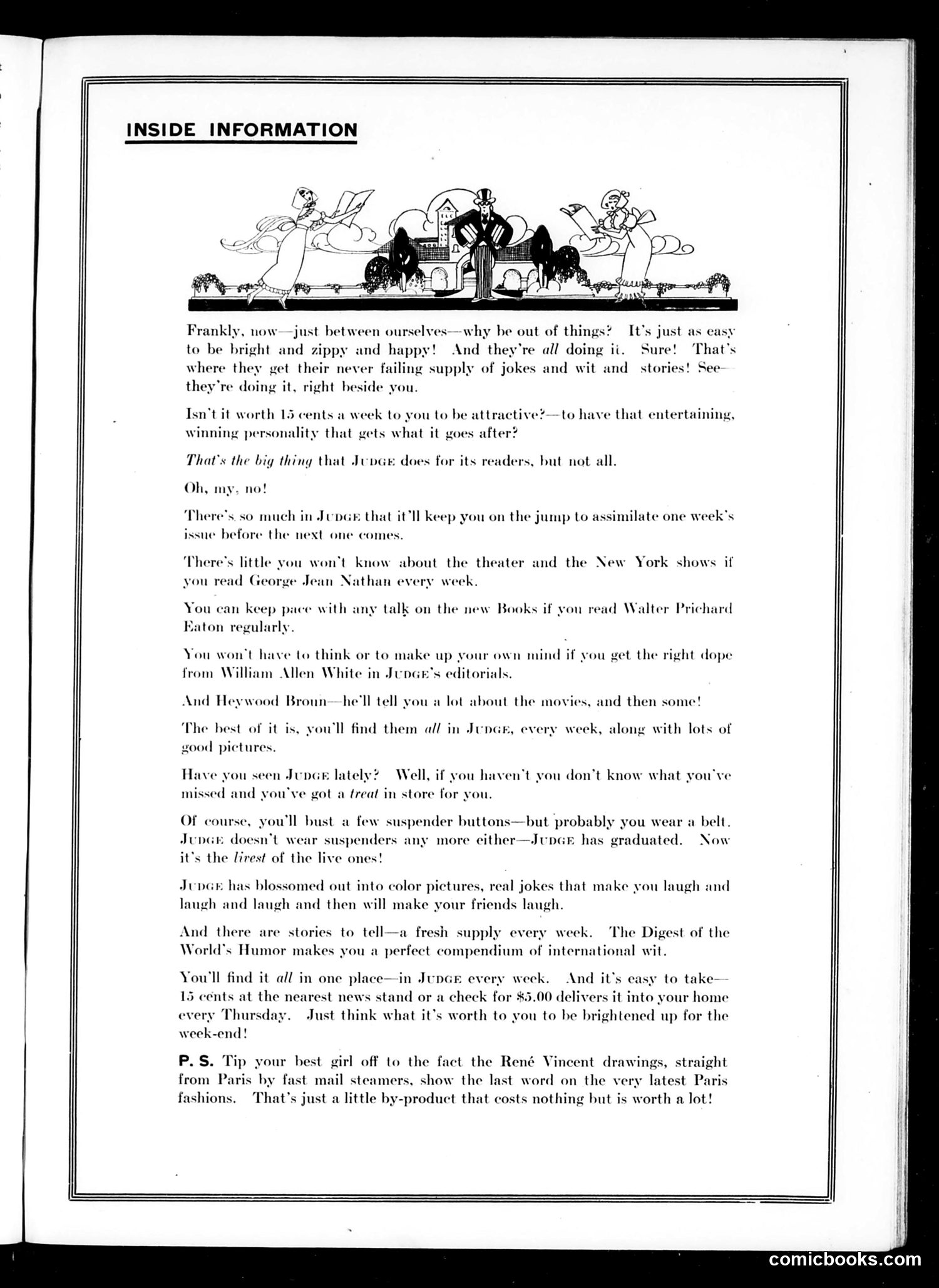
This is a **self-promotional advertisement** for *Judge* magazine itself, not a political cartoon. The illustration shows a stylized mansion or estate, representing sophistication and success. The ad targets readers (especially women, given the fashion reference) by promising that reading *Judge* will make them witty, well-informed, and socially attractive. It highlights the magazine's contributors—George Jean Nathan (theater critic), Walter Prichard Eaton (books), William Allen White (editorials), and Heywood Broun (film criticism)—as authorities who will provide readers ready-made opinions so they needn't "think or make up your own mind." The pitch is essentially: *Judge* offers jokes, stories, color illustrations, and René Vincent's Paris fashion drawings for 15 cents weekly. The underlying satire is self-aware: the ad humorously promises that consuming the magazine will make readers "bright and zippy and happy" and socially successful—a tongue-in-cheek sales pitch typical of early 20th-century magazine marketing.
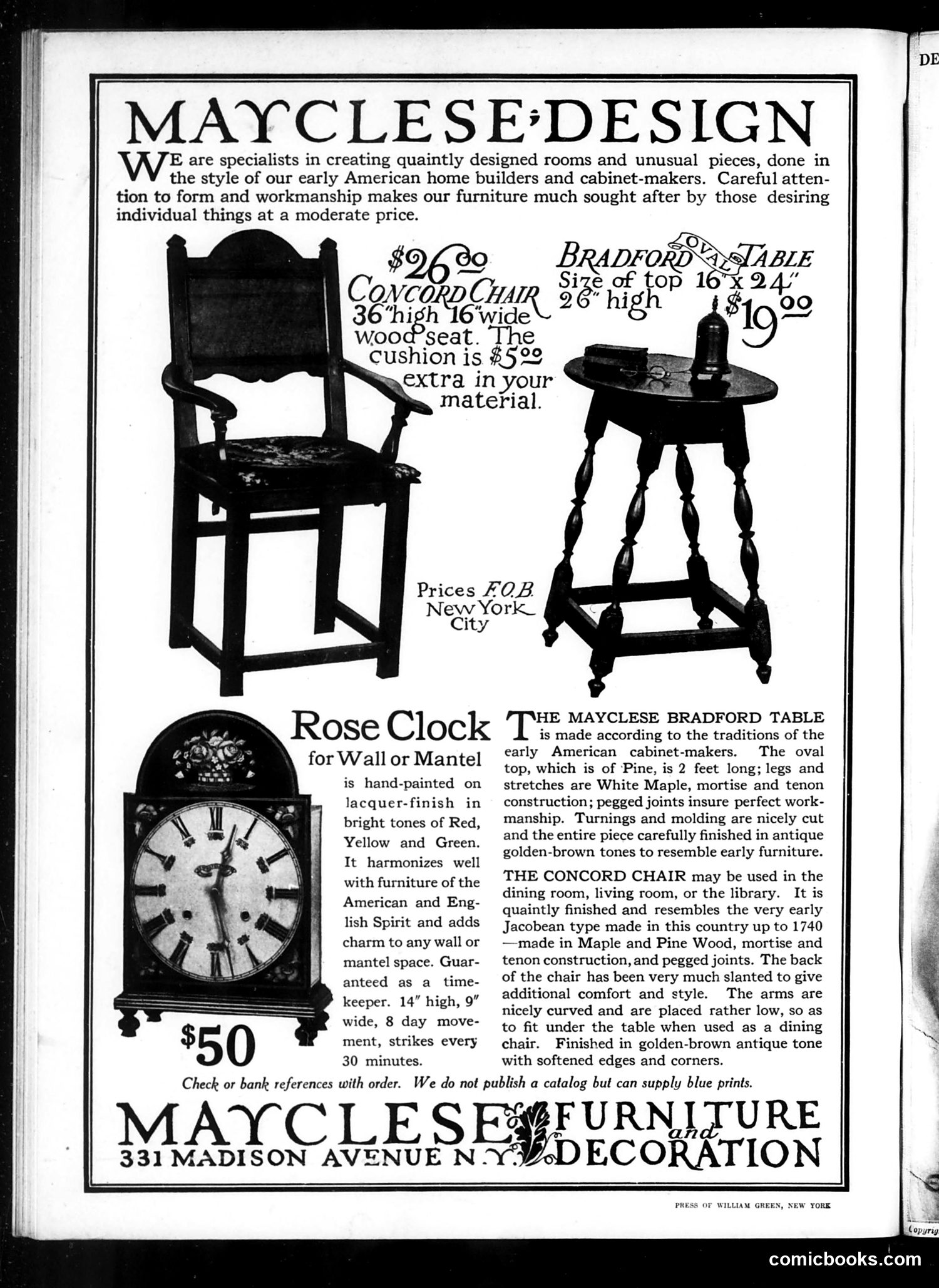
This page is **not a political cartoon but a furniture advertisement**. It promotes Mayclese Furniture and Decoration, located at 331 Madison Avenue in New York City, which specializes in Early American colonial-style furniture. The page showcases three pieces: a Concord Chair ($26.80, with optional $5 cushion), a Bradford Table ($19), and a Rose Clock ($50). Each item emphasizes authentic colonial craftsmanship—mortise-and-tenon construction, hand-painted details, maple and pine wood—designed to appeal to wealthy buyers seeking "quaintly designed rooms" with historical authenticity. The advertisement reflects early 20th-century American nostalgia for colonial design and "early American" aesthetics, positioning such furniture as markers of taste and individual distinction for affluent consumers willing to pay premium prices for craftsmanship and historical styling.