
Judge, 1921-12-24 · page 12 of 36
Judge — December 24, 1921 — page 12: what you’re looking at
What you’re looking at
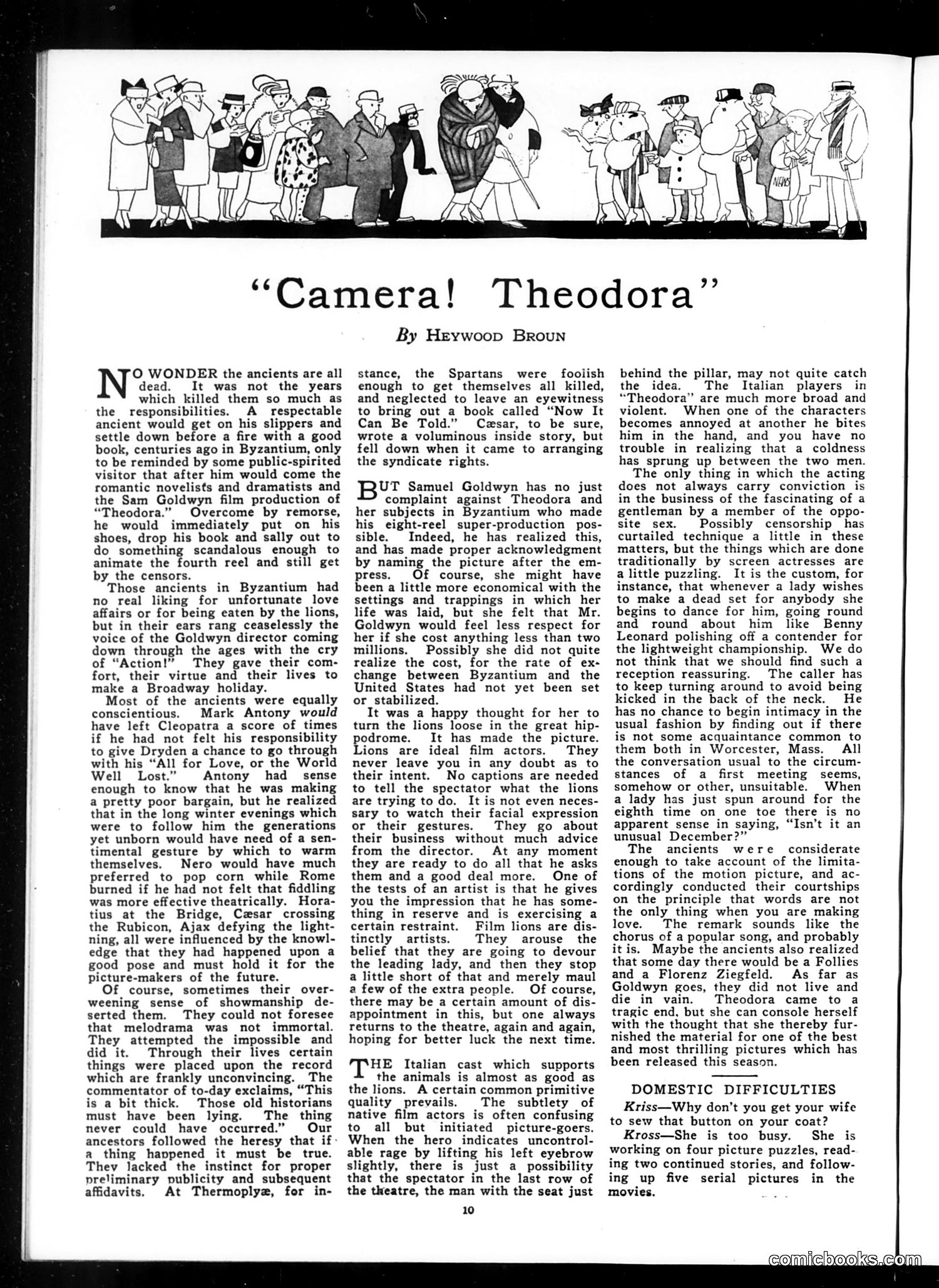
This is a satirical essay by Heywood Broun (byline visible) about Samuel Goldwyn's film production of *Theodora*. The illustration shows a silhouette line of various historical and contemporary figures. **The satire's point:** Broun humorously argues that historical figures—Mark Antony, Nero, the Spartans, Caesar—actually shaped their famous deeds *for future dramatization*, anticipating they'd become stories. Ancient people supposedly felt obligated to behave dramatically enough to interest future novelists and filmmakers. **The specific target:** Goldwyn's two-million-dollar *Theodora* film production, which depicts the Byzantine empress. Broun ironically suggests Theodora herself—aware of Goldwyn's eventual interest—deliberately created spectacles (like releasing lions in the hippodrome) to ensure cinematic appeal. **The joke:** It inverts causality: instead of history naturally inspiring cinema, Broun suggests historical figures preemptively performed *for cinema*, taking responsibility to future audiences over their own comfort and virtue. It's a clever dig at both Hollywood's grandiosity and cinema's power over historical imagination.
📄 Transcribed text from this page (OCR, searchable)
Machine-transcribed from the original scan — historical spelling and the odd misread are preserved.
‘“‘Camera! O WONDER the ancients are all dead. It was not the years which killed them so much as the responsibilities. A respectable ancient would get on his slippers and settle down before a fire with a good book, centuries ago in Byzantium, only to be reminded by some public-spirited visitor that after him would come the romantic novelists and dramatists and the Sam Goldwyn film production of “Theodora.” Overcome by remorse, he would immediately put on his shoes, drop his book and sally out to do something scandalous enough to animate the fourth reel and still get by the censors. Those ancients in Byzantium had no real liking for unfortunate love affairs or for being eaten by the lions, but in their ears rang ceaselessly the voice of the Goldwyn director coming down through the ages with the cry of “Action!” They gave their com- fort, their virtue and their lives to make a Broadway holiday. Most of the ancients were equally conscientious. Mark Antony would have left Cleopatra a score of times if he had not felt his responsibility to give Dryden a chance to go through with his “All for Love, or the World Well Lost.” Antony had sense enough to know that he was making a pretty poor bargain, but he realized that in the long winter evenings which were to follow him the generations yet unborn would have need of a sen- timental gesture by which to warm themselves. Nero would have much preferred to pop corn while Rome burned if he had not felt that fiddling was more effective theatrically. Hora- tius at the Bridge, Cesar crossing the Rubicon, Ajax defying the light- ning, all were influenced by the knowl- edge that they had happened upon a good pose and must hold it for the picture-makers of the future. Of course, sometimes their over- weening sense of showmanship de- serted them. They could not foresee that melodrama was not immortal. They attempted the impossible and did it. Through their lives certain things were placed upon the record which are frankly unconvincing. The commentator of to-day exclaims, “This is a bit thick. Those old historians must have been lying. The thing never could have occurred.” Our ancestors followed the heresy that if- a thing happened it must be true. They lacked the instinct for proper preliminary publicity and subsequent affidavits. At Thermoplyz, for in- By Heywoop Broun stance, the Spartans were foolish enough to get themselves all killed, and neglected to leave an eyewitness to bring out a book called “Now It Can Be Told.” Czsar, to be sure, wrote a voluminous inside story, but fell down when it came to arranging the syndicate rights. Bur Samuel Goldwyn has no just complaint against Theodora and her subjects in Byzantium who made his eight-reel super-production pos- sible. Indeed, he has realized this, and has made proper acknowledgment by naming the picture after the em- press. Of course, she might have been a little more economical with the settings and trappings in which her life was laid, but she felt that Mr. Goldwyn would feel less respect for her if she cost anything less than two millions. Possibly she did not quite realize the cost, for the rate of ex- change between Byzantium and the United States had not yet been set or stabilized. It was a happy thought for her to turn the lions loose in the great hip- podrome. It has made the picture. Lions are ideal film actors. They never leave you in any doubt as to their intent. No captions are needed to tell the spectator what the lions are trying to do. It is not even neces- sary to watch their facial expression or their gestures. They go about their business without much advice from the director. At any moment they are ready to do all that he asks them and a good deal more. One of the tests of an artist is that he gives you the impression that he has some- thing in reserve and is exercising a certain restraint. Film lions are dis- tinctly artists. They arouse the belief that they are going to devour the leading lady, and then they stop a little short of that and merely maul a few of the extra people. Of course, there may be a certain amount of dis- appointment in this, but one always returns to the theatre, again and again, hoping for better luck the next time. THE Italian cast which supports the animals is almost as good as the lions. A certain common primitive quality prevails. The subtlety of native film actors is often confusing to all but initiated picture-goers. When the hero indicates uncontrol- able rage by lifting his left eyebrow slightly, there is just a_ possibility that the spectator in the last row of the theatre, the man with the seat just 10 Theodora” behind the pillar, may not quite catch the idea. The Italian players in “Theodora” are much more broad and violent. When one of the characters becomes annoyed at another he bites him in the hand, and you have no trouble in realizing that a coldness has sprung up between the two men. The only thing in which the acting does not always carry conviction is in the business of the fascinating of a gentleman by a member of the oppo- site sex. Possibly censorship has curtailed technique a little in these matters, but the things which are done traditionally by screen actresses are a little puzzling. It is the custom, for instance, that whenever a lady wishes to make a dead set for anybody she begins to dance for him, going round and round about him like Benny Leonard polishing off a contender for the lightweight championship. We do not think that we should find such a reception reassuring. The caller has to keep turning around to avoid being kicked in the back of the neck. He has no chance to begin intimacy in the usual fashion by finding out if there is not some acquaintance common to them both in Worcester, Mass. All the conversation usual to the circum- stances of a first meeting seems, somehow or other, unsuitable. When a lady has just spun around for the eighth time on one toe there is no apparent sense in saying, “Isn’t it an unusual December?” The ancients were considerate enough to take account of the limita- tions of the motion picture, and ac- cordingly conducted their courtships on the principle that words are not the only thing when you are making love. The remark sounds like the chorus of a popular song, and probably itis. Maybe the ancients also realized that some day there would be a Follies and a Florenz Ziegfeld. As far as Goldwyn goes, they did not live and die in vain. Theodora came to a tragic end, but she can console herself with the thought that she thereby fur- nished the material for one of the best and most thrilling pictures which has been released this season. DOMESTIC DIFFICULTIES Kriss—Why don’t you get your wife to sew that button on your coat? Kross—She is too busy. She is working on four picture puzzles, read- ing two continued stories, and follow- ing up five serial pictures in the movies.