
Judge, 1921-12-24 · page 7 of 36
Judge — December 24, 1921 — page 7: what you’re looking at
What you’re looking at
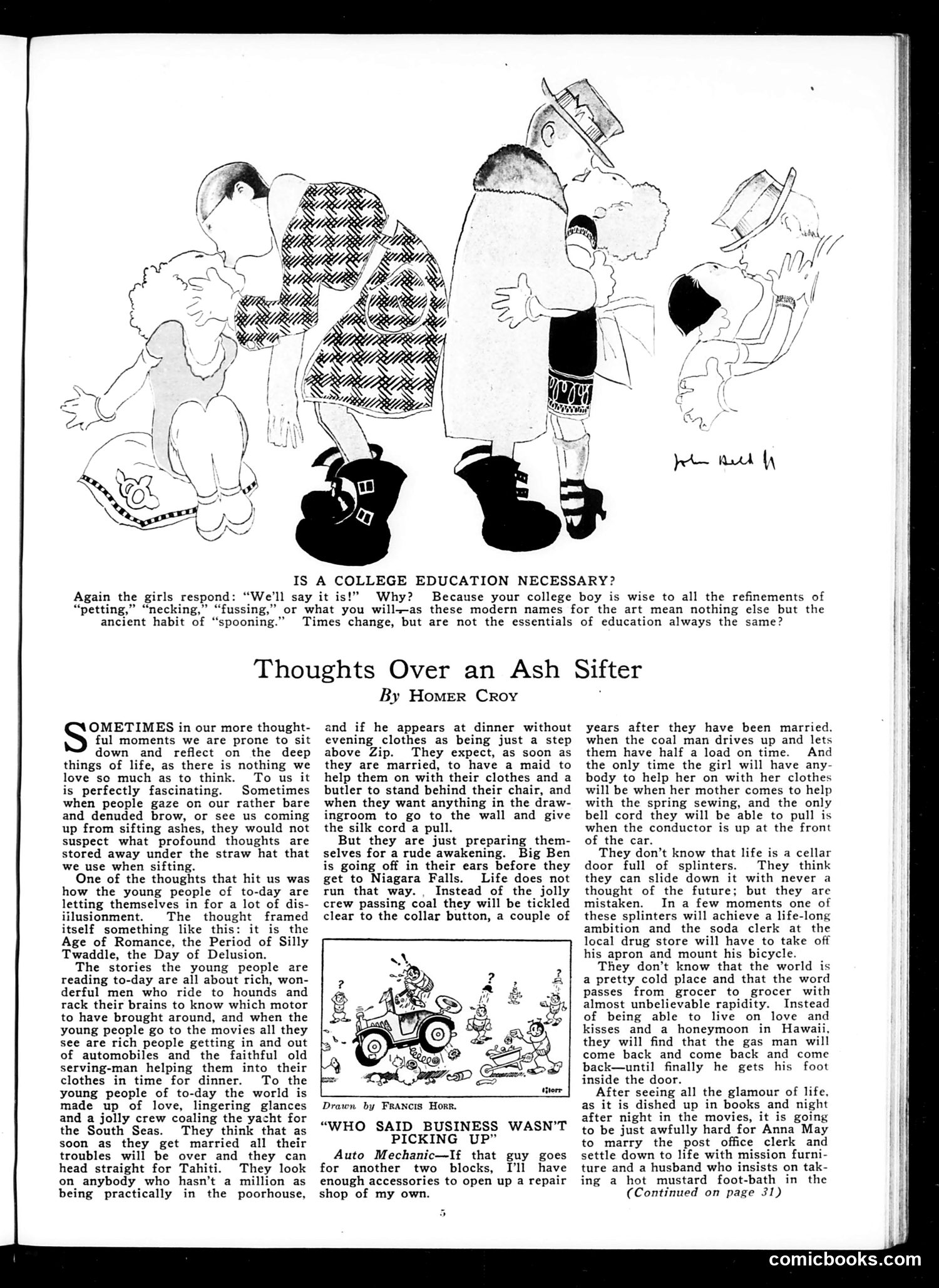
**Top Cartoon - "Is a College Education Necessary?"** This satirical illustration mocks the superficiality of 1920s romance among college-educated youth. The cartoon depicts young women endorsing college education because it teaches men modern courtship techniques—"petting," "necking," "fussing"—merely renamed versions of the old practice of "spooning." The satire suggests that despite educational advancement, young people haven't evolved beyond ancient romantic behavior, only rebranded it with contemporary slang. **Main Article - "Thoughts Over an Ash Sifter" by Homer Croy** This humorous essay critiques young people's romantic delusions, shaped by movies and popular fiction featuring wealthy lifestyles. Croy argues youth expect marriage to solve all problems and imagine luxurious lives with servants and yachts. The reality, he satirizes, is far grimmer: they'll face financial struggles, creditors (coal men, grocers, gas companies), and mundane hardship. The piece uses mordant wit to deflate 1920s consumerist and romantic fantasy culture.
📄 Transcribed text from this page (OCR, searchable)
Machine-transcribed from the original scan — historical spelling and the odd misread are preserved.
Is A COLLEGE EDUCATION NECESSARY? Again the girls respond: “We'll say it is!” Why? Because your college boy is wise to all the refinements of “petting,” “necking,” “fussing,” or what you willz-as these modern names for the art mean nothing else but the ancient habit of “spooning.” Times change, but are not the essentials of education always the same? Thoughts Over an Ash Sifter By Homer Croy OMETIMES in our more thought- ful moments we are prone to sit down and reflect on the deep things of life, as there is nothing we love so much as to think. To us it is perfectly fascinating. Sometimes when people gaze on our rather bare and denuded brow, or see us coming up from sifting ashes, they would not suspect what profound thoughts are stored away under the straw hat that we use when sifting. One of the thoughts that hit us was how the young people of to-day are letting themselves in for a lot of dis- iilusionment. The thought framed itself something like this: it is the Age of Romance, the Period of Silly Twaddle, the Day of Delusion. The stories the young people are reading to-day are all about rich, won- derful men who ride to hounds and rack their brains to know which motor to have brought around, and when the young people go to the movies all they see are rich people getting in and out of automobiles and the faithful old serving-man helping them into their clothes in time for dinner. To the young people of to-day the world is made up of love, lingering glances and a jolly crew coaling the yacht for the South Seas. They think that as soon as they get married all their troubles will be over and they can head straight for Tahiti. They look on anybody who hasn’t a million as being practically in the poorhouse, and if he appears at dinner without evening clothes as being just a step above Zip. They expect, as soon as they are married, to have a maid to help them on with their clothes and a butler to stand behind their chair, and when they want anything in the draw- ingroom to go to the wall and give the silk cord a pull. But they are just preparing them- selves for a rude awakening. Big Ben is going off in their ears before they get to Niagara Falls. Life does not run that way. , Instead of the jolly crew passing coal they will be tickled clear to the collar button, a couple of Drawn by FRANcIS Horr. “WHO SAID BUSINESS WASN’T PICKING UP” Auto Mechanic—If that guy goes for another two blocks, I'll have enough accessories to open up a repair shop of my own. years after they have been married. when the coal man drives up and lets them have half a load on time. And the only time the girl will have any- body to help her on with her clothes will be when her mother comes to help with the spring sewing, and the only bell cord they will be able to pull is when the conductor is up at the front of the car. They don’t know that life is a cellar door full of splinters. They think they can slide down it with never a thought of the future; but they are mistaken. In a few moments one of these splinters will achieve a life-long ambition and the soda clerk at the local drug store will have to take off his apron and mount his bicycle. They don’t know that the world is a pretty cold place and that the word passes from grocer to grocer with almost unbelievable rapidity. Instead of being able to live on love and kisses and a honeymoon in Hawaii, they will find that the gas man will come back and come back and come back—until finally he gets his foot inside the door. After seeing all the glamour of life, as it is dished up in books and night after night in the movies, it is going to be just awfully hard for Anna May to marry the post office clerk and settle down to life with mission furni- ture and a husband who insists on tak- ing a hot mustard foot-bath in the (Continued on page 31) comicbooks.com