
Judge, 1921-12-24 · page 20 of 36
Judge — December 24, 1921 — page 20: what you’re looking at
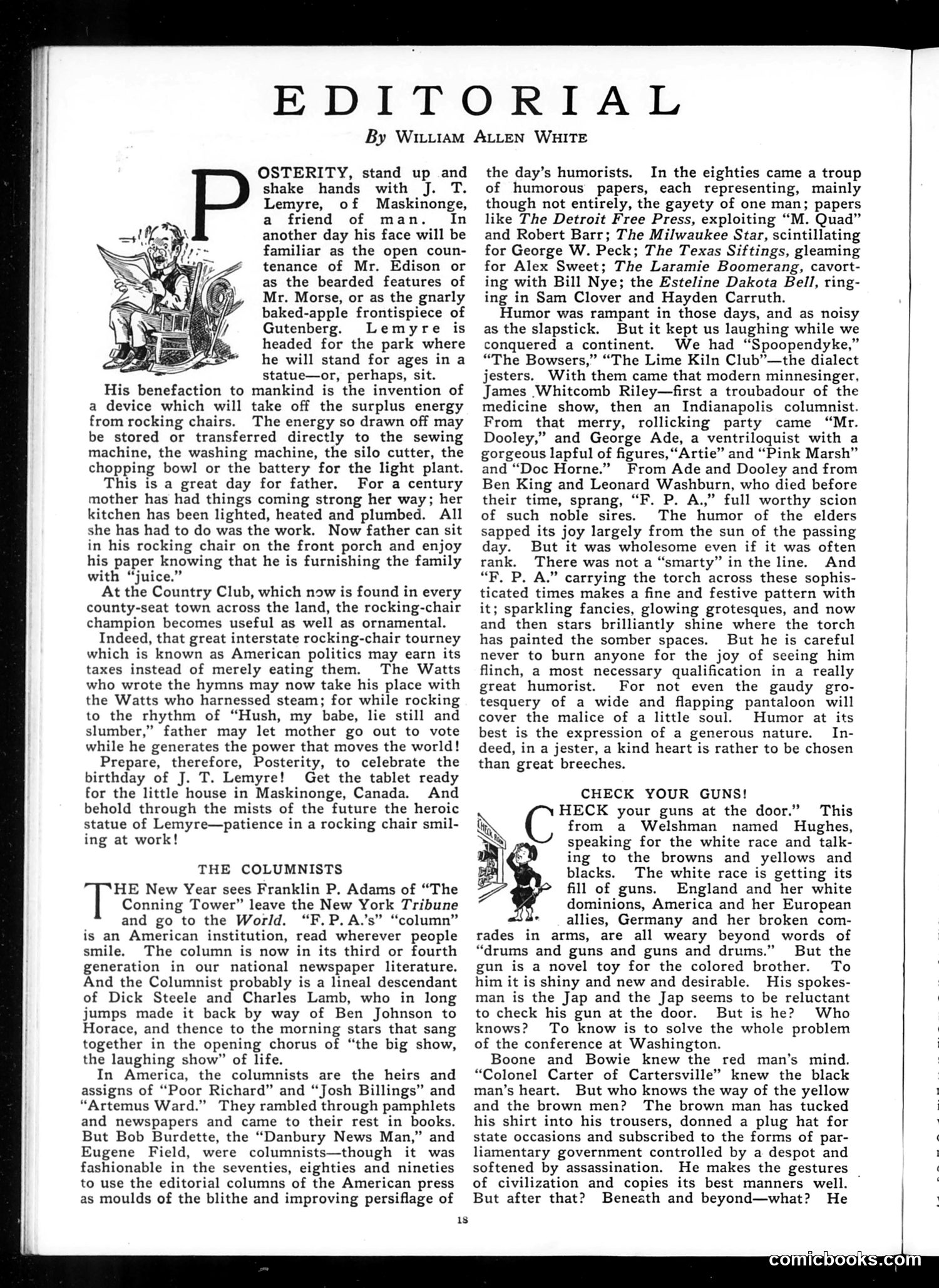
What you’re looking at
**The Main Editorial by William Allen White** satirizes technological progress through absurdist humor. It celebrates J.T. Lemyre, a fictional Canadian inventor who creates a device to harvest energy from rocking chairs—allowing fathers to sit idle on porches while generating household power. White mocks both the era's obsession with labor-saving inventions (which had revolutionized women's kitchen work) and the irony that fathers would be celebrated for *not working* while mothers continue laboring. The reference to "Watts who harnessed steam" puns on both the inventor James Watt and hymn-writer Isaac Watts. **"The Columnists" section** discusses the evolution of American newspaper humor columns, tracing lineage from 18th-century essayists (Steele, Lamb) through 19th-century humorists (Josh Billings, Artemus Ward) to contemporary columnists like Franklin P. Adams. It celebrates how humor journalism shaped American culture during westward expansion, featuring dialect comedians and literary humorists who entertained readers while the nation "conquered a continent." Both pieces reflect Progressive Era attitudes: technological optimism mixed with social commentary.
📄 Transcribed text from this page (OCR, searchable)
Machine-transcribed from the original scan — historical spelling and the odd misread are preserved.
EDITORIAL By Wiu1amM ALLEN WHITE OSTERITY, stand up and shake hands with J. T. Lemyre, of Maskinonge, a friend of man. In another day his face will be familiar as the open coun- tenance of Mr. Edison or as the bearded features of Mr. Morse, or as the gnarly baked-apple frontispiece of Gutenberg. Lemyre is headed for the park where he will stand for ages in a statue—or, perhaps, sit. His benefaction to mankind is the invention of a device which will take off the surplus energy from rocking chairs. The energy so drawn off may be stored or transferred directly to the sewing machine, the washing machine, the silo cutter, the chopping bowl or the battery for the light plant. This is a great day for father. For a century mother has had things coming strong her way; her kitchen has been lighted, heated and plumbed. All she has had to do was the work. Now father can sit in his rocking chair on the front porch and enjoy his paper knowing that he is furnishing the family with “juice.” At the Country Club, which now is found in every county-seat town across the land, the rocking-chair champion becomes useful as well as ornamental. Indeed, that great interstate rocking-chair tourney which is known as American politics may earn its taxes instead of merely eating them. The Watts who wrote the hymns may now take his place with the Watts who harnessed steam; for while rocking to the rhythm of “Hush, my babe, lie still and slumber,” father may let mother go out to vote while he generates the power that moves the world! Prepare, therefore, Posterity, to celebrate the birthday of J. T. Lemyre! Get the tablet ready for the little house in Maskinonge, Canada. And behold through the mists of the future the heroic statue of Lemyre—patience in a rocking chair smil- ing at work! THE COLUMNISTS HE New Year sees Franklin P. Adams of “The Conning Tower” leave the New York Tribune and go to the World. “F.P.A.’s” “column” is an American institution, read wherever people smile. The column is now in its third or fourth generation in our national newspaper literature. And the Columnist probably is a lineal descendant of Dick Steele and Charles Lamb, who in long jumps made it back by way of Ben Johnson to Horace, and thence to the morning stars that sang together in the opening chorus of “the big show, the laughing show” of life. In America, the columnists are the heirs and assigns of “Poor Richard” and “Josh Billings” and “Artemus Ward.” They rambled through pamphlets and newspapers and came to their rest in books. But Bob Burdette, the “Danbury News Man,” and Eugene Field, were columnists—though it was fashionable in the seventies, eighties and nineties to use the editorial columns of the American press as moulds of the blithe and improving persiflage of the day’s humorists. In the eighties came a troup of humorous papers, each representing, mainly though not entirely, the gayety of one man; papers like The Detroit Free Press, exploiting “M. Quad” and Robert Barr; The Milwaukee Star, scintillating for George W. Peck; The Texas Siftings, gleaming for Alex Sweet; The Laramie Boomerang, cavort- ing with Bill Nye; the Esteline Dakota Bell, ring- ing in Sam Clover and Hayden Carruth. Humor was rampant in those days, and as noisy as the slapstick. But it kept us laughing while we conquered a continent. We had “Spoopendyke,” “The Bowsers,” “The Lime Kiln Club”—the dialect jesters. With them came that modern minnesinger, James Whitcomb Riley—first a troubadour of the medicine show, then an Indianapolis columnist. From that merry, rollicking party came “Mr. Dooley,” and George Ade, a ventriloquist with a gorgeous lapful of figures, “Artie” and “Pink Marsh” and “Doc Horne.” From Ade and Dooley and from Ben King and Leonard Washburn, who died before their time, sprang, “F. P. A.,” full worthy scion of such noble sires. The humor of the elders sapped its joy largely from the sun of the passing day. But it was wholesome even if it was often rank. There was not a “smarty” in the line. And “F. P. A.” carrying the torch across these sophis- ticated times makes a fine and festive pattern with it; sparkling fancies, glowing grotesques, and now and then stars brilliantly shine where the torch has painted the somber spaces. But he is careful never to burn anyone for the joy of seeing him flinch, a most necessary qualification in a really great humorist. For not even the gaudy gro- tesquery of a wide and flapping pantaloon will cover the malice of a little soul. Humor at its best is the expression of a generous nature. In- deed, in a jester, a kind heart is rather to be chosen than great breeches. CHECK YOUR GUNS! HECK your guns at the door.” This from a Welshman named Hughes, —y speaking for the white race and talk- ing to the browns and yellows and blacks. The white race is getting its fill of guns. England and her white dominions, America and her European * allies, Germany and her broken com- rades in arms, are all weary beyond words of “drums and guns and guns and drums.” But the gun is a novel toy for the colored brother. To him it is shiny and new and desirable. His spokes- man is the Jap and the Jap seems to be reluctant to check his gun at the door. But is he? Who knows? To know is to solve the whole problem of the conference at Washington. Boone and Bowie knew the red man’s mind. “Colonel Carter of Cartersville” knew the black man’s heart. But who knows the way of the yellow and the brown men? The brown man has tucked his shirt into his trousers, donned a plug hat for state occasions and subscribed to the forms of par- liamentary government controlled by a despot and softened by assassination. He makes the gestures _ of civilization and copies its best manners well. But after that? Beneath and beyond—what? He