
Judge, 1921-12-24 · page 10 of 36
Judge — December 24, 1921 — page 10: what you’re looking at
What you’re looking at
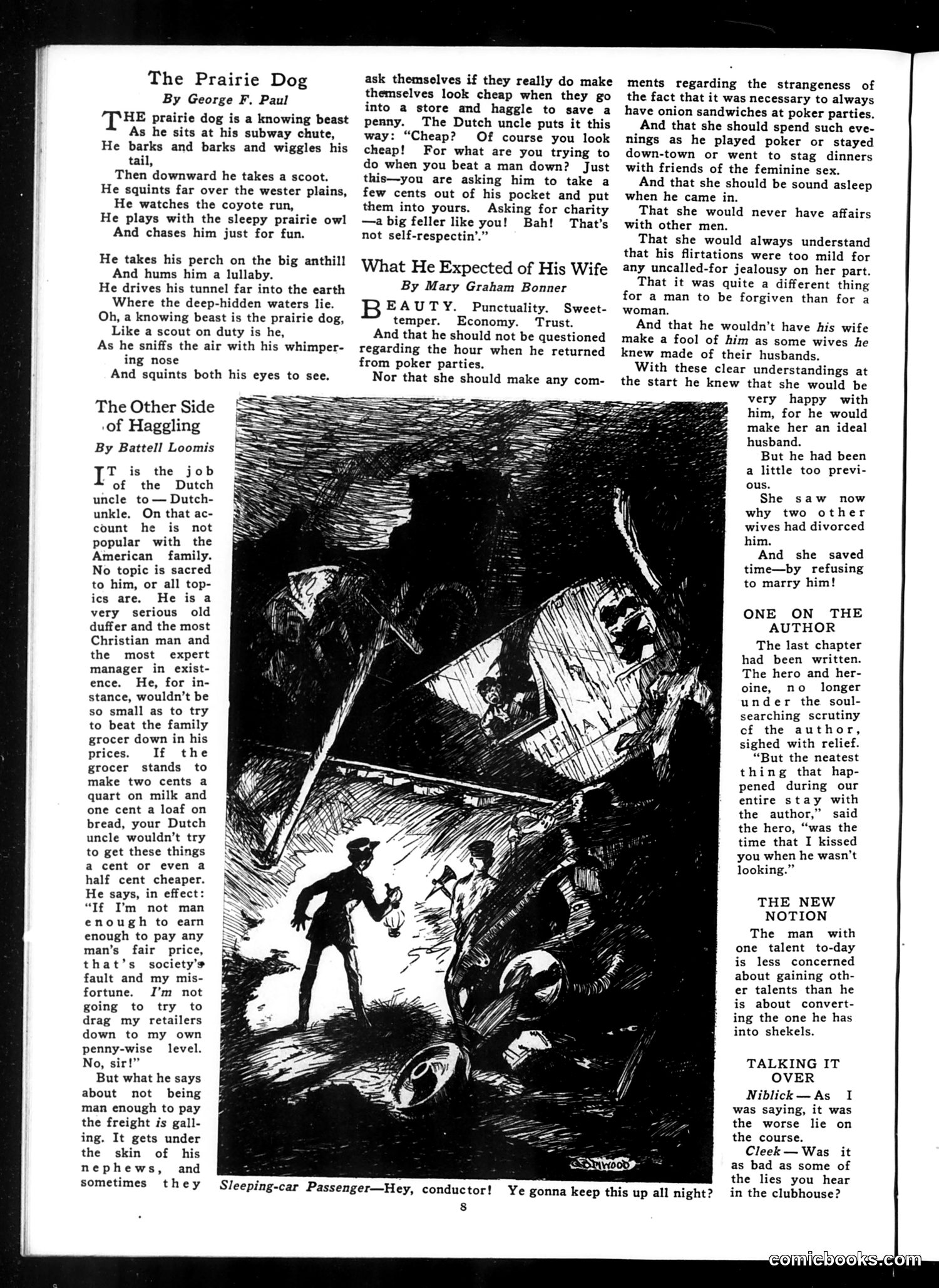
This page contains three satirical pieces mocking early 20th-century American attitudes: **"The Prairie Dog"** is sentimental nature poetry—likely gentle satire of overly romantic descriptions of Western wildlife common in period literature. **"The Other Side of Haggling"** satirizes the "Dutch uncle" (a stern moralist who offers unwelcome advice). It mocks both this sanctimonious figure *and* working-class penny-pinching. The Dutch uncle refuses to haggle with grocers on moral grounds, yet condescends to those who do—exposing the hypocrisy of moral superiority masking class judgment. **"What He Expected of His Wife"** is sharp social satire about marital double standards. The piece lists a husband's unrealistic expectations—beauty, punctuality, economy, unquestioned acceptance of his poker nights and flirtations—while he demands she never has affairs or questions him. The punchline: a woman wisely refuses to marry such a man after seeing two previous wives divorced him. This mocks men's entitled, contradictory demands of wives. The sleeping-car illustration appears unrelated cartoon humor about train passengers.
📄 Transcribed text from this page (OCR, searchable)
Machine-transcribed from the original scan — historical spelling and the odd misread are preserved.
The Prairie Dog By George F. Paul THE prairie dog is a knowing beast As he sits at his subway chute, He barks and barks and wiggles his tail, Then downward he takes a scoot. He squints far over the wester plains, He watches the coyote run, He plays with the sleepy prairie owl And chases him just for fun. He takes his perch on the big anthill And hums him a lullaby. He drives his tunnel far into the earth Where the deep-hidden waters lie. Oh, a knowing beast is the prairie dog, Like a scout on duty is he, As he sniffs the air with his whimper- ing nose And squints both his eyes to see. The Other Side of Haggling By Battell Loomis —— = = T is the job of the Dutch uncle to— Dutch- unkle. On that ac- count he is not popular with the American family. No topic is sacred to him, or all top- ics are. He is a very serious old duffer and the most Christian man and the most expert manager in exist- ence. He, for in- stance, wouldn’t be so small as to try to beat the family grocer down in his prices. If the grocer stands to make two cents a quart on milk and one cent a loaf on bread, your Dutch uncle wouldn’t try to get these things a cent or even a half cent cheaper. He says, in effect: “If I’m not man enough to earn enough to pay any man’s fair price, that’s society's fault and my mis- fortune. I’m not going to try to drag my retailers down to my own penny-wise level. No, sir!” But what he says about not being man enough to pay the freight is gall- ing. It gets under the skin of his nephews, and sometimes they e SSS == ~ ask themselves if they really do make themselves look cheap when they go into a store and haggle to save a penny. The Dutch uncle puts it this way: “Cheap? Of course you look cheap! For what are you trying to do when you beat a man down? Just this—you are asking him to take a few cents out of his pocket and put them into yours. Asking for charity —a big feller like you! Bah! That’s not self-respectin’. What He Expected of His Wife By Mary Graham Bonner EAUTY. Punctuality. Sweet- temper. Economy. Trust. And that he should not be questioned regarding the hour when he returned from poker parties. Nor that she should make any com- 8 ments regarding the strangeness of the fact that it was necessary to always have onion sandwiches at poker parties. And that she should spend such eve- nings as he played poker or stayed down-town or went to stag dinners with friends of the feminine sex. And that she should be sound asleep when he came in. That she would never have affairs with other men. That she would always understand that his flirtations were too mild for any uncalled-for jealousy on her part. That it was quite a different thing for a man to be forgiven than for a woman. And that he wouldn’t have his wife make a fool of him as some wives he knew made of their husbands. With these clear understandings at the start he knew that she would be very happy with him, for he would make her an ideal husband. But he had been a little too previ- ous. She saw now why two other wives had divorced him. And she saved time—by refusing to marry him! ONE ON THE AUTHOR The last chapter had been written. The hero and her- oine, no longer under the soul- searching scrutiny ef the author, sighed with relief. “But the neatest thing that hap- pened during our entire stay with the author,” said the hero, “was the time that I kissed you when he wasn’t looking.” THE NEW NOTION The man with one talent to-day is less concerned about gaining oth- er talents than he is about convert- ing the one he has into shekels. TALKING IT OVER Niblick—As I was saying, it was the worse lie on the course. Cleek — Was it as bad as some of the lies you hear in the clubhouse?