
Judge, 1921-12-24 · page 11 of 36
Judge — December 24, 1921 — page 11: what you’re looking at
What you’re looking at
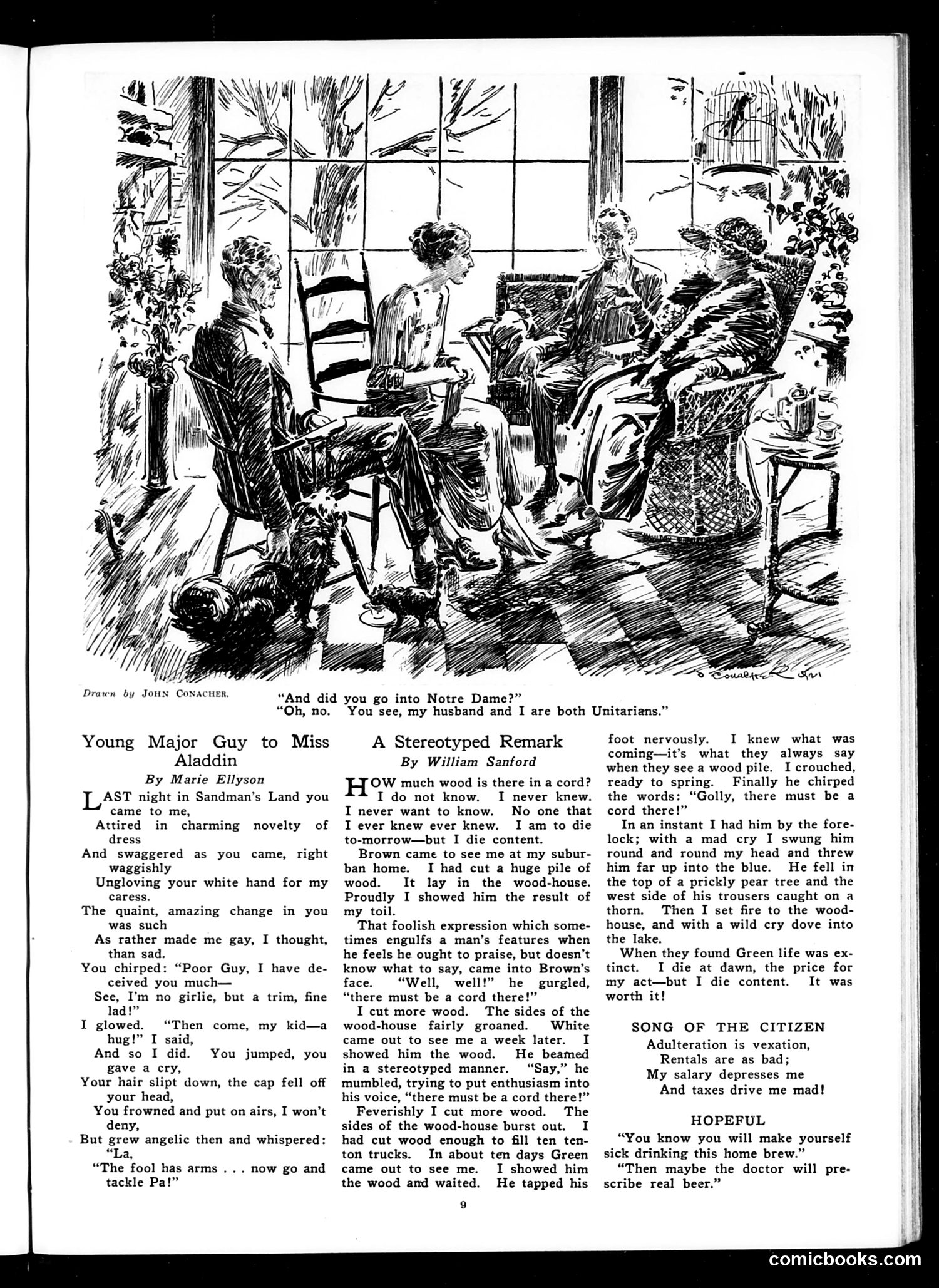
This page contains three distinct pieces of satire: **"Young Major Guy to Miss Aladdin"** (poem): A dream-narrative joke about gender role-playing and deception in courtship. The speaker believes his companion is a woman who's playfully revealed herself as male, then reverts to feminine behavior—satirizing performative gender and romantic confusion. **"A Stereotyped Remark"** (prose): The main satire targets repetitive, empty social conventions. The narrator becomes increasingly maddened by visitors who—upon seeing his wood pile—automatically say "there must be a cord there," regardless of actual quantity. It mocks how people mindlessly repeat clichéd remarks rather than genuine observation, escalating absurdly to violence and suicide. The point: society's reliance on thoughtless stock phrases in social interaction. **Bottom items**: Brief comic verses satirizing common complaints (inflation, taxes, prohibition-era "home brew"), and a joke about circumventing alcohol prohibition laws through doctor prescriptions. The common thread: all mock shallow or formulaic behavior in modern society.
📄 Transcribed text from this page (OCR, searchable)
Machine-transcribed from the original scan — historical spelling and the odd misread are preserved.
Drawn by JouN CoNAcHER. “Oh, no. Young Major Guy to Miss Aladdin By Marie Ellyson LASst night in Sandman’s Land you came to me, Attired in charming novelty of dress And swaggered as you came, right waggishly Ungloving your white hand for my caress. The quaint, amazing change in you was such As rather made me gay, I thought, than sad. You chirped: “Poor Guy, I have de- ceived you much— See, I'm no girlie, but a trim, fine lad!” I glowed. “Then come, my kid—a hug!” I said, And so I did. gave a cry, Your hair slipt down, the cap fell off your head, You frowned and put on airs, I won’t deny, But grew angelic then and whispered: “La, “The fool has arms... tackle Pa!” You jumped, you now go and “And did you go into Notre Dame?” You see, my husband and I are both Unitarians.” A Stereotyped Remark By William Sanford OW much wood is there in a cord? I do not know. I never knew. I never want to know. No one that I ever knew ever knew. I am to die to-morrow—but I die content. Brown came to see me at my subur- ban home. I had cut a huge pile of wood. It lay in the wood-house. Proudly I showed him the result of my toil. That foolish expression which some- times engulfs a man’s features when he feels he ought to praise, but doesn’t know what to say, came into Brown’s face. “Well, well!” he gurgled, “there must be a cord there!” I cut more wood. The sides of the wood-house fairly groaned. White came out to see me a week later. I showed him the wood. He beamed in a stereotyped manner. “Say,” he mumbled, trying to put enthusiasm into his voice, “there must be a cord there!” Feverishly I cut more wood. The sides of the wood-house burst out. I had cut wood enough to fill ten ten- ton trucks. In about ten days Green came out to see me. I showed him the wood and waited. He tapped his 9 foot nervously. I knew what was coming—it’s what they always say when they see a wood pile. I crouched, ready to spring. Finally he chirped the words: “Golly, there must be a cord there!” In an instant I had him by the fore- lock; with a mad cry I swung him round and round my head and threw him far up into the blue. He fell in the top of a prickly pear tree and the west side of his trousers caught on a thorn. Then I set fire to the wood- house, and with a wild cry dove into the lake. When they found Green life was ex- tinct. I die at dawn, the price for my act—but I die content. It was worth it! SONG OF THE CITIZEN Adulteration is vexation, Rentals are as bad; My salary depresses me And taxes drive me mad! HOPEFUL “You know you will make yourself sick drinking this home brew.” “Then maybe the doctor will pre- scribe real beer.” comicbooks.com