
Judge, 1921-12-24 · page 14 of 36
Judge — December 24, 1921 — page 14: what you’re looking at
What you’re looking at
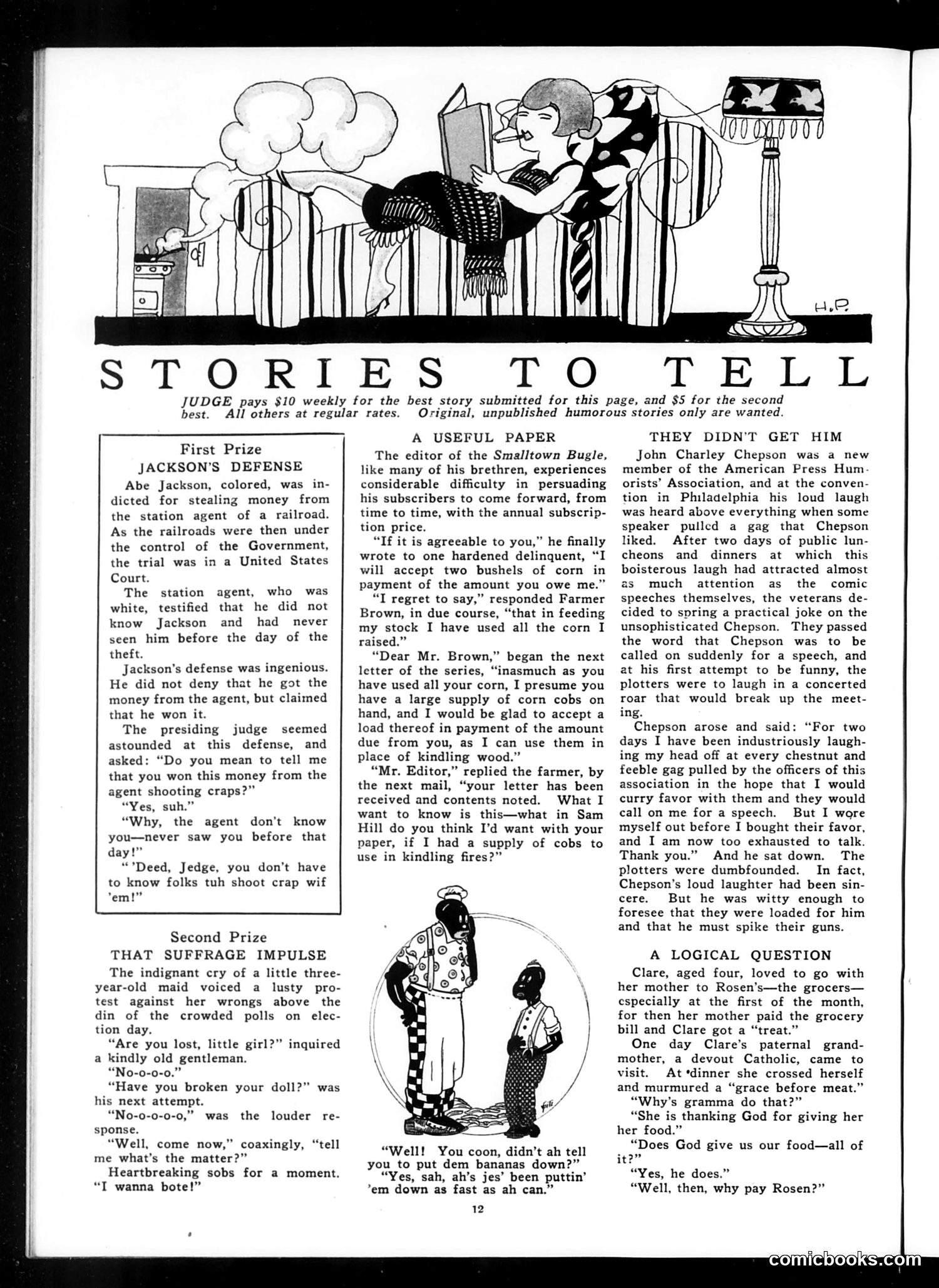
This is a humor page featuring four original short stories submitted for publication. The content reflects early 20th-century American attitudes: **"Jackson's Defense"** presents a racist caricature of a Black railroad worker who uses "craps" (dice gambling) as a legal defense for theft—the joke relies on dialect humor ("'deed, Jedge") and portrays him as clever yet foolish. **"That Suffrage Impulse"** mocks women's voting rights by depicting a toddler demanding a vote, suggesting suffrage advocates are emotionally immature—common anti-suffrage satire of the era. **"A Useful Paper"** uses dialect humor with African American characters ("ah's jes' been puttin'") to joke about a newspaper editor's desperate barter for corn cobs. **"They Didn't Get Him"** depicts humor industry insiders attempting to embarrass a naive newcomer, ultimately failing. The page exhibits period-typical casual racism, anti-women's suffrage sentiment, and working-class humor stereotyping. These stories reflect Judge's satirical voice targeting contemporary social issues and prejudices.
📄 Transcribed text from this page (OCR, searchable)
Machine-transcribed from the original scan — historical spelling and the odd misread are preserved.
STORIES JUDGE pays $10 weekly for the best story submitted for this page, and $5 for the second Original, unpublished humorous stories only are wanted. best. First Prize JACKSON’S DEFENSE Abe Jackson, colored, was in- dicted for stealing money from the station agent of a railroad. As the railroads were then under the control of the Government, the trial was in a United States Court. The station agent, who was white, testified that he did not know Jackson and had never seen him before the day of the theft. Jackson’s defense was ingenious. He did not deny that he got the money from the agent, but claimed that he won it. The presiding judge seemed astounded at this defense, and asked: “Do you mean to tell me that you won this money from the agent shooting craps?” “Yes, suh.” “Why, the agent don’t know you—never saw you before that day!” “"Deed, Jedge, you don't have to know folks tuh shoot crap wif ‘em!” Second Prize THAT SUFFRAGE IMPULSE The indignant cry of a little three- year-old maid voiced a lusty pro- test against her wrongs above the din of the crowded polls on elec- tion day. “Are you lost, little girl?” inquired a kindly old gentleman. “No-o-0-0.” “Have you broken your doll?” was his next attempt. “No-0-0-0-0,” sponse. “Well, come now,” coaxingly, “tell me what's the matter?” Heartbreaking sobs for a moment. “IT wanna bote!” was the louder re- All others at regular rates. A USEFUL PAPER The editor of the Smalltown Bugle, like many of his brethren, experiences considerable difficulty in persuading his subscribers to come forward, from time to time, with the annual subscrip- tion price. “If it is agreeable to you,” he finally wrote to one hardened delinquent, “I will accept two bushels of corn in payment of the amount you owe me.” “I regret to say,” responded Farmer Brown, in due course, “that in feeding my stock I have used all the corn I raised.” “Dear Mr. Brown,” began the next letter of the series, “inasmuch as you have used all your corn, I presume you have a large supply of corn cobs on hand, and I would be glad to accept a load thereof in payment of the amount due from you, as I can use them in place of kindling wood.” “Mr. Editor,” replied the farmer, by the next mail, “your letter has been received and contents noted. What I want to know is this—what in Sam Hill do you think I’d want with your paper, if I had a supply of cobs to use in kindling fires?” “Well! You coon, didn’t ah tell you to put dem bananas down?” “Yes, sah, ah’s jes’ been puttin’ ’em down as fast as ah can.” 12 THEY DIDN'T GET HIM John Charley Chepson was a new member of the American Press Hum orists’ Association, and at the conven- tion in Philadelphia his loud laugh was heard above everything when some speaker pulled a gag that Chepson liked. After two days of public lun- cheons and dinners at which this boisterous laugh had attracted almost as much attention as the comic speeches themselves, the veterans de- cided to spring a practical joke on the unsophisticated Chepson. They passed the word that Chepson was to be called on suddenly for a speech, and at his first attempt to be funny, the plotters were to laugh in a concerted roar that would break up the meet- ing. Chepson arose and said: “For two days I have been industriously laugh- ing my head off at every chestnut and feeble gag pulled by the officers of this association in the hope that I would curry favor with them and they would call on me for a speech. But I wore myself out before I bought their favor, and I am now too exhausted to talk. Thank you.” And he sat down. The plotters were dumbfounded. In fact, Chepson’s loud laughter had been sin- cere. But he was witty enough to foresee that they were loaded for him and that he must spike their guns. A LOGICAL QUESTION Clare, aged four, loved to go with her mother to Rosen’s—the grocers— especially at the first of the month, for then her mother paid the grocery bill and Clare got a “treat.” One day Clare’s paternal grand- mother, a devout Catholic, came to visit. At ‘dinner she crossed herself and murmured a “grace before meat.” “Why’s gramma do that?” “She is thanking God for giving her her food.” “Does God give us our food—all of it?” “Yes, he does.” “Well, then, why pay Rosen?”