
Judge, 1921-12-24 · page 16 of 36
Judge — December 24, 1921 — page 16: what you’re looking at
What you’re looking at
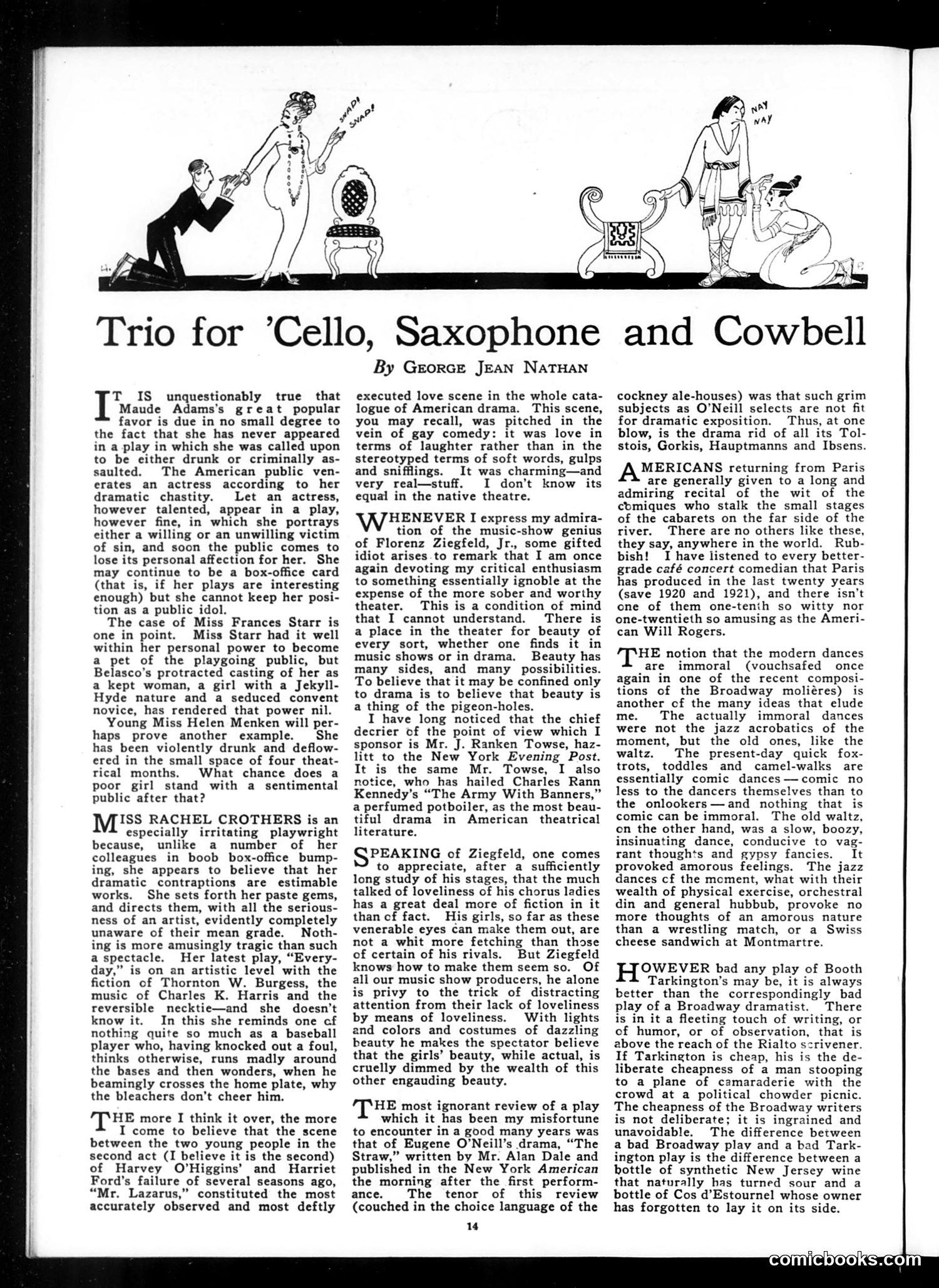
The cartoon heading this page depicts three figures in a absurdist scene: a man on his knees playing what appears to be a cello toward a woman in classical dress, with a decorative chair and cowbell completing the "trio." The illustration satirizes pretentious or incongruous artistic combinations—mixing serious instruments (cello) with lowbrow ones (cowbell). The article by George Jean Nathan that follows is theater criticism discussing American playwrights and performers. Nathan critiques actress Rachel Crothers for producing mediocre work while treating it seriously, comparing her to a baseball player who hits a foul but runs the bases triumphantly. He also discusses other actresses (Maude Adams, Frances Starr) and their public reputations, while praising Florenz Ziegfeld's musicales and criticizing theater critic J. Ranken Towse for dismissing musical theater while praising inferior dramatic works. The satire targets theatrical pretension and inconsistent critical standards rather than specific political figures.
📄 Transcribed text from this page (OCR, searchable)
Machine-transcribed from the original scan — historical spelling and the odd misread are preserved.
Trio for "Cello, Saxophone and Cowbell T IS unquestionably true that Maude Adams’s great popular favor is due in no small degree to the fact that she has never appeared in a play in which she was called upon to be either drunk or criminally as- saulted. The American public ven- erates an actress according to her dramatic chastity. Let an actress, however talented, appear in a play, however fine, in which she portrays either a willing or an unwilling victim of sin, and soon the public comes to lose its personal affection for her. She may continue to be a box-office card (that is, if her plays are interesting enough) but she cannot keep her posi- tion as a public idol. The case of Miss Frances Starr is one in point. Miss Starr had it well within her personal power to become a pet of the playgoing public, but Belasco’s protracted casting of her as a kept woman, a girl with a Jekyll- Hyde nature and a seduced convent novice, has rendered that power nil. Young Miss Helen Menken will per- haps prove another example. She has been violently drunk and deflow- ered in the small space of four theat- tical months. What chance does a poor girl stand with a sentimental public after that? ISS RACHEL CROTHERS is an especially irritating playwright because, unlike a number of her colleagues in boob box-office bump- ing, she appears to believe that her dramatic contraptions are estimable works. She sets forth her paste gems, and directs them, with all the serious- ness of an artist, evidently completely unaware of their mean grade. Noth- ing is more amusingly tragic than such aspectacle. Her latest play, “Every- day,” is on an artistic level with the fiction of Thornton W. Burgess, the music of Charles K. Harris and the reversible necktie—and she doesn’t know it. In this she reminds one cf nothing quite so much as a baseball player who, having knocked out a foul, thinks otherwise, runs madly around the bases and then wonders, when he beamingly crosses the home plate, why the bleachers don’t cheer him. HE more I think it over, the more I come to believe that the scene between the two young people in the second act (I believe it is the second) of Harvey O’Higgins’ and Harriet Ford's failure of several seasons ago, “Mr. Lazarus,” constituted the most accurately observed and most deftly By Grorce Jean NaTHAN executed love scene in the whole cata- logue of American drama. This scene, you may recall, was pitched in the vein of gay comedy: it was love in terms of laughter rather than in the stereotyped terms of soft words, gulps and snifflings. It was charming—and very real—stuff. I don’t know its equal in the native theatre. WHENEVER I express my admira- tion of the music-show genius of Florenz Ziegfeld, Jr., some gifted idiot arises.to remark that I am once again devoting my critical enthusiasm to something essentially ignoble at the expense of the more sober and worthy theater. This is a condition of mind that I cannot understand. There is a place in the theater for beauty of every sort, whether one finds it in music shows or in drama. Beauty has many sides, and many possibilities. To believe that it may be confined only to drama is to believe that beauty is a thing of the pigeon-holes. I have long noticed that the chief decrier of the point of view which I sponsor is Mr. J. Ranken Towse, haz- litt to the New York Evening Post. It is the same Mr. Towse, I also notice, who has hailed Charles Rann Kennedy’s “The Army With Banners,” a perfumed potboiler, as the most beau- tiful drama in American theatrical literature. PEAKING of Ziegfeld, one comes to appreciate, after a sufficiently long study of his stages, that the much talked of loveliness of his chorus ladies has a great deal more of fiction in it than of fact. His girls, so far as these venerable eyes can make them out, are not a whit more fetching than those of certain of his rivals. But Ziegfeld knows how to make them seem so. Of all our music show producers, he alone is privy to the trick of distracting attention from their lack of loveliness by means of loveliness. With lights and colors and costumes of dazzling beauty he makes the spectator believe that the girls’ beauty, while actual, is cruelly dimmed by the wealth of this other engauding beauty. ‘THE most ignorant review of a play which it has been my misfortune to encounter in a good many years was that of Eugene O’Neill’s drama, “The Straw,” written by Mr. Alan Dale and published in the New York American the morning after the first perform- ance. The tenor of this review (couched in the choice language of the 14 cockney ale-houses) was that such grim subjects as O'Neill selects are not fit for dramatic exposition. Thus, at one blow, is the drama rid of all its Tol- stois, Gorkis, Hauptmanns and Ibsens. AMERICANS returning from Paris are generally given to a long and admiring recital of the wit of the comiques who stalk the small stages of the cabarets on the far side of the river. There are no others like these, they say, anywhere in the world. Rub- bish! I have listened to every better- grade café concert comedian that Paris has produced in the last twenty years (save 1920 and 1921), and there isn’t one of them one-tenth so witty nor one-twentieth so amusing as the Ameri- can Will Rogers. HE notion that the modern dances are immoral (vouchsafed once again in one of the recent composi- tions of the Broadway moliéres) is another cf the many ideas that elude me. The actually immoral dances were not the jazz acrobatics of the moment, but the old ones, like the waltz. The present-day quick fox- trots, toddles and camel-walks are essentially comic dances—comic no less to the dancers themselves than to the onlookers —and nothing that is comic can be immoral. The old waltz, on the other hand, was a slow, boozy, insinuating dance, conducive to vag- rant thoughts and gypsy fancies. It provoked amorous feelings. The jazz dances cf the moment, what with their wealth of physical exercise, orchestral din and general hubbub, provoke no more thoughts of an amorous nature than a wrestling match, or a Swiss cheese sandwich at Montmartre. HOWEVER bad any play of Booth Tarkington’s may be, it is always better than the correspondingly bad play of a Broadway dramatist. There is in it a fleeting touch of writing, or of humor, or of observation, that is above the reach of the Rialto scrivener. If Tarkington is cheap, his is the de- liberate cheapness of a man stooping to a plane of camaraderie with the crowd at a political chowder picnic. The cheapness of the Broadway writers is not deliberate; it is ingrained and unavoidable. The difference between a bad Broadway play and a bad Tark- ington play is the difference between a bottle of synthetic New Jersey wine that naturally has turned sour and a bottle of Cos d’Estournel whose owner has forgotten to lay it on its side.