
Judge, 1921-12-24 · page 21 of 36
Judge — December 24, 1921 — page 21: what you’re looking at
What you’re looking at
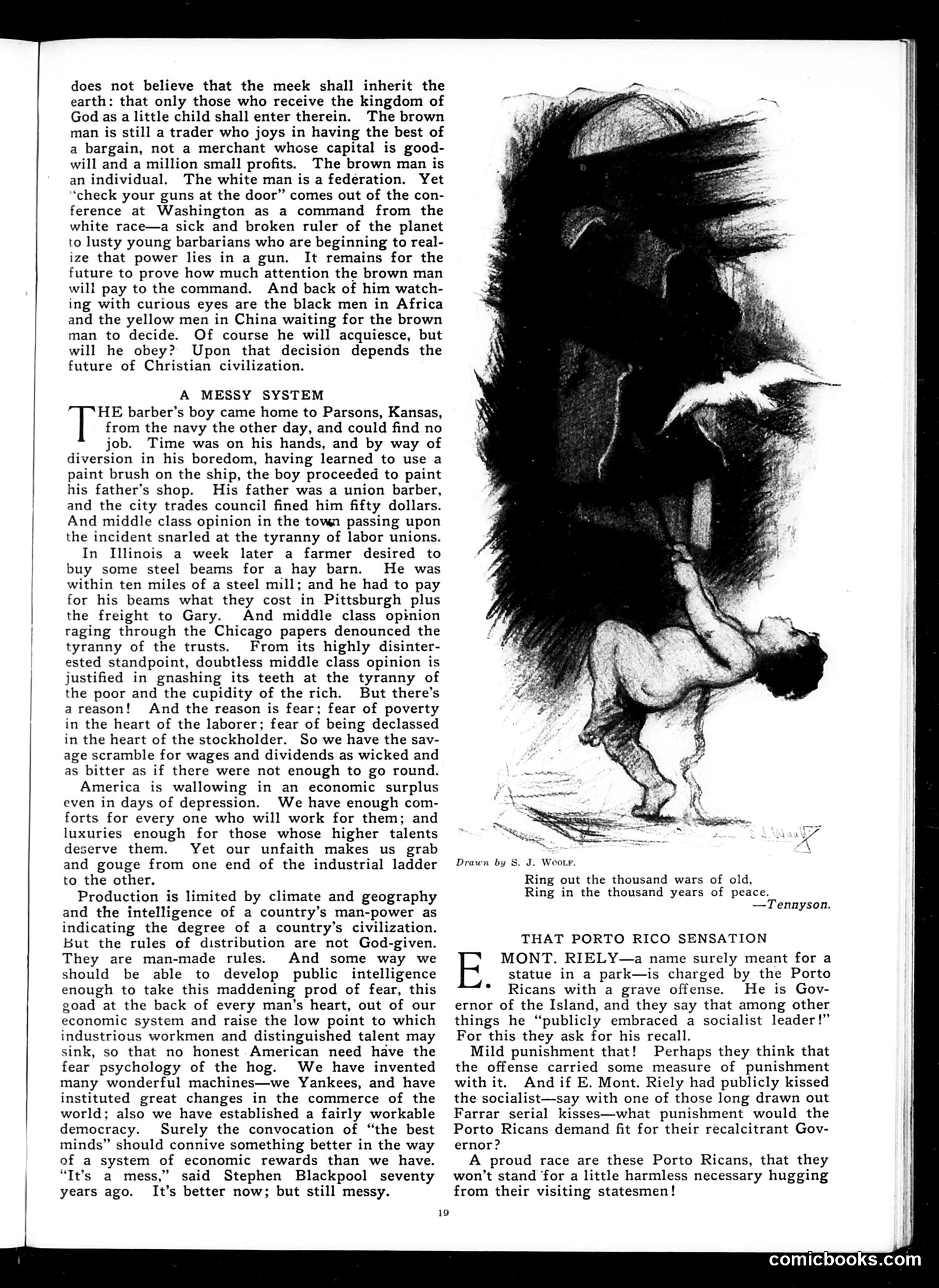
**The Cartoon (by S.J. Woolf):** Depicts a figure appearing distressed or contorted, illustrating the article's theme of economic anxiety and social struggle. **"A Messy System":** This article critiques economic inequality through two anecdotes. A navy barber's boy paints his father's shop and the union fines the father $50—middle-class opinion blames "labor tyranny." Meanwhile, a farmer near a steel mill must pay Pittsburgh prices plus freight—middle-class opinion blames "trust tyranny." The author argues both labor and capital operate from *fear*: workers fear poverty and declassing; stockholders fear losing wealth. Judge argues America has *economic surplus* but poor distribution systems. The author (quoting Dickens's Stephen Blackpool) calls for better public intelligence to remove "fear psychology" from economics and establish fairer reward systems. **"That Porto Rico Sensation":** References Governor Mont. Riely's mild punishment of Puerto Rican socialists, arguing they deserve harsher discipline. The piece mocks their "demands" and portrays Puerto Ricans as oversensitive to American governance.
📄 Transcribed text from this page (OCR, searchable)
Machine-transcribed from the original scan — historical spelling and the odd misread are preserved.
does not believe that the meek shall inherit the earth: that only those who receive the kingdom of God as a little child shall enter therein. The brown man is still a trader who joys in having the best of a bargain, not a merchant whose capital is good- will and a million small profits. The brown man is an individual. The white man is a federation. Yet ‘check your guns at the door” comes out of the con- ference at Washington as a command from the white race—a sick and broken ruler of the planet to lusty young barbarians who are beginning to real- ize that power lies in a gun. It remains for the future to prove how much attention the brown man will pay to the command. And back of him watch- ing with curious eyes are the black men in Africa and the yellow men in China waiting for the brown man to decide. Of course he will acquiesce, but will he obey? Upon that decision depends the future of Christian civilization. A MESSY SYSTEM HE barber’s boy came home to Parsons, Kansas, from the navy the other day, and could find no job. Time was on his hands, and by way of diversion in his boredom, having learned to use a paint brush on the ship, the boy proceeded to paint his father’s shop. His father was a union barber, and the city trades council fined him fifty dollars. And middle class opinion in the town passing upon the incident snarled at the tyranny of labor unions. In Illinois a week later a farmer desired to buy some steel beams for a hay barn. He was within ten miles of a steel mill; and he had to pay for his beams what they cost in Pittsburgh plus the freight to Gary. And middle class opinion raging through the Chicago papers denounced the tyranny of the trusts. From its highly disinter- ested standpoint, doubtless middle class opinion is justified in gnashing its teeth at the tyranny of the poor and the cupidity of the rich. But there’s areason! And the reason is fear; fear of poverty in the heart of the laborer; fear of being declassed in the heart of the stockholder. So we have the sav- age scramble for wages and dividends as wicked and as bitter as if there were not enough to go round. America is wallowing in an economic surplus even in days of depression. We have enough com- forts for every one who will work for them; and luxuries enough for those whose higher talents deserve them. Yet our unfaith makes us grab and gouge from one end of the industrial ladder to the other. Production is limited by climate and geography and the intelligence of a country’s man-power as indicating the degree of a country’s civilization. But the rules of distribution are not God-given. They are man-made rules. And some way we should be able to develop public intelligence enough to take this maddening prod of fear, this goad at the back of every man’s heart, out of our economic system and raise the low point to which industrious workmen and distinguished talent may sink, so that no honest American need have the fear psychology of the hog. We have invented many wonderful machines—we Yankees, and have instituted great changes in the commerce of the world; also we have established a fairly workable democracy. Surely the convocation of “the best minds” should connive something better in the way of a system of economic rewards than we have. “It’s a mess,” said Stephen Blackpool seventy years ago. It’s better now; but still messy. Drawn by S. J. Wootr. Ring out the thousand wars of old, Ring in the thousand years of peace. —Tennyson. THAT PORTO RICO SENSATION MONT. RIELY—a name surely meant for a statue in a park—is charged by the Porto * Ricans with a grave offense. He is Gov- ernor of the Island, and they say that among other things he “publicly embraced a socialist leader!” For this they ask for his recall. Mild punishment that! Perhaps they think that the offense carried some measure of punishment with it. Andif E. Mont. Riely had publicly kissed the socialist—say with one of those long drawn out Farrar serial kisses—what punishment would the Porto Ricans demand fit for their recalcitrant Gov- ernor? A proud race are these Porto Ricans, that they won't stand for a little harmless necessary hugging from their visiting statesmen! comicbooks.com