
A complete issue · 36 pages · 1921
Judge — December 17, 1921
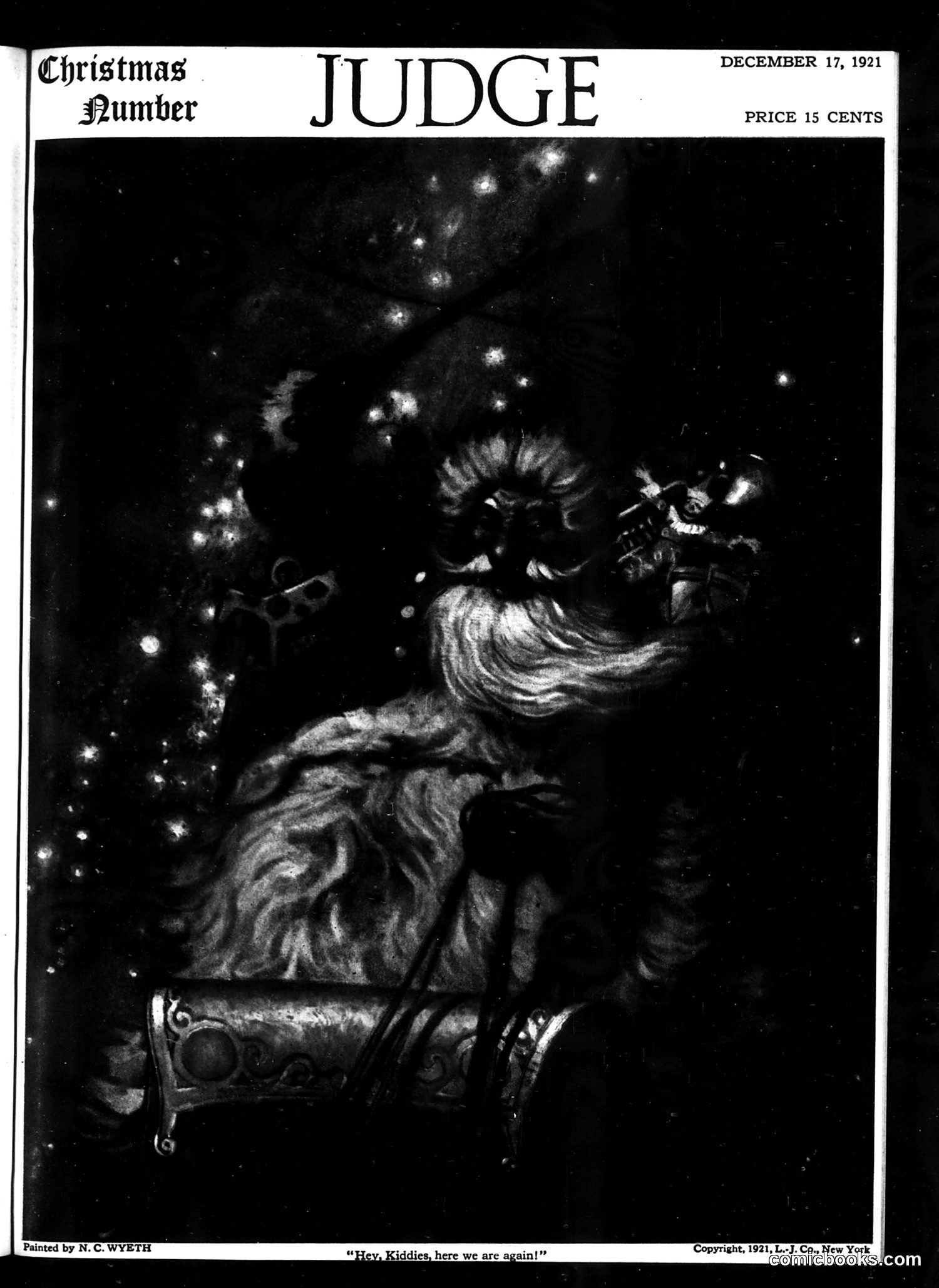
This Christmas Number cover, painted by N.C. Wyeth, depicts Santa Claus in a cheerful moment with the caption "Hey, Kiddies, here we are again!" The image shows Santa with his characteristic long beard and jolly demeanor, surrounded by magical sparkling lights against a dark background, with what appears to be a decorative mantelpiece or furniture below. This is a straightforward holiday illustration rather than political satire. It's a nostalgic, heartwarming cover celebrating Christmas and Santa's return for the season—typical festive content for Judge's Christmas issue. The artwork emphasizes traditional holiday cheer and the joy of Santa's annual visit to children, a common magazine cover theme during this era.
This page contains no cartoon or satirical image—it's purely editorial text promoting *Leslie's Weekly* magazine's value proposition. The article "The Way to Measure Magazine Value" argues that *Leslie's Weekly*, at 10 cents per copy, offers superior content-to-price ratio compared to a competitor (likely *Judge* itself, humorously), which charges 25 cents for a bulkier monthly format. The piece boasts *Leslie's* features established writers (Theodore Waters, Samuel Hopkins Adams, Arthur Ruhl) and announces new content by Seammon Lockwood. It emphasizes entertainment value alongside substance, claiming readers gain permanent worth beyond mere amusement. The self-promotional tone is characteristic of early 20th-century magazine advertising, though the specific competitive comparison remains somewhat indirect.
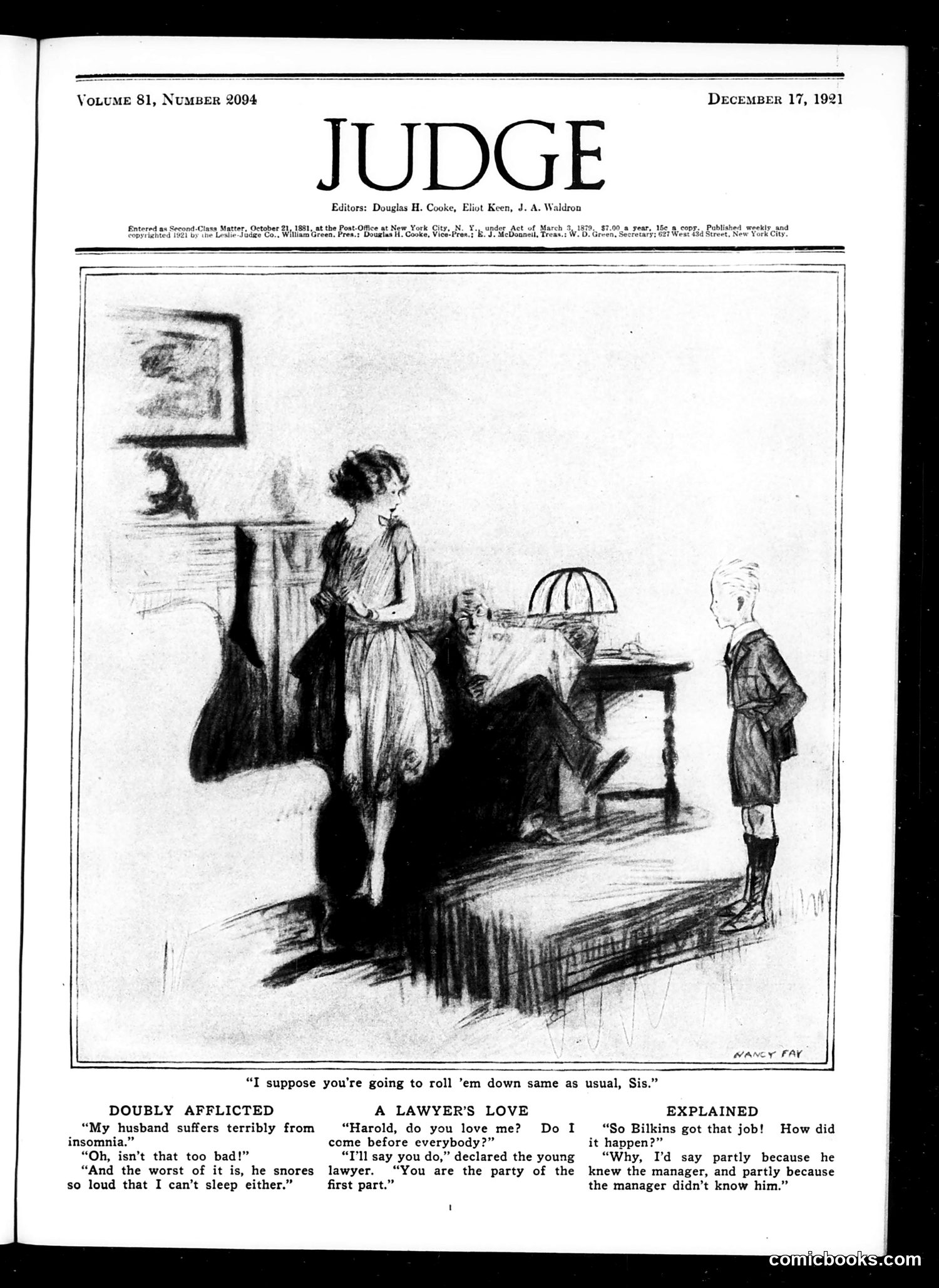
This page contains three unrelated humorous vignettes typical of Judge's satirical style: **"Doubly Afflicted"**: A wife complains that her husband's insomnia and snoring create a double problem—he can't sleep, and his snoring prevents her from sleeping either. **"A Lawyer's Love"**: A young lawyer reassures his romantic partner that she comes before everyone else, then clarifies she's "the party of the first part"—a legal phrase suggesting he views their relationship through a contractual, legalistic lens rather than emotional one. **"Explained"**: An unexplained job acquisition is attributed to connections and ignorance—the candidate knew the manager personally but the manager didn't know the applicant. The central sketch by Nancy Fox depicts a domestic scene. These pieces rely on wordplay and situational irony typical of early 1920s genteel humor magazines.
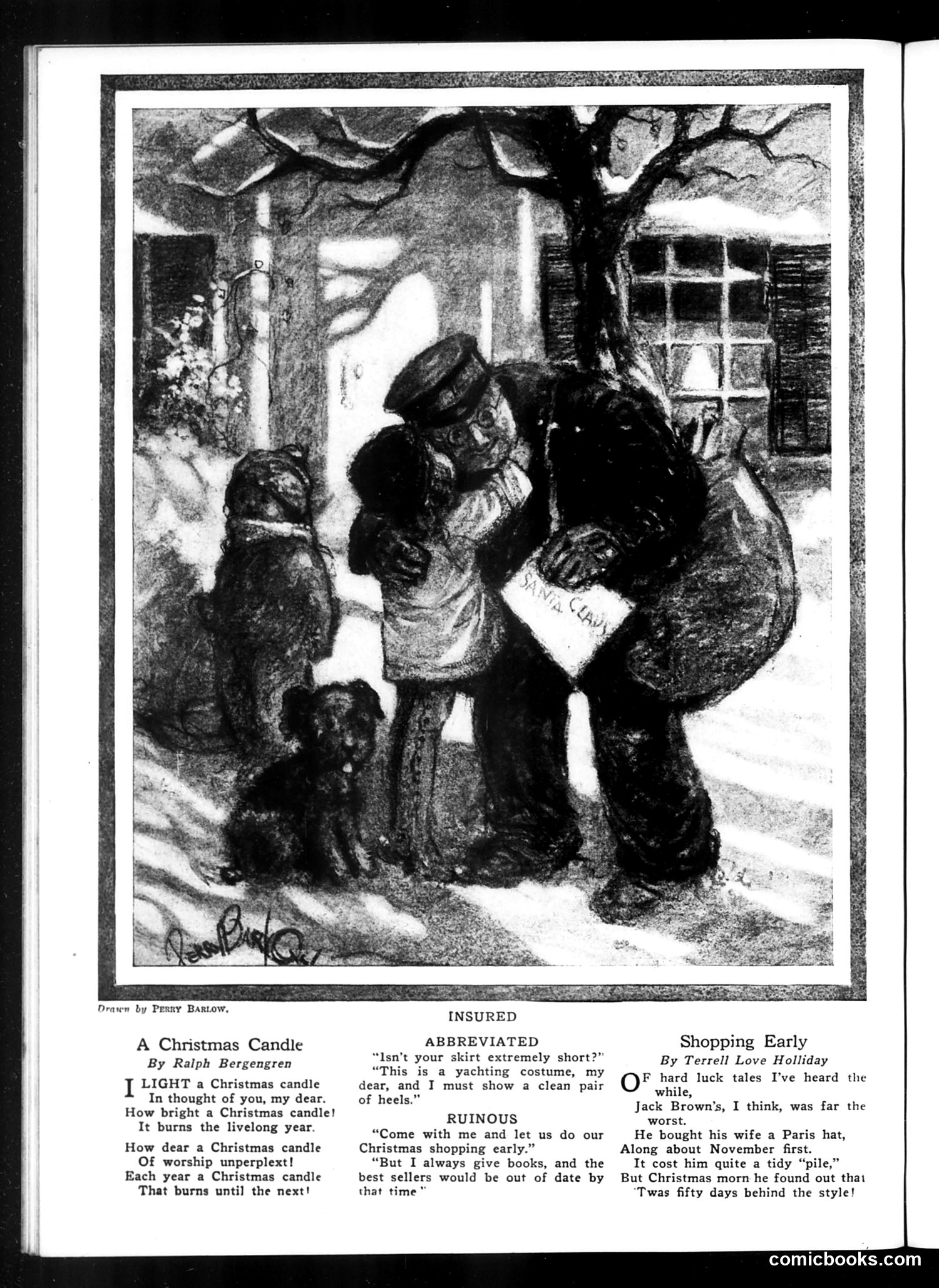
This page from *Judge* magazine contains three short humorous pieces with accompanying illustration by Perry Barlow. The central drawing depicts anthropomorphized animals (appearing to be bears or similar creatures) in winter clothing conducting Christmas shopping, illustrating the accompanying verses and jokes below. The three pieces—"A Christmas Candle" by Ralph Bergengren, "Abbreviated" (about yachting costume propriety), and "Ruinous" (about Christmas shopping timing)—are gentle domestic humor focusing on seasonal customs and shopping habits rather than political satire. "Shopping Early" by Berton Braley jokes about men's gift-giving failures, suggesting a husband's November hat purchase proved outdated by Christmas—typical turn-of-the-century domestic comedy mocking male shopping incompetence. The content reflects *Judge*'s focus on social observation and wordplay rather than hard political commentary.
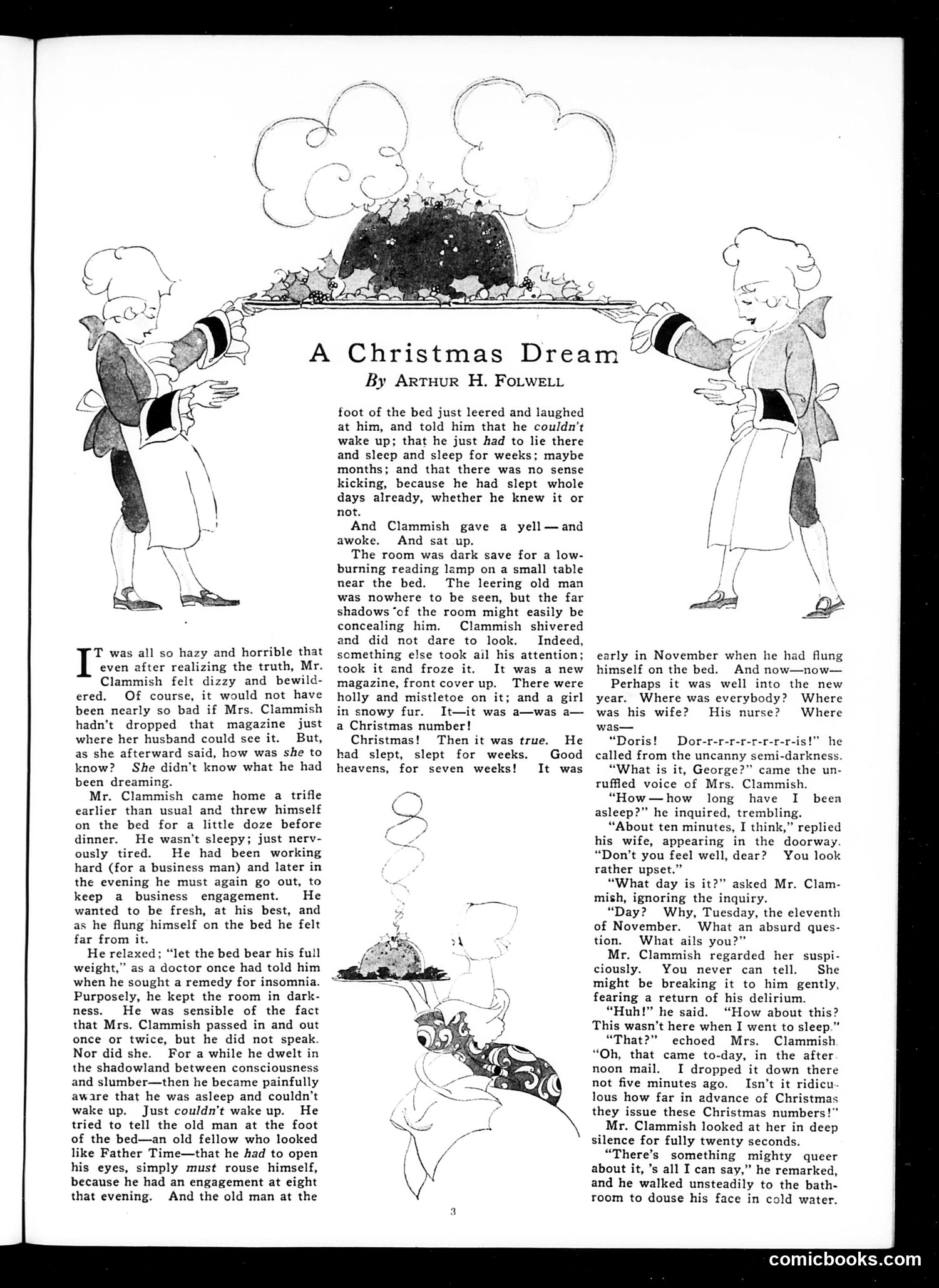
This is a humorous short story rather than political satire. The narrative concerns Mr. Clammish, a businessman who falls asleep at his desk early in November and awakens believing he's slept for weeks—convinced it's Christmas time. His wife finds him confused and disoriented, insisting the date is November 11th despite his insistence that weeks have passed. The story appears to satirize the anxieties of overworked businessmen and the compressed, hectic nature of the pre-Christmas season, where time seems to distort. The accompanying illustrations by the cherubic, cloud-dwelling figures suggest a dreamlike quality. This is primarily entertainment rather than political commentary.
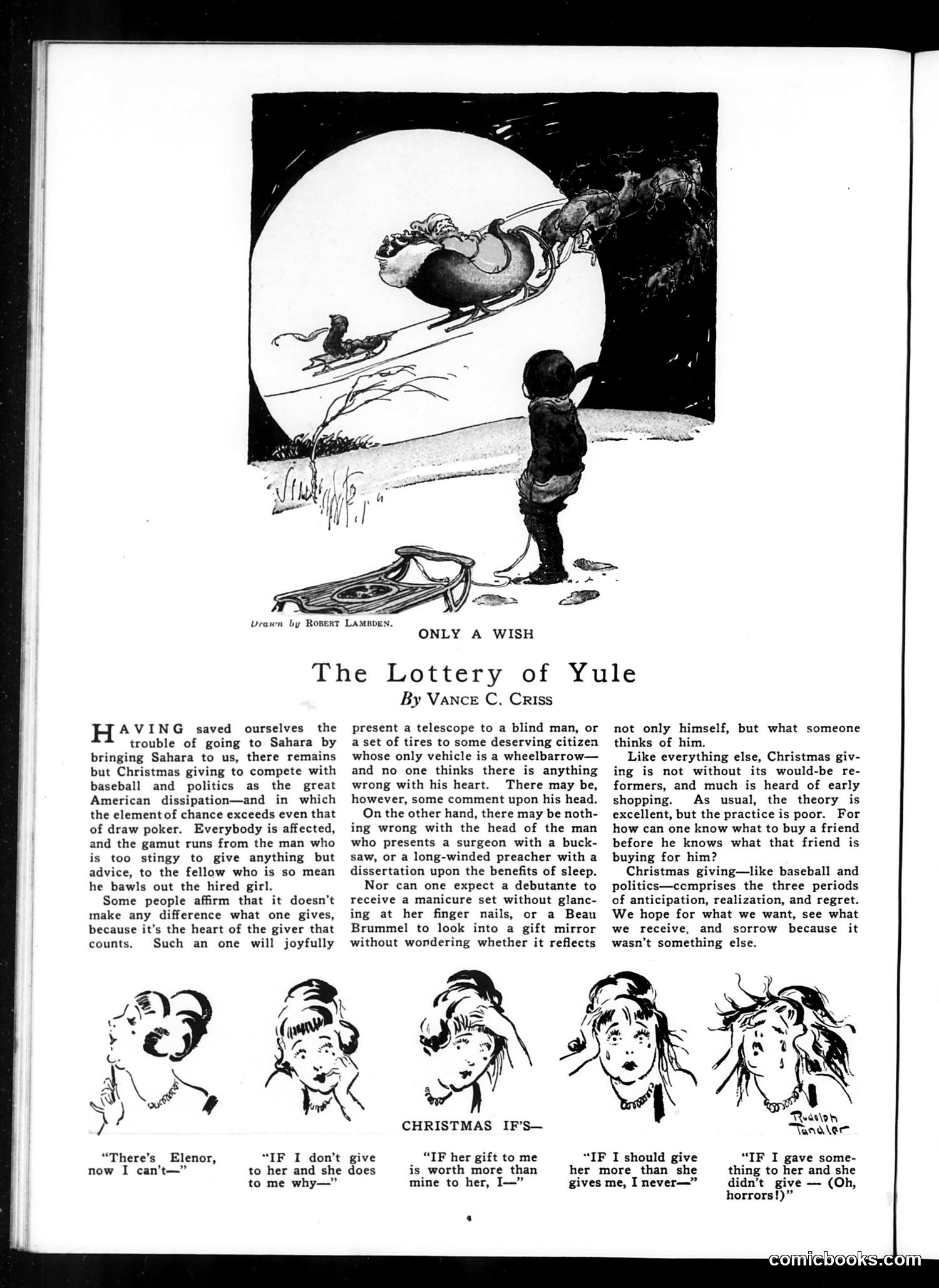
**Main Article:** Vance C. Criss's essay critiques Christmas gift-giving expectations. He argues that the *spirit* of giving matters more than the *object* given, and that people obsess over material gifts while missing the true meaning of Christmas. The essay warns against the anxiety and regret surrounding gift-exchange. **Illustration by Robert Lambden ("Only a Wish"):** Shows a child gazing at Santa's sleigh against the moon—a straightforward romantic image of Christmas wonder. **Bottom Comics ("Christmas If's"):** Five female faces express anxiety about gift-giving reciprocity—worrying whether gifts received are "worth more" than those given, or fearing they'll receive nothing in return. These satirize the transactional, competitive nature of holiday gift-exchange among adults. The page collectively mocks how Christmas gift-giving had become an anxious social obligation rather than an expression of genuine goodwill.
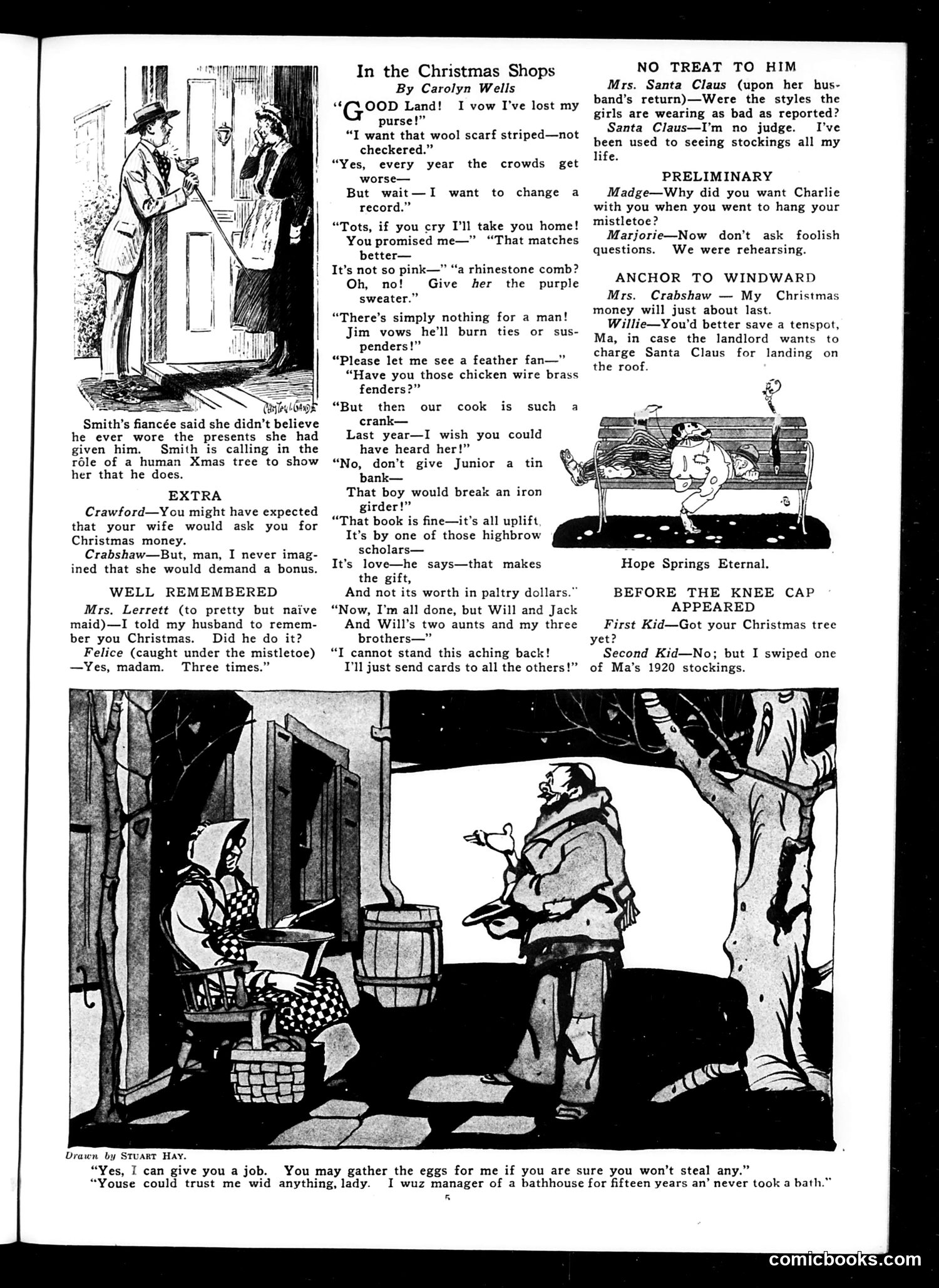
This page contains multiple short humorous pieces satirizing Christmas shopping and domestic life circa 1920s America. **Main cartoon** (Stuart Hay illustration): A woman hires a man for a job, asking him to gather eggs while promising trustworthiness. He responds that as a former bathhouse manager for fifteen years who "never took a bath," he's reliable—the joke being that someone who steals from his employer (bathwater) while claiming honesty is obviously untrustworthy. It's a working-class humor piece about dishonest servants. **Text pieces** by Carolyn Wells humorously catalogue Christmas shopping frustrations: indecisive customers, demanding wives, exhausted shoppers, and the commercialization of gift-giving. One bit jokes that Santa's wife finds his comment about "seeing stockings all my life" unsurprising. The smaller items mock marital dynamics, mistletoe encounters, and children's Christmas expectations. **Overall tone**: Lighthearted domestic satire targeting consumer culture, marriage complications, and class anxieties—typical Judge magazine fare mocking middle-class American life.
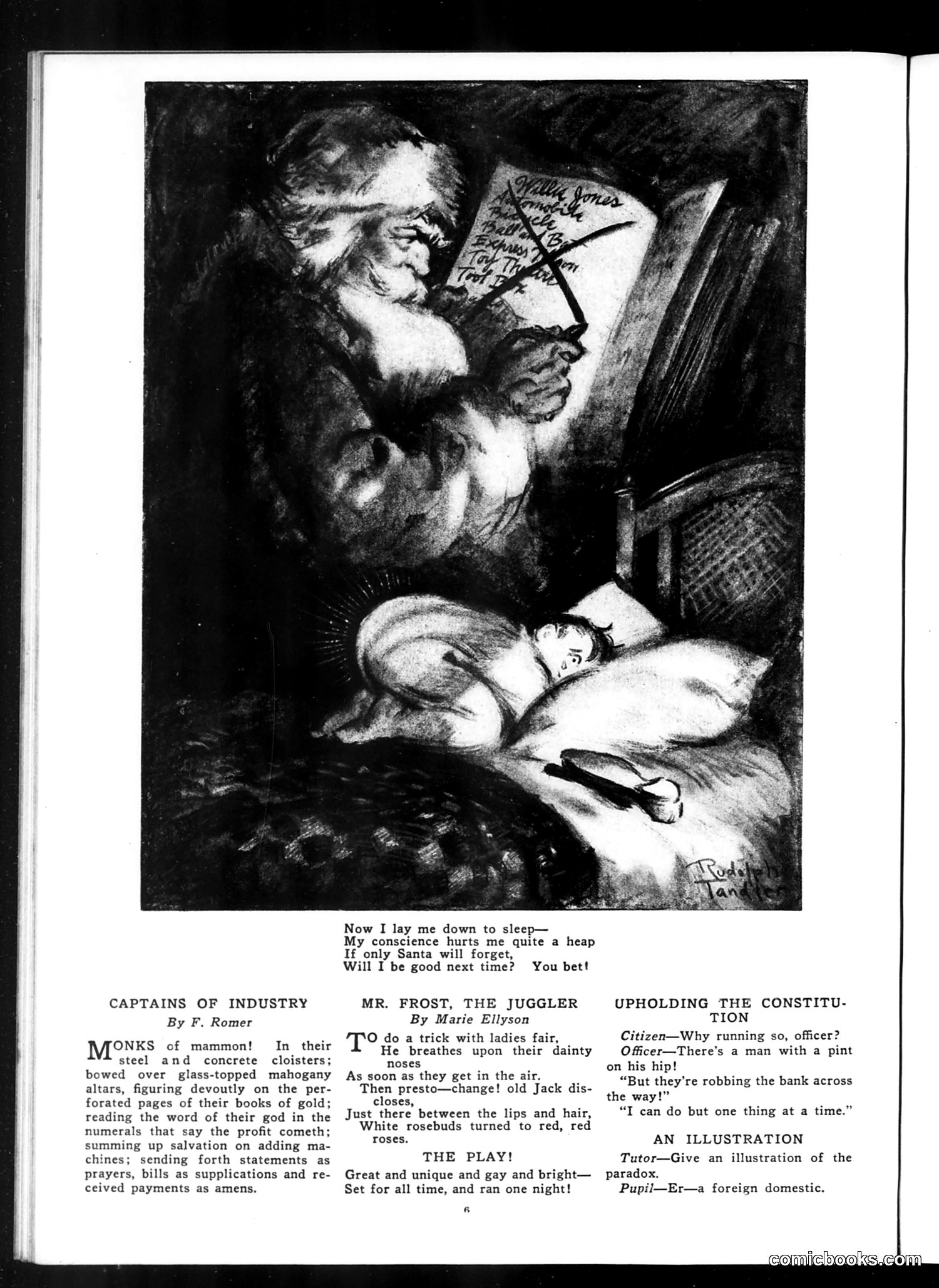
This page contains three distinct satirical pieces attacking American society: **"Captains of Industry"** mocks wealthy industrialists as quasi-religious figures worshipping profit, treating ledgers as scripture and financial statements as prayers—critiquing unchecked capitalism and moral corruption among the wealthy. **"Mr. Frost, the Juggler"** appears to reference a public figure (likely Jack Frost or similar) seducing women, using magical imagery to suggest deceptive romantic manipulation. **"Upholding the Constitution"** satirizes law enforcement priorities: a police officer pursues a man with alcohol (during Prohibition era) while ignoring an actual bank robbery, exposing the absurdity of enforcing unpopular moral legislation over protecting property and public safety. The etching above shows a figure examining a child, with a darkly comic prayer about conscience and Santa—likely condemning hypocrisy among the wealthy who exploit children while maintaining moral pretenses. These pieces collectively attack corruption, materialism, and selective justice in American institutions.
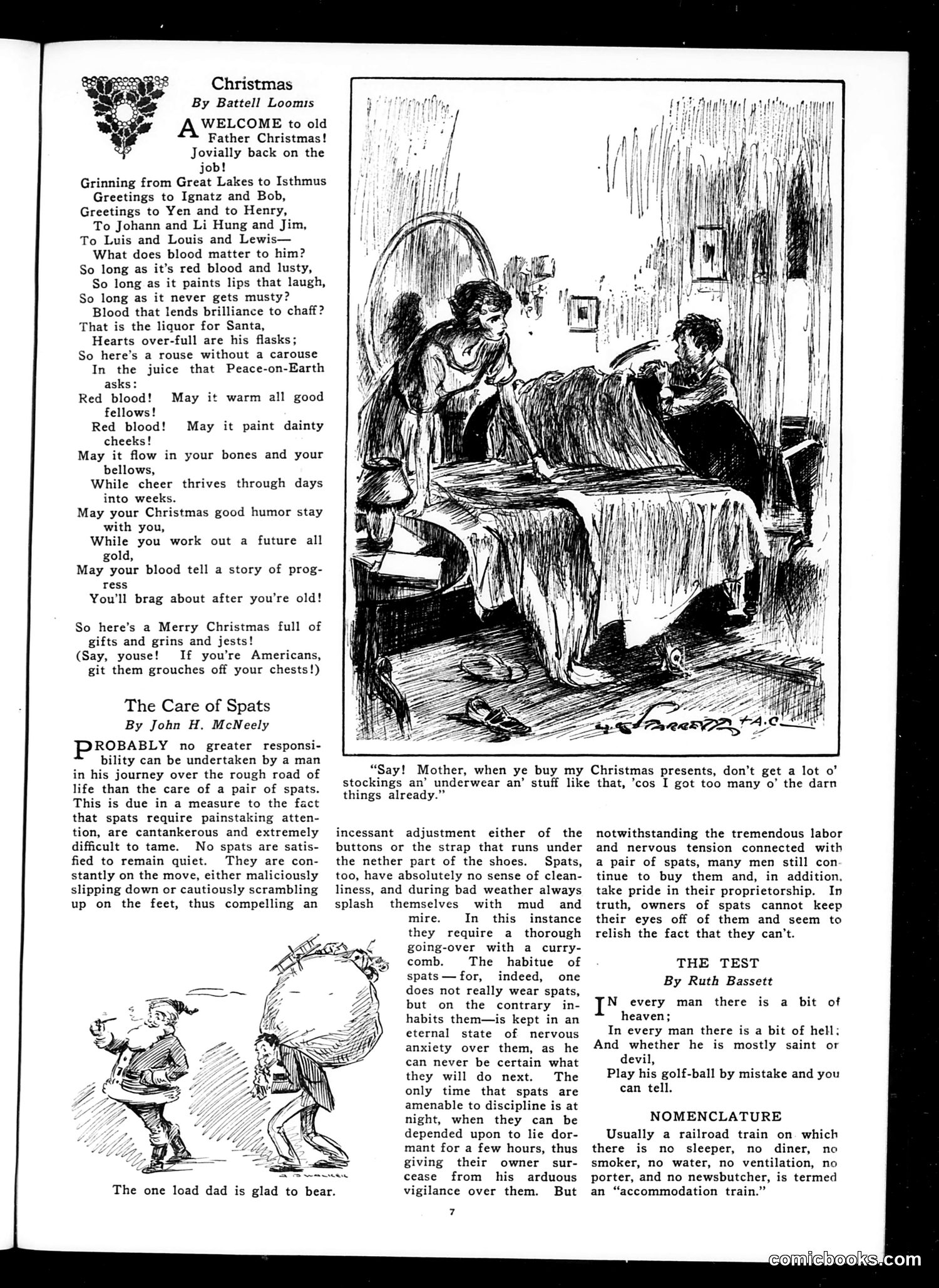
This page contains three humorous pieces from Judge magazine: 1. **"Christmas" by Battell Loomis**: A poem welcoming Father Christmas back, celebrating the festive spirit. It addresses various ethnic groups ("Ignatz," "Johann," "Li Hung," "Luis") with inclusive goodwill—reflecting early 20th-century America's immigrant diversity. The repeated references to "red blood" emphasize vitality and shared humanity across these groups. 2. **"The Care of Spats" by John H. McNeely**: A satirical essay treating spats (ankle coverings worn over shoes—a fashionable accessory of the era) as if they were high-maintenance pets requiring constant vigilance. The humor lies in the exaggerated solemnity applied to a trivial fashion concern. 3. **"The Test" by Ruth Bassett**: A brief, cynical poem suggesting that how a man behaves when someone accidentally hits his golf ball reveals his true character—saint or devil. The cartoon shows a domestic scene of gift-giving, with a child requesting toys rather than practical clothing.
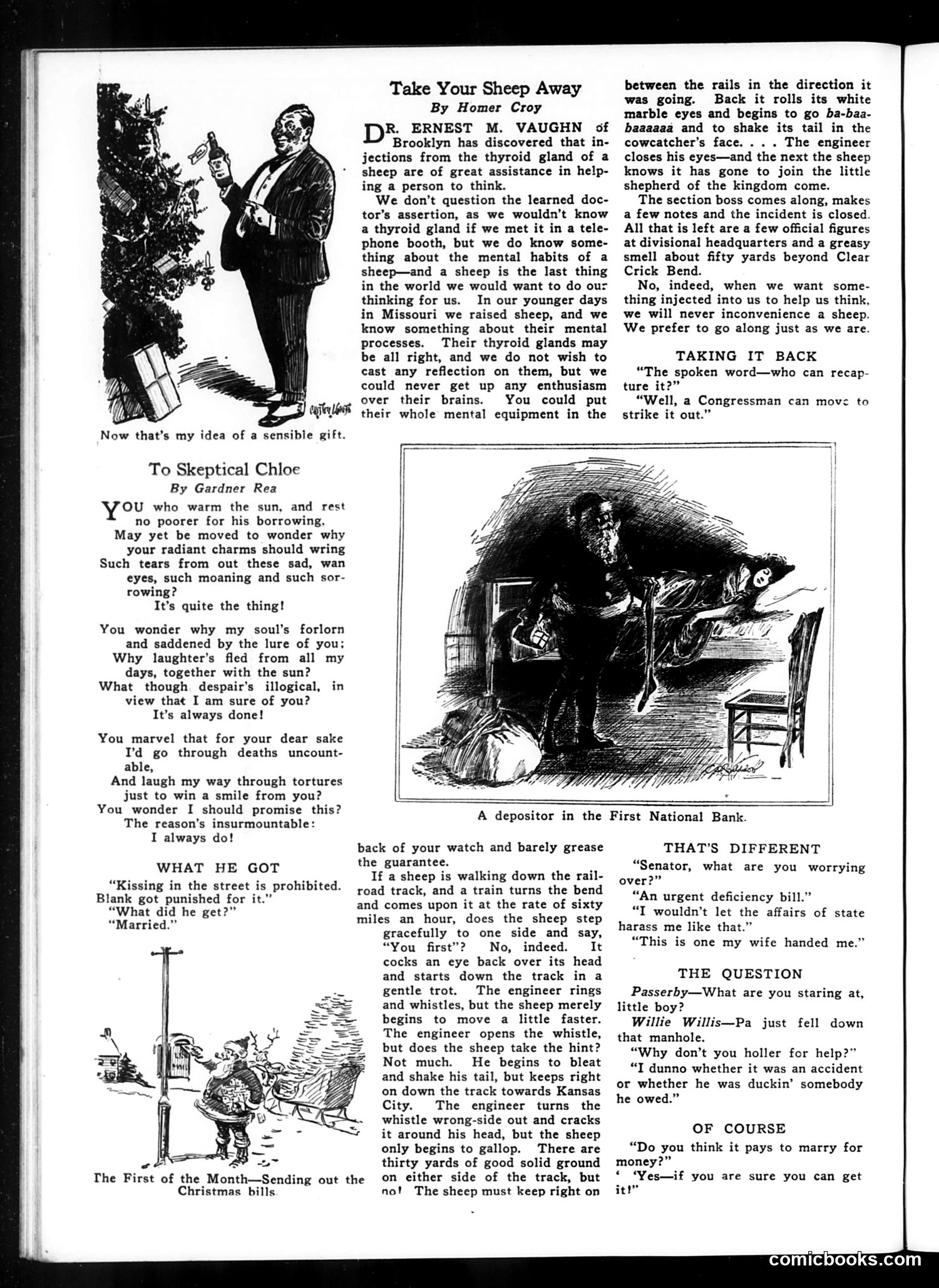
This Judge magazine page contains several satirical pieces mocking human behavior through exaggeration and wordplay. **"Take Your Sheep Away"** ridicules a Brooklyn doctor's claim that sheep thyroid injections improve thinking. The author humorously argues sheep are intellectually worthless, illustrated by an anecdote about a sheep's stubborn stupidity on railroad tracks—it refuses to step aside from an oncoming train despite the engineer's desperate attempts to warn it, ultimately getting hit. The satire targets both the doctor's dubious medical claim and sheep's legendary lack of common sense. **Other items** include a sentimental poem mocking romantic devotion, a joke about kissing in public leading to marriage as punishment, and political humor about congressmen striking spoken words from the record—referencing legislative procedures for removing statements from official proceedings. The cartoon showing "A depositor in the First National Bank" appears to depict anxiety about banking, likely referencing contemporary financial concerns.
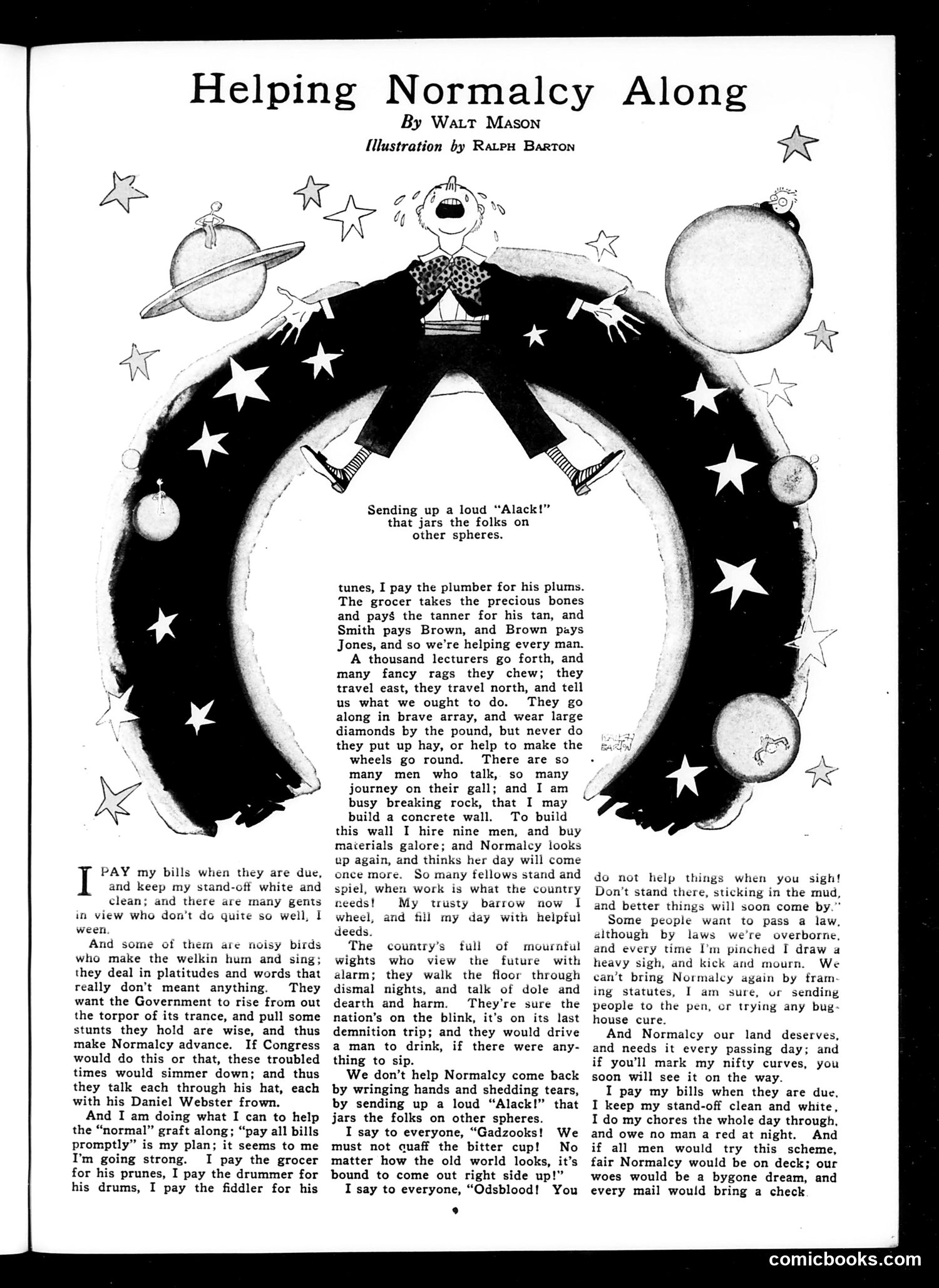
This satirical piece critiques post-WWI America's embrace of "Normalcy"—President Warren G. Harding's 1920 campaign promise to return to pre-war stability after social upheaval. **The satire:** The narrator claims to help "Normalcy" by simply paying his bills on time and doing manual labor (breaking rocks, building walls). He mocks two groups: verbose lecturers and politicians who make grandiose speeches but accomplish nothing, and pessimists who constantly warn of national collapse. **The point:** Mason argues that genuine progress comes through ordinary work and financial responsibility, not rhetoric or doom-saying. However, the irony is sharp—the illustration shows a figure literally juggling planets while claiming his modest bill-paying helps the nation. This suggests that individual actions, while admirable, cannot actually address systemic problems or prevent larger forces (economic cycles, social change) from affecting the country. **Context:** This reflects 1920s conservative thinking that blamed labor unrest and social criticism for instability, promoting instead a "bootstrap" philosophy of personal virtue solving national problems.
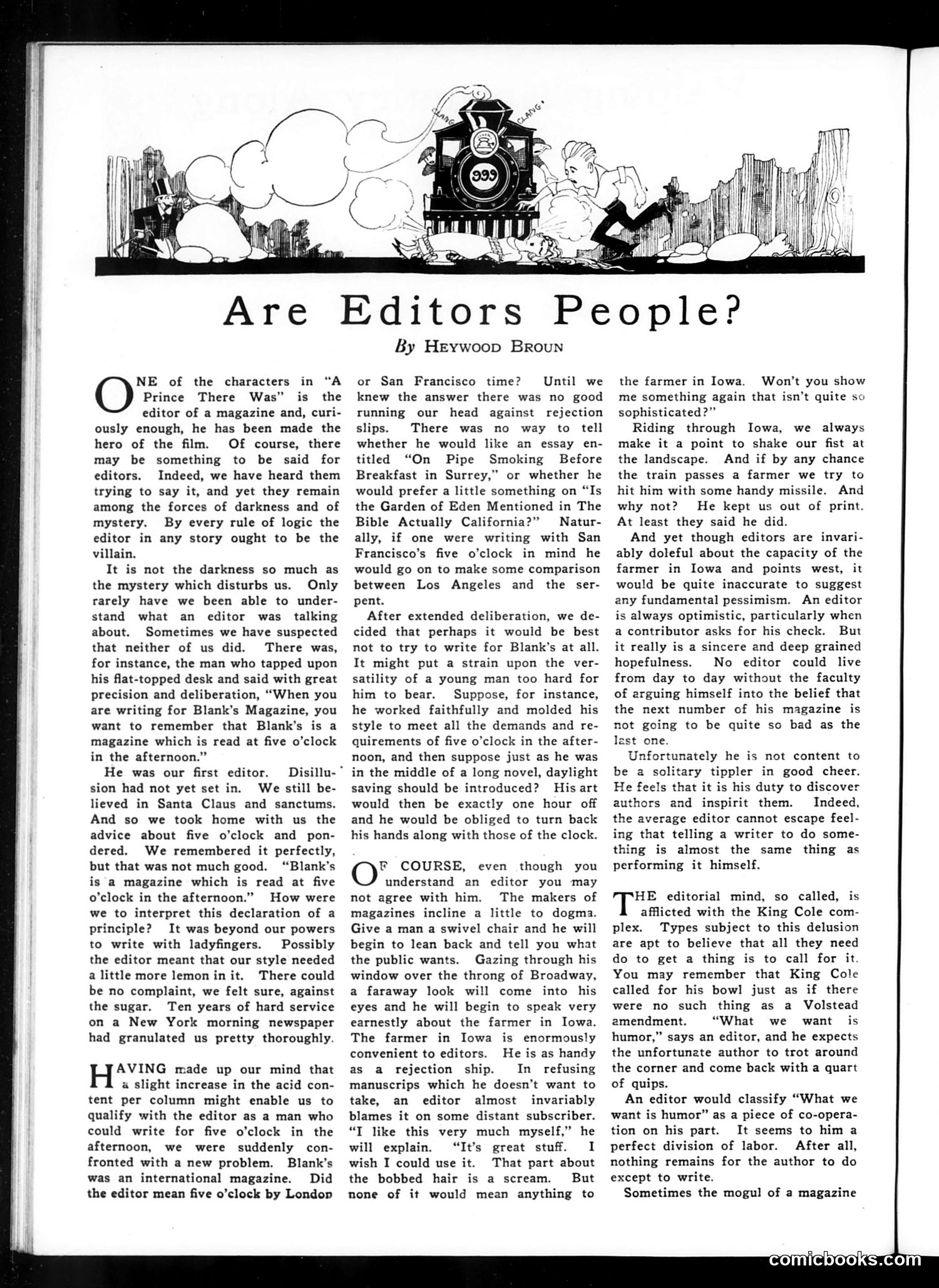
This satirical essay mocks magazine editors as mysterious, illogical figures who make incomprehensible demands on writers. The cartoon header depicts a locomotive labeled "1939" alongside figures in an editorial office—visualizing the collision between editors and creative work. Broun's humor targets editors' pretentious vagueness: one editor cryptically insists writers remember "Blank's Magazine is read at five o'clock in the afternoon"—advice so obscure it paralyzes the writer with uncertainty (does he mean London or San Francisco time?). The piece ridicules editors' invocation of the "farmer in Iowa" as an imaginary arbiter of public taste—a convenient, distant figure used to reject manuscripts without real justification. Broun suggests editors wield arbitrary power from their swivel chairs while claiming to speak for ordinary readers they don't actually understand. The title poses a rhetorical question: are editors even *people*—implying they're incomprehensible beings of pure institutional authority.
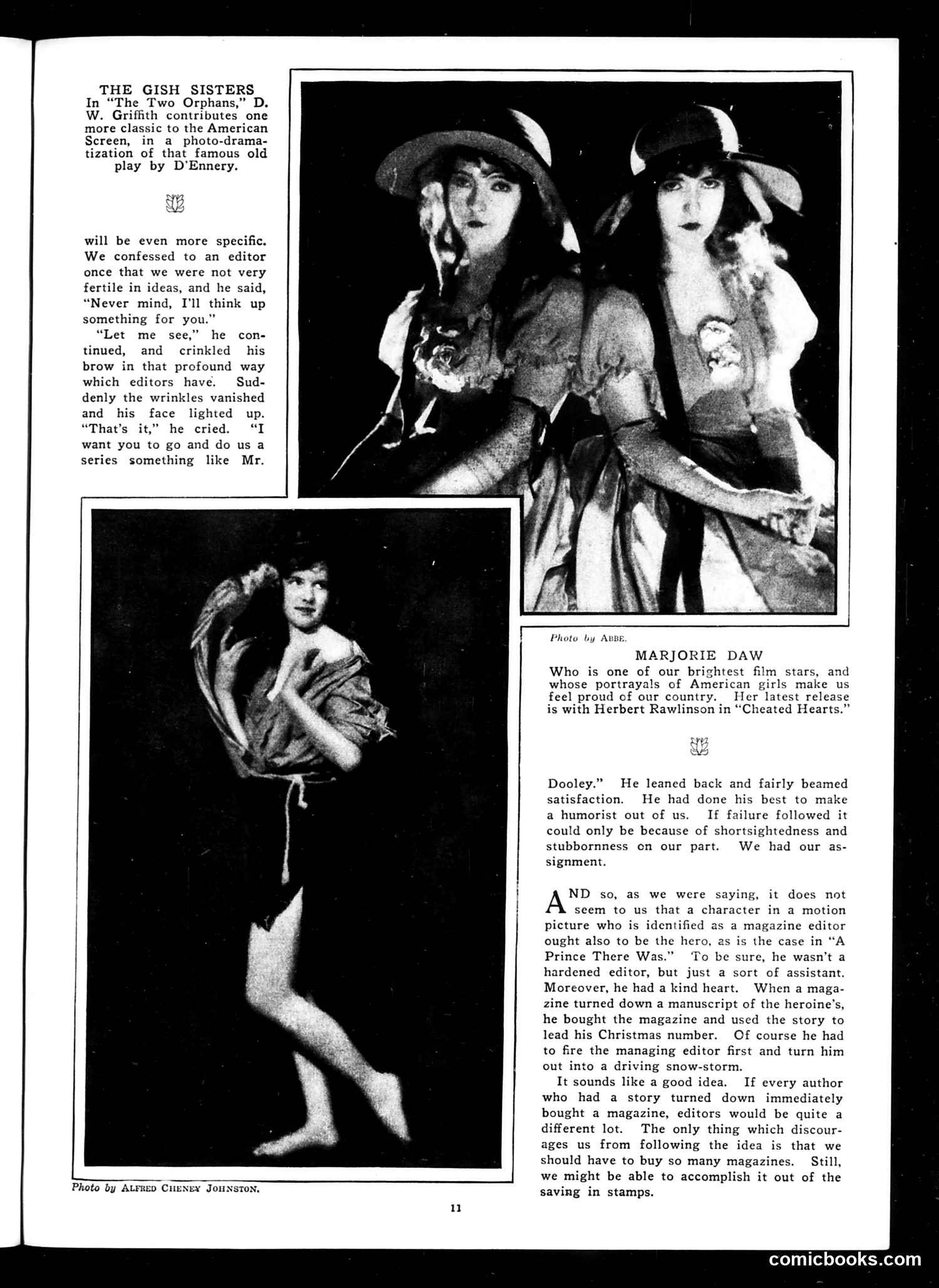
This Judge magazine page reviews D.W. Griffith's film adaptation of *The Two Orphans*, featuring the Gish Sisters, prominent silent film actresses. The accompanying photos showcase Marjorie Daw, another contemporary film star. The main satire critiques film plots—specifically how *A Prince There Was* portrays a sympathetic magazine editor as hero. The writer mocks this trope: if every rejected author literally bought a magazine to publish their story (firing the managing editor into a snowstorm), editors would face financial ruin. The joke suggests this fantasy scenario reflects authors' actual resentment toward rejection. This reflects early 1920s tensions between literary establishments and emerging film culture, where movies increasingly adapted stage plays and literary works while satirizing the publishing world's gatekeepers.
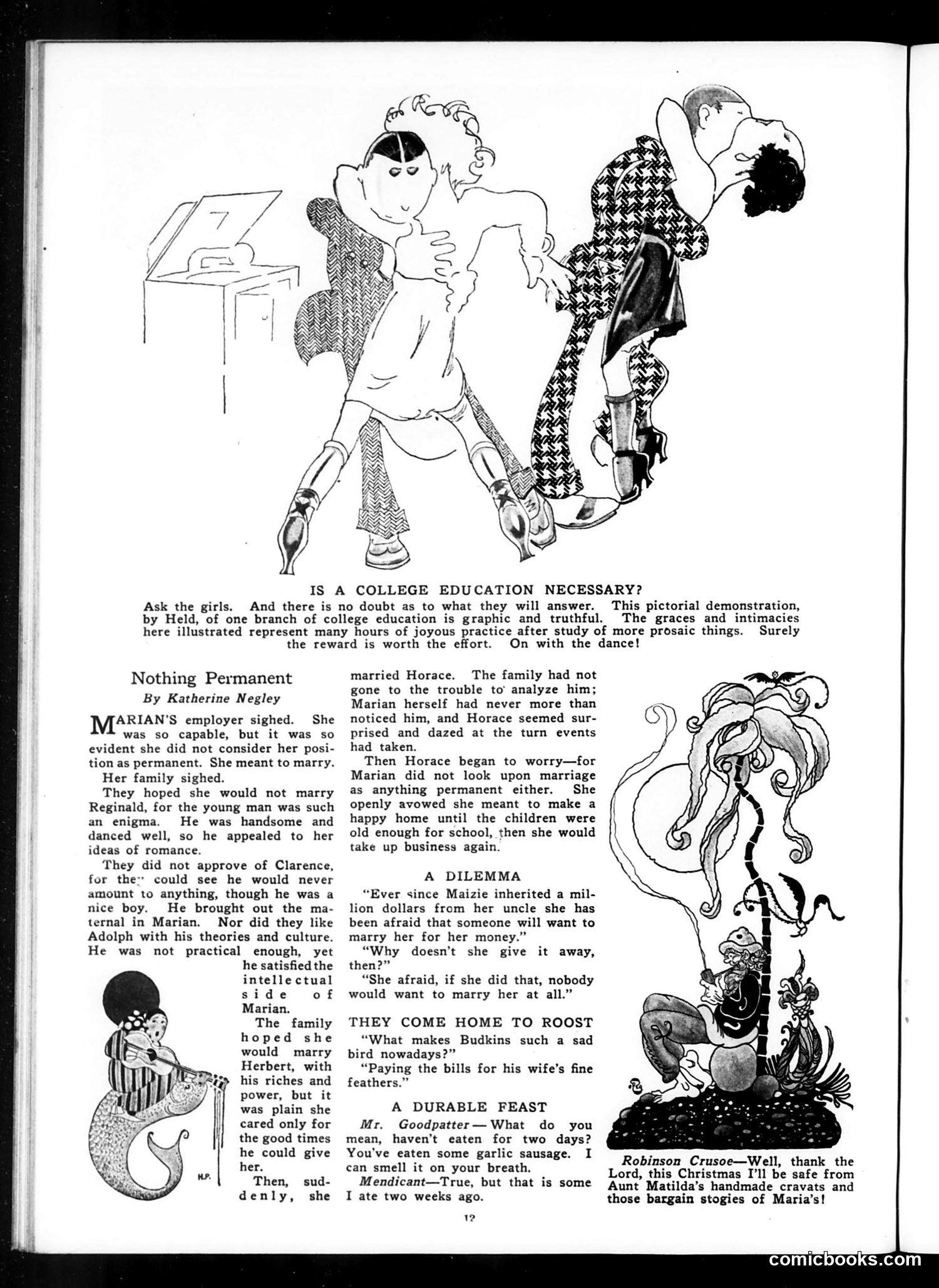
The top cartoon titled "IS A COLLEGE EDUCATION NECESSARY?" depicts a woman in academic robes dancing enthusiastically with a man in patterned clothing. The satire questions whether higher education is worthwhile for women, suggesting instead that dancing and social activities represent the actual outcome of college for female students. This reflects early 20th-century skepticism about women's higher education—the implication being that women attended college primarily to find husbands and enjoy social events rather than serious intellectual pursuit. The lower portion contains short humorous fiction pieces ("Nothing Permanent," "A Dilemma," etc.) typical of Judge's satirical content, mocking domestic life, marriage expectations, and social conventions of the era. The overall page reflects period attitudes dismissing women's educational ambitions.
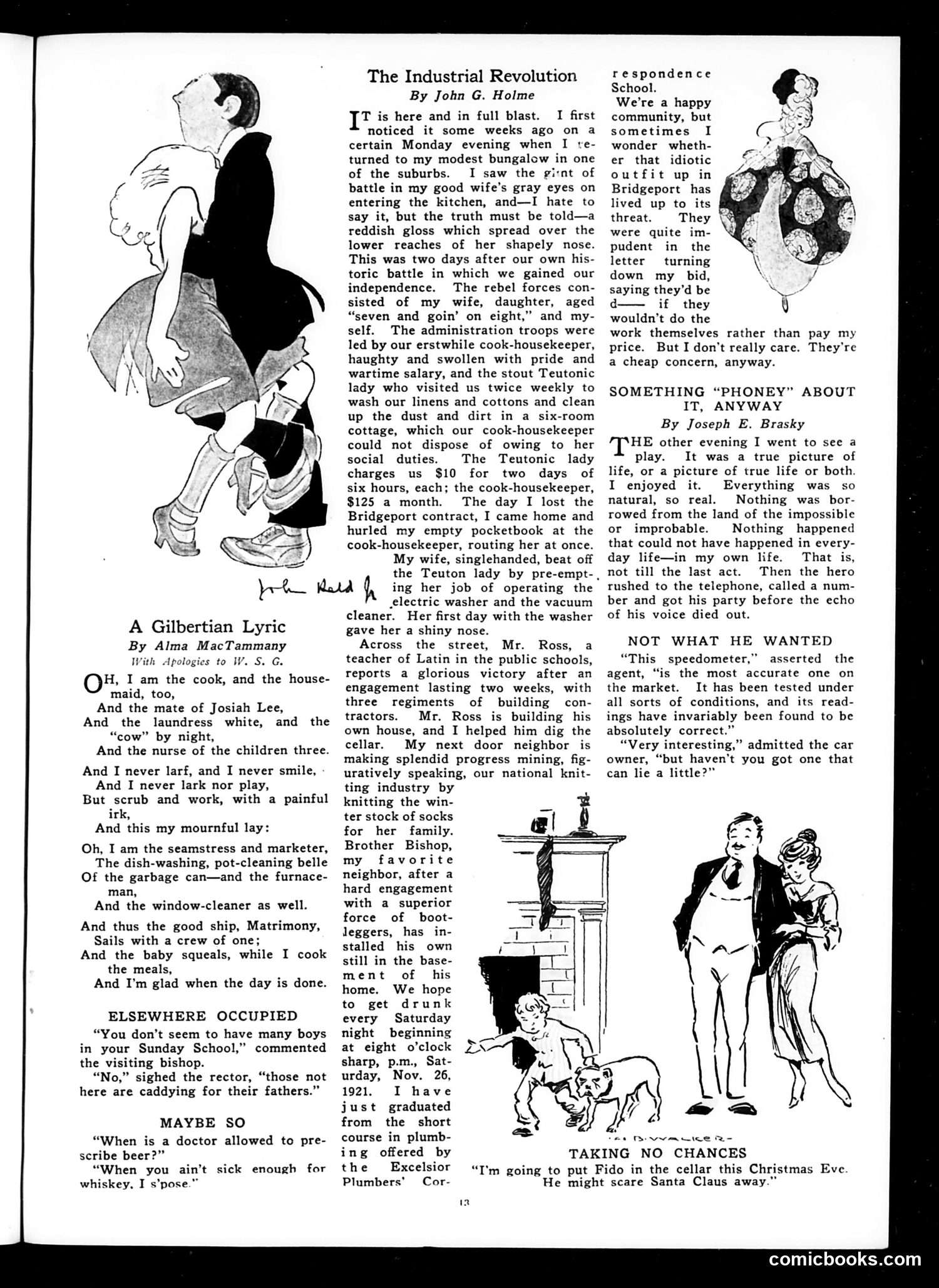
This page satirizes post-WWI American life through multiple pieces: **"A Gilbertian Lyric"** mocks exhausted housewives doing all domestic labor alone—a Gilbert & Sullivan parody about a woman serving as cook, maid, laundress, nurse, seamstress, and more. The satire critiques women's endless unpaid housework. **"The Industrial Revolution"** uses mock-military language to describe middle-class men and women doing their own housework after losing domestic servants—likely due to post-war labor shortages and changing employment patterns. The author humorously describes his wife operating a vacuum cleaner, neighbors building their own homes, and a bishop installing homemade alcohol (referencing Prohibition). The satire suggests this represents either progress or absurd desperation. **Minor jokes** include references to priests' concerns about boys absent from Sunday School (caddying for wealthy fathers) and doctor-prescribed alcohol. The overall theme: WWI and its aftermath disrupted traditional domestic service arrangements, forcing middle and upper-class families into unfamiliar self-sufficiency. Judge magazine finds this situation both comedic and somewhat concerning.
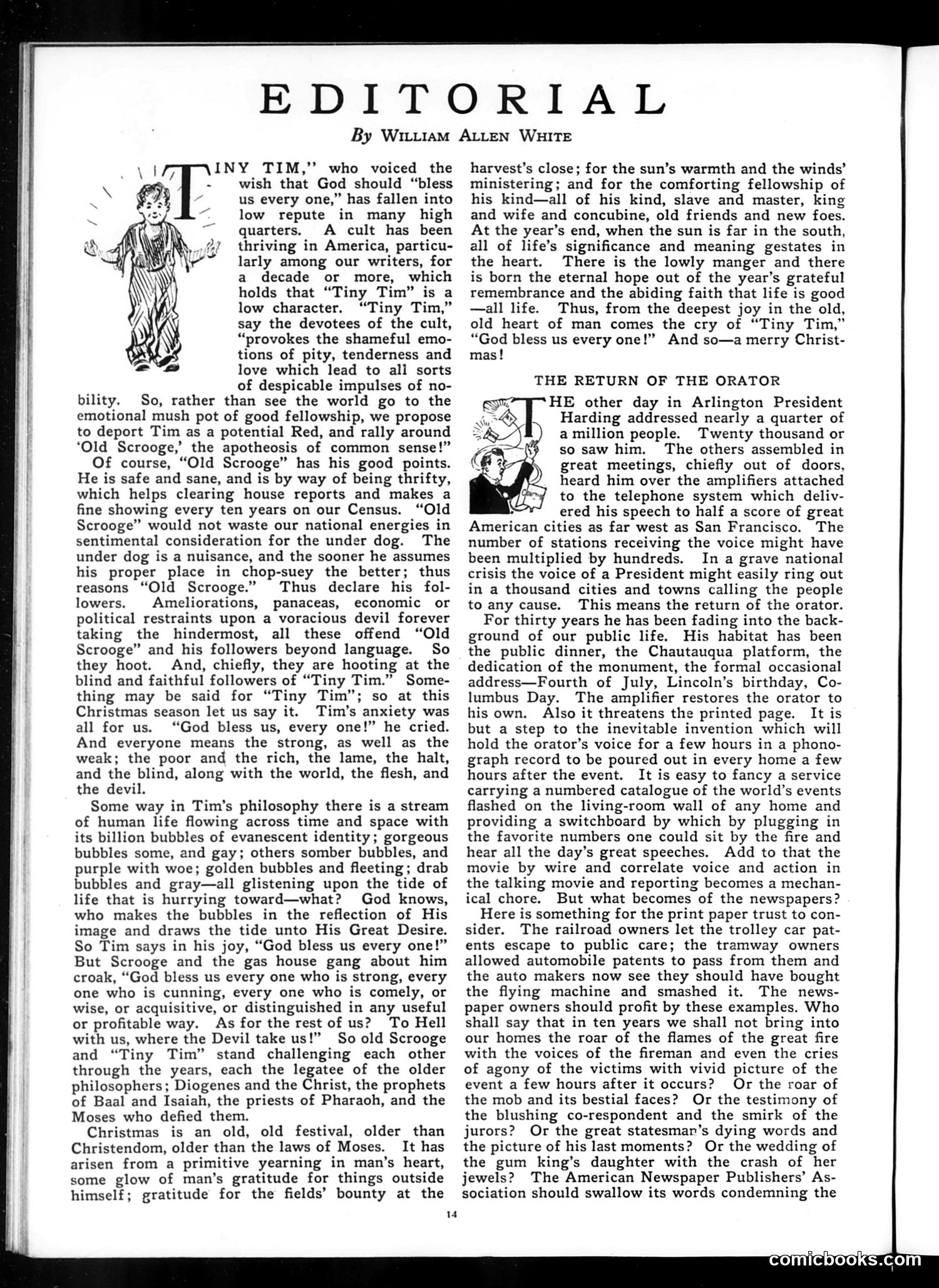
This editorial by William Allen White uses Charles Dickens characters as allegory for a contemporary American ideological debate, likely from the 1920s-1930s. **The Figures:** "Tiny Tim" represents compassion, charity, and inclusive goodwill toward all people regardless of class. "Old Scrooge" represents ruthless individualism, economic self-interest, and Social Darwinism—the philosophy that society should aid only the strong and profitable. **The Context:** White attacks an emerging cultural movement among American writers and intellectuals who mock sentimentality and charity as weakness, dismissing advocates for the poor as "potential Reds" (Communists). They advocate deporting compassion itself. **The Point:** White argues that Christmas and human philosophy fundamentally rest on Tiny Tim's inclusive blessing—"God bless us every one"—not Scrooge's selective cruelty. The editorial defends sentimental humanism against a hardening cynicism gaining ground in American intellectual circles.
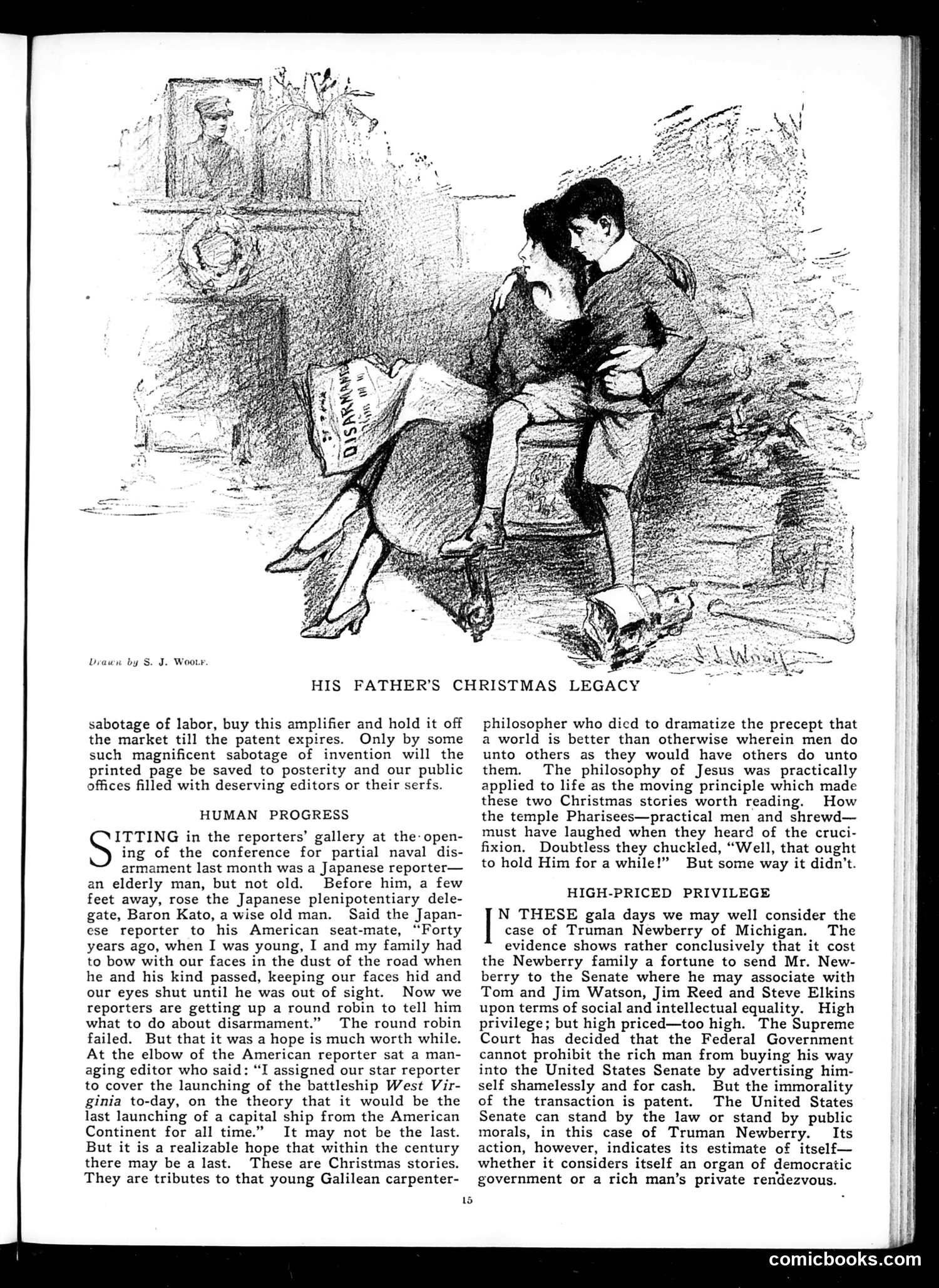
This page contains editorial commentary rather than traditional cartoons. The illustration depicts a couple reading together, titled "His Father's Christmas Legacy." The content critiques three topics: 1. **Patent Sabotage**: Attacks industrial interests blocking invention patents to maintain market control. 2. **Human Progress**: Celebrates a Japanese reporter's transformation from servitude to authority—a hopeful story about social advancement. It also mentions the USS West Virginia launch, expressing hope that battleship construction may eventually cease through disarmament efforts. 3. **Truman Newberry Case**: Directly criticizes a recent Supreme Court decision allowing wealthy candidates to buy Senate seats through advertising and campaign spending. The author condemns the Newberry family's fortune spent to elect him, arguing the Senate has chosen protecting rich men's privileges over democratic principles and public morals. The "Christmas Legacy" framing references Jesus's teachings about treating others fairly—juxtaposing spiritual ideals against material corruption in American institutions.
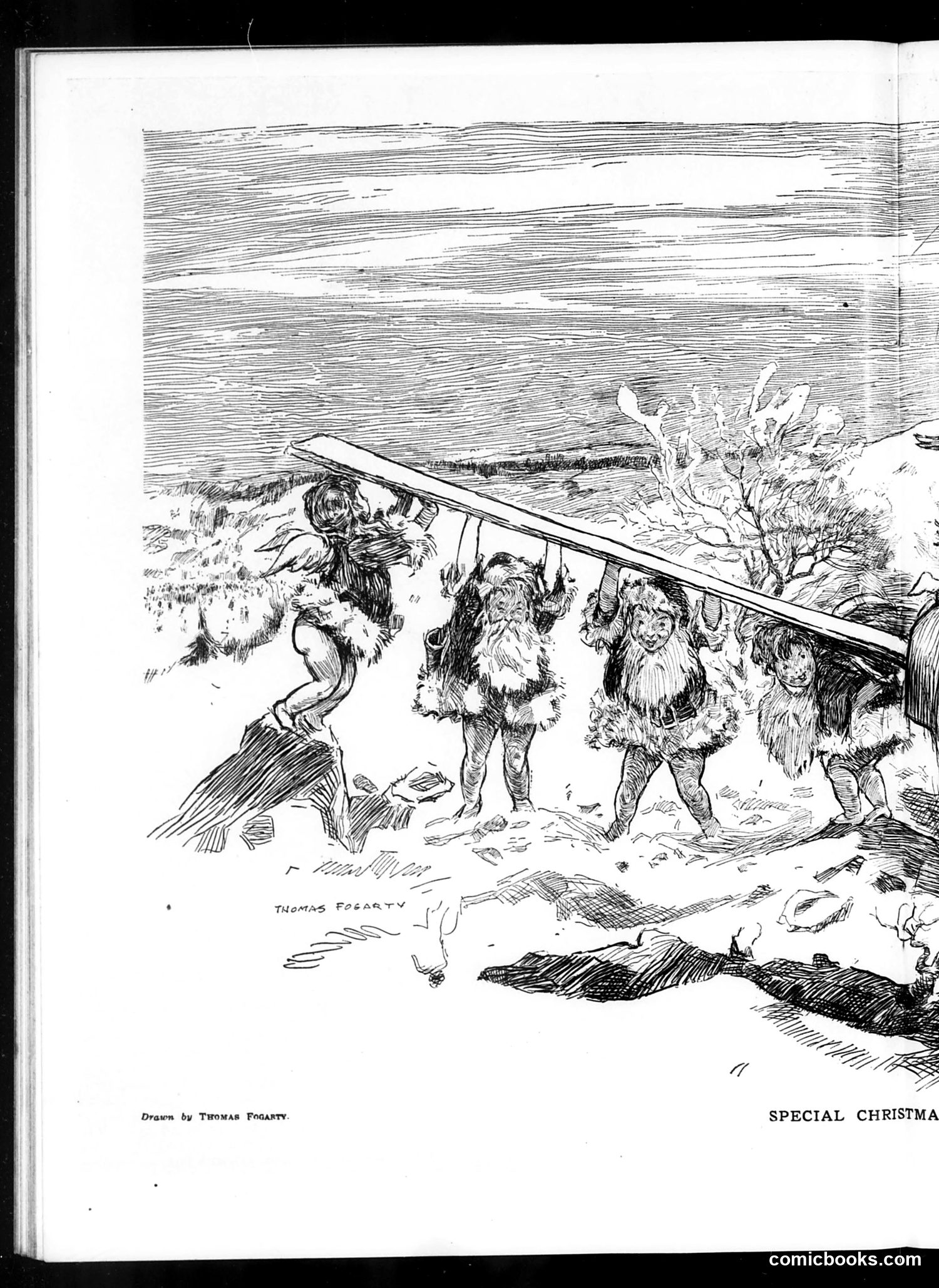
This illustration by Thomas Fogarty depicts what appears to be mythological or fantastical creatures—possibly trolls or gnomes with distinctive bearded faces and furry bodies—gathered around a wooden structure, seemingly interacting with a bird-like figure on the left. The caption indicates this is a "Special Christmas" contribution, suggesting holiday-themed content. However, without additional context from the magazine's surrounding text or the specific date of publication, the precise political or social satire remains unclear. The cartoon may reference Christmas folklore, seasonal themes, or contemporary social commentary typical of *Judge* magazine's satirical style, but the specific target of the satire cannot be definitively determined from the image alone.
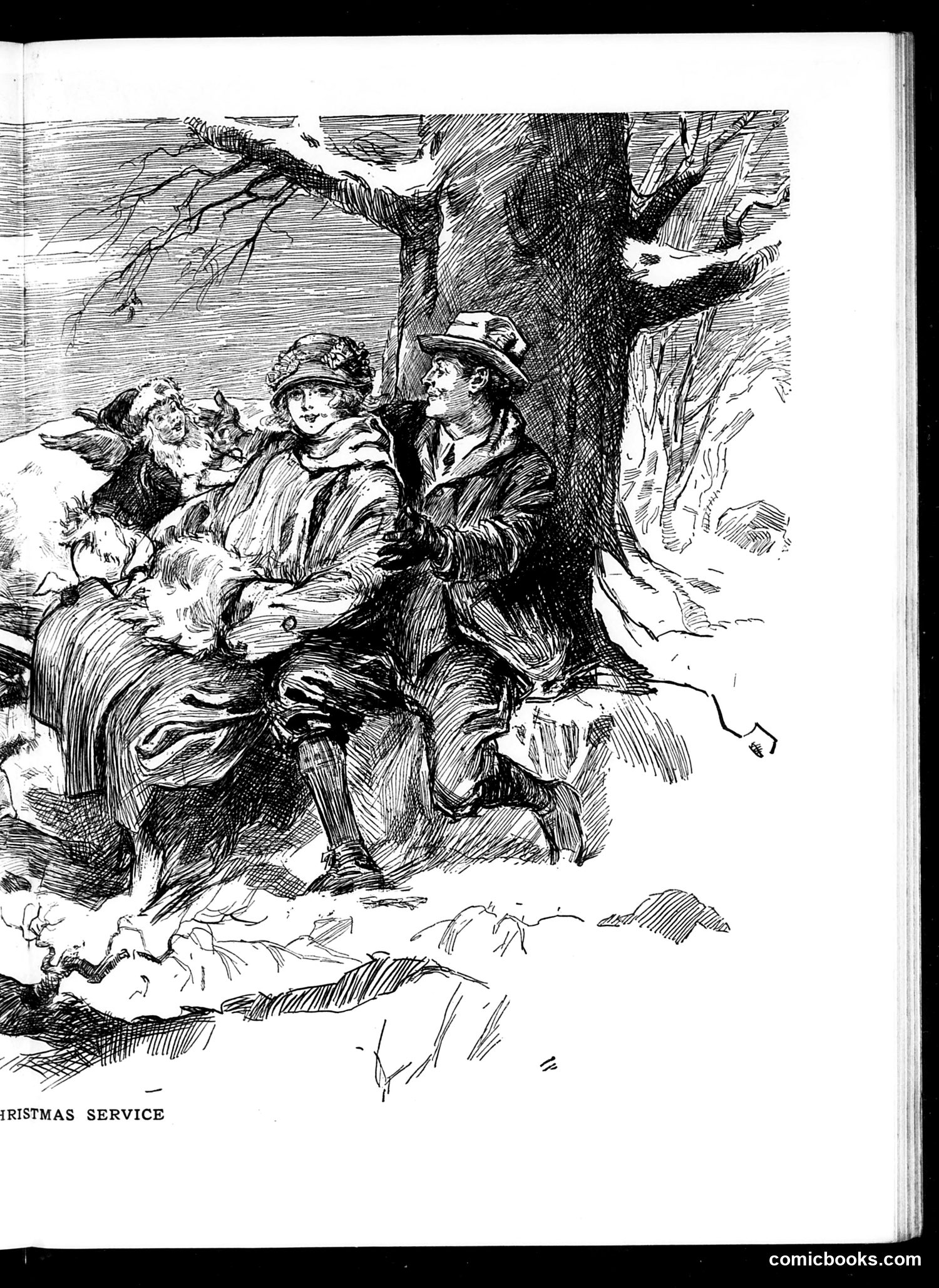
This appears to be a Christmas-themed illustration from *Judge* magazine, titled "Christmas Service" (the first letter "C" is cut off in the OCR). The sketch depicts three figures in winter clothing gathered beneath a large tree. Two men wearing hats appear to be engaged with a third figure on the left. The style and composition suggest a scene of holiday charity or social interaction, likely satirizing some aspect of Christmas observance or charitable giving practices of the era. However, without additional context about the specific date of publication or accompanying article text, I cannot definitively identify the particular figures, political figures referenced, or the precise satirical point being made. The image quality and partial OCR text limit more specific interpretation of the intended commentary.
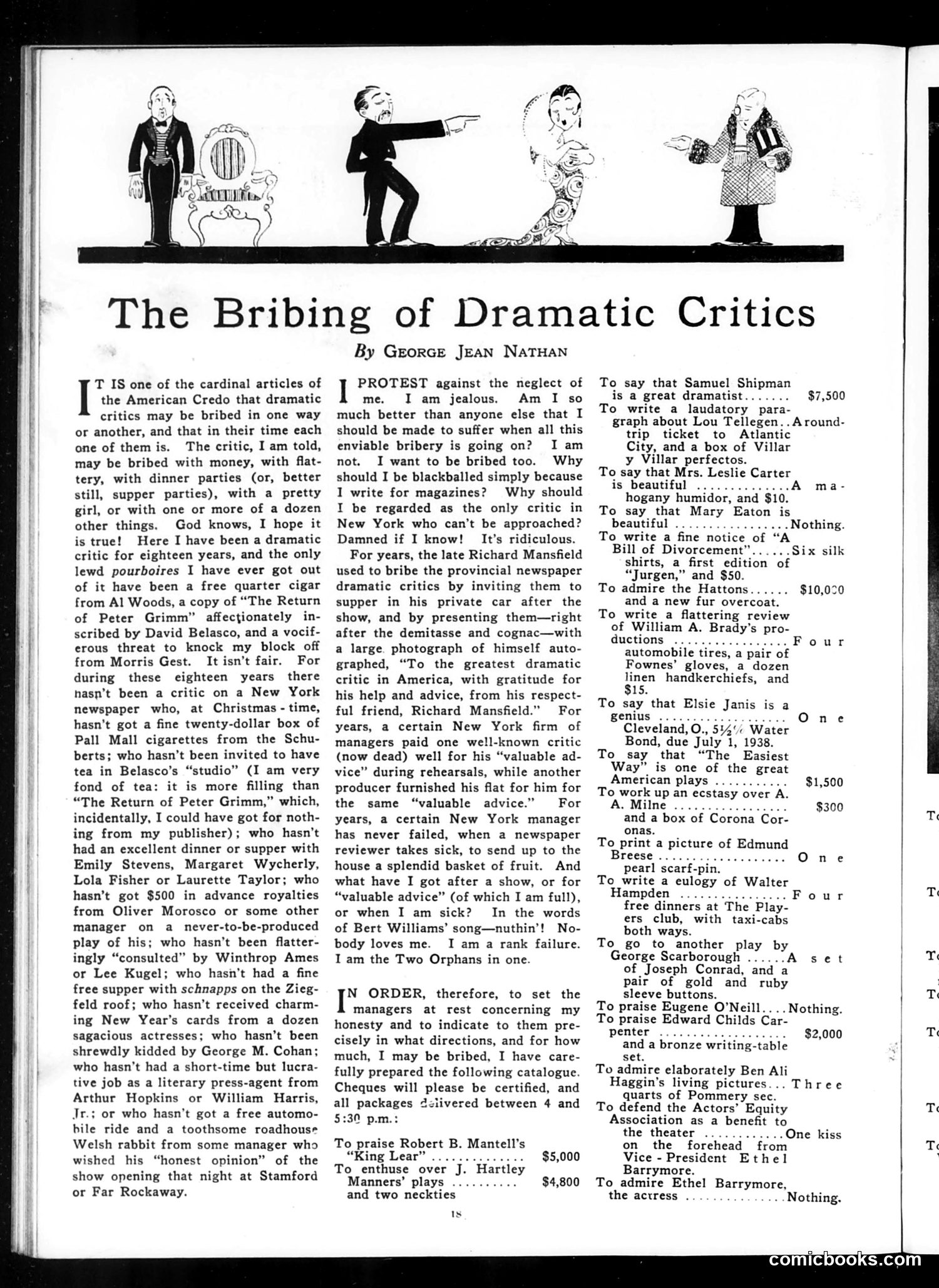
This satirical article attacks the widespread practice of theater managers bribing New York drama critics with gifts, dinners, favors, and money to secure positive reviews. Nathan, himself a dramatic critic, ironically complains that *he alone* has been excluded from this corrupt system for eighteen years. The piece names real theatrical figures—David Belasco, the Shuberts, Florenz Ziegfeld, George M. Cohan, and others—as habitual bribe-givers. Nathan catalogs the bribes other critics receive: luxury cigars, advance royalties, free meals, automobiles, and cash payments. His satire works by inverting expectation: rather than denouncing bribery as unethical, he protests his *exclusion* from it, treating accepted corruption as an entitlement he's been unfairly denied. The accompanying illustration shows figures in various poses of transaction or persuasion, visualizing the article's central complaint about systematic payoffs in theater criticism.
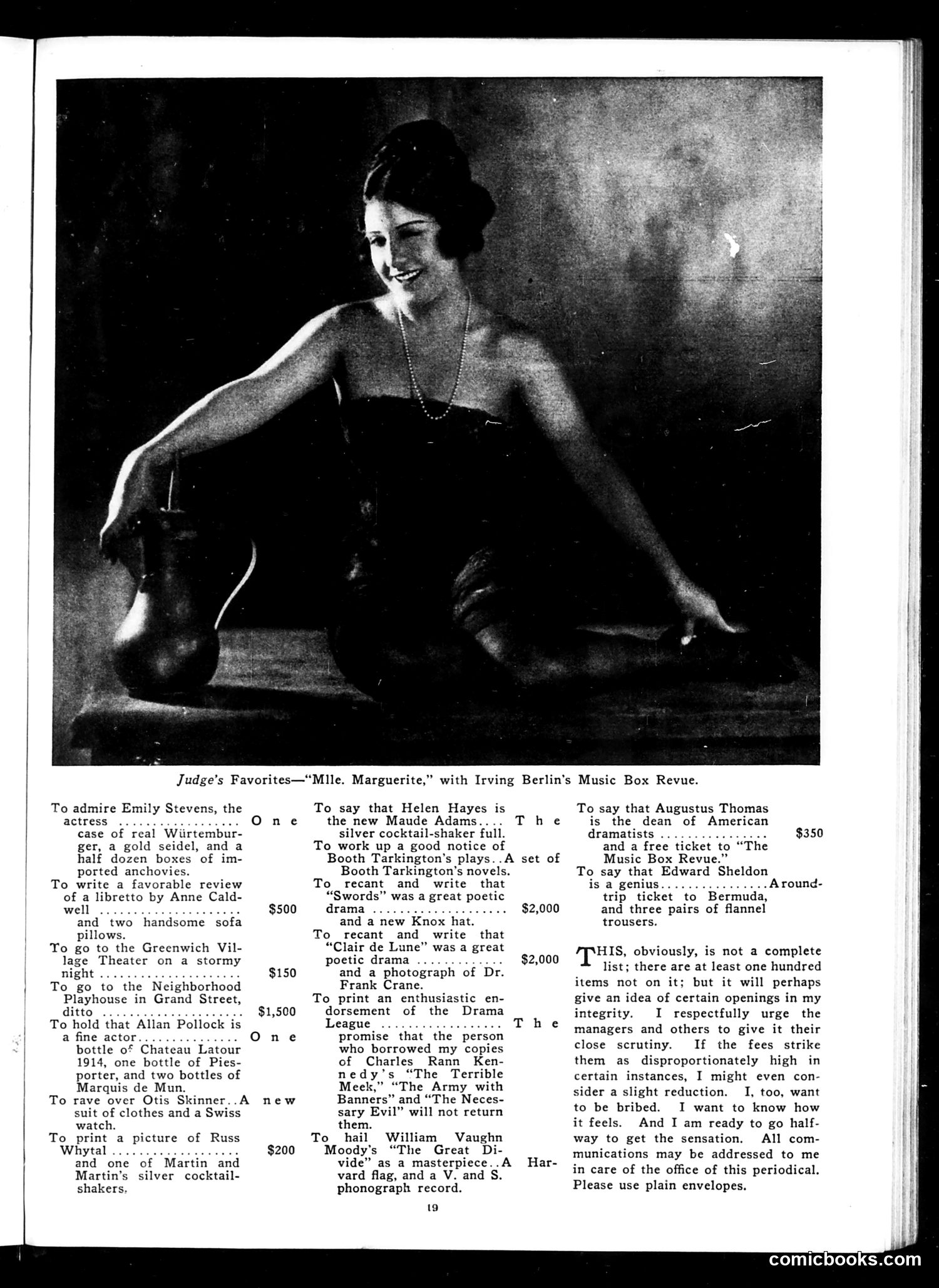
This is primarily a satirical price list rather than a cartoon. The piece humorously catalogs what bribes—ranging from food and theater tickets to clothing—the magazine's theater critic would accept in exchange for favorable reviews of various Broadway productions and personalities. The satire targets theaterworld pretension and critical integrity. It references specific figures (Emily Stevens, Helen Hayes, Booth Tarkington, Edward Sheldon) and works popular with 1920s audiences, offering increasingly absurd "payment" for endorsements—from champagne and anchovies to trips to Bermuda. The headshot accompanying the text shows a woman identified as "Mlle. Marguerite" from "Irving Berlin's Music Box Revue," likely the production being promoted. The satire's point: theater critics are openly corruptible and the entire enterprise of dramatic criticism is a transaction. Modern readers would recognize this as commentary on paid promotion and compromised journalism.
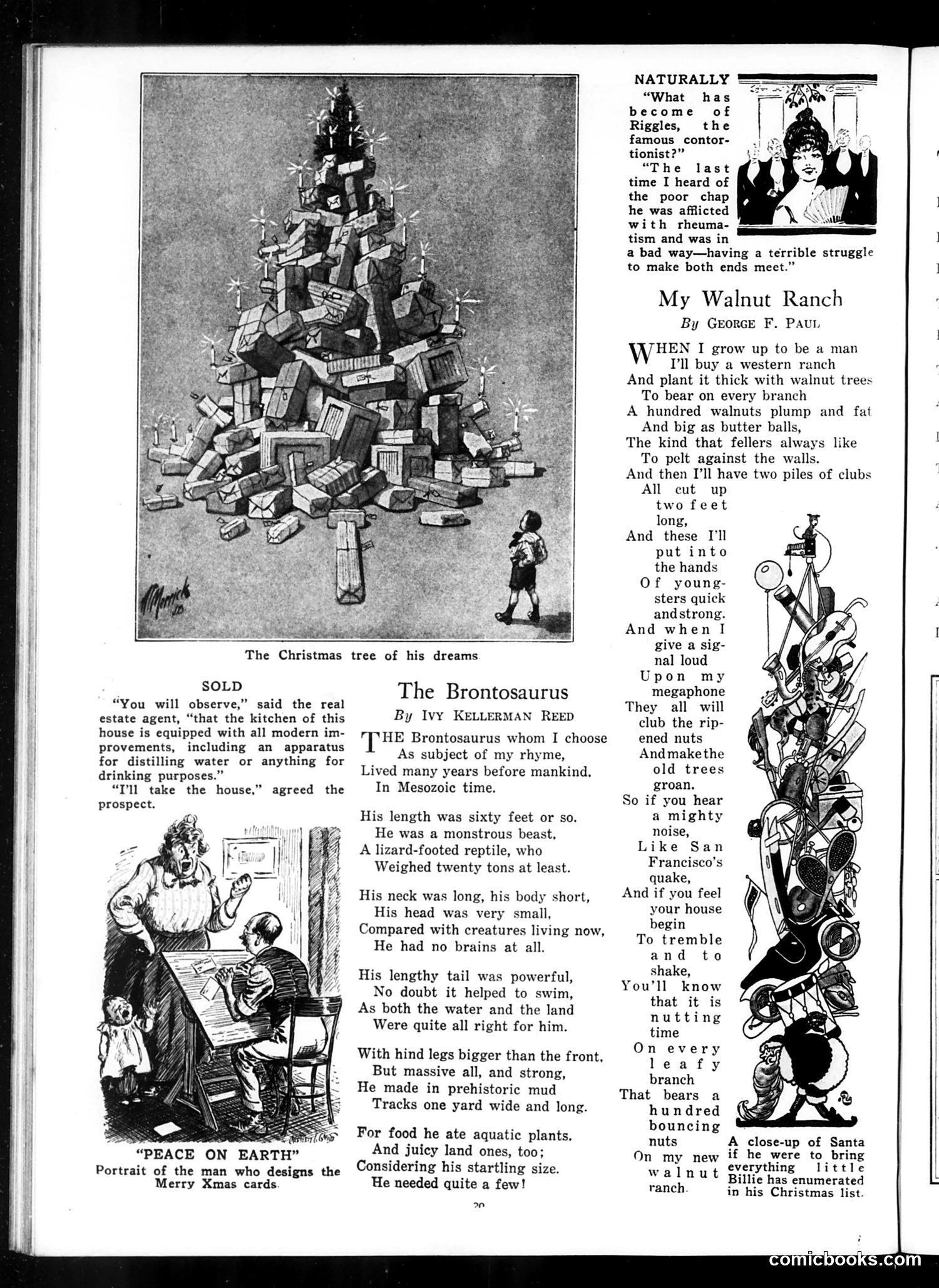
This page contains three satirical pieces typical of early 20th-century American humor: **"The Christmas Tree of His Dreams"** (top left): A real estate agent pitches a house by highlighting its "modern improvements," including water distillation apparatus. The joke mocks the era's obsession with newfangled technology and the agent's misleading sales pitch—the prospect excitedly agrees to buy based on pseudo-scientific gadgetry rather than actual value. **"Peace on Earth"** (bottom left): A portrait of "the man who designs the Merry Xmas cards"—showing a harried, overwhelmed figure amid chaos. This satirizes the contrast between sentimental Christmas card imagery and the actual stress of commercial holiday production. **"My Walnut Ranch" and "The Brontosaurus"** (right side): Light verse pieces. The walnut ranch is a child's fantastical vision of mechanical nut-harvesting; the accompanying illustration of Santa under a pile of toys mocks the contrast between modest wish-lists and excessive gift-giving. "The Brontosaurus" is educational verse about prehistory. The page blends social satire with whimsy and gentle mockery of modern life.
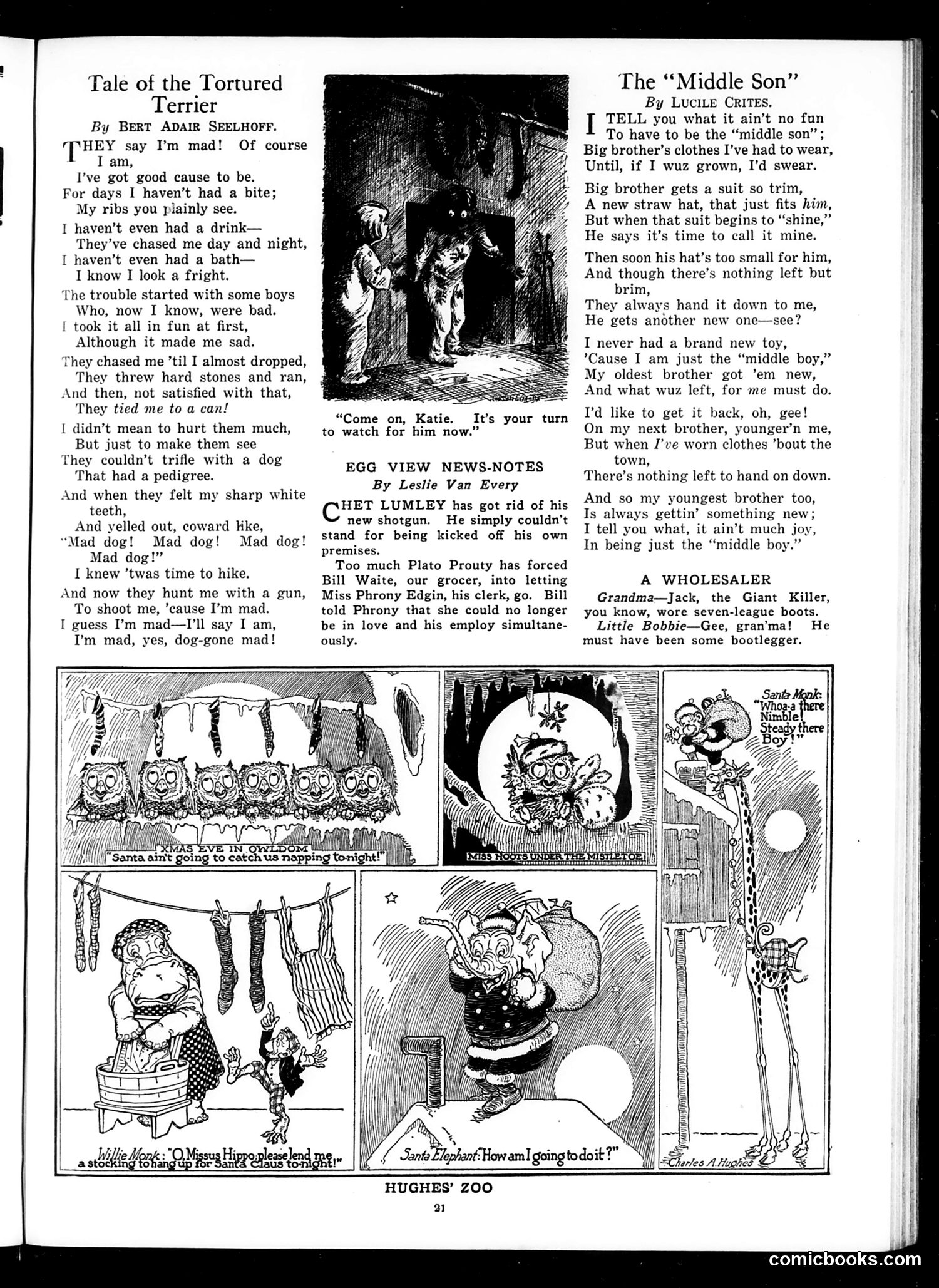
This page contains three separate humorous pieces from *Judge* magazine: **"Tale of the Tortured Terrier"** presents a dog's perspective after being chased by boys, bitten them in self-defense, and now being hunted as a "mad dog." The satire critiques how innocent victims become demonized—the dog is portrayed sympathetically while society judges it solely by its desperate actions. **"Egg View News-Notes"** offers brief rural gossip items, including a man discarding his shotgun after being kicked off his own property and an employer firing his female clerk for being in love. These mock small-town scandal-mongering while subtly critiquing social rigidity. **"The 'Middle Son'"** humorously depicts the plight of middle children inheriting only hand-me-downs while older siblings get new items and younger ones receive gifts. It's light family humor about birth-order inequality. **"Hughes' Zoo"** presents Christmas-themed animal comics, including a bootlegger joke playing on "seven-league boots"—a dated reference to the Prohibition era's illegal alcohol trade. The page emphasizes relatable domestic and rural humor rather than political satire.
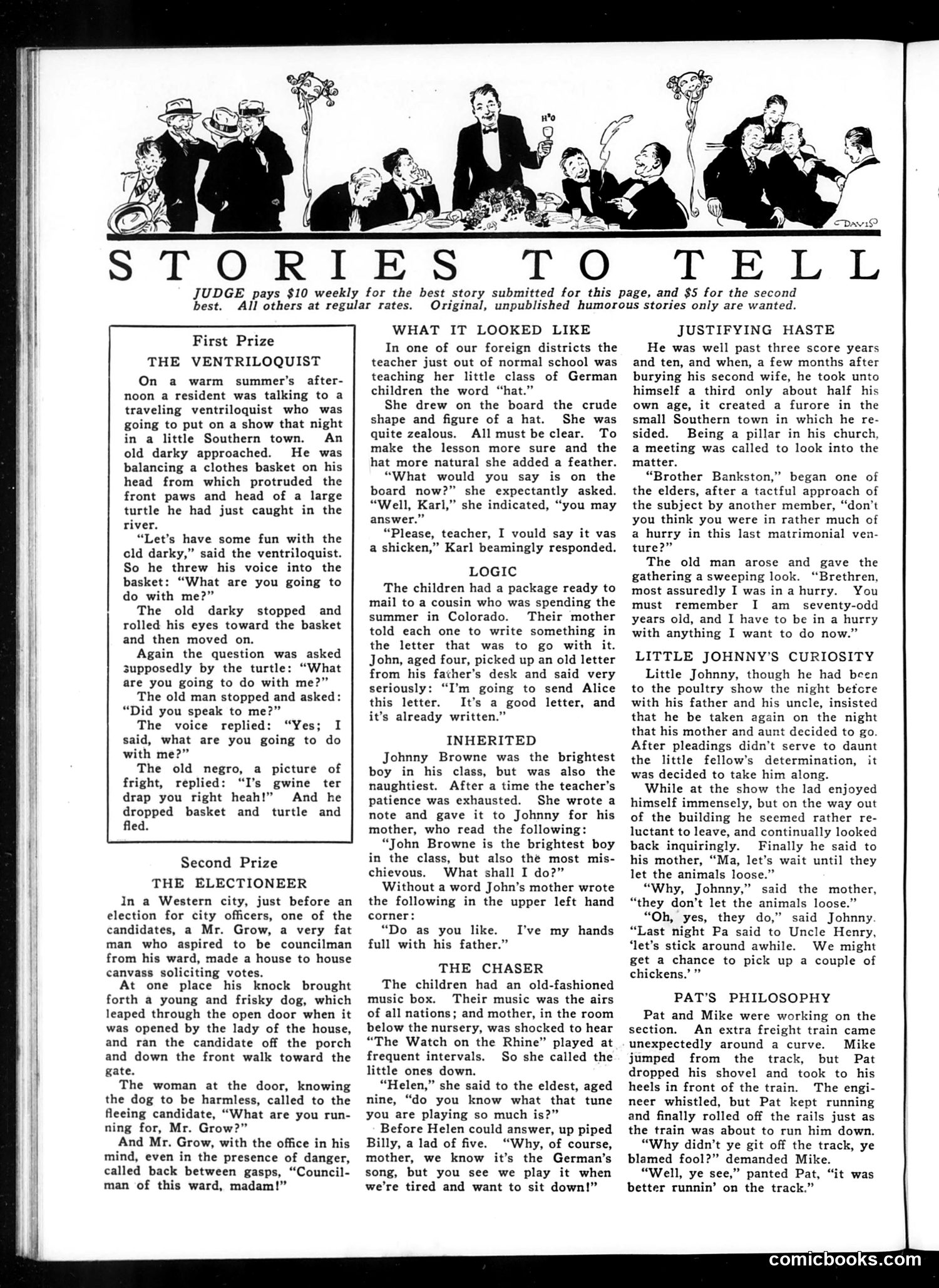
This page from *Judge* presents humorous short stories competing for cash prizes ($10 for first place). The content reflects early 20th-century American attitudes and humor. **"The Ventriloquist"** uses racial stereotypes common to the era: a ventriloquist tricks an elderly Black man by throwing his voice into a basket containing a turtle, frightening him into fleeing. The humor relies on depicting the man as credulous and superstitious. **"The Electioneer"** satirizes a political candidate's single-minded ambition: when chased by a harmless dog, he reflexively answers a woman's question "What are you running for?" with "Councilman of this ward"—treating political aspiration as automatic even during embarrassing flight. The remaining brief stories joke about immigrant children's English ("a shicken" for hat), childhood logic, and parental discipline. The page's header illustration shows well-dressed gentlemen at what appears to be a social gathering, establishing *Judge's* target audience: educated, affluent readers amused by scenarios mocking working-class immigrants, Black Americans, and political pretension.
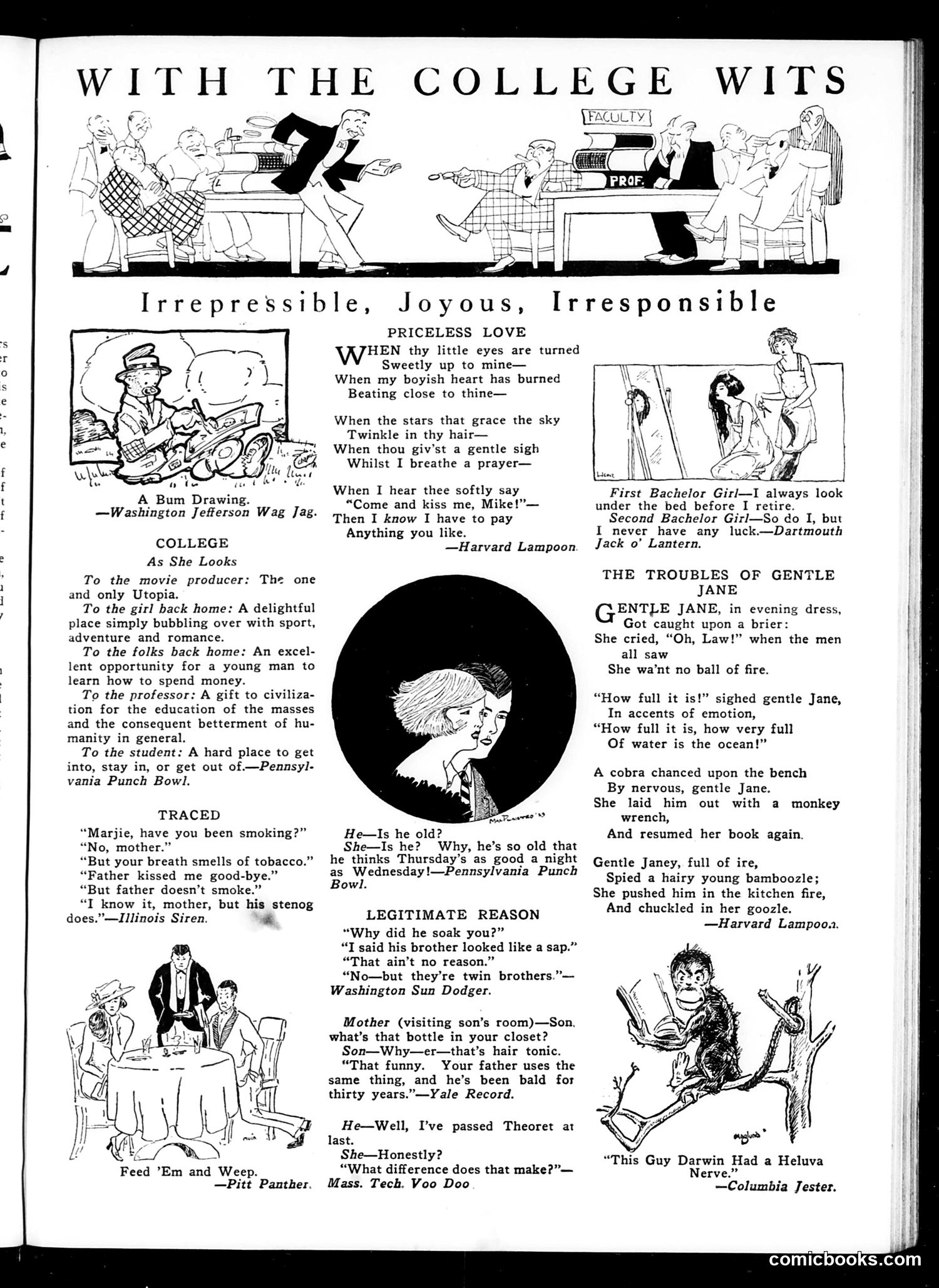
This page from *Judge* magazine collects humorous submissions from college newspapers, satirizing college life and romantic relationships circa the 1920s. **Main content:** A series of jokes and comic verses from various university publications (Harvard Lampoon, Yale Record, Pennsylvania Punch Bowl, etc.), organized around college themes and romantic mishaps. **Key satirical points:** - **"College As She Looks"** mocks the gap between how different groups view universities—students see it as difficult; parents see education; professors see enlightenment; administrators see profit. - **Romance jokes** target young men's financial vulnerability in courtship ("Anything you like") and the absurdity of youthful romance. - **"Gentle Jane"** ridicules overly delicate femininity through exaggerated scenarios where this "gentle" woman suddenly becomes violent (beating a cobra, pushing a man into fire). The humor assumes a college-educated, middle-class audience familiar with these institutions' pretensions and the era's gender dynamics.
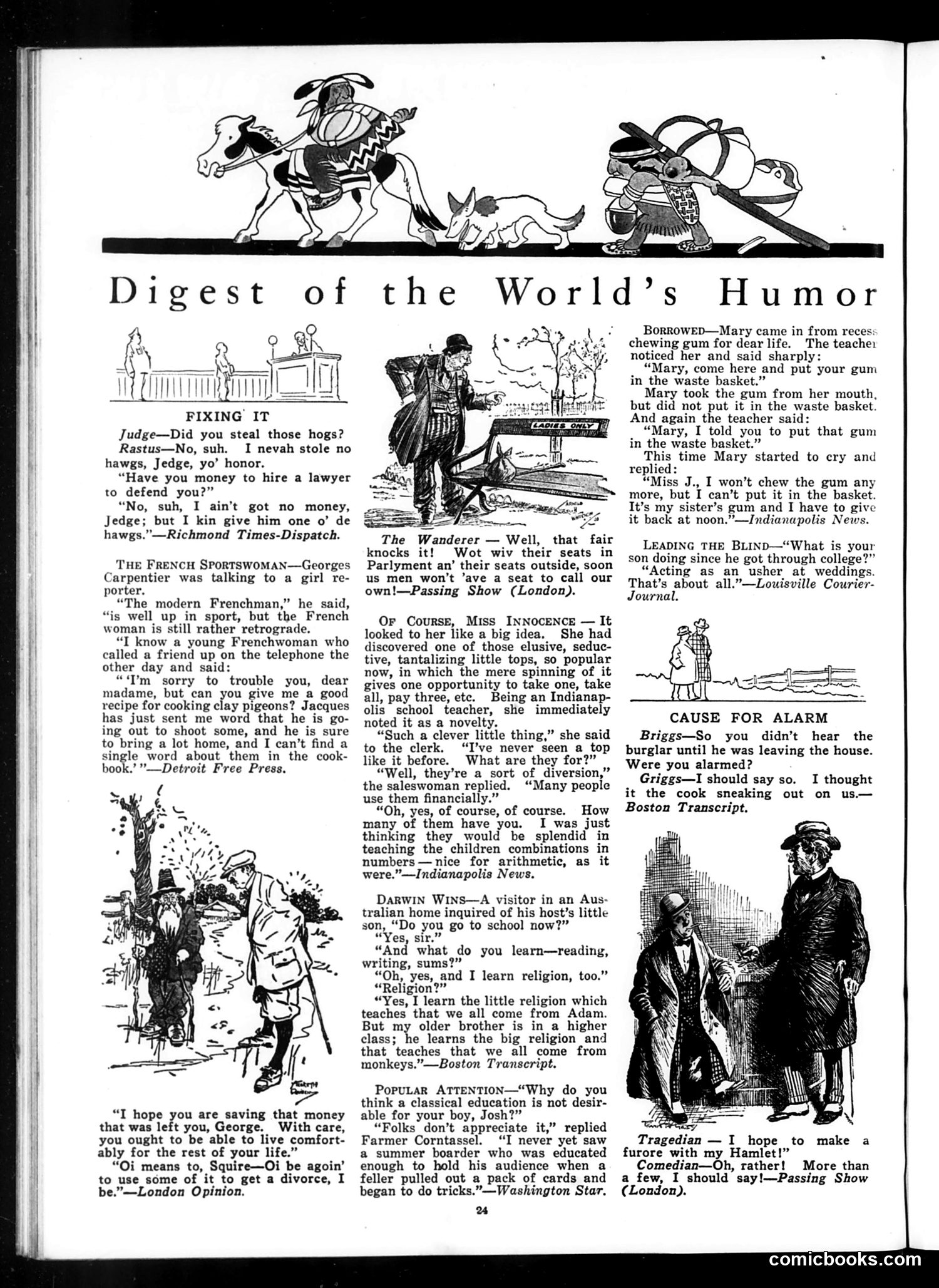
This is a humor compilation page from *Judge* magazine featuring short jokes and anecdotes from various sources. Key content includes: **Racial Stereotype Humor**: The opening "Fixing It" joke uses a racist dialect and portrays a Black defendant ("Rastus") offering a stolen hog as legal payment—reflecting era-standard offensive caricature in American publications. **Gender Satire**: "The French Sportswoman" mocks women as out-of-touch with modern sport, portraying a Frenchwoman unfamiliar with shooting terminology. **Class Commentary**: Several jokes target working-class immigrants ("Oi") and rural figures (Farmer Corntassel), while others mock education's practical limitations. **Evolutionary Humor**: "Darwin Wins" jokes about Australian children learning evolution ("big religion") versus creationism—reflecting early 20th-century anxieties about Darwinism. **Domestic/School Humor**: Lighter anecdotes about children and teachers explore social conventions. The page reflects *Judge's* editorial stance: satirizing social pretension while reinforcing period stereotypes about race, gender, class, and education. The humor relies heavily on dialect and caricature now considered offensive.
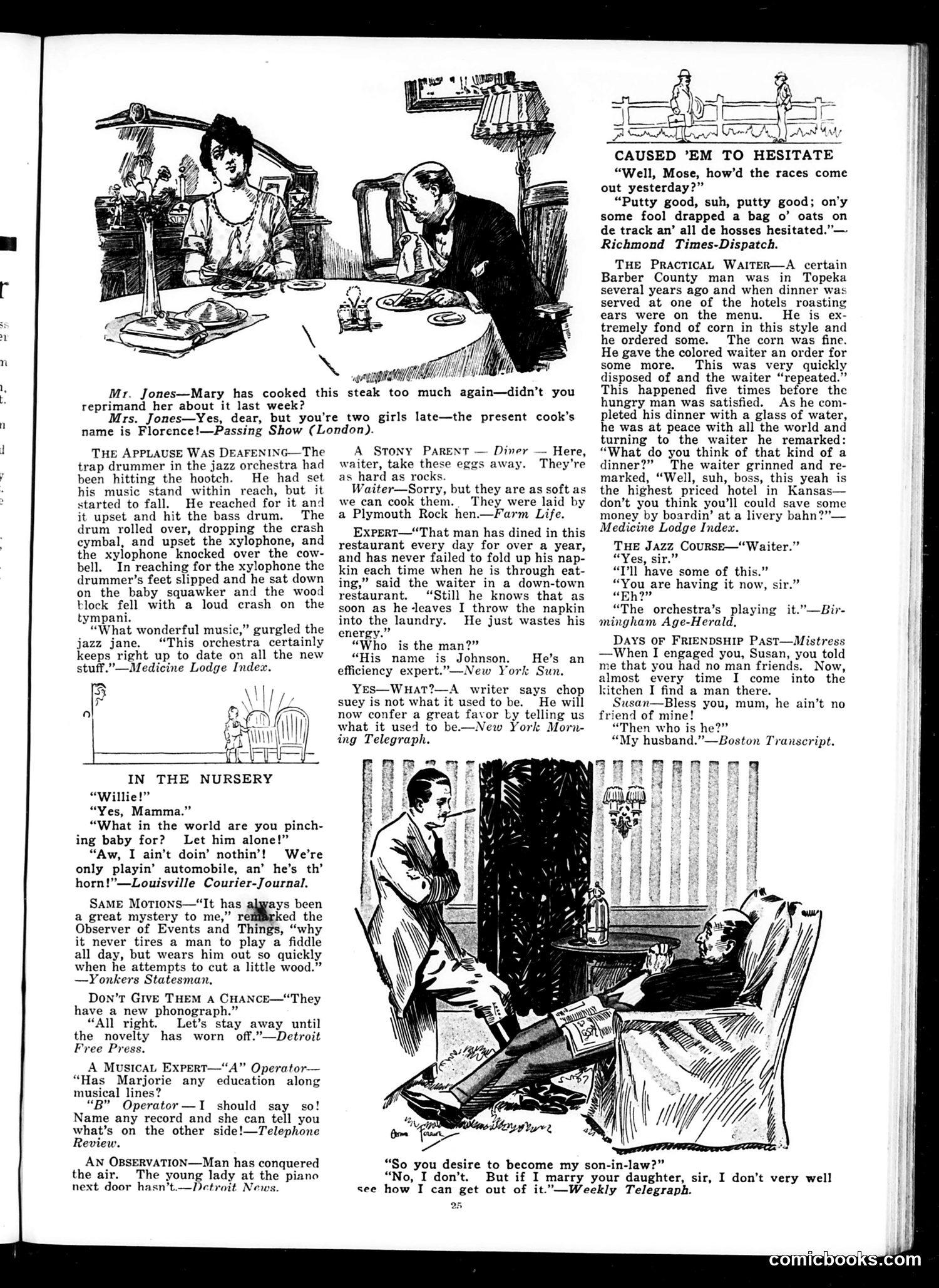
This page collects brief humorous anecdotes typical of early 20th-century American humor magazines. The jokes reflect period concerns and stereotypes: **Key content includes:** - Domestic humor about servants and cooking (multiple "cook named Florence" jokes about frequent staff turnover) - Jazz-age satire mocking the "jazz jane" and modern dance music's chaotic appeal - Class commentary via waiter observations and efficiency experts - Racist dialect humor featuring "Mose" and a "colored waiter" using exaggerated African American vernacular - Gender stereotypes about women at pianos and their education - Child discipline and automotive novelty references **The satire targets:** - Modernity's disruptions (phonographs, automobiles, jazz) - Urban hotel culture and service industry dynamics - Emerging "efficiency expert" management trends The humor relies heavily on ethnic/racial caricature and dialect comedy standard for the era but offensive today. The page reflects Judge's audience: educated, urban, middle-to-upper class Americans amused by observations of social change and working-class life.
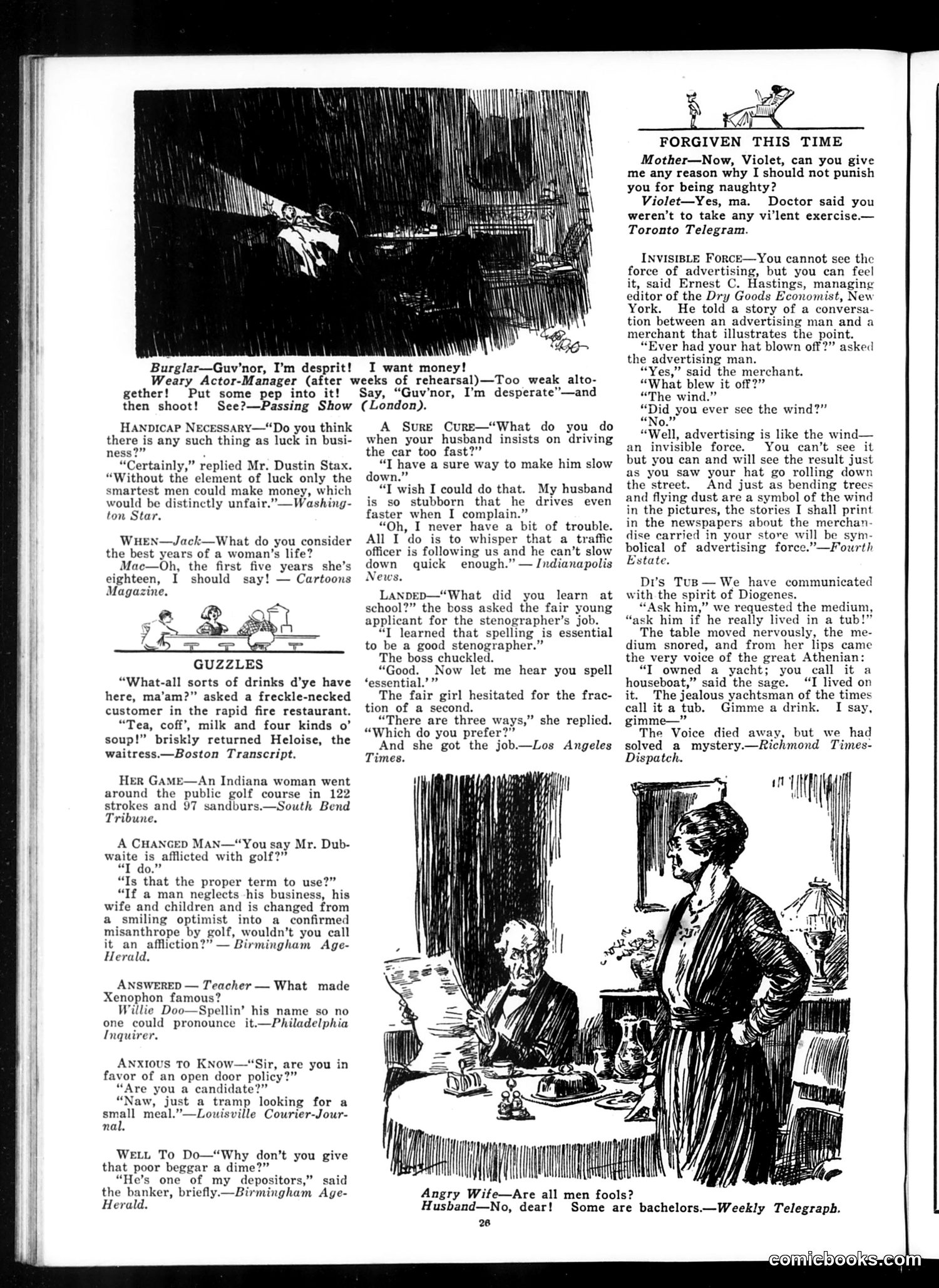
This page from *Judge* magazine contains various humorous anecdotes and two cartoons mocking social conventions of the era. The top cartoon depicts a burglar demanding money from a weary theater actor-manager, who criticizes the burglar's performance as lacking energy—a joke about theatrical rehearsals bleeding into real life. The bottom cartoon shows an angry wife confronting her husband about whether "all men [are] fools," with the husband's reply: "No, dear! Some are bachelors." This satirizes marriage stereotypes, implying bachelors avoid foolishness by avoiding matrimony. The surrounding text contains brief jokes on contemporary topics: golf as an addictive vice, stenographer job interviews, banking, and an advertisement-as-invisible-force metaphor. One anecdote ("Forgiven This Time") shows a child avoiding punishment because her doctor restricted the mother's exercise—gentle satire of parental excuses. The humor targets middle-class anxieties, gender relations, and consumer culture typical of early 20th-century American satire.
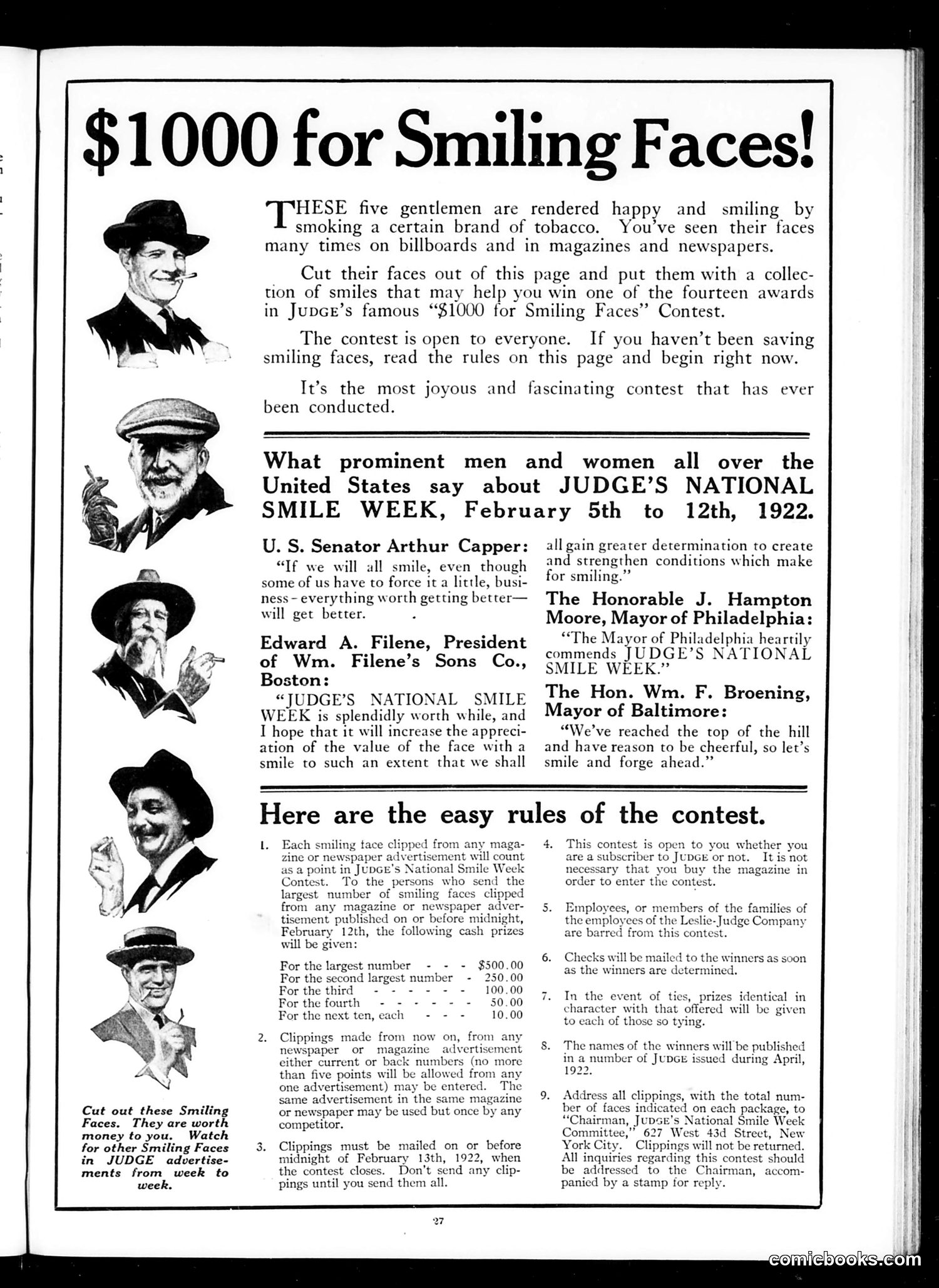
This page promotes Judge magazine's promotional contest tied to "National Smile Week" (February 5-12, 1922). Readers could cut smiling faces from tobacco advertisements, collect them, and submit the collection for cash prizes up to $500. The five illustrated men are unidentified tobacco-advertisement personalities—not specific historical figures, but rather generic "smiling faces" used in advertising. Their purpose was simply to be collectible. The satire appears gentle: prominent officials (a U.S. Senator, three mayors) endorse smiling as beneficial to business and morale during the post-WWI era. The implicit joke is that Judge is monetizing optimism itself—turning the act of smiling into a commodity game while wrapping it in civic virtue. It's advertising-as-satire: lampooning both commercial manipulation and Americans' susceptibility to feel-good campaigns, even as Judge profits from the contest.
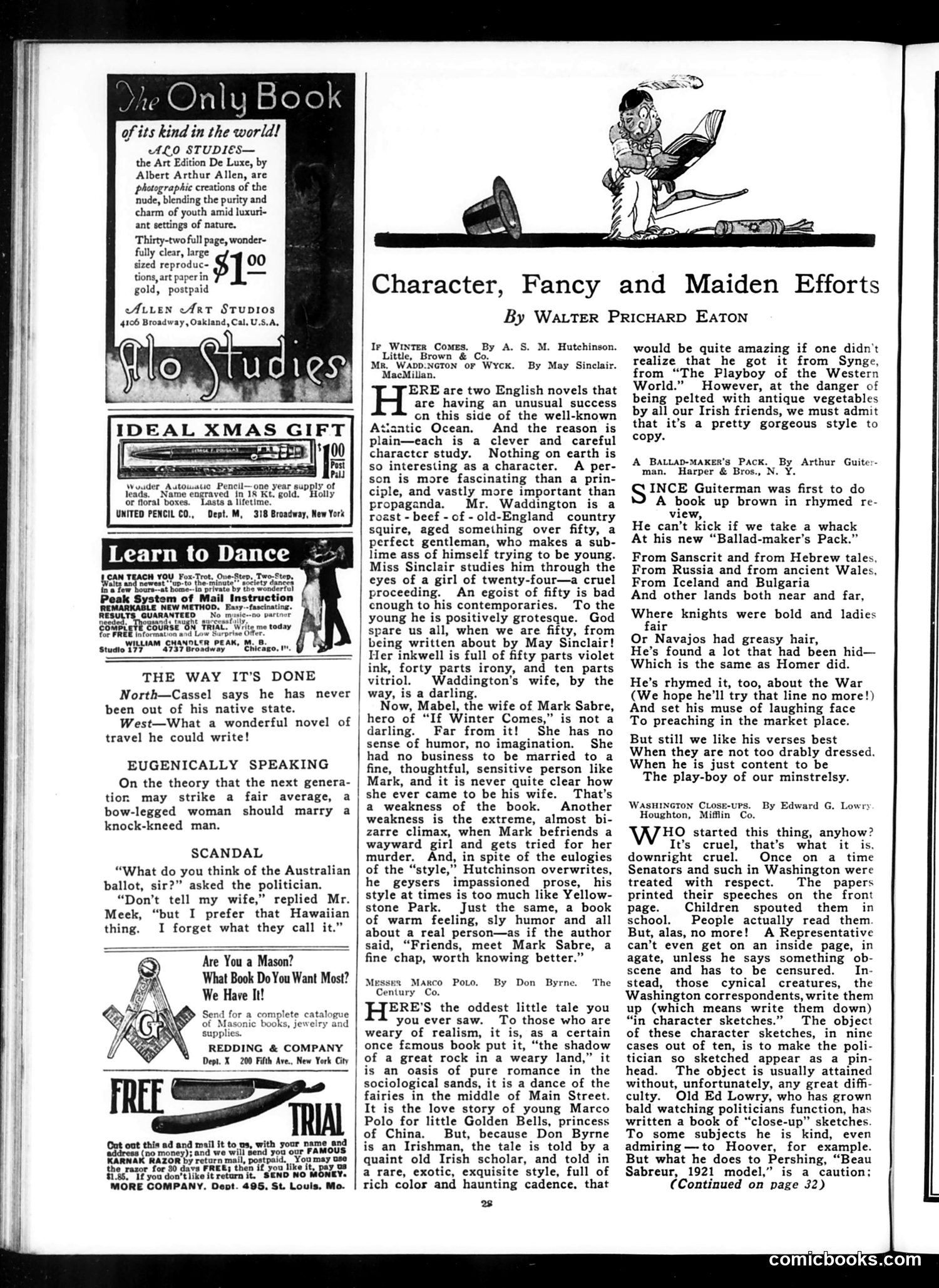
This page is primarily **book reviews and advertisements** from Judge magazine, with minimal satirical content. The main article reviews three novels: *If Winter Comes*, *Mr. Waddington of Wyck*, and *Marco Polo*. Reviewer Walter Prichard Eaton praises character-driven fiction, noting that people fascinate readers more than principles or propaganda. He critiques the novels' technical aspects—praising their psychological depth but faulting overwrought prose and implausible plot elements. The small humorous items (labeled "The Way It's Done," "Eugenically Speaking," "Scandal") are brief jokes, not cartoons: they mock provincial attitudes, pseudo-scientific breeding theories, and political hypocrisy. The page is dominated by advertisements for art books, pencils, dancing lessons, and Masonic materials—typical Judge content. **There are no political cartoons visible** on this page; it's primarily a literary review with surrounding ads.
This is not a cartoon but rather an **advertisement/promotional piece** for H.W. Slauson's automotive expertise and his book "Everyman's Guide to Motor Efficiency," published in *Leslie's Weekly*. The page addresses car owners directly with two practical questions about economical operation and maintenance—then positions Slauson as the authoritative expert to answer them. Slauson is identified as a mechanical engineer, chairman of the Metropolitan Section of the Society of Automotive Engineers, and automotive columnist for *Leslie's Weekly*. The pitch emphasizes that car manufacturers bear no responsibility after sale—maintenance becomes the owner's responsibility. The advertisement promotes both Slauson's book ($3.00) and a subscription bundle to *Leslie's Weekly* plus the book ($7.00), positioning the publication as an essential resource for the growing automobile-owning public. This reflects early 1900s car culture when automobiles were still relatively new, complex machines requiring owner knowledge to maintain properly.
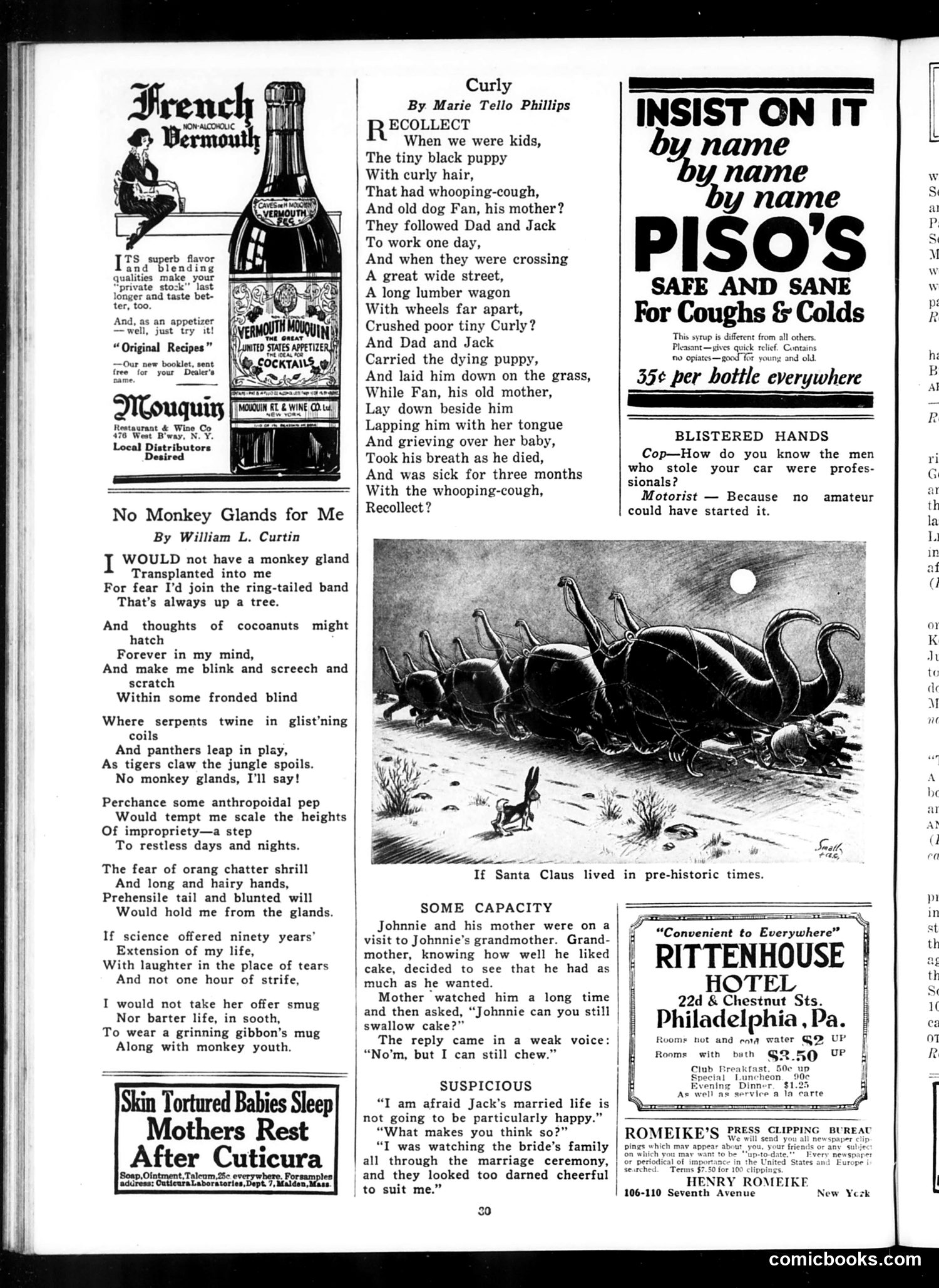
This page contains **primarily poetry and humor pieces** rather than political cartoons. The main satirical content includes: **"No Monkey Glands for Me"** by William L. Curtin references the 1920s craze for "rejuvenation" through monkey gland transplants—a pseudoscientific fad where doctors claimed gland grafts could restore youth and vigor. The poem humorously rejects this by cataloging absurd fears of becoming ape-like. **"Curly"** is a sentimental poem about a childhood pet dog killed by a wagon, notable mainly for being bathetic rather than satirical. The remaining content is **humorous anecdotes** ("Some Capacity," "Blistered Hands," "Suspicious") with mild wordplay and domestic humor typical of period magazines. **This is not primarily a political or social satire page**—it's mostly light entertainment and advertising. The monkey gland poem is the only piece with contemporary cultural commentary, mocking a real but discredited medical trend of the era.
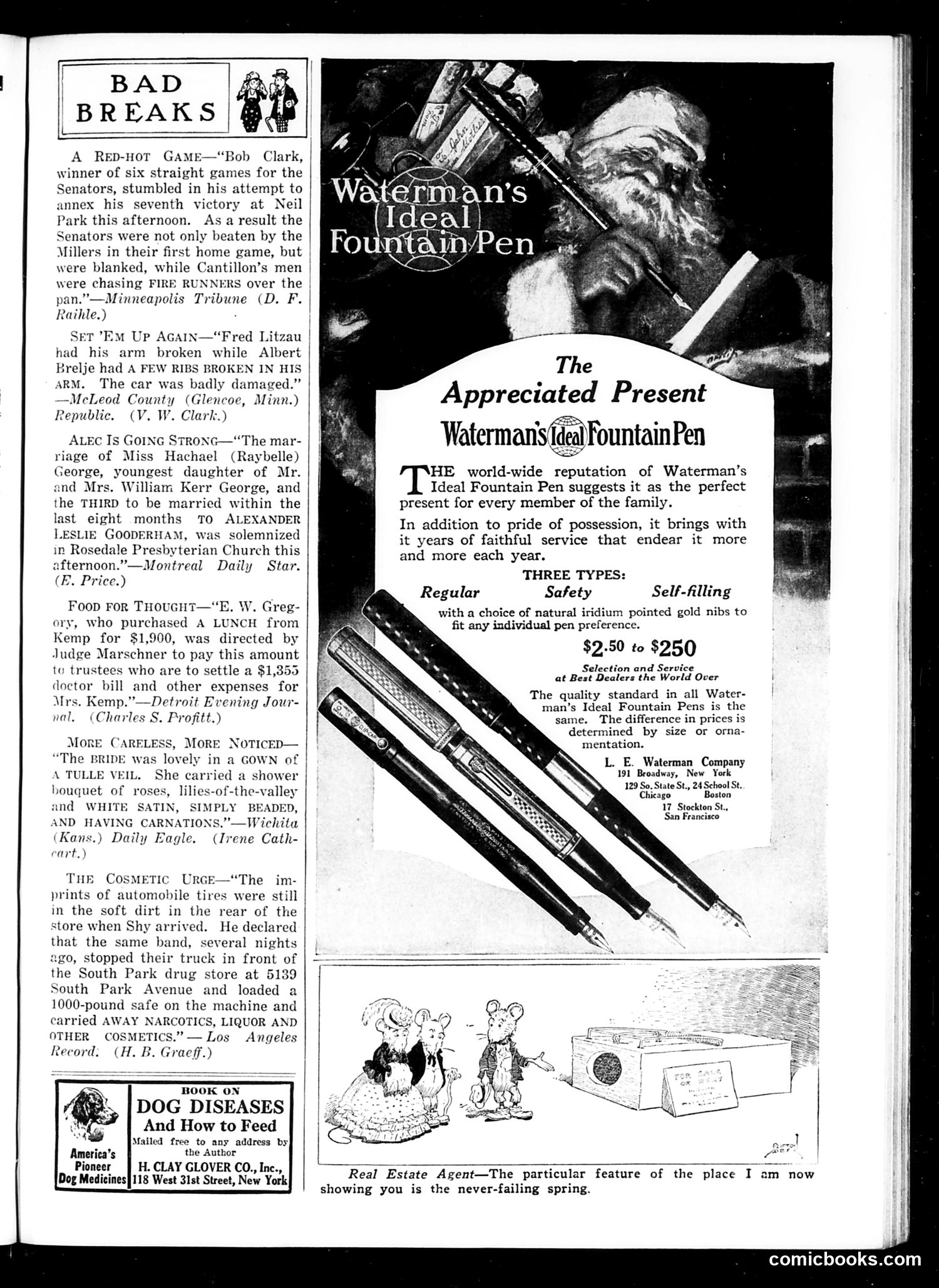
This page features Judge's "Bad Breaks" column, a humor section highlighting absurd or ironic news clippings from American newspapers. The satire works through deadpan presentation of unfortunate coincidences and odd situations: - A baseball player (Bob Clark) loses his seventh consecutive game attempt - People suffer injuries in unrelated car accidents - A man pays $1,900 for a lunch to settle medical debts - A bride's elaborate wedding dress is described in excessive detail - Police discover thieves disguised stolen goods as "cosmetics" The column's appeal lies in finding humor in real misfortunes and awkward situations by presenting them without commentary—the absurdity speaks for itself. The "real estate agent" cartoon at bottom uses similar dry humor: the agent proudly highlights a "never-failing spring," seemingly oblivious to how this feature advertises poor drainage rather than property appeal. The page also contains period advertisements, including a Waterman's Fountain Pen ad—typical of early-20th-century magazine content.
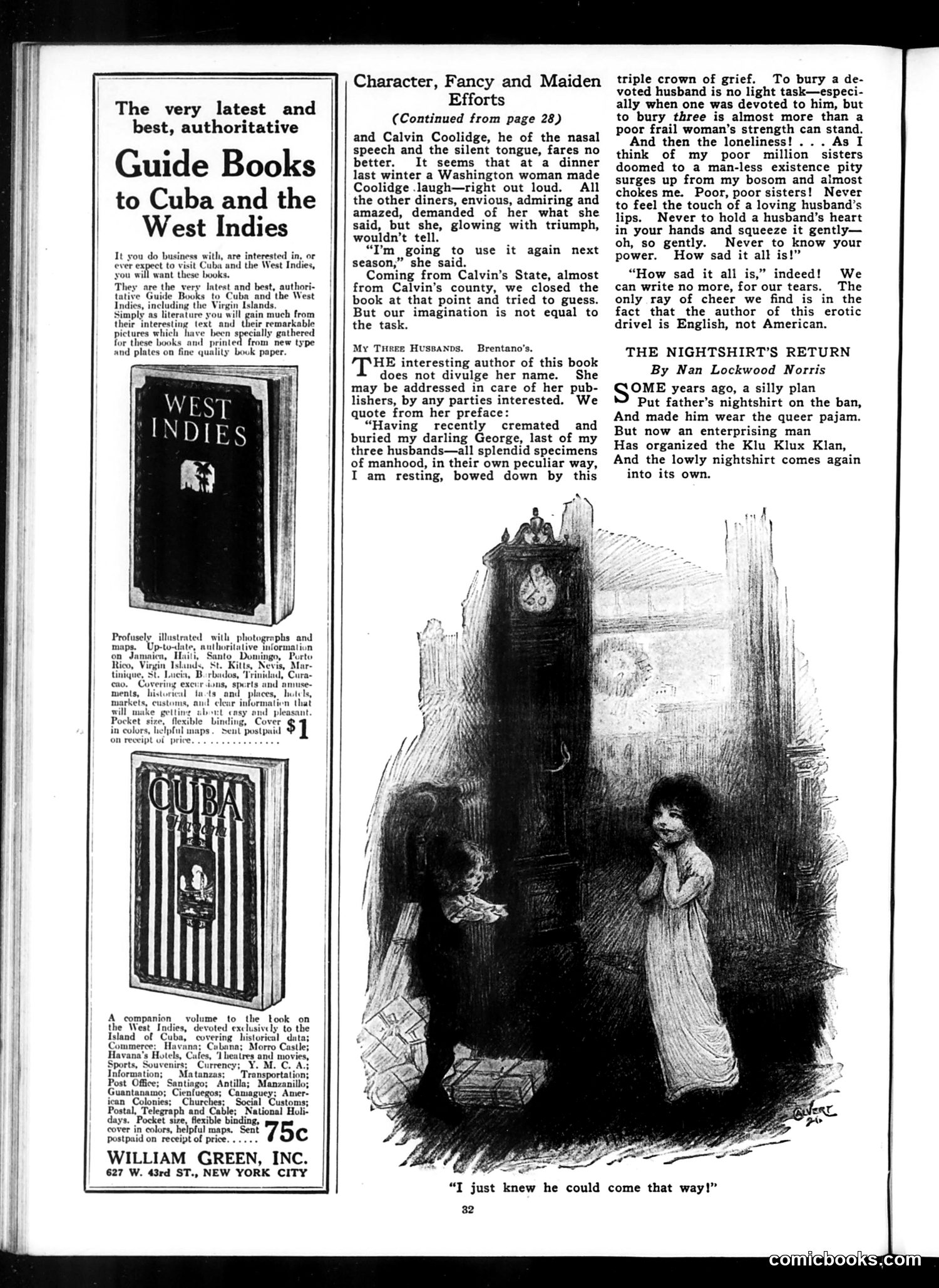
This page combines book advertisements with satirical literary reviews and a poem, all reflecting 1920s American attitudes. **The Coolidge Anecdote**: The author ridicules President Calvin Coolidge's famous taciturn nature, treating his rare public laugh as newsworthy—a common satirical jab at his famously quiet demeanor. **"My Three Husbands"**: The review mocks a book by an unnamed female author describing her grief over burying three husbands. The satire targets the book's maudlin sentimentality and what the reviewer considers overwrought, self-pitying prose about widowhood, ending with a dig that such "erotic drivel" is English rather than American. **"The Nightshirt's Return"**: This poem references the KKK directly. It satirizes how the Klan has revived old-fashioned nightshirts as their robes—transforming mundane sleepwear into sinister regalia. The illustration depicts a figure in a nightshirt-like garment, likely mocking the absurdity of the Klan's appearance. The humor assumes readers recognize Coolidge and understand contemporary women's grievance literature, while the KKK reference indicates Judge's satirical hostility toward the organization.
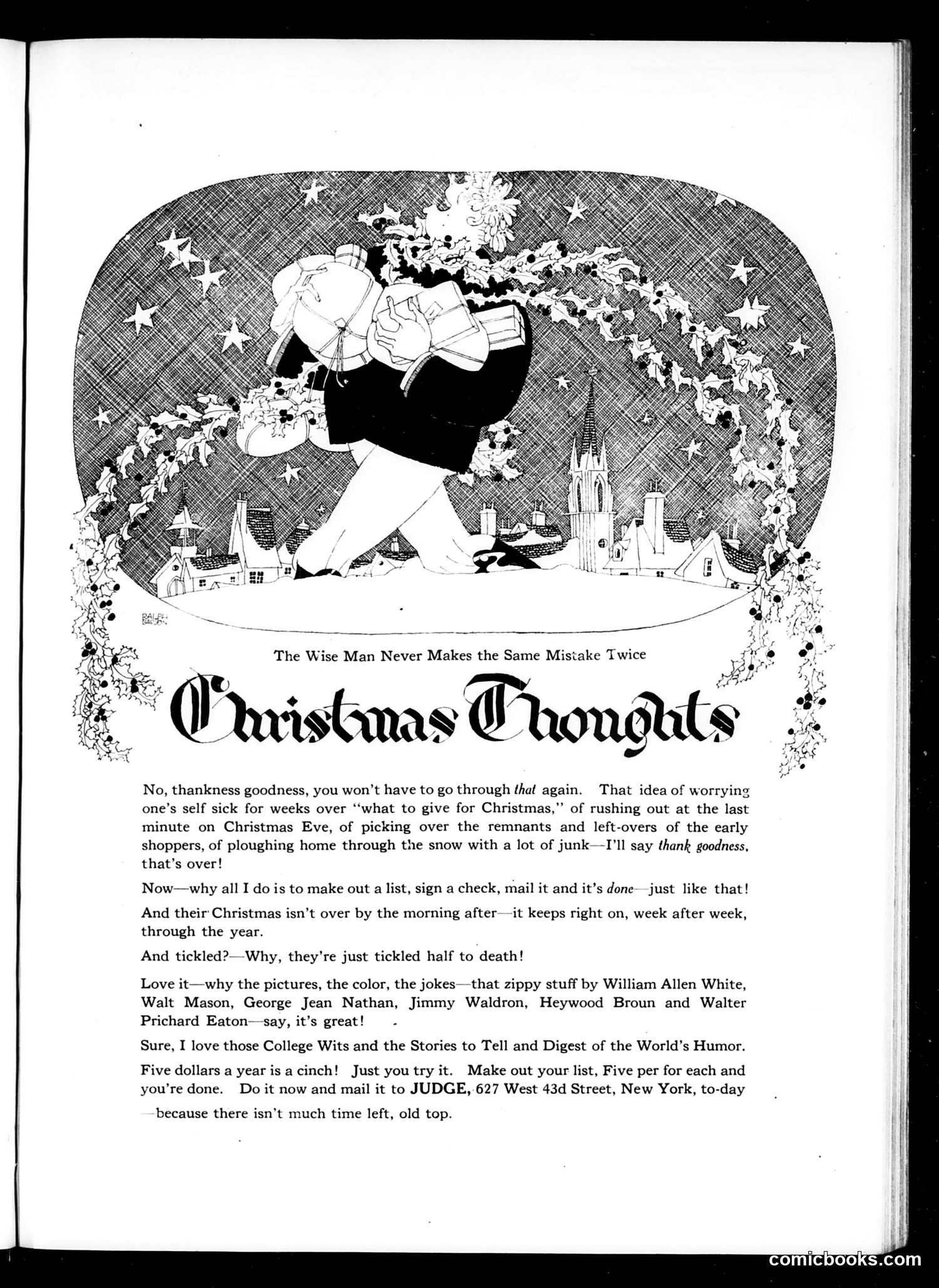
This is an **advertisement for Judge magazine** disguised as editorial content. The illustration shows a kneeling figure in formal dress presenting wrapped gifts beneath a starry, festive sky—depicting the ease of gift-giving through subscription. The text promotes Judge subscriptions as a solution to Christmas shopping stress. Rather than last-minute scrambling for physical gifts, the ad suggests simply mailing a check to gift Judge subscriptions ($5/year) to multiple people. The copy emphasizes the year-round pleasure recipients will enjoy from the magazine's humor and featured writers (William Allen White, Heywood Broun, et al.). The satire is implicit: the "wise man" who learns from experience avoids Christmas shopping altogether by giving subscriptions instead—practical, effortless, and appreciated. This reflects both early 20th-century consumer culture and Judge's self-promotional strategy, positioning the magazine as the thoughtful, convenient gift choice.
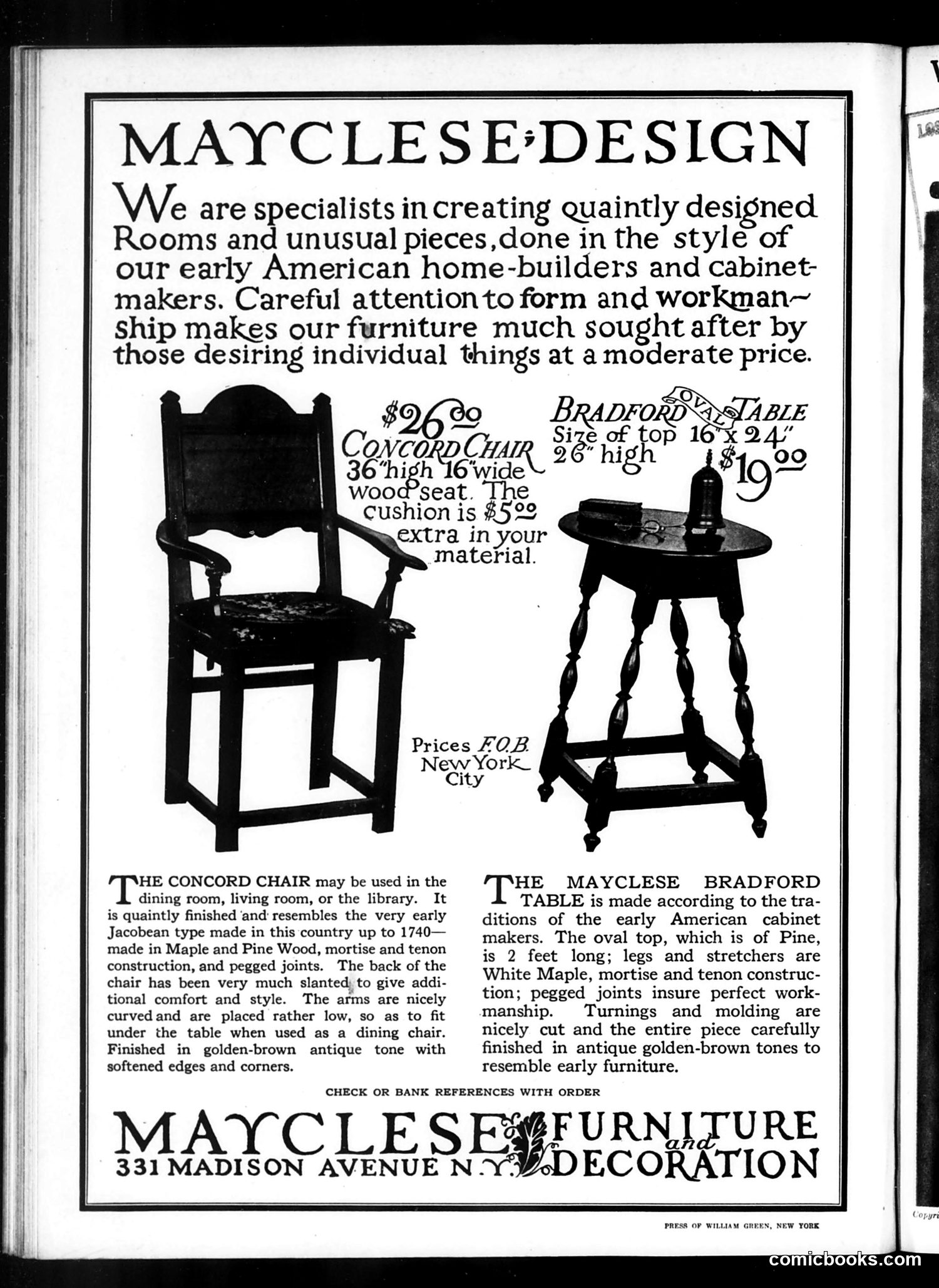
This is not a cartoon or satirical content—it is a straightforward advertisement for Mayclese Furniture & Decoration on Madison Avenue, New York City. The page showcases reproduction Colonial and early American furniture: a Concord Chair ($26.80) styled after pre-1740 Jacobean designs, and a Bradford Table ($19.00). The marketing emphasizes hand-crafted authenticity using traditional joinery techniques (mortise and tenon, pegged joints) and period finishes. The appeal reflects early 20th-century consumer taste for Colonial Revival furniture—a widespread aesthetic movement celebrating American heritage and craftsmanship as markers of quality and cultural value. The advertisement positions such pieces as individually distinguished yet moderately priced, appealing to middle-class customers seeking to signal taste and refinement through historically styled home furnishings.