
Judge, 1921-12-17 · page 6 of 36
Judge — December 17, 1921 — page 6: what you’re looking at
What you’re looking at
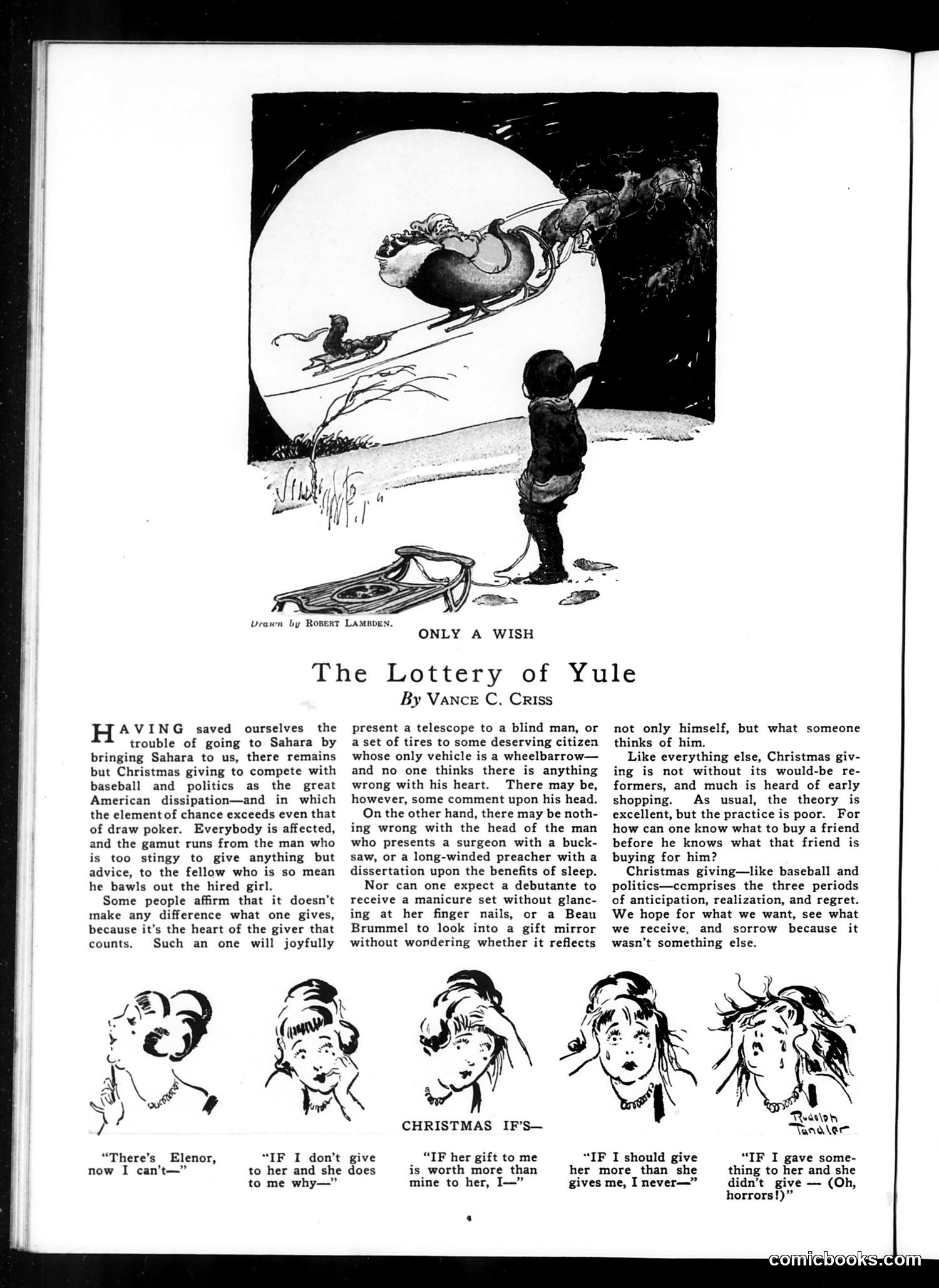
**Main Article:** Vance C. Criss's essay critiques Christmas gift-giving expectations. He argues that the *spirit* of giving matters more than the *object* given, and that people obsess over material gifts while missing the true meaning of Christmas. The essay warns against the anxiety and regret surrounding gift-exchange. **Illustration by Robert Lambden ("Only a Wish"):** Shows a child gazing at Santa's sleigh against the moon—a straightforward romantic image of Christmas wonder. **Bottom Comics ("Christmas If's"):** Five female faces express anxiety about gift-giving reciprocity—worrying whether gifts received are "worth more" than those given, or fearing they'll receive nothing in return. These satirize the transactional, competitive nature of holiday gift-exchange among adults. The page collectively mocks how Christmas gift-giving had become an anxious social obligation rather than an expression of genuine goodwill.
📄 Transcribed text from this page (OCR, searchable)
Machine-transcribed from the original scan — historical spelling and the odd misread are preserved.
Urawn by Rosert LAMBDEN. ONLY A WISH The Lottery of Yule By Vance C. Criss AVING saved ourselves the trouble of going to Sahara by bringing Sahara to us, there remains but Christmas giving to compete with baseball and politics as the great American dissipation—and in which the element of chance exceeds even that of draw poker. Everybody is affected, and the gamut runs from the man who is too stingy to give anything but advice, to the fellow who is so mean he bawls out the hired girl. Some people affirm that it doesn’t make any difference what one gives, because it’s the heart of the giver that counts. Such an one will joyfully > ps “There’s Elenor, now I can’t—” to me why—” “IF I don’t give to her and she does present a telescope to a blind man, or a set of tires to some deserving citizen whose only vehicle is a wheelbarrow— and no one thinks there is anything wrong with his heart. There may be, however, some comment upon his head. On the other hand, there may be noth- ing wrong with the head of the man who presents a surgeon with a buck- saw, or a long-winded preacher with a dissertation upon the benefits of sleep. Nor can one expect a debutante to receive a manicure set without glanc- ing at her finger nails, or a Beau Brummel to look into a gift mirror without wondering whether it reflects CHRISTMAS IF’S— “IF her gift to me is worth more than mine to her, I—” “IF I should give her more than she gives me, I never—” not only himself, but what someone thinks of him. Like everything else, Christmas giv- ing is not without its would-be re- formers, and much is heard of early shopping. As usual, the theory is excellent, but the practice is poor. For how can one know what to buy a friend before he knows what that friend is buying for him? Christmas giving—like baseball and politics—ccmprises the three periods of anticipation, realization, and regret. We hope for what we want, see what we receive, and sorrow because it wasn’t something else. Tenaler “IF I gave some- thing to her and she didn’t give — (Oh, horrors!)”