
Judge, 1921-12-17 · page 17 of 36
Judge — December 17, 1921 — page 17: what you’re looking at
What you’re looking at
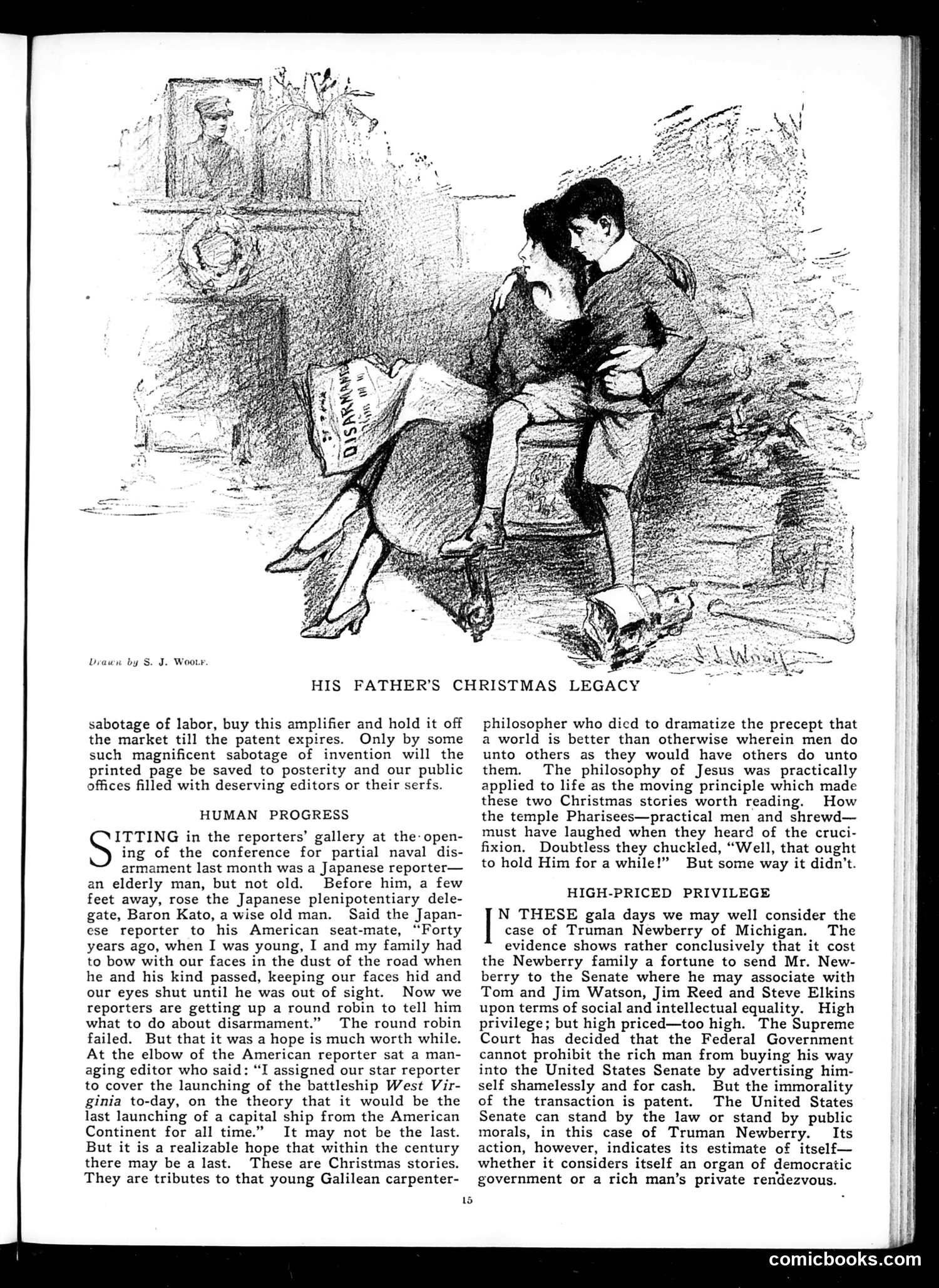
This page contains editorial commentary rather than traditional cartoons. The illustration depicts a couple reading together, titled "His Father's Christmas Legacy." The content critiques three topics: 1. **Patent Sabotage**: Attacks industrial interests blocking invention patents to maintain market control. 2. **Human Progress**: Celebrates a Japanese reporter's transformation from servitude to authority—a hopeful story about social advancement. It also mentions the USS West Virginia launch, expressing hope that battleship construction may eventually cease through disarmament efforts. 3. **Truman Newberry Case**: Directly criticizes a recent Supreme Court decision allowing wealthy candidates to buy Senate seats through advertising and campaign spending. The author condemns the Newberry family's fortune spent to elect him, arguing the Senate has chosen protecting rich men's privileges over democratic principles and public morals. The "Christmas Legacy" framing references Jesus's teachings about treating others fairly—juxtaposing spiritual ideals against material corruption in American institutions.
📄 Transcribed text from this page (OCR, searchable)
Machine-transcribed from the original scan — historical spelling and the odd misread are preserved.
Drawn by §. J. Woorr sabotage of labor, buy this amplifier and hold it off the market till the patent expires. Only by some such magnificent sabotage of invention will the printed page be saved to posterity and our public offices filled with deserving editors or their serfs. HUMAN PROGRESS ITTING in the reporters’ gallery at the: open- S ing of the conference for partial naval dis- armament last month was a Japanese reporter— an elderly man, but not old. Before him, a few feet away, rose the Japanese plenipotentiary dele- gate, Baron Kato, a wise old man. Said the Japan- ese reporter to his American seat-mate, ‘Forty years ago, when I was young, I and my family had to bow with our faces in the dust of the road when he and his kind passed, keeping our faces hid and our eyes shut until he was out of sight. Now we reporters are getting up a round robin to tell him what to do about disarmament.” The round robin failed. But that it was a hope is much worth while. At the elbow of the American reporter sat a man- aging editor who said: “I assigned our star reporter to cover the launching of the battleship West Vir- ginia to-day, on the theory that it would be the last launching of a capital ship from the American Continent for all time.” It may not be the last. But it is a realizable hope that within the century there may be a last. These are Christmas stories. They are tributes to that young Galilean carpenter- HIS FATHER’S CHRISTMAS LEGACY philosopher who diced to dramatize the precept that a world is better than otherwise wherein men do unto others as they would have others do unto them. The philosophy of Jesus was practically applied to life as the moving principle which made these two Christmas stories worth reading. How the temple Pharisees—practical men and shrewd— must have laughed when they heard of the cruci- fixion. Doubtless they chuckled, “Well, that ought to hold Him for a while!” But some way it didn’t. HIGH-PRICED PRIVILEGE N THESE gala days we may well consider the case of Truman Newberry of Michigan. The evidence shows rather conclusively that it cost the Newberry family a fortune to send Mr. New- berry to the Senate where he may associate with Tom and Jim Watson, Jim Reed and Steve Elkins upon terms of social and intellectual equality. High privilege; but high priced—too high. The Supreme Court has decided that the Federal Government cannot prohibit the rich man from buying his way into the United States Senate by advertising him- self shamelessly and for cash. But the immorality of the transaction is patent. The United States Senate can stand by the law or stand by public morals, in this case of Truman Newberry. Its action, however, indicates its estimate of itself— whether it considers itself an organ of democratic government or a rich man’s private rendezvous. comicbooks.com