
Judge, 1921-12-17 · page 12 of 36
Judge — December 17, 1921 — page 12: what you’re looking at
What you’re looking at
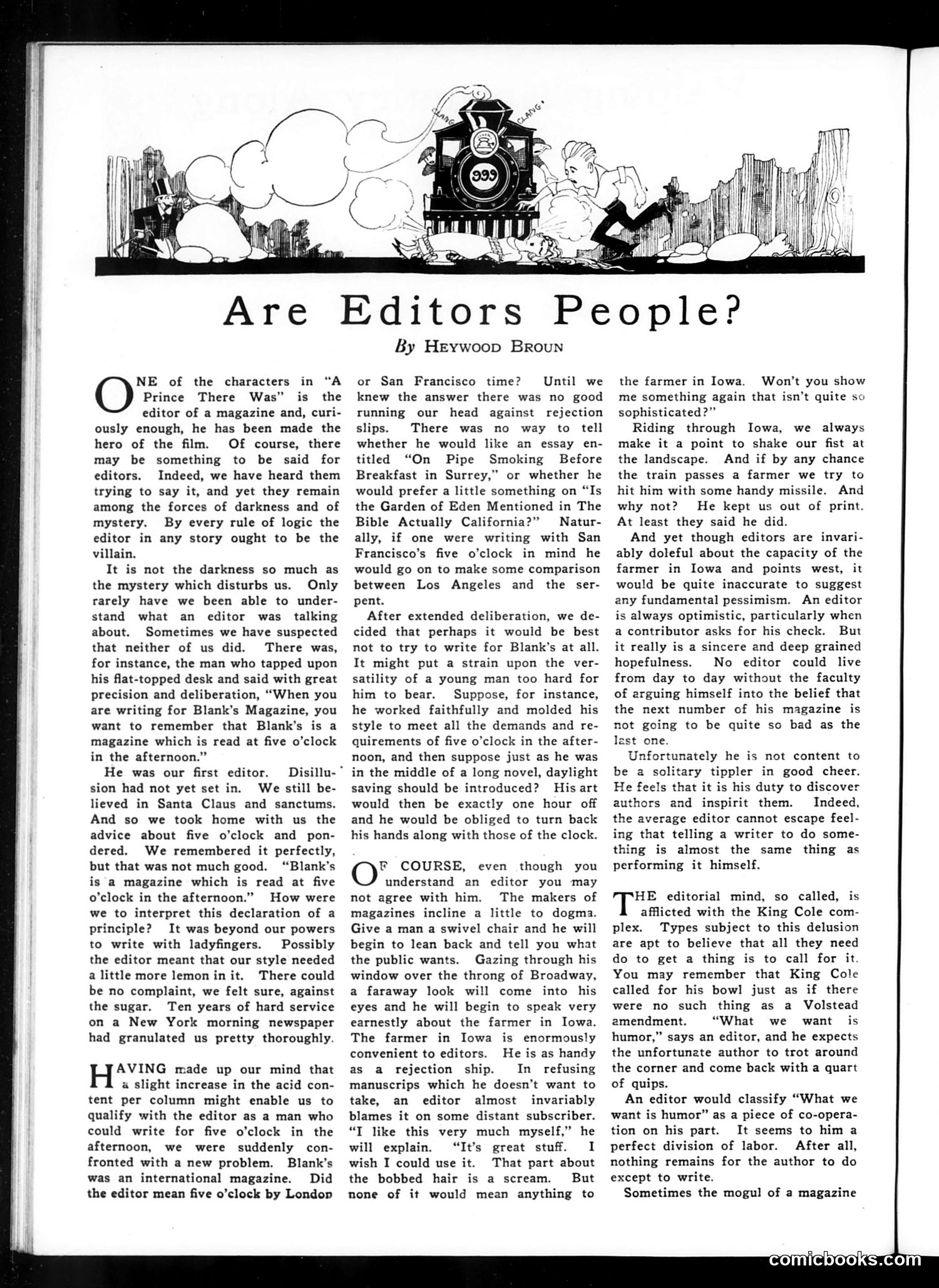
This satirical essay mocks magazine editors as mysterious, illogical figures who make incomprehensible demands on writers. The cartoon header depicts a locomotive labeled "1939" alongside figures in an editorial office—visualizing the collision between editors and creative work. Broun's humor targets editors' pretentious vagueness: one editor cryptically insists writers remember "Blank's Magazine is read at five o'clock in the afternoon"—advice so obscure it paralyzes the writer with uncertainty (does he mean London or San Francisco time?). The piece ridicules editors' invocation of the "farmer in Iowa" as an imaginary arbiter of public taste—a convenient, distant figure used to reject manuscripts without real justification. Broun suggests editors wield arbitrary power from their swivel chairs while claiming to speak for ordinary readers they don't actually understand. The title poses a rhetorical question: are editors even *people*—implying they're incomprehensible beings of pure institutional authority.
📄 Transcribed text from this page (OCR, searchable)
Machine-transcribed from the original scan — historical spelling and the odd misread are preserved.
Are Editors People? By Heywoop Broun NE of the characters in “A O Prince There Was” is the editor of a magazine and, curi- ously enough, he has been made the hero of the film. Of course, there may be something to be said for editors. Indeed, we have heard them trying to say it, and yet they remain among the forces of darkness and of mystery. By every rule of logic the editor in any story ought to be the villain. It is not the darkness so much as the mystery which disturbs us. Only rarely have we been able to under- stand what an editor was talking about. Sometimes we have suspected that neither of us did. There was, for instance, the man who tapped upon his flat-topped desk and said with great precision and deliberation, “When you are writing for Blank’s Magazine, you want to remember that Blank’s is a magazine which is read at five o’clock in the afternoon.” He was our first editor. sion had not yet set in. We still be- lieved in Santa Claus and sanctums. And so we took home with us the advice about five o'clock and pon- dered. We remembered it perfectly, but that was not much good. “Blank’s is a magazine which is read at five o’clock in the afternoon.” How were we to interpret this declaration of a principle? It was beyond our powers to write with ladyfingers. Possibly the editor meant that our style needed a little more lemon in it. There could be no complaint, we felt sure, against the sugar. Ten years of hard service on a New York morning newspaper had granulated us pretty thoroughly. AVING made up our mind that a slight increase in the acid con- tent per column might enable us to qualify with the editor as a man who could write for five o’clock in the afternoon, we were suddenly con- fronted with a new problem. Blank’s was an international magazine. Did the editor mean five o’clock by London Disillu-* or San Francisco time? Until we knew the answer there was no good running our head against rejection slips. There was no way to tell whether he would like an essay en- titled “On Pipe Smoking Before Breakfast in Surrey,” or whether he would prefer a little something on “Is the Garden of Eden Mentioned in The Bible Actually California?” Natur- ally, if one were writing with San Francisco’s five o'clock in mind he would go on to make some comparison between Los Angeles and the ser- pent. After extended deliberation, we de- cided that perhaps it would be best not to try to write for Blank’s at all. It might put a strain upon the ver- satility of a young man too hard for him to bear. Suppose, for instance, he worked faithfully and molded his style to meet all the demands and re- quirements of five o’clock in the after- noon, and then suppose just as he was in the middle of a long novel, daylight saving should be introduced? His art would then be exactly one hour off and he would be obliged to turn back his hands along with those of the clock. F COURSE, even though you understand an editor you may not agree with him. The makers of magazines incline a little to dogma. Give a man a swivel chair and he will begin to lean back and tell you what the public wants. Gazing through his window over the throng of Broadway, a faraway look will come into his eyes and he will begin to speak very earnestly about the farmer in Iowa. The farmer in Iowa is enormously convenient to editors. He is as handy as a rejection ship. In refusing manuscrips which he doesn’t want to take, an editor almost invariably blames it on some distant subscriber. “I like this very much myself,” he will explain. “It’s great stuff. I wish I could use it. That part about the bobbed hair is a scream. But none of it would mean anything to the farmer in Iowa. Won’t you show me something again that isn’t quite so sophisticated?” Riding through Iowa, we always make it a point to shake our fist at the landscape. And if by any chance the train passes a farmer we try to hit him with some handy missile. And why not? He kept us out of print. At least they said he did. And yet though editors are invari- ably doleful about the capacity of the farmer in Iowa and points west, it would be quite inaccurate to suggest any fundamental pessimism. An editor is always optimistic, particularly when a contributor asks for his check. But it really is a sincere and deep grained hopefulness. No editor could live from day to day without the faculty of arguing himself into the belief that the next number of his magazine is not going to be quite so bad as the 2st one. Unfortunately he is not content to be a solitary tippler in good cheer. He feels that it is his duty to discover authors and inspirit them. Indeed, the average editor cannot escape feel- ing that telling a writer to do some- thing is almost the same thing as performing it himself. HE editorial mind, so called, is afflicted with the King Cole com- plex. Types subject to this delusion are apt to believe that all they need do to get a thing is to call for it. You may remember that King Cole called for his bowl just as if there were no such thing as a Volstead amendment. “What we want is humor,” says an editor, and he expects the unfortunate author to trot around the corner and come back with a quart of quips. An editor would classify “What we want is humor” as a piece of co-opera- tion on his part. It seems to him a perfect division of labor. After all, nothing remains for the author to do except to write. Sometimes the mogul of a magazine