
Judge, 1921-12-17 · page 16 of 36
Judge — December 17, 1921 — page 16: what you’re looking at
What you’re looking at
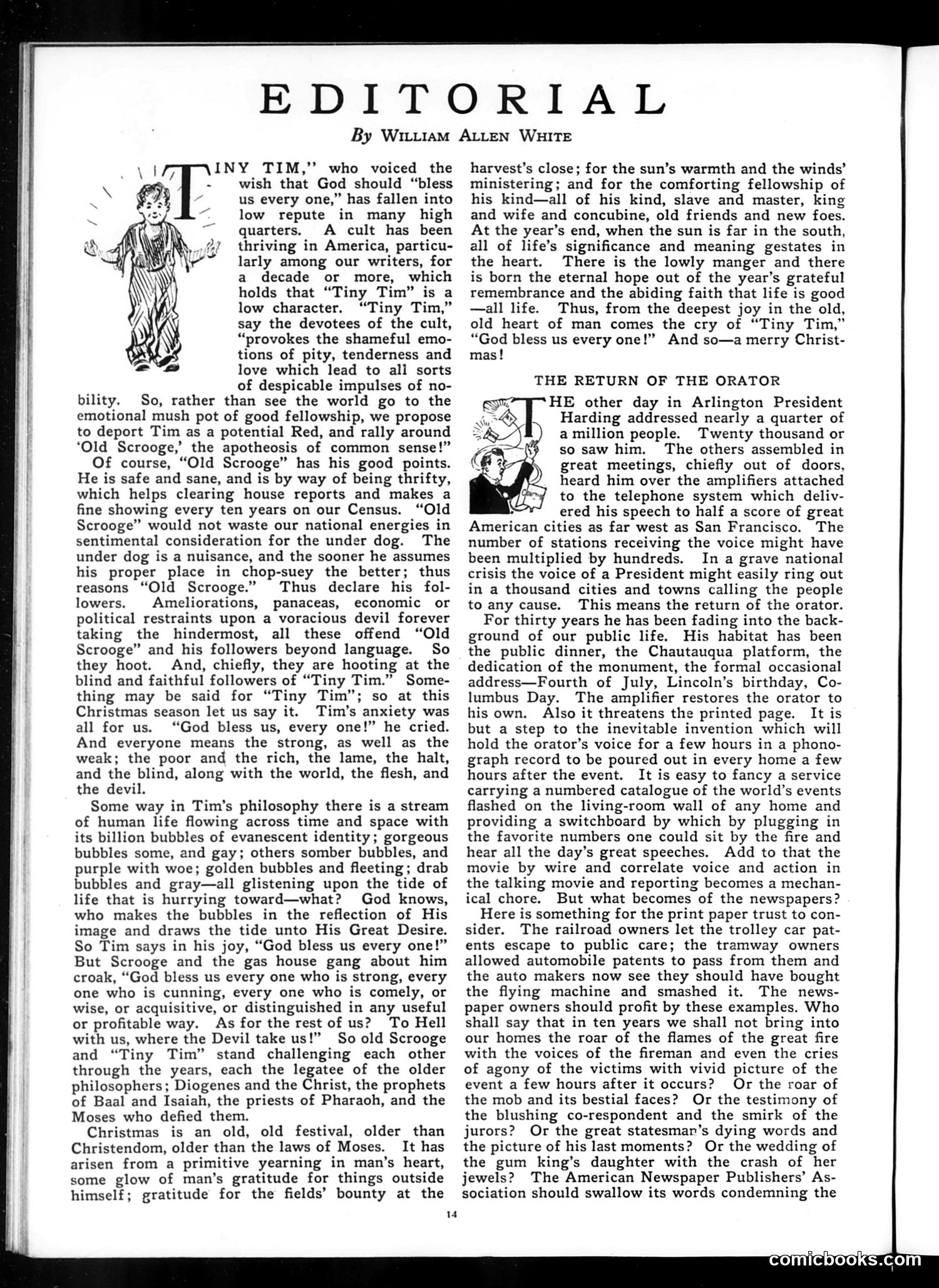
This editorial by William Allen White uses Charles Dickens characters as allegory for a contemporary American ideological debate, likely from the 1920s-1930s. **The Figures:** "Tiny Tim" represents compassion, charity, and inclusive goodwill toward all people regardless of class. "Old Scrooge" represents ruthless individualism, economic self-interest, and Social Darwinism—the philosophy that society should aid only the strong and profitable. **The Context:** White attacks an emerging cultural movement among American writers and intellectuals who mock sentimentality and charity as weakness, dismissing advocates for the poor as "potential Reds" (Communists). They advocate deporting compassion itself. **The Point:** White argues that Christmas and human philosophy fundamentally rest on Tiny Tim's inclusive blessing—"God bless us every one"—not Scrooge's selective cruelty. The editorial defends sentimental humanism against a hardening cynicism gaining ground in American intellectual circles.
📄 Transcribed text from this page (OCR, searchable)
Machine-transcribed from the original scan — historical spelling and the odd misread are preserved.
EDITORIAL By Wituram ALLEN WHITE INY TIM,’ who voiced the wish that God should “bless us every one,” has fallen into low repute in many high quarters. A cult has been thriving in America, particu- larly among our writers, for a decade or more, which holds that “Tiny Tim” is a low character. “Tiny Tim,” say the devotees of the cult, “provokes the shameful emo- tions of pity, tenderness and love which lead to ali sorts of despicable impulses of no- bility. So, rather than see the world go to the emotional mush pot of good fellowship, we propose to deport Tim as a potential Red, and rally around ‘Old Scrooge,’ the apotheosis of common sense!” Of course, “Old Scrooge” has his good points. He is safe and sane, and is by way of being thrifty, which helps clearing house reports and makes a fine showing every ten years on our Census. “Old Scrooge” would not waste our national energies in sentimental consideration for the under dog. The under dog is a nuisance, and the sooner he assumes his proper place in chop-suey the better; thus reasons “Old Scrooge.” Thus declare his fol- lowers. Ameliorations, panaceas, economic or political restraints upon a voracious devil forever taking the hindermost, all these offend “Old Scrooge” and his followers beyond language. So they hoot. And, chiefly, they are hooting at the blind and faithful followers of “Tiny Tim.” Some- thing may be said for “Tiny Tim”; so at this Christmas season let us say it. Tim’s anxiety was all for us. “God bless us, every one!” he cried. And everyone means the strong, as well as the weak; the poor and the rich, the lame, the halt, and the blind, along with the world, the flesh, and the devil. Some way in Tim's philosophy there is a stream of human life flowing across time and space with its billion bubbles of evanescent identity; gorgeous bubbles some, and gay; others somber bubbles, and purple with woe; golden bubbles and fleeting; drab bubbles and gray—all glistening upon the tide of life that is hurrying toward—what? God knows, who makes the bubbles in the reflection of His image and draws the tide unto His Great Desire. So Tim says in his joy, “God bless us every one!” But Scrooge and the gas house gang about him croak, “God bless us every one who is strong, every one who is cunning, every one who is comely, or wise, or acquisitive, or distinguished in any useful or profitable way. As for the rest of us? To Hell with us, where the Devil take us!” So old Scrooge and “Tiny Tim” stand challenging each other through the years, each the legatee of the older philosophers; Diogenes and the Christ, the prophets of Baal and Isaiah, the priests of Pharaoh, and the Moses who defied them. Christmas is an old, old festival, older than Christendom, older than the laws of Moses. It has arisen from a primitive yearning in man’s heart, some glow of man’s gratitude for things outside himself; gratitude for the fields’ bounty at the harvest’s close; for the sun’s warmth and the winds’ ministering; and for the comforting fellowship of his kind—all of his kind, slave and master, king and wife and concubine, old friends and new foes. At the year’s end, when the sun is far in the south, all of life’s significance and meaning gestates in the heart. There is the lowly manger and there is born the eternal hope out of the year’s grateful remembrance and the abiding faith that life is good —all life. Thus, from the deepest joy in the old, old heart of man comes the cry of “Tiny Tim,” “God bless us every one!” And so—a merry Christ- mas! THE RETURN OF THE ORATOR med other day in Arlington President Harding addressed nearly a quarter of a million people. Twenty thousand or so saw him. The others assembled in great meetings, chiefly out of doors, heard him over the amplifiers attached to the telephone system which deliv- ered his speech to half a score of great American cities as far west as San Francisco. The number of stations receiving the voice might have been multiplied by hundreds. In a grave national crisis the voice of a President might easily ring out in a thousand cities and towns calling the people to any cause. This means the return of the orator. For thirty years he has been fading into the back- ground of our public life. His habitat has been the public dinner, the Chautauqua platform, the dedication of the monument, the formal occasional address—Fourth of July, Lincoln’s birthday, Co- lumbus Day. The amplifier restores the orator to his own. Also it threatens the printed page. It is but a step to the inevitable invention which will hold the orator’s voice for a few hours in a phono- graph record to be poured out in every home a few hours after the event. It is easy to fancy a service carrying a numbered catalogue of the world’s events flashed on the living-room wall of any home and providing a switchboard by which by plugging in the favorite numbers one could sit by the fire and hear all the day’s great speeches. Add to that the movie by wire and correlate voice and action in the talking movie and reporting becomes a mechan- ical chore. But what becomes of the newspapers? Here is something for the print paper trust to con- sider. The railroad owners let the trolley car pat- ents escape to public care; the tramway owners allowed automobile patents to pass from them and the auto makers now see they should have bought the flying machine and smashed it. The news- paper owners should profit by these examples. Who shall say that in ten years we shall not bring into our homes the roar of the flames of the great fire with the voices of the fireman and even the cries of agony of the victims with vivid picture of the event a few hours after it occurs? Or the roar of the mob and its bestial faces? Or the testimony of the blushing co-respondent and the smirk of the jurors? Or the great statesman’s dying words and the picture of his last moments? Or the wedding of the gum king’s daughter with the crash of her jewels? The American Newspaper Publishers’ As- sociation should swallow its words condemning the