
Judge, 1921-12-17 · page 2 of 36
Judge — December 17, 1921 — page 2: what you’re looking at
What you’re looking at
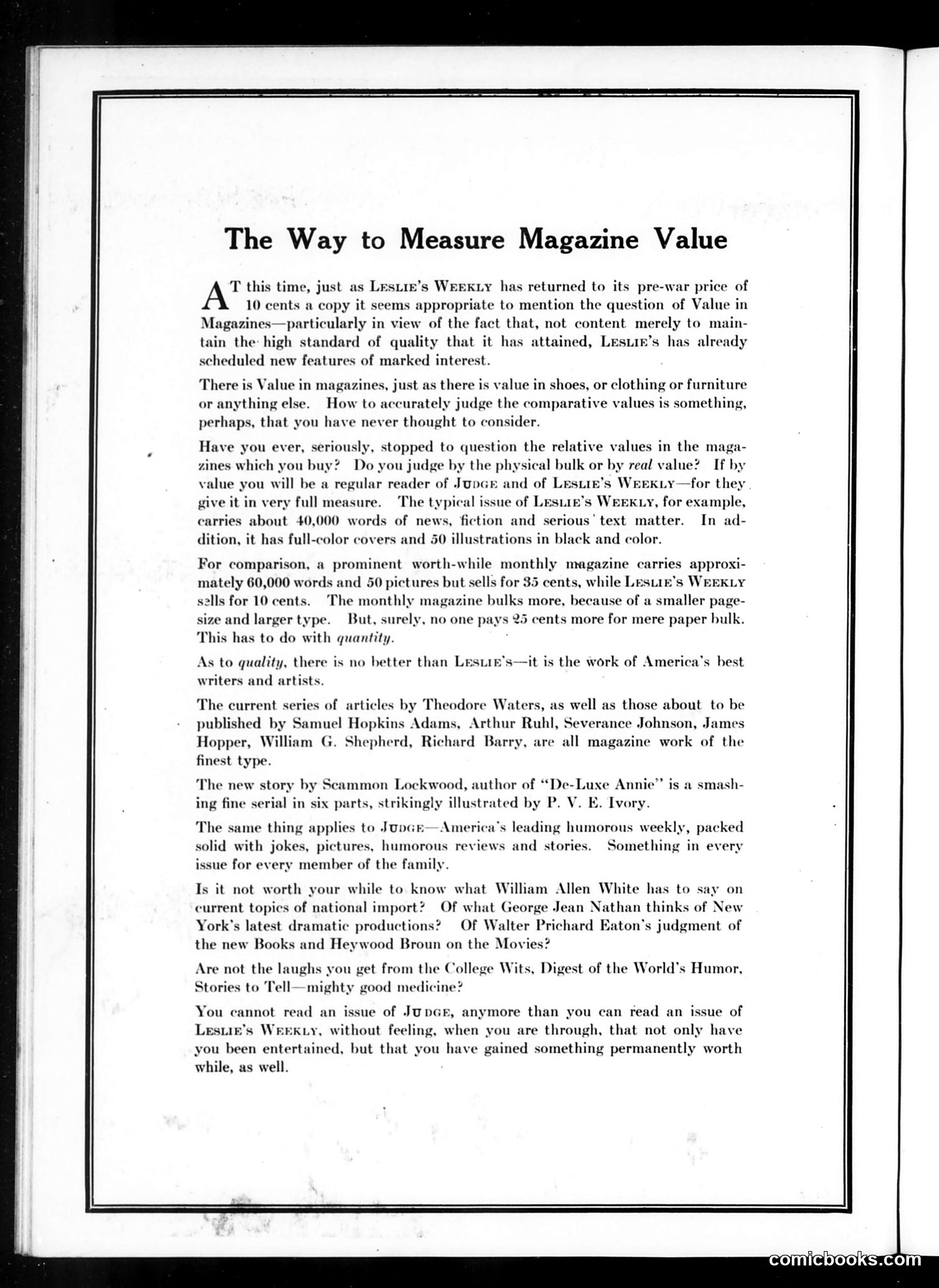
This page contains no cartoon or satirical image—it's purely editorial text promoting *Leslie's Weekly* magazine's value proposition. The article "The Way to Measure Magazine Value" argues that *Leslie's Weekly*, at 10 cents per copy, offers superior content-to-price ratio compared to a competitor (likely *Judge* itself, humorously), which charges 25 cents for a bulkier monthly format. The piece boasts *Leslie's* features established writers (Theodore Waters, Samuel Hopkins Adams, Arthur Ruhl) and announces new content by Seammon Lockwood. It emphasizes entertainment value alongside substance, claiming readers gain permanent worth beyond mere amusement. The self-promotional tone is characteristic of early 20th-century magazine advertising, though the specific competitive comparison remains somewhat indirect.
📄 Transcribed text from this page (OCR, searchable)
Machine-transcribed from the original scan — historical spelling and the odd misread are preserved.
The Way to Measure Magazine Value Ae this time, just as Lestre’s WEEKLY has returned to its pre-war price of 10 cents a copy it seems appropriate to mention the question of Value in Magazines—particularly in view of the fact that, not content merely to main- tain the high standard of quality that it has attained, Lesiir’s has already scheduled new features of marked interest. There is Value in magazines, just as there is value in shoes, or clothing or furniture or anything else. How to accurately judge the comparative values is something, perhaps, that you have never thought to consider. Have you ever, seriously, stopped to question the relative values in the me zines which you buy? Do you judge by the physical bulk or by real value? If by value you will be a regular reader of JupGe and of Lestre’s Werkty—for they give it in very full measure. The typical issue of Lestin’s WEEKLY, for example, carries about 40,000 words of news, fiction and serious’ text matter. In ad- dition, it has full-color covers and 50 illustrations in black and color. For comparison, a prominent worth-while monthly magazine carries approxi- mately 60,000 words and 50 pictures but sells for 35 cents, while Lestir’s WEEKLY sells for 10 cents. The monthly magazine bulks more, because of a smaller page- size and larger type. But, surely, no one pays 25 cents more for mere paper bulk. This has to do with quantity. As to quality, there is no better than Lesiir’s—it is the work of America’s best writers and artists. The current series of articles by Theodore Waters, as well as those about to be published by Samuel Hopkins Adams, Arthur Ruhl, Severance Johnson, James Hopper, William G. Shepherd, Richard Barry, are all magazine work of the finest type. The new story by Seammon Lockwood, author of ‘““De-Luxe Annie” is a smash- ing fine serial in six parts, strikingly illustrated by P. V. E. Ivory. The same thing applies to JooGe—America’s leading humorous weekly, packed solid with jokes, pictures, humorous reviews and stories. Something in every issue for every member of the family. Is it not worth your while to know what William Allen White has to sa current topics of national import? Of what George Jean Nathan thinks of New York's latest dramatic productions? Of Walter Prichard Eaton's judgment of the new Books and Heywood Broun on the Movies? Are not the laughs you get from the College Wits, Digest of the World’s Humor, Stories to Tell—mighty good medicine? You cannot read an issue of JUDGE, anymore than you can read an issue of Lesiie’s WEEKLY, without feeling, when you are through, that not only have you been entertained, but that you have gained something permanently worth while, as well.