
Judge, 1921-12-17 · page 13 of 36
Judge — December 17, 1921 — page 13: what you’re looking at
What you’re looking at
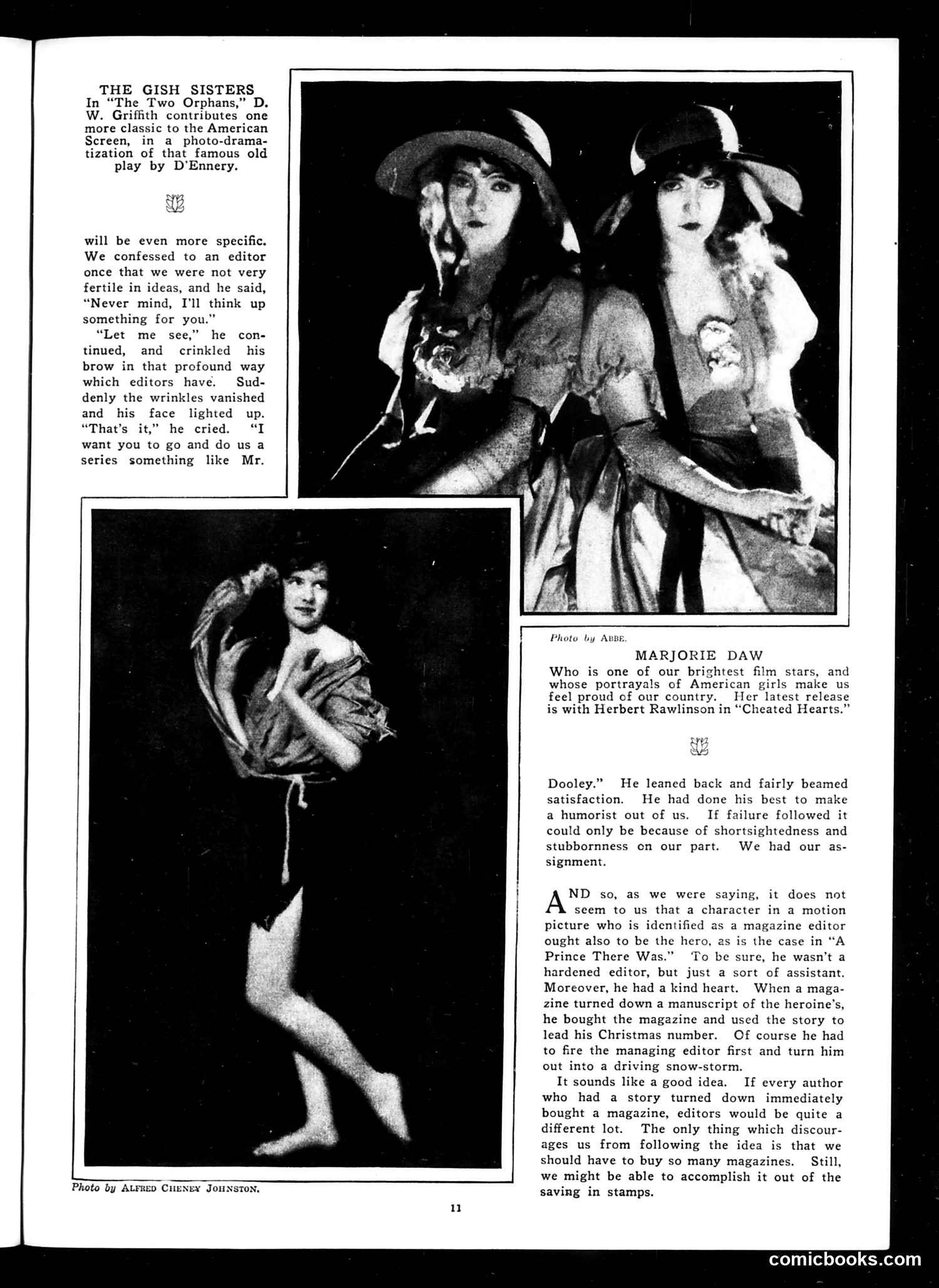
This Judge magazine page reviews D.W. Griffith's film adaptation of *The Two Orphans*, featuring the Gish Sisters, prominent silent film actresses. The accompanying photos showcase Marjorie Daw, another contemporary film star. The main satire critiques film plots—specifically how *A Prince There Was* portrays a sympathetic magazine editor as hero. The writer mocks this trope: if every rejected author literally bought a magazine to publish their story (firing the managing editor into a snowstorm), editors would face financial ruin. The joke suggests this fantasy scenario reflects authors' actual resentment toward rejection. This reflects early 1920s tensions between literary establishments and emerging film culture, where movies increasingly adapted stage plays and literary works while satirizing the publishing world's gatekeepers.
📄 Transcribed text from this page (OCR, searchable)
Machine-transcribed from the original scan — historical spelling and the odd misread are preserved.
THE GISH SISTERS In “The Two Orphans,” D. W. Griffith contributes one more classic to the American Screen, in a photo-drama- tization of that famous old play by D’Ennery. will be even more specific. We confessed to an editor once that we were not very fertile in ideas, and he said, “Never mind, I'll think up something for you.” “Let me see,” he con- tinued, and crinkled his brow in that profound way which editors have. Sud- denly the wrinkles vanished and his face lighted up. “That’s it,” he cried. “I want you to go and do us a series something like Mr. Photo by Atrrep CuENEY JouNSTON, Photo by Avse. MARJORIE DAW Who is one of our brightest film stars, and whose portrayals of American girls make us feel proud of our country. Her latest release is with Herbert Rawlinson in “Cheated Hearts.” Ve Dooley.” He leaned back and fairly beamed satisfaction. He had done his best to make a humorist out of us. If failure followed it could only be because of shortsightedness and stubbornness en our part. We had our as- signment. ND so, as we were saying, it does not seem to us that a character in a motion picture who is identified as a | magazine editor ought also to be the hero, as is the case in “A Prince There Was.” To be sure, he wasn’t a hardened editor, but just a sort of istant. Moreover, he had a kind heart. When a maga- zine turned down a manuscript of the heroine's, he bought the magazine and used the story to lead his Christmas number. Of course he had to fire the managing editor first and turn him out into a driving snow-storm. It sounds like a good idea. If every author who had a story turned down immediately bought a magazine, editors would be quite a different lot. The only thing which discour- ages us from following the idea is that we should have to buy so many magazines. Still, we might be able to accomplish it out of the saving in stamps. comicbooks.com