
A complete issue · 36 pages · 1921
Judge — October 29, 1921
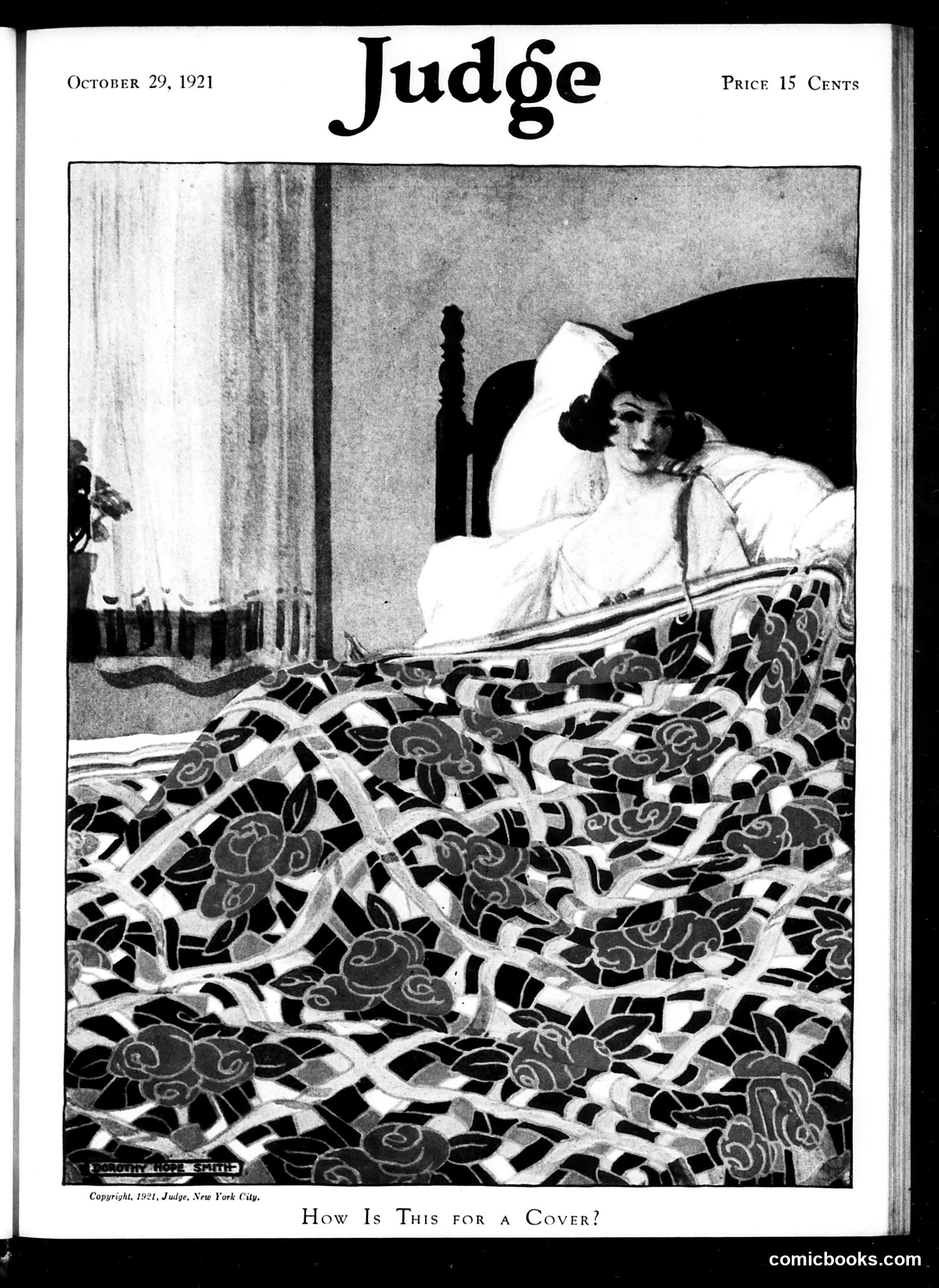
This cover depicts a woman in bed surrounded by an elaborate, patterned quilt or bedspread decorated with rose motifs. The caption reads "How Is This for a Cover?" — a meta-joke about the image itself serving as Judge magazine's cover. The humor appears to be a double entendre: the woman is literally "covered" by decorative bedding, while the phrase references whether this suggestive bedroom scene works as the magazine's cover design. The composition and intimate setting suggest mild sexual innuendo typical of 1920s satirical humor. The illustration style and subject matter reflect the era's comedic sensibilities, blending visual puns with slightly risqué domestic scenarios that were acceptable for the magazine's readership.
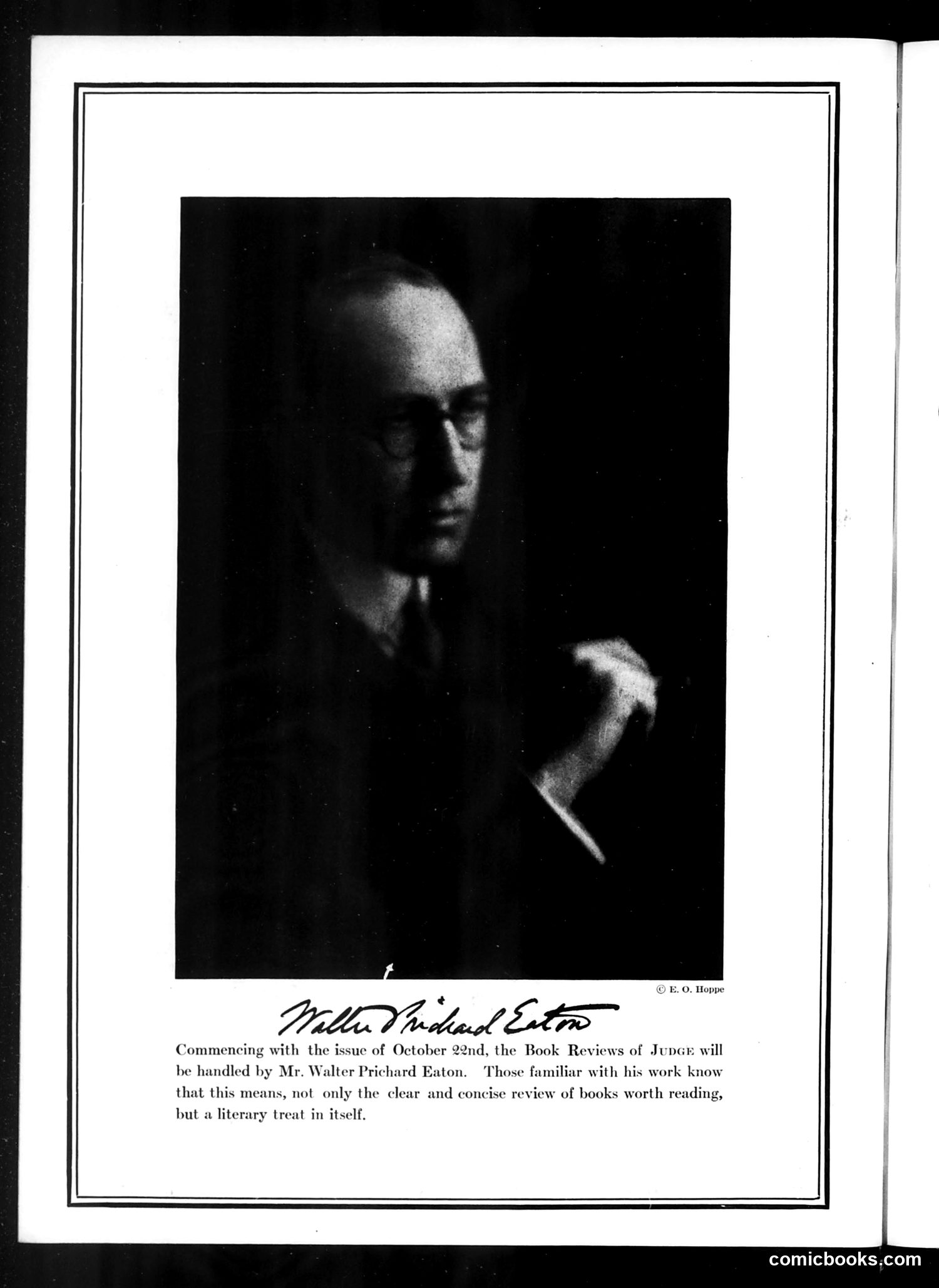
This page features a portrait photograph of **Walter Prichard Eaton** with an accompanying announcement. The text states that beginning October 22nd, Eaton will handle the Book Reviews section of *Judge* magazine. The announcement emphasizes Eaton's credentials, suggesting his reviews will offer "clear and concise" commentary on "books worth reading" while functioning as "a literary treat in itself." This appears to be a professional introduction rather than satire or political commentary. *Judge* is promoting a new editorial appointment to its readers. The formal portrait and endorsement indicate Eaton was a respected literary figure of the period, and the magazine is positioning his book reviews as a significant feature designed to attract readers interested in serious literary criticism alongside the magazine's typical satirical content.
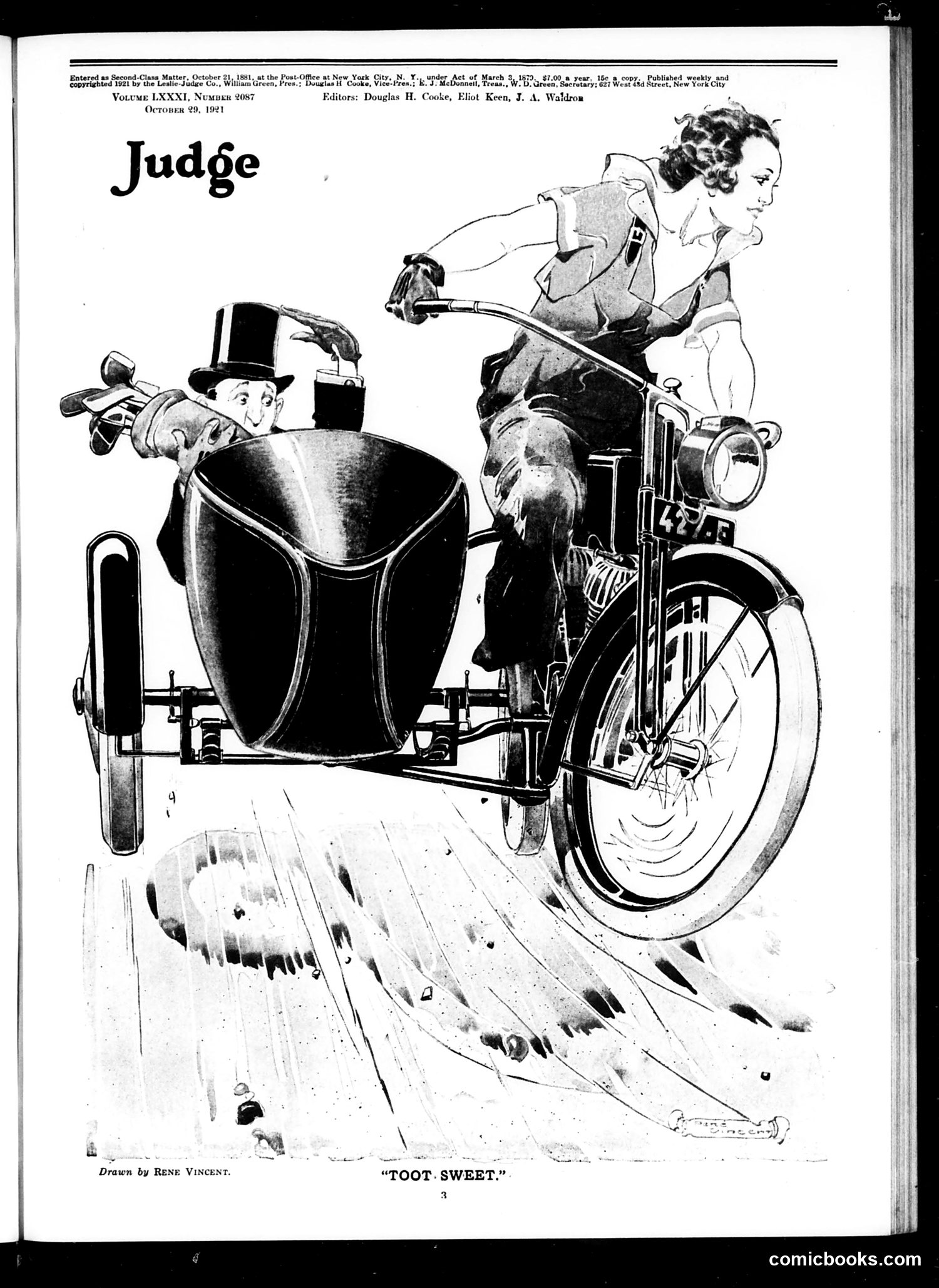
This cartoon by René Vincent depicts a motorcycle with sidecar speeding rapidly, titled "Toot Sweet" (a pun on the French phrase "tout de suite," meaning "immediately"). The image shows a fashionable woman operating the motorcycle while a formally dressed man in a top hat sits in the sidecar, appearing startled or alarmed by their speed. The motion lines and scattered debris suggest reckless, dangerously fast driving. The satire likely comments on the 1920s phenomenon of women gaining independence—including driving automobiles—and the social anxieties this generated among older generations represented by the formal gentleman. The joke plays on the contrast between modern female autonomy and traditional masculine discomfort with changing social norms.
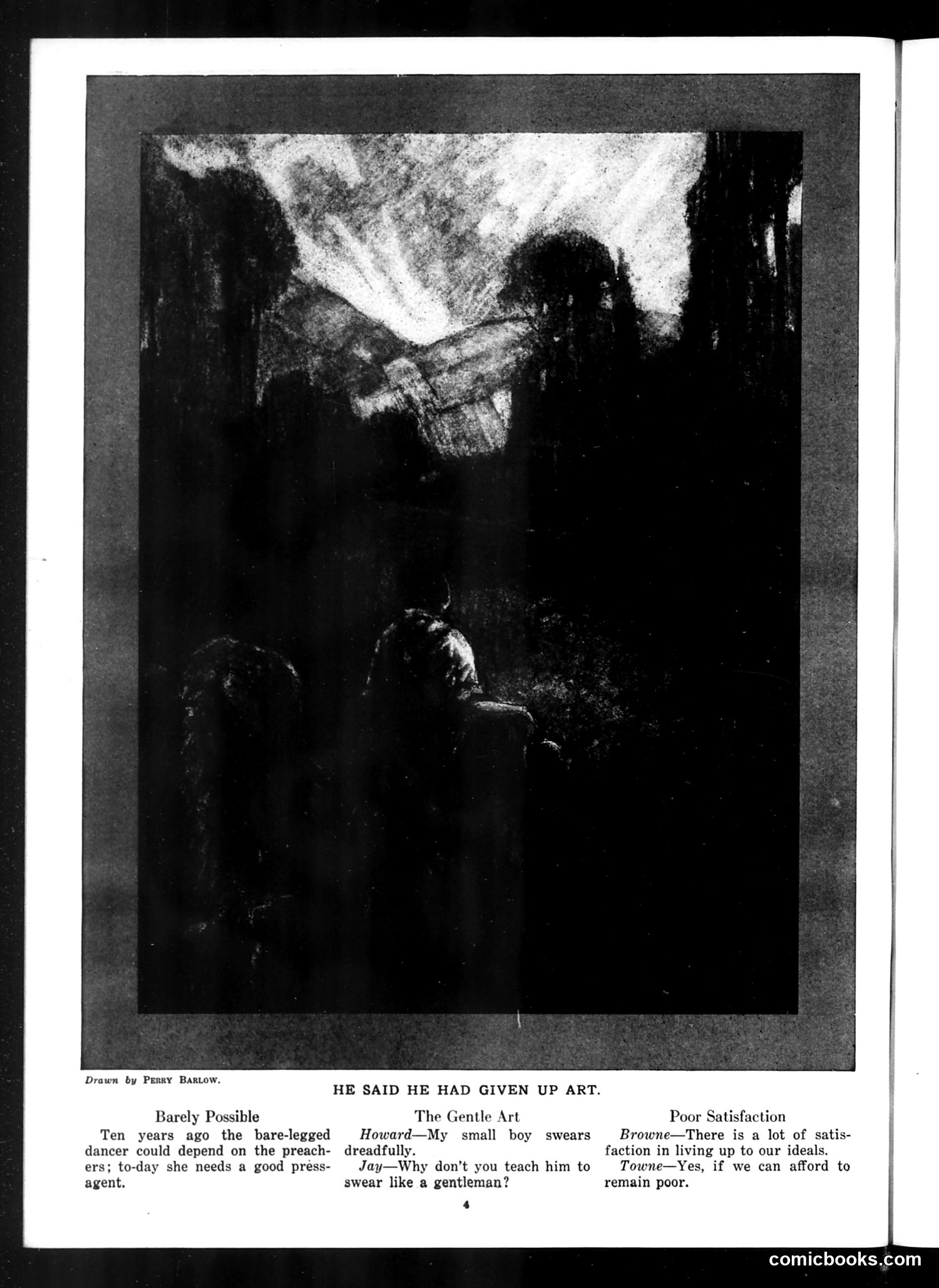
This page contains a drawing by Perry Barlow titled "He Said He Had Given Up Art," presenting three satirical scenarios about art and social class. The comic critiques attitudes toward artistic pursuits among different social strata: - **"Barely Possible"**: A bare-legged dancer struggles to find patronage; the caption suggests she needs a "press agent" for survival. - **"The Gentle Art"**: A father (Howard) is horrified his son swears, asking why he doesn't teach gentlemanly behavior—suggesting ironic disconnect between aspiration and reality. - **"Poor Satisfaction"**: Browne sarcastically notes that poverty allows one to "remain poor" while living up to ideals—mocking how the poor are praised for virtue born of necessity rather than choice. The satire targets class hypocrisy and the romanticization of struggling artists.
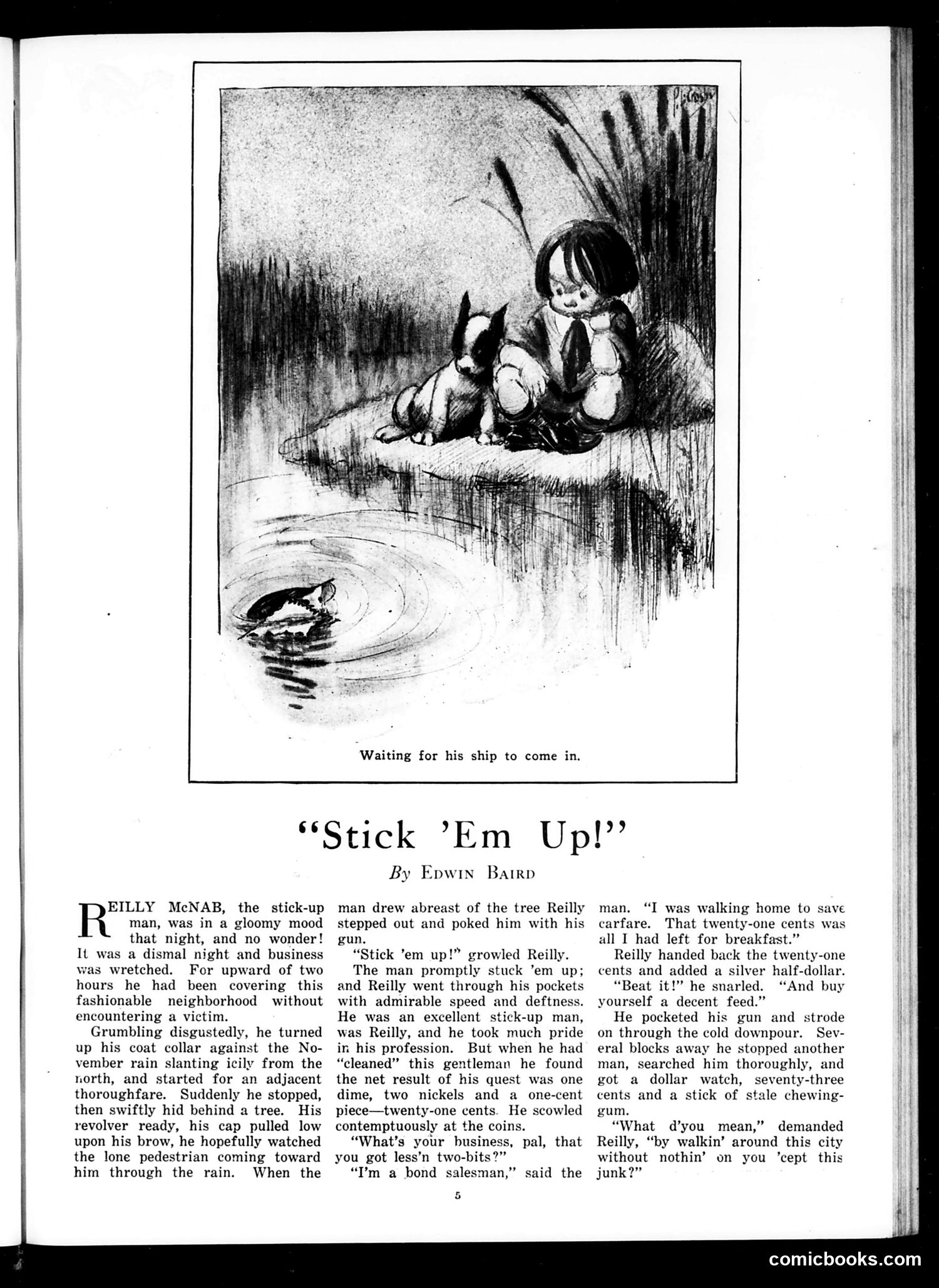
This is a humorous short story rather than a political cartoon. It depicts a classic urban crime scenario from the early 20th century: Reilly McNab, a "stick-up man" (armed robber), encounters another criminal—a bond salesman—who robs him first. The illustration shows a child and dog waiting by water, presumably referencing the story's narrative. The satire appears to target the financial/bond-selling industry of the era, suggesting that legitimate businessmen who sell bonds are themselves "criminals" engaging in theft through commerce—implying these transactions are as dishonest as street robbery. It's commentary on perceived fraud or manipulation in financial markets, presented through the ironic device of a petty criminal being robbed by a respectable businessman.
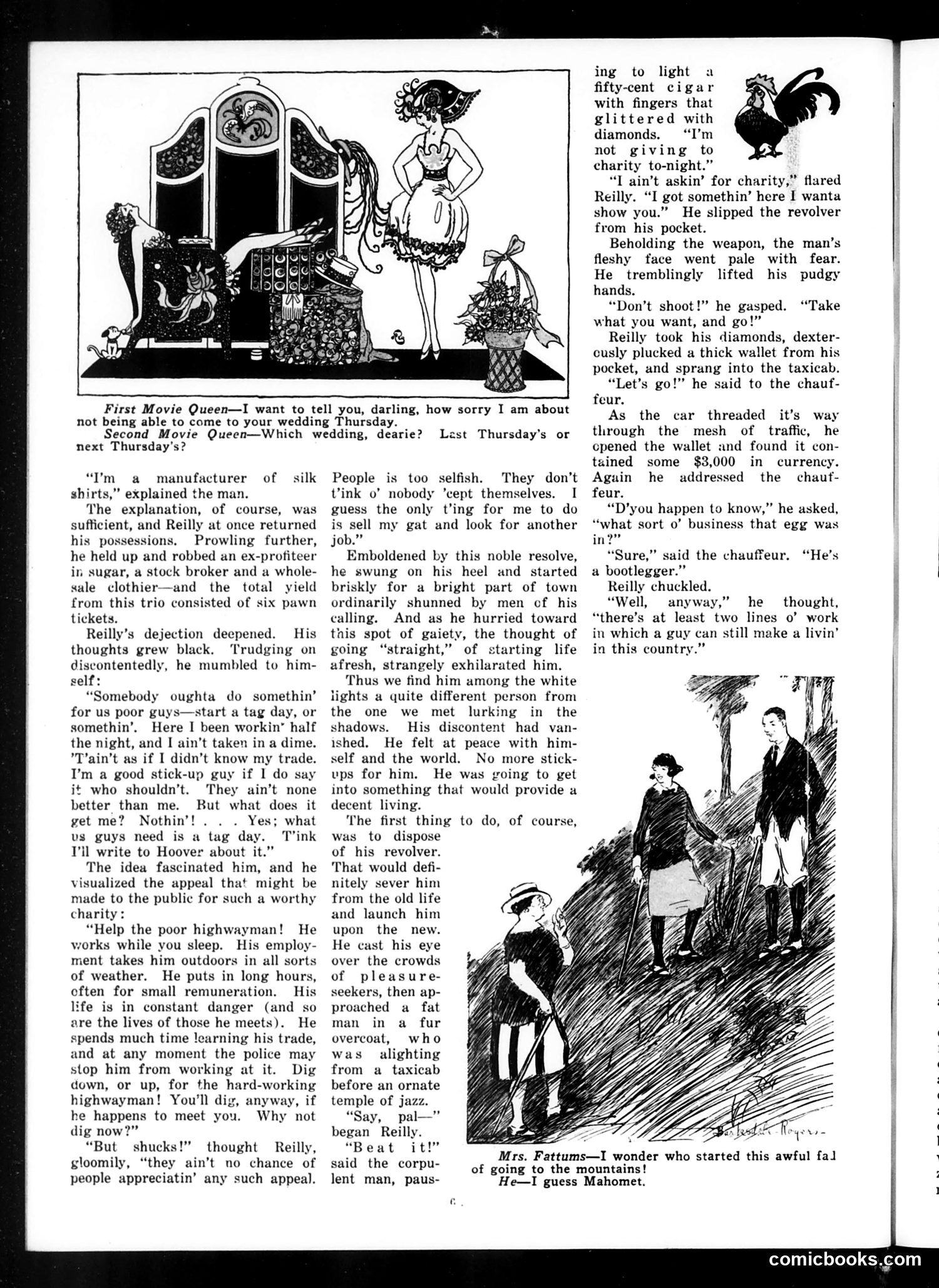
This page contains two separate satirical narratives with accompanying illustrations. The top cartoon titled "First Movie Queen" mocks wealthy socialites' casual cruelty. A fashionable woman dismisses her fiancé's wedding invitation, claiming she's too busy. The satire targets the selfish materialism of the upper class—she prioritizes social gatherings and personal possessions over genuine human relationships and commitments. The bottom illustration labeled "Mrs. Fattums" and "He—I guess Mahomes" appears incomplete in context, though it depicts social interaction with a satirical edge typical of Judge's class-based humor. Both pieces reflect early-20th-century satirical concerns: wealth's corrupting influence, the hollowness of high society, and the contrast between appearances and moral character. The magazine used humor to critique American social pretension.
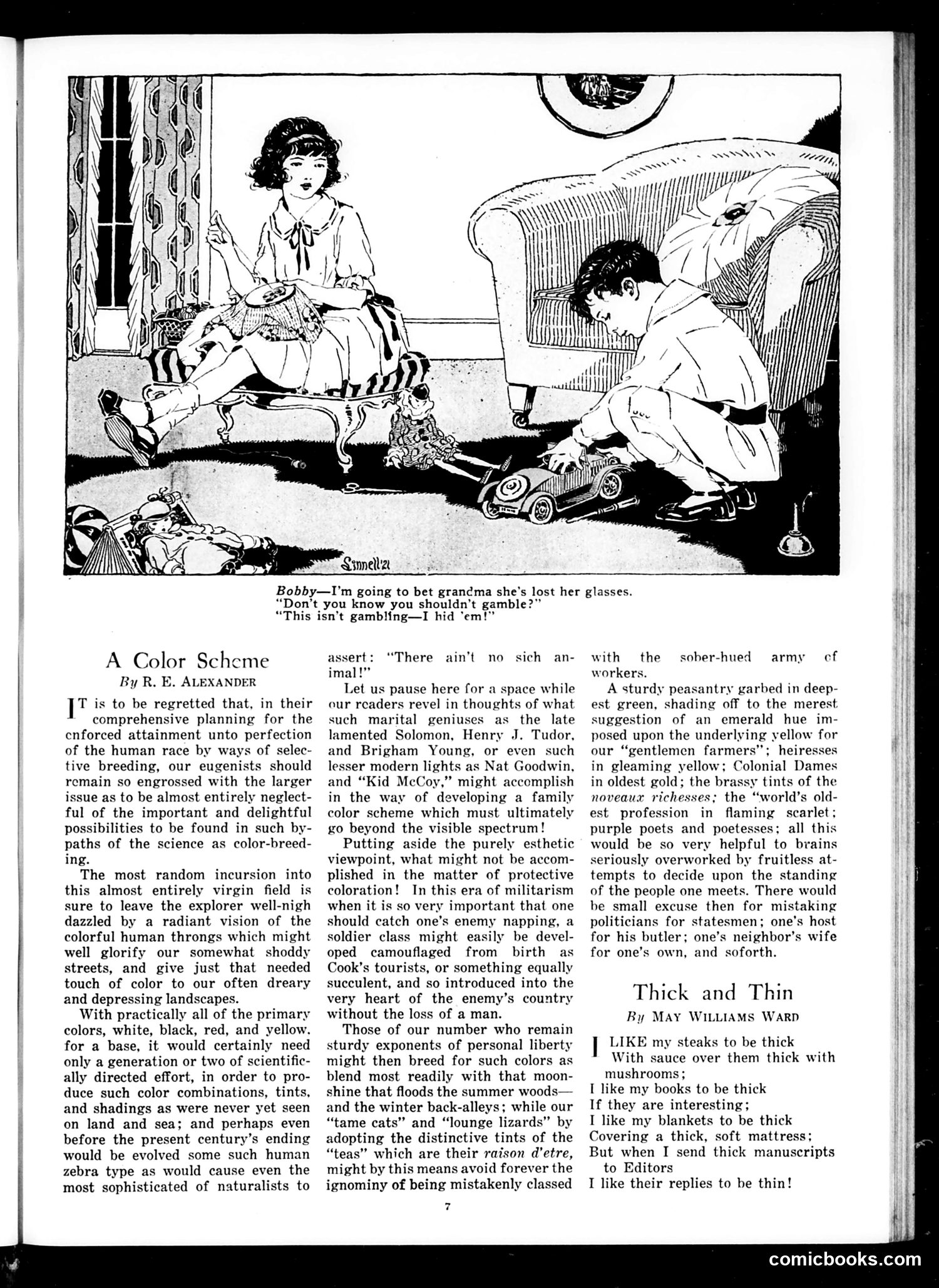
**The Cartoon:** A mother watches a boy play with toy cars on the floor while his grandmother sits nearby. The boy jokes he's "bet" his grandmother she's lost her glasses—but clarifies he actually *hid* them, so it's not gambling. The humor plays on wordplay: the boy redefines a bet (wager) as a hidden-object game, innocently evading the gambling prohibition. **The Articles Below:** These are satirical essays. "A Color Scheme" mockingly proposes eugenics-based selective breeding to create humans of specific colors for social classification and military camouflage—a darkly sarcastic critique of early 20th-century eugenics pseudoscience. "Thick and Thin" is lighthearted verse about preferring thick steaks, books, and blankets, but thin rejection letters from editors. **Historical Context:** The eugenics piece reflects Judge magazine's skeptical take on the period's pseudo-scientific racial theories, using absurdist satire to expose their illogic.
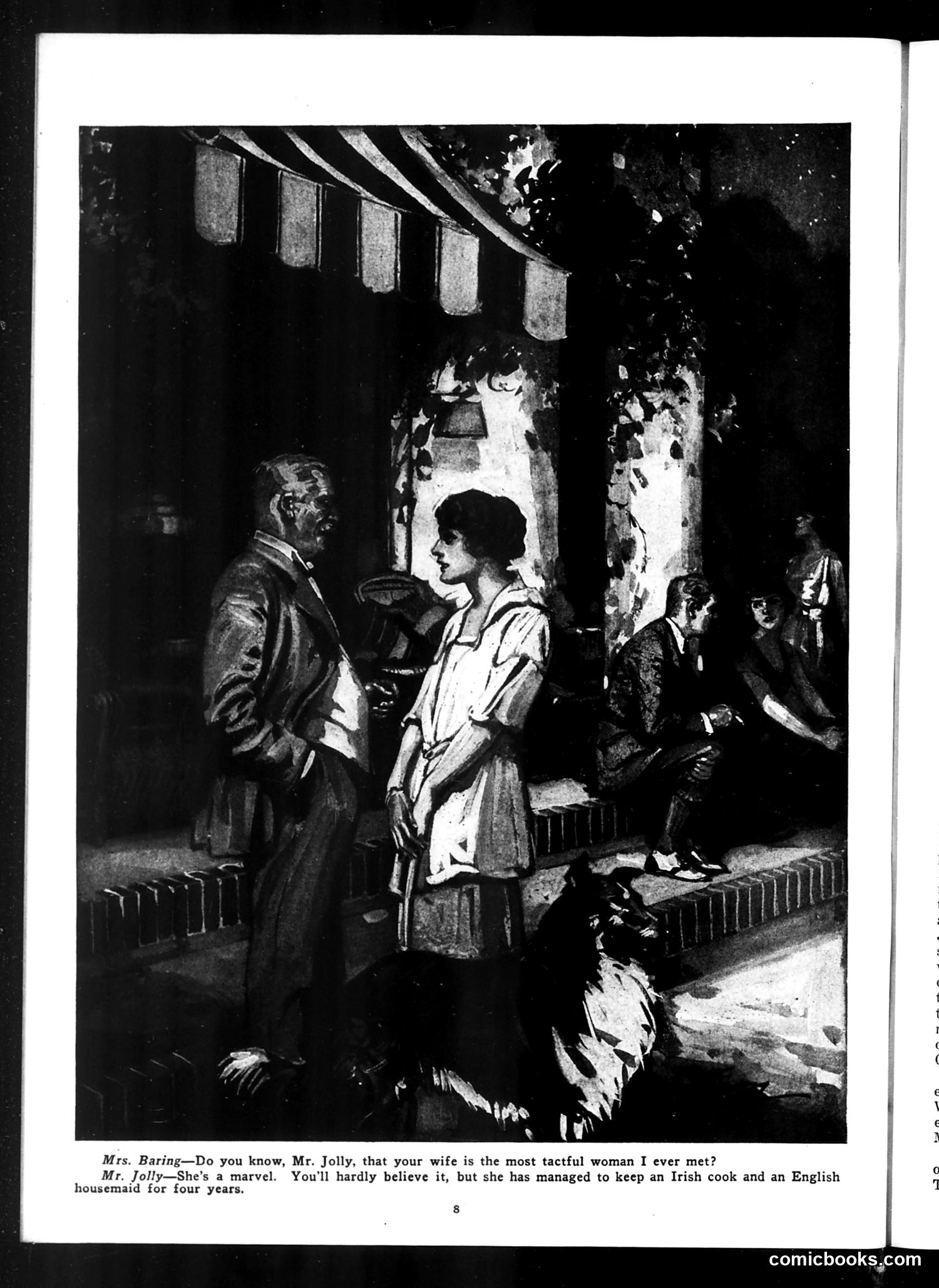
This is a domestic humor scene satirizing the difficulty of household staff management in early 20th-century America. The joke celebrates Mrs. Jolly's exceptional diplomacy: she has maintained employment harmony between an Irish cook and English housemaid for four years—presented as a remarkable achievement. The satire reflects period stereotypes about ethnic tensions between Irish and English workers, suggesting such conflicts were common enough to make their peaceful coexistence noteworthy and praiseworthy. The cartoon mocks both the class anxieties of the employing household and the assumption that national/ethnic differences would naturally create workplace friction. The humor relies on contemporary prejudices about Irish-English antagonism that modern readers would recognize as offensive stereotyping.
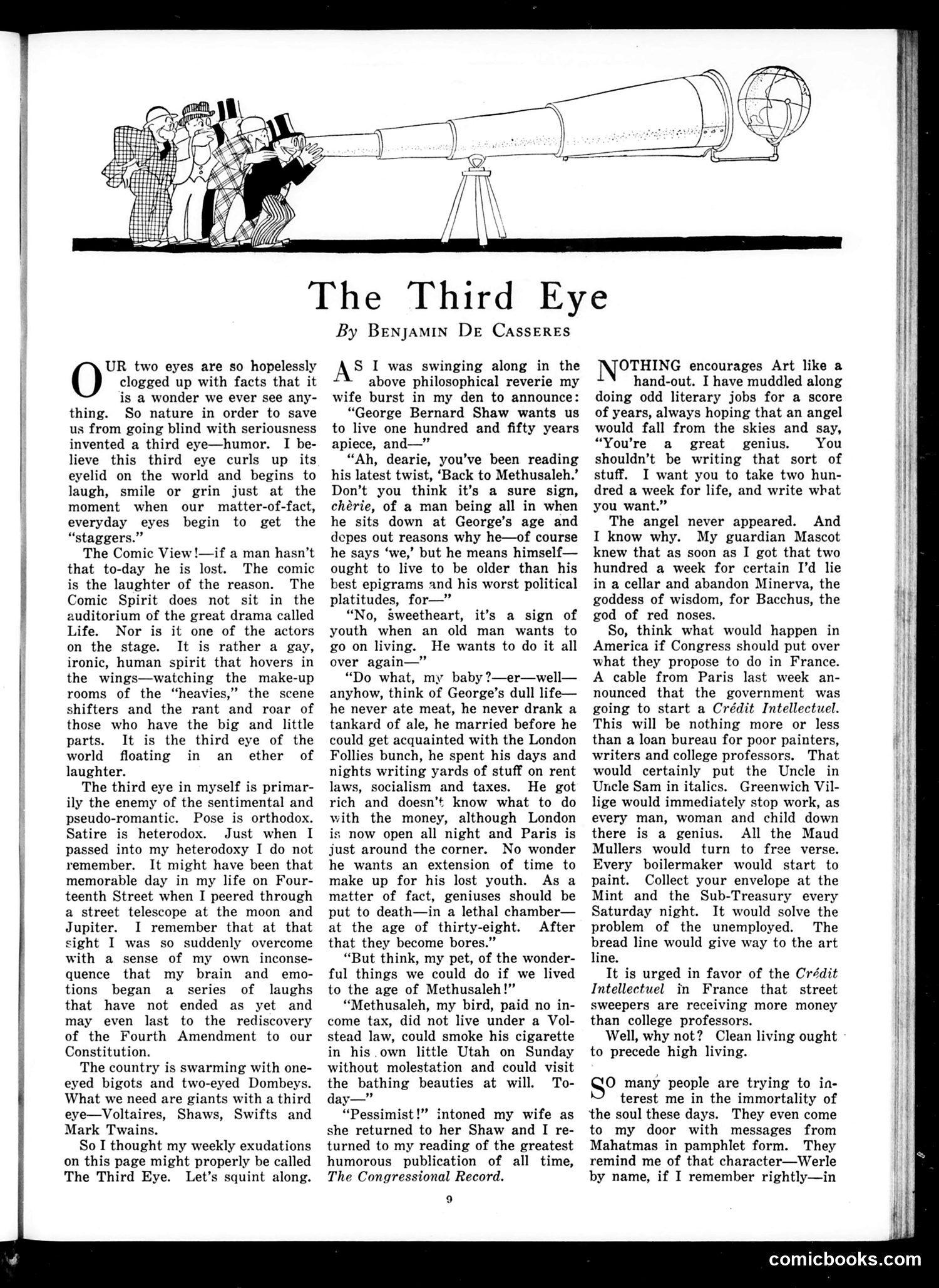
This is primarily an essay/column rather than a political cartoon. De Casseres argues for "the third eye"—humor and satire—as essential to seeing through social pretense and hypocrisy. He cites satirists like Voltaire, Shaw, and Mark Twain as models. The piece includes a dialogue mocking **George Bernard Shaw's recent play "Back to Methuselah,"** which proposed extending human lifespans. De Casseres ridicules Shaw for wanting to live longer despite his austere, joyless life (no meat, ale, or pleasures). The satire suggests Shaw's desire for longevity reflects exhaustion, not youthful vigor. De Casseres also jabs at **Prohibition** (the Volstead law) and suggests Congress is inherently absurd by calling the Congressional Record "the greatest humorous publication." The broader point: use humor and critical thinking to expose the contradictions and pretensions of public figures and institutions.
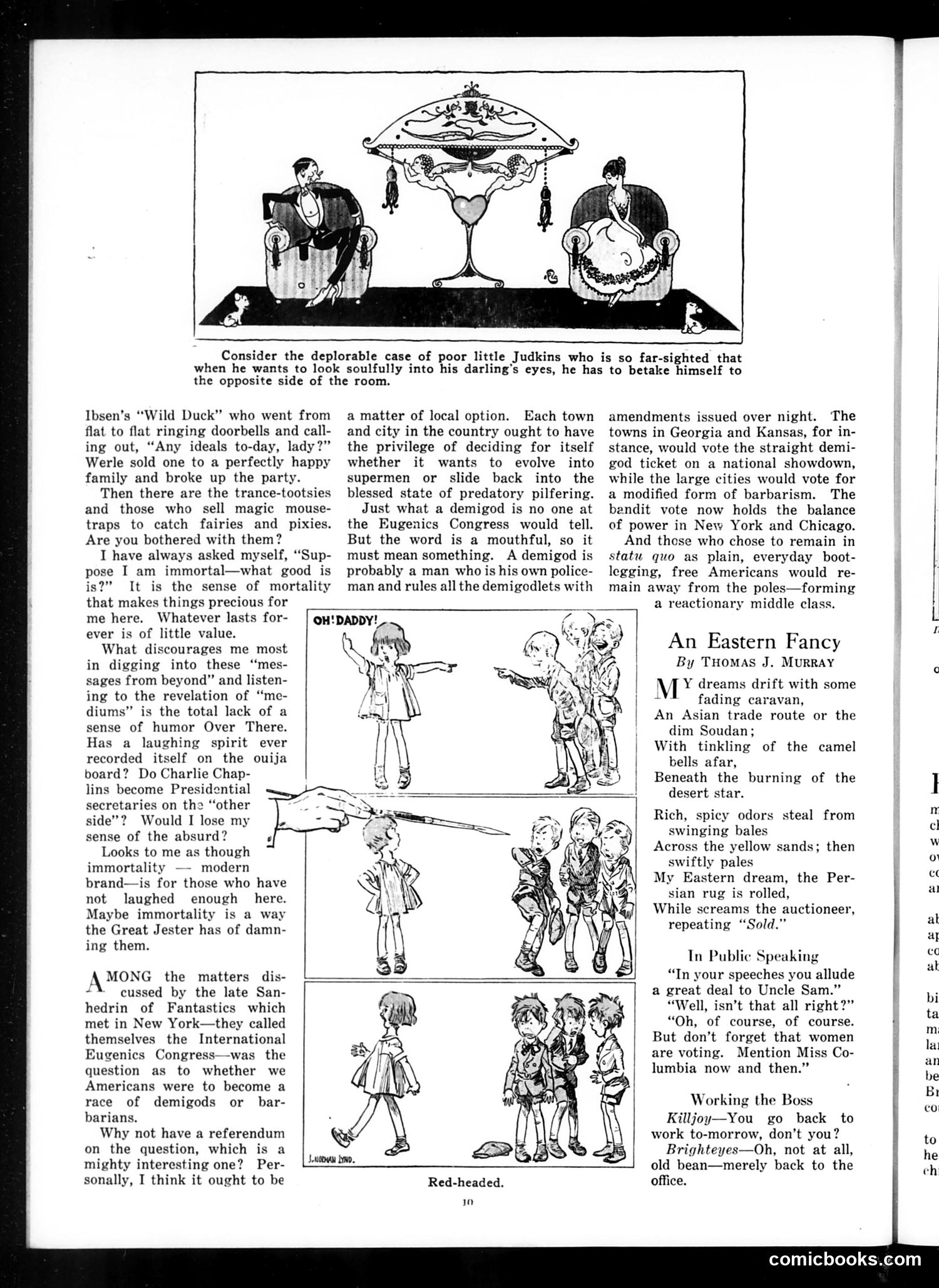
This page from *Judge* satirizes early 20th-century intellectual and social pretensions. The top cartoon mocks poor eyesight through the absurd figure of "little Judkins," who must move across a room to gaze into his lover's eyes—a visual pun on romantic sentiment meeting practical limitation. The main text ridicules the "International Eugenics Congress" (a real movement of the era promoting selective breeding). The author sarcastically proposes a "referendum" on whether Americans should become "demigods or barbarians," suggesting the congress's pseudo-scientific categorizations are absurd. He notes cynically that different regions would vote differently, and that criminals ("bandit vote") hold actual political power—undercutting the congress's pretensions to rational human improvement. The "Eastern Fancy" poem and office jokes in the right column are lighter filler content. **Context:** This reflects skepticism toward eugenics pseudoscience that was gaining credibility among American intellectuals in this era, despite its eventual association with Nazi ideology.
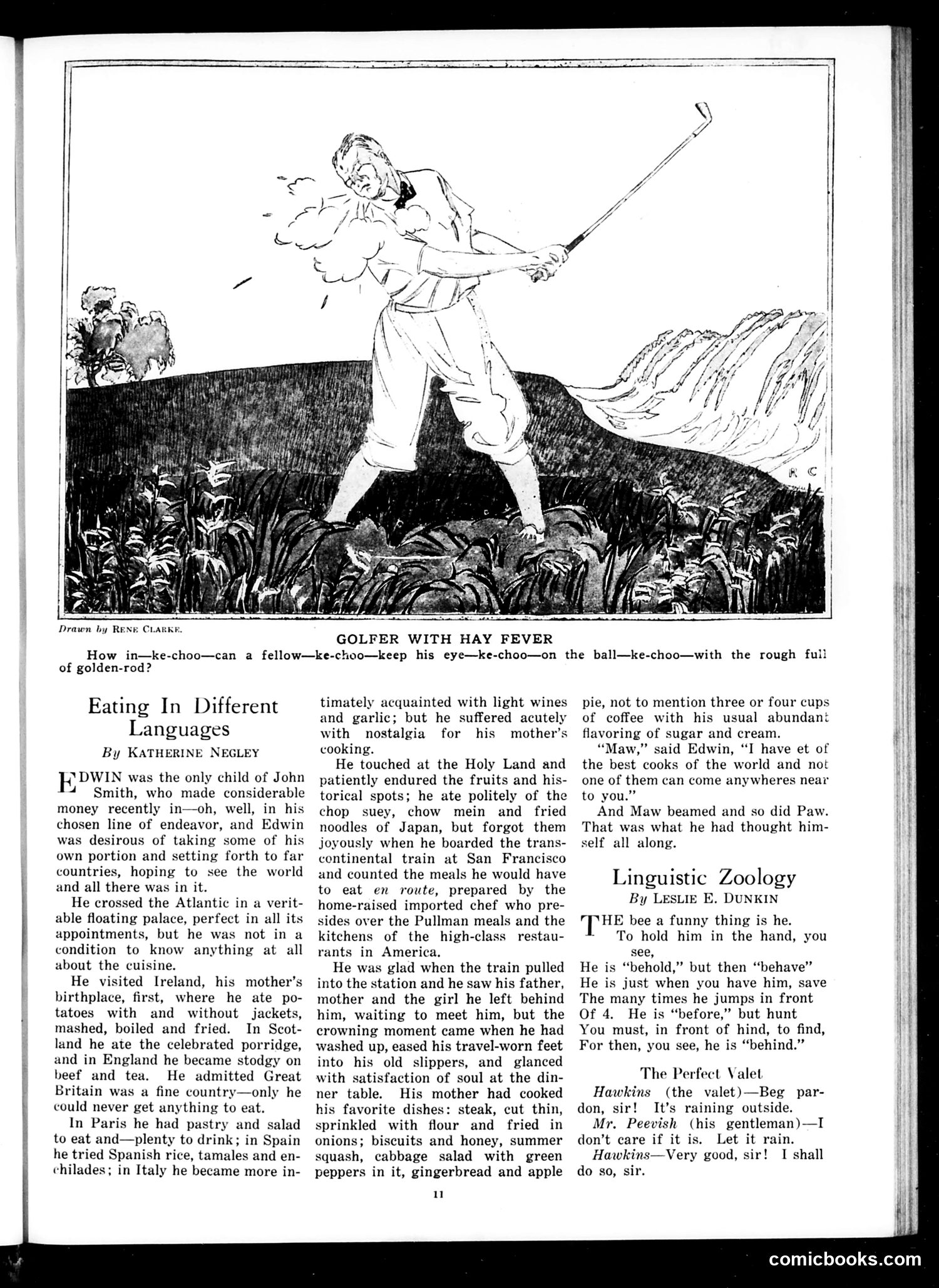
**Top Cartoon:** "Golfer with Hay Fever" depicts a golfer mid-swing, repeatedly sneezing ("ke-choo") while surrounded by goldenrod plants. The joke satirizes the frustration of attempting to play golf while suffering from hay fever—the pollen from goldenrod causes uncontrollable sneezing that ruins concentration on the ball. This references a common seasonal ailment that would particularly plague golfers in late summer/early fall. **Main Article:** "Eating in Different Languages" humorously traces a wealthy young American's overseas journey. Despite sampling cuisines worldwide—Irish potatoes, French pastry, Spanish rice, Japanese chop suey—he constantly longs for his mother's American home cooking. The satire gently mocks both nouveau riche Americans' tendency to travel abroad seeking sophistication, and their underlying inability to appreciate foreign cultures, ultimately preferring familiar American fare. **Minor Pieces:** Brief comedic sketches on linguistic wordplay and servant-master dynamics round out the page.
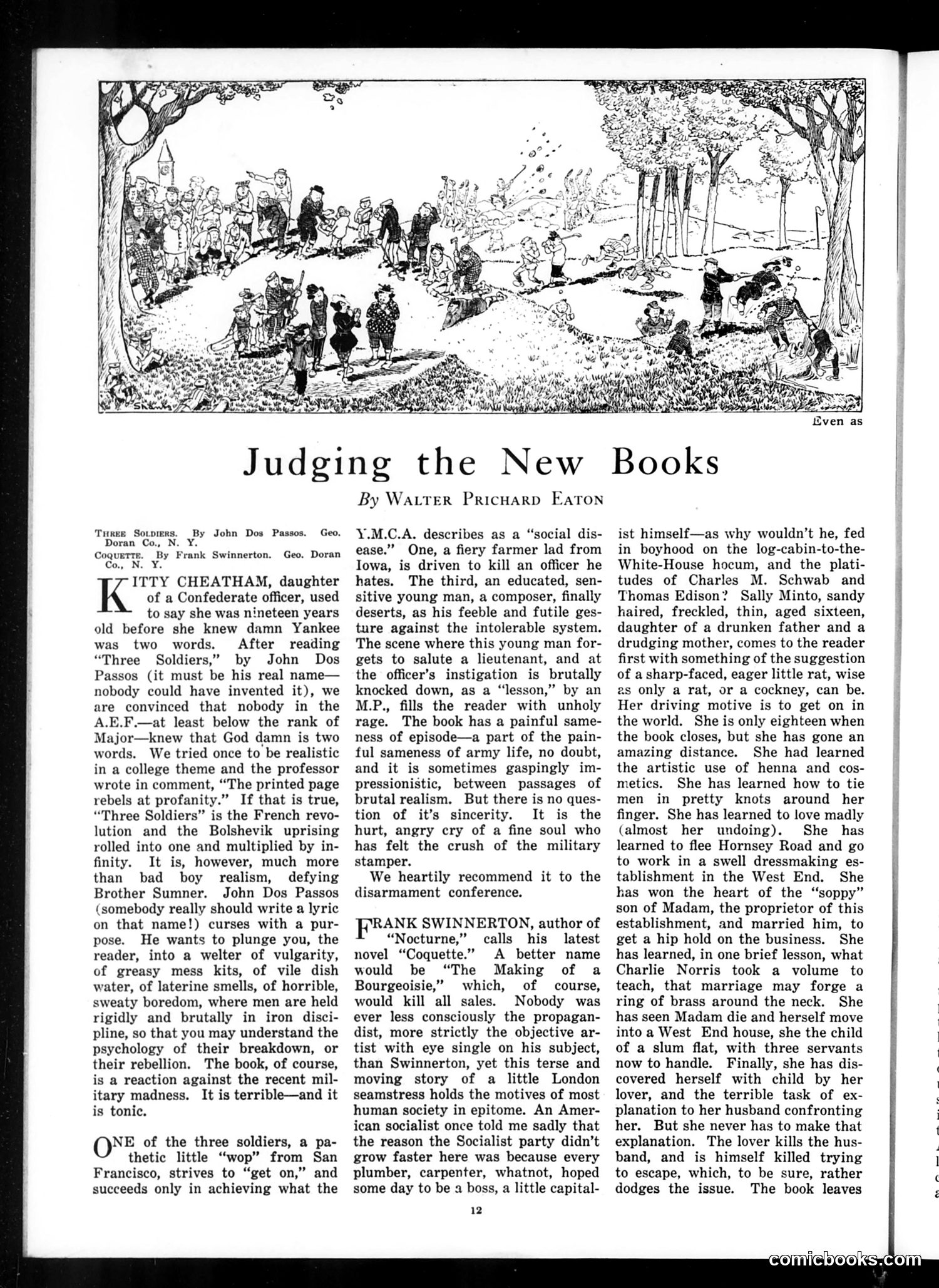
This page features literary reviews by Walter Prichard Eaton of two post-WWI novels. The illustration depicts an outdoor gathering of people—likely representing readers or the literary community. **"Three Soldiers" by John Dos Passos:** The reviewer praises this anti-war novel about military brutality and discipline breaking soldiers' spirits. Three protagonists represent different backgrounds: an Italian-American ("wop") seeking advancement, an Iowa farmer driven to kill an officer, and an educated composer who deserts. The reviewer notes Dos Passos uses profanity deliberately to immerse readers in the degradation of army life, endorsing the book's "sincere" anti-militarism. The recommendation to send it to a "disarmament conference" is satirical approval of its pacifist message. **"Coquette" by Frank Swinnerton:** The reviewer observes this novel about an ambitious London seamstress actually critiques capitalism's seductive appeal, though the author claims artistic objectivity. The character Sally Minto's drive to "get on" reflects American bourgeois aspiration—the reviewer notes Americans' hope of becoming bosses themselves, fed by Horatio Alger mythology and capitalist propaganda. Both reviews are sympathetic to progressive/socialist critiques of militarism and capitalism.
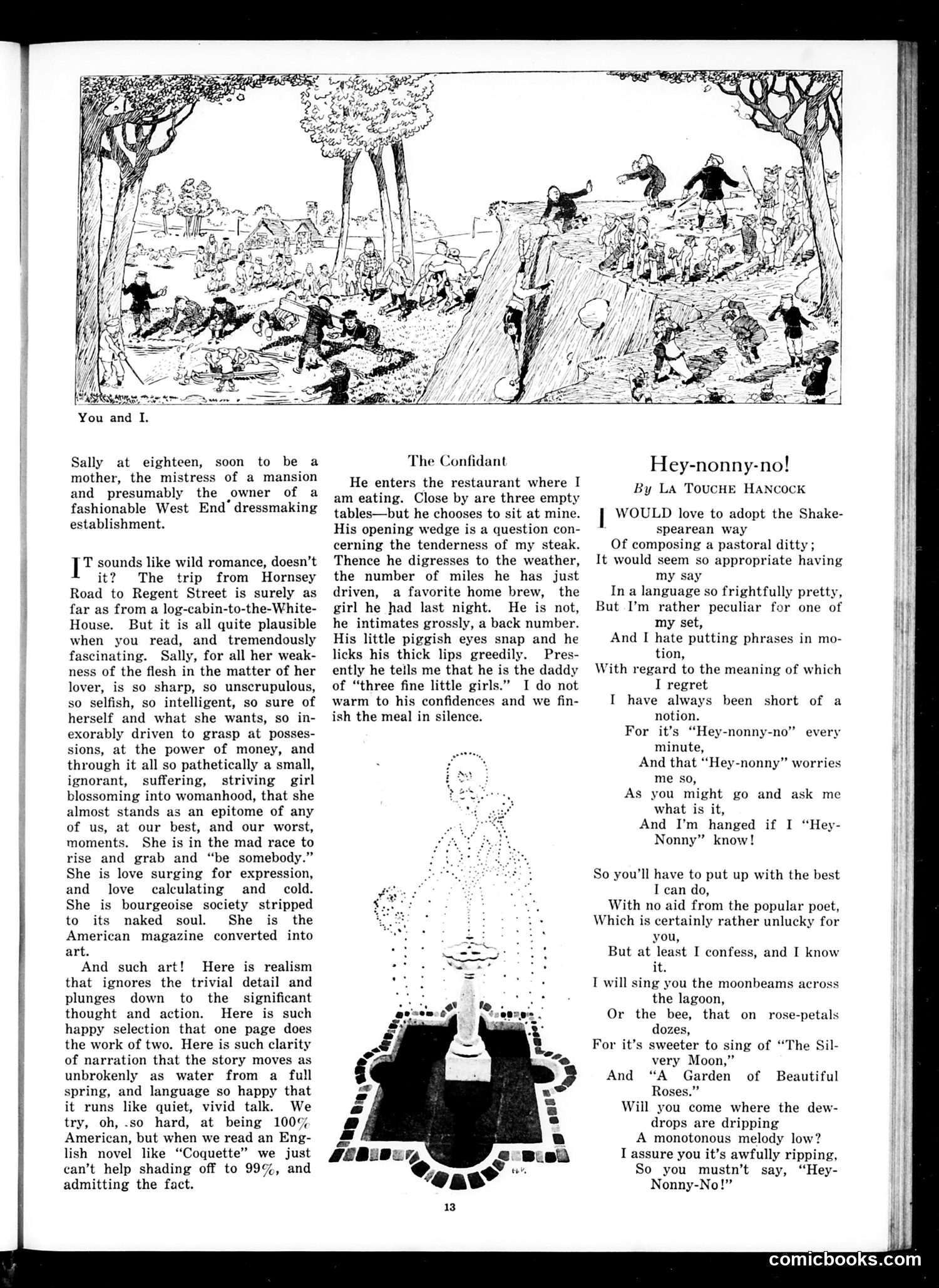
This page contains two distinct pieces: **"You and I" (left):** A book review praising the novel "Coquette," which tells of Sally, an eighteen-year-old working-class girl from Hornsey Road who becomes a wealthy West End dressmaking establishment owner. The reviewer celebrates the novel's realism, character development, and clarity of narration. The critique notably acknowledges that despite American efforts at 100% independence, English novels like this remain superior—a backhanded compliment admitting British literary superiority. **"The Confidant" and "Hey-nonny-no!" (right):** Two unrelated pieces. "The Confidant" briefly satirizes an intrusive restaurant stranger who overshares personal details. "Hey-nonny-no!" is a humorous poem by La Touche Hancock mocking Shakespearean pastoral verse conventions while admitting the author doesn't understand archaic expressions like "hey-nonny-no" but will attempt pretty nature poetry anyway. The page blends literary criticism with light social satire and whimsical verse.
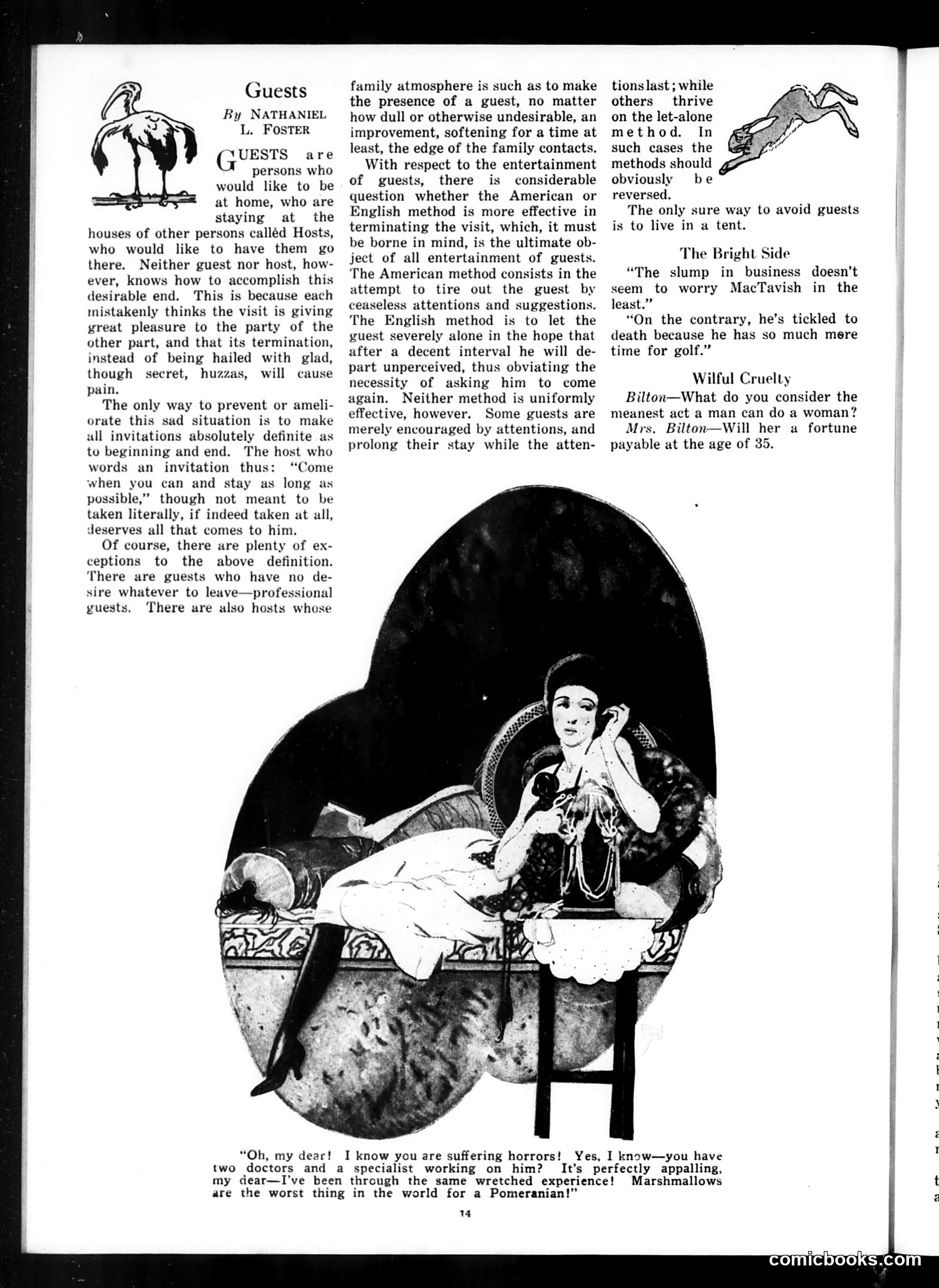
This page from *Judge* magazine contains a satirical essay on houseguests by Nathaniel L. Foster, accompanied by a cartoon illustration. **The Main Article:** Foster defines "guests" as people mutually uncomfortable with each other—hosts want guests to leave; guests want to leave but don't know how to say so. He contrasts American and English methods of terminating visits: Americans exhaust guests with constant attention; English hosts ignore them into leaving. The humor lies in exposing this universal social hypocrisy. **The Cartoon:** Shows an elegantly dressed woman commiserating with a bedridden, clearly ill visitor about the visitor's Pomeranian dog suffering from doctors' care—"marshmallows are the worst thing in the world for a Pomeranian." The satire mocks upper-class social performance: the hostess performs sympathy over trivialities (the dog) while the guest lies suffering, exemplifying the awkward, dishonest dynamics Foster describes. **Sidebar jokes** about business slumps and willing fortunes are unrelated society humor typical of the era.
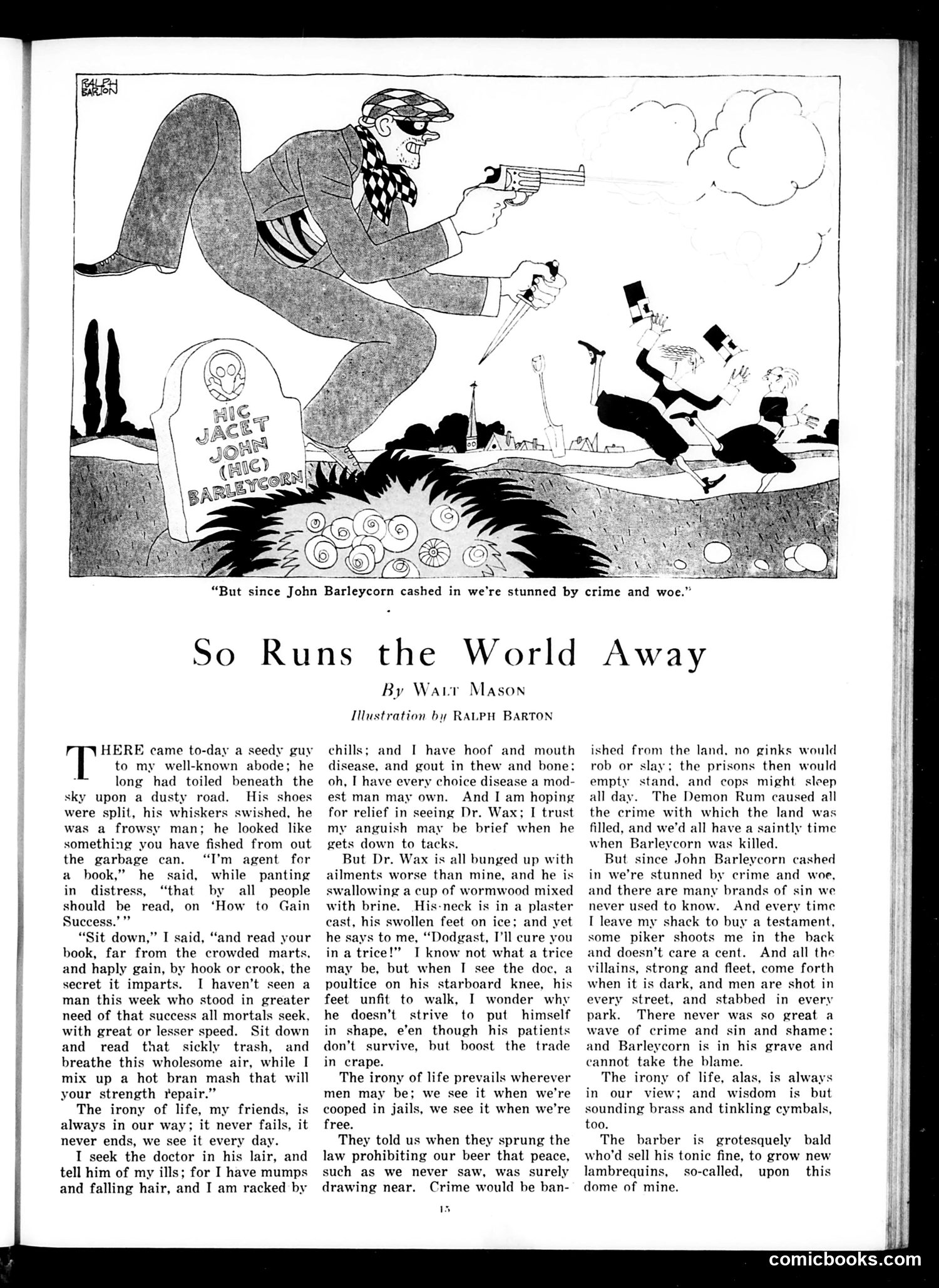
This story by Walt Mason, illustrated by Ralph Barton, satirizes Prohibition's failure. The cartoon shows a giant gangster firing a gun over a graveyard marked "John Barleycorn" (personification of alcohol), with well-dressed men fleeing in panic—representing crime erupting after Prohibition's enactment. The text mocks the ironic contradiction: Prohibition advocates promised that banning alcohol ("John Barleycorn") would eliminate crime. Instead, the narrator observes crime has *increased* dramatically—shootings, robberies, and violence plague the streets daily. The story's repeated refrain, "the irony of life," emphasizes this bitter paradox: well-intentioned law created worse conditions. The doctor and barber anecdotes underscore life's general ironies, but the central satire critiques Prohibition as a failed social experiment that spawned organized crime rather than virtue.
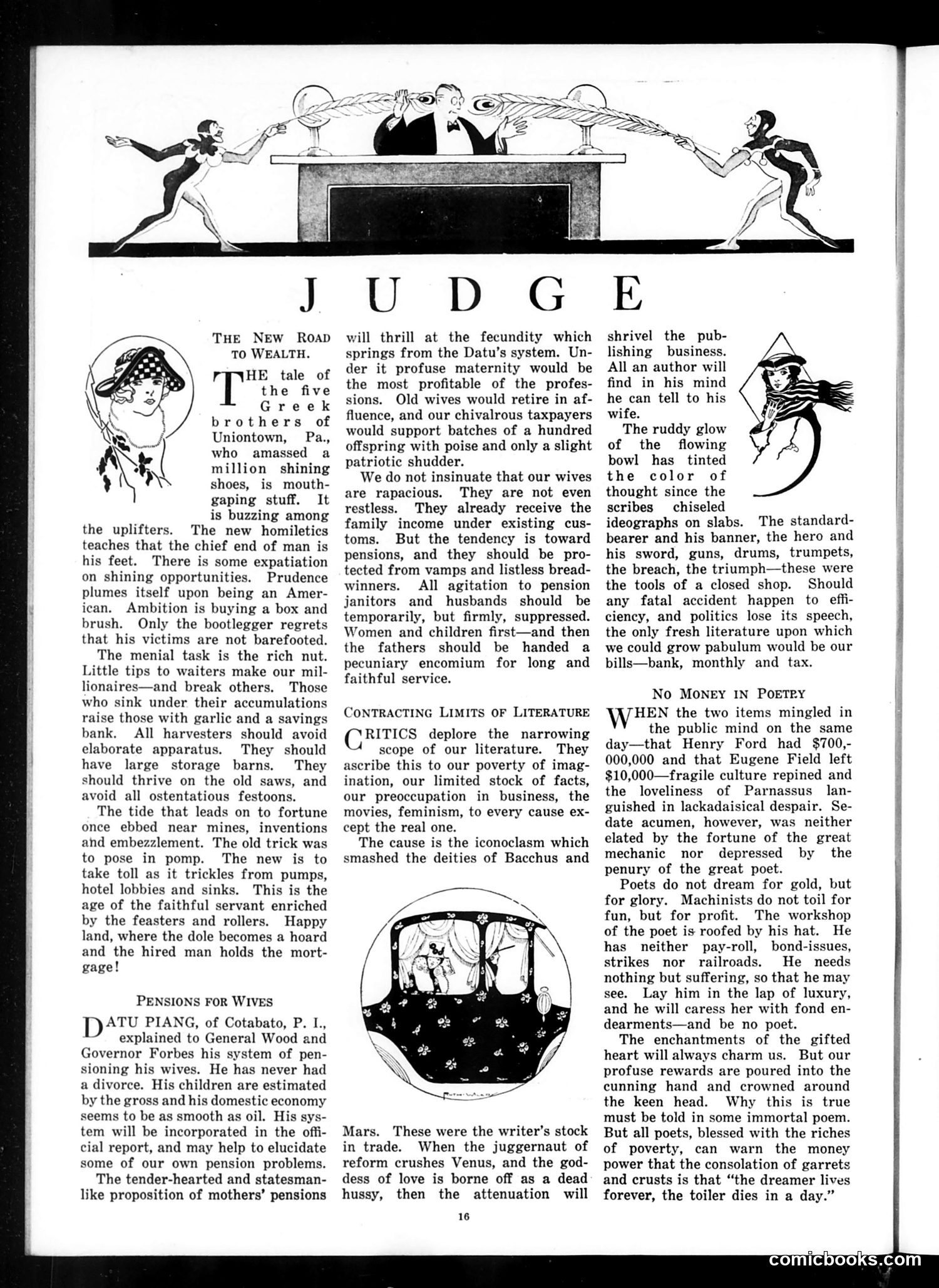
**Top Cartoon:** Shows a judge presiding over two figures juggling globes—a visual metaphor for balancing competing interests or managing complex situations. **Main Articles:** 1. **"The New Road to Wealth"** satirizes the American fascination with rags-to-riches stories, mocking the elevation of shoe-shining (manual labor) into a romantic success narrative. Judge ridicules the "uplifters"—reformers and moral crusaders—for glorifying menial work while ignoring that wealth traditionally came from mines, inventions, and embezzlement. 2. **"Pensions for Wives"** attacks a Philippine colonial official (Datu Piang) who supported multiple wives and praised his system to U.S. officials. Judge satirically suggests adopting his pension model would incentivize prolific motherhood, mocking both colonial governance and contemporary feminist pension proposals. 3. **"Contracting Limits of Literature"** claims modern literature has narrowed because reform movements eliminated traditional literary subjects: Bacchus (drinking/revelry), Mars (war/heroism), and Venus (romance). Without these, writers have nothing to discuss except their wives and tax bills. All three pieces reflect early 1910s skepticism toward Progressive reform, feminism, and colonial ventures.
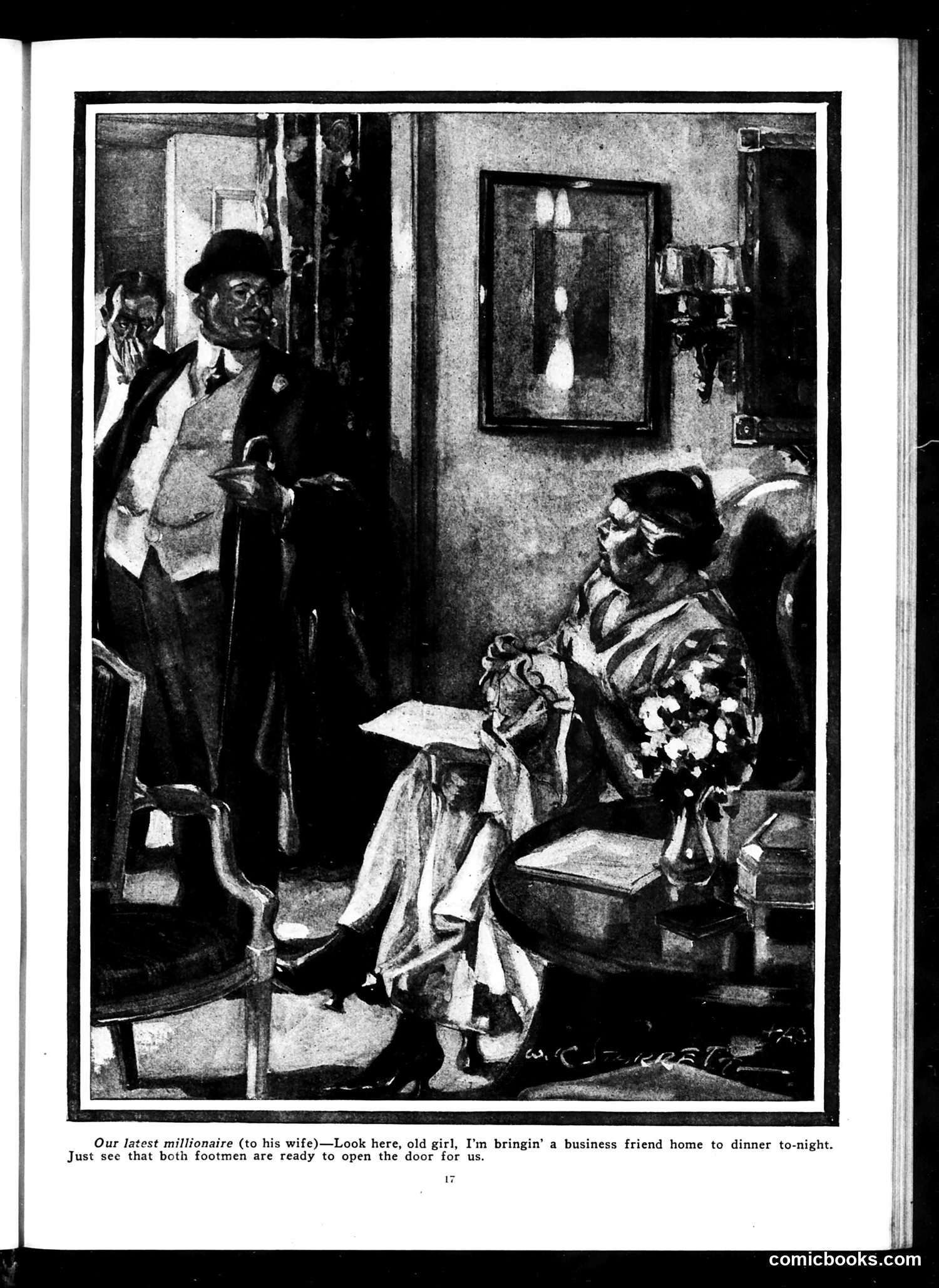
This cartoon satirizes newly wealthy individuals and their pretensions. A man identified as "our latest millionaire" instructs his wife to ensure both footmen are positioned to open the door—an ostentatious display of servants and status. The humor lies in the absurd excess: hiring two footmen merely to open a door for a business dinner guest demonstrates the character's insecurity about his newfound wealth and his need to publicly display it through elaborate, unnecessary ceremony. The satire targets the gauche materialism of the nouveau riche—those who've recently acquired money but lack established refinement. Judge magazine regularly mocked this social climbing and conspicuous consumption among the newly wealthy during the Gilded Age, suggesting that true gentility requires restraint rather than theatrical displays of household staff.
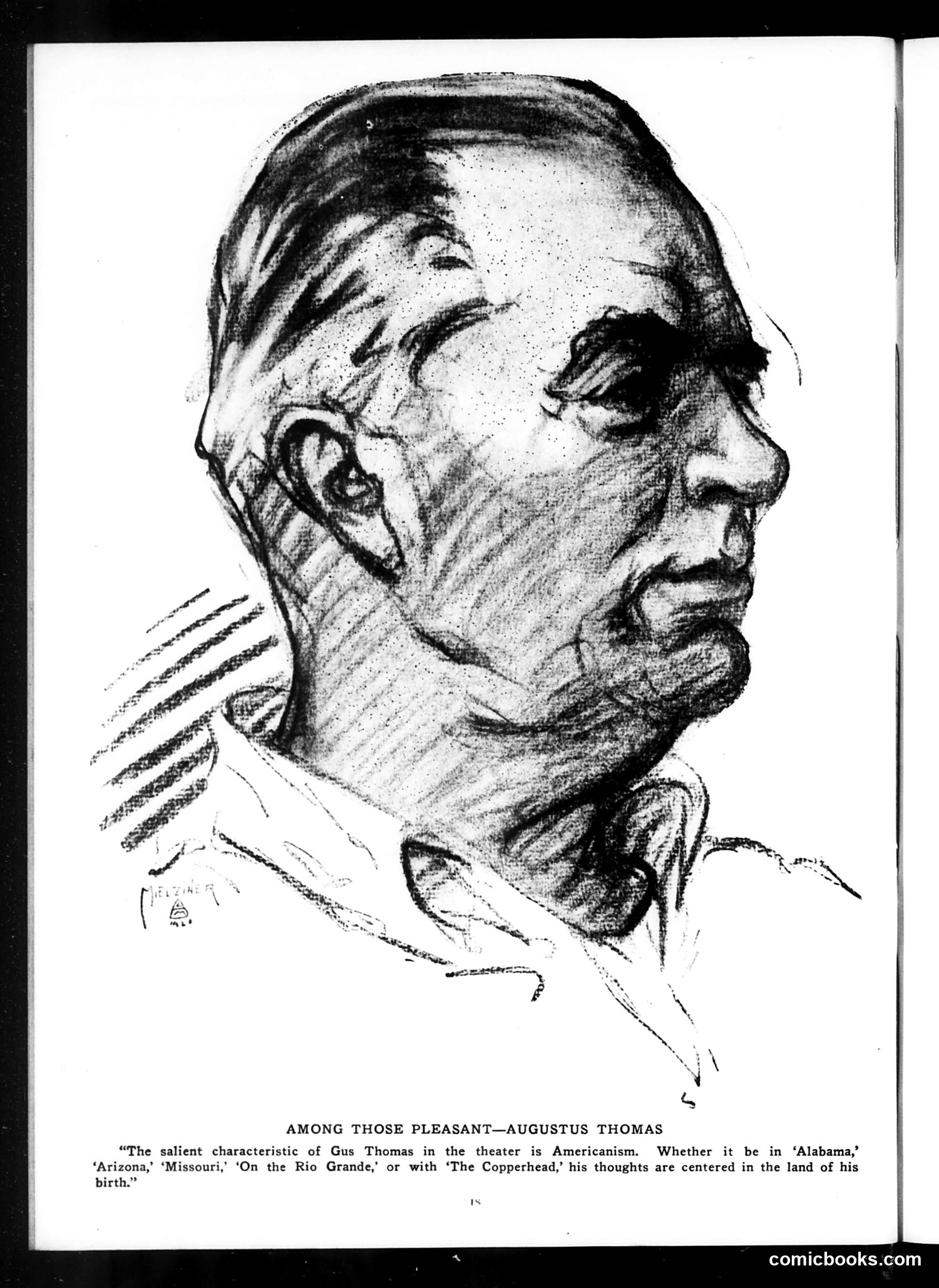
This page features a portrait sketch of **Augustus Thomas**, a prominent American playwright. The accompanying text praises Thomas for his distinctly American theatrical voice, noting that regardless of setting—whether Alabama, Arizona, Missouri, or frontier locations—his plays center on American themes and values. The reference to works like *Alabama*, *Arizona*, *Missouri*, *On the Rio Grande*, and *The Copperhead* identifies these as his major productions, each set in different American regions. The satire's point appears celebratory rather than mocking: Judge magazine is recognizing Thomas as embodying "Americanism" in theater during an era when American playwrights were still establishing cultural independence from European dramatic traditions. The sketch captures him in profile, presenting him as a significant figure worthy of serious artistic representation.
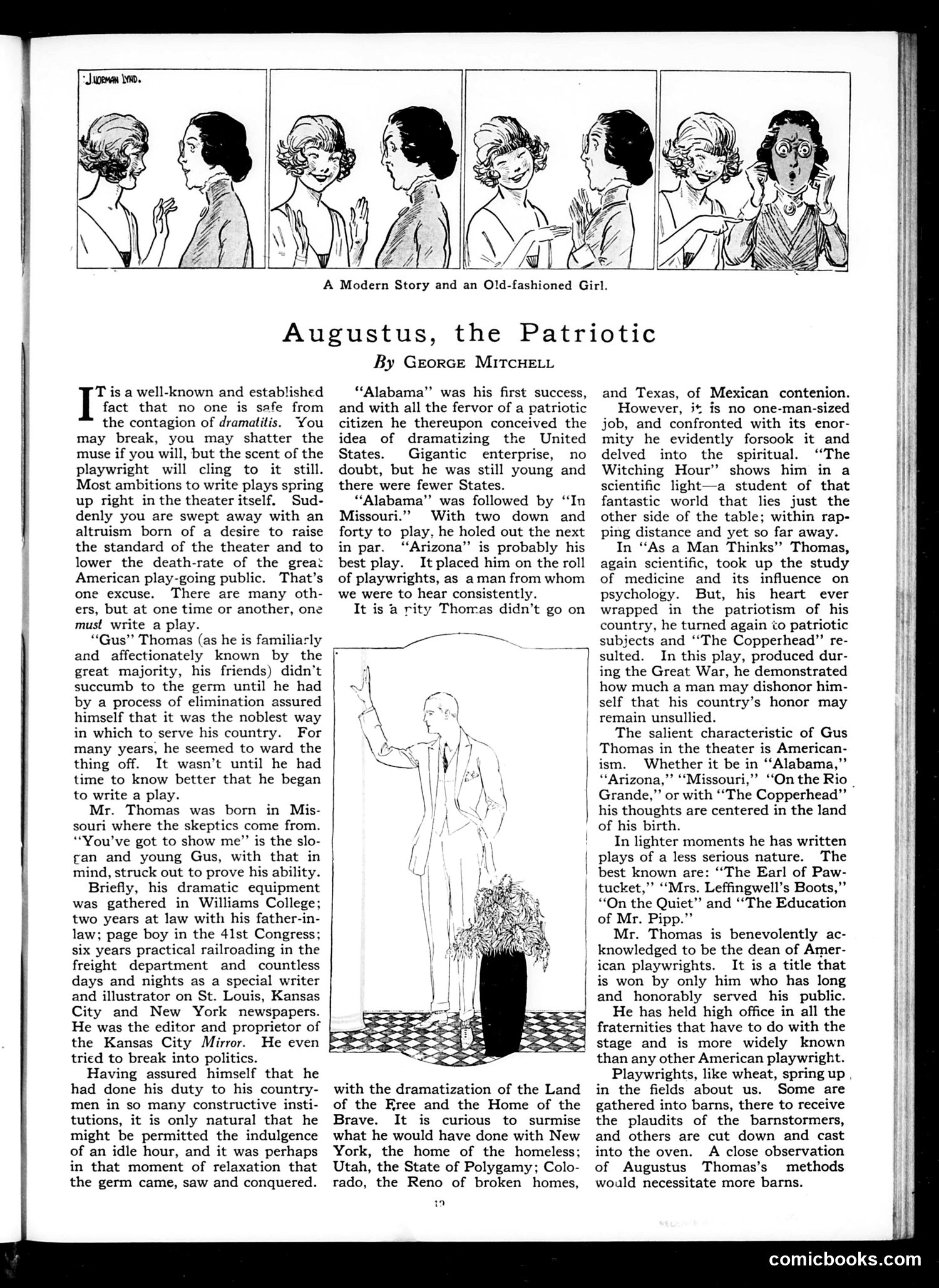
This page profiles American playwright Augustus Thomas. The comic strip at top depicts "A Modern Story and an Old-fashioned Girl"—likely satirizing contemporary gender dynamics or romantic conventions, though specific characters aren't identified. The main article celebrates Thomas as a patriotic dramatist who "assured himself that it was the noblest way in which to serve his country" by writing plays. The humor lies in the exaggerated notion that playwriting is a patriotic duty. Thomas, a Missouri native ("show me" skeptic), built credibility through journalism and railroading before turning to drama. The satire gently mocks his ambitious project: dramatizing individual American states (*Alabama*, *Arizona*, *Missouri*). The piece jokes he prudently abandoned completing all forty-eight states, while humorously speculating what he'd make of morally complicated places like Utah (polygamy) and Colorado (divorce capital). The overall tone praises Thomas's "Americanism" while subtly satirizing both his grandiose theatrical ambitions and the cultural elevation of theatrical work to patriotic service.
This is a satirical essay, not a political cartoon. The illustration shows a caricatured mime or theatrical performer in a circular frame, flanked by grotesque head studies—typical Judge visual styling for commentary pieces. Nathan's text viciously attacks American stage actors as incompetent, vain, and unprofessional. His central complaint: Broadway actors are lazy "hams" who've debased their profession through disrespect, relying on union membership and physical display rather than genuine skill or study. He contrasts the few serious performers (mentioning Drew and Daly as worthy examples) against the "swivel-eyed morons" who dominate modern theater. Notably, Nathan praises American actresses as having improved themselves through discipline, while condemning male actors as increasingly mediocre. The satire targets not politics but theatrical culture itself—mocking actors' pretension, Union protection, and the audiences who enable their mediocrity.
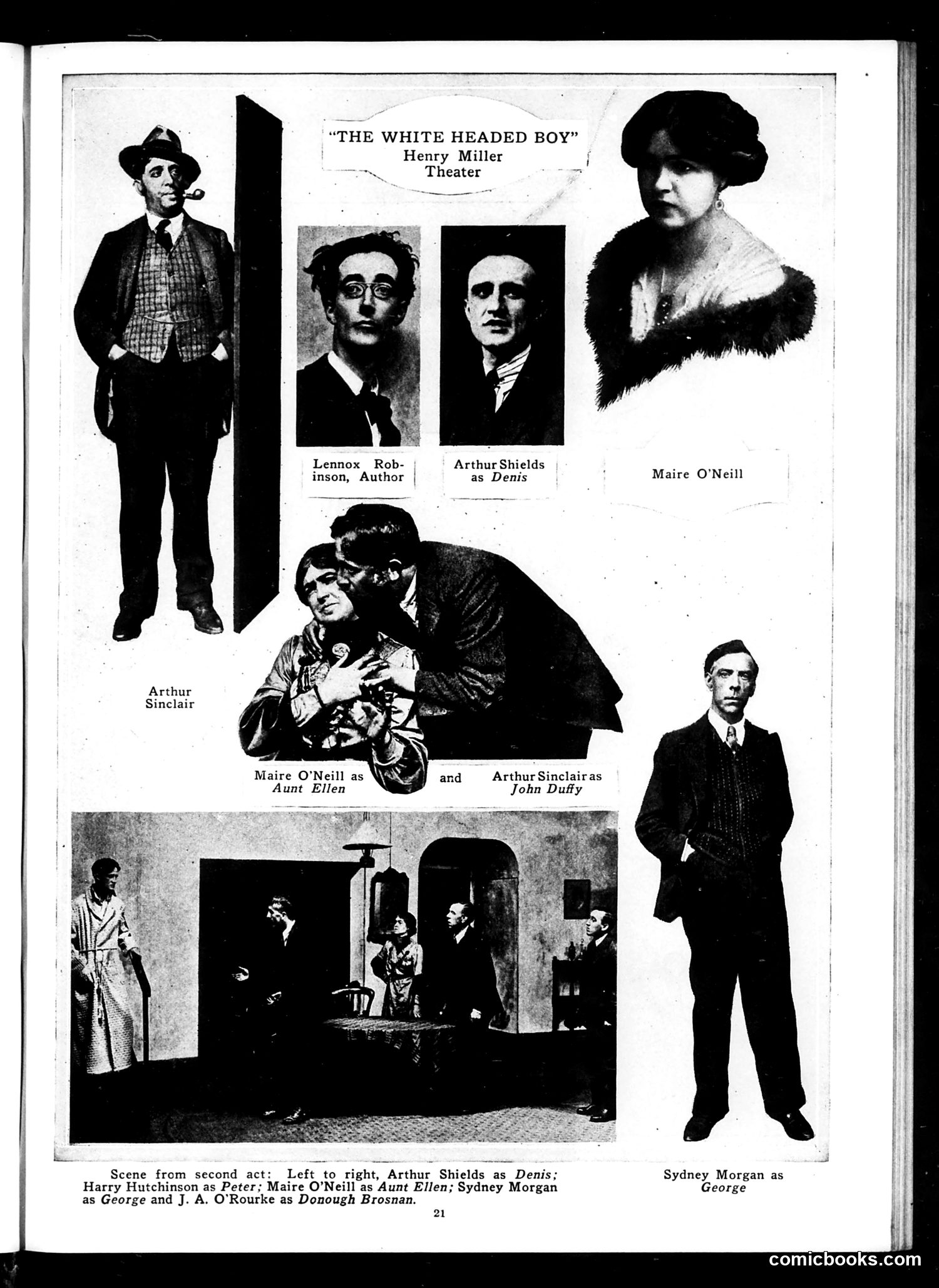
This is a theatrical advertisement/review page for a play called "The White Headed Boy" by Irish author Lennox Robinson, performed at Henry Miller Theater. The page features cast photographs and a scene still from the production. The layout presents headshots of the main actors (Arthur Sinclair, Maire O'Neill, Arthur Shields, and Sydney Morgan) along with their character names, and includes a scene photograph from Act Two showing multiple cast members in what appears to be an interior setting. This appears to be a straightforward theatrical promotion rather than political satire—it's documenting a stage production, likely from the early 20th century based on the photographic style. The Irish names and author suggest this was an Irish play, possibly addressing Irish cultural themes, though the specific satirical or dramatic content isn't evident from this cast/credits page alone.
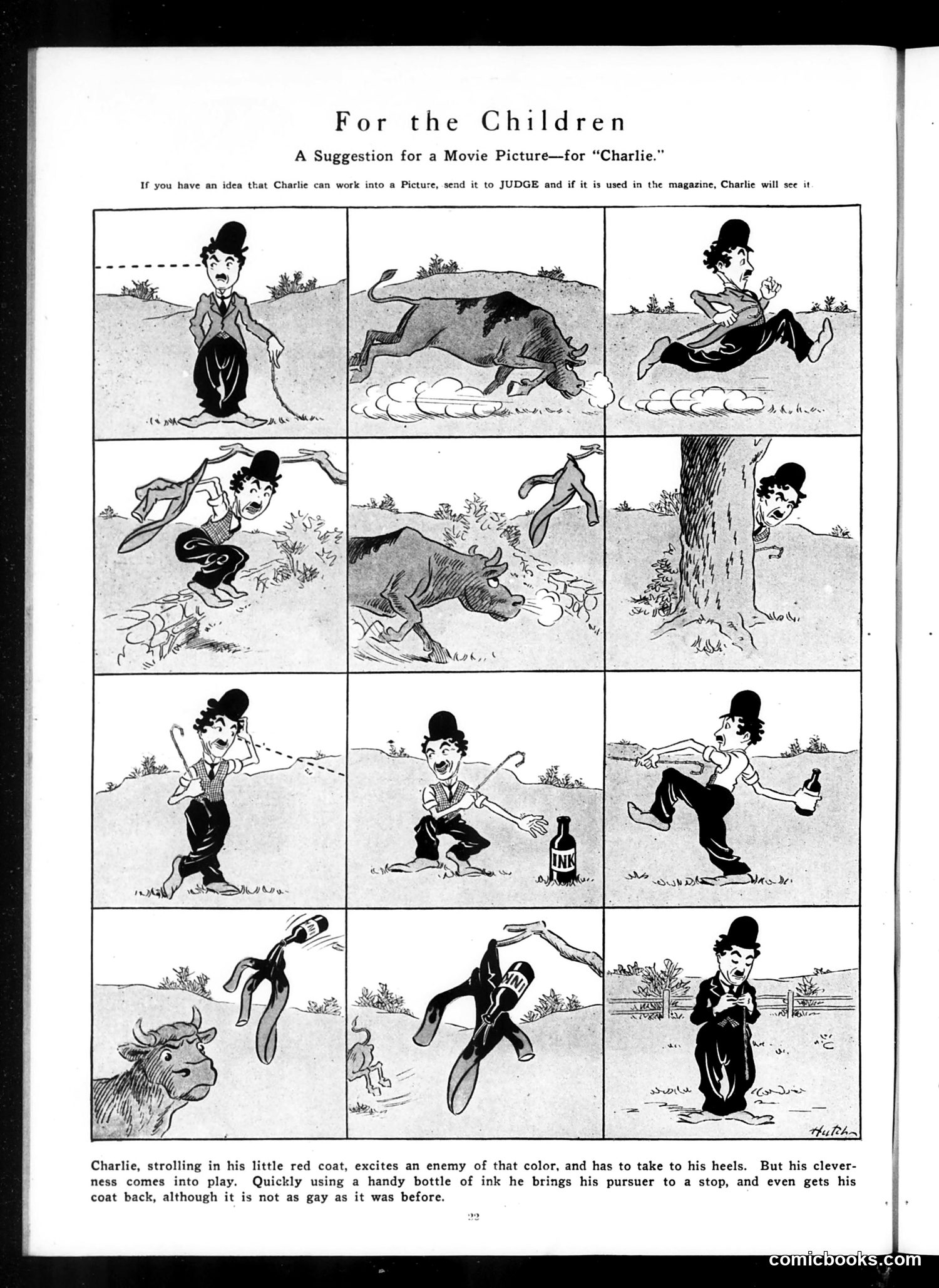
This is a comedic storyboard titled "A Suggestion for a Movie Picture—for 'Charlie,'" inviting readers to submit ideas for a film featuring someone called "Charlie." The narrative follows a character in a red coat being chased by an enemy (apparently a bull, based on the horned animal depicted) who is enraged by the color red. The joke's humor relies on slapstick and clever wordplay: Charlie escapes using a bottle of ink as a weapon, which stops his pursuer and allows him to recover his coat—though now stained black from the ink, making it "not as gay [bright] as it was before." This appears to be an interactive feature inviting reader submissions rather than political satire. The reference to "Charlie" likely refers to a popular film character of that era, though the specific identity is unclear from the page alone.
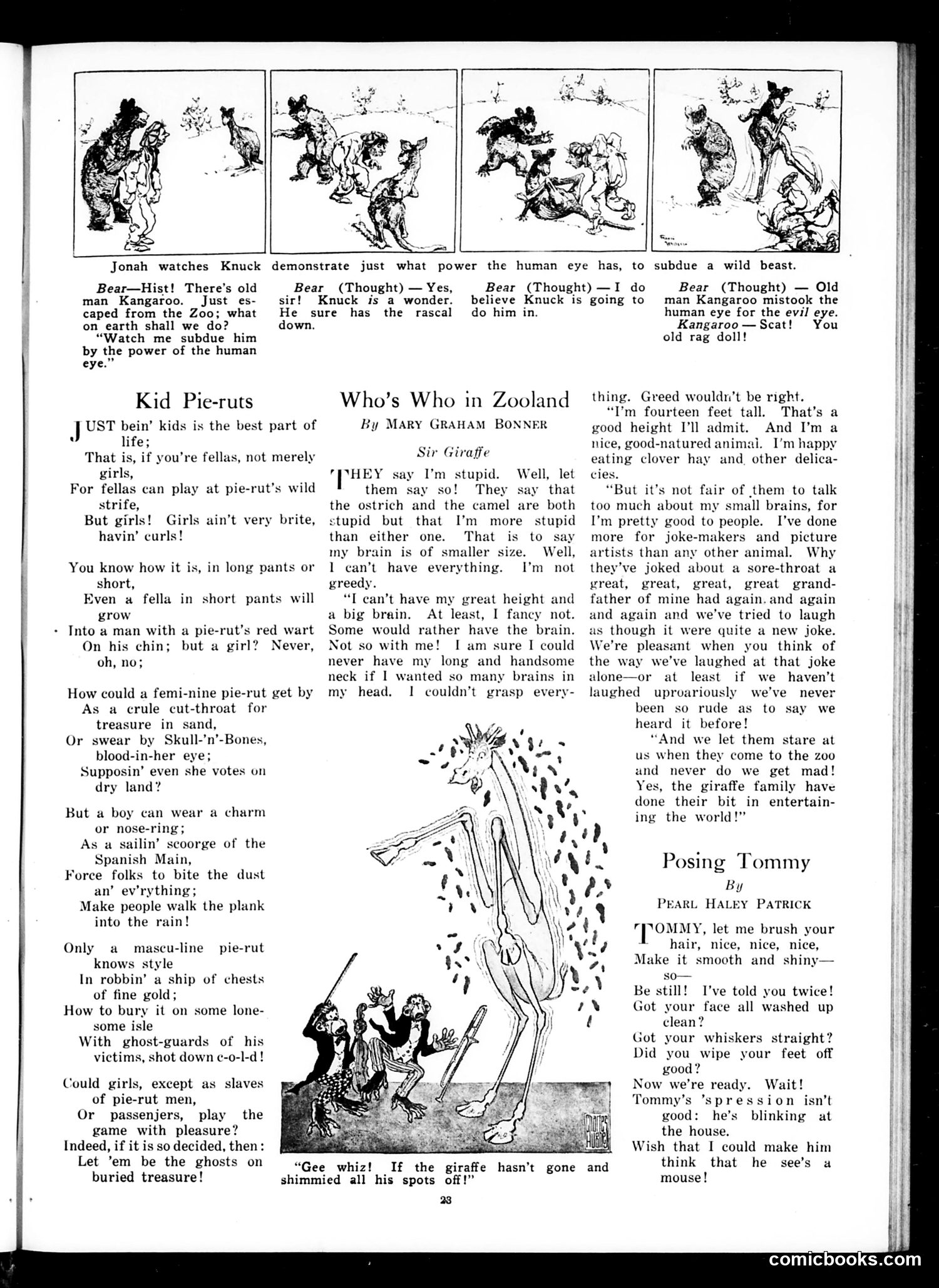
This page contains three separate pieces of light humor content typical of early-20th-century American magazines: **Top cartoon:** Shows a child named Jonah attempting to subdue escaped zoo animals (a bear and kangaroo) through "the power of the human eye." The bears' thought balloons reveal the joke—the animals misinterpret this as an "evil eye" and flee, making the child's claim accidentally work. It's gentle slapstick humor. **"Kid Pie-ruts":** A poem satirizing gender expectations. It argues boys can engage in adventurous pirate play with social acceptance, while girls cannot—they're expected to remain proper despite having "curls." The satire critiques these restrictive social norms, though from a period perspective that still assumes girls' inferiority. **"Who's Who in Zooland":** The giraffe personified complains about being called stupid due to small brain size, defending itself by claiming contentment and noting its entertainment value to humans. **"Posing Tommy":** A brief domestic scene about preparing a child for a photograph, with gentle humor about childhood restlessness. The page reflects early-1900s attitudes toward children, gender roles, and animals.
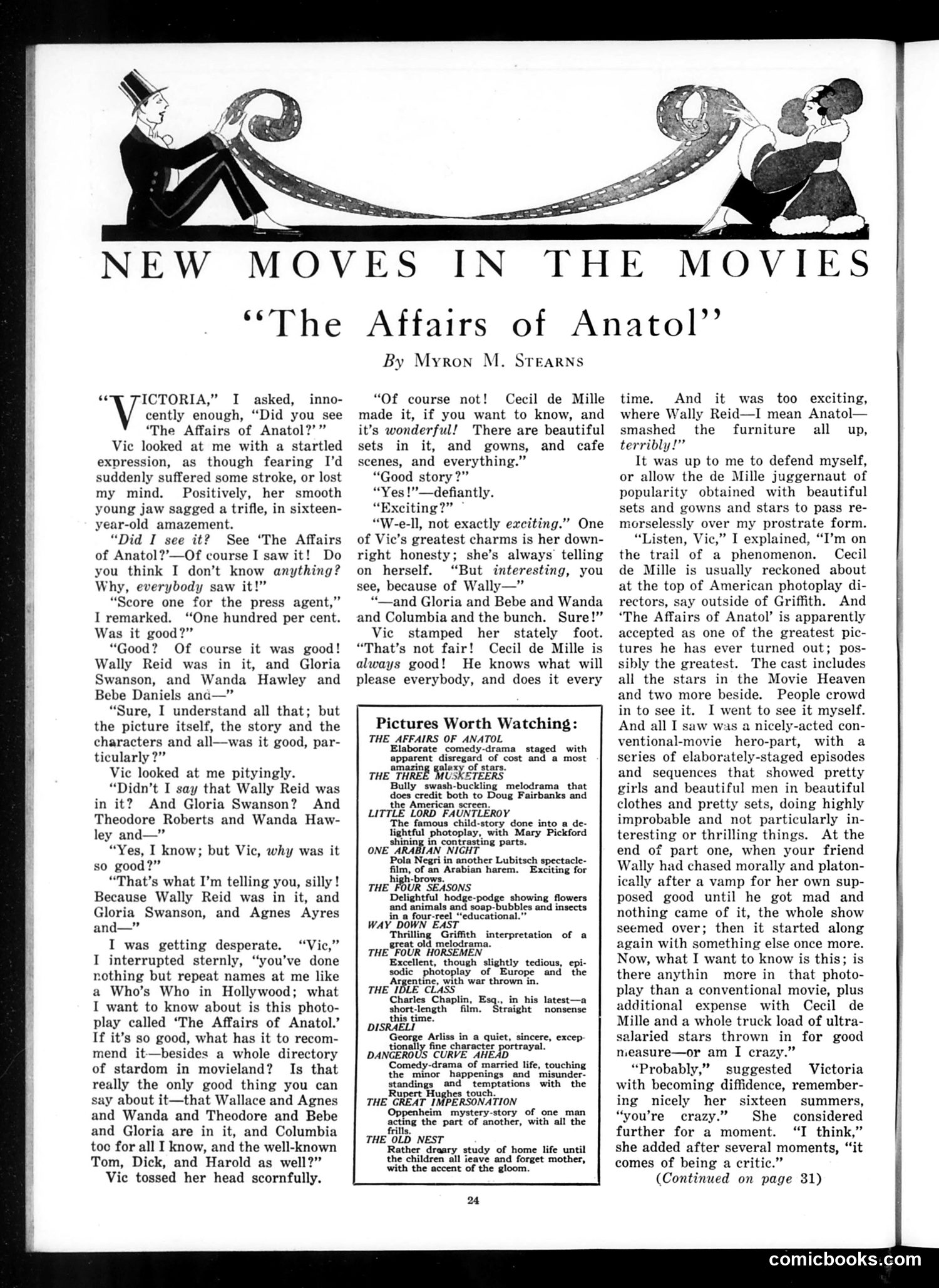
This article satirizes how 1920s moviegoers evaluated films based solely on **celebrity casts** rather than artistic merit. The dialogue between the narrator and "Vic" (a teenage girl) shows her repeatedly defending "The Affairs of Anatol" by listing stars—Wally Reid, Gloria Swanson, Wanda Hawley—rather than discussing plot, story quality, or direction. The satire's target: audiences didn't care about the film itself. When pressed about whether the story was actually "exciting," Vic reluctantly admits it's "not exactly exciting" but "interesting...because of Wally." Even Cecil B. DeMille's directorial reputation becomes secondary to star names. The accompanying movie reviews (in the box) focus on substantive elements—plot, direction, cinematography—highlighting the contrast. The joke: modern moviegoers are intellectually lazy, valuing marquee names over the actual cinematic experience. This reflects genuine 1920s anxiety about mass entertainment and celebrity culture's growing influence.
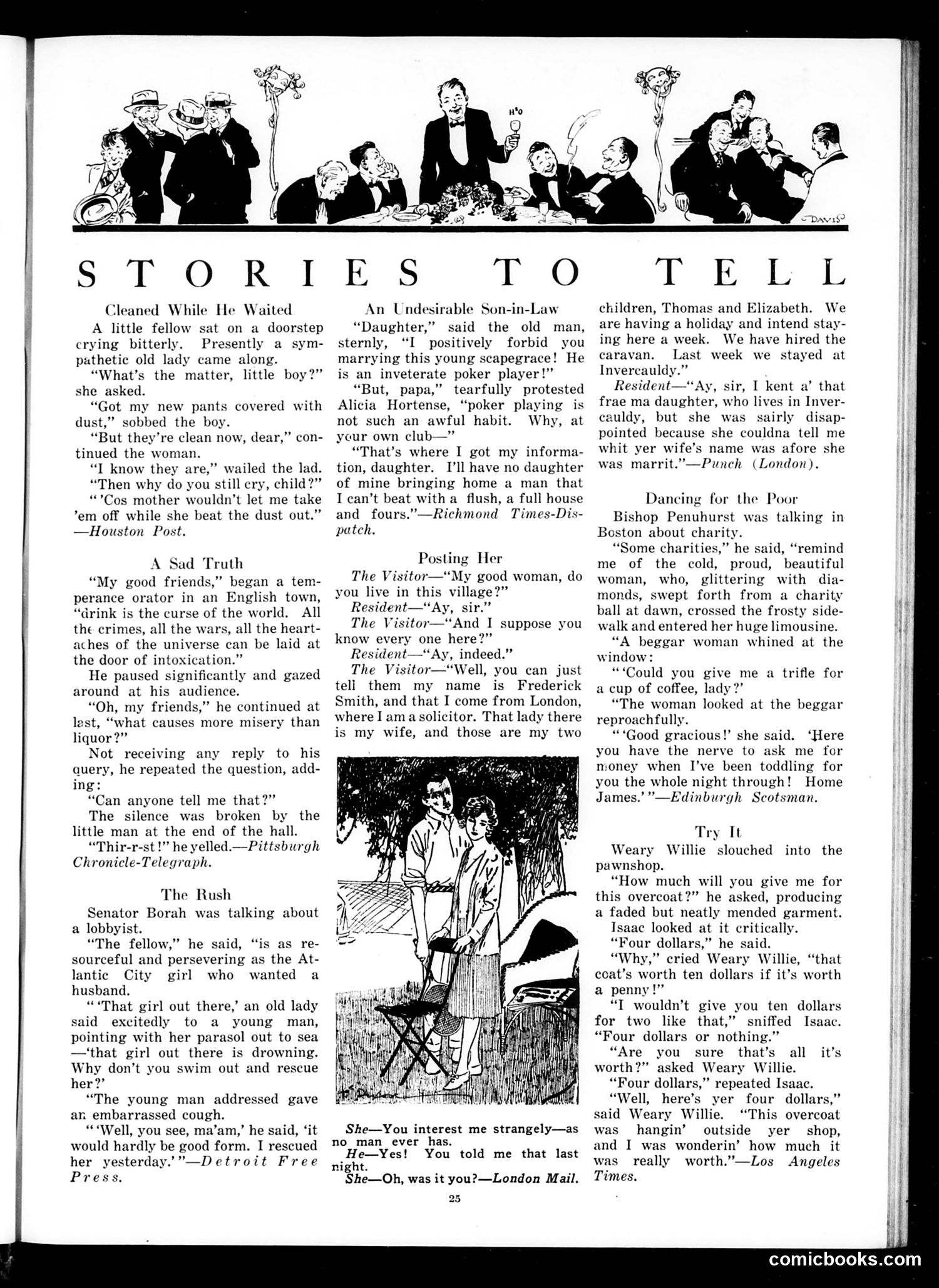
This page contains six brief humorous stories typical of early 20th-century satirical magazines, each mocking social pretenses and human nature. **Key stories:** "Cleaned While He Waited" jokes about a mother beating dust from her son's pants while wearing them—practical but absurd. "A Sad Truth" satirizes a temperance speaker whose lecture on alcohol's evils is undermined when an audience member shouts "Thirst!"—suggesting people's actual motivations contradict moral arguments. "The Rush" uses a Senator's anecdote about a lobbyist as a metaphor for persistence, comparing him to an Atlantic City girl who repeatedly tries to marry men. "An Undesirable Son-in-Law" mocks a father who forbids his daughter marrying a poker player—hypocritically, since he gambles at his own club. The remaining stories humorously depict social awkwardness and class differences. The overall tone reflects Judge's satirical approach: poking fun at human folly, Victorian social conventions, and the gap between public morality and private behavior.
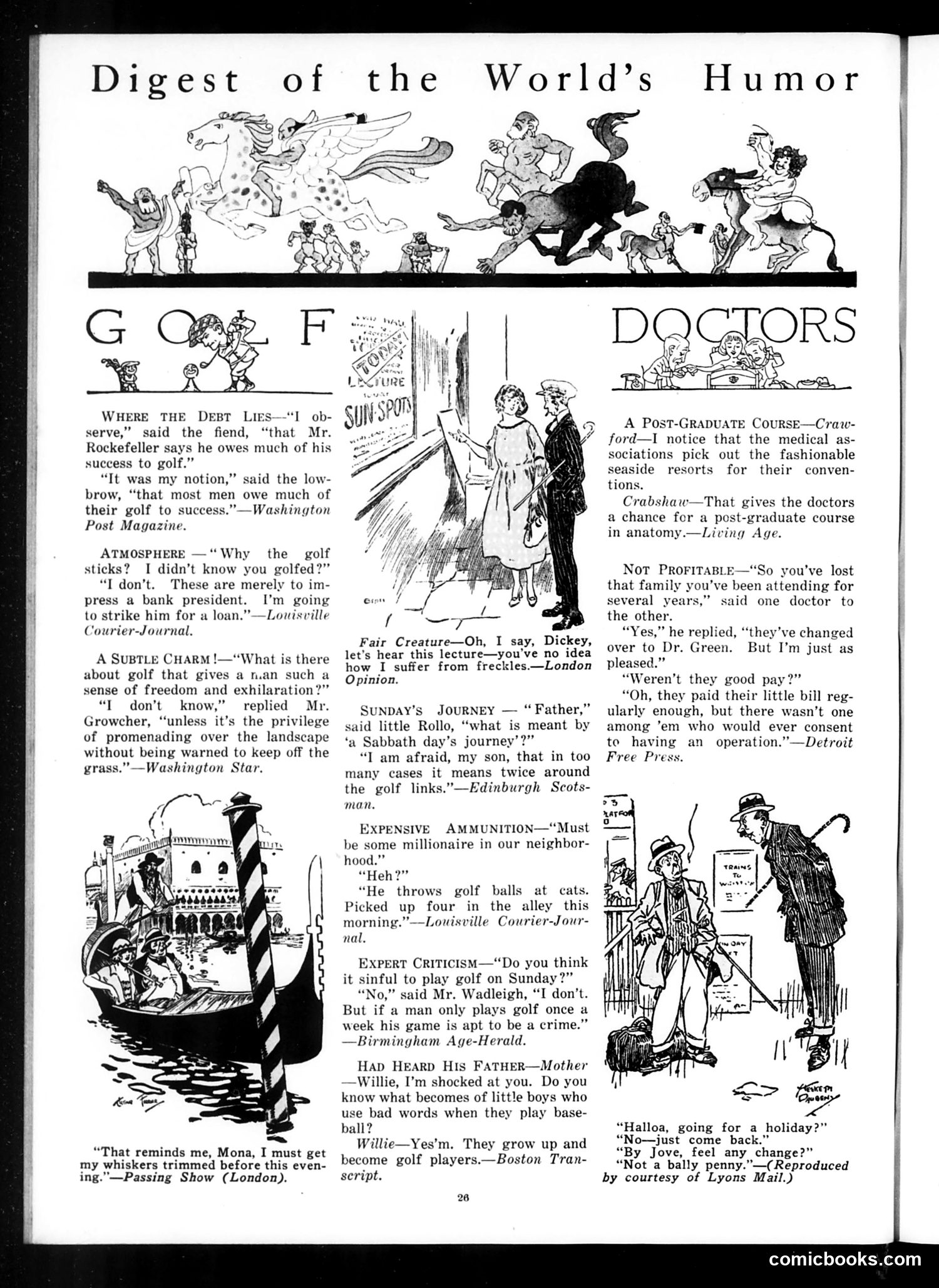
This page collects brief satirical jokes about golf's cultural obsession in early 20th-century America, plus medical humor. **Golf jokes:** Multiple quips mock golf's pervasive hold on society. One suggests Rockefeller attributes success to golf rather than vice versa. Another depicts a man carrying golf clubs merely to impress a banker for a loan. A banker joke contrasts wealthy men's golf freedom with ordinary workers' restrictions. Sunday golf receives criticism as potentially worse than weekday play. Children supposedly hear golf discussed so much they use profanity about it. **Medical humor:** Doctors supposedly attend seaside resorts for "post-graduate courses in anatomy" (implying romantic encounters). Another joke notes doctors lose patients to competitors but don't miss losing families who refuse surgery. The cartoons and captions satirize golf as an absurdly dominant leisure preoccupation among the wealthy, while poking fun at professional vanity in banking and medicine.
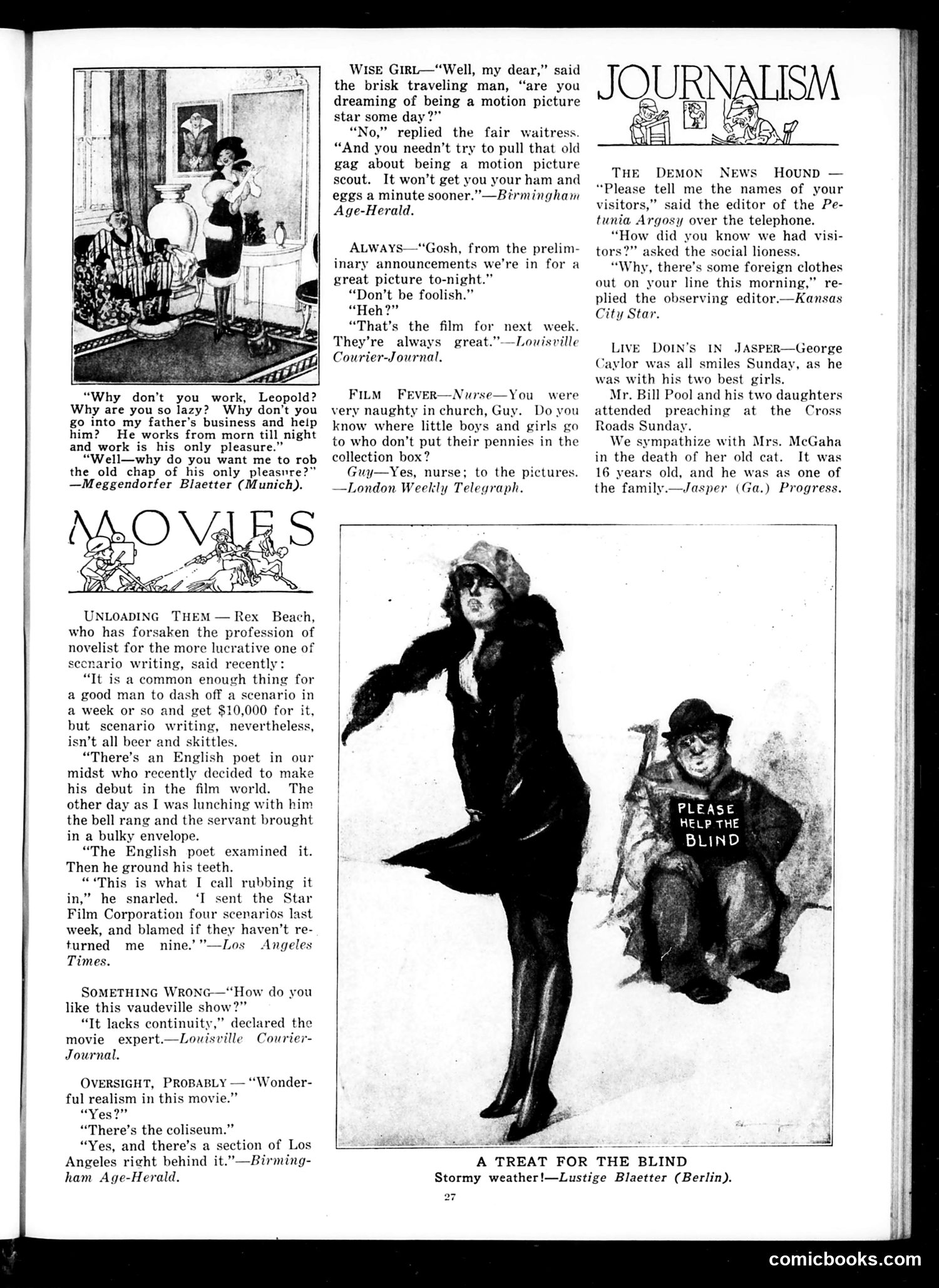
This page comprises several brief humorous anecdotes mocking the early film industry's rapid expansion and cultural pretensions circa 1910s-1920s. **Key satire targets:** 1. **Scenario writing boom**: Rex Beach's anecdote mocks how lucrative (yet absurd) film scenario-writing had become—a poet submits four scenarios and receives nine rejections back, suggesting the industry's chaotic overproduction. 2. **Movie snobbery**: Jokes about "movie experts" criticizing films for lacking "continuity" and praising "realism" while missing obvious anachronisms (like the Coliseum appearing in modern Los Angeles footage). 3. **Motion picture scout clichés**: A waitress deflates the traveling salesman's predictable pickup line about discovering her for cinema—she doesn't believe the tired trope. 4. **Film quality**: The recurring joke that preliminary announcements promise greatness, but films are "always" disappointing. The cartoon "A Treat for the Blind" (bottom right) shows a well-dressed woman helping a blind beggar in stormy weather—the humor likely being either ironic commentary on charity or the visual incongruity of fashionable assistance.
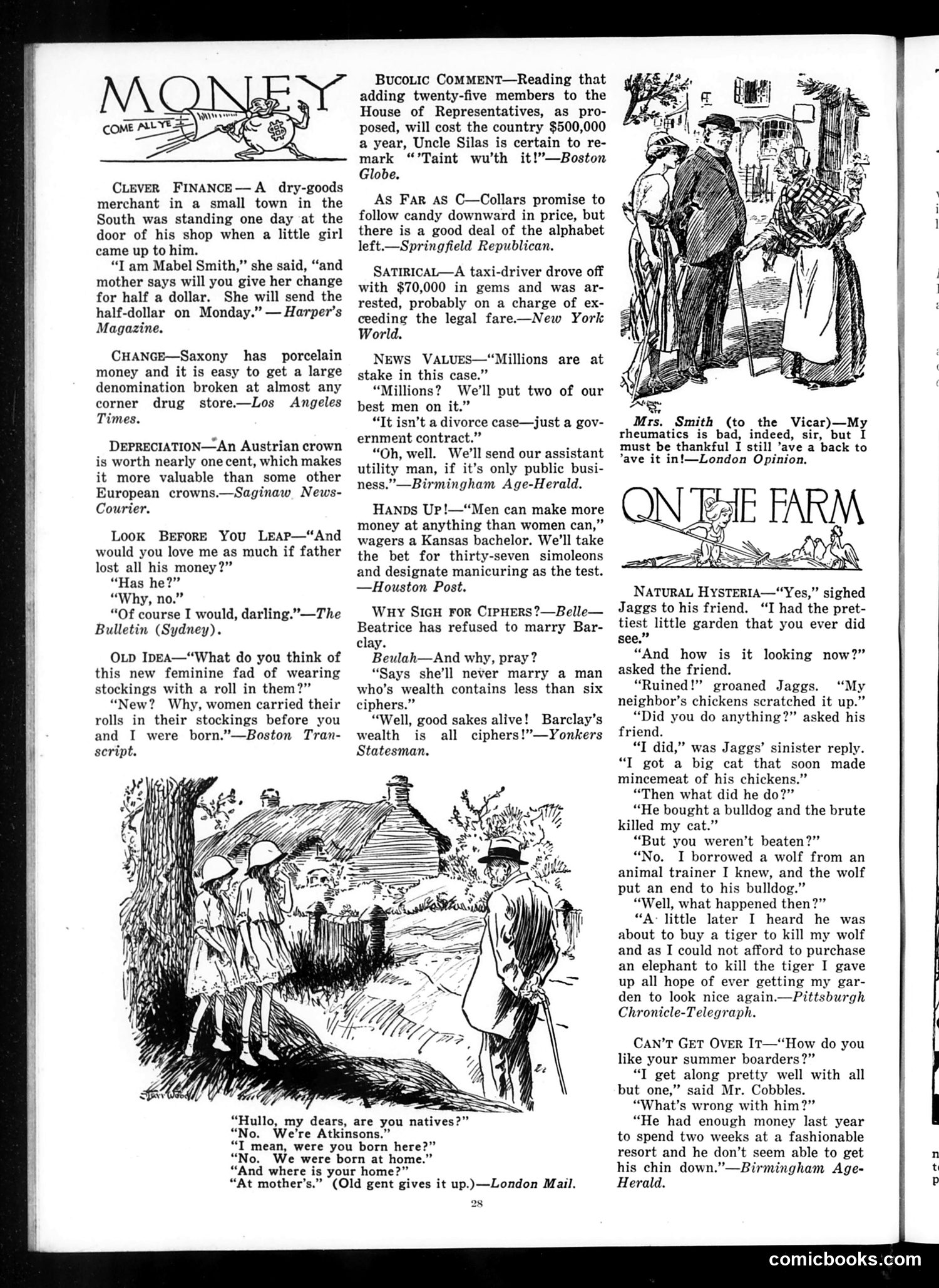
This page collects brief humorous anecdotes satirizing early 20th-century American society and economics. Key targets include: **Financial absurdity**: Multiple items mock currency depreciation (Austrian crowns nearly worthless), "porcelain money" in Saxony, and a taxi driver charged with "exceeding the legal fare" after stealing $70,000 in gems—suggesting fares are arbitrarily inflated. **Class and wealth**: Jokes about women's economic value ("manicuring" contest), a woman rejecting a suitor because his wealth contains "less than six ciphers" (mocking materialistic marriage), and summer boarders displaying newfound wealth pretentiously. **Domestic absurdity**: The escalating neighbor feud (chickens → cat → bulldog → wolf → planned tiger) satirizes neighborly disputes spiraling into ridiculousness. **Labor politics**: A congressman joke suggests adding House members costs $500,000 yearly—likely critiquing government bloat during Progressive Era expansion debates. The cartoon illustration shows rural characters, supporting the "bucolic comment" theme. Overall, the page satirizes economic inequality, materialism, and governmental inefficiency through working-class perspectives.
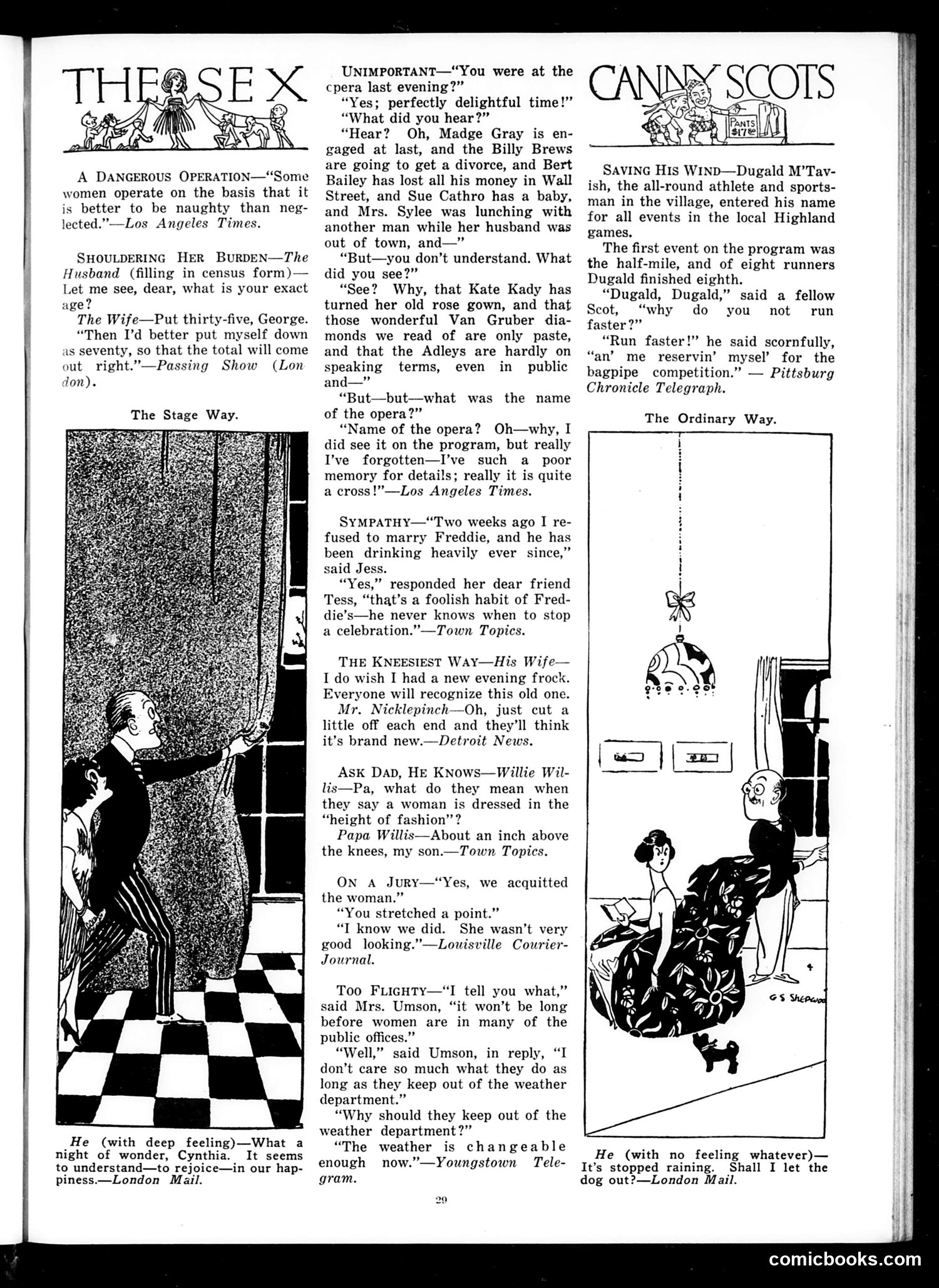
This page from the satirical magazine **Judge** contains multiple short humor pieces targeting early 20th-century social conventions and gender roles. Key satirical targets include: **Women's behavior**: The "Unimportant" piece mocks women attending opera who gossip about scandal rather than appreciating the performance itself—a critique of women's supposed frivolity and shallow interests. **Marriage dynamics**: Multiple jokes attack marital relationships—wives lying about age to husbands, husbands dismissing wives' wardrobe concerns with penny-pinching solutions, and couples' emotional disconnection. **Women in public life**: "Too Flighty" jokes that women shouldn't work in weather forecasting because they're inherently "changeable"—a common argument against women's participation in professional roles. **Physical appearance**: Recurring jokes about women's fashion, particularly hemlines ("height of fashion" = one inch above knees), treating female bodies as objects of scrutiny. The humor reflects period anxieties about women's expanding social roles while reinforcing stereotypes about female irrationality, materialism, and appearance-obsession. The stage illustration shows a theatrical setting, reinforcing the "performance" theme of social pretense.
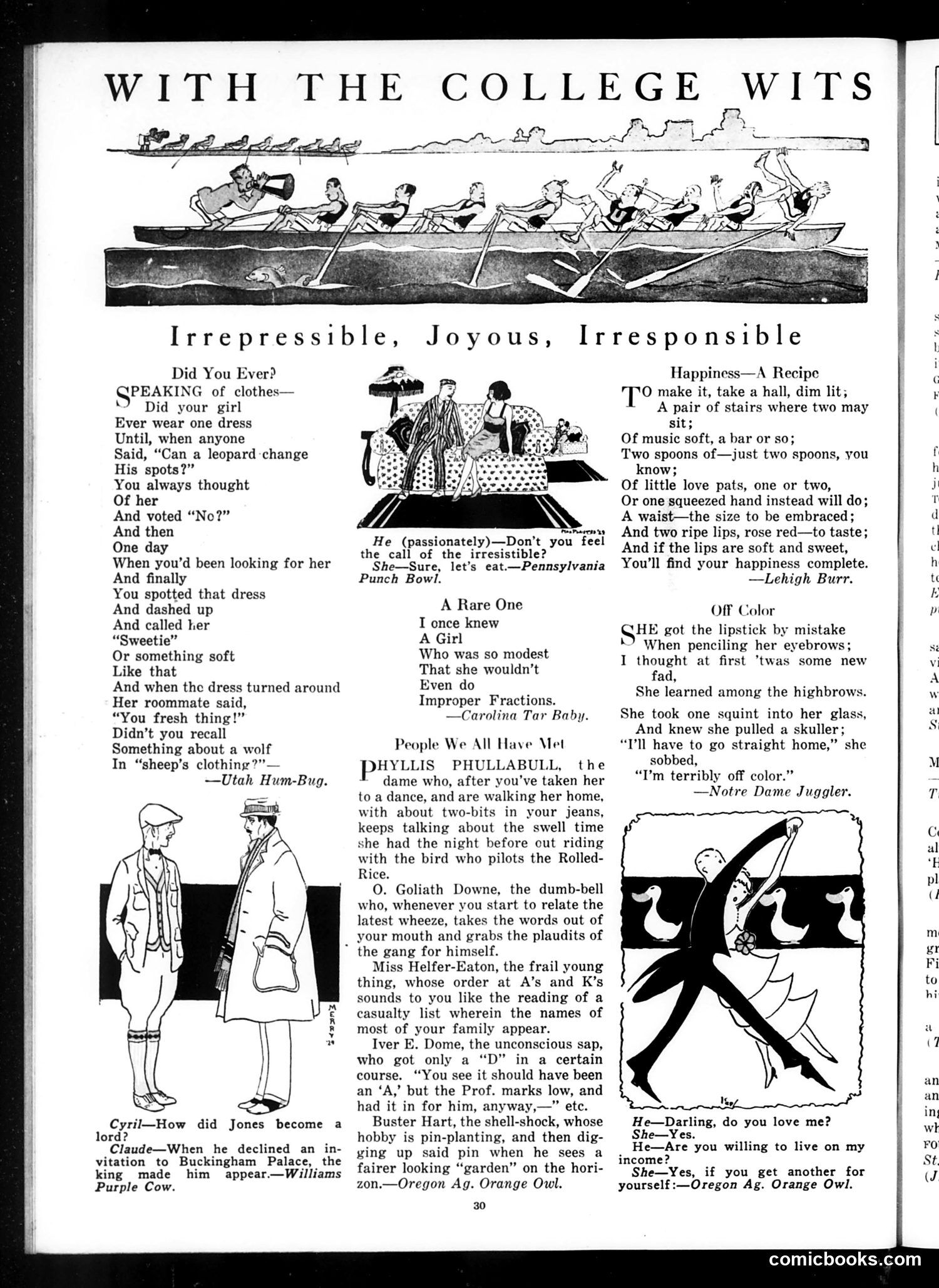
This page collects humor pieces from college newspapers, typical of Judge's satirical format. The content targets college-age dating and social behavior: **Main themes:** - **Dating awkwardness**: "Did You Ever?" mocks a boyfriend's confusion when his girlfriend rewears the same dress; the roommate's "You fresh thing!" suggests he's being inappropriately forward. - **Male social types**: "People We All Have Met" catalogs annoying college men—the broke date who hears about better previous dates, the joke-stealer, the inconsiderate eater, the grade-complainer, and the serial romantic "pin-planter" (fraternity pin-giving). - **Flirtation humor**: Recipes for "Happiness" and romantic banter play on 1920s courtship conventions. - **Women's cosmetics**: "Off Color" jokes about a woman mistakenly using lipstick as eyebrow pencil—poking fun at the era's heavy makeup trends. The satirical edge targets vanity, social pretension, and dating dishonesty among college youth. The rowing imagery at top suggests collegiate sophistication the content undercuts.
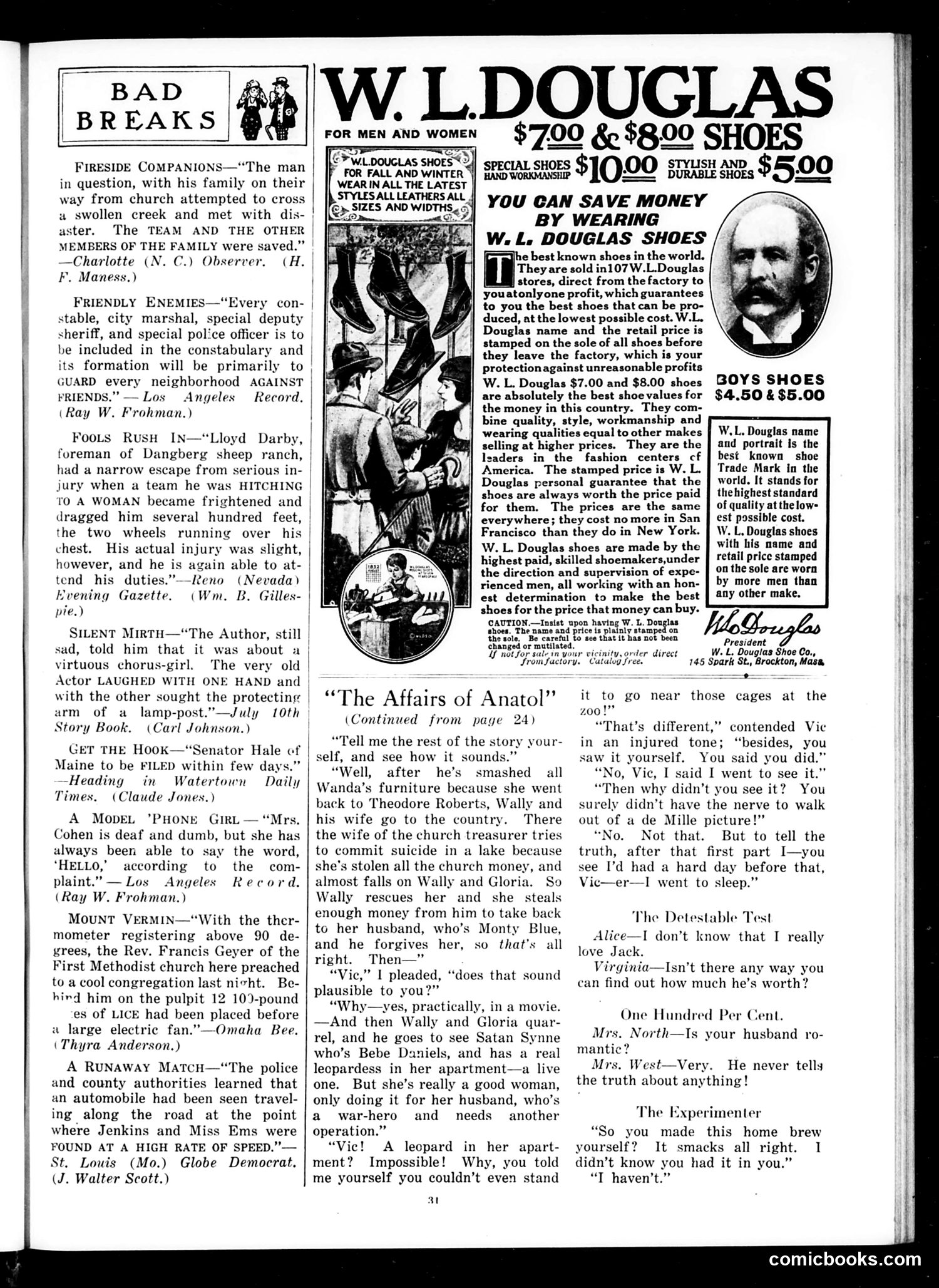
This page contains two elements: a satirical "Bad Breaks" column and a large shoe advertisement. **"Bad Breaks"** consists of humorous newspaper excerpts highlighting absurd or ironic situations. Examples include a family nearly drowning while crossing a creek after church, a sheep ranch foreman dragged by a frightened team, and a reverend preaching to a cool congregation thanks to 109 pounds of lice placed behind him. The humor derives from the deadpan newspaper reporting of ridiculous circumstances. The page also features a serialized film review of "The Affairs of Anatol," discussing an implausible plot involving furniture destruction, church theft, suicide attempts, and a live leopard in an apartment. The dominant feature is a **W.L. Douglas shoe advertisement** claiming to offer the "best known shoes in the world" at factory-direct prices ($7-$8 for men, $4.50-$5 for boys), eliminating middleman profit. The ad emphasizes quality, workmanship, and fair pricing compared to competitors.
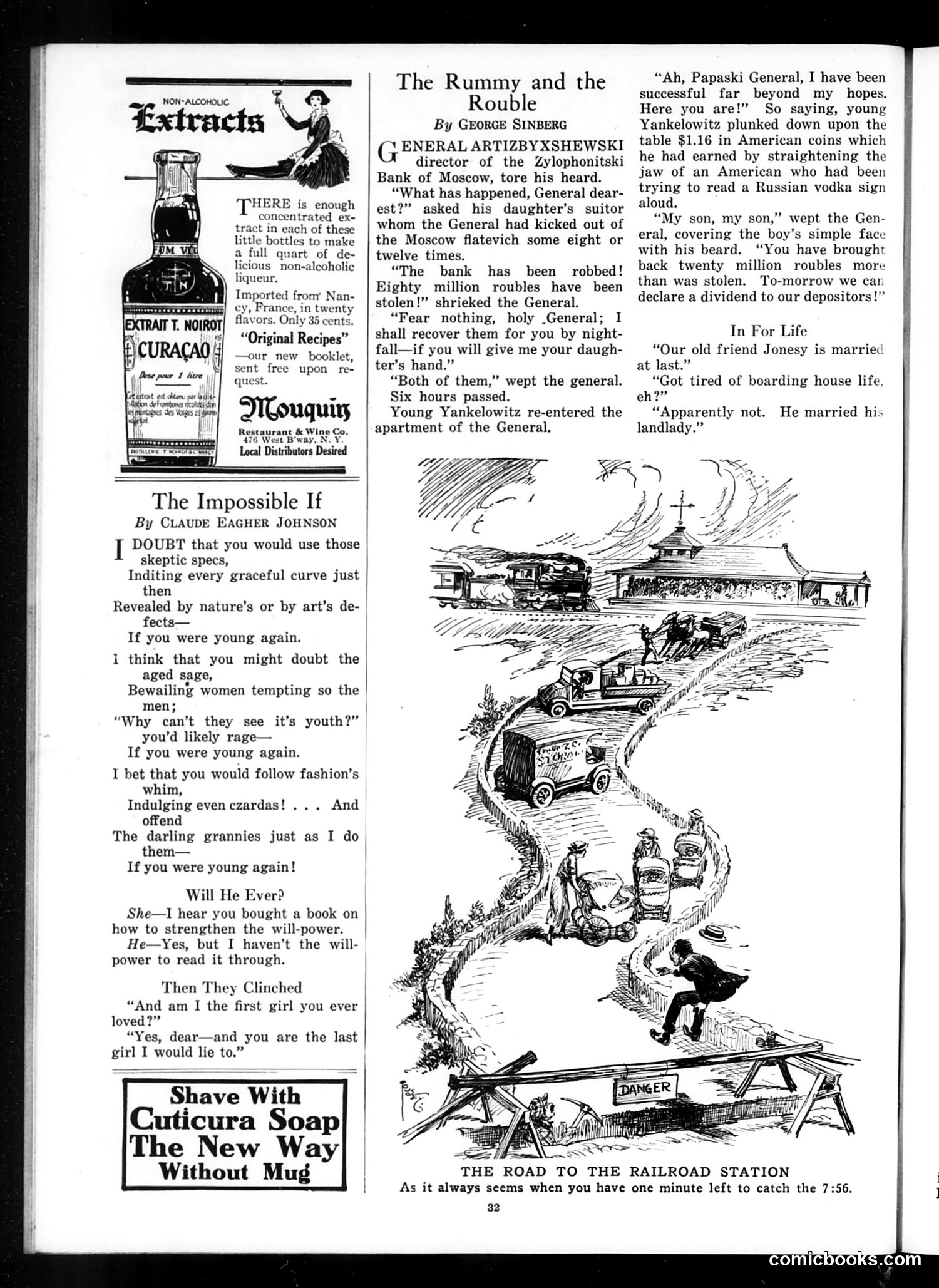
**"The Rummy and the Rouble"** is a Jewish stereotype joke typical of early 20th-century American humor. General Artizbyxshewski's Russian bank loses 80 million rubles. Young Yankelowitz, a Jewish suitor previously rejected eight times, promises recovery in exchange for the daughter's hand. He returns with only $1.16—earned by "straightening the jaw of an American reading a Russian vodka sign aloud"—yet the General celebrates this pittance as exceeding the loss. The satire mocks both stereotypical Jewish scheming (getting the girl through deception) and Russian-Jewish immigrant experience in America, where such meager earnings represented genuine hardship. The joke relies on ethnic caricature and antisemitic tropes common to the era. **The other content** includes light domestic humor ("Will He Ever?" about willpower) and a cartoon showing the chaotic road to catching a 7:56 train—relatable everyday satire about rushing.
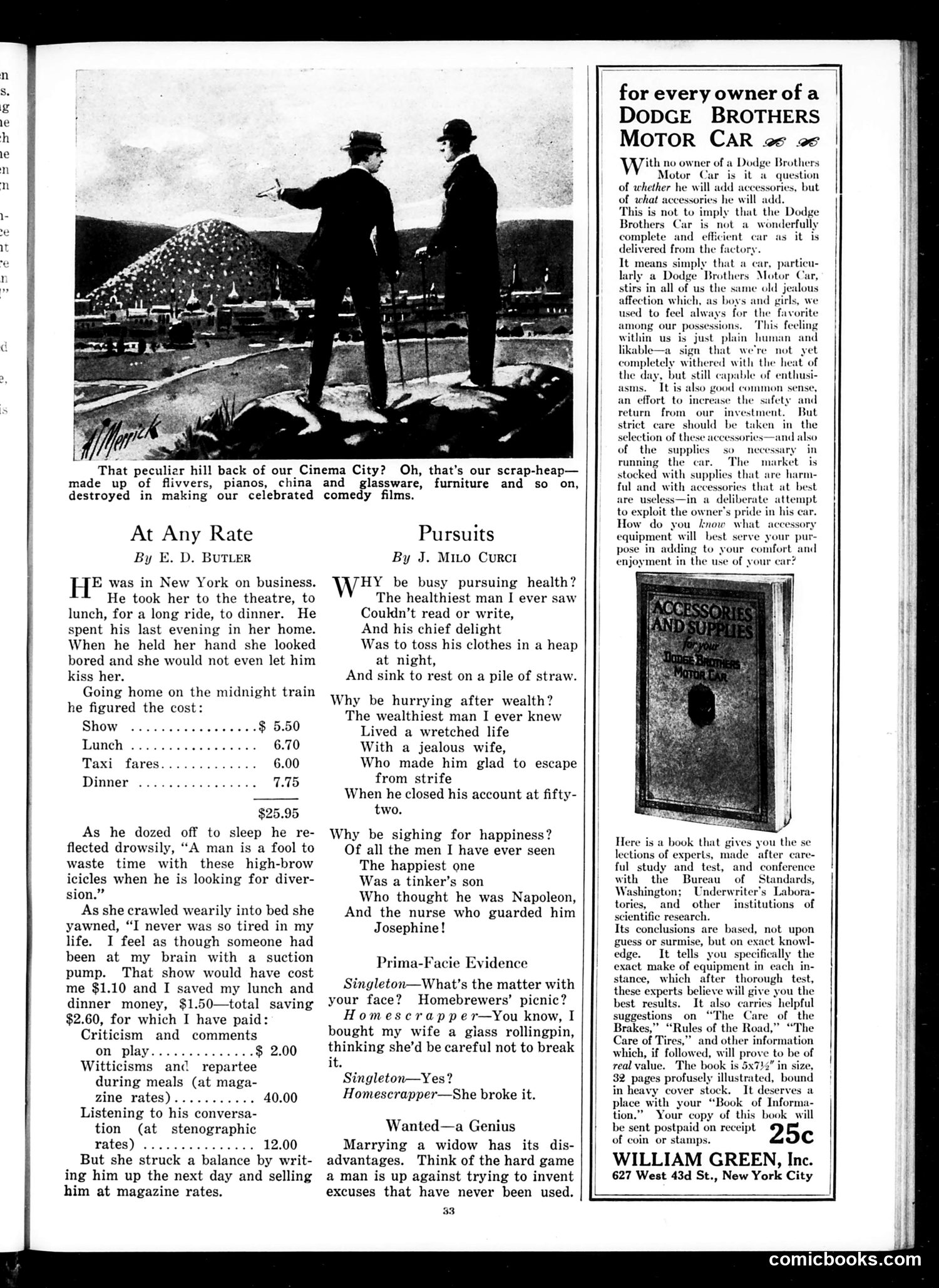
**The Main Cartoon:** The top image shows two men on a rooftop overlooking what appears to be a movie studio backlot. One points to a large hill of debris, explaining it's made from props destroyed during comedy film production—"flivvers, pianos, china and glassware, furniture" wrecked for slapstick scenes. This satirizes the extravagant waste of 1920s silent film comedies, where destruction was a primary source of humor. **The Written Pieces:** Three satirical stories mock social pretense and relationships. "At Any Rate" presents a date where both parties calculate costs and emotional labor as currency. "Pursuits" ridicules ambitions for wealth, health, and happiness through ironic examples. "Prima-Facie Evidence" jokes about domestic violence (a "glass rolling pin" used as a weapon). **The Dodge Advertisement** occupies the right column, promoting motor car accessories. The overall tone reflects post-WWI American skepticism toward romance, materialism, and social conventions.
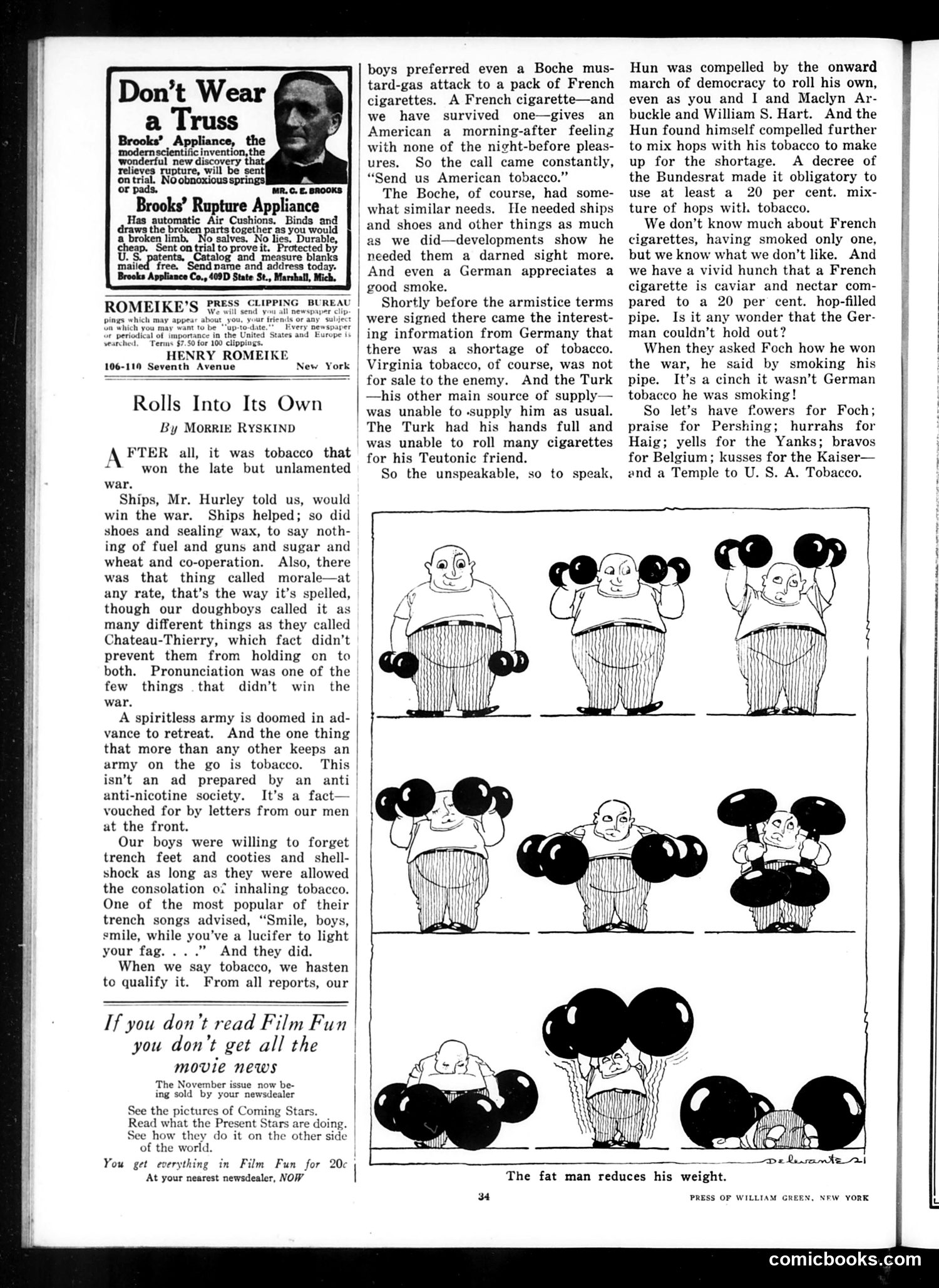
This page contains two distinct pieces of content: **Left side:** Advertisements (Brooks' Rupture Appliance, Romeike's clipping service, Film Fun magazine) and an article titled "Rolls Into Its Own" by Morris Ryskind about tobacco's role in World War I. **Right side:** A humorous cartoon strip showing a fat man performing weight-loss exercises with boxing gloves, titled "The fat man reduces his weight." **The Tobacco Article's Satire:** Ryskind humorously argues that tobacco—not ships, shoes, or morale—actually won WWI. He presents this tongue-in-cheek, citing soldiers' preference for American tobacco over French cigarettes, and concluding with darkly comic irony: even Germany's enemy, the "Hun," couldn't function without tobacco. The punchline mocks German desperation—they were forced to mix hops into tobacco because supplies ran short. **The Cartoon:** A simple gag showing a rotund figure repeatedly using boxing gloves, presumably expecting weight loss. The joke plays on the absurdity of ineffective exercise methods—the gloves comically shrink as he grows smaller, suggesting impossible, magical results rather than realistic fitness.
This is a **promotional announcement** for a new column in Leslie's Weekly magazine, not a cartoon. It introduces "You and Your Work," a practical advice department launching October 29th, conducted by Jacob Penn. The piece addresses employment—getting, keeping, and improving jobs—framed as a vital service to readers. It emphasizes that Penn's advice is based on "actual, practical experience" rather than theory, promising "specific, simple, clear" guidance on job-seeking. For modern readers, the notable context is the era's apparent assumption that employment advice was magazine-worthy content addressing a widespread public concern. The earnest, service-oriented tone reflects early-20th-century magazine philosophy: positioning periodicals as comprehensive life guides addressing readers' core ambitions and problems.

This is a full-page advertisement for Chesterfield cigarettes by Liggett & Myers Tobacco Co., not political satire. The ad uses a large question mark as its visual centerpiece, with the tagline "Taste is a matter of tobacco quality" above it. The copy claims Chesterfield uses superior tobacco compared to competitors at the same price point, emphasizing the blend of Turkish and domestic tobaccos. There's a handwritten signature reading "They Satisfy" at the bottom. This represents straightforward mid-20th-century cigarette marketing—before health warnings became mandatory. The advertisement appears in *Judge*, a satirical magazine, but the ad itself is sincere product promotion rather than satire or commentary.