
Judge, 1921-10-29 · page 19 of 36
Judge — October 29, 1921 — page 19: what you’re looking at
What you’re looking at
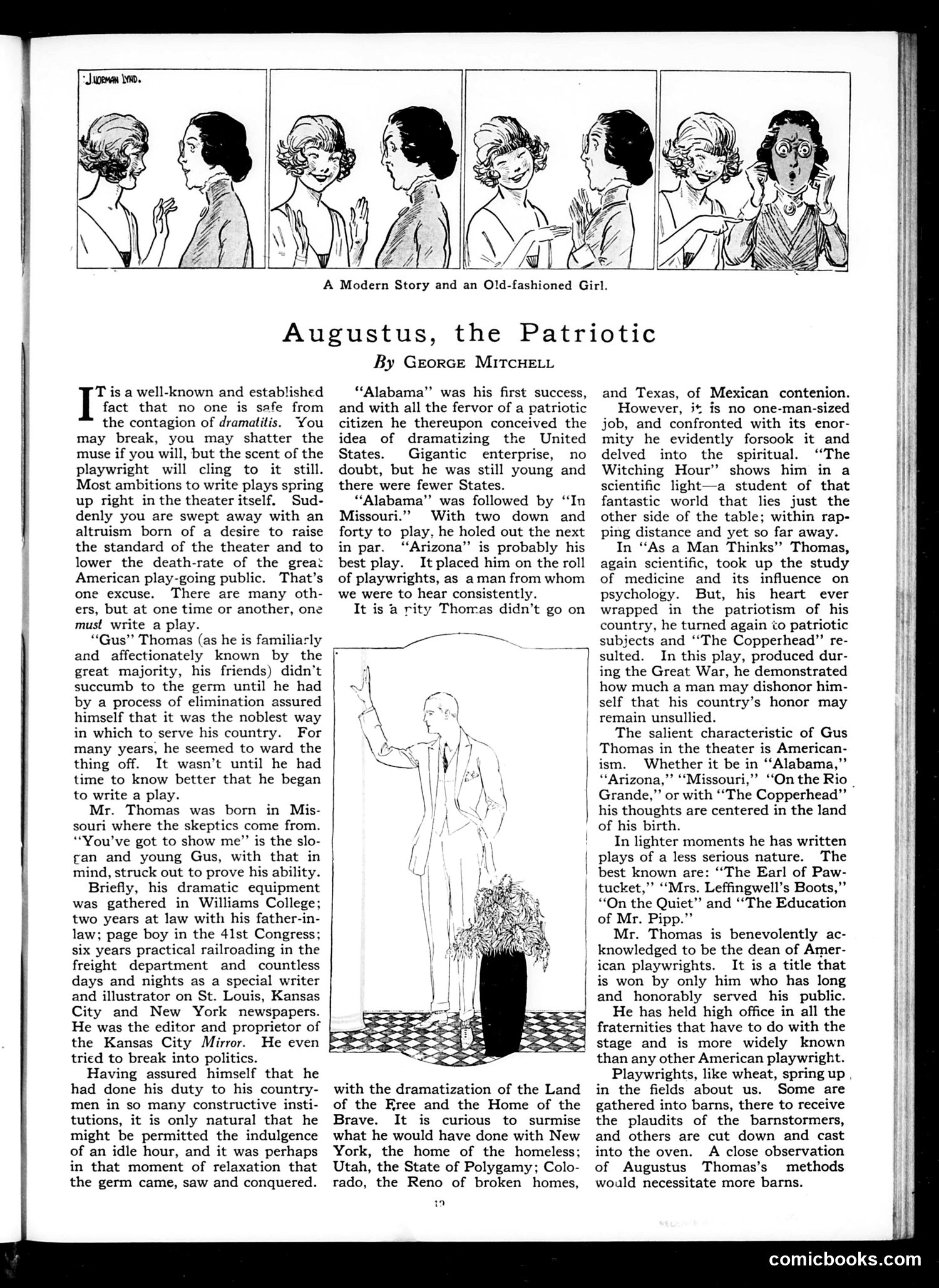
This page profiles American playwright Augustus Thomas. The comic strip at top depicts "A Modern Story and an Old-fashioned Girl"—likely satirizing contemporary gender dynamics or romantic conventions, though specific characters aren't identified. The main article celebrates Thomas as a patriotic dramatist who "assured himself that it was the noblest way in which to serve his country" by writing plays. The humor lies in the exaggerated notion that playwriting is a patriotic duty. Thomas, a Missouri native ("show me" skeptic), built credibility through journalism and railroading before turning to drama. The satire gently mocks his ambitious project: dramatizing individual American states (*Alabama*, *Arizona*, *Missouri*). The piece jokes he prudently abandoned completing all forty-eight states, while humorously speculating what he'd make of morally complicated places like Utah (polygamy) and Colorado (divorce capital). The overall tone praises Thomas's "Americanism" while subtly satirizing both his grandiose theatrical ambitions and the cultural elevation of theatrical work to patriotic service.
📄 Transcribed text from this page (OCR, searchable)
Machine-transcribed from the original scan — historical spelling and the odd misread are preserved.
——— A Modern Story and an Old-fashioned Girl. Augustus, the Patriotic fact that no one is safe from the contagion of dramatitis. You may break, you may shatter the muse if you will, but the scent of the playwright will cling to it still. Most ambitions to write plays spring up right in the theater itself. Sud- denly you are swept away with an altruism born of a desire to raise the standard of the theater and to lower the death-rate of the great American play-going public. That’s one excuse. There are many oth- ers, but at one time or another, one must write a play. “Gus” Thomas (as he is familiarly and affectionately known by the great majority, his friends) didn’t succumb to the germ until he had by a process of elimination assured himself that it was the noblest way in which to serve his country. For many years, he seemed to ward the thing off. It wasn’t until he had time to know better that he began to write a play. Mr. Thomas was born in Mis- souri where the skeptics come from. “You’ve got to show me”’ is the slo- gan and young Gus, with that in mind, struck out to prove his ability. Briefly, his dramatic equipment was gathered in Williams College; two years at law with his father-in- law; page boy in the 41st Congress; six years practical railroading in the freight department and countless days and nights as a special writer and illustrator on St. Louis, Kansas City and New York newspapers. He was the editor and proprietor of the Kansas City Mirror. He even tried to break into politics. Having assured himself that he had done his duty to his country- men in so many constructive insti- tutions, it is only natural that he might be permitted the indulgence of an idle hour, and it was perhaps in that moment of relaxation that the germ came, saw and conquered. I‘ is a well-known and established By Grorce MitcHELL “‘Alabama’’ was his first success, and with all the fervor of a patriotic citizen he thereupon conceived the idea of dramatizing the United States. Gigantic enterprise, no doubt, but he was still young and there were fewer States. “Alabama” was followed by “In Missouri.”” With two down and forty to play, he holed out the next in par. “Arizona” is probably his best play. It placed him on the roll of playwrights, as aman from whom we were to hear consistently. It is a rity Thomas didn’t go on : i | \ — with the dramatization of the Land of the Kree and the Home of the Brave. It is curious to surmise what he would have done with New York, the home of the homeless; Utah, the State of Polygamy; Colo- rado, the Reno of broken homes, 9 and Texas, of Mexican contenion. However, i+ is no one-man-sized job, and confronted with its enor- mity he evidently forsook it and delved into the spiritual. ‘The Witching Hour’ shows him in a scientific light—a student of that fantastic world that lies just the other side of the table; within rap- ping distance and yet so far away. In “As a Man Thinks” Thomas, again scientific, took up the study of medicine and its influence on psychology. But, his heart ever wrapped in the patriotism of his country, he turned again io patriotic subjects and ‘“The Copperhead” re- sulted. In this play, produced dur- ing the Great War, he demonstrated how much a man may dishonor him- self that his country’s honor may | remain unsullied. The salient characteristic of Gus | Thomas in the theater is American- ism. Whether it be in “Alabama,” “Arizona,” ‘““Missouri,”’ ‘On the Rio | Grande,” or with ‘“The Copperhead” his thoughts are centered in the land of his birth. In lighter moments he has written plays of a less serious nature. The best known are: “The Earl of Paw- tucket,”’ “‘Mrs. Leffingwell’s Boots,” | “On the Quiet” and ‘The Education of Mr. Pipp.”” Mr. Thomas is benevolently ac- knowledged to be the dean of Amer- ican playwrights. It is a title that is won by only him who has long and honorably served his public. He has held high office in all the fraternities that have to do with the stage and is more widely known than any other American playwright. Playwrights, like wheat, spring up in the fields about us. Some are gathered into barns, there to receive the plaudits of the barnstormers, and others are cut down and cast into the oven. A close observation of Augustus Thomas’s methods would necessitate more barns. comicbooks.com