
Judge, 1921-10-29 · page 11 of 36
Judge — October 29, 1921 — page 11: what you’re looking at
What you’re looking at
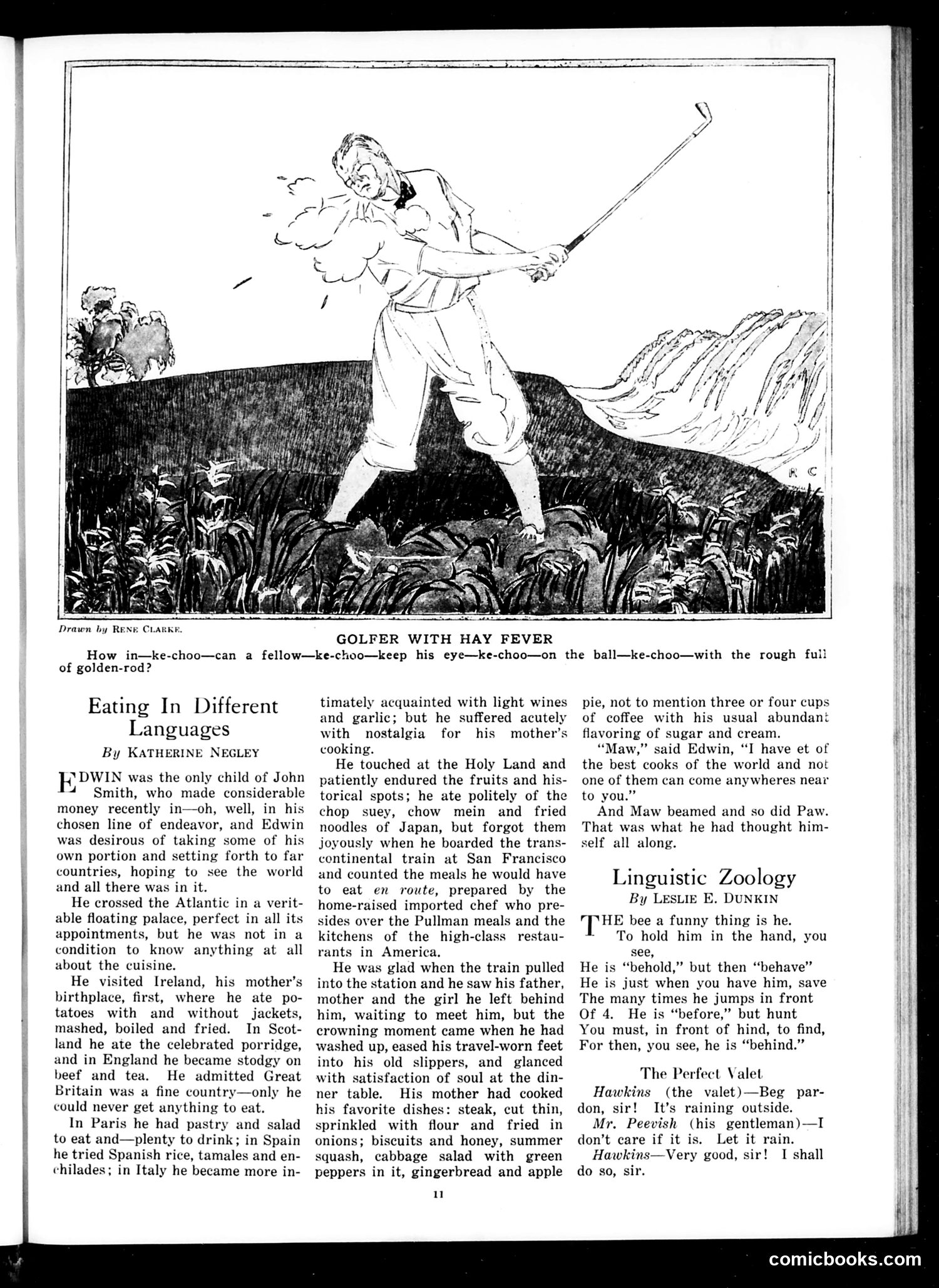
**Top Cartoon:** "Golfer with Hay Fever" depicts a golfer mid-swing, repeatedly sneezing ("ke-choo") while surrounded by goldenrod plants. The joke satirizes the frustration of attempting to play golf while suffering from hay fever—the pollen from goldenrod causes uncontrollable sneezing that ruins concentration on the ball. This references a common seasonal ailment that would particularly plague golfers in late summer/early fall. **Main Article:** "Eating in Different Languages" humorously traces a wealthy young American's overseas journey. Despite sampling cuisines worldwide—Irish potatoes, French pastry, Spanish rice, Japanese chop suey—he constantly longs for his mother's American home cooking. The satire gently mocks both nouveau riche Americans' tendency to travel abroad seeking sophistication, and their underlying inability to appreciate foreign cultures, ultimately preferring familiar American fare. **Minor Pieces:** Brief comedic sketches on linguistic wordplay and servant-master dynamics round out the page.
📄 Transcribed text from this page (OCR, searchable)
Machine-transcribed from the original scan — historical spelling and the odd misread are preserved.
Drawn by REN® CLARKE. GOLFER WITH HAY FEVER How in—ke-choo—can a fellow—ke-choo—keep his eye—ke-choo—on the ball—ke-choo—with the rough full of golden-rod? Eating In Different Languages By KATHERINE NEGLEY E DWIN was the only child of John 4 Smith, who made considerable money recently in—oh, well, in his chosen line of endeavor, and Edwin was desirous of taking some of his own portion and setting forth to far countries, hoping to see the world and all there was in it. He crossed the Atlantic in a verit- able floating palace, perfect in all its appointments, but he was not in a condition to know anything at all about the cuisine. He visited Ireland, his mother’s birthplace, firs where he ate po- tatoes with and without jackets, mashed, boiled and fried. In Scot- land he ate the celebrated porridge, and in England he became stodgy on beef and tea. He admitted Great Britain was a fine country—only he could never get anything to eat. In Paris he had pastry and salad to eat and—plenty to drink; in Spain he tried Spanish rice, tamales and en- chilades; in Italy he became more in- timately acquainted with light wines and garlic; but he suffered acutely with nostalgia for his mother’s cooking. He touched at the Holy Land and patiently endured the fruits and his- torical spots; he ate politely of the chop suey, chow mein and fried noodles of Japan, but forgot them joyously when he boarded the trans- continental train at San Francisco and counted the meals he would have to eat en route, prepared by the home-raised imported chef who pre- sides over the Pullman meals and the kitchens of the high-class restau- rants in America, He was glad when the train pulled into the station and he saw his father, mother and the girl he left behind him, waiting to meet him, but the crowning moment came when he had washed up, eased his travel-worn feet into his old slippers, and glanced with satisfaction of soul at the din- ner table. His mother had cooked his favorite dishes: steak, cut thin, sprinkled with flour and fried in onions; biscuits and honey, summer squash, cabbage salad with green peppers in it, gingerbread and apple 11 pie, not to mention three or four cups of coffee with his usual abundant flavoring of sugar and cream. “Maw,” said Edwin, “I have et of the best cooks of the world and not one of them can come anywheres near to you.” And Maw beamed and so did Paw. That was what he had thought him- self all along. Linguistic Zoology By LESLIE E. DUNKIN (THE bee a funny thing is he. To hold him in the hand, you see, He is “behold,” but then “behave” He is just when you have him, save The many times he jumps in front Of 4. He is “before,” but hunt You must, in front of hind, to find, For then, you see, he is “behind.” The Perfect Valet Hawkins (the valet)—Beg par- don, sir! It’s raining outside. Mr. Peevish (his gentleman)—I don’t care if it is. Let it rain. Hawkins—Very good, sir! I shall do so, sir. comicbooks.com