
Judge, 1921-10-29 · page 12 of 36
Judge — October 29, 1921 — page 12: what you’re looking at
What you’re looking at
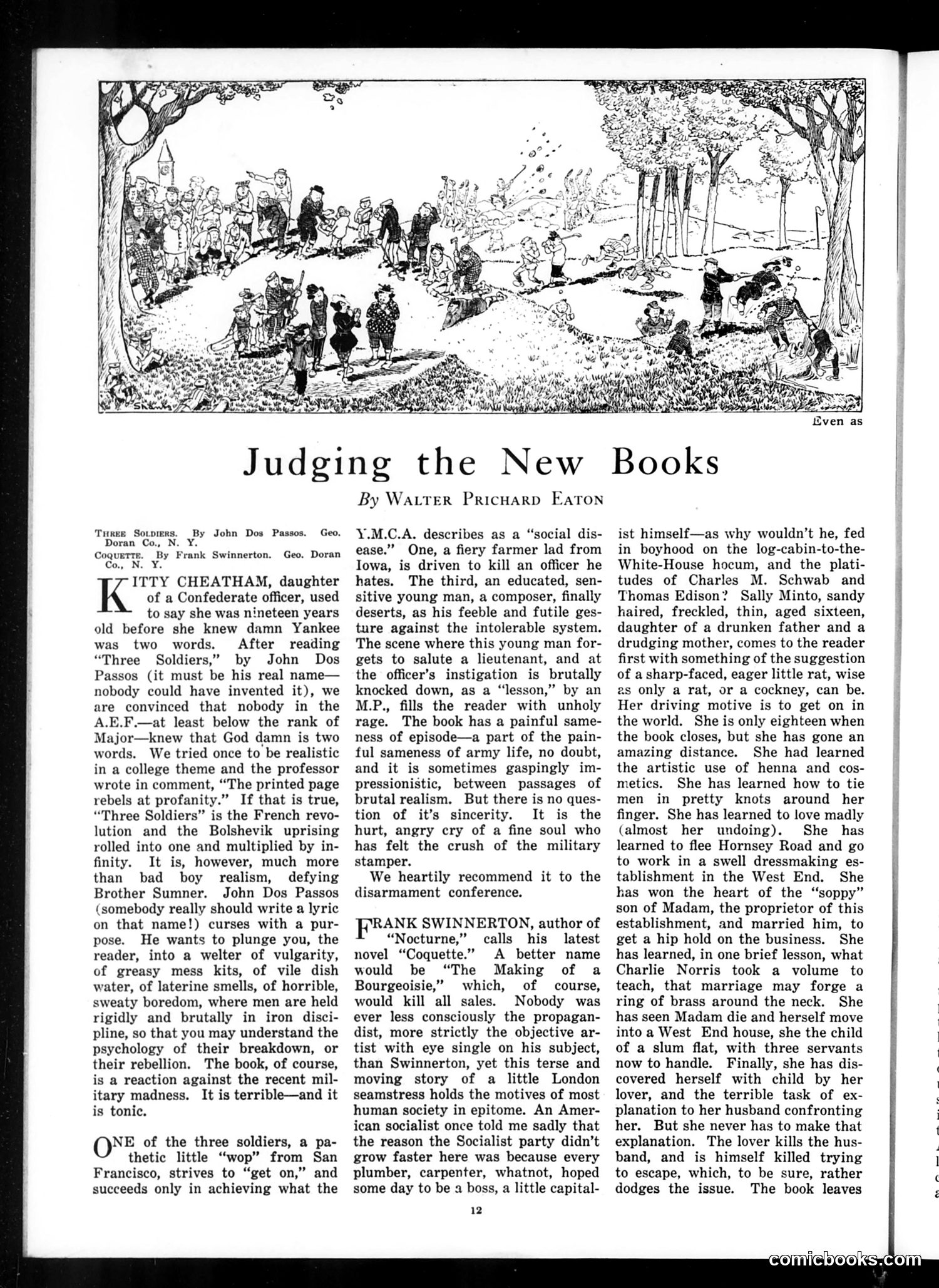
This page features literary reviews by Walter Prichard Eaton of two post-WWI novels. The illustration depicts an outdoor gathering of people—likely representing readers or the literary community. **"Three Soldiers" by John Dos Passos:** The reviewer praises this anti-war novel about military brutality and discipline breaking soldiers' spirits. Three protagonists represent different backgrounds: an Italian-American ("wop") seeking advancement, an Iowa farmer driven to kill an officer, and an educated composer who deserts. The reviewer notes Dos Passos uses profanity deliberately to immerse readers in the degradation of army life, endorsing the book's "sincere" anti-militarism. The recommendation to send it to a "disarmament conference" is satirical approval of its pacifist message. **"Coquette" by Frank Swinnerton:** The reviewer observes this novel about an ambitious London seamstress actually critiques capitalism's seductive appeal, though the author claims artistic objectivity. The character Sally Minto's drive to "get on" reflects American bourgeois aspiration—the reviewer notes Americans' hope of becoming bosses themselves, fed by Horatio Alger mythology and capitalist propaganda. Both reviews are sympathetic to progressive/socialist critiques of militarism and capitalism.
📄 Transcribed text from this page (OCR, searchable)
Machine-transcribed from the original scan — historical spelling and the odd misread are preserved.
Turee Soupiers. By John Dos Passos. Geo. Doran Co., N. Y. Coquette. By Frank Swinnerton. Geo. Doran Co, N. Y. ITTY CHEATHAM, daughter K of a Confederate officer, used to say she was nineteen years old before she knew damn Yankee was two words. After reading “Three Soldiers,” by John Dos Passos (it must be his real name— nobody could have invented it), we are convinced that nobody in the A.E.F.—at least below the rank of Major—knew that God damn is two words. We tried once to be realistic in a college theme and the professor wrote in comment, “The printed page rebels at profanity.” If that is true, “Three Soldiers” is the French revo- lution and the Bolshevik uprising rolled into one and multiplied by in- finity. It is, however, much more than bad boy realism, defying Brother Sumner. John Dos Passos (somebody really should write a lyric on that name!) curses with a pur- pose. He wants to plunge you, the reader, into a welter of vulgarity, of greasy mess kits, of vile dish water, of laterine smells, of horrible, sweaty boredom, where men are held rigidly and brutally in iron disci- pline, so that you may understand the psychology of their breakdown, or their rebellion. The book, of course, is a reaction against the recent mil- itary madness. It is terrible—and it is tonic. ONE of the three soldiers, a pa- thetic little “wop” from San Francisco, strives to “get on,” and succeeds only in achieving what the Judging the New Books By WatTeR Pricuarp Eaton Y.M.C.A. describes as a “social dis- ease.” One, a fiery farmer lad from Iowa, is driven to kill an officer he hates. The third, an educated, sen- sitive young man, a composer, finally deserts, as his feeble and futile ges- ture against the intolerable system. The scene where this young man for- gets to salute a lieutenant, and at the officer’s instigation is brutally knocked down, as a “lesson,” by an M.P., fills the reader with unholy rage. The book has a painful same- ness of episode—a part of the pain- ful sameness of army life, no doubt, and it is sometimes gaspingly im- pressionistic, between passages of brutal realism. But there is no ques- tion of it’s sincerity. It is the hurt, angry cry of a fine soul who has felt the crush of the military stamper. We heartily recommend it to the disarmament conference. RANK SWINNERTON, author of “Nocturne,” calls his latest novel “Coquette.” A better name would be “The Making of a Bourgeoisie,” which, of course, would kill all sales. Nobody was ever less consciously the propagan- dist, more strictly the objective ar- tist with eye single on his subject, than Swinnerton, yet this terse and moving story of a little London seamstress holds the motives of most human society in epitome. An Amer- ican socialist once told me sadly that the reason the Socialist party didn’t grow faster here was because every plumber, carpenter, whatnot, hoped some day to be a boss, a little capital- 12 ist himself—as why wouldn’t he, fed in boyhood on the log-cabin-to-the- White-House hocum, and the plati- tudes of Charles M. Schwab and Thomas Edison? Sally Minto, sandy haired, freckled, thin, aged sixteen, daughter of a drunken father and a drudging mother, comes to the reader first with something of the suggestion of a sharp-faced, eager little rat, wise es only a rat, or a cockney, can be. Her driving motive is to get on in the world. She is only eighteen when the book closes, but she has gone an amazing distance. She had learned the artistic use of henna and cos- metics. She has learned how to tie men in pretty knots around her finger. She has learned to love madly (almost her undoing). She has learned to flee Hornsey Road and go to work in a swell dressmaking es- tablishment in the West End. She has won the heart of the “soppy” son of Madam, the proprietor of this establishment, and married him, to get a hip hold on the business. She has learned, in one brief lesson, what Charlie Norris took a volume to teach, that marriage may forge a ring of brass around the neck. She has seen Madam die and herself move into a West End house, she the child of a slum flat, with three servants now to handle. Finally, she has dis- covered herself with child by her lover, and the terrible task of ex- planation to her husband confronting her. But she never has to make that explanation. The lover kills the hus- band, and is himself killed trying to escape, which, to be sure, rather dodges the issue. The book leaves