
Judge, 1921-10-29 · page 20 of 36
Judge — October 29, 1921 — page 20: what you’re looking at
What you’re looking at
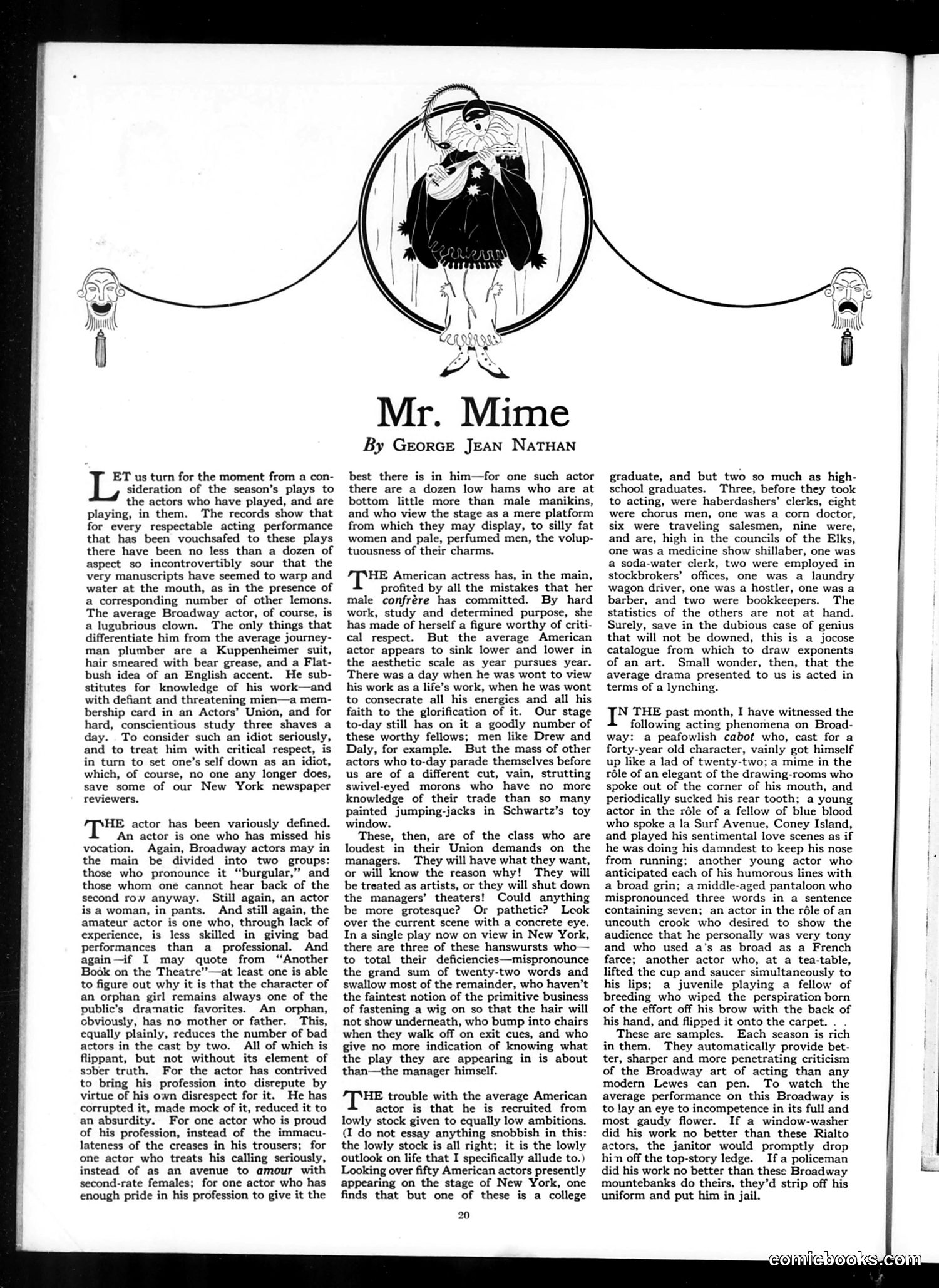
This is a satirical essay, not a political cartoon. The illustration shows a caricatured mime or theatrical performer in a circular frame, flanked by grotesque head studies—typical Judge visual styling for commentary pieces. Nathan's text viciously attacks American stage actors as incompetent, vain, and unprofessional. His central complaint: Broadway actors are lazy "hams" who've debased their profession through disrespect, relying on union membership and physical display rather than genuine skill or study. He contrasts the few serious performers (mentioning Drew and Daly as worthy examples) against the "swivel-eyed morons" who dominate modern theater. Notably, Nathan praises American actresses as having improved themselves through discipline, while condemning male actors as increasingly mediocre. The satire targets not politics but theatrical culture itself—mocking actors' pretension, Union protection, and the audiences who enable their mediocrity.
📄 Transcribed text from this page (OCR, searchable)
Machine-transcribed from the original scan — historical spelling and the odd misread are preserved.
sideration of the season’s plays to the actors who have played, and are playing, in them. The records show that for every respectable acting performance that has been vouchsafed to these plays there have been no less than a dozen of aspect so incontrovertibly sour that the very manuscripts have seemed to warp and water at the mouth, as in the presence of a corresponding number of other lemons. The average Broadway actor, of course, is a lugubrious clown. The only things that differentiate him from the average journey- man plumber are a Kuppenheimer suit, hair smeared with bear grease, and a Flat- bush idea of an English accent. He sub- stitutes for knowledge of his work—and with defiant and threatening mien—a mem- bership card in an Actors’ Union, and for hard, conscientious study three shaves a day. To consider such an idiot seriously, and to treat him with critical respect, is in turn to set one’s self down as an idiot, which, of course, no one any longer does, save some of our New York newspaper reviewers. I ET us turn for the moment from a con- HE actor has been variously defined. An actor is one who has missed his vocation. Again, Broadway actors may in the main be divided into two groups: those who pronounce it “‘burgular,” and those whom one cannot hear back of the second row anyway. Still again, an actor is a woman, in pants. And still again, the amateur actor is one who, through lack of experience, is less skilled in giving bad performances than a professional. And again—if I may quote from “Another Book on the Theatre’”’—at least one is able to figure out why it is that the character of an orphan girl remains always one of the public’s dramatic favorites. An orphan, obviously, has no mother or father. This, equally plainly, reduces the number of bad actors in the cast by two. All of which is flippant, but not without its element of sober truth. For the actor has contrived to bring his profession into disrepute by virtue of his own disrespect for it. He has corrupted it, made mock of it, reduced it to an absurdity. For one actor who is proud of his profession, instead of the immacu- lateness of the creases in his trousers; for one actor who treats his calling seriously, instead of as an avenue to amour with second-rate females; for one actor who has enough pride in his profession to give it the Mr. Mime By Greorce Jean NaTHAN best there is in him—for one such actor there are a dozen low hams who are at bottom little more than male manikins, and who view the stage as a mere platform from which they may display, to silly fat women and pale, perfumed men, the volup- tuousness of their charms. HE American actress has, in the main, profited by all the mistakes that her male confrére has committed. By hard work, study and determined purpose, she has made of herself a figure worthy of criti- cal respect. But the average American actor appears to sink lower and lower in the aesthetic scale as year pursues year. There was a day when he was wont to view his work as a life’s work, when he was wont to consecrate all his energies and all his faith to the glorification of it. Our stage to-day still has on it a goodly number of these worthy fellows; men like Drew and Daly, for example. But the mass of other actors who to-day parade themselves before us are of a different cut, vain, strutting swivel-eyed morons who have no more knowledge of their trade than so many painted jumping-jacks in Schwartz’s toy window. These, then, are of the class who are loudest in their Union demands on the managers. They will have what they want, or will know the reason why! They will be treated as artists, or they will shut down the managers’ theaters! Could anything be more grotesque? Or pathetic? Look over the current scene with a concrete eye. In a single play now on view in New York, there are three of these hanswursts who— to total their deficiencies—mispronounce the grand sum of twenty-two words and swallow most of the remainder, who haven’t the faintest notion of the primitive business of fastening a wig on so that the hair will not show underneath, who bump into chairs when they walk off on exit cues, and who give no more indication of knowing what the play they are appearing in is about than—the manager himself. Tt! trouble with the average American actor is that he is recruited from lowly stock given to equally low ambitions. (I do not essay anything snobbish in this: the lowly stock is all right; it is the lowly outlook on life that I specifically allude to.) Looking over fifty American actors presently appearing on the stage of New York, one finds that but one of these is a college 20 graduate, and but two so much as high- school graduates. Three, before they took to acting, were haberdashers’ clerks, eight were chorus men, one was a corn doctor, six were traveling salesmen, nine were, and are, high in the councils of the Elks, one was a medicine show shillaber, one was a soda-water clerk, two were employed in stockbrokers’ offices, one was a laundry wagon driver, one was a hostler, one was a barber, and two were bookkeepers. The statistics of the others are not at hand. Surely, save in the dubious case of genius that will not be downed, this is a jocose catalogue from which to draw exponents of an art. Small wonder, then, that the average drama presented to us is acted in terms of a lynching. i Gas THE past month, I have witnessed the following acting phenomena on Broad- way: a peafowlish cabot who, cast for a forty-year old character, vainly got himself up like a lad of twenty-two; a mime in the réle of an elegant of the drawing-rooms who spoke out of the corner of his mouth, and periodically sucked his rear tooth; a young actor in the réle of a fellow of blue blood who spoke a la Surf Avenue, Coney Island, and played his sentimental love scenes as if he was doing his damndest to keep his nose from running; another young actor who anticipated each of his humorous lines with a broad grin; a middle-aged pantaloon who mispronounced three words in a sentence containing seven; an actor in the réle of an uncouth crook who desired to show the audience that he personally was very tony and who used a's as broad as a French farce; another actor who, at a tea-table, lifted the cup and saucer simultaneously to his lips; a juvenile playing a fellow of breeding who wiped the perspiration born of the effort off his brow with the back of his hand, and flipped it onto the carpet. These are samples. Each season is rich in them. They automatically provide bet- ter, sharper and more penetrating criticism of the Broadway art of acting than any modern Lewes can pen. To watch the average performance on this Broadway is to lay an eye to incompetence in its full and most gaudy flower. If a window-washer did his work no better than these Rialto actors, the janitor would promptly drop hin off the top-story ledge. Ifa policeman did his work no better than these Broadway mountebanks do theirs, they’d strip off his uniform and put him in jail.