
Judge, 1921-10-29 · page 7 of 36
Judge — October 29, 1921 — page 7: what you’re looking at
What you’re looking at
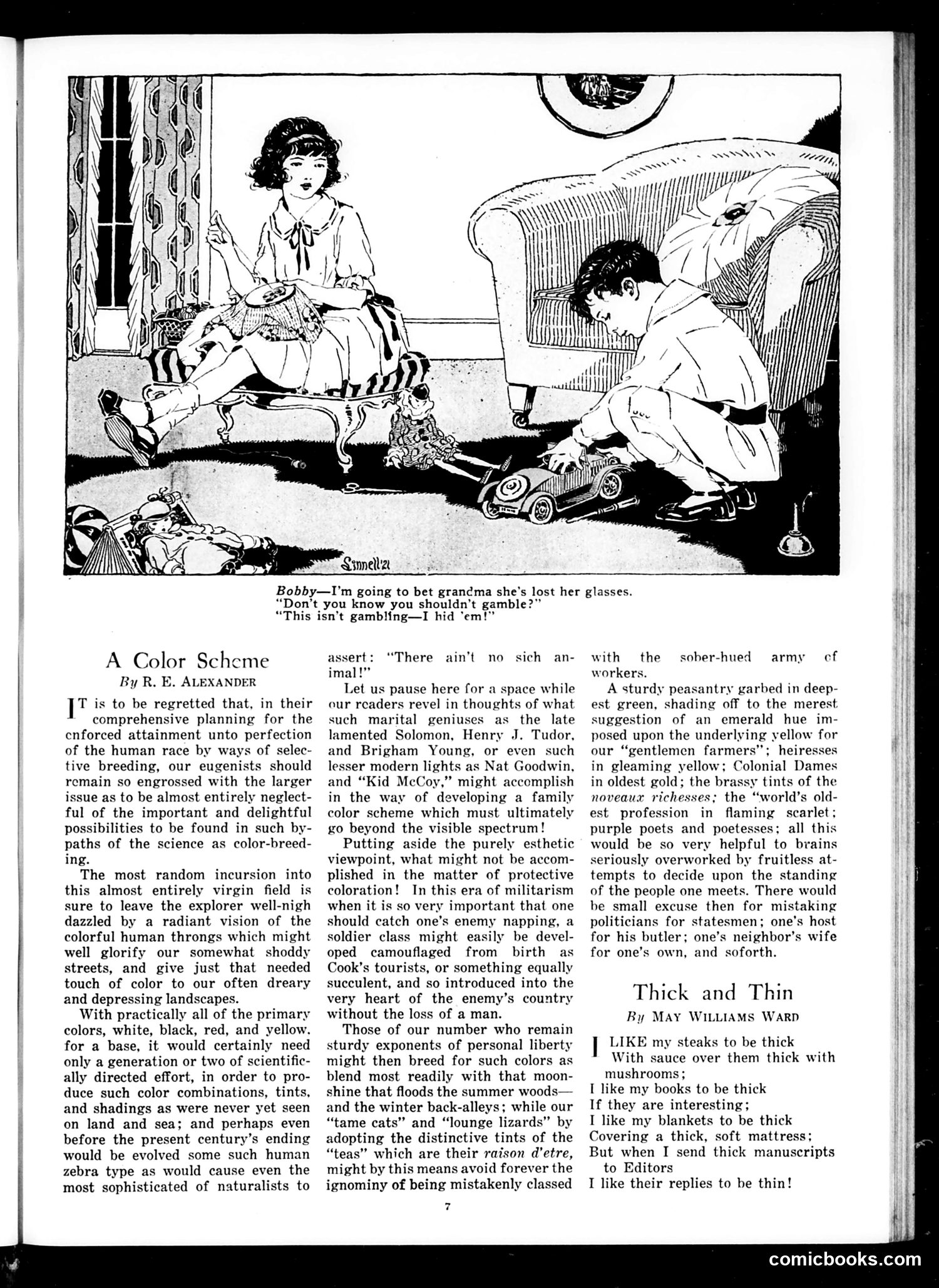
**The Cartoon:** A mother watches a boy play with toy cars on the floor while his grandmother sits nearby. The boy jokes he's "bet" his grandmother she's lost her glasses—but clarifies he actually *hid* them, so it's not gambling. The humor plays on wordplay: the boy redefines a bet (wager) as a hidden-object game, innocently evading the gambling prohibition. **The Articles Below:** These are satirical essays. "A Color Scheme" mockingly proposes eugenics-based selective breeding to create humans of specific colors for social classification and military camouflage—a darkly sarcastic critique of early 20th-century eugenics pseudoscience. "Thick and Thin" is lighthearted verse about preferring thick steaks, books, and blankets, but thin rejection letters from editors. **Historical Context:** The eugenics piece reflects Judge magazine's skeptical take on the period's pseudo-scientific racial theories, using absurdist satire to expose their illogic.
📄 Transcribed text from this page (OCR, searchable)
Machine-transcribed from the original scan — historical spelling and the odd misread are preserved.
Lanner SSNS ez, WO, = iB i ers Y Bobby—I'm going to bet grancma she’s lost her glasses. “Don’t you know you shouldn't gamble?” “This isn’t gambling—I hid ‘em!” A Color Scheme By R. E. ALEXANDER I" is to be regretted that, in their comprehensive planning for the enforced attainment unto perfection of the human race by ways of selec- tive breeding, our eugenists should remain so engrossed with the larger issue as to be almost entirely neglect- ful of the important and delightful possibilities to be found in such by- paths of the science as color-breed- ing. The most random incursion into this almost entirely virgin field is sure to leave the explorer well-nigh dazzled by a radiant vision of the colorful human throngs which might well glorify our somewhat shoddy streets, and give just that needed touch of color to our often dreary and depressing landscapes. With practically all of the primary colors, white, black, red, and yellow. for a base, it would certainly need only a generation or two of scientific- ally directed effort, in order to pro- duce such color combinations, tints, and shadings as were never yet seen on land and sea; and perhaps even before the present century’s ending would be evolved some such human zebra type as would cause even the most sophisticated of naturalists to assert: “There ain't no sich imal!” Let us pause here for a space while our readers revel in thoughts of what such marital geniuses as the late lamented Solomon, Henry J. Tudor, and Brigham Young, or even such lesser modern lights as Nat Goodwin, and “Kid McCoy,” might accomplish in the way of developing a family color scheme which must ultimately go beyond the visible spectrum! Putting aside the purely esthetic viewpoint, what might not be accom- plished in the matter of protective coloration! In this era of militarism when it is so very important that one should catch one’s enemy napping, a soldier class might easily be devel- oped camouflaged from birth as Cook’s tourists, or something equally succulent, and so introduced into the very heart of the enemy’s country without the loss of a man. Those of our number who remain sturdy exponents of personal liberty might then breed for such colors as blend most readily with that moon- shine that floods the summer woods— and the winter back-alleys; while our “tame cats” and “lounge lizards” by adopting the distinctive tints of the “teas” which are their raison d'etre, might by this means avoid forever the ignominy of being mistakenly classed an- with the sober-hued army cf workers. A sturdy peasantry garbed in deep- est green, shading off to the merest. suggestion of an emerald hue im- posed upon the underlying yellow for our “gentlemen farmers”; heiresses in gleaming yellow; Colonial Dames in oldest gold; the brassy tints of the noveaux richesses; the “world’s old- est profession in flaming scarlet; purple poets and poetesses; all this would be so very helpful to brains seriously overworked by fruitless at- tempts to decide upon the standing of the people one meets. There would be small excuse then for mistaking politicians for statesmen; one’s host for his butler; one’s neighbor’s wife for one’s own, and soforth. Thick and Thin By May WILLIAMS WARD LIKE my steaks to be thick With sauce over them thick with mushrooms ; I like my books to be thick If they are interesting; I like my blankets to be thick Covering a thick, soft mattress; But when I send thick manuscripts to Editors I like their replies to be thin! comicbooks.com