
Judge, 1921-10-29 · page 9 of 36
Judge — October 29, 1921 — page 9: what you’re looking at
What you’re looking at
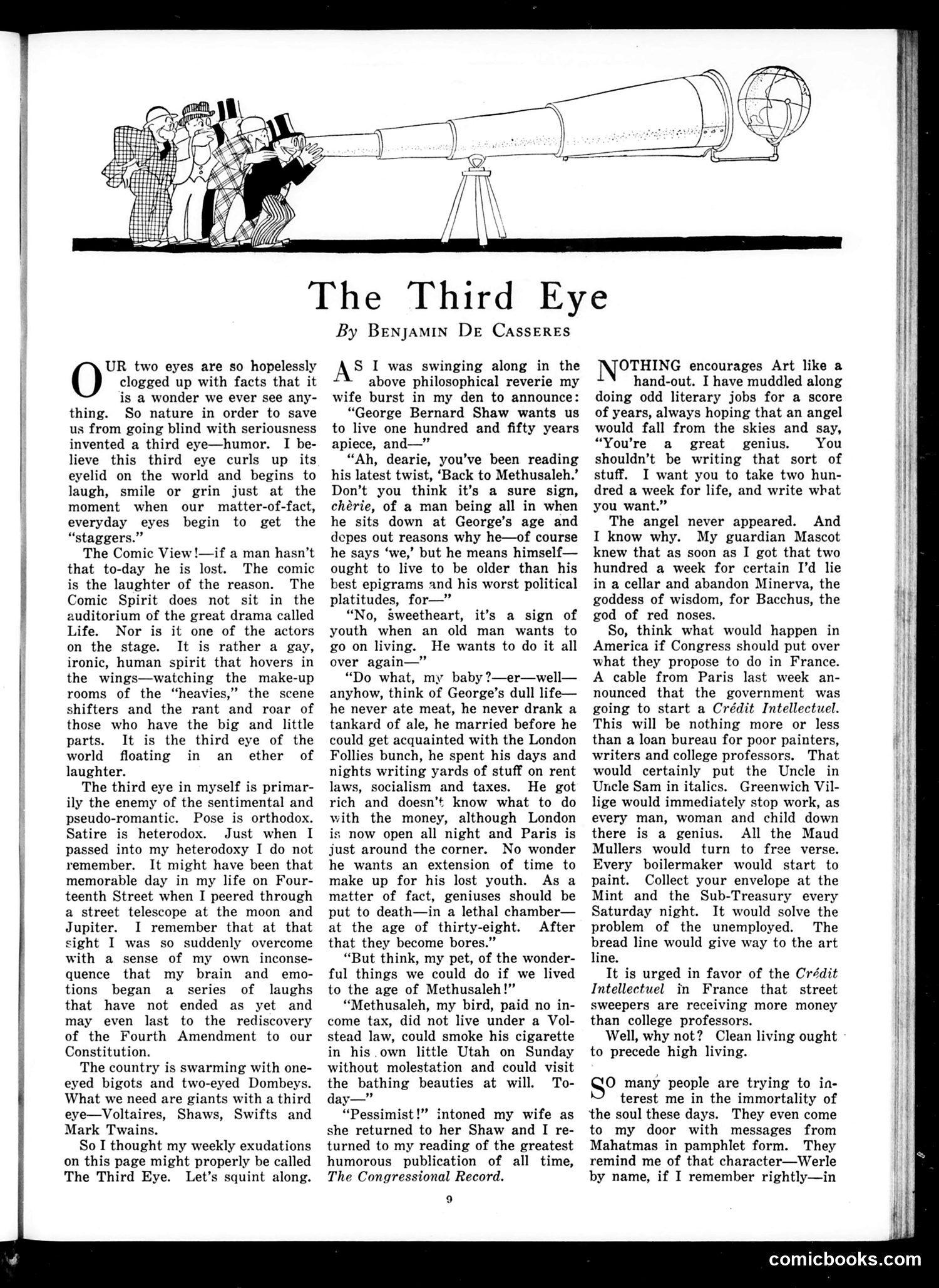
This is primarily an essay/column rather than a political cartoon. De Casseres argues for "the third eye"—humor and satire—as essential to seeing through social pretense and hypocrisy. He cites satirists like Voltaire, Shaw, and Mark Twain as models. The piece includes a dialogue mocking **George Bernard Shaw's recent play "Back to Methuselah,"** which proposed extending human lifespans. De Casseres ridicules Shaw for wanting to live longer despite his austere, joyless life (no meat, ale, or pleasures). The satire suggests Shaw's desire for longevity reflects exhaustion, not youthful vigor. De Casseres also jabs at **Prohibition** (the Volstead law) and suggests Congress is inherently absurd by calling the Congressional Record "the greatest humorous publication." The broader point: use humor and critical thinking to expose the contradictions and pretensions of public figures and institutions.
📄 Transcribed text from this page (OCR, searchable)
Machine-transcribed from the original scan — historical spelling and the odd misread are preserved.
UR two eyes are so hopelessly O clogged up with facts that it is a wonder we ever see any- thing. So nature in order to save us from going blind with seriousness invented a third eye—humor. I be- lieve this third eye curls up its eyelid on the world and begins to laugh, smile or grin just at the moment when our matter-of-fact, everyday eyes begin to get the “staggers.” The Comic View!—if a man hasn’t that to-day he is lost. The comic is the laughter of the reason. The Comic Spirit does not sit in the auditorium of the great drama called Life. Nor is it one of the actors on the stage. It is rather a gay, ironic, human spirit that hovers in the wings—watching the make-up rooms of the “heavies,” the scene shifters and the rant and roar of those who have the big and little parts. It is the third eye of the world floating in an ether of laughter. The third eye in myself is primar- ily the enemy of the sentimental and pseudo-romantic. Pose is orthodox. Satire is heterodox. Just when I passed into my heterodoxy I do not remember. It might have been that memorable day in my life on Four- teenth Street when I peered through a street telescope at the moon and Jupiter. I remember that at that sight I was so suddenly overcome with a sense of my own inconse- quence that my brain and emo- tions began a series of laughs that have not ended as yet and may even last to the rediscovery of the Fourth Amendment to our Constitution. The country is swarming with one- eyed bigots and two-eyed Dombeys. What we need are giants with a third eye—Voltaires, Shaws, Swifts and Mark Twains. So I thought my weekly exudations on this page might properly be called The Third Eye. Let’s squint along. The Third Eye By Benjamin De CassEReES AS I was swinging along in the above philosophical reverie my wife burst in my den to announce: “George Bernard Shaw wants us to live one hundred and fifty years apiece, and—” “Ah, dearie, you’ve been reading his latest twist, ‘Back to Methusaleh.’ Don’t you think it’s a sure sign, chérie, of a man being all in when he sits down at George’s age and depes out reasons why he—of course he says ‘we,’ but he means himself— ought to live to be older than his best epigrams and his worst political platitudes, for—” “No, Sweetheart, it’s a sign of youth when an old man wants to go on living. He wants to do it all over again—” “Do what, my baby ?—er—well— anyhow, think of George’s dull life— he never ate meat, he never drank a tankard of ale, he married before he could get acquainted with the London Follies bunch, he spent his days and nights writing yards of stuff on rent laws, socialism and taxes. He got rich and doesn’t know what to do with the money, although London is now open all night and Paris is just around the corner. No wonder he wants an extension of time to make up for his lost youth. As a matter of fact, geniuses should be put to death—in a lethal chamber— at the age of thirty-eight. After that they become bores.” “But think, my pet, of the wonder- ful things we could do if we lived to the age of Methusaleh!” “Methusaleh, my bird, paid no in- come tax, did not live under a Vol- stead law, could smoke his cigarette in his.own little Utah on Sunday without molestation and could visit the bathing beauties at will. To- day—” “Pessimist!” intoned my wife as she returned to her Shaw and I re- turned to my reading of the greatest humorous publication of all time, The Congressional Record. 9 NOTHING encourages Art like a hand-out. I have muddled along doing odd literary jobs for a score of years, always hoping that an angel would fall from the skies and say, “You’re a great genius. You shouldn’t be writing that sort of stuff. I want you to take two hun- dred a week for life, and write what you want.” The angel never appeared. And I know why. My guardian Mascot knew that as soon as I got that two hundred a week for certain I’d lie in a cellar and abandon Minerva, the goddess of wisdom, for Bacchus, the god of red noses. So, think what would happen in America if Congress should put over what they propose to do in France. A cable from Paris last week an- nounced that the government was going to start a Crédit Intellectuel. This will be nothing more or less than a loan bureau for poor painters, writers and college professors. That would certainly put the Uncle in Uncle Sam in italics. Greenwich Vil- lige would immediately stop work, as every man, woman and child down there is a genius. All the Maud Mullers would turn to free verse. Every boilermaker would start to paint. Collect your envelope at the Mint and the Sub-Treasury every Saturday night. It would solve the problem of the unemployed. The bread line would give way to the art line. It is urged in favor of the Crédit Intellectuel in France that street sweepers are receiving more money than college professors. Well, why not? Clean living ought to precede high living. Se many people are trying to in- terest me in the immortality of the soul these days. They even come to my door with messages from Mahatmas in pamphlet form. They remind me of that character—Werle by name, if I remember rightly—in comicbooks.com