
Judge, 1921-10-29 · page 16 of 36
Judge — October 29, 1921 — page 16: what you’re looking at
What you’re looking at
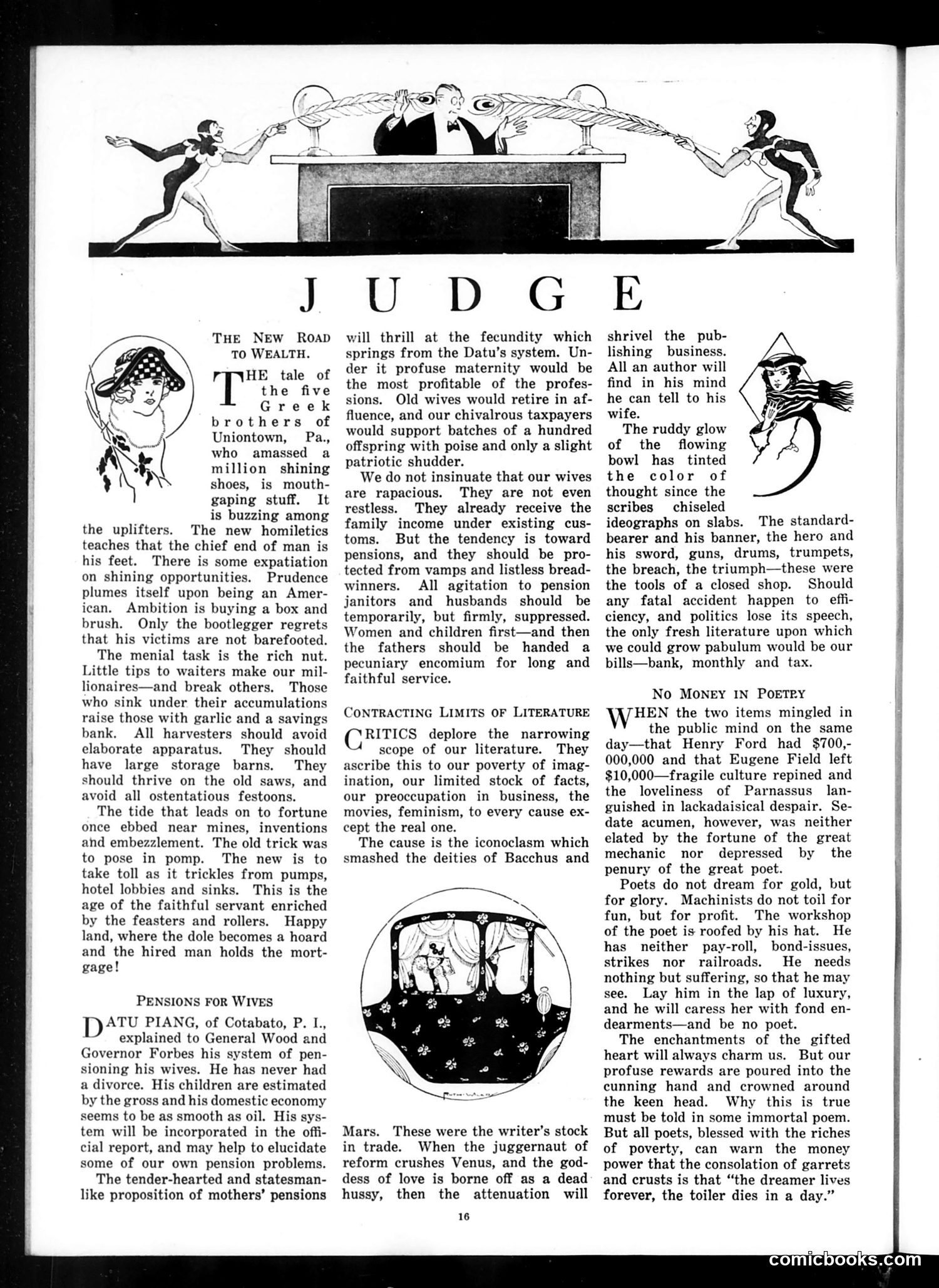
**Top Cartoon:** Shows a judge presiding over two figures juggling globes—a visual metaphor for balancing competing interests or managing complex situations. **Main Articles:** 1. **"The New Road to Wealth"** satirizes the American fascination with rags-to-riches stories, mocking the elevation of shoe-shining (manual labor) into a romantic success narrative. Judge ridicules the "uplifters"—reformers and moral crusaders—for glorifying menial work while ignoring that wealth traditionally came from mines, inventions, and embezzlement. 2. **"Pensions for Wives"** attacks a Philippine colonial official (Datu Piang) who supported multiple wives and praised his system to U.S. officials. Judge satirically suggests adopting his pension model would incentivize prolific motherhood, mocking both colonial governance and contemporary feminist pension proposals. 3. **"Contracting Limits of Literature"** claims modern literature has narrowed because reform movements eliminated traditional literary subjects: Bacchus (drinking/revelry), Mars (war/heroism), and Venus (romance). Without these, writers have nothing to discuss except their wives and tax bills. All three pieces reflect early 1910s skepticism toward Progressive reform, feminism, and colonial ventures.
📄 Transcribed text from this page (OCR, searchable)
Machine-transcribed from the original scan — historical spelling and the odd misread are preserved.
J THE NEW RoapD TO WEALTH. HE tale of | the five Greek brothers of Uniontown, Pa., who amassed a million shining shoes, is mouth- gaping stuff. It is buzzing among The new homiletics the uplifters. teaches that the chief end of man is his feet. There is some expatiation on shining opportunities. Prudence plumes itself upon being an Amer- ican. Ambition is buying a box and brush. Only the bootlegger regrets that his victims are not barefooted. The menial task is the rich nut. Little tips to waiters make our mil- lionaires—and break others. Those who sink under their accumulations raise those with garlic and a savings bank. All harvesters should avoid elaborate apparatus. They should have large storage barns. They should thrive on the old saws, and avoid all ostentatious festoons. The tide that leads on to fortune once ebbed near mines, inventions and embezzlement. The old trick was to pose in pomp. The new is to take toll as it trickles from pumps, hotel lobbies and sinks. This is the age of the faithful servant enriched by the feasters and rollers. Happy land, where the dole becomes a hoard and the hired man holds the mort- gage! PENSIONS FOR WIVES pat PIANG, of Cotabato, P. I., explained to General Wood and Governor Forbes his system of pen- sioning his wives. He has never had a divorce. His children are estimated by the gross and his domestic economy seems to be as smooth as oil. His sys- tem will be incorporated in the offi- cial report, and may help to elucidate some of our own pension problems. The tender-hearted and statesman- like proposition of mothers’ pensions will thrill at the fecundity which springs from the Datu’s system. Un- der it profuse maternity would be the most profitable of the profes- sions. Old wives would retire in af- fluence, and our chivalrous taxpayers would support batches of a hundred offspring with poise and only a slight patriotic shudder. We do not insinuate that our wives are rapacious. They are not even restless. They already receive the family income under existing cus- toms. But the tendency is toward pensions, and they should be pro- tected from vamps and listless bread- winners. All agitation to pension janitors and husbands should be temporarily, but firmly, suppressed. Women and children first—and then the fathers should be handed a pecuniary encomium for long and faithful service. CONTRACTING LIMITS OF LITERATURE CPR tics deplore the narrowing scope of our literature. They ascribe this to our poverty of imag- ination, our limited stock of facts, our preoccupation in business, the movies, feminism, to every cause ex- cept the real one. The cause is the iconoclasm which smashed the deities of Bacchus and Mars. These were the writer’s stock in trade. When the juggernaut of reform crushes Venus, and the god- dess of love is borne off as a dead hussy, then the attenuation will 16 shrivel the pub- lishing business. All an author will find in his mind he can tell to his wife. The ruddy glow of the flowing bowl has tinted the color of thought since the scribes chiseled ideographs on slabs. The standard- bearer and his banner, the hero and his sword, guns, drums, trumpets, the breach, the triumph—these were the tools of a closed shop. Should any fatal accident happen to effi- ciency, and politics lose its speech, the only fresh literature upon which we could grow pabulum would be our bills—bank, monthly and tax. No MONEY IN POETRY V HEN the two items mingled in the public mind on the same day—that Henry Ford had $700,- 000,000 and that Eugene Field left $10,000—fragile culture repined and the loveliness of Parnassus lan- guished in lackadaisical despair. Se- date acumen, however, was neither elated by the fortune of the great mechanic nor depressed by the penury of the great poet. Poets do not dream for gold, but for glory. Machinists do not toil for fun, but for profit. The workshop of the poet is roofed by his hat. He has neither pay-roll, bond-issues, strikes nor railroads. He needs nothing but suffering, so that he may see. Lay him in the lap of luxury, and he will caress her with fond en- dearments—and be no poet. The enchantments of the gifted heart will always charm us. But our profuse rewards are poured into the cunning hand and crowned around the keen head. Why this is true must be told in some immortal poem. But all poets, blessed with the riches of poverty, can warn the money power that the consolation of garrets and crusts is that “the dreamer lives forever, the toiler dies in a day.”