
Judge, 1921-10-29 · page 6 of 36
Judge — October 29, 1921 — page 6: what you’re looking at
What you’re looking at
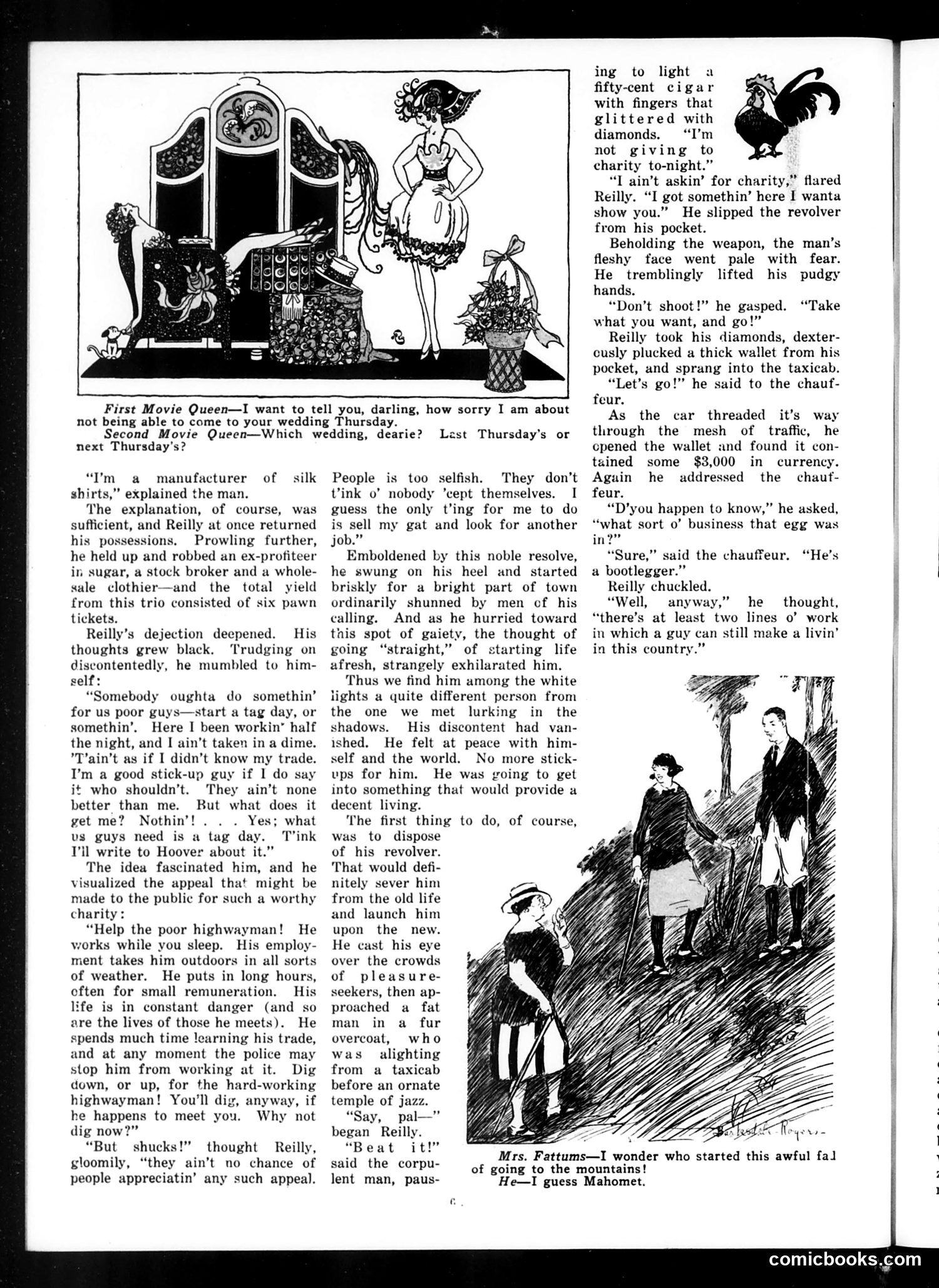
This page contains two separate satirical narratives with accompanying illustrations. The top cartoon titled "First Movie Queen" mocks wealthy socialites' casual cruelty. A fashionable woman dismisses her fiancé's wedding invitation, claiming she's too busy. The satire targets the selfish materialism of the upper class—she prioritizes social gatherings and personal possessions over genuine human relationships and commitments. The bottom illustration labeled "Mrs. Fattums" and "He—I guess Mahomes" appears incomplete in context, though it depicts social interaction with a satirical edge typical of Judge's class-based humor. Both pieces reflect early-20th-century satirical concerns: wealth's corrupting influence, the hollowness of high society, and the contrast between appearances and moral character. The magazine used humor to critique American social pretension.
📄 Transcribed text from this page (OCR, searchable)
Machine-transcribed from the original scan — historical spelling and the odd misread are preserved.
First Movie Queen—I want to tell you, darling, how sorry I am about not being able to come to your wedding Thursday. Second Movie Queen—Which wedding, dearie? Last Thursday's or next Thursday's? “I’m a manufacturer of silk shirts,” explained the man. The explanation, of course, was sufficient, and Reilly at once returned his possessions. Prowling further, he held up and robbed an ex-profiteer in sugar, a stock broker and a whole- sale clothier—and the total yield from this trio consisted of six pawn tickets. Reilly’s dejection deepened. His thoughts grew black. ‘Trudging on discontentedly, he mumbled to him- self: “Somebody oughta do somethin’ for us poor guys—start a tag day, or somethin’. Here I been workin” half the night, and I ain’t taken in a dime. ’T’ain’t as if I didn’t know my trade. I’m a good stick-up guy if 1 do say it who shouldn’t. They ain’t none better than me. But what does it get me? Nothin’! . . Yes; what us guys need is a tag day. T’ink I'll write to Hoover about it.” The idea fascinated him, and he visualized the appeal that might be made to the public for such a worthy charity: “Help the poor highwayman! He works while you sleep. His employ- ment takes him outdoors in all sorts of weather. He puts in long hours, often for small remuneration. His life is in constant danger (and so are the lives of those he meets). He spends much time learning his trade, and at any moment the police may stop him from working at it. Dig down, or up, for the hard-working highwayman! You'll dig, anyway, if he happens to meet you. Why not dig now?” “But shucks!” thought Reilly, gloomily, “they ain’t no chance of people appreciatin’ any such appeal. People is too selfish. They don’t tink o’ nobody 'cept themselves. I guess the only t’ing for me to do is sell my gat and look for another job.” Emboldened by this noble resolve, he swung on his heel and started briskly for a bright part of town ordinarily shunned by men of his calling. And as he hurried toward this spot of gaiety, the thought of going “straight,” of starting life afresh, strangely exhilarated him. Thus we find him among the white lights a quite different person from the one we met lurking in the shadows. His discontent had van- ished. He felt at peace with him- self and the world. No more stick- ups for him. He was going to get into something that would provide a decent living. The first thing to do, of course, was to dispose of his revolver. That would defi- nitely sever him from the old life and launch him upon the new. He cast his eye over the crowds of pleasure- seekers, then ap- proached a fat man in a fur overcoat, who was alighting from a taxicab before an ornate temple of jazz. “Say, pal—” began Reilly. “Beat it!” said the corpu- lent man, paus- Mrs. Fattums—I wonder who started this awful fa] of going to the mountains! He—I guess Mahomet. ing to light a fifty-cent cigar with fingers that glittered with diamonds. “I’m not giving to charity to-night.” “I ain’t askin’ for charity,” flared Reilly. “I got somethin’ here I wanta show you.” He slipped the revolver from his pocket. Beholding the weapon, the man’s fleshy face went pale with fear. He tremblingly lifted his pudgy hands. “Don’t shoot!” he gasped. “Take what you want, and go!” Reilly took his diamonds, dexter- cusly plucked a thick wallet from his pocket, and sprang into the taxicab. “Let’s go!” he said to the chauf- feur. As the car threaded it’s way through the mesh of traffic, he cpened the wallet and found it con- tained some $3,000 in currency. Again he addressed the chauf- feur. “D’you happen to know,” he asked, “what sort o’ business that egg was in?” “Sure,” said the chauffeur. “He’s a bootlegger.” Reilly chuckled. “Well, anyway,” he thought, “there’s at least two lines 0’ work in which a guy can still make a livin’ in this country.” comicbooks.com