
A complete issue · 36 pages · 1921
Judge — October 15, 1921
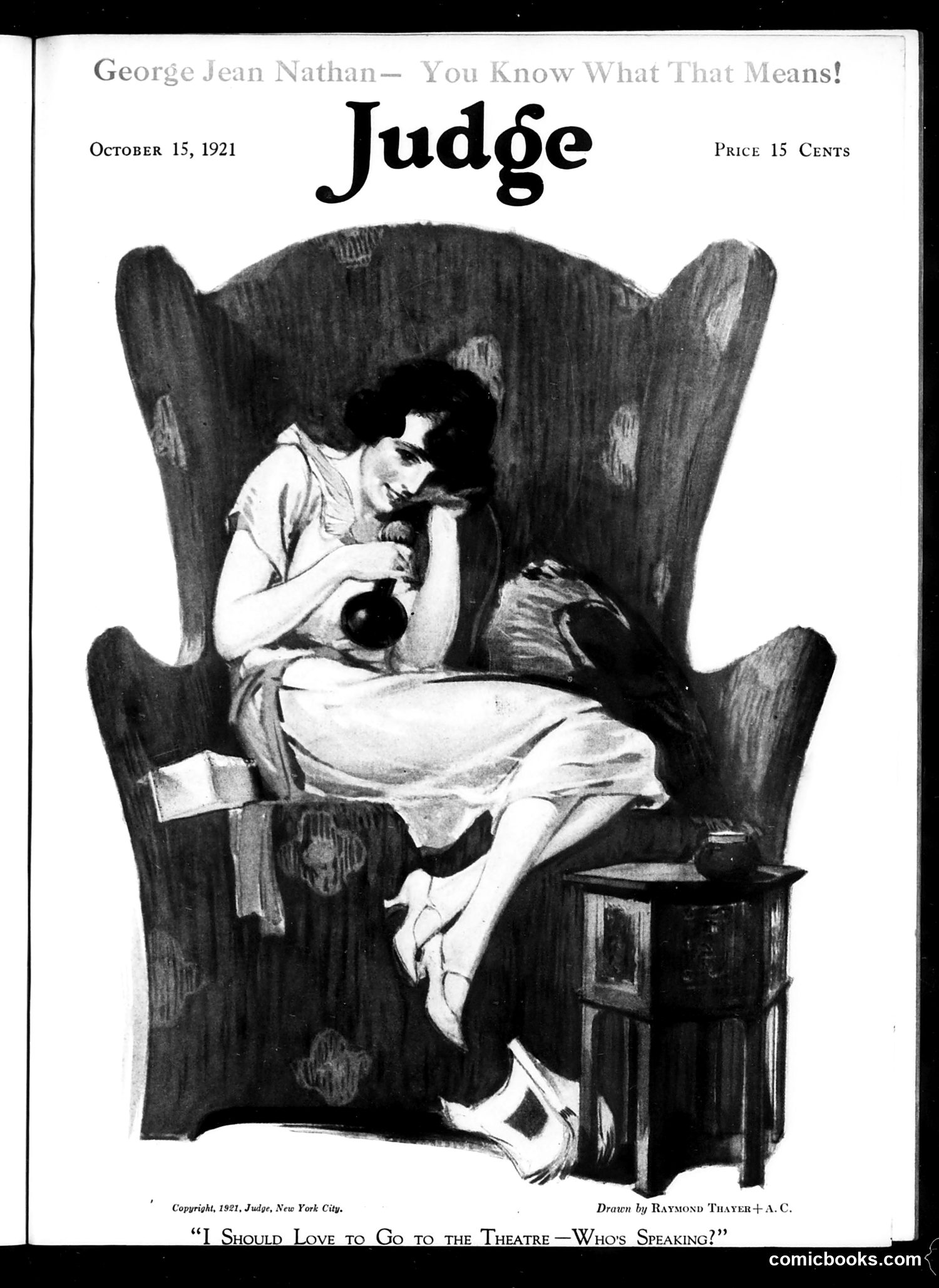
This cover illustrates a romantic scene captioned "I Should Love to Go to the Theatre—Who's Speaking?" The joke plays on ambiguity: a couple sits intimately in an armchair, but it's unclear which person is expressing the desire to attend the theatre. The humor relies on the woman's flirtatious uncertainty about her companion's identity or intentions. The reference to "George Jean Nathan—You Know What That Means!" in the header suggests this relates to Nathan, a prominent drama critic of the era known for his sophisticated wit and romantic escapades. The theatrical setting and Nathan's reputation for social commentary make this likely satirizing contemporary celebrity culture and romantic pretense among the theatrical elite.
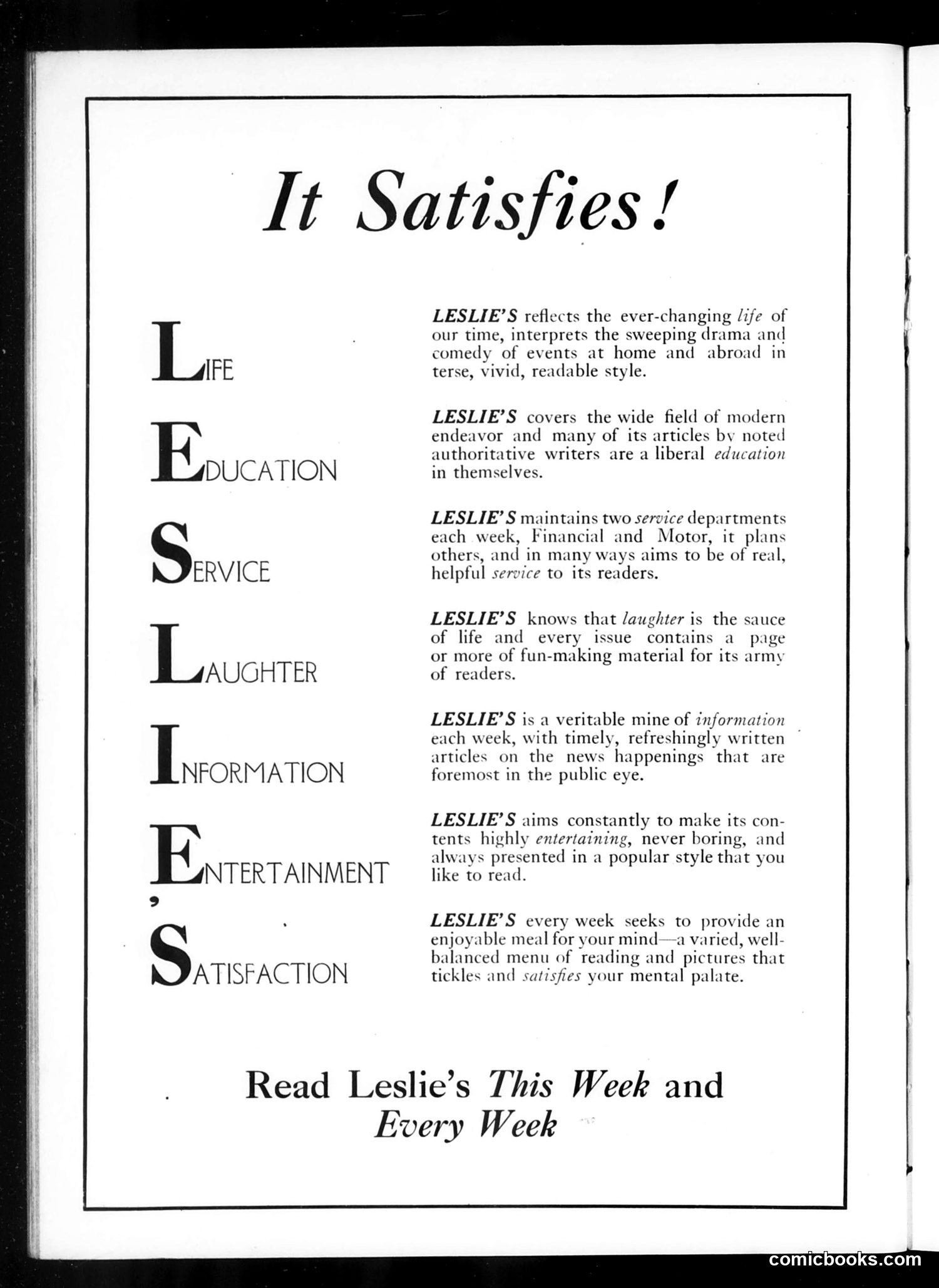
This is a promotional advertisement for **Leslie's** magazine, not a political cartoon. The page uses an acrostic format spelling "LESLIE'S" to list the publication's selling points. The advertisement emphasizes Leslie's as a comprehensive weekly magazine offering: - Life coverage and contemporary events - Education and authoritative writing - Service departments (Financial, Motor) - Humor and entertainment - Current information on newsworthy topics - Entertainment content - Reader satisfaction through varied, engaging material The ad targets middle-class readers seeking a balanced publication combining news, practical advice, and amusement. The concluding call-to-action ("Read Leslie's This Week and Every Week") is typical early-20th-century magazine promotion. This appears to be house advertising within Judge magazine itself.
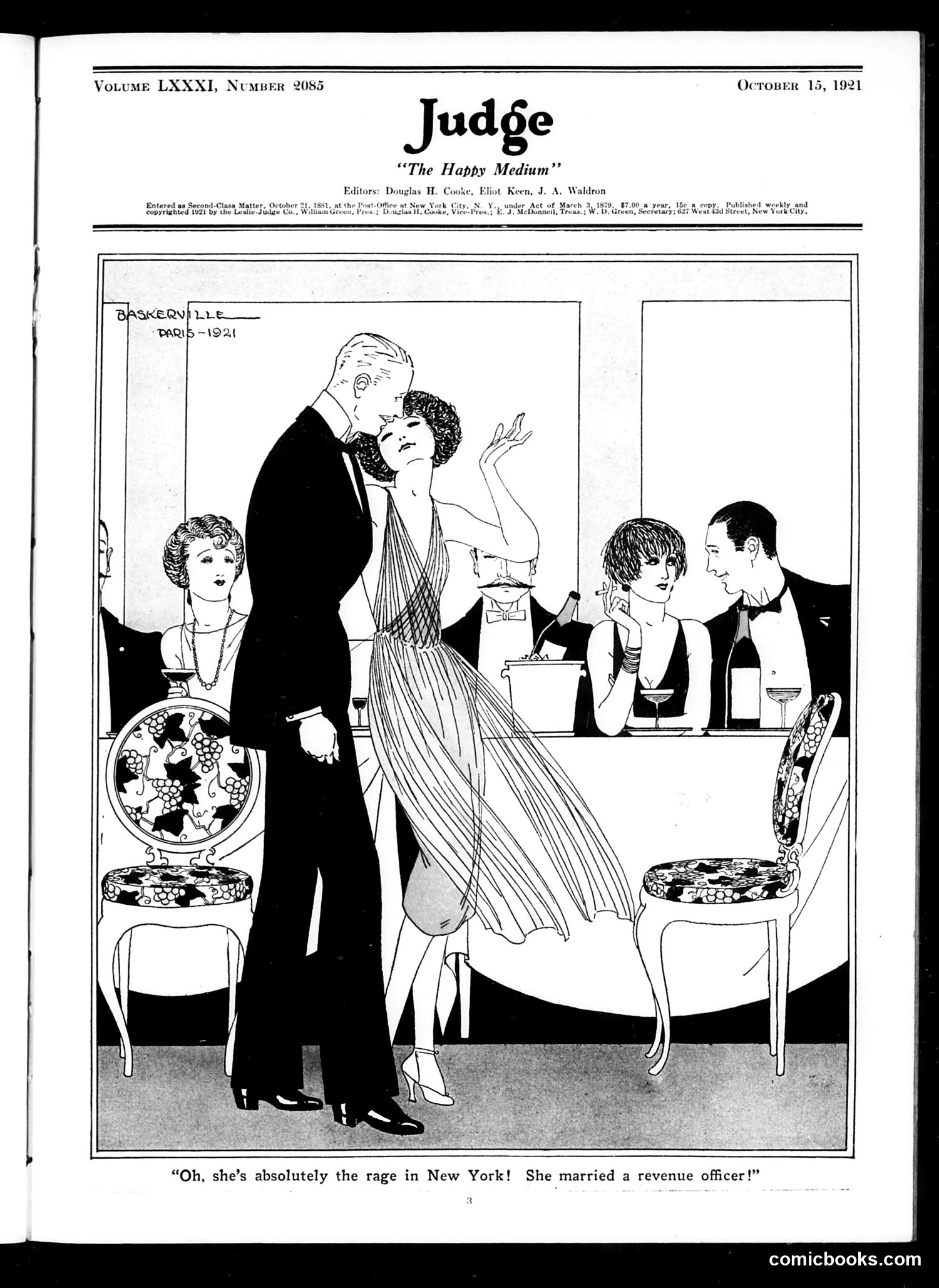
This cartoon satirizes social attitudes toward women's marriages in 1920s New York high society. The scene depicts a cocktail party where a woman in an elegant flowing dress is the center of attention among wealthy men in formal attire. The caption—"Oh, she's absolutely the rage in New York! She married a revenue officer!"—conveys the joke: marrying a government revenue officer (a federal tax collector, likely associated with Prohibition enforcement) is considered surprisingly fashionable among the wealthy elite. The satire mocks the social pretension of the wealthy, who would celebrate this unconventional match as trendy rather than pragmatic. It reflects 1920s anxieties about Prohibition and federal authority's growing intrusiveness into American life.
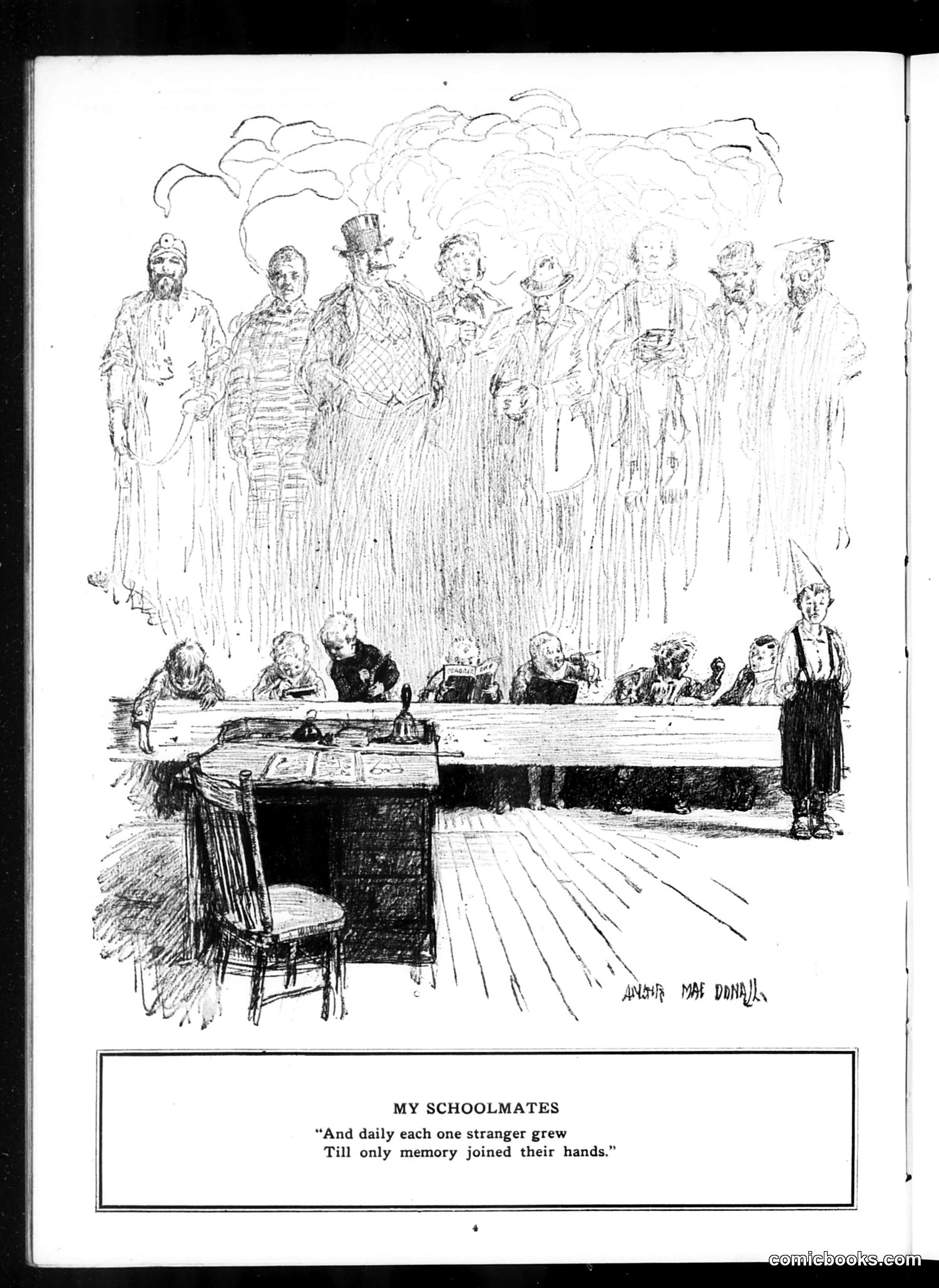
This illustration depicts a classroom scene with the title referencing the poignant quoted lines: "And daily each one stranger grew / Till only memory joined their hands." The sketch shows a schoolmaster or teacher at a desk addressing a group of students standing behind him. The artistic style and melancholic quotation suggest this piece reflects on how schoolmates, once close during their shared school years, gradually become strangers as they age and diverge into different adult lives. Only shared memories of their school days remain to connect them. The satire appears gentle rather than sharp—a nostalgic commentary on the inevitable dissolution of childhood friendships and the passage of time, a theme common to Judge magazine's mix of humor and social observation.
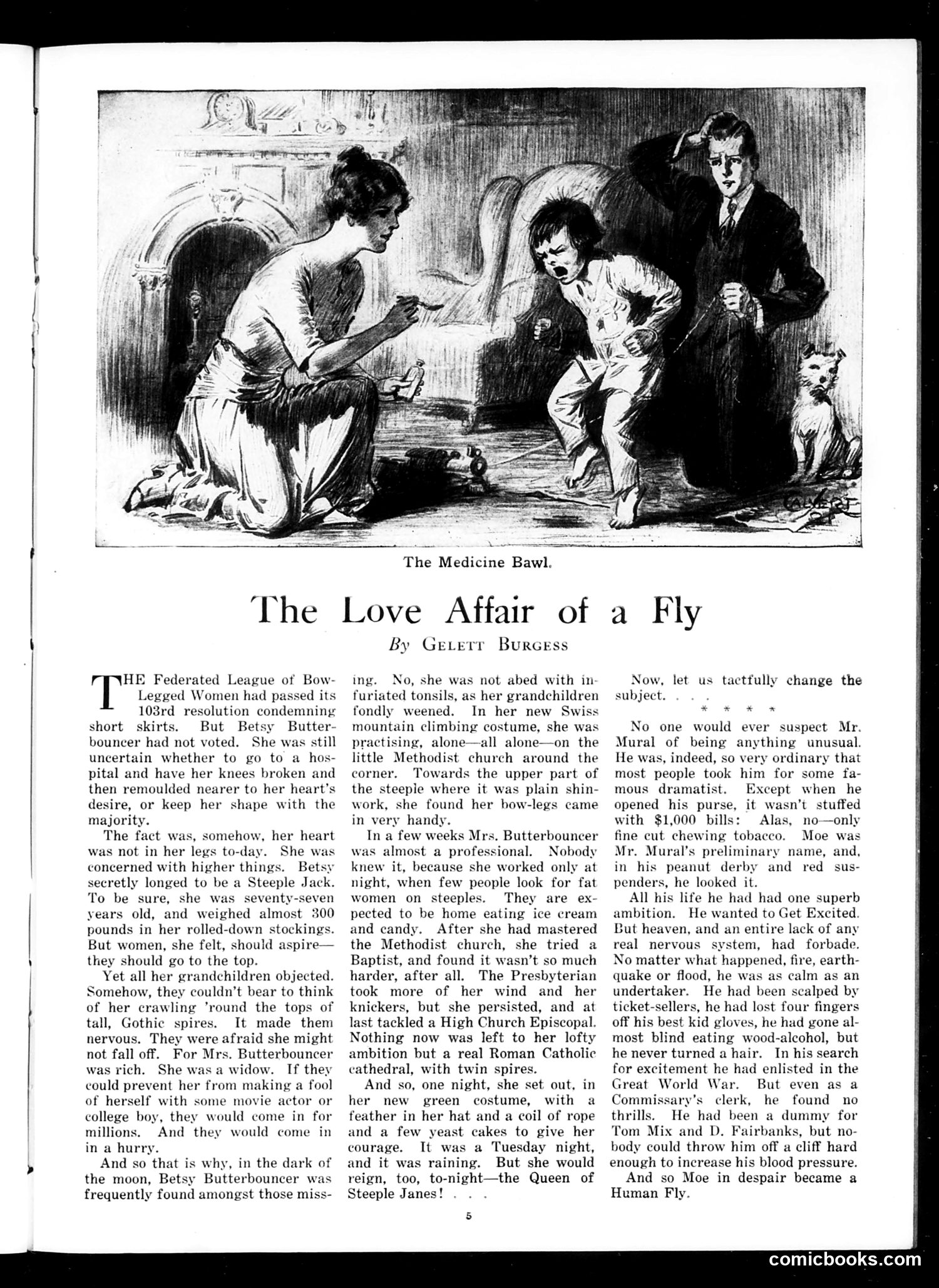
This appears to be a humorous short story rather than a political cartoon. The illustration at top shows a domestic scene with adults and children gathered around, seemingly witnessing something on the ground—likely a fly, given the story's title. The text is a satirical narrative about Betsy Butterbouncer, a widow who joins the "Federated League of Bow-legged Women" and takes up steeple-climbing in climbing costumes. The story's humor derives from absurdist elements: the ridiculous organization, her eccentric hobbies, and apparent romantic entanglement with a man named Mr. Mural. This is social satire targeting women's organizations and unconventional behavior of the era, though the specific topical references are unclear without additional historical context about Judge magazine's 1910s-1920s period.
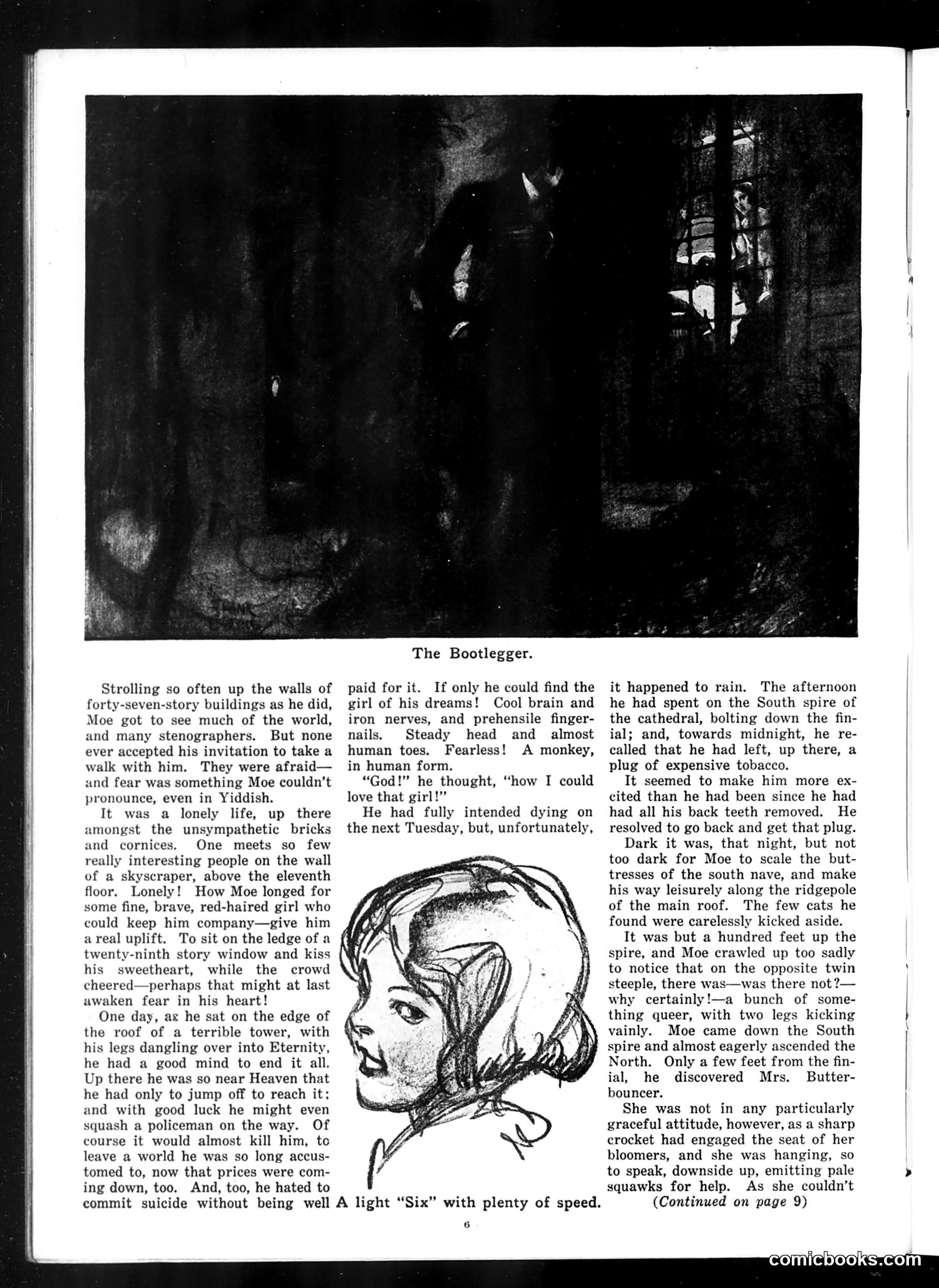
This page presents a serialized short story rather than a political cartoon. The narrative depicts "Moe," a lonely man living in a tall urban building who fantasizes about a girl and contemplates suicide. The illustrated portrait shows a woman's face labeled "A light 'Six' with plenty of speed." The story references Prohibition-era themes—the title "The Bootlegger" suggests illegal alcohol distribution. The narrative's mention of the protagonist's despair, his contemplation of jumping from a building, and the romantic fantasy reflect early 20th-century urban alienation literature. This appears to be serialized fiction rather than satirical commentary, presenting melodramatic social realism typical of Judge magazine's entertainment content during the Prohibition period.
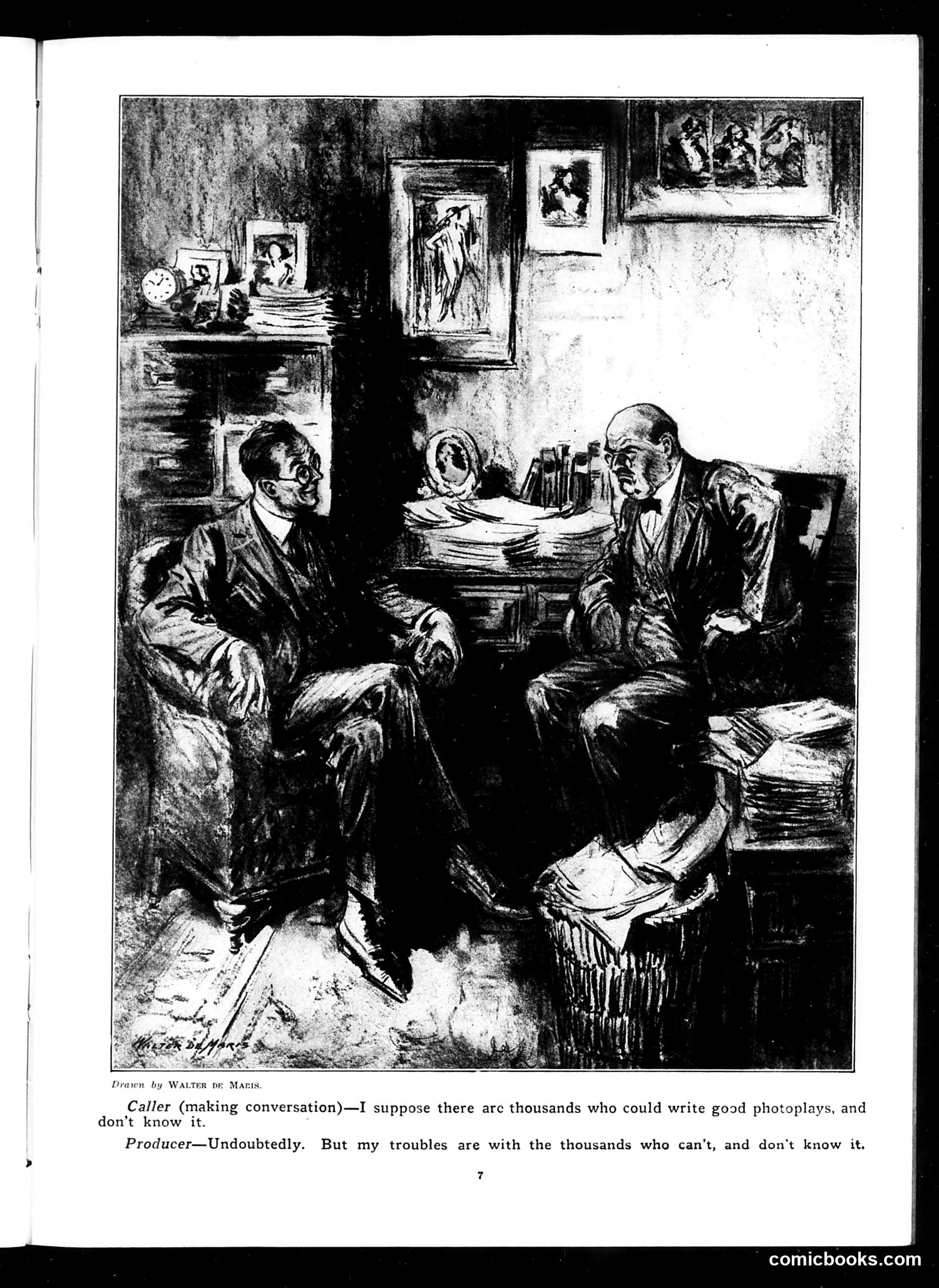
This cartoon satirizes the early film industry's struggle with screenwriting quality. Two men in an office—apparently a film producer (at desk) and a caller—discuss aspiring playwrights. The caller optimistically suggests many untapped writing talents exist. The producer's sharp reply flips this: his real problem isn't undiscovered genius, but the opposite—the vast number of incompetent writers who overestimate their abilities and submit poor screenplays. The joke targets the explosion of amateur screenwriters flooding Hollywood during the silent film era, when "photoplay" writing was perceived as easier than stage drama. It reflects industry frustration with unsolicited submissions and delusional amateurs, a common complaint among early cinema producers.
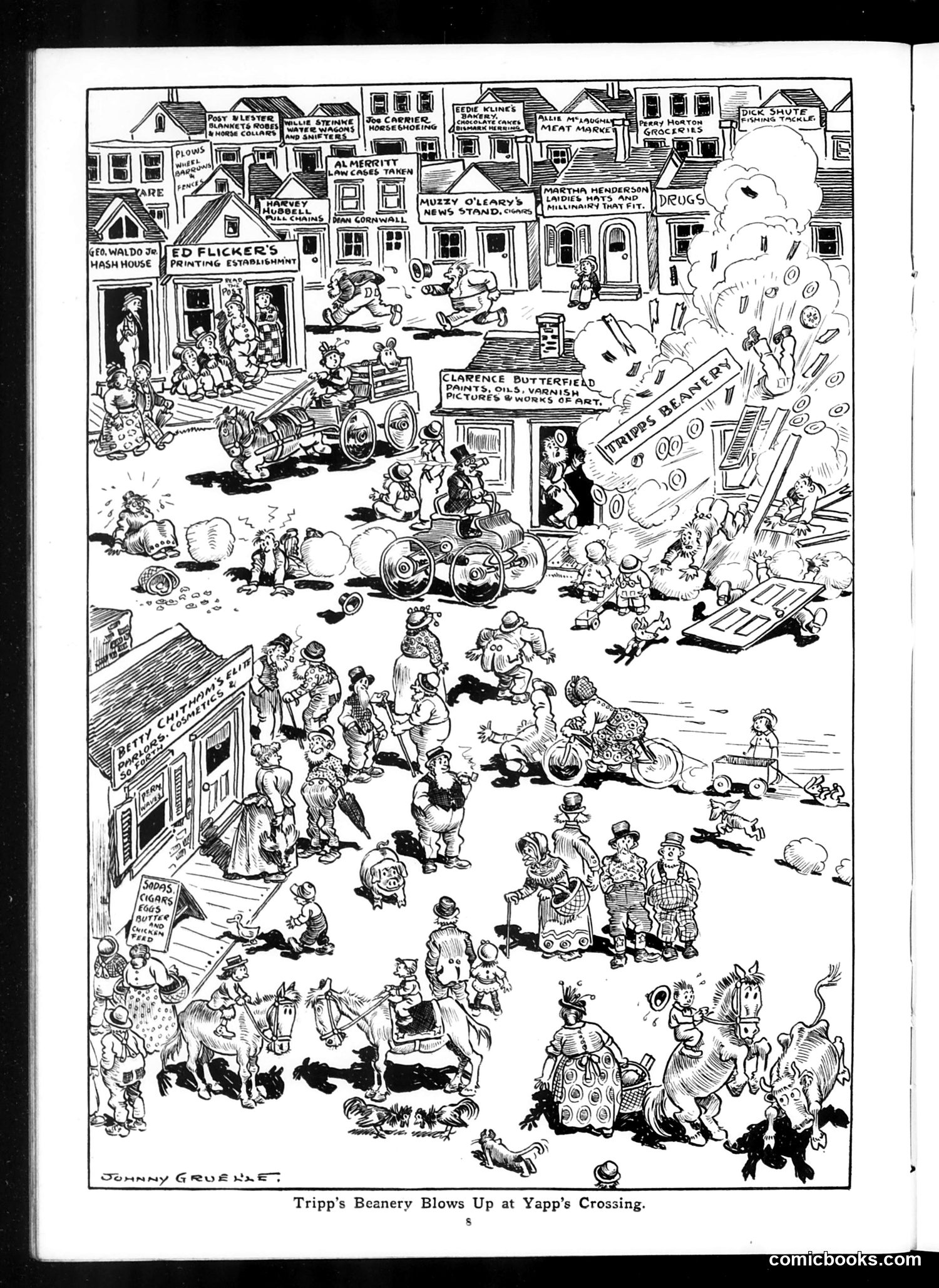
This satirical illustration depicts a chaotic street scene following an explosion at what appears to be Tripp's restaurant ("beanery"). The cartoon shows the destruction's aftermath with debris scattered across a town square, featuring various businesses identifiable by storefront signs (a hash house, printing establishment, drug store, meat market, and news stand). The humor derives from the double meaning of "beanery"—a cheap restaurant, but here suggesting the explosion resulted from the notorious digestive effects of beans. The cartoon satirizes small-town life and the domino effect of disaster, with townspeople, animals, and debris strewn about in exaggerated panic. The artist is credited as Johnny Gruelle at the bottom. This appears to be a classic Judge magazine visual gag playing on bathroom humor and small-town calamity for comedic effect.
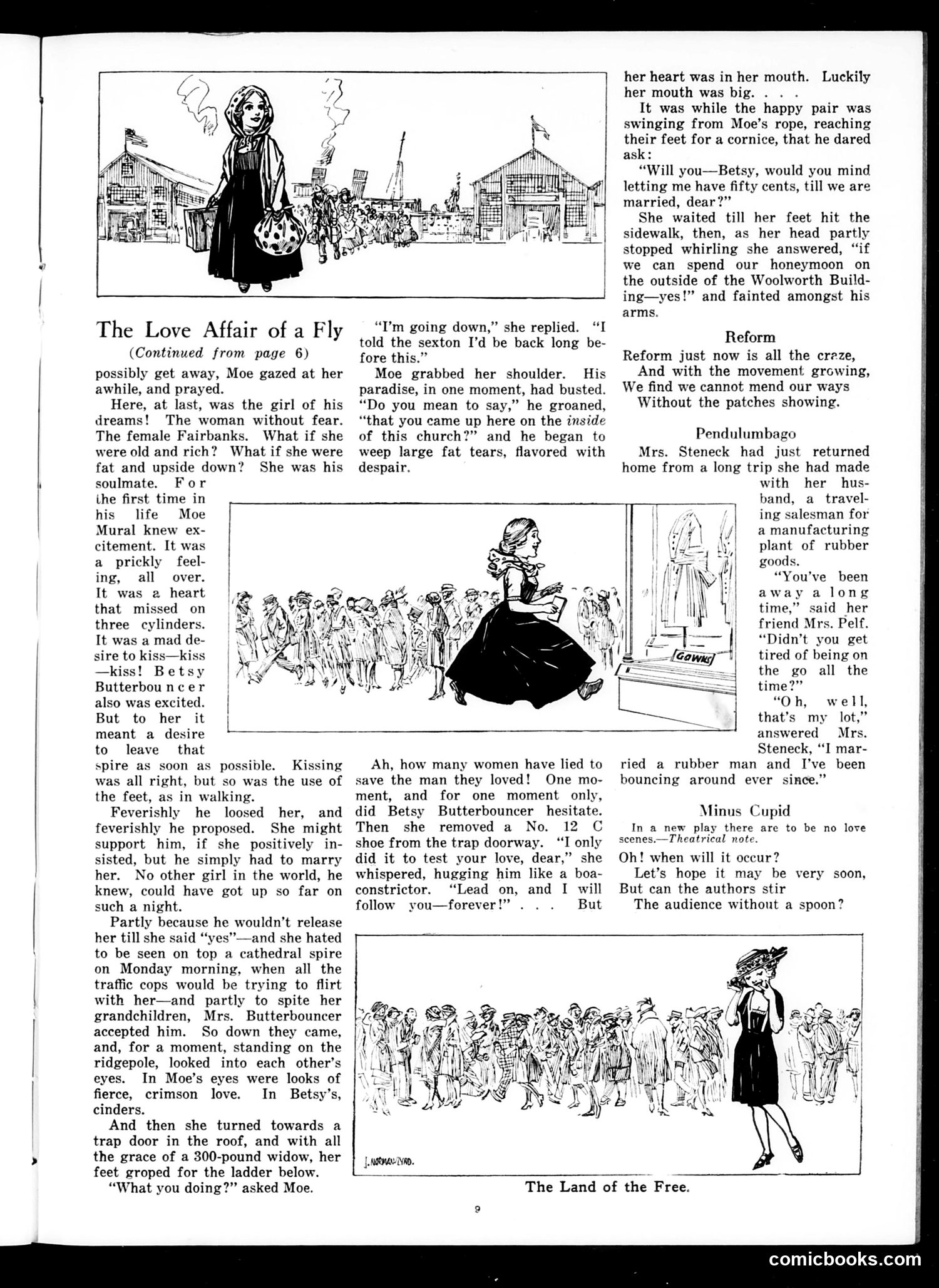
This page contains a humorous serialized story mocking romantic sentimentality and working-class courtship. "The Love Affair of a Fly" (continued from earlier) depicts Moe Mural, an apparently ordinary man, pursuing Betsy Butterbouncer atop a cathedral spire. The satire targets naive romantic idealism: Moe overlooks that Betsy is old, rich, and overweight because she's "fearless" like a movie star. The joke culminates when she admits entering the church through the *inside*—implying she took the practical route while Moe performed dangerous acrobatics on the outside, mocking masculine posturing. The secondary pieces ("Reform," "Pendulumbago," "Minus Cupid," "The Land of the Free") are brief satirical verses on contemporary concerns: reform movements, travel, theatrical trends, and presumably American freedom. These were typical Judge magazine filler—witty jabs at everyday life and current events rather than focused political commentary.
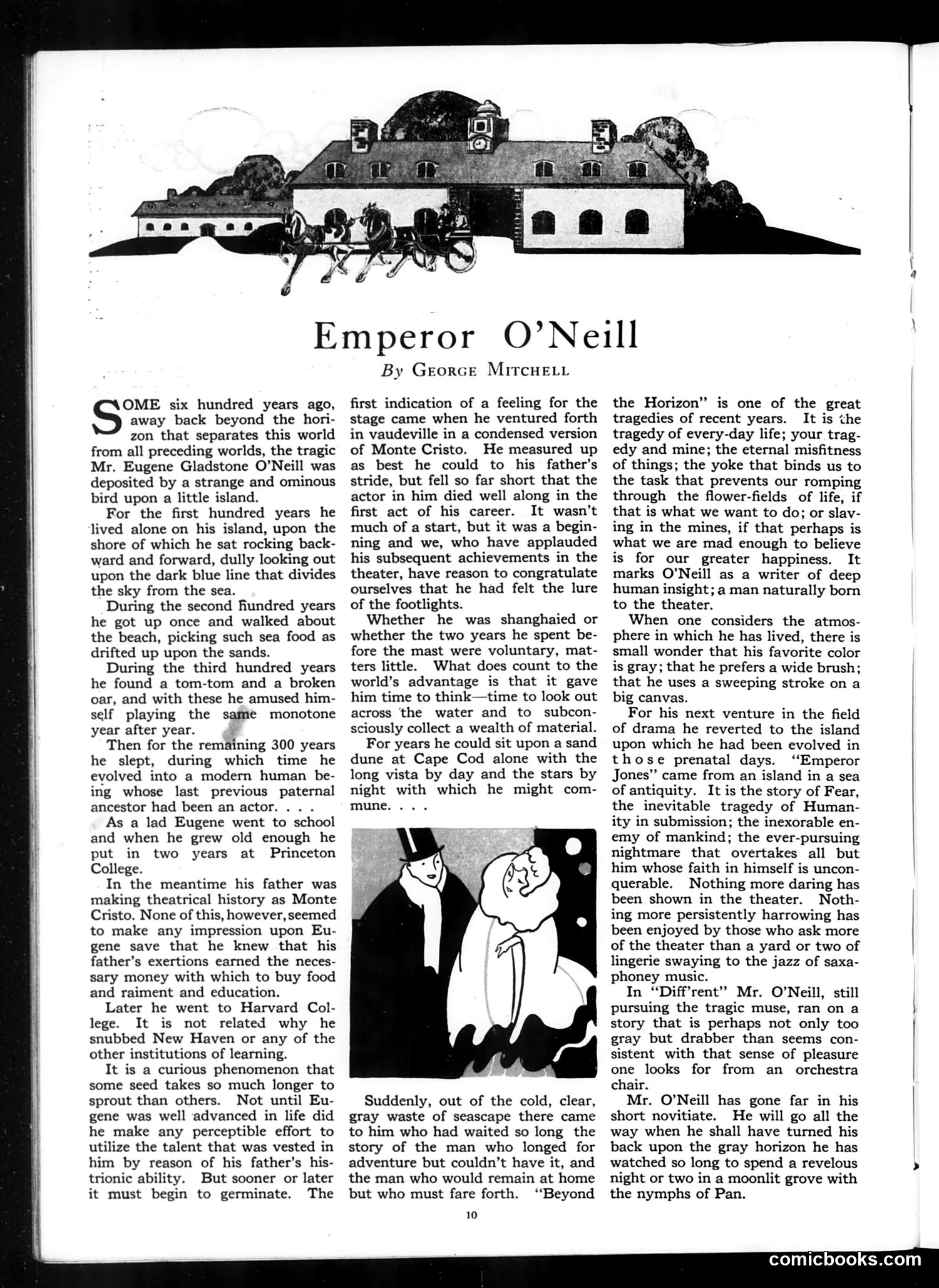
This is a satirical biographical essay about playwright Eugene O'Neill by George Mitchell. The text uses absurdist humor to mock O'Neill's slow development as an artist: it claims he evolved over 600 years on an island before becoming human, then spent years at Princeton and Harvard without apparent ambition. The satire suggests O'Neill was a late bloomer who initially failed in vaudeville (following his actor father James O'Neill's footsteps), only later finding success through unconventional experience—working at sea and meditating alone at Cape Cod. The accompanying illustration shows a man in formal dress conversing with another figure, likely depicting O'Neill during his early theatrical struggles or idle periods. The piece celebrates O'Neill's eventual achievement while gently ridiculing his indirect path to becoming a serious dramatist. "Beyond the Horizon," mentioned prominently, was O'Neill's acclaimed 1920 play that established his reputation. The humor lies in exaggerating how unlikely and circuitous his journey to greatness appeared.
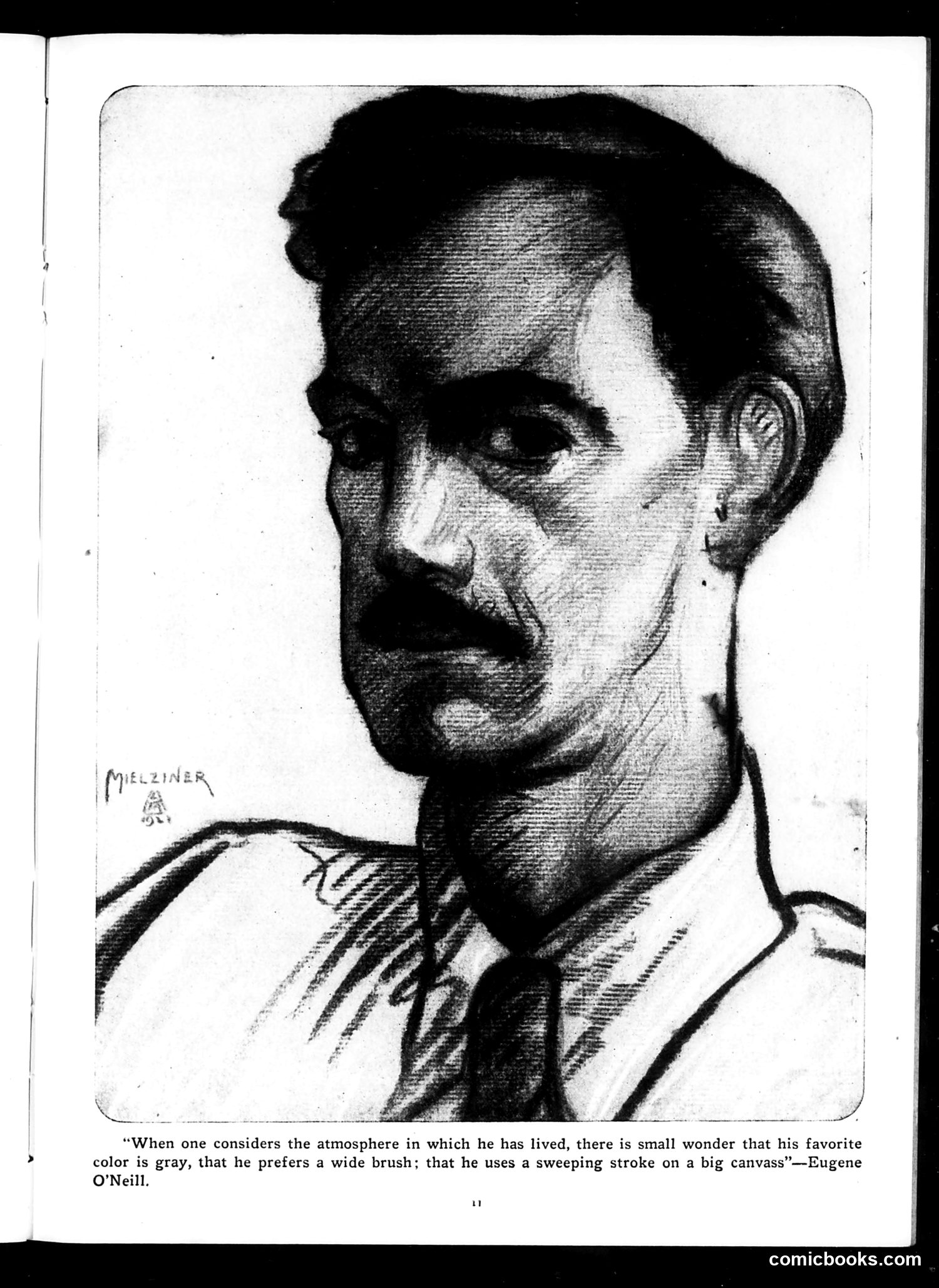
This page features a portrait sketch signed "Mielziner" (likely designer Jo Mielziner) of an unidentified man with a prominent mustache. The accompanying quote from playwright Eugene O'Neill discusses the subject's artistic preferences—favoring gray tones, broad brushwork, and large canvases—while cryptically referencing "the atmosphere in which he has lived." Without additional context (artist identification, publication date, or caption), I cannot definitively identify the portrait subject or explain what specific "atmosphere" O'Neill references. The quote suggests the subject is a visual artist whose style reflects his life experiences, but the satirical point remains unclear. This appears to be a profile or tribute page rather than a political cartoon, though the source being *Judge* magazine suggests there may be social commentary embedded in the choice to profile this particular artist.
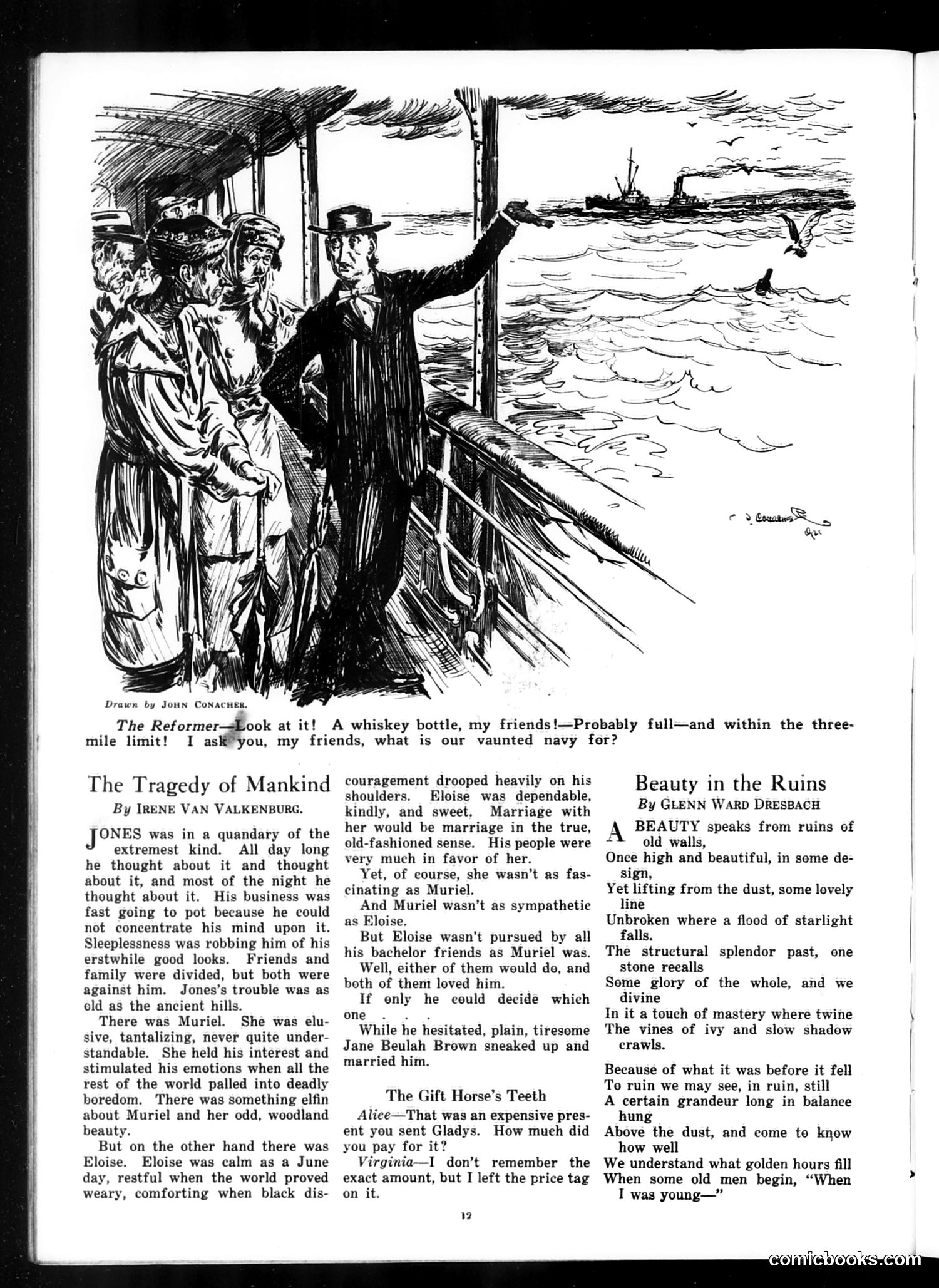
The top cartoon by John Conacher satirizes naval readiness concerns. A well-dressed man on a ship's deck points to a whiskey bottle floating in the ocean, sarcastically asking companions what purpose the "vaunted navy" serves if it cannot prevent such debris—likely full bottles—from being lost at sea. This appears to critique either naval incompetence or the Navy's failure to prevent alcohol smuggling/loss during Prohibition era concerns. The page also contains three literary pieces: "The Tragedy of Mankind" (a humorous short story about a man unable to choose between two women who is ultimately married by a third), "The Gift Horse's Teeth" (a brief joke about leaving a price tag on a gift to display its cost), and "Beauty in the Ruins" (a serious poem about finding grandeur in decay). The magazine blends satirical commentary on contemporary issues with fiction and poetry typical of early 20th-century Judge publications.
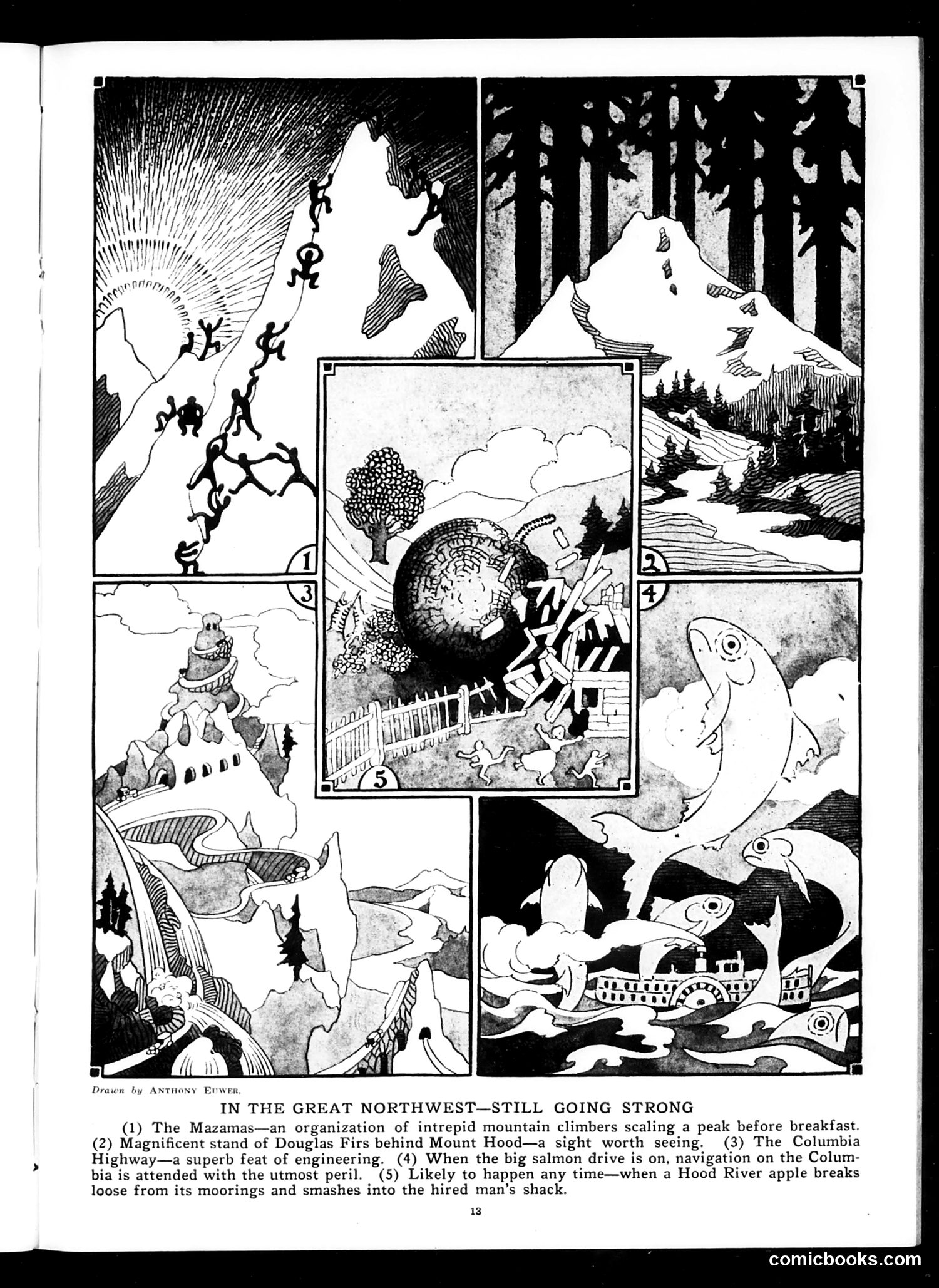
This is a humorous illustrated essay celebrating the Pacific Northwest's natural and engineering achievements. The five panels showcase: 1. The **Mazamas** (a real mountaineering club) climbing before breakfast—emphasizing regional toughness 2. Douglas fir forests and Mount Hood—showcasing natural beauty 3. The Columbia River Highway—celebrating modern infrastructure 4. Salmon runs on the Columbia River as navigation hazards 5. A satirical final panel: Hood River apples so massive they become dangerous projectiles The joke is escalating hyperbole. The first three panels celebrate legitimate regional attractions. The final two panels exaggerate natural abundance absurdly—salmon creating "utmost peril" and apples literally smashing buildings—poking fun at regional boosterism and tall tales. The cartoonist mocks the tendency to overstate the Pacific Northwest's grandeur and productivity, suggesting locals inflate every regional feature into something extraordinary or dangerous.
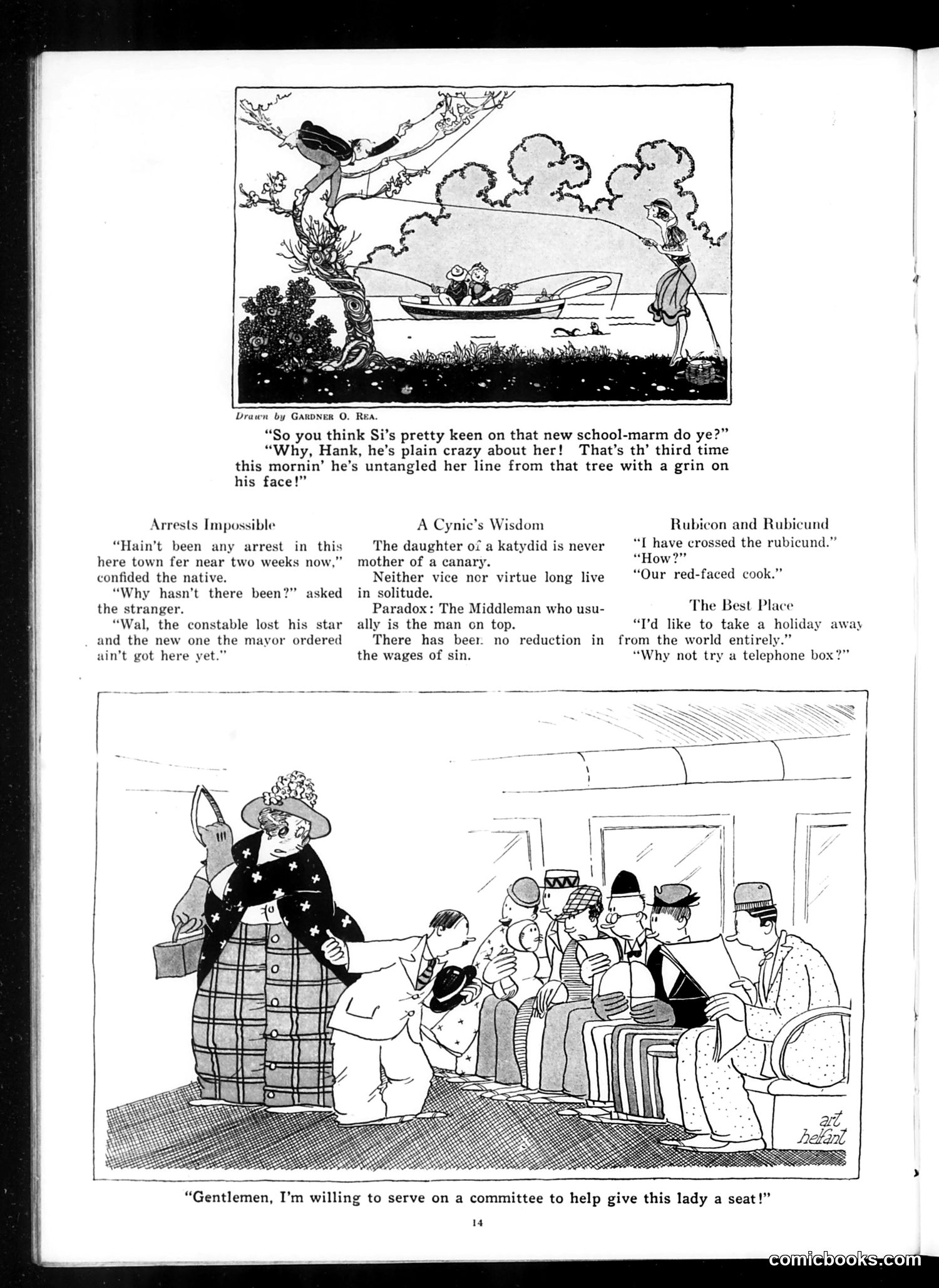
This page contains rural humor and satirical quips typical of early 20th-century American comedy. **Top cartoon** (by Gardner O. Rea): A rural romance sketch where "Si" is infatuated with a new schoolteacher. The humor lies in his clumsily untangling her fishing line from a tree as evidence of his romantic interest—depicting rural courtship as awkward and earnest. **Text sections** offer brief satirical observations: - "Arrests Impossible": Small-town incompetence—the constable lost his badge and the replacement hasn't arrived, so no arrests occur. - "A Cynic's Wisdom": Paradoxical observations about human nature and morality. - "Rubicon and Rubicund": A pun on "rubicund" (red-faced) rather than the historical Rubicon. - "The Best Place": Urban satire suggesting a telephone booth offers the only escape from the modern world. **Bottom cartoon**: A large woman in elaborate dress addresses men, offering to form a committee to provide her a seat—satirizing both aristocratic pretension and gentlemanly courtesy culture. The page reflects Judge's mixture of rural simplicity humor and urbane social satire.
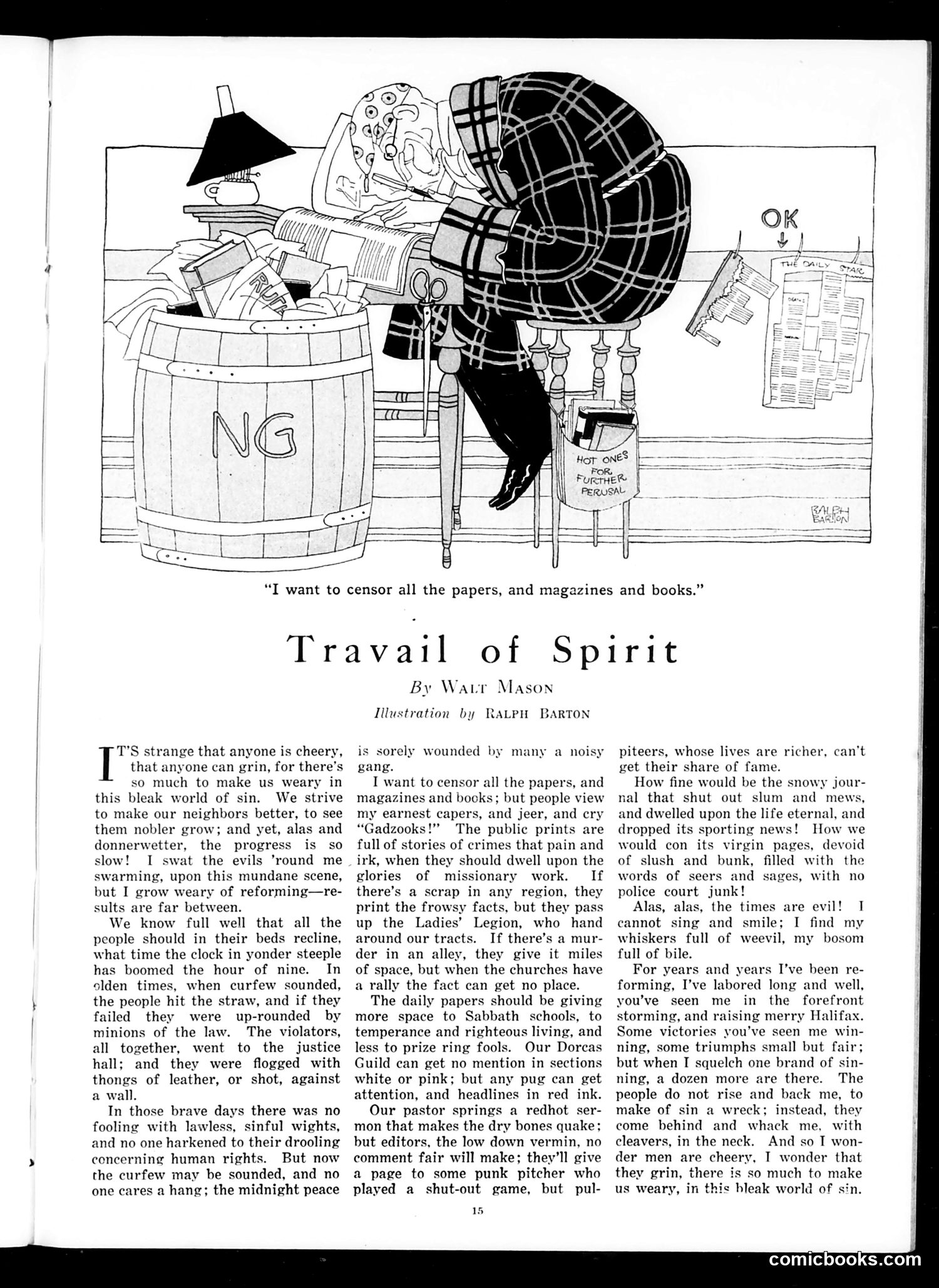
This satirical piece targets **moral reformers and censors** who want to control public discourse. The cartoon shows a figure in a plaid skirt (suggesting Scottish prudishness) sitting at a desk surrounded by papers, declaring: "I want to censor all the papers, and magazines and books." The accompanying poem by Walt Mason, illustrated by Ralph Barton, mocks a self-righteous reformer who complains that newspapers waste space on crime stories and sports instead of promoting religious virtue, temperance, and moral improvement. The reformer laments that his "earnest capers" to censor media are met with mockery. The satire's point: **such censorial impulses are both futile and absurd**. Despite the reformer's decades of effort, vice persists and society ignores his agenda. The poem ends ironically—the reformer is weary precisely *because* his censorship crusade fails, yet he remains unable to smile. This reflects early 20th-century tensions between progressive reformers seeking media control and those defending editorial freedom and popular entertainment.
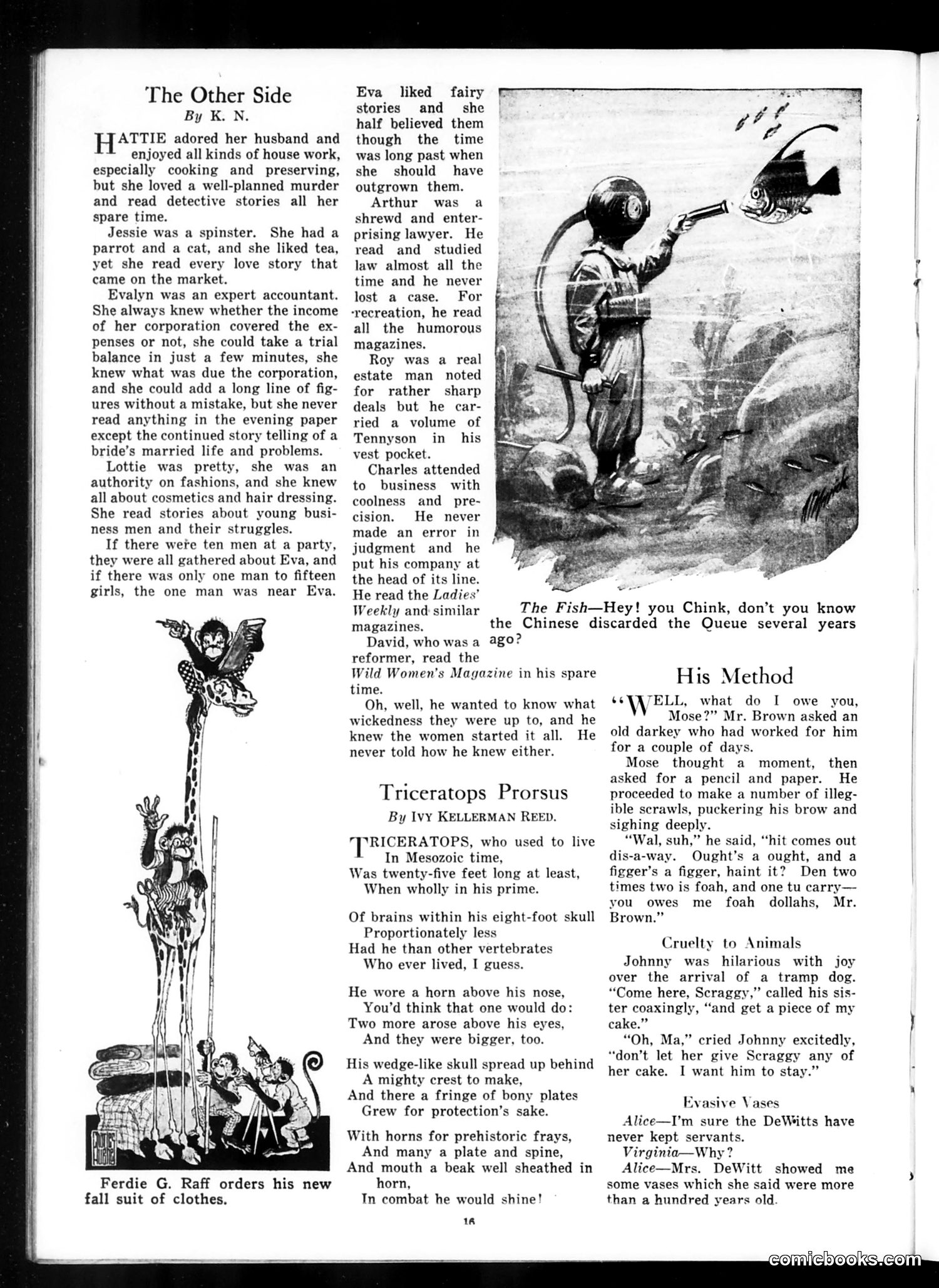
**"The Other Side"** presents ironic character sketches satirizing the gap between people's professional competence and their reading habits. Hattie loves murder mysteries despite being a homemaker; Evalyn is a brilliant accountant yet reads only bride-problem stories; Roy, a shrewd businessman, carries Tennyson poetry. The satire targets how successful, intelligent people—especially women—indulge in escapist fiction disconnected from their expertise. The punchline: despite their serious accomplishments, all gravitate toward Eva at parties, suggesting that charisma trumps professional achievement. The other pieces are light humor: "Triceratops Porsus" is playful paleontology verse; "His Method" jokes about Black dialect and mathematical illiteracy (a period stereotype); "Cruelty to Animals" is a mild joke about a child's misplaced concern; "Evasive Vases" appears incomplete but likely mocks pretentious antique collecting. The cartoons (Ferdie Raff's suit, the dinosaur illustration) are decorative rather than satirically pointed.
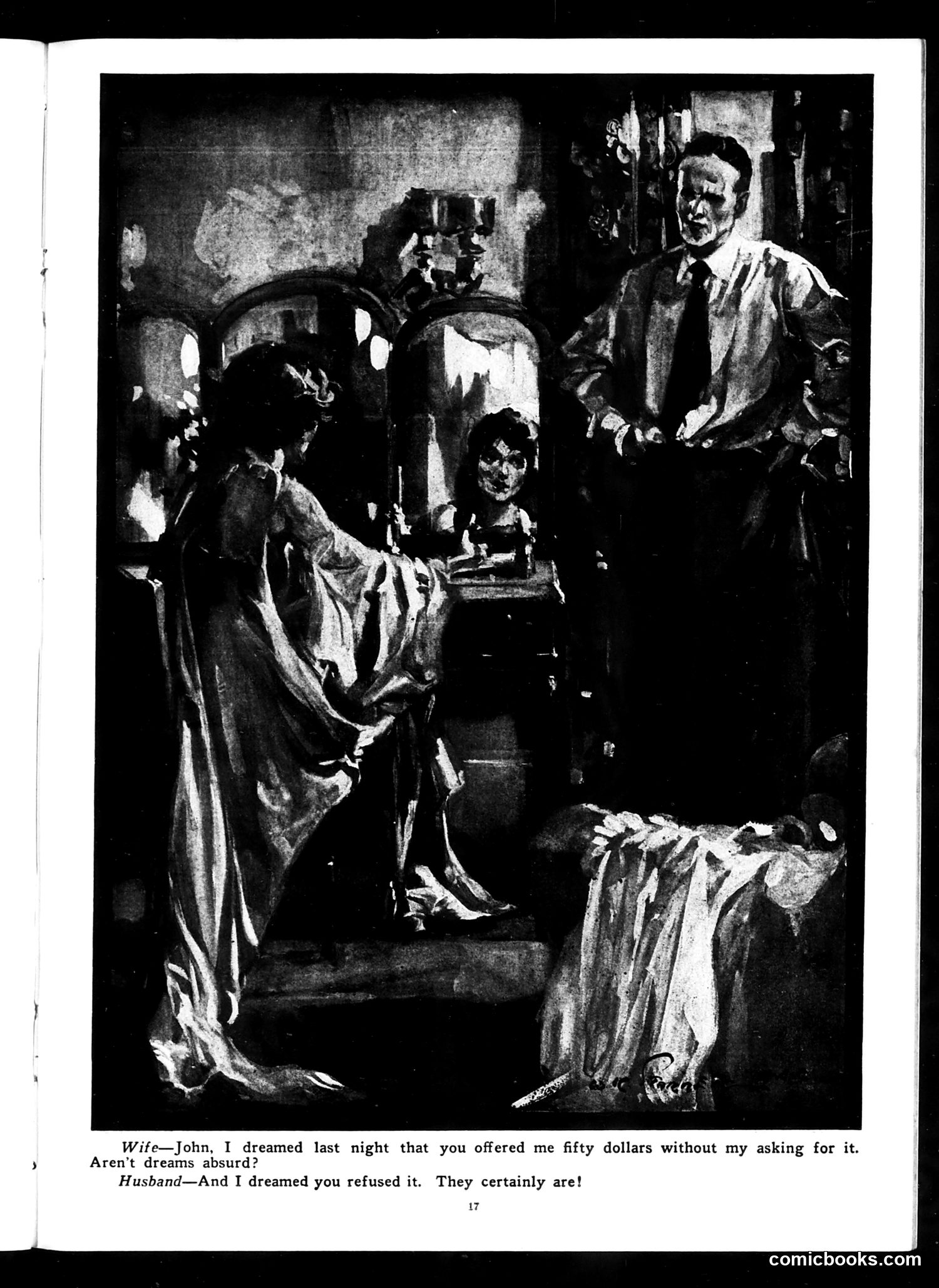
This is a domestic humor cartoon satirizing marital economics and gender relations in early 20th-century America. The joke relies on contrasting spousal expectations: the wife finds it absurd that her husband would *voluntarily* offer her money without prompting, while the husband finds it equally implausible that she would *refuse* it. The humor targets both spouses—suggesting husbands were stingy with household allowances while wives persistently sought financial support. It reflects contemporary anxieties about money management in marriage and the power dynamics around who controlled family finances. The shared conclusion that both scenarios are "certainly absurd" offers mutual mockery of typical marital behavior, making this a gender-balanced (if cynical) observation about domestic life.
This Judge magazine page contains three satirical columns addressing post-WWI American issues: **"Who Won the War?"** mocks politicians and labor leaders (General Pershing and Mr. Gompers, the AFL leader) claiming credit for America's WWI victory. Judge argues the entire nation—workers, soldiers, bond-buyers—won together, and warns that some leaders are now conveniently taking credit to boost their candidacies for office. **"The Slave Markets"** critiques a theatrical performance at Boston's Faneuil Hall (historically significant as an abolitionist venue) that apparently used slavery imagery as publicity. Judge condemns this as exploitative mockery that trivializes past suffering while ignoring present problems: five million unemployed Americans and hungry families. **"The Reaction Against Surgery"** satirizes a medical conference's statement discouraging unnecessary operations. Judge jokes that people will misinterpret this as endorsement of drinking instead, while noting the social phenomenon where those without surgical scars were previously viewed with suspicion—mocking this sudden reversal in medical opinion.
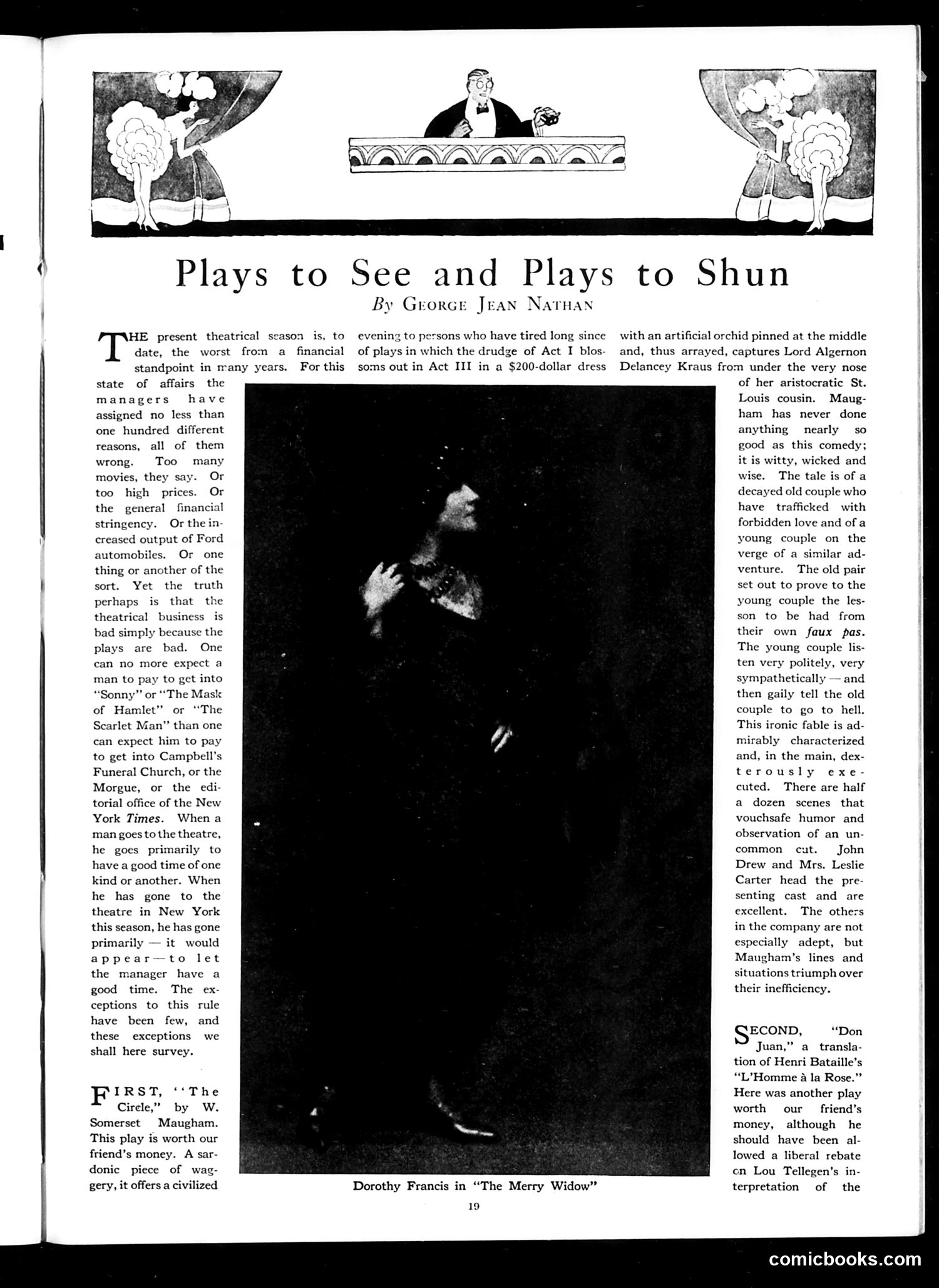
This is a theater review column by George Jean Nathan in *Judge* magazine, critiquing the current Broadway season. The author argues bluntly that the theatrical business is failing not due to movies, high prices, or economic conditions—but because **the plays themselves are bad**. He compares paying to see poor theater to paying admission to a funeral home or morgue. The photograph shows actress Dorothy Francis in "The Merry Widow." Nathan then reviews specific plays worth seeing: W. Somerset Maugham's "The Circle" (praised as witty and wise, starring John Drew and Mrs. Leslie Carter) and a translation of Henri Bataille's "Don Juan" (with reservations about Lou Tellegen's performance). The satire targets theater managers' excuses for poor box office while audiences increasingly stayed home or sought entertainment elsewhere.
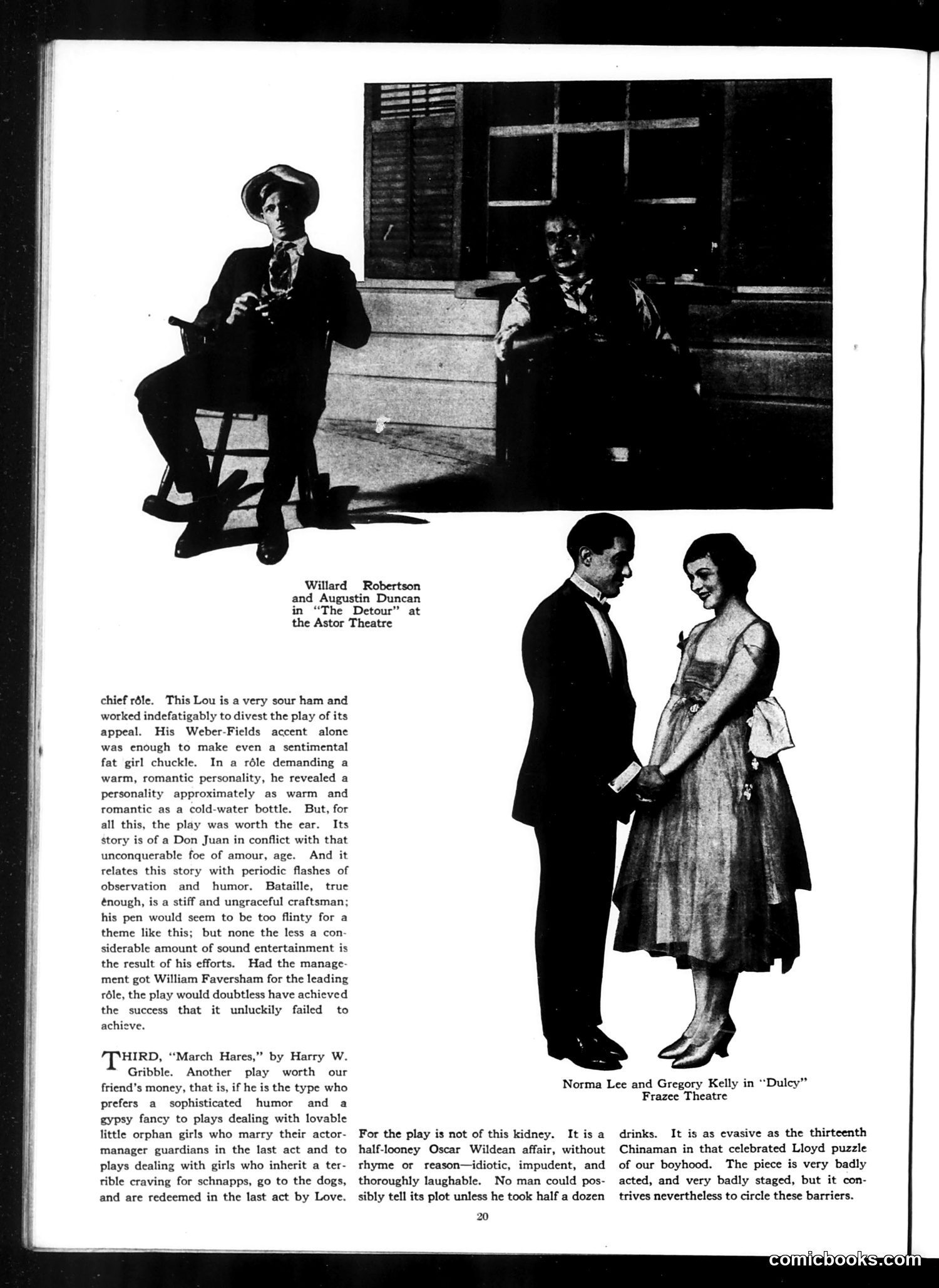
This page contains theater criticism rather than cartoons. It reviews three Broadway plays with accompanying production photos: 1. **"The Detour"** (Astor Theatre) — The reviewer harshly critiques lead actor Lou for his poor performance, describing him as a "sour ham" with an off-putting accent. However, the play itself about an aging Don Juan is deemed worthwhile. The critic suggests star William Faversham might have saved it. 2. **"March Hares"** by Harry W. Gribble — Praised as sophisticated comedy for audiences preferring witty humor over sentimental plots (mocking typical theater fare of orphans and reformed alcoholics redeemed by love). The play is described as nonsensical but entertaining—"as evasive as the thirteenth Chinaman in that celebrated Lloyd puzzle." 3. **"Dulcy"** (Frazee Theatre) — Photo shows Norma Lee and Gregory Kelly. The satire targets both bad acting and predictable theatrical conventions of the era.
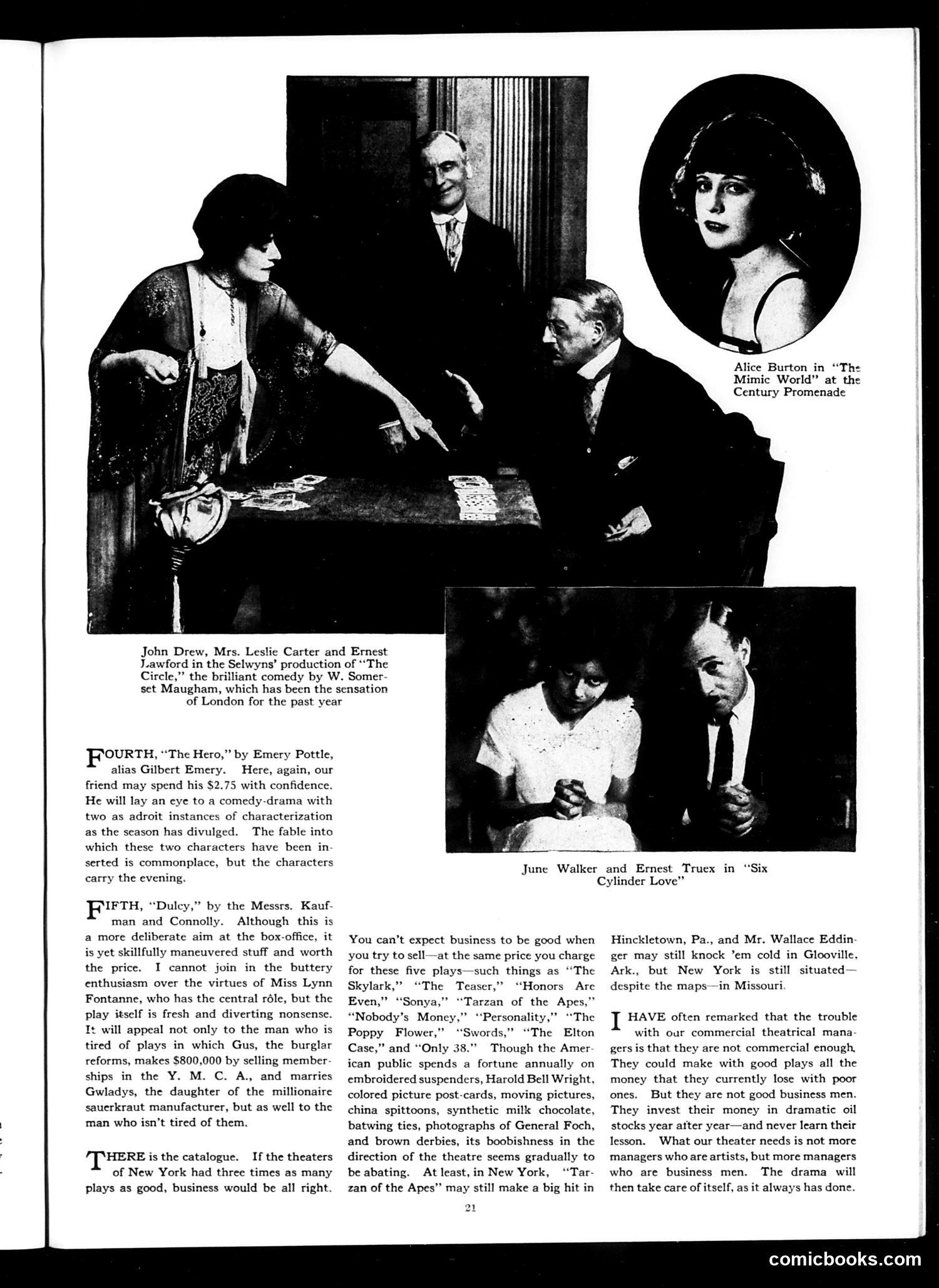
This is a theater review column evaluating five Broadway plays for potential $2.75 ticket purchases. The page features photographs of actors in productions like "The Circle" (praised as a Somerset Maugham hit) and "Dulcy" (a new comedy). The satirical commentary criticizes American theatergoers' poor taste while mocking commercially unsuccessful plays with absurd titles: "Tarzan of the Apes," "Nobody's Money," "Only 38." The author contrasts the public's willingness to spend money on frivolous items—embroidered suspenders, Harold Bell Wright novels, picture postcards—with their reluctance to support quality theater. The final section argues that Broadway needs business-minded managers rather than artistic ones. The phrase "New York is still situated—despite the maps—in Missouri" sarcastically implies New Yorkers have rural, unsophisticated tastes.
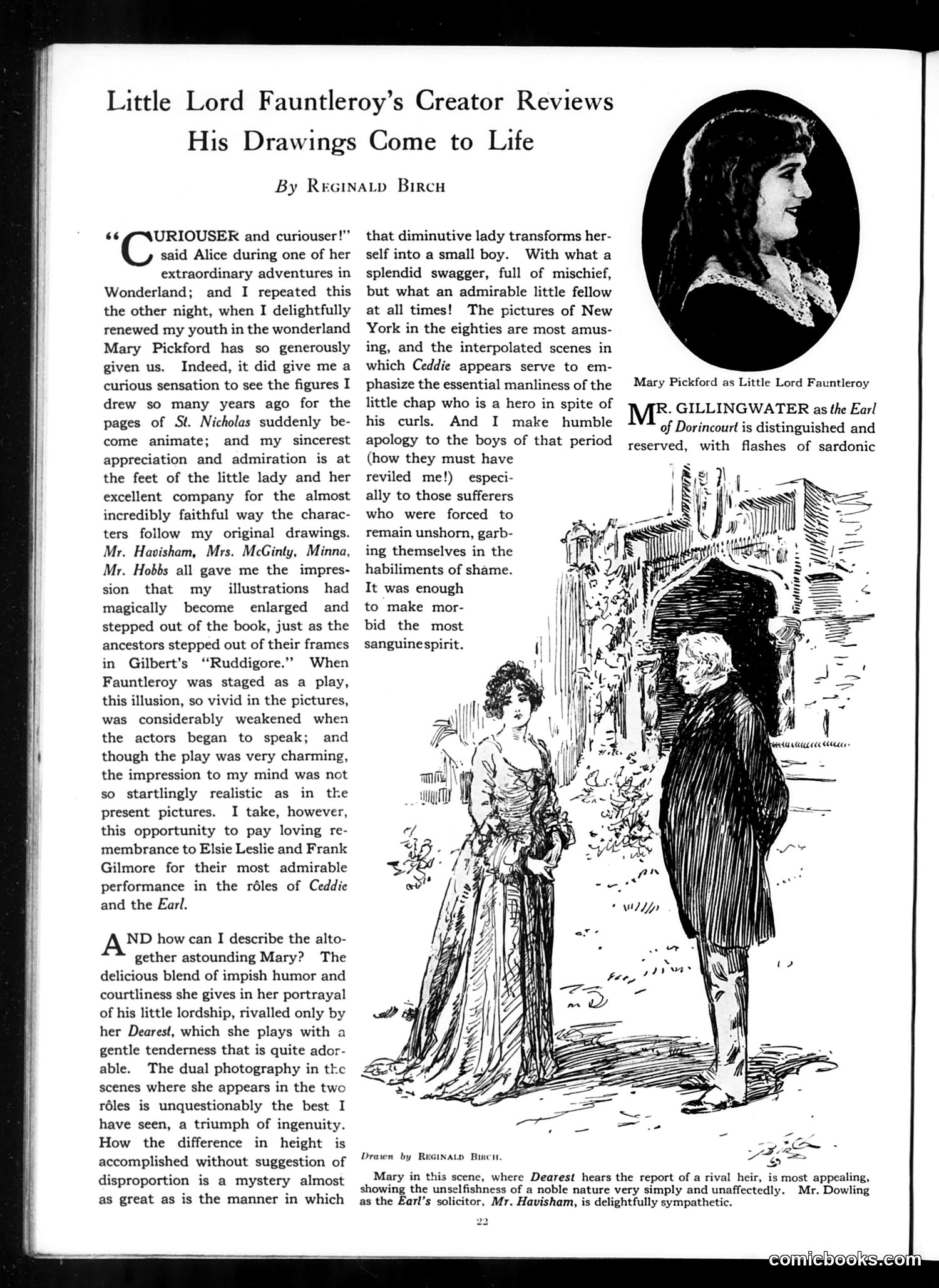
This is a **favorable review** by illustrator Reginald Birch of a film adaptation of "Little Lord Fauntleroy" starring Mary Pickford. Birch originally illustrated the classic children's novel decades earlier and is praising how faithfully the film captures his drawings. **Key figures:** Mary Pickford (the star actress), who plays dual roles as both the boy Ceddie and his mother "Dearest"; supporting actors Elsie Leslie and Frank Gilmore (referenced from an earlier stage play); and H. B. Warner as the Earl. **The satire/humor:** Birch humorously apologizes to boys of the 1880s who were forced to wear the "Little Lord Fauntleroy" style—long curls and fancy clothing—which apparently caused them embarrassment. He calls this period a "sanguine spirit" worthy of ridicule, reflecting contemporary attitudes mocking the sentimental Victorian children's fashion. The piece celebrates cinema's superiority over theater in creating realistic illusions.
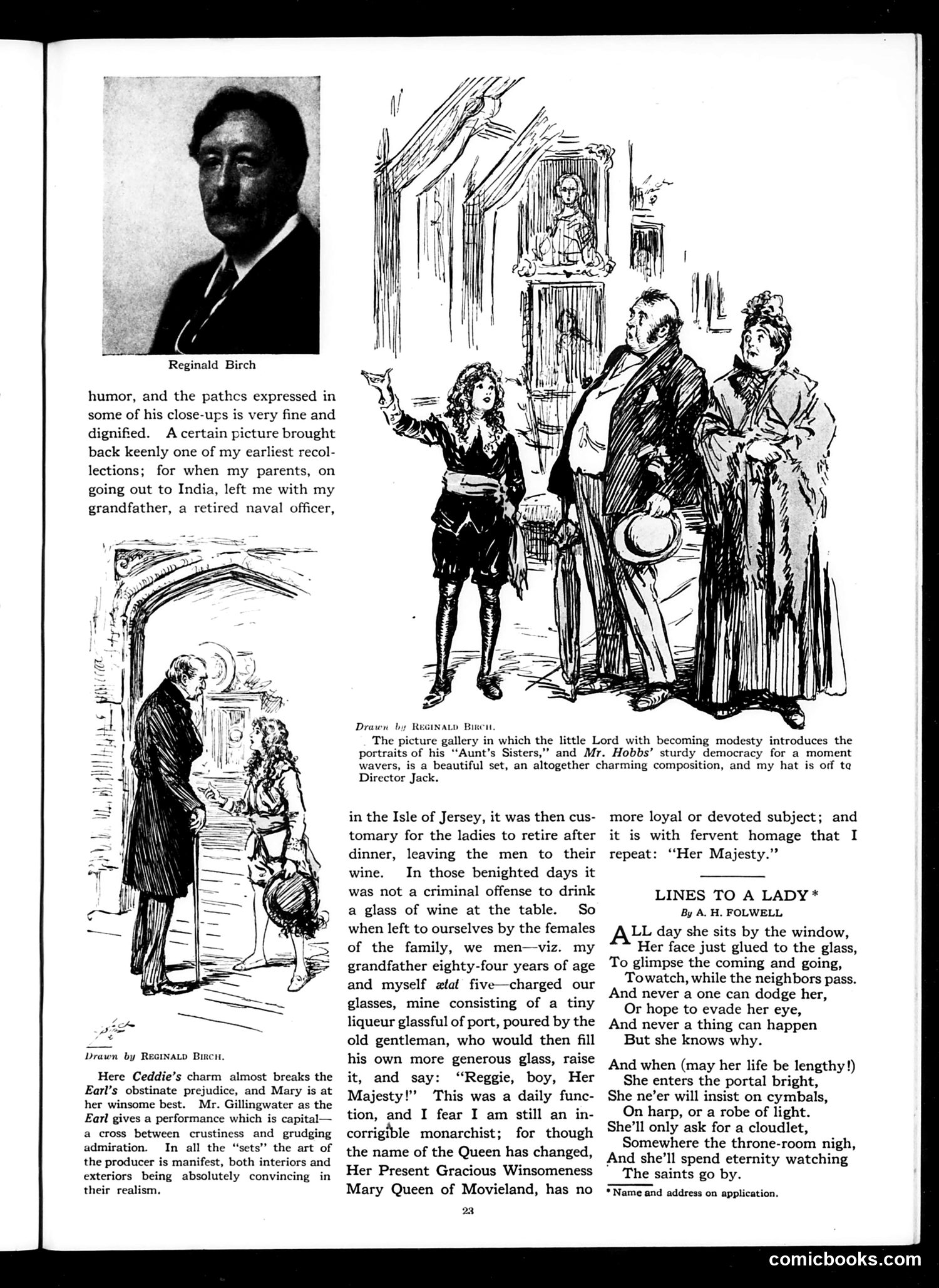
This page reviews a theatrical production of "Little Lord Fauntleroy," illustrated by artist Reginald Birch. The critic praises the cast—particularly the young lead ("Ceddie"), the Earl actor Mr. Gillingwater, and Mary—along with Director Jack's realistic set design, including a notably effective picture gallery scene. The accompanying sketches by Birch depict scenes from the play: an older gentleman and young boy in formal domestic settings, illustrating the sentimental story of aristocratic reconciliation. The page also includes a humorous personal anecdote from the critic about being a five-year-old toasting "Her Majesty" with port wine in Jersey, establishing his lifelong monarchist devotion. This nostalgia frames his appreciation for the play's themes of honor and social hierarchy. The poem "Lines to a Lady" is unrelated social verse about a gossip-prone neighbor.
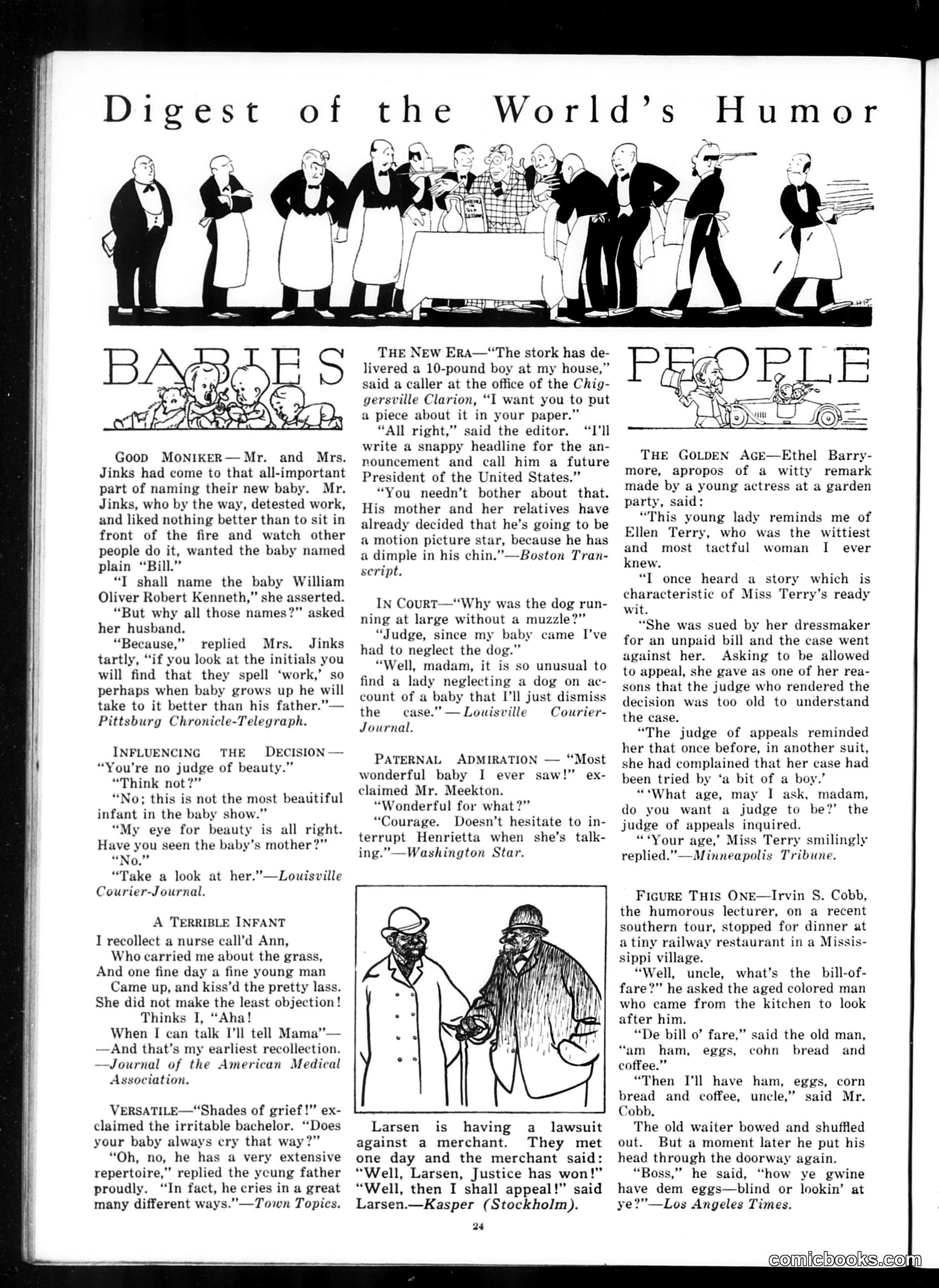
This page collects brief humorous anecdotes organized by topic, typical of Judge's format. The satirical points: **"Good Moniker"**: Mocks pretentious naming—Mrs. Jinks insists on "William Oliver Robert Kenneth" so initials spell "WORK," hoping her lazy husband will adopt the habit. **"Influencing the Decision"**: A man judges babies without seeing the winner's mother, exposing the absurdity of beauty pageant logic. **"In Court"**: Judges a woman neglecting her dog due to a new baby; the judge dismisses the case, suggesting motherhood excuses all negligence. **"The New Era"**: Satirizes parental ambition—a caller boasts his newborn will become a movie star because of a dimple, while the editor jokes he'll become President. **"Paternal Admiration"**: Mr. Meekton praises his baby's "courage" for interrupting his wife—mocking how fathers find faults endearing in infants. The page satirizes parental vanity, judicial incompetence, and society's tendency to project unrealistic futures onto children.
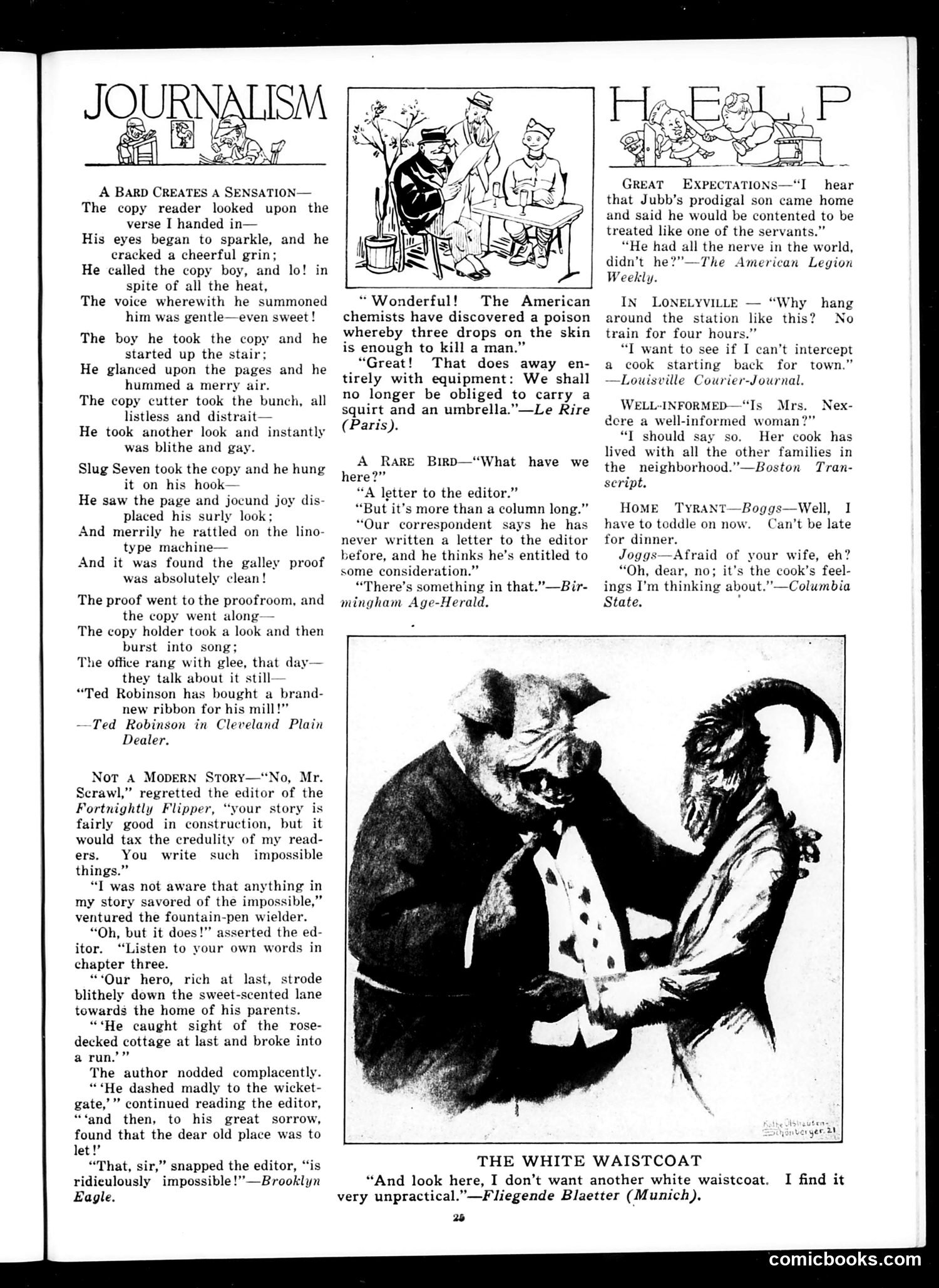
This page collects several brief satirical pieces and jokes typical of early 20th-century American humor magazines. **"A Bard Creates a Sensation"** mocks newsroom hierarchy through exaggeration: a poet's mundane verse about someone buying a typewriter ribbon generates disproportionate enthusiasm as it passes through each department, with workers increasingly emotional about the trivial subject matter. **"Not a Modern Story"** satirizes editorial gatekeeping: an editor rejects a manuscript as implausible because the protagonist runs toward his childhood home after learning it's being rented out—treating ordinary human emotion as unrealistic. The remaining items are brief jokes about domestic life (wives and cooks), a Paris-based quip about poison technology, and a cartoon showing two figures in conflict over a white waistcoat's practicality. The humor relies on workplace absurdity, editorial pretension, and domestic comedies—themes reflecting early 1900s magazine culture where trivial matters received exaggerated treatment for comic effect.
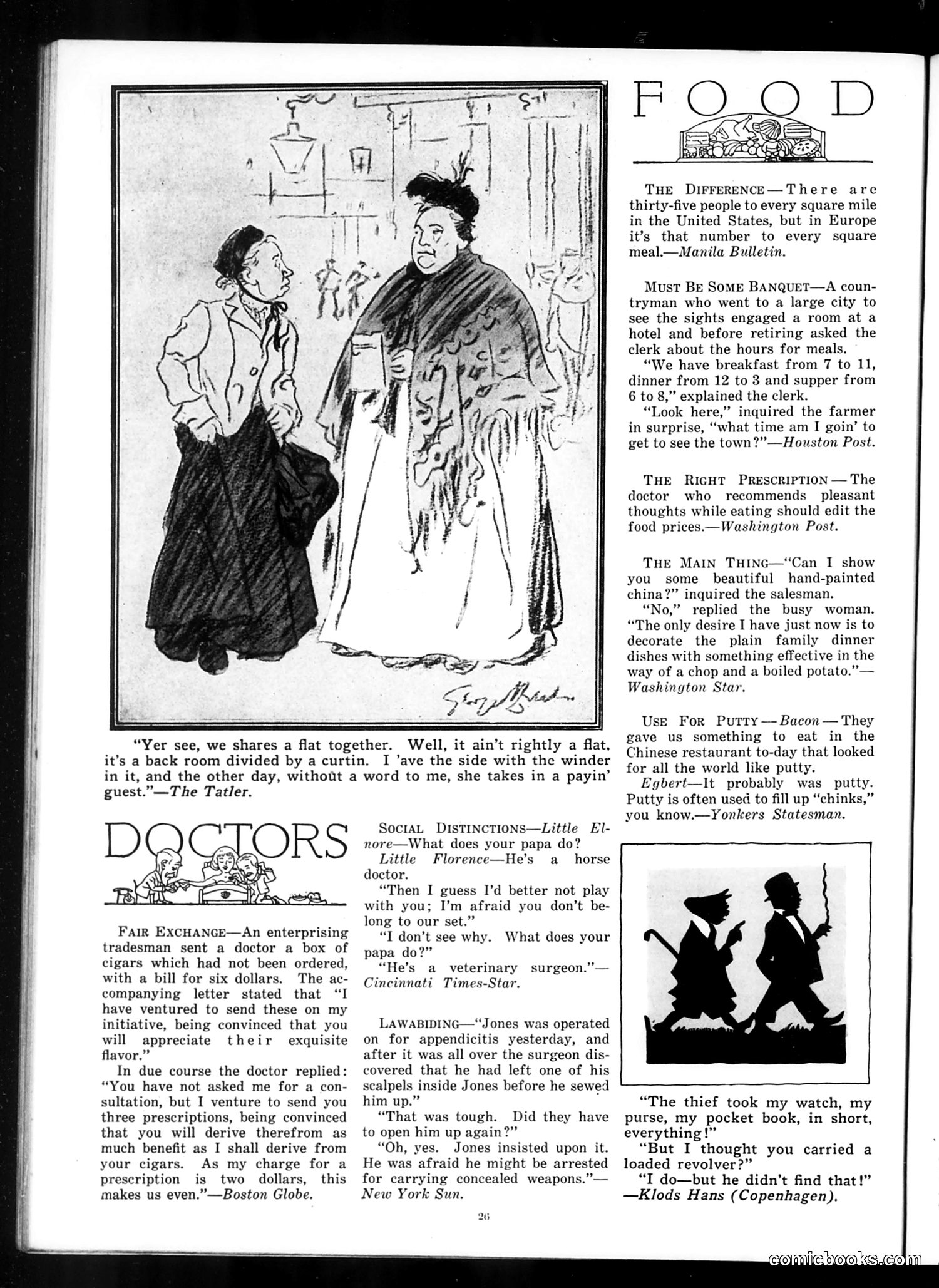
This page from the satirical magazine *Judge* contains humor pieces mocking early 20th-century social pretensions and absurdities. The main cartoon depicts two working-class women sharing cramped lodgings—one complains her roommate secretly rented out part of their shared flat to a paying guest without permission. It satirizes urban housing scarcity and the desperation of the poor. The accompanying jokes target: **Social hypocrisy**: A child rejects a playmate whose father is a "horse doctor," only to learn her own father is a "veterinary surgeon"—the same job with a fancier name, mocking class distinctions. **Professional incompetence**: A surgeon forgets surgical tools inside a patient; the patient fears arrest for "carrying concealed weapons." **Rural-urban disconnect**: A farmer, bewildered by hotel meal schedules, asks when he'll have time to sightsee—humor based on rural simplicity versus city pace. **Food quality complaints**: Jokes about poor-quality restaurant food and the working woman's modest domestic aspirations reflect Depression-era concerns about sustenance and economic hardship. The overall tone satirizes class pretension, professional bungling, and economic struggle.
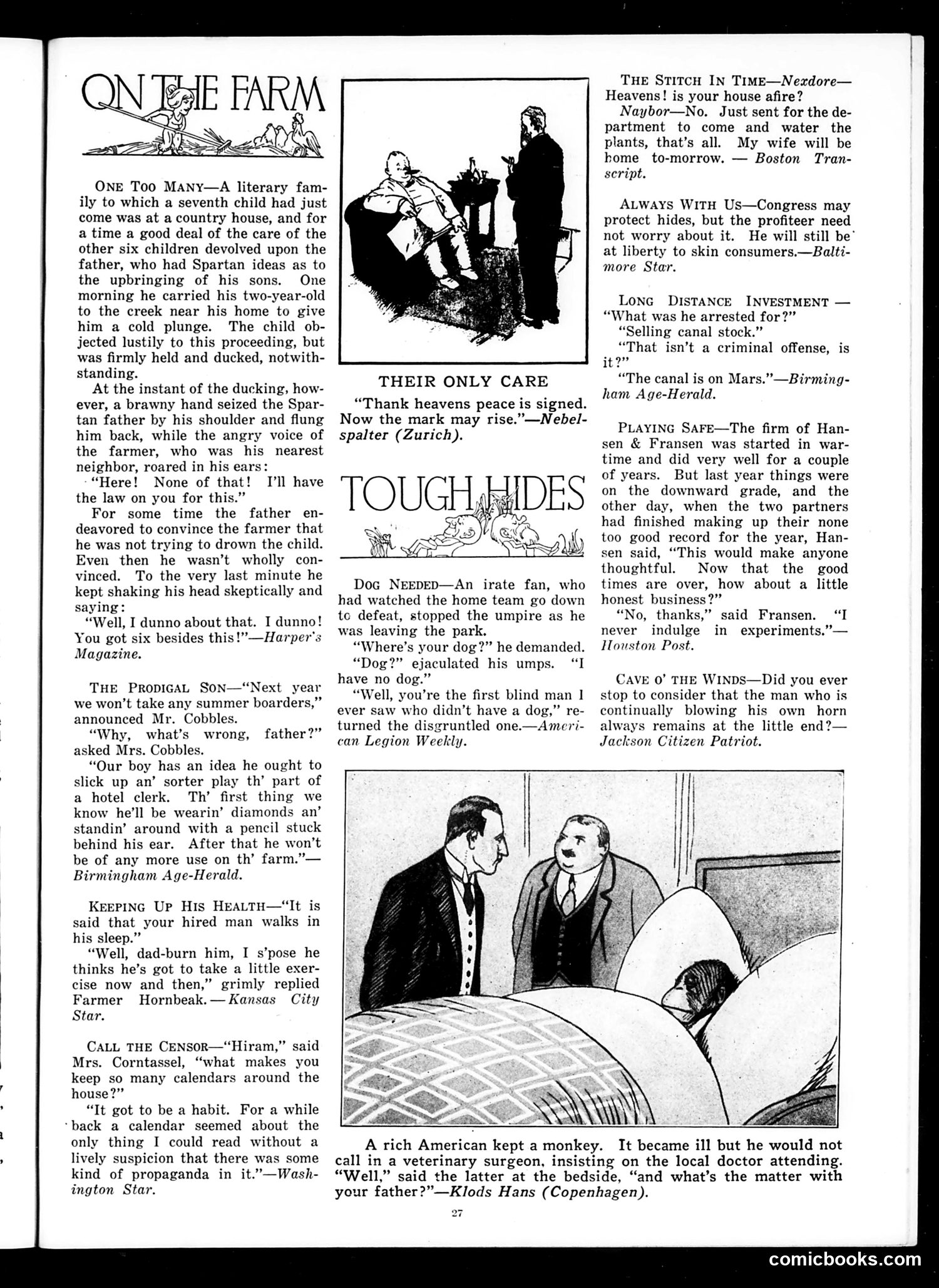
This page from Judge contains a collection of brief humorous anecdotes typical of early 20th-century American satirical humor. The pieces mock rural life, parenting, business ethics, and social behaviors: **"One Too Many"** satirizes an overzealous father's harsh parenting methods (cold-water dunking) and his neighbor's protective intervention—implying anxiety about child welfare. **"The Prodigal Son"** jokes about a farmer's son wanting to work as a hotel clerk rather than farm work, treating genteel employment as corrupting. **Other vignettes** target war profiteers ("Playing Safe"), blind spots in business ("Long Distance Investment"), and predictable American character flaws (self-promotion in "Cave o' the Winds"). The **Swiss cartoon** references post-WWI economic concerns—the "mark" (German currency) rising after peace agreements. These pieces reflect anxieties of their era: wartime profiteering, rural versus urban values, and economic uncertainty. The humor relies on stereotypes of simple farmers confronting modern complications. No specific historical figures are depicted—the satire targets social types and behaviors.
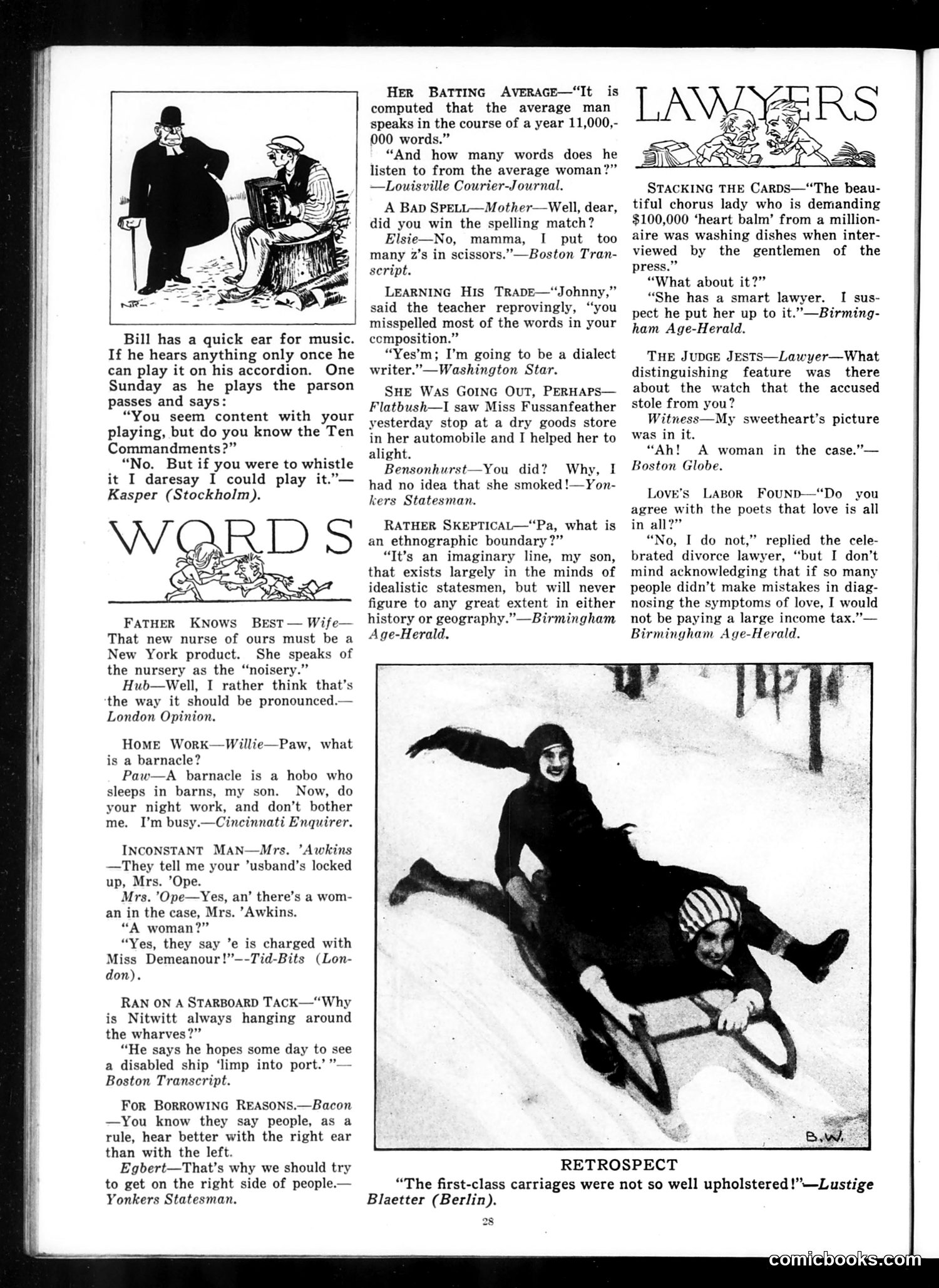
This page from Judge magazine presents a collection of brief humorous anecdotes and jokes organized under headings like "Words" and "Lawyers." The humor reflects early-20th-century social preoccupations: **Key Themes:** The jokes mock gender stereotypes (women's talkativeness, wives' nagging), working-class speech patterns, and professional types. "Learning His Trade" satirizes dialect writers; "Stacking the Cards" critiques both chorus girls seeking "heart balm" (breach-of-promise settlements) and their lawyers' exploitation. **The Cartoon:** The bottom image labeled "Retrospect" shows two people sledding, with a caption about uncomfortable old carriages. It's nostalgic humor—comparing modern comfort unfavorably to rougher "good old days." **Social Context:** These jokes assume readers share certain prejudices and familiarity with contemporary scandals (heart-balm suits were common headlines). The humor is mild, domestic, and class-conscious—typical of Judge's middle-class readership in an era when such stereotypes were considered acceptable entertainment.
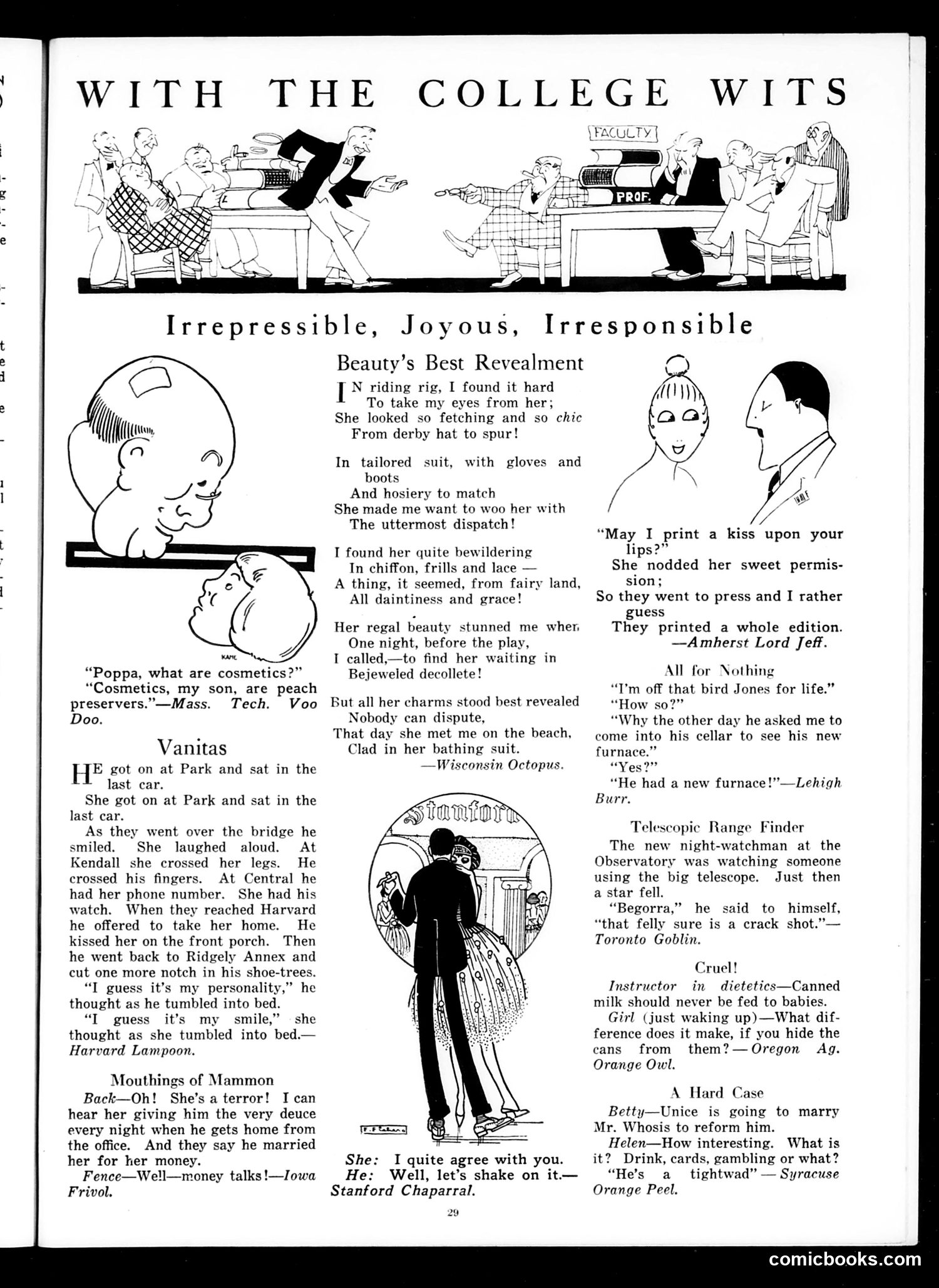
This page collects humor submissions from college and university magazines of the era. The content satirizes college life and courtship customs of the 1920s-30s. Key pieces include: **"Vanitas"** mocks male vanity—a man encounters a woman on a streetcar, exchanges minimal interaction, yet each credits their own appeal (personality/smile) for the encounter's success. **"Beauty's Best Revealment"** presents a man charmed by a woman in various fashions, climaxing absurdly when she appears in a bathing suit on the beach—undermining romantic pretense. **Other shorts** joke about cosmetics as "peach preservers," a wife's temper despite marrying for money, and a naive night-watchman's misunderstanding of astronomy. The humor reflects period attitudes: male sexual conquest narratives, women reduced to physical appearance, and gentle mockery of intellectual pretension among college students. The tone is lighthearted rather than mean-spirited, typical of college humor magazines.
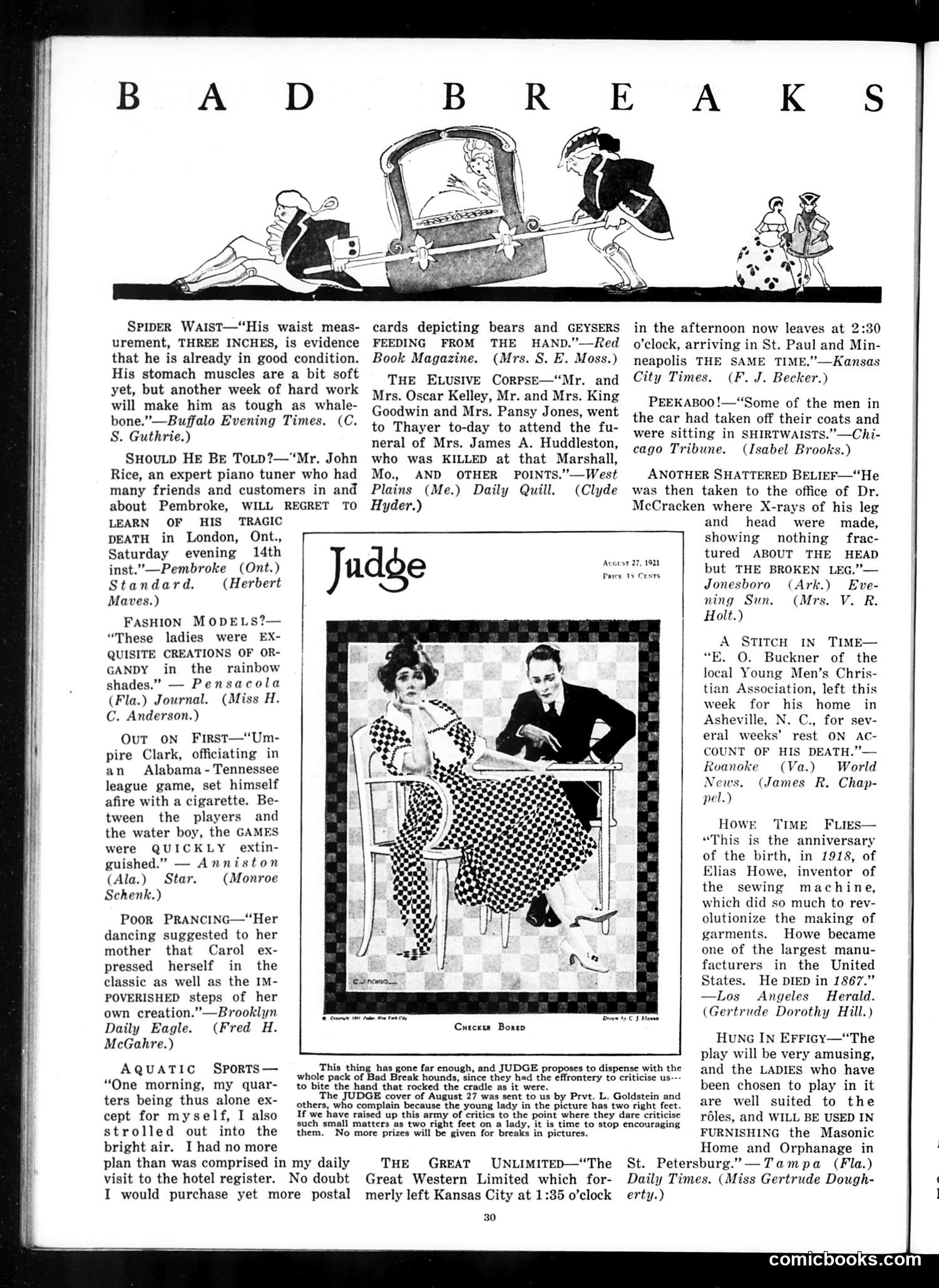
This page showcases Judge's signature "Bad Breaks" feature—humorous newspaper clippings containing absurd typographical or logical errors. The main cartoon depicts the magazine's editorial response to reader criticism: they're firing their "Bad Break hounds" (the mascots who hunt these errors) because readers have become too nitpicky, even complaining about artistic mistakes like a woman in the cover illustration having two right feet. The surrounding text items are genuine newspaper blunders: a man "regret[ting] to learn of his tragic death," someone attending a funeral for a woman who was "killed," and a man taking rest "on account of his death." The humor relies on readers appreciating the absurdity of these real-world editorial mishaps—the stock-in-trade of Judge's popular mid-century satire about incompetent journalism.
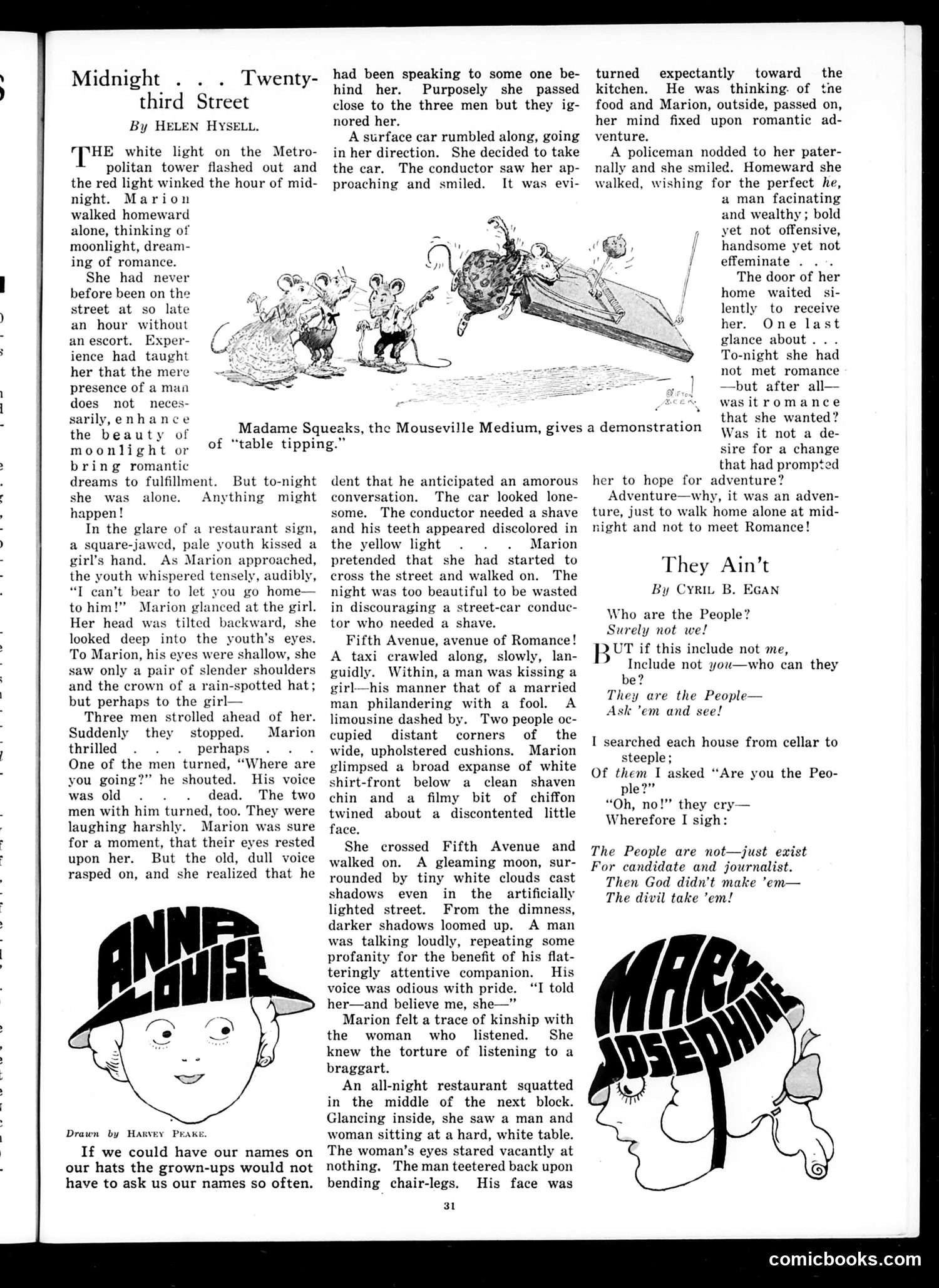
This short story by Helen Hysell satirizes romantic ideals versus urban reality. Marion, a young woman walking alone at midnight in New York City, encounters various "romantic" scenarios—couples kissing, men flirting—yet each proves disappointing or off-putting: the youth's melodrama rings false, the conductor needs a shave, the taxi passenger is a married man "philandering with a fool," and a braggart loudly boasts to his companion. The satire targets both naive romanticism and actual urban courtship. Marion's fantasy of "the perfect he"—"a man fascinating and wealthy; bold yet not offensive"—contrasts sharply with the crude, vain, or morally compromised men she observes. The story mocks both women's romantic escapism and men's actual behavior, suggesting that idealized "romance" cannot survive contact with reality. The cartoon "Madame Squeaks, the Mouseville Medium" offers comic relief through animal parody.
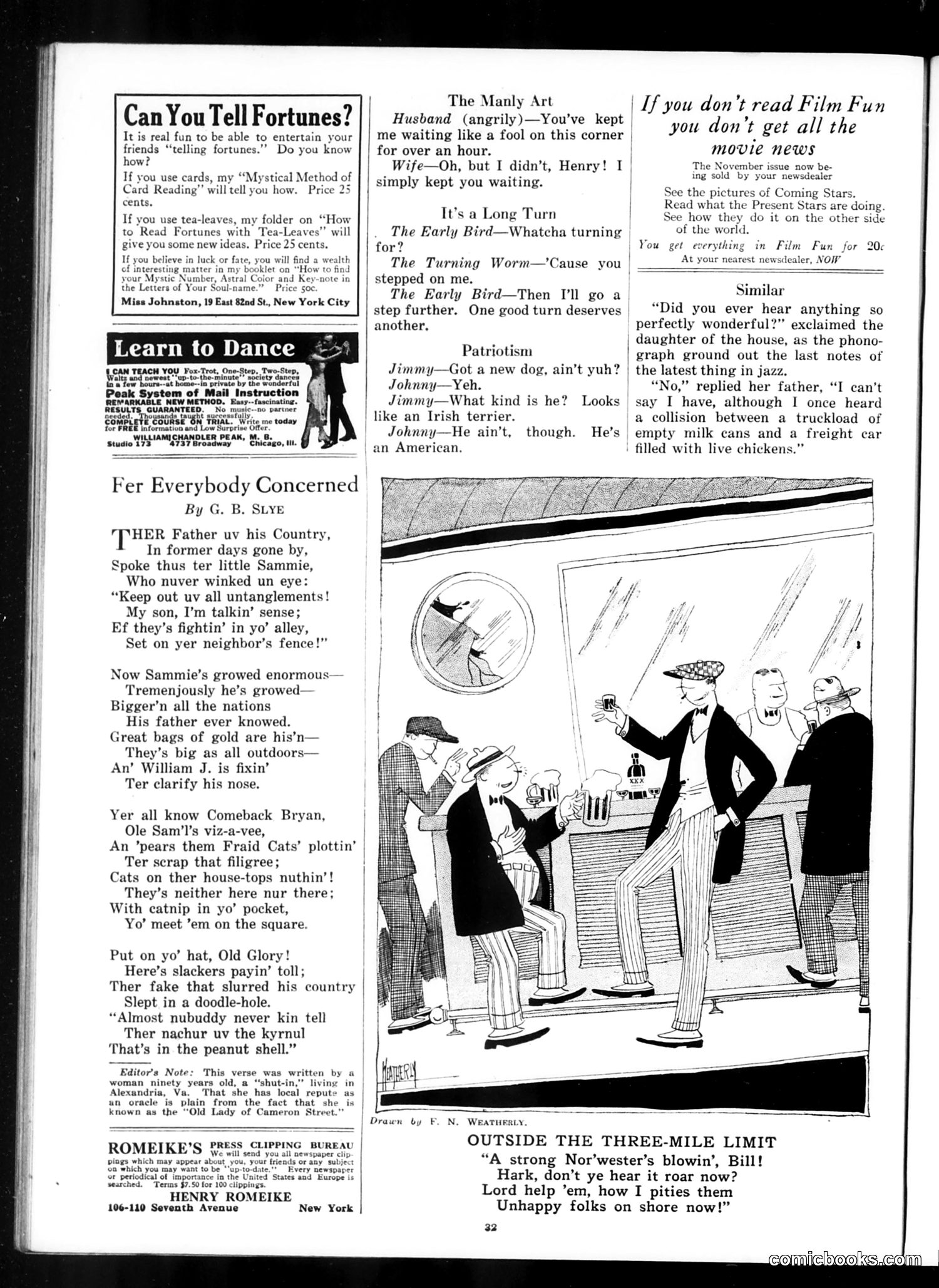
This page contains several short humor pieces typical of early 20th-century American satire: **"Fer Everybody Concerned"** is a dialectal poem by G.B. Slye addressing American isolationism. Written in exaggerated rural speech, it references George Washington's advice to avoid foreign "entanglements," then applies it to contemporary politics—mentioning "Comeback Bryan" (William Jennings Bryan) and apparent tensions between interventionists ("Fraid Cats") and isolationists. The poem advocates American neutrality while acknowledging the nation's growing wealth and power. **Other content** includes brief joke exchanges about turn-taking, patriotism (a dog being "American" rather than Irish), and jazz-age humor. **"Outside the Three-Mile Limit"** appears to reference maritime law or Prohibition-era smuggling beyond U.S. jurisdiction. The page is primarily humor and advertisements rather than political cartooning, though the Bryan reference dates this to the early 1900s when isolationism was a live political debate.
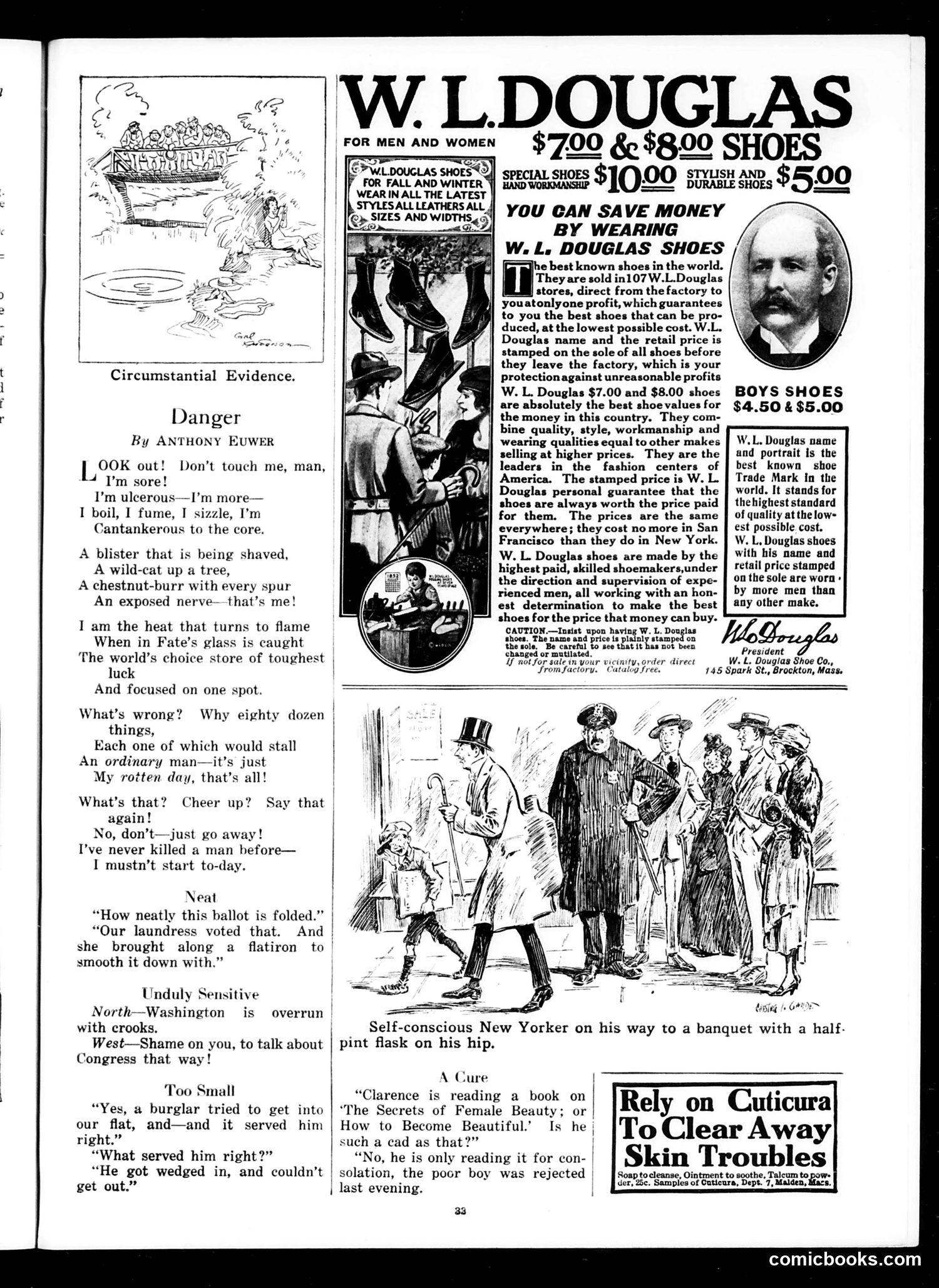
This page contains **primarily advertisements and humorous short pieces**, not political cartoons. **"Danger" (poem by Anthony Euwer):** A comedic monologue personifying a bad day—the speaker is irritable, comparing himself to blistered skin, wild cats, and exposed nerves. It's lighthearted venting about minor misfortunes. **The cartoons are brief social jokes:** - "Circumstantial Evidence" (top left): An unmarked visual gag—unclear without clearer image detail. - "Self-conscious New Yorker": Satirizes Prohibition-era hypocrisy—a man sneaking a hip flask to a formal event, pretending propriety while breaking the law. - Brief dialogue pieces mock Washington corruption, burglary, and romantic rejection. **The W.L. Douglas shoe advertisement dominates the right side**, emphasizing direct factory-to-consumer sales and value. The remaining ads promote Cuticura skincare. This is typical Judge content: **mix of mild social satire, advertising, and light humor**—not hard-hitting political commentary.
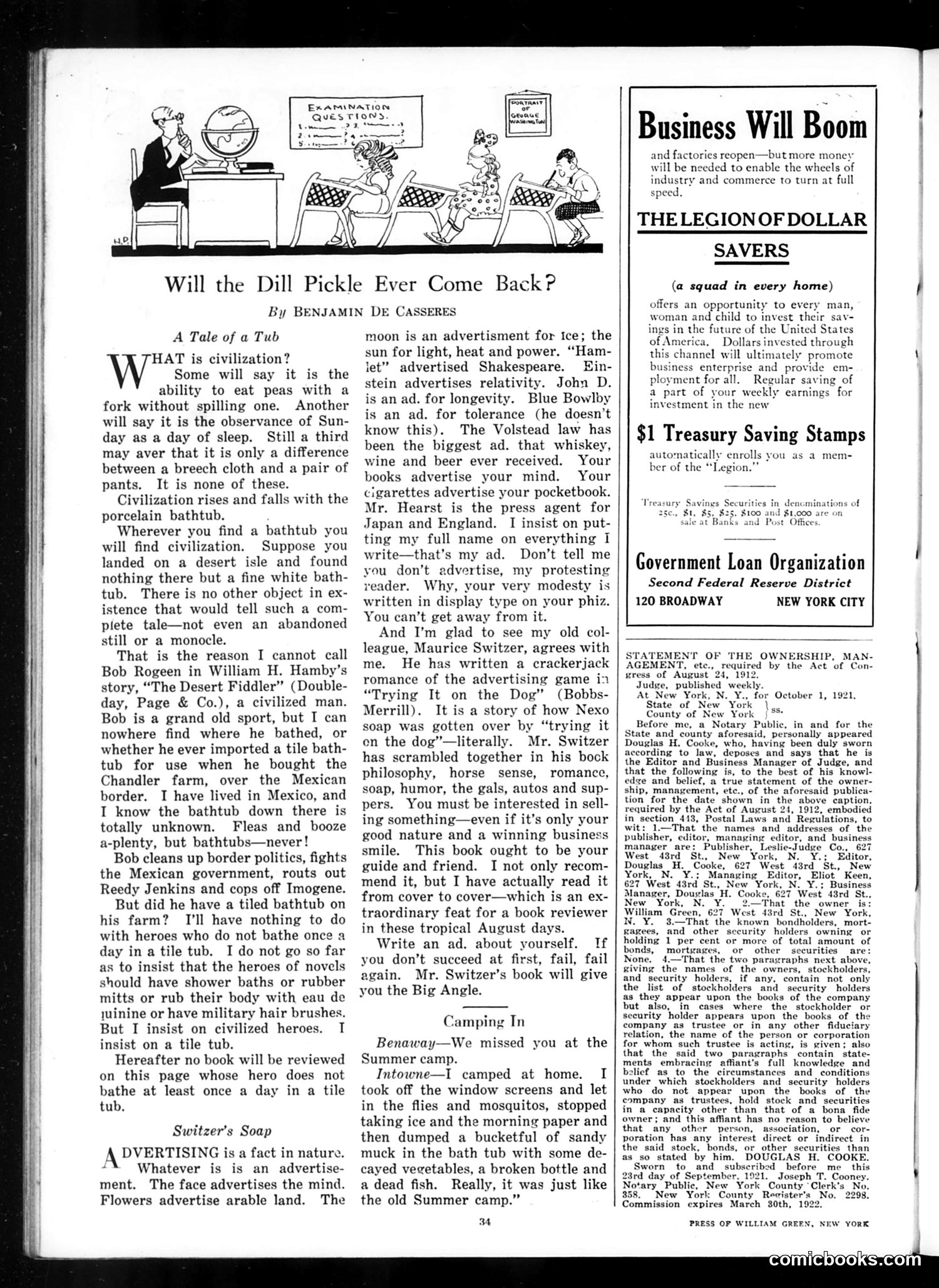
The top cartoon illustrates the article's title "Will the Dill Pickle Ever Come Back?" It depicts a classroom scene where a teacher presents "Examination Questions" to students seated at desks. The visual joke likely references the famous "Dill Pickle Club," a Chicago bohemian gathering spot known for intellectual debates and avant-garde discussion—suggesting whether such cultural institutions would survive post-WWI economic disruption. The main article by Benjamin De Casseres humorously argues that civilization is defined by the porcelain bathtub. He critiques novelist William H. Hamby's hero "Bob Rogeen" for lacking proper bathing facilities on his Mexican border farm, declaring such un-bathed characters uncivilized. This is absurdist satire mocking both literary pretension and American assumptions about civilization and hygiene. The page also contains book reviews and advertisements typical of Judge's content—lighthearted commentary on contemporary publications and consumer goods.
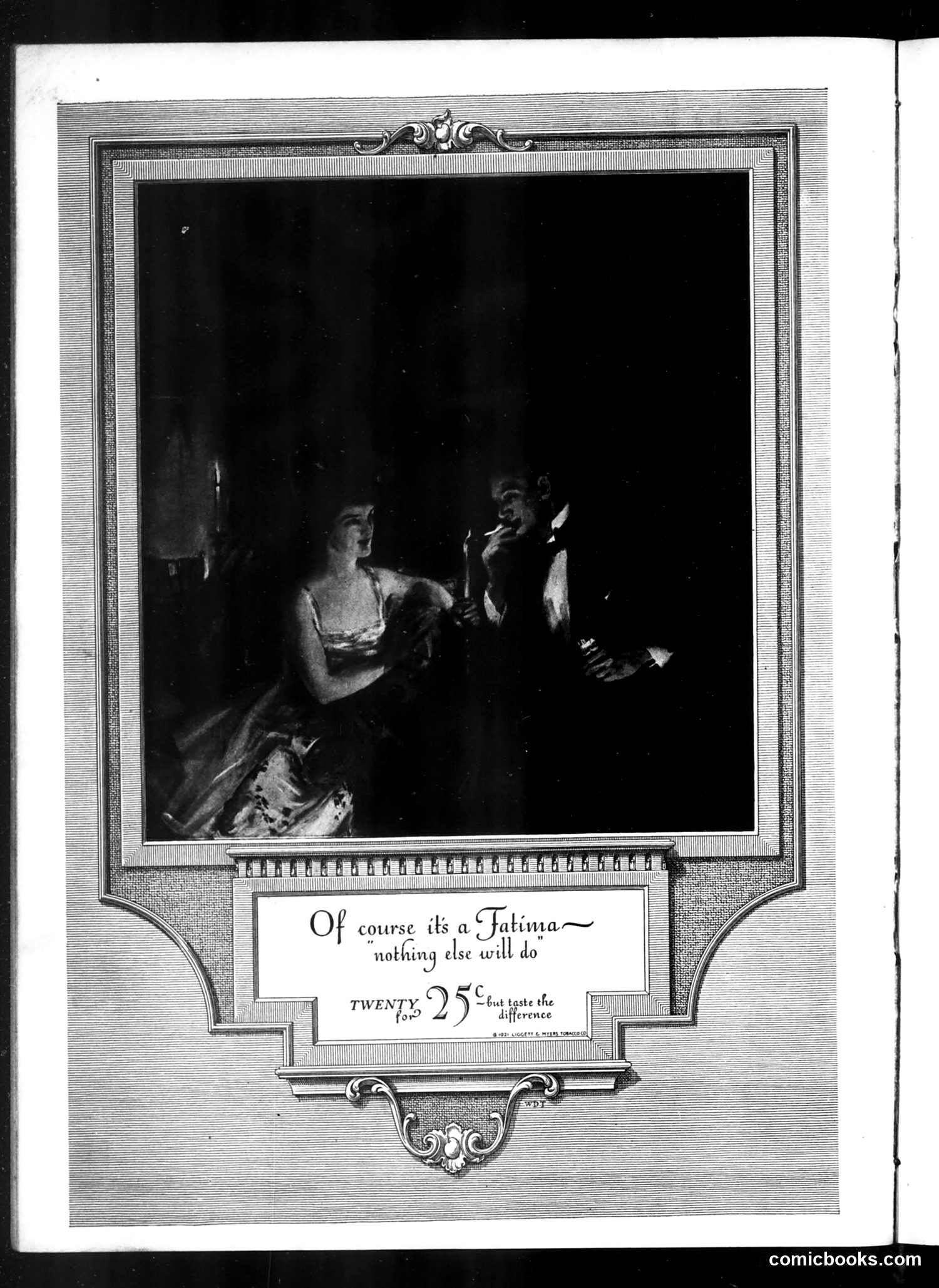
This is an advertisement for Fatima brand cigarettes, not a political cartoon. The image shows a woman in elegant early 20th-century dress in a dimly lit interior scene, apparently with a male companion. The tagline "Of course it's a Fatima—nothing else will do" emphasizes brand loyalty, while "but taste the difference" highlights the product's purported superior quality. The price of twenty cigarettes for 25 cents appears at bottom. Fatima was a real cigarette brand popular in this era. The advertisement uses aspirational imagery—depicting upscale social situations—to market the product to consumers. Without knowing the magazine's date, the specific cultural context of this ad's appeal remains unclear, though it reflects typical early 20th-century cigarette marketing strategies.