
Judge, 1921-10-15 · page 6 of 36
Judge — October 15, 1921 — page 6: what you’re looking at
What you’re looking at
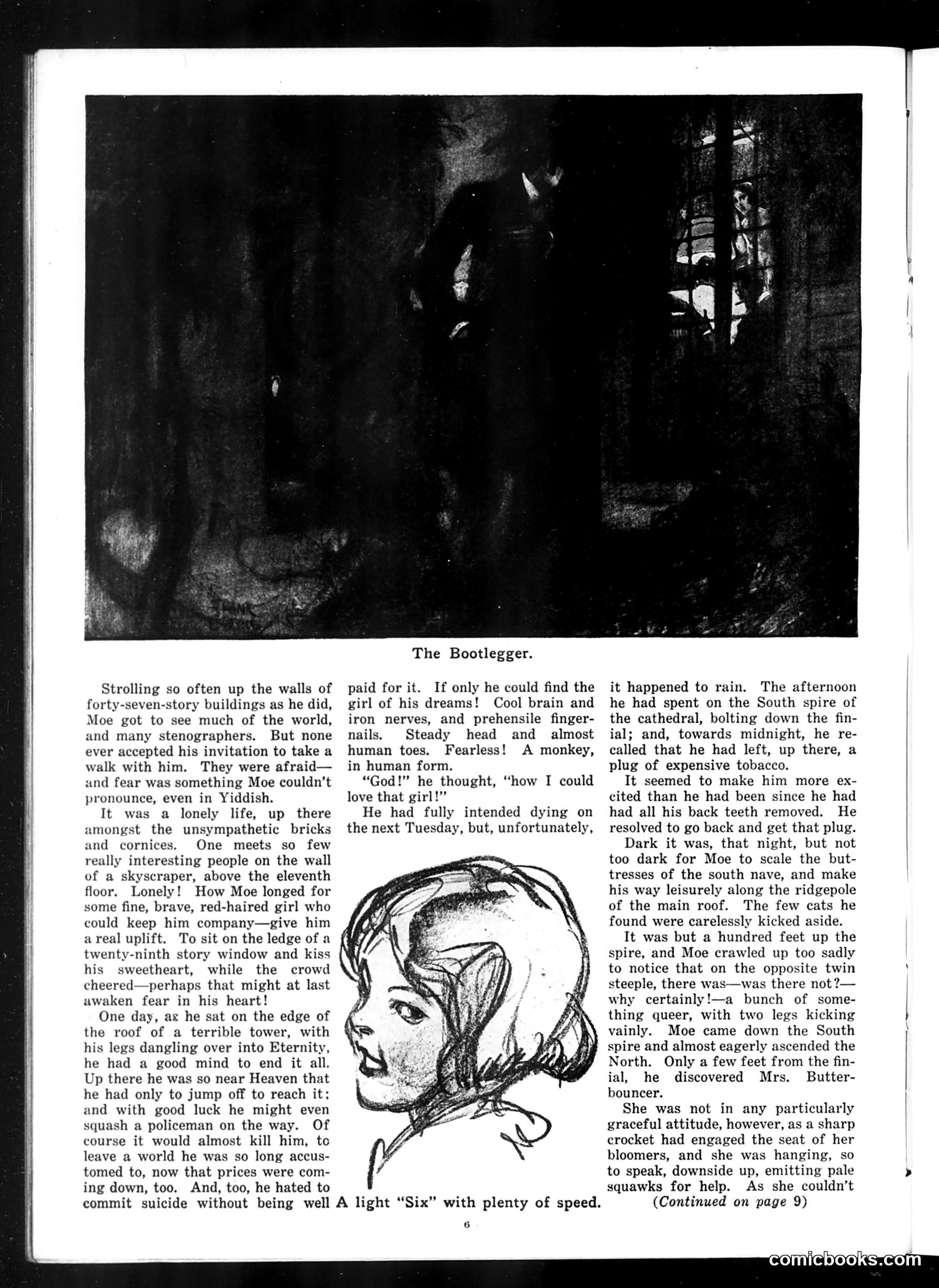
This page presents a serialized short story rather than a political cartoon. The narrative depicts "Moe," a lonely man living in a tall urban building who fantasizes about a girl and contemplates suicide. The illustrated portrait shows a woman's face labeled "A light 'Six' with plenty of speed." The story references Prohibition-era themes—the title "The Bootlegger" suggests illegal alcohol distribution. The narrative's mention of the protagonist's despair, his contemplation of jumping from a building, and the romantic fantasy reflect early 20th-century urban alienation literature. This appears to be serialized fiction rather than satirical commentary, presenting melodramatic social realism typical of Judge magazine's entertainment content during the Prohibition period.
📄 Transcribed text from this page (OCR, searchable)
Machine-transcribed from the original scan — historical spelling and the odd misread are preserved.
Strolling so often up the walls of forty-seven-story buildings as he did, Moe got to see much of the world, and many stenographers. But none ever accepted his invitation to take a walk with him. They were afraid— and fear was something Moe couldn’t pronounce, even in Yiddish. It was a lonely life, up there amongst the unsympathetic bricks and cornices. One meets so few really interesting people on the wall of a skyscraper, above the eleventh floor. Lonely! How Moe longed for some fine, brave, red-haired girl who could keep him company—give him areal uplift. To sit on the ledge of a twenty-ninth story window and kiss his sweetheart, while the crowd cheered—perhaps that might at last awaken fear in his heart! One day, az he sat on the edge of the roof of a terrible tower, with his legs dangling over into Eternity, he had a good mind to end it all. Up there he was so near Heaven that he had only to jump off to reach it; and with good luck he might even squash a policeman on the way. Of course it would almost kill him, te leave a world he was so long accus- tomed to, now that prices were com- ing down, too. And, too, he hated to commit suicide without being well A light “Six” with plenty of speed. The Bootlegger. paid for it. If only he could find the girl of his dreams! Cool brain and iron nerves, and prehensile finger- nails. Steady head and almost human toes. Fearless! A monkey, in human form. “God!” he thought, “how I could love that girl!” He had fully intended dying on the next Tuesday, but, unfortunately, 6 it happened to rain. The afternoon he had spent on the South spire of the cathedral, bolting down the fin- ial; and, towards midnight, he re- called that he had left, up there, a plug of expensive tobacco. It seemed to make him more ex- cited than he had been since he had had all his back teeth removed. He resolved to go back and get that plug. Dark it was, that night, but not too dark for Moe to scale the but- tresses of the south nave, and make his way leisurely along the ridgepole of the main roof. The few cats he found were carelessly kicked aside. It was but a hundred feet up the spire, and Moe crawled up too sadly to notice that on the opposite twin steeple, there was—was there not?— why certainly!—a bunch of some- thing queer, with two legs kicking vainly. Moe came down the South spire and almost eagerly ascended the North. Only a few feet from the fin- ial, he discovered Mrs. Butter- bouncer. She was not in any particularly graceful attitude, however, as a sharp crocket had engaged the seat of her bloomers, and she was hanging, so to speak, downside up, emitting pale squawks for help. As she couldn’t (Continued on page 9)