
Judge, 1921-10-15 · page 19 of 36
Judge — October 15, 1921 — page 19: what you’re looking at
What you’re looking at
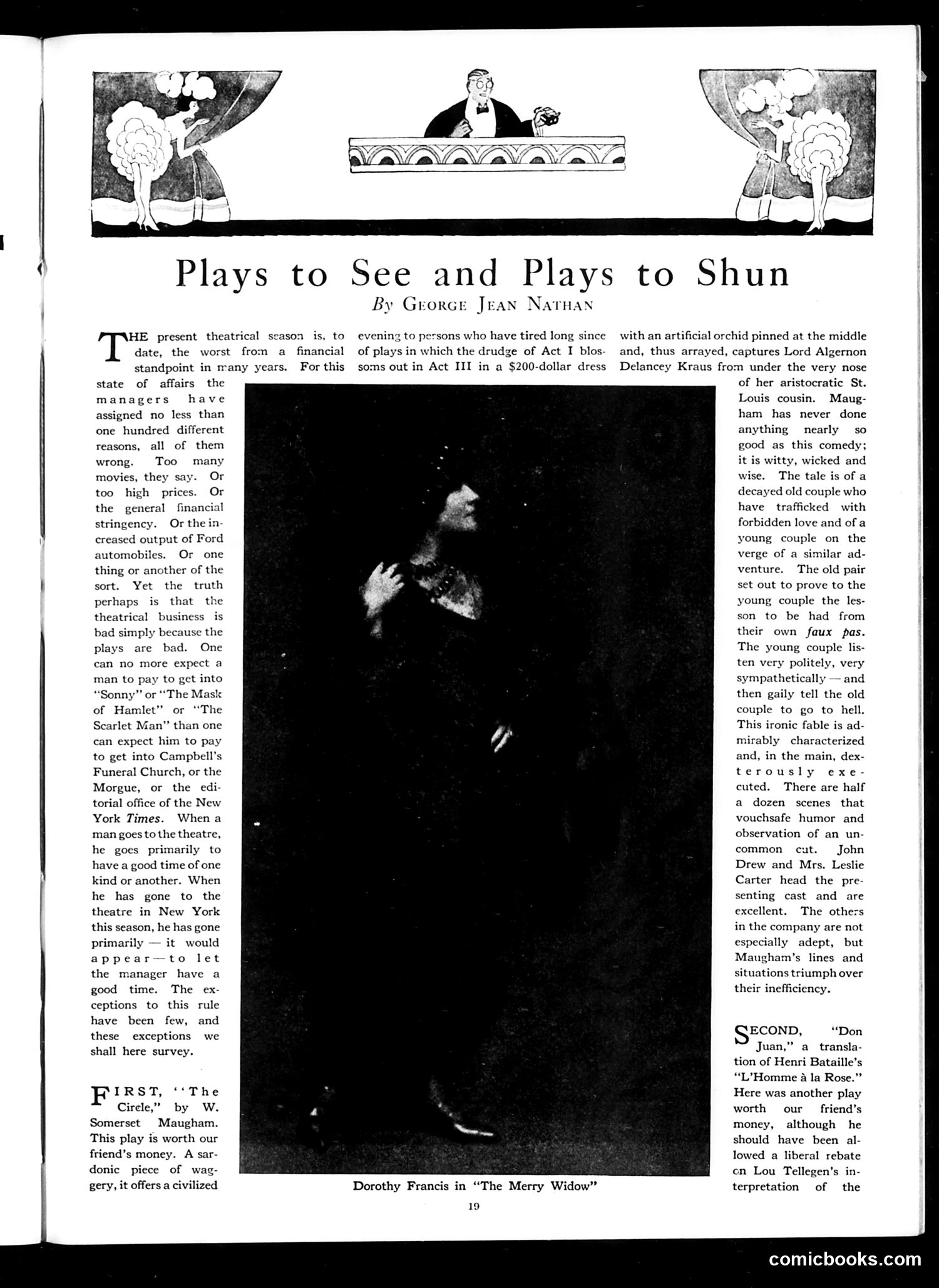
This is a theater review column by George Jean Nathan in *Judge* magazine, critiquing the current Broadway season. The author argues bluntly that the theatrical business is failing not due to movies, high prices, or economic conditions—but because **the plays themselves are bad**. He compares paying to see poor theater to paying admission to a funeral home or morgue. The photograph shows actress Dorothy Francis in "The Merry Widow." Nathan then reviews specific plays worth seeing: W. Somerset Maugham's "The Circle" (praised as witty and wise, starring John Drew and Mrs. Leslie Carter) and a translation of Henri Bataille's "Don Juan" (with reservations about Lou Tellegen's performance). The satire targets theater managers' excuses for poor box office while audiences increasingly stayed home or sought entertainment elsewhere.
📄 Transcribed text from this page (OCR, searchable)
Machine-transcribed from the original scan — historical spelling and the odd misread are preserved.
~ Plays to See and Plays to Shun By Grorce Jean Natuan date, the worst from a financial of plays in which the drudge of Act I blos- and, thus arrayed, captures Lord Algernon "T= present theatrical season is, to evening to persons who have tired long since__ with an artificial orchid pinned at the middle For this soms out in Act III in a $200-dollar dress Delancey Kraus from under the very nose standpoint in many years. state of affairs the managers have assigned no less than one hundred different reasons, all of them wrong. Too many movies, they say. Or too high prices. Or the general financial stringency. Or the in- creased output of Ford automobiles. Or one thing or another of the sort. Yet the truth perhaps is that th theatrical business is bad simply because the plays are bad. One can no more expect a man to pay to get into “Sonny” or “The Mask of Hamlet” or ‘The Scarlet Man” than one can expect him to pay to get into Campbell's Funeral Church, or the Morgue, or the edi- torial office of the New York Times. Whena man goes to the theatre, he goes primarily to have a good time of one kind or another. When he has gone to the theatre in New York this season, he has gone primarily it would appear—to let the manager have a good time. The ex- ceptions to this rule have been few, and these exceptions we shall here survey. IRST, ‘‘The Cirele,” by W. Somerset Maugham. This play is worth our friend’s money. A sar- donic piece of wag- gery, it offers a civilized Dorothy Francis in “The Merry Widow” 19 of her aristocratic St. Louis cousin. Maug- ham has never done anything nearly so good as this comedy; it is witty, wicked and wise. The tale is of a decayed old couple who have trafficked with forbidden love and of a young couple on the verge of a similar ad- venture. The old pair set out to prove to the young couple the les- son to be had from their own faux pas. The young couple lis- ten very politely, very sympathetically — and then gaily tell the old couple to go to hell. This ironic fable is ad- mirably characterized and, in the main, dex- terously exe- cuted. There are half a dozen scenes that vouchsafe humor and observation of an un- common cut. John Drew and Mrs. Leslie Carter head the pre- senting cast and are excellent. The others in the company are not especially adept, but Maugham’s lines and situations triumph over their inefficiency. ECOND, “Don Juan,” a transla- tion of Henri Bataille’s “L’Homme a la Rose.” Here was another play worth our friend’s money, although he should have been al- lowed a liberal rebate cn Lou Tellegen’s in- terpretation of the comicbooks.com