
Judge, 1921-10-15 · page 21 of 36
Judge — October 15, 1921 — page 21: what you’re looking at
What you’re looking at
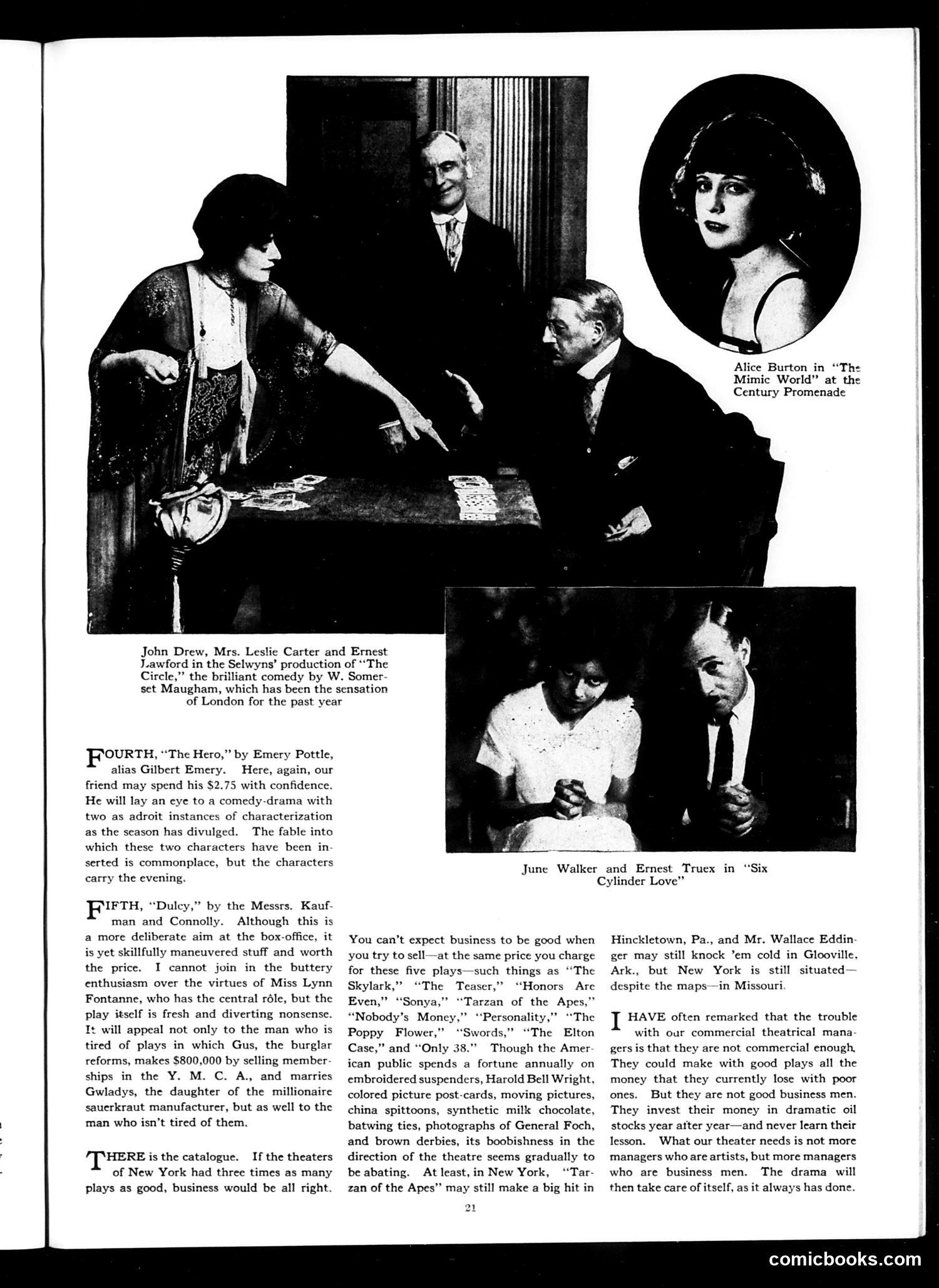
This is a theater review column evaluating five Broadway plays for potential $2.75 ticket purchases. The page features photographs of actors in productions like "The Circle" (praised as a Somerset Maugham hit) and "Dulcy" (a new comedy). The satirical commentary criticizes American theatergoers' poor taste while mocking commercially unsuccessful plays with absurd titles: "Tarzan of the Apes," "Nobody's Money," "Only 38." The author contrasts the public's willingness to spend money on frivolous items—embroidered suspenders, Harold Bell Wright novels, picture postcards—with their reluctance to support quality theater. The final section argues that Broadway needs business-minded managers rather than artistic ones. The phrase "New York is still situated—despite the maps—in Missouri" sarcastically implies New Yorkers have rural, unsophisticated tastes.
📄 Transcribed text from this page (OCR, searchable)
Machine-transcribed from the original scan — historical spelling and the odd misread are preserved.
Alice Burton in “The Mimic World” at the Century Promenade John Drew, Mrs. Leslie Carter and Ernest J.awford in the Selwyns’ production of “The Circle,” the brilliant comedy by W. Somer- set Maugham, which has been the sensation of London for the past year FPOURTH, “The Hero,” by Emery Pottle, alias Gilbert Emery. Here, again, our friend may spend his $2.75 with confidence. He will lay an eye to a comedy-drama with two as adroit instances of characterization as the season has divulged. The fable into which these two characters have been in serted is commonplace, but the characters carry the evening. FFTs, “Dulcy,” by the Messrs. Kauf- man and Connolly. Although this is a more deliberate aim at the box-office, it is yet skillfully maneuvered stuff and worth the price. I cannot join in the buttery enthusiasm over the virtues of Miss Lynn Fontanne, who has the central réle, but the play itself is fresh and diverting nonsense. It will appeal not only to the man who is tired of plays in which Gus, the burglar reforms, makes $800,000 by selling member ships in the Y. M. C. A., and marries Gwladys, the daughter of the millionaire sauerkraut manufacturer, but as well to the man who isn’t tired of them. (THERE is the catalogue. If the theaters of New York had three times as many plays as good, business would be all right. June Walker and Ernest Truex in ‘‘Six You can’t expect business to be good when you try to sell—at the same price you charge for these five plays—such things as “The Skylark,” “The Teaser,” “Honors Are Even,” “Sonya,” “Tarzan of the Apes,” “Nobody’s Money,” “Personality,” “The Poppy Flower,” “Swords,” “The Elton Case,” and “Only 38." Though the Amer ican public spends a fortune annually on embroidered suspenders, Harold Bell Wright, colored picture post-cards, moving pictures, china spittoons, synthetic milk chocolate, batwing ties, photographs of General Foch, and brown derbies, its boobishness in the direction of the theatre seems gradually to be abating. At least, in New York, “Tar- zan of the Apes” may still make a big hit in Cylinder Love” Hinckletown, Pa., and Mr. Wallace Eddin ger may still knock ’em cold in Glooville, Ark., but New York is still situated— despite the maps—in Missouri HAVE often remarked that the trouble with our commercial theatrical mana gers is that they are not commercial enough, They could make with good plays all the money that they currently lose with poor But they are not good business men. They invest their money in dramatic oil stocks year after year—and never learn their What our theater needs is not more ones. lesson. managers who are artists, but more managers who are business men. The drama will then take care of itself, as it always has done. comicbooks.com