
Judge, 1921-10-15 · page 20 of 36
Judge — October 15, 1921 — page 20: what you’re looking at
What you’re looking at
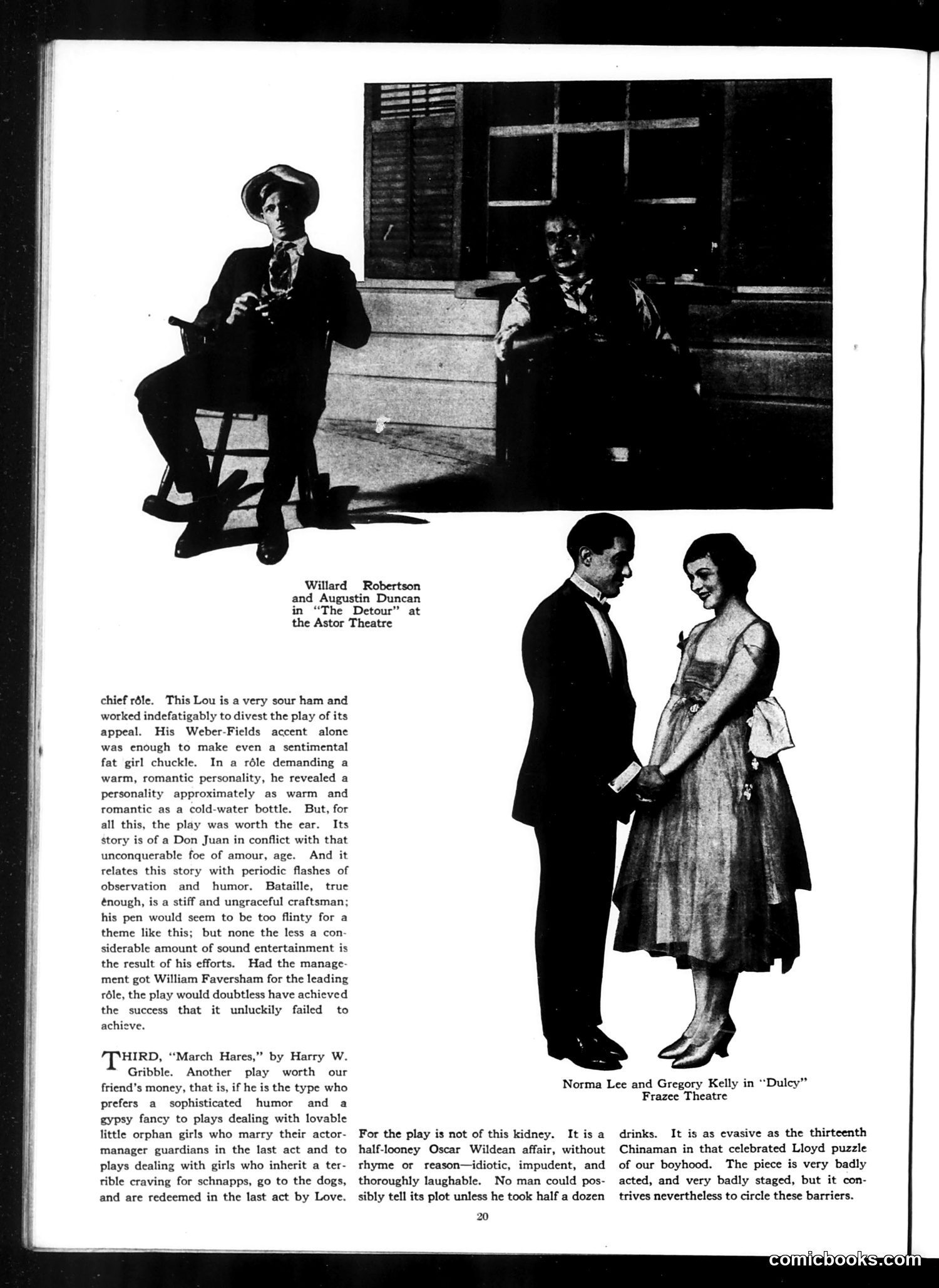
This page contains theater criticism rather than cartoons. It reviews three Broadway plays with accompanying production photos: 1. **"The Detour"** (Astor Theatre) — The reviewer harshly critiques lead actor Lou for his poor performance, describing him as a "sour ham" with an off-putting accent. However, the play itself about an aging Don Juan is deemed worthwhile. The critic suggests star William Faversham might have saved it. 2. **"March Hares"** by Harry W. Gribble — Praised as sophisticated comedy for audiences preferring witty humor over sentimental plots (mocking typical theater fare of orphans and reformed alcoholics redeemed by love). The play is described as nonsensical but entertaining—"as evasive as the thirteenth Chinaman in that celebrated Lloyd puzzle." 3. **"Dulcy"** (Frazee Theatre) — Photo shows Norma Lee and Gregory Kelly. The satire targets both bad acting and predictable theatrical conventions of the era.
📄 Transcribed text from this page (OCR, searchable)
Machine-transcribed from the original scan — historical spelling and the odd misread are preserved.
Willard Robertson and Augustin Duncan in “The Detour” at the Astor Theatre chief réle. This Lou is a very sour ham and worked indefatigably to divest the play of its appeal. His Weber-Fields accent alone was enough to make even a sentimental fat girl chuckle. In a réle demanding a warm, romantic personality, he revealed a approximately as warm and romantic as a cold-water bottle. But, for all this, the play was worth the ear. Its story is of a Don Juan in conflict with that unconquerable foe of amour, age. And it relates this story with periodic flashes of observation Bataille, énough, is a stiff and ungraceful craftsman; his pen would seem to be too flinty for a theme like this; but none the less a con siderable amount of sound entertainment is the result of his efforts. Had the manage ment got William Faversham for the leading réle, the play would doubtless have achieved it unluckily failed to personality and humor. true the success that achieve. THIRD, “March Hares,” by Harry W. Gribble. Another play worth our friend’s money, that is, if he is the type who prefers a sophisticated humor and a gypsy fancy to plays dealing with lovable little orphan girls who marry their actor- manager guardians in the last act and to plays dealing with girls who inherit a ter- rible craving for schnapps, go to the dogs, and are redeemed in the last act by Love. Norma Lee and Gregory Kelly in “Dulcy” For the play is not of this kidney. It is a half-looney Oscar Wildean affair, without rhyme or reason—idiotic, impudent, and thoroughly laughable. No man could pos- sibly tell its plot unless he took half a dozen 20 Frazee Theatre drinks. It is as evasive as the thirteenth Chinaman in that celebrated Lloyd puzzle of our boyhood. The piece is very badly acted, and very badly staged, but it con- trives nevertheless to circle these barriers.