
Judge, 1921-10-15 · page 18 of 36
Judge — October 15, 1921 — page 18: what you’re looking at
What you’re looking at
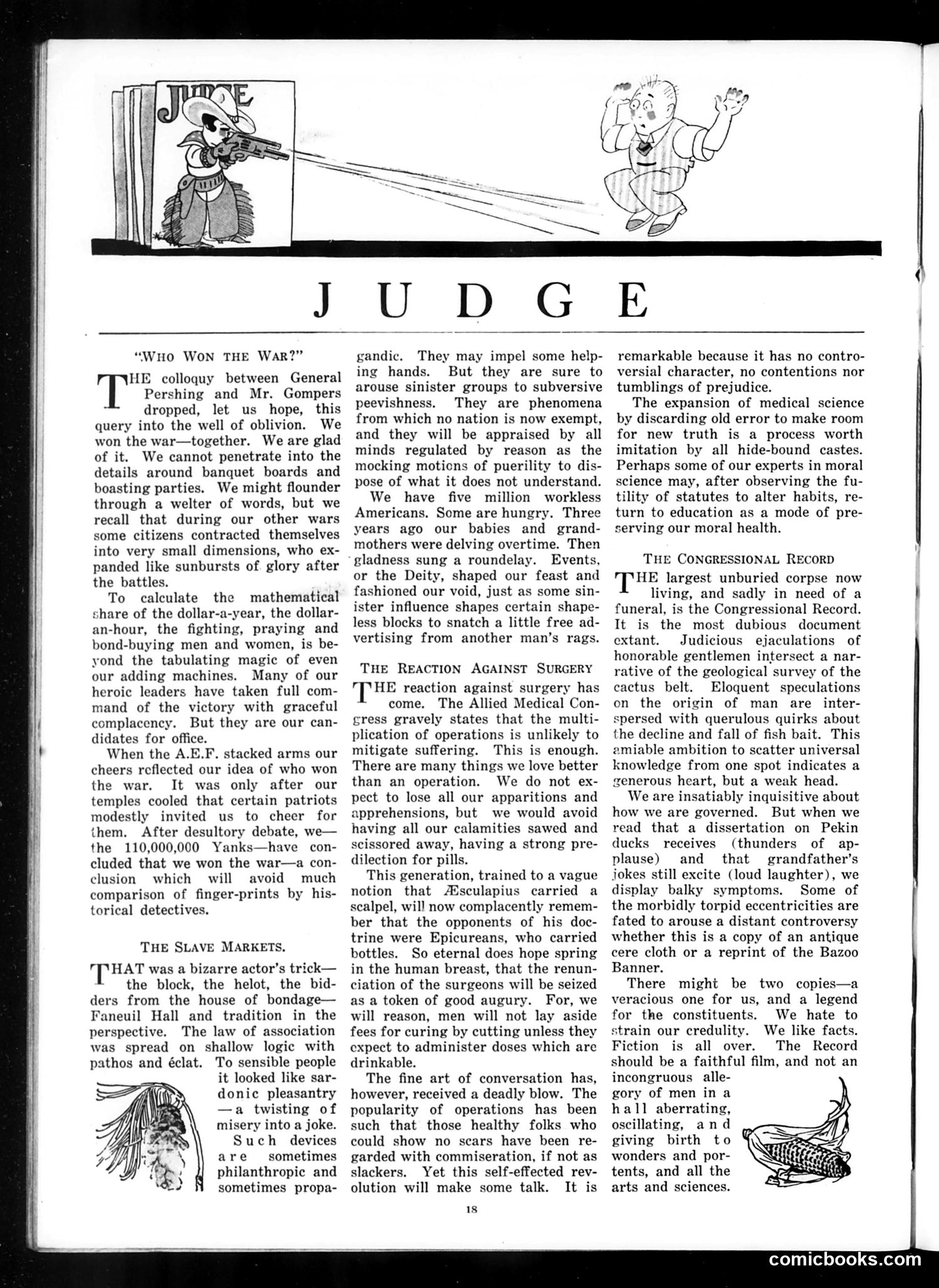
This Judge magazine page contains three satirical columns addressing post-WWI American issues: **"Who Won the War?"** mocks politicians and labor leaders (General Pershing and Mr. Gompers, the AFL leader) claiming credit for America's WWI victory. Judge argues the entire nation—workers, soldiers, bond-buyers—won together, and warns that some leaders are now conveniently taking credit to boost their candidacies for office. **"The Slave Markets"** critiques a theatrical performance at Boston's Faneuil Hall (historically significant as an abolitionist venue) that apparently used slavery imagery as publicity. Judge condemns this as exploitative mockery that trivializes past suffering while ignoring present problems: five million unemployed Americans and hungry families. **"The Reaction Against Surgery"** satirizes a medical conference's statement discouraging unnecessary operations. Judge jokes that people will misinterpret this as endorsement of drinking instead, while noting the social phenomenon where those without surgical scars were previously viewed with suspicion—mocking this sudden reversal in medical opinion.
📄 Transcribed text from this page (OCR, searchable)
Machine-transcribed from the original scan — historical spelling and the odd misread are preserved.
“Wuo WON THE WAR?” HE colloquy between General T Pershing and Mr. Gompers dropped, let us hope, this query into the well of oblivion. We won the war—together. We are glad of it. We cannot penetrate into the details around banquet boards and boasting parties. We might flounder through a welter of words, but we recall that during our other wars some citizens contracted themselves into very small dimensions, who ex- panded like sunbursts of glory after the battles. To calculate the mathematical share of the dollar-a-year, the dollar- an-hour, the fighting, praying and bond-buying men and women, is be- yond the tabulating magic of even our adding machines. Many of our heroic leaders have taken full com- mand of the victory with graceful complacency. But they are our can- didates for office. When the A.E.F. stacked arms our cheers reflected our idea of who won the war. It was only after our temples cooled that certain patriots modestly invited us to cheer for them. After desultory debate, we— the 110,000,000 Yanks—have con- cluded that we won the war—a con- clusion which will avoid much comparison of finger-prints by his- torical detectives. THE SLAVE MARKETS. THAT was a bizarre actor’s trick— the block, the helot, the bid- ders from the house of bondage— Faneuil Hall and tradition in the perspective. The law of association was spread on shallow logic with pathos and éclat. To sensible people it looked like sar- donic pleasantry —a twisting of misery into a joke. Such devices are sometimes philanthropic and sometimes propa- gandic. They may impel some help- ing hands. But they are sure to arouse sinister groups to subversive peevishness. They are phenomena from which no nation is now exempt, and they will be appraised by all minds regulated by reason as the mocking motions of puerility to dis- pose of what it does not understand. We have five million workless Americans. Some are hungry. Three years ago our babies and grand- mothers were delving overtime. Then gladness sung a roundelay. Events, or the Deity, shaped our feast and fashioned our void, just as some sin- ister influence shapes certain shape- less blocks to snatch a little free ad- vertising from another man’s rags. THE REACTION AGAINST SURGERY [THE reaction against surgery has come. The Allied Medical Con- gress gravely states that the multi- plication of operations is unlikely to mitigate suffering. This is enough. There are many things we love better than an operation. We do not ex- pect to lose all our apparitions and apprehensions, but we would avoid having all our calamities sawed and scissored away, having a strong pre- dilection for pills. This generation, trained to a vague notion that Assculapius carried a scalpel, will now complacently remem- ber that the opponents of his doc- trine were Epicureans, who carried bottles. So eternal does hope spring in the human breast, that the renun- ciation of the surgeons will be seized as a token of good augury. For, we will reason, men will not lay aside fees for curing by cutting unless they expect to administer doses which are drinkable. The fine art of conversation has, however, received a deadly blow. The popularity of operations has been such that those healthy folks who could show no scars have been re- garded with commiseration, if not as slackers. Yet this self-effected rev- olution will make some talk. It is remarkable because it has no contro- versial character, no contentions nor tumblings of prejudice. The expansion of medical science by discarding old error to make room for new truth is a process worth imitation by all hide-bound castes. Perhaps some of our experts in moral science may, after observing the fu- tility of statutes to alter habits, re- turn to education as a mode of pre- serving our moral health. THE CONGRESSIONAL RECORD THE largest unburied corpse now living, and sadly in need of a funeral, is the Congressional Record. It is the most dubious document extant. Judicious ejaculations of honorable gentlemen intersect a nar- rative of the geological survey of the cactus belt. Eloquent speculations on the origin of man are inter- spersed with querulous quirks about the decline and fall of fish bait. This amiable ambition to scatter universal knowledge from one spot indicates a generous heart, but a weak head. We are insatiably inquisitive about how we are governed. But when we read that a dissertation on Pekin ducks receives (thunders of ap- plause) and that grandfather’s jokes still excite (loud laughter), we display balky symptoms. Some of the morbidly torpid eccentricities are fated to arouse a distant controversy whether this is a copy of an antique cere cloth or a reprint of the Bazoo Banner. There might be two copies—a veracious one for us, and a legend for the constituents. We hate to strain our credulity. We like facts. Fiction is all over. The Record should be a faithful film, and not an incongruous alle- gory of men ina hall aberrating, oscillating, and giving birth to wonders and por- tents, and all the arts and sciences. comicbooks.com