
Judge, 1921-10-15 · page 10 of 36
Judge — October 15, 1921 — page 10: what you’re looking at
What you’re looking at
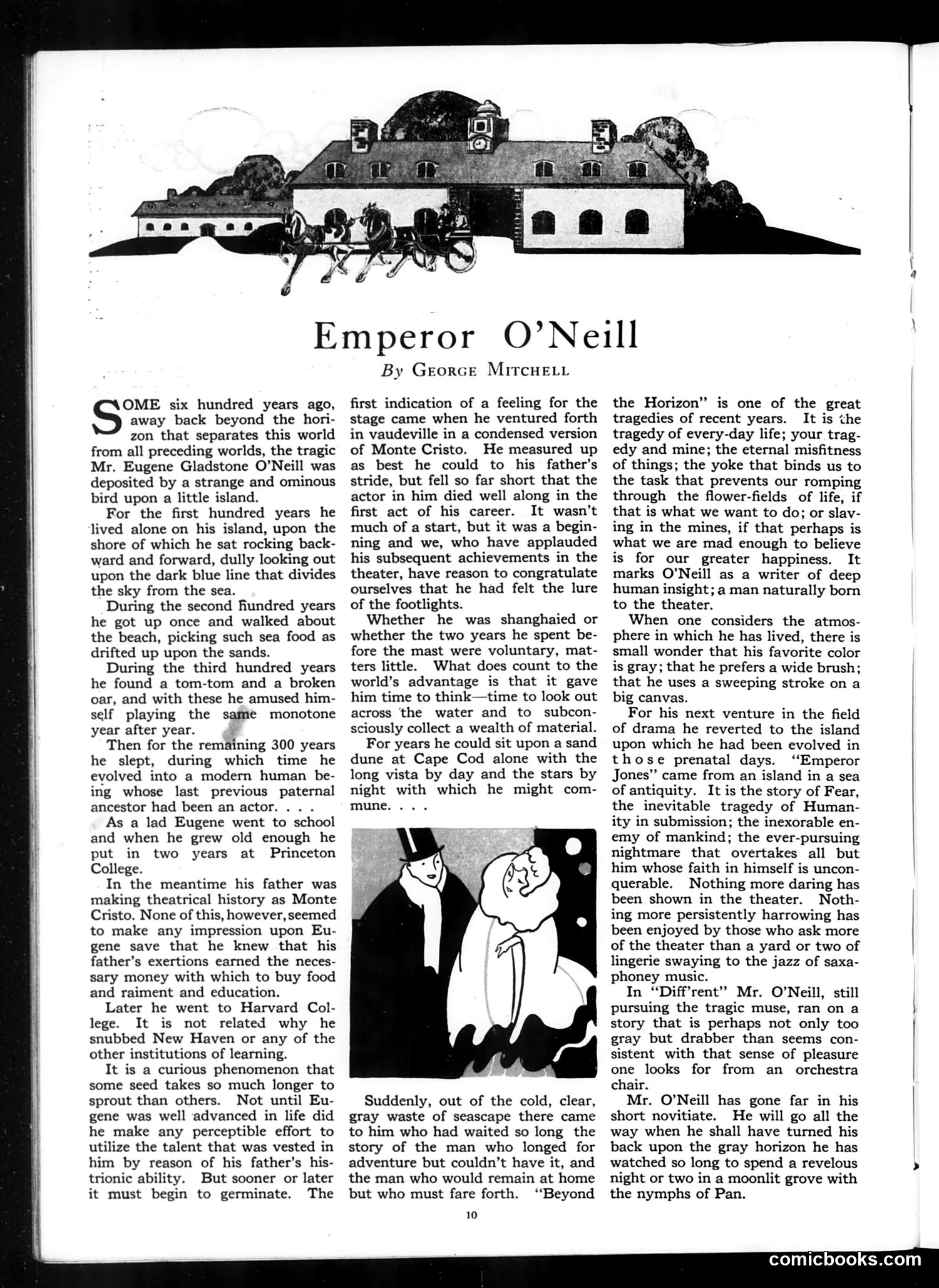
This is a satirical biographical essay about playwright Eugene O'Neill by George Mitchell. The text uses absurdist humor to mock O'Neill's slow development as an artist: it claims he evolved over 600 years on an island before becoming human, then spent years at Princeton and Harvard without apparent ambition. The satire suggests O'Neill was a late bloomer who initially failed in vaudeville (following his actor father James O'Neill's footsteps), only later finding success through unconventional experience—working at sea and meditating alone at Cape Cod. The accompanying illustration shows a man in formal dress conversing with another figure, likely depicting O'Neill during his early theatrical struggles or idle periods. The piece celebrates O'Neill's eventual achievement while gently ridiculing his indirect path to becoming a serious dramatist. "Beyond the Horizon," mentioned prominently, was O'Neill's acclaimed 1920 play that established his reputation. The humor lies in exaggerating how unlikely and circuitous his journey to greatness appeared.
📄 Transcribed text from this page (OCR, searchable)
Machine-transcribed from the original scan — historical spelling and the odd misread are preserved.
OME six hundred years ago, & away back beyond the hori- zon that separates this world from all preceding worlds, the tragic Mr. Eugene Gladstone O’Neill was deposited by a strange and ominous bird upon a little island. For the first hundred years he lived alone on his island, upon the shore of which he sat rocking back- ward and forward, dully looking out upon the dark blue line that divides the sky from the sea. During the second fundred years he got up once and walked about the beach, picking such sea food as drifted up upon the sands. During the third hundred years he found a tom-tom and a broken oar, and with these he amused him- self playing the same monotone year after year. Then for the remaining 300 years he slept, during which time he evolved into a modern human be- ing whose last previous paternal ancestor had been an actor. . . . As a lad Eugene went to school and when he grew old enough he put in two years at Princeton College. In the meantime his father was making theatrical history as Monte Cristo. None of this, however, seemed to make any impression upon Eu- gene save that he knew that his father’s exertions earned the neces- sary money with which to buy food and raiment and education. Later he went to Harvard Col- lege. It is not related why he snubbed New Haven or any of the other institutions of learning. It is a curious phenomenon that some seed takes so much longer to sprout than others. Not until Eu- gene was well advanced in life did he make any perceptible effort to utilize the talent that was vested in him by reason of his father’s his- trionic ability. But sooner or later it must begin to germinate. The Emperor O’Neill By Georce MitcHeLi first indication of a feeling for the stage came when he ventured forth in vaudeville in a condensed version of Monte Cristo. He measured up as best he could to his father’s stride, but fell so far short that the actor in him died well along in the first act of his career. It wasn’t much of a start, but it was a begin- ning and we, who have applauded his subsequent achievements in the theater, have reason to congratulate ourselves that he had felt the lure of the footlights. Whether he was shanghaied or whether the two years he spent be- fore the mast were voluntary, mat- ters little. What does count to the world’s advantage is that it gave him time to think—time to look out across the water and to subcon- sciously collect a wealth of material. For years he could sit upon a sand dune at Cape Cod alone with the long vista by day and the stars by night with which he might com- mune... . Suddenly, out of the cold, clear, gray waste of seascape there came to him who had waited so long the story of the man who longed for adventure but couldn’t have it, and the man who would remain at home but who must fare forth. 10 “Beyond the Horizon” is one of the great tragedies of recent years. It is the tragedy of every-day life; your trag- edy and mine; the eternal misfitness of things; the yoke that binds us to the task that prevents our romping through the flower-fields of life, if that is what we want to do; or slav- ing in the mines, if that perhaps is what we are mad enough to believe is for our greater happiness. It marks O’Neill as a writer of deep human insight; a man naturally born to the theater. When one considers the atmos- phere in which he has lived, there is small wonder that his favorite color is gray; that he prefers a wide brush; that he uses a sweeping stroke on a big canvas. For his next venture in the field of drama he reverted to the island upon which he had been evolved in those prenatal days. ‘Emperor Jones” came from an island in a sea of antiquity. It is the story of Fear, the inevitable tragedy of Human- ity in submission; the inexorable en- emy of mankind; the ever-pursuing nightmare that overtakes all but him whose faith in himself is uncon- querable. Nothing more daring has been shown in the theater. Noth- ing more persistently harrowing has been enjoyed by those who ask more of the theater than a yard or two of lingerie swaying to the jazz of saxa- phoney music. In “Diff’rent” Mr. O’Neill, still pursuing the tragic muse, ran on a story that is perhaps not only too gray but drabber than seems con- sistent with that sense of pleasure one looks for from an orchestra chair. Mr. O’Neill has gone far in his short novitiate. He will go all the way when he shall have turned his back upon the gray horizon he has watched so long to spend a revelous night or two in a moonlit grove with the nymphs of Pan. comicbooks.com